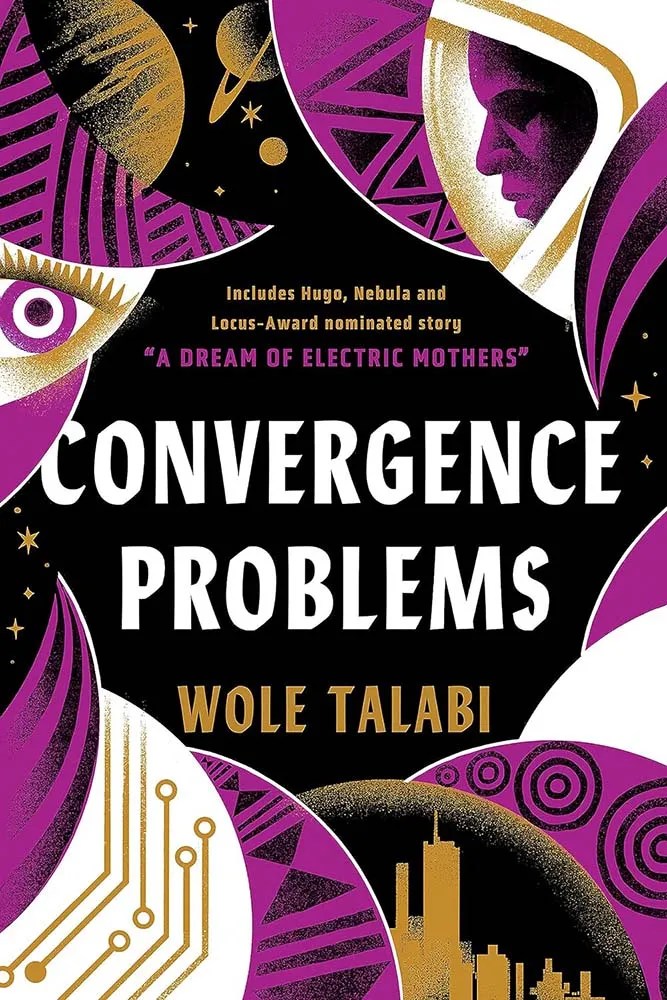
Kathleen Hughes reviews Convergence Problems by Wole Talabi

Reviewed by Kathleen Hughes

It came as no surprise to me to learn that Wole Talabi is an engineer by profession. Convergence Problems (2024), Talabi’s anthology of short stories, is filled with vivid tales of industrial failure, mechanical faults, and systemic entropy. In the future worlds depicted by Talabi – often set in Nigeria, where he is from – prosperity and investment have come and gone (‘Embers’), citizen dissidents are sentenced to death (‘An Arc of Electric Skin’), and dangerous interplanetary mining landscapes become the setting for just-in-time rescue missions (‘Blowout’). What struck me most about the collection as a whole is its recurring focus on the human side of systems and states: the legacy of industrial injury across generations, the bitterness of unfulfilled potential, and the pressure to succeed, conform, or escape. Talabi’s strength lies in his ability to highlight the profound human impact within hard-science themes such as environmental collapse, mining, or the oil industry. 

The longer stories stood out for me, such as ‘Saturday’s Song’ and ‘Ganger,’ both beautifully crafted, though in very different styles. ‘Saturday’s Song’ is the haunting sequel to an earlier short piece (‘Wednesday’s Story’) and tells the tale of Saura and Mobola, who fall in love at a financial management conference in Abuja, whose relationship ends in tragedy after Saura’s mother seeks the intervention of Shigidi, the Yoruba deity (Orisha) of nightmares. This Orisha also appears in Talabi’s 2023 novel Shigidi and the Brass Head of Obalufon, and Talabi’s use of Yoruba figures, here,  is typical of his ability to weave traditional beliefs between harder science themes found through the collection. Told through the accounts of personified days of the week, the story is multi-layered, spanning the lives of humans and deities and the strange interactions among them and the anthropomorphised calendar. ‘Ganger’ is particularly striking and timely, portraying a segregated society overseen by a megalomaniac tech CEO who, after whisking the wealthy to safety in the wake of a climate catastrophe, creates an indentured class out of pity or necessity, whose lives are micromanaged and whose every action is pre-empted. As Adelaide, the central character, becomes trapped inside a robot built to manage her subservient class after a calamitous attempt to rebel, the reader is left wondering whether she has actually attained a peculiar type of freedom.

Continue reading “Kathleen Hughes reviews Convergence Problems by Wole Talabi”

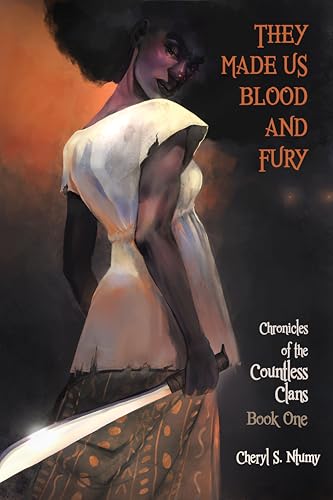
First of the Countless: A Review of Cheryl S. Ntumy’s They Made Us Blood and Fury

Reviewed by Nkereuwem Albert

They Made Us Blood and Fury is a nightmare brought to life, dripping with characters that will drive a dagger into your very being. An epic fantasy novel that does not shirk from its gritty bits and moral ambiguity, Ntumy’s world is relentless and well put together, with layers within layers to consider. 

One of the things I enjoy most in fantasy is worldbuilding that never feels like too much information; it is a difficult thing to execute, but in this novel, we’re given all we need to engage with the world without it ever feeling superfluous or inadequate, a line walked beautifully. Anyi is a beacon of glory to the Countless Clans, led by a council of elders and queens that provide lifeblood, a magical substance that can be moulded into anything, from medicine to weapons. Anyi has so much lifeblood that they give it away to the neighbouring kingdoms and cities, from Ka to Bediaku, Gbota and Xose.  From believable history, to enthralling magic, to commerce and social structure, the world presented feels full and ready for a great story to be told within.

As the novel opens, we are thrown into an Anyi on the edge. The queen is dying and none of her heirs, the Divewe, can produce it. Reservoirs run dry and gods stay silent, leaving the Anyi with too little of the substance they once gave away in excess. Across the continent, in the empire of Ka, we meet Aseye, an Anyi native working with lifeblood in the imperial armoury. Setting her sights on starting her own practice, her life is complicated by the death of the Anyi queen and the secrets it unearths. There’s also the issue of Kwame–beautiful Kwame–an imperial courtier with a hidden heritage and conflicting loyalties. 

Ntumy’s magic system is especially cool and inventive, with seers and blood-as-power done in ways that I’ve never seen. A culture where magic is embedded in the history, geography and economics of the world, we see the impact of lifeblood excesses and shortages play out both in the present and contextually. Spirit possessions and gods’ whisperings come at a terrible price. The creatures that manifest across the novel are beautiful, visceral and terrifying! 

For all its detailed worldbuilding, They Made Us Blood and Fury is also an education in heart-rending character development. Aseye and Kwame are very compelling protagonists. Aseye’s past is shrouded in mystery that unravels with massive implications for the countless clans, and with Kwame, a character with conflicting loyalties and motivations that are unclear, we have an intriguing pair, written with raw intensity and unyielding prose that is very compelling to read. 

The supporting cast—spread out across the Countless Clans—deliver, filling out the necessary points in this story beautifully and disturbingly as the novel progresses. In They Made Us Blood and Fury, you sense the threads that link the cast, but Ntumy still delivers excellent character arcs, in both positive and antagonistic directions. Fafa, Fia Kofi, and Mamiga are an excellent investigation into the choices we make to sustain life as we know it, even when we know better. The Divewe’s choices are driven by their need to survive and their thirst for the power they were destined for, now a destiny denied. The Kahene and the politics of his empire ask the necessary questions about imperialism and its swallowing of cultures and people alike. In the sandlands and the spaces between, the nomads offer Aseye philosophy that is antithetical to what is the norm in the countless clans, and the entirety of the supporting cast feel real and fleshed out, to the betterment of the novel. 

All these elements come together to make a world in which the truth is always lurking, and this novel captures that eerie feeling perfectly. With a story told in journeys through the Countless Clans,  there were many moments that shocked me and broke my heart, and pivots that grabbed my attention and made me perk up and hope, all ending with a flawless landing that leaves me wanting more of the Countless. Cheryl S. Ntumy delivers a very inventive fantasy novel on so many fronts, and I know this is not the end, so I will wait impatiently for the next book. 
A very British genealogy of zoefuturism

By Christine Aicardi

Vector’s call to explore zoefuturism was the first time I heard of the word. But the editors’ framing of this newly coined variety of futurism spoke to me. Reading it through the prism of (feminist) scholarly literature in Science and Technology Studies (STS), it brought to mind the theorizing of ethics in more-than-human worlds, and its emphasis on the living relationalities of care across human and nonhuman agencies (Puig de la Bellacasa, 2017); it brought to mind multispecies assemblages and their lifeways entanglements (Lowenhaupt Tsing, 2015); it brought to mind the Chthulucene, proposed by Donna Haraway as more apt than the Anthropocene at describing current times, when human and nonhuman are more than ever inextricably entangled in living and dying together (Haraway, 2016).

But what caught me was a recommendation in the “Further explorations…” section of Vector’s call – the short story “Euglena” by Jane Norris (Norris, 2024). I had read “Euglena” and remembered it as a moving homage to the second generation of British cybernetics through one of its main figures, Stafford Beer. The monologuing slime mould narrating the story (we don’t know at the start that they are a slime mould) explain that their “first connection was with Stafford Beer”, that they loved his brain, and that they were born as a pond computer around 1960 (265-67). This, for me, raised intriguing questions about the possible relations between zoefuturism and cybernetics.

Beer (1926-2002), born in Putney, London, is best remembered for his contributions to operational research, management cybernetics (a field he launched in the 1950s) and (exceedingly) complex systems thinking (Rosenhead, 2006). A historical landmark was Project Cybersyn (1971-73), an experiment in socialist cybernetics in Allende’s Chile, which was framed by Beer’s writings on management cybernetics and to which he actively participated (Medina, 2006). Less known are Beer’s highly imaginative forays into biological computing in the 1950s and 1960s, on his own and in collaboration with Gordon Pask, another important British cybernetician of the second generation.

From the mid-1950s, Beer started looking far and wide for natural systems that could be used in the construction of cybernetic machines (Pickering, 2010: 231-34). He investigated with young children (his own, probably), successfully using positive and negative feedback to train them in solving simultaneous equations without teaching them the maths. He reported on thought experiments aimed at enticing various kinds of animals to “play this game” using adequate “reward function[s]”: mice, using cheese; rats and pigeons (already studied for their learning abilities); bees, ants, termites, which “have all been systematically considered as components of self-organizing systems” (Beer, 1962, cited in Pickering (2010): 232). But it was with simple pond life that he most experimented: colonies of a freshwater crustacean (Daphnia) and… of Euglena, a genus of microscopic unicellular flagellate algae, of which some species live in freshwater and some in saltwater. Eventually, for over a year he tried to enrol an entire pond ecosystem, in a large tank which contents “were randomly sampled from ponds in Derbyshire and Surrey” (Beer, 1962, cited in Pickering (2010): 234).

Continue reading “A very British genealogy of zoefuturism”