Reviewed by Kathleen Hughes
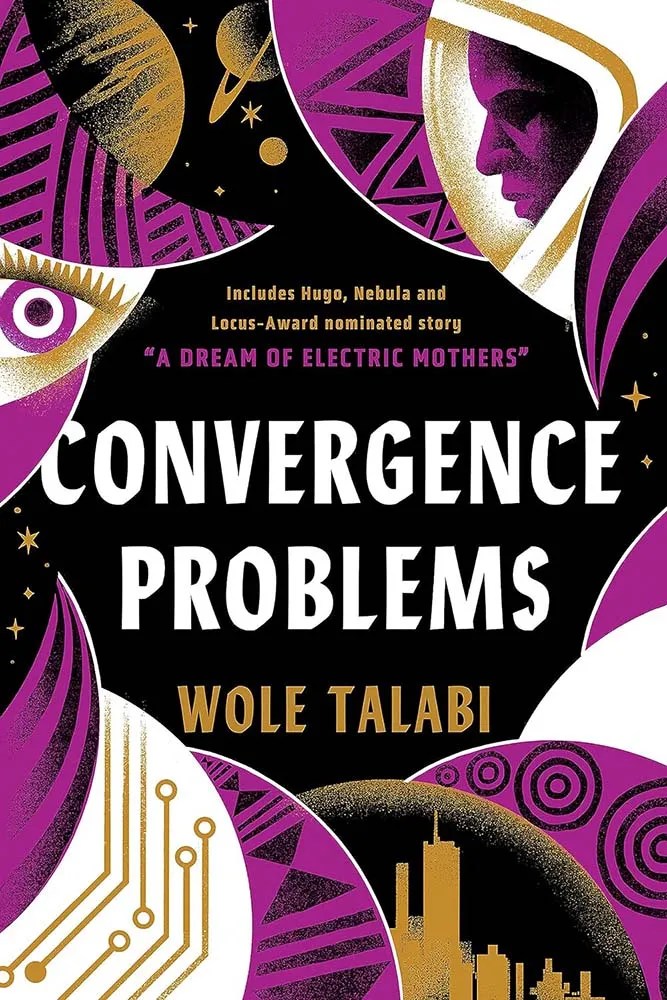
It came as no surprise to me to learn that Wole Talabi is an engineer by profession. Convergence Problems (2024), Talabi’s anthology of short stories, is filled with vivid tales of industrial failure, mechanical faults, and systemic entropy. In the future worlds depicted by Talabi – often set in Nigeria, where he is from – prosperity and investment have come and gone (‘Embers’), citizen dissidents are sentenced to death (‘An Arc of Electric Skin’), and dangerous interplanetary mining landscapes become the setting for just-in-time rescue missions (‘Blowout’). What struck me most about the collection as a whole is its recurring focus on the human side of systems and states: the legacy of industrial injury across generations, the bitterness of unfulfilled potential, and the pressure to succeed, conform, or escape. Talabi’s strength lies in his ability to highlight the profound human impact within hard-science themes such as environmental collapse, mining, or the oil industry.
The longer stories stood out for me, such as ‘Saturday’s Song’ and ‘Ganger,’ both beautifully crafted, though in very different styles. ‘Saturday’s Song’ is the haunting sequel to an earlier short piece (‘Wednesday’s Story’) and tells the tale of Saura and Mobola, who fall in love at a financial management conference in Abuja, whose relationship ends in tragedy after Saura’s mother seeks the intervention of Shigidi, the Yoruba deity (Orisha) of nightmares. This Orisha also appears in Talabi’s 2023 novel Shigidi and the Brass Head of Obalufon, and Talabi’s use of Yoruba figures, here, is typical of his ability to weave traditional beliefs between harder science themes found through the collection. Told through the accounts of personified days of the week, the story is multi-layered, spanning the lives of humans and deities and the strange interactions among them and the anthropomorphised calendar. ‘Ganger’ is particularly striking and timely, portraying a segregated society overseen by a megalomaniac tech CEO who, after whisking the wealthy to safety in the wake of a climate catastrophe, creates an indentured class out of pity or necessity, whose lives are micromanaged and whose every action is pre-empted. As Adelaide, the central character, becomes trapped inside a robot built to manage her subservient class after a calamitous attempt to rebel, the reader is left wondering whether she has actually attained a peculiar type of freedom.
I also very much enjoyed ‘Performance Review,’ as a researcher of the future of work, in its portrayal of a meeting between an employee and her boss. As the story unfolds, he proposes she maximise her efficacy by taking an experimental performance-enhancing drug, Optimiline – no obligation, of course, but with the coercive persuasion of a threat of termination. The take brilliantly portrays the dehumanising and flattening effect of corporate performance metrics, shaping employee conduct to fit data points, as well as the creeping effect of encouraging behaviour modifications to achieve what a company perceives as value. I was then surprised to find out that ‘Performance Review’ was written as part of a workshop testing out an AI tool in development – Google’s Wordcraft – as a writing assistant. This makes the story even more fascinating, as an experimental product of emerging technology, the debates about which touch on some of the same themes of the story itself (standardisation, depersonalisation, corporate overreach). Talabi does not shy away from these points in the ‘Authors’ notes’ at the end of the collection, reflecting carefully on how he weighs his optimism for technology and its potential against serious concerns about AI’s impact on the creative industries. These reflections form part of a very informative set of authors’ notes overall, which chart the development of stories, their connections, and the cross-fertilisation of ideas, which provide insight into the writer’s craft.
Talabi has also written on his writing process and source material elsewhere, for example, in the essay ‘Human and Energy Transitions’ (2026), included in this volume. That piece is an extremely valuable accompaniment to ‘Embers’, a short story in the collection that depicts the downfall of its protagonist, Uduak. Uduak is a once hopeful scholarship recipient in the Nigerian oil industry whose dreams – and life – unravel in the face of new renewable energy technologies (Kawashida cells) that render his career redundant. In the companion essay, Talabi explores the human cost of an industry that refuses to take responsibility for the impact of the dependence it fosters, providing a lifeline to communities through their resources and skills which risk becoming stranded assets. Talabi’s short story captures the nuances of the ‘just transition’ debate through the complexities of a personal story, embracing the fact that people make poor choices and react badly when faced with loss and wounded pride. As Talabi highlights, how can just transitions be truly just when the foundations they are built on are exploitative, extractive, and ‘take a page from the standard colonial playbook’?
As a collection, broad themes emerge across stories. In no particular order, they are technological advances and industry at a large scale, and the impact of technology on societies or states; the human impact of both work and technology, especially as it echoes across generations; and family ties, including legacies, disappointments, and grief. These themes connect together, recurring and repeating like echoes across stories. In ‘Blowout,’ for example, Folake Adeyemi strives to rescue her brother Femi, part of the N-12 surface exploration crew, battling through both Martian conditions and the emotional turmoil of the circumstances that bear resemblance to their mother’s catastrophic injury decades before, at work on an offshore gas production site near Angola. Talabi portrays the depth and contradictions of traumatic response, as it is not only the impact of the risk her brother is in that is so disturbing to Folake, but also her own actions, as she contemplates how far she is blindly repeating her mother’s devastating heroism.
The familial impact of workplace injury is further portrayed in ‘Abeokuta52,’ partly written in the form of an opinion piece in The Guardian, by the child (Bidemi Akindele) of a researcher studying an alien impact site, after the researcher’s death from the subsequent illness. The opinion piece wraps the details of the events in Nigeria that led to Stella Akindele’s death, alongside Bidemi’s lament at the injustice of her death and concern that she does not suffer a ‘second death’ through her name passing outside of living memory. Thus, ontological questions of time and memory are woven eloquently with the personal and political circumstances described. Like several of the stories in the collection, the piece takes on an experimental form, including the somewhat mysterious online comments below the opinion piece, adding complexity to the portrayal of Government corruption and cover-up.
The theme of inter-generational and familial trauma tied to industry, exploitation, and sacrifice is once again returned to in ‘A Dream of Electric Mothers,’ which also featured in Africa Risen, the 2022 anthology edited by Oghenechovwe Donald Ekpeki, Sherée Renee Thomas, and Zelda Knight. In this story, it is the great-aunt of the protagonist who has given herself to the National Memory Data Server (NMDS), a national computational consciousness based on the recorded thoughts of every previous citizen. This is a profound re-imagining of AI that again brings in ontological dimensions through collectivism that I have also seen in academic work on Ubuntu and AI. Here, in literary form, the lived reality of grief, of having not properly said goodbye to one’s mother, is juxtaposed with ethical considerations of AI decision-making. AI adopts a maternal wisdom that could be fruitfully critically juxtaposed against, for example, the personification of contemporary AI chatbots (Siri, Alexa) as subservient females who aim to please (Sindoni, 2024; West, Kraut and Chew, 2019). It is here that the value of the speculative literary form in relation to knotty and abstract topics is particularly apparent, as through the building of a complete alternative world where a computer system is built on the idea of an ‘electric mother,’ with the wisdom to speak what we need to hear, the contours and limitations of our own technologies and imaginations become more apparent and stark.
Collectively, the deep intertwining of parental grief, sibling rivalry, and the impacts of technology at an industrial and state scale leave the reader with a deep sense of missed opportunity and injustice. Together, they create a collection that would be valuable to anyone interested in the intersection between humans and technology.
References:
Sindoni, M.G. (2024). The femininization of AI-powered voice assistants: Personification, anthropomorphism and discourse ideologies. Discourse Context & Media, 62, pp.100833–100833. doi:https://doi.org/10.1016/j.dcm.2024.100833.
Talabi, W. (2026). ‘Human and Energy Transitions’ in Applied African SF (Ping Press, 2026).
West, M., Kraut, R. and Chew, H.E. (2019). I’d Blush If I could: Closing Gender Divides in Digital Skills through Education. [online] Unesco.org. Available at: https://unesdoc.unesco.org/ark:/48223/pf0000367416.

