Experimentation

When Dan Green reads Dave Itzkoff:

Itzkoff’s take on science fiction in general (or at least that branch he calls “military sci-fi”) leads me to think I might not clearly understand the ambitions of science fiction, at least among its more serious-minded authors and critics. Although I have only relatively recently begun to sample noteworthy science fiction novels and writers (that is, I am most assuredly a johnny-come-lately), I have done so under the assumption it is a genre that seeks to provide an alternative to “realism” and other conventionally “literary” practices, not just by evoking speculative worlds and looking to the future rather than the past or present but also by creating alternative forms and experimenting with the established elements of fiction (plot, setting, point of view, etc.). That SF is inherently a kind of experimental fiction is a proposition I have been convinced to take seriously by some of the more intelligent critical discussion of the genre, both on SF litblogs and elsewhere.

Unfortunately, I have yet to find this proposition very persuasively confirmed. The novels I have attempted, by among others Philip K. Dick, China Mieville, and Samuel Delaney, while they certainly do engage the imagination well beyond what is offered in most humdrum literary realism, do not seem to me especially preoccupied with formal experiment or stylistic innovation. (Which is not to deny that the latter two, at any rate, do write well.) Traditional plotting prevails, setting is described in the kind of minute detail a Flaubert-inspired realist would almost certainly admire, and point of view (at least in the particular novels I have read) remains transparent and undisturbed. They are, finally, resolutely traditional novels, if anything overloaded with conventional storytelling, marked as “other” only by their deliberately exotic subjects.

[…]

Perhaps having “no position at all” on real war isn’t very “commendable,” but declining to take positions in fiction, even if war is the ostensible subject, brings no moral opprobrium at all. In purely literary terms, refusing to “take a position” by sticking to, well, literature, and leaving the moral or political discourse to other, more suitable forums is as much of a “stance” most fiction writers ought to feel comfortable assuming. If John Scalzi thinks his job is to write engaging works of fiction rather than “cultivate a philosophy” by indirection, it’s all to his credit. But is Itzkoff’s own position, that the work of the science fiction writer can be reduced to the attempt to stake out a position on this or that, really shared by most writers and readers who lay claim to this genre? Is it the literary “philosophy” of SF?

Oh, crumbs. Where to start? As ever when Green writes about sf, I find myself having to translate everything he says; we have different enough starting assumptions about reading and fiction in general, never mind our approaches to sf in particular, and never mind that in this instance he seems to be under the unfortunate impression that Dave Itzkoff knows what he’s talking about. (I actually have more time for Itzkoff than some, but he’s really not the man I’d go to get a coherent articulation of what sf does and why.) As John Scalzi noted in response to the review at the time, sf isn’t short of writers who use their novels to articulate a philosophical stance of some kind, but they can hardly be held to represent a central ambition of the genre, because the genre doesn’t really have a central ambition.

Which means that sf also can’t be summarised as ‘a genre that seeks to provide an alternative to “realism” and other conventionally “literary” practices’. For starters, assuming there is a broad division of fiction into “realistic” and “fantastic”, as I understand it there is at least some debate about which camp sf should sit in. Certainly, on an intuitive basis I can see arguments on both sides — a science-fiction world is an extension of the realistic world; but of course it’s a world that doesn’t exist. But readers more knowledgeable than myself (I know you’re out there) should feel free to weigh in any time now, since I feel that I’m on quite tentative ground both here and below.

To a certain extent, I can think of examples of sf that play with the examples Green gives of the established elements of fiction. Whether or not sf is a form of realism, for example, there is something distinctive about the way language is used to create setting in sf: hence the history of discussion about sentences that are distinctively science-fictional (“The door dilated”), or that read differently depending on whether you’re approaching them as science fiction or not (“She turned on her left side”). That is, in fact, exactly the sort of thing I would expect to get from the work of China Mieville and Philip K. Dick. Similarly, I can think of stories that do interesting things with point of view, either by portraying characters who perceive the world according to radically different frameworks than our own (“Story of Your Life”, Ted Chiang, or “In Blue” by John Crowley), or by mixing up the identity of narrator, writer and character (The Female Man, Joanna Russ), or by trying to integrate standard approaches to character with a contermporary scientific understanding of how we actually think (Peter Watts, Greg Egan). I’m drawing a temporary blank on experimental plotting (the work of Hal Duncan, possibly?), but I’m sure examples exist there too.

But I get the impression that Green is looking for sf to do something formally new not found in other kinds of fiction, and I suspect he’s doomed to fail, particularly if — as his current reading list suggests — he’s sticking to canonically recognised sf writers, because they are often the writers with the most traditional plotting, the most transparent points of view. (Delany seems like he should be the exception here, but I haven’t read much Delany and I don’t know which Delany Green has read, either.) This is not to say that sf can’t be formally experimental — I’m not sure there’s much possible in sf that isn’t possible in other kinds of fictions, although I’m comfortable with the idea that there are approaches to which sf is particularly well-suited. But to the extent that sf can be described as inherently experimental fiction, I would say it’s almost never experimental as an end in itself; it experiments with the world, and any experimentation with the conventions of fiction will be a consequence of that. Or to put it another way, sf stories won’t often look like experiments, because the point is the subject.

Welcome to the Internet

Two interesting contributions to the ongoing bloggers-vs-newspaper-critics debate in the Guardian today, by Peter Bradshaw and Dorian Lynskey — interesting not so much because they advance the debate, but because they show evidence of understanding the nature of the debate in a way that most other contributors from the professional side (*cough*) haven’t managed. To all intents and purposes, Bradshaw even comes out in favour of slapfights:

This paper’s Comment Is Free and Arts & Entertainment sites regularly get a massive reaction to their featured blogs. Many believe readers will offer critics and journalists measured, friendly qualifications to their pieces. They will write: “Mmm, yes, but have you considered …” To which we will reply: “Mmm, yes, you could be right about …” And so a wonderfully civilised post-Blairite conversation will ensue. I wonder. There’s nothing very civilised about a lot of the posting happening now; it’s more like a shouting match-cum-punchup. And that’s why it’s often so entertaining. There is something about the Mmm-yes-but theory of the blog that is quite disquieting. Even if it became a reality, it could result only in hesitant journalism, bland criticism and writing that is predisposed to dull consensus.

[…]

The web and blogging have hugely increased the scope for such debates. The critic is finding that the newly empowered bloggers do not share his or her opinions about the new film, play or book, and especially his or her high opinion of him- or herself. So critics must sharpen their wits, clarify their opinions – and, just as importantly, get a sense of humour about themselves.

Lynskey has more reservations — and seems to assume that the rough-and-tumble on the Guardian blogs is representative of all blogs, which I don’t think is true; it’s possible to have extensive, lively, and intelligent discussions, such as those that often take place on Making Light or Whatever — but he still thinks (I think) that, on balance, the web is a good thing:

There is an appetite for genuine debate on the web, but it is often drowned out by the howling of people who seem to regard the very existence of professional critics as an outrageous affront. The subtext is this: anyone can be a critic, so anyone who has the temerity to be paid for the privilege deserves to be put in the stocks.

This is just one front in a wide-ranging battle between the blogosphere and so-called old media. In an ideal world, there should be room for both print critics and online ones, with plenty of overlap between them. Good writing is good writing, wherever it appears. But the campaign is in its early days and there are several years’ worth of grievances to thrash out before a peace treaty can be agreed.

[…]

With time and luck, the good will out and the bad will lose the chips from their shoulders; or, failing that, find something better to do with those slow periods at work. Until then, at least, every critic knows that it is always better to be read than ignored. No amount of abuse at the foot of a blog is quite as disheartening as the dread phrase: “Comments (0)”.

Philip K. Dick Shortlist

And so it begins: via Jeff Vandermeer, the shortlist for the 2006 Philip K. Dick Award “for distinguished science fiction published in paperback original form in the United States”:

Mindscape by Andrea Hairston (Aqueduct Press)
Carnival by Elizabeth Bear (Bantam Spectra)
Spin Control by Chris Moriarty (Bantam Spectra)
Catalyst by Nina Kiriki Hoffman (Tachyon Publications)
Recursion by Tony Ballantyne (Bantam Spectra)
Idolon by Mark Budz (Bantam Spectra)
Living Next-Door to the God of Love by Justina Robson (Bantam Spectra)

I’ve read three — the Ballantyne, the Budz, and the Robson — all of which are fun, but of which Living Next-Door to the God of Love is the best by a country mile. I’ve heard mixed things about the Bear, the Hairston and the Hoffman, although Carnival is already on my TBR-pile and I’d like to give Mindscape a go. Pointing out omissions is trickier, since (from this side of the pond) I don’t always have a good sense of what was published as a paperback and what wasn’t; but I’m a bit surprised to see nothing at all from Pyr.

Happy New Links

What Kind Of Year Has It Been?

I like lists. This will probably not come as a surprise. But when it comes to the time for end-of-year roundups, I’m like a kid in a candy store: I like reading everyone’s lists, I like arguing with them, and I like composing my own. A large part of the reason I keep track of what I read, sad to say, is so that I can summarise it at the end of the year in a post like this. This time (admittedly, by request), I even made graphs. Look on my works, ye less geeky, and despair.

Although this year the portrait of 2006 that I can offer is even more partial than usual. That’s not to say I don’t have a portrait in my head, but I am currently a judge for the Arthur C. Clarke Award, and will not be talking about eligible books, although I’m including them in my summary stats; which means that everything mentioned below is either (a) not fiction, (b) not science fiction, (c) not a novel, (d) not published in the UK, (e) not published in 2006, or (f) some combination of (a) to (e). (There were also a fair few fantasy novels submitted. I’m not going to talk about those, either.) Since I’m about to blind you with numbers, I should also say that my totals don’t include books that I didn’t finish (over a dozen, this year) or haven’t yet finished (some books, such as anthologies or collections of essays, I tend to read in small chunks over longish periods of time, unless I’m reading them for review). I’m going to talk about collections and anthologies that I have finished, but not (in this post) about individual short stories. And one final consequence of having read a large number of published-in-2006-books that I wouldn’t otherwise have read means that there is a substantial pile of such books that I would otherwise have read but haven’t: off the top of my head, it includes Vernor Vinge’s Rainbows End, James Morrow’s The Last Witchfinder, Margo Lanagan’s Red Spikes, Jo Walton’s Farthing, Charles Stross’ Glasshouse, John Clute’s The Darkening Garden, and Stephen Baxter’s Resplendent. And I haven’t finished M. Rickert’s debut collection Map of Dreams, either, although it seems obvious that it’s one of the best books of the year.

So, all of that said, what did I read?

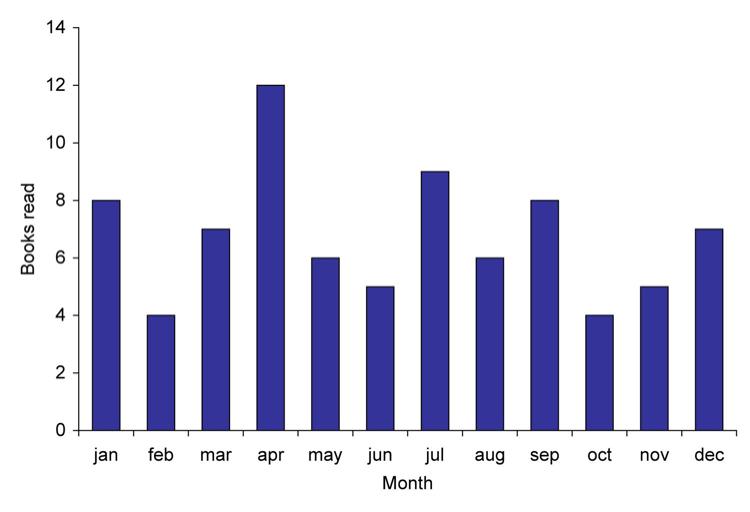
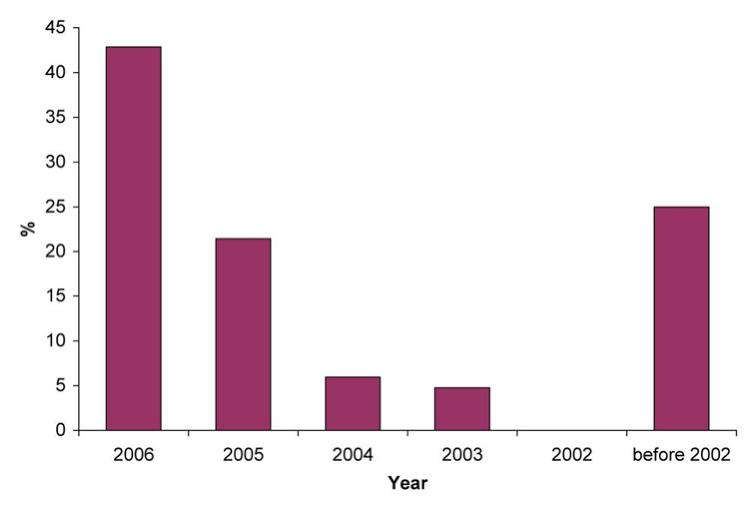
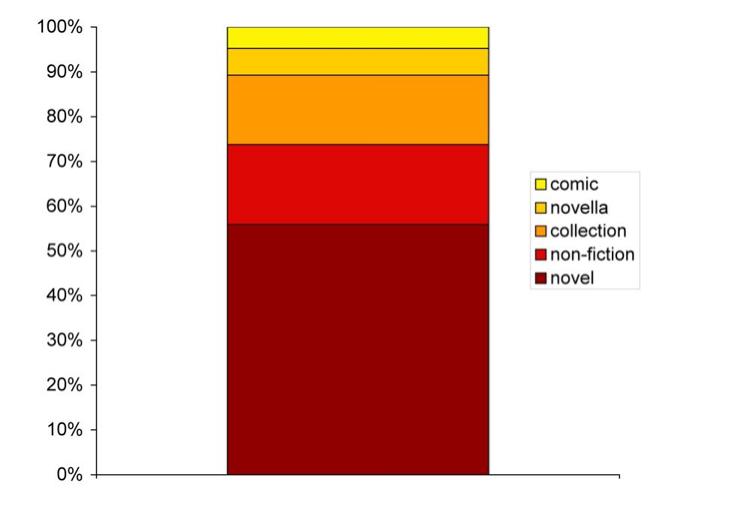
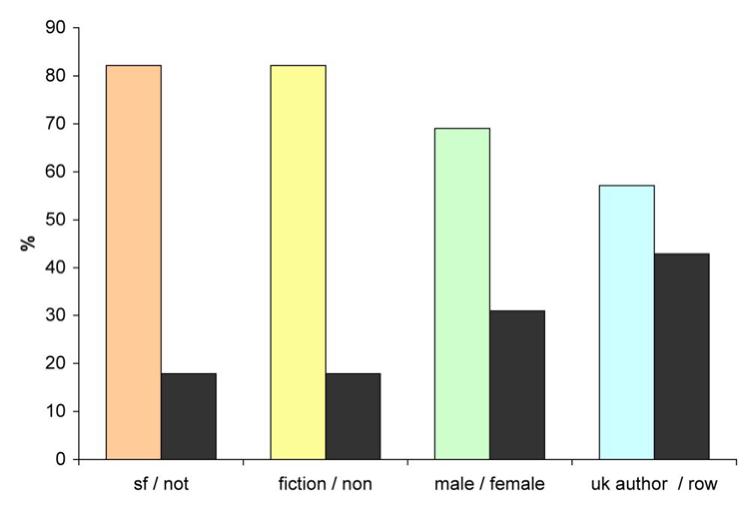
I finished 84 books in 2006, up from 64 in 2005; of these, 56% were novels, 18% were non-fiction, 15% were collections, 6% were standalone novellas, and 5% were collections of comic strips or graphic novels. I read at a relatively consistent rate throughout the year — the peak in April coincides with a reading holiday; the lesser peaks in January, July, September and December largely coincide with either other holidays or business trips where I could read on the flights — and I marked 44 titles as particularly worth reading. Bear in mind that although my reading was heavily skewed towards recent titles — only a quarter of the books I read were published before 2002 — this is a snapshot of what I read in 2006, not the best books published in 2006 per se. The demographics (for want of a better word) of my reading were more or less what you’d expect, based on my natural tendencies being amplified by Clarke submissions —

— which is to say that 82% of the books I read were sf (in the broadest sense) or sf-related, 82% were fiction (although that’s actually a higher percentage of non-fiction than in some previous years), 69% had the names of male writers or editors on the cover, and 57% had the names of UK-based writers or editors on the cover.

For those of you whose eyes haven’t glazed over yet, this is where I start talking about specific titles, although I won’t pretend I’m going to mention everything. The Rickert aside, the best collection of short stories I read — old or new — was Jeffrey Ford’s second, The Empire of Ice Cream. It’s a book in which almost every story is a highlight: not just the ones that everyone knows, like “The Empire of Ice-Cream” and “The Annals of Eelin-Ok“, but also the stories from more out-of-the-way venues, such as “The Beautiful Gelreesh” (I can’t decide whether the ending is a closed door or a slingshot; either way it’s wonderful) and “Summer Afternoon” (which spins off from Henry James’ famous phrase in an irresistably playful manner), as well as the long original novella, “Botch Town”. Two other new collections that I finished in 2006 were particularly notable, although neither was of quite such sustained brilliance. Past Magic, the third collection by Ian R. Macleod (a writer not dissimilar to Ford in a number of ways) was delayed for months but eventually snuck in under the end-of-year wire, and displayed its author’s strengths and weaknesses in roughly equal measure; with stories like “Nina-With-The-Sky-In-Her-Hair”, “Returning”, and “Nevermore”, however, the good far outweighs the bad. Similarly, if some of the stories in Theodora Goss’ much-anticipated debut, In The Forest of Forgetting, were too self-aware and mannered to breath, the majority — and particularly the graved-by-time fairytales and folk myths — were beautifully balanced.

The older collections I read ranged from the superb (Maureen McHugh’s Mothers and Other Monsters, although it perhaps presents a slightly distorted picture of her as a writer, and arguably the two stories-that-later-became-novels don’t justify their hefty page count) through the good (China Mieville’s Looking for Jake) and the mixed (Margo Lanagan’s White Time, which isn’t a patch on Black Juice; Sonya Taaffe’s Singing Innocence and Experience, which includes a number of richly beautiful, often melancholy tales, but also plenty that don’t quite work; Geoff Ryman’s Unconquered Countries, which includes the extraordinary title novella and the powerful dystopia “O Happy Day”, but also the badly-dated “Fan” and the frankly baffling “A Fall of Angels” — and I’ve said it before, but a more comprehensive collection of Ryman’s short fiction is long overdue) to the downright terrible (the less said about Mike Resnick’s Kirinyaga the better, I think). I didn’t read enough anthologies in 2006 — or at least didn’t finish enough, since I’m still dipping into (and enjoying) Pete Crowther’s Forbidden Planet and David Moles and Susan Marie Groppi’s Twenty Epics — but as you may have gathered, I liked Ellen Datlow and Terri Windling’s Salon Fantastique a good deal; and whatever my reservations about the argument it presents, the James Patrick Kelly and John Kessel-edited slipstream anthology, Feeling Very Strange, is at least composed almost entirely of home-run stories.

My non-fiction reading, like my fiction reading, was heavily sf-driven, although the best non-fiction book I read in 2006 — which was, of course, Julie Philips’ biography of Alice Sheldon — should be read by everyone, sf fan or not. (Although you may want to hang on for the paperback, which is apparently going to include additional photos and examples of Sheldon’s artwork.) The other book I’d have no hesitation in recommending to anyone is Jan Morris’ A Writer’s World. It’s a collection of Morris’ travel writing spanning the second half of the twentieth century, and remarkable in many ways, from the simple grace and clarity of its prose, to the portrait of the world it offers: arguably it’s as interesting as a historical text as it is as travel writing, because by virtue of the fact that it’s defined by both geography and time, it is frequently less parochial than the stories you think you know of the period it covers. It’s fascinating to watch the past turn into the present, and there’s something in the way Morris captures pre-millennial fever — “Everywhere people were similarly disturbed, with the same sense of rudderless betrayal. There was something febrile in the air of the world, like the start of a fever” — that resonates strongly with such intensely of-the-moment novels as William Gibson’s Pattern Recognition, or Simon Ings’ The Weight of Numbers (for which see below). I don’t usually read much travel writing, but A Writer’s World is a book that has sent me seeking more — although so far, at least, with mixed results.

My other nonfiction recommendations are more idiosyncratic, although I doubt there are many people reading this who would not be charmed by Anne Fadiman’s Ex Libris, a slender collection of witty essays about all things bookish. Mention the problem of merging libraries — or the simple instruction SIR, YOU MUST NEVER DO THAT TO A BOOK — to anyone familiar with the book and watch them wince in recognition. Anyone who aspires to write anything intelligent about sf, meanwhile, should seek out The Issue at Hand and More Issues at Hand, two compilations of (mainly) review-essays by James Blish (writing as William Atheling Jr) which are frequently trenchant and infuriating, and as frequently entertaining and devastatingly perceptive: for me they even eclipse Damon Knight’s In Search of Wonder as exemplary introductions to sf criticism. And once you’ve digested those (there’s a third volume of Atheling, The Tale That Wags The God, but I haven’t finished it yet and it seems less even), you could do worse than to move on to Farah Mendlesohn’s festschrift for John Clute and Judith Clute, Polder. I’m not quite as effusive about the book as I was when I first read it, but it’s still true to say that it features a high proportion of strong essays (those by Bruce Sterling, Gary K. Wolfe, Paul Kincaid and Graham Sleight are particularly good) about not just the Clutes, but the practice of sf criticism in general — plus at least two excellent original stories, by Pamela Zoline and Sean McMullen.

Looking at my novel reading, I find that I only read half a dozen novels published in 2006 that were not eligible for the Clarke Award. On the upside, the hit rate was satisfyingly high. Two were major non-sf novels by writers better known for their sf. Simon Ings’ dazzling The Weight of Numbers is a story woven into the mesh of the second half of the twentieth century; as Abigail Nussbaum noted in her review, it can be read as an exploration of the limits of reason, and as a thundering broadside against the assumptions of genre sf (indeed, I would argue that for sf-familiar readers it demands to be read as such, and not just because it features an eccentric organisation modeled after the SF Foundation). But there is much more to the novel than that: characters whose struggles against a world turning inevitably into the present are absorbing even when they’re infuriating; stories that grip; and writing that is, sentence by sentence, simply very good. Geoff Ryman’s The King’s Last Song is not much less ambitious, being a portrait of past and present-day Cambodia, and perhaps more heartfelt: the sixty-page segment set in the immediate aftermath of the collapse of the Khmer Rouge is powerful, while — miraculously — not descending into cliche or easy sentiment. But it’s not quite as comprehensively impressive as the Ings. Nor is David Mitchell’s Black Swan Green an unqualified success — it feels, in retrospect, just a little lightweight, although Mitchell’s command of voice is as impressive as ever, and it’s a fascinating book when looked at as a marker in his continuing career.

Back in the genre, I am no less impressed by Peter Watts’ Blindsight now than I was when I first read it. Watts’ depiction of characters who have internalised the language and paradigms of science — whose psyches are shaped by the operations of science — is as impressive as that of any writer this side of Greg Egan, and the remorseless logic of his novel’s central premise more than compensates for any brief moments of impenetrability (arguably, in fact, such moments are a demonstration of fidelity, of commitment to his argument). Not nearly on the same level, but not un-worthwhile, are Mark Budz’ Idolon and Scott Lynch’s The Lies of Locke Lamora; both struggle to own their generic components in the way that Watts manages so effortlessly, but at the very least both succeed simply as engaging yarns.

Lynch’s novel is, of course, his first; a nontrivial chunk of the older books I read were also lauded first novels (the genres of the fantastic are nothing if not relentlessly neophilic), a number of them by names already mentioned above. So, travelling back in time, we have David Marusek’s restless, information-dense Counting Heads (roll on his debut short story collection later this year, I say); Johanna Sinisalo’s lively examination of sexuality and gender identity, Not Before Sundown; Ian R. Macleod’s mesmerising exploration of faith and purpose, The Great Wheel; Maureen McHugh’s moving, meandering China Mountain Zhang; and Geoff Ryman’s (him again) exuberant if undisciplined The Warrior Who Carried Life.

Of the remaining books on my list, the one that most demands to be noted is Ali Smith’s The Accidental, deserved winner of the Whitbread Novel of the Year Prize (and, in all honesty, probably the book that should have won both the Orange and Booker prizes). Almost a full year after I read it, my memories of the book are fresh and vivid, from the characters (particularly, of course, the precocious Astrid) to particular phrases and sentences (“Believe me. Everything is meant”) to the breathtaking energy and invention of the telling. If there is one writer whose back-catalogue I want to investigate further in 2007, it’s Ali Smith (if there’s a second, it’s Ian McDonald, but I’ve been saying that for a while). Too many other much-anticipated books, however, failed to live up to their billing: David Mitchell’s Number9Dream and Christopher Priest’s The Prestige are perfectly adequate, but both writers have done better before and since; Octavia E. Butler’s last novel, Fledgling, is curiously dry, succeeding more as thought experiment than story; similarly, Alastair Reynolds’ Pushing Ice is as average as the other novels I’ve read by him (though I have both his 2006 short story collections — Galactic North and Zima Blue — and look forward to getting stuck into them); Scott Westerfeld’s So Yesterday is fun enough, but far too thin to induce me to pick up his other books (although I’m looking forward to the second novel of another YA writer I encountered in 2006, Frances Hardinge, with no small anticipation); and we will draw a discreet veil over Jon Courtenay Grimwood’s 9TailFox.

There were other books, but I think at this point I’ve gone on long enough. Can I say what kind of year it has been? Only in a very limited sense: although the vast majority of my reading came from a quite narrow slice of the literary spectrum, 2006 felt like a diverse and diffuse year. But to the half-dozen books I was most impressed by in my personal reading — The Empire of Ice-Cream, James Tiptree Jr, A Writer’s World, The Weight of Numbers, Blindsight and The Accidental — I could probably add another four or five of similar calibre from the Clarke dark matter, and that’s not nothing. Coming soon: posts about films and short stories, although probably without graphs — and of course, I need to start working on my lists for 2007.
My Science Fiction Life

I’m a sucker. I was genuinely looking forward to My Science Fiction Life. Yes, on the one hand, it was a documentary about science fiction fans, and we know how those turn out. On the other hand, though, it was on BBC4, and it was coming at the tail-end of a perfectly respectable season of sf-related programming, and they’d gone to the trouble of sending a camera crew to a First Thursday, and they were going to be drawing talking heads from the general public. The signs were good, I tell you.

But look how it turned out. For starters, the format was a million miles away from The Martians and Us. I don’t mean that My Science Fiction Life should have been deadly serious — clearly that would have been disastrous in its own special way — but that it would have been nice to have got a sense that the programme-makers respected their subjects. Many of the contributions from the real people who contributed to the MSFL website (including Paul Cornell! Of whom more anon) were saying perfectly reasonable things, in good humour, in response to some pretty daft questions. But the frame that was built up around them made them seem, by association, like pedigree oddballs.

The opening narration, even, was quite promising, saying things like “science fiction fascinates everyone from bus drivers to brain surgeons, up and down the country”. The programme proper, though, was divided into segments, each of which was built around an interview with A. Person with a Science Fiction Life, and supplemented with the aforementioned MSFL interviews, and clips from sundry sf shows and films, and you can see where this is going already, can’t you? So, yes, under “They came from outer space” we got Jeff Wayne and Nick Pope, and under “Man & Machine” we got the ever-more-bonkers Kevin Warwick (and an atrociously misrepresentative piece of narration along the lines of, “From Arthur C. Clarke’s HAL to Isaac Asimov’s renegade I, Robot, that recently starred alongside Will Smith, science fiction writers have been imagining the damage that out-of-control machines could do”), who revealed that he had been first inspired by none other than Michael Crichton’s The Terminal Man. Under “Designs on the Future” (probably the best segment) we got Will Alsop, who revealed that Blade Runner is an architects’ favourite, and talked about redesigning Barnsley; and under “The Meaning of Life, the Universe, and Everything” we got everything from Scientology (although that was introduced with a rather nice interview clip: “L. Ron Hubbard, do you ever think that you might be mad?” “Oh, yes.”) to the vicar who uses Star Wars and Star Trek in his sermons.

It rapidly became staggeringly obvious that for all that My Science Fiction Life had looked like it was going to be about the communities that have built up around science fiction, what the producers actually wanted to make was a programme about the people who take sf, or sf-related pursuits, to extremes. I’m trying not to be either too flippant or too grumpy here, since I realise that arguably any attempt by sf fans to explain the fundamental appeal of sf — to say that, yes, thinking about the future and about possibility matters — is liable to end up looking either over-earnest or just a bit barmy. But as it turned out, the gestures My Science Fiction Life made in that direction were superficial at best. The narration would make the (quite reasonable) point that sf can be a venue for looking at moral and ethical questions; cut to scientology and the sf priest. The narration would make the (perfectly understandable) point that our living spaces are likely to change in the future; cut to the man who’s made his flat into a Star Trek flat. And they didn’t use any of the footage from their trip to First Thursday, after all, although in the final analysis that’s probably a blessing.

But there was a bright spot, at least for me: Paul Cornell, who (bafflingly) was just listed as a MSFL contributer (rather than as, say, a writer of Doctor Who and other sf), but whose oblivious enthusiasm for his science fiction life shone through every time he was on-screen. He got the last word before the credits, too, with the rather endearing observation that “Oddly, without science fiction, I would be unmarried, lonely, and penniless.” Which is, it seems to me, as good a note as any on which to say that I’m off to the wilds of York, with little more than an 1,100 page Thomas Pynchon novel to sustain me, to spend a few days with people I wouldn’t have met except for my science fiction life. I’ll be back next Wednesday or so with best-stuff-of-the-year posts. Happy New Year, everyone!

Salon Fantastique: La Fee Verte

I’m pretty sure the fault is in me rather than in Delia Sherman’s story, but as I read the first few pages of “La Fee Verte” I kept thinking of the pilot episode of Angel. As Our Heroine, Victorine, is approached for no apparent reason by the title character (“exquisitely thin … dark eyes huge and bruised in her narrow face”; her name is never translated in the story, although the frequent references to (a) absinthe and (b) green silk should be enough to jog most peoples’ memory), and recoils in astonishment as the enigmatic woman relates events from her past, I kept thinking of the half-demon Doyle appearing out of nowhere and doing the same for Angel. So I was all ready for Victorine to turn around and say, “Okay, you’ve told me the story of my life which, since I was there, I already knew … why aren’t I kicking you out?” (Or, given the setting, some 19th-century Parisian equivalent). Instead:

When the tale was done, La Fee Verte allowed her tears to overflow and trickle, crystalline, down her narrow cheeks. Enchanted, Victorine wiped them away and licked their bitter salt from her fingers. She was inebriated, she was enchanted. She was in love.

I very nearly gave up on the story then and there, because the moment felt unjustified and overwritten, and because it seemed highly unlikely that a character who fell in love on such dubious grounds was someone I was going to enjoy spending the best part of fifty pages with. (“La Fee Verte” is, I think, the longest story in Salon Fantastique.) But I didn’t give up, because many other people have spoken highly of the story, and in the end I’m glad to have read it: I think it’s quite far from being one of the best stories in the book, but it’s enjoyable, with a few moments that raise it above the ordinary.

The first promising moment, in fact, occurs only a few paragraphs later, when it transpires that the stories La Fee Verte tells of Victorine’s past aren’t quite true. “Little by little,” we are told, “Victorine came to depend on [these revisions], as a drunkard depends on his spirits, to mediate between her and her life.” The explicit parallel with drunkenness is probably unnecessary, but the conceit of an addiction to a seer’s visions — not to mention a seer who enables such addiction — is an interesting one. Things between the two women quite quickly sour, though, as La Fee Verte becomes entangled with a (male) client, a writer “of novels in the vein of M. Jules Verne”, to whom she divulges clearly absurd visions of the future, such as a man on the moon who “plants a flag in the dust, scarlet and blue and white, marching in rows of stripes and little stars.” Since this was the US flag at the time the story is set, it’s perhaps a little surprising that La Fee Verte doesn’t recognise it, but the moment serves its purpose, such that when the seer tells Victorine that she is destined to be loved, we know that she is telling the truth.

Gradually Paris as a place asserts itself, and some of the best parts of the rest of the story contribute to a portrait of a city in flux. The story takes place between winter of 1868, when Victorine and La Fee Verte first meet, and autumn of 1870, when Paris is besieged by the Prussian army. Victorine has a succession of lovers, and through her eyes we see the effects that the change in government and fortune is having on the city and its people. At one point, during a relationship with a colonel, Victorine finds herself at an extravagant dinner that “belonged more properly to last month, last year, two years ago”, and feels herself “lost in one of La Fee Verte’s visions, where past, present, and future exist as one.” Such feelings of instability, brought about by the rigid class divisions in the city, are almost eerie, as is the lingering sense — reinforced by La Fee Verte’s periodic appearances — that though Paris too is destined to be loved, the course will not be a smooth one. Which (indulge me) I suppose you could say parallels how I feel about Salon Fantastique. I haven’t been writing about the stories in order; and this is my last post, although “La Fee Verte” is, in fact, the first story in the book. So I know that for anyone who reads the book through, there will be ups and downs, but I think it is probably destined to be loved. There are stories here worth loving.

Locus Reviews — online, with comments

Great news via Mark Kelly:

We’re doing something a bit new here at Locus Online (and Locus Magazine), for which I’ve created a new Blogger blog for ‘Locus Online Features’, and have re-posted the Graham Sleight retrospective review of Arthur C. Clarke and George R. Stewart using that function with a new URL. The point is to more easily enable commenting from readers, which will appear almost-automatically (I did enable comment moderation, which means the comments you post are sent to me via email first, for my approval or rejection, as a means of blocking spam).

Gary Westfahl’s review of Children of Men has been posted the same way.

More sample reviews from Locus Magazine are on the way — Graham Sleight’s columns, as well as one or two reviews from each issue by Gary Wolfe, Faren Miller, and the others. The idea is to drum up interest in subscribing to the magazine! Of course surely anyone reading this blog is already a subscriber.

Whether or not you’re a subscriber, the RSS feed for the Locus Online site, which (it seems) will include new Features posts in the same way it always has, is here (or, on livejournal, here, though I’m not sure that feed’s quite got with the programme yet).

Salon Fantastique: Down the Wall

In the season four West Wing presidential debate episode, “Game On”, there’s a rather nice running joke about a Republican, Albie Duncan, who Toby thinks they should use in the post-debate spin session, to counteract the fact that the Republican candidate has a Democrat “shilling for him on defense”. CJ and Toby have the following exchange:

TOBY: This is why I’m talking to you. You’re going to use Albie Duncan.
CJ: He’ll do it?
TOBY: Yes.
CJ: Duncan?
TOBY: Yes.
CJ: He will?
TOBY: Yes.
CJ: Look at me. He’s not a little bit crazy?
TOBY: Albie Duncan?
CJ: Yes.
TOBY: No. No. No. [beat] A little bit.

Give or take Richard Schiff’s ever-marvellous delivery, that’s sort of how I feel about Greer Gilman’s story “Down the Wall”. It’s not because of Gilman’s much-discussed use of language, or not specifically. Here’s the opening of the story:

Stilt-legs scissoring, snip-snap! the bird gods dance. Old craneycrows, a skulk of powers. How they strut and ogle with their long eyes, knowing. How they serpentine their necks. And stalking, how they flirt their tails, insouciant as Groucho. Fugue and counterfugue, the music jigs and sneaks. On tiptoe, solemnly, they hop and flap; they whirl and whet their long curved clever bills. A sly dance, a wry dance, miching mallecho. Pavane. They peacock, but their drab is eyeless, black as mourners, black as mutes. They are clownish, they are sinister, in their insatiable invention, their unending.

As I had been led to expect, this is certainly careful, formidable writing — the unfamiliar words (“miching”), the words verbed (“serpentine”) or nouned (“drab”), the striking phrases (“the music jigs and sneaks”), the oddly placed cultural reference (“insouciant as Groucho”), the rhythms — but it doesn’t require significantly more unpacking than the writing of, say, Margo Lanagan, or even Catherynne Valente or Hal Duncan in full flow. What impressed me was what happened next. When the long paragraph (at least double the amount I quoted) ends, we have an extremely vivid image of the bird gods’ dance in our minds, and we think we know what sort of fantasy story we’re reading. And then we’re confronted with one phrase — “the birds are phosphor in a box” — which forces us to reframe everything we thought we’d learnt. The second paragraph continues:

The birds are phosphor in a box. They sift and sift across the screen; they whisper. They are endless snow or soot, the ashes of the old world burning. Elsewhere fire. The hailbox whispers, whispers. There is no way to turn it off. No other channel but the gods. All day and night it snows grey phosphor, sifting in the corners of the air. The earth is grey with ash.

The birds are images seen in the static of a dead tv. And quite suddenly, it starts to become apparent that “Down the Wall” isn’t fantasy at all. There’s a tv the characters can’t, or don’t know how, to turn off; they think of the static as “the ashes of the old world burning”; it all sounds very much like post-apocalyptic science fiction.

I think I’m right in saying that nothing in the story later contradicts this interpretation. The bird gods, it transpires, have an existence beyond static, but it’s an existence in stories of this time. The world of “Down the Wall” struck me very much as world where the horizon has drawn closer, where the giants have been kicked out from under the characters. They describe lightning, for instance, as “godlight”; the bird gods themselves are described so lyrically it’s hard to be sure, but I think we are meant to understand that they are the projections of a people scared by a world they no longer comprehend, and not a literal reality. Which is to say that I think they are wind and sticks and storm, but I could be wrong.

What makes the story — which involves a brother and sister going out from their home, into the world — so decidedly odd, though, isn’t this shift, it’s the way in which the world is rendered. For one thing, the characters all have names — Spugget, Harpic, Fligger, Theek — straight out of Peake, which makes them sound grotesque, although there’s little indication that they actually are. For another, when they speak they say things like “Hush. Nobbut an awd busker. I’ll fend” and “Gerroff wi’ yer. Left, left, down close and top o’t stairs”, which frankly makes them sound like they came from the North of England and brought all their cliches with them. It was all I could do not to imagine the lot of them wearing flat caps — not exactly a common image in sf. But in the end, if the story’s construction feels a bit patchwork, and if its ending is somewhat arbitrary, there’s no denying its urgency or imagination — the descriptions of the gang of children running world are particularly impressive. Later in the West Wing episode I mentioned above, defending Albie Duncan further (the Democrats do eventually use him), Toby says, “Look, he’s Albie Duncan. […] If he’s crazy, then I don’t want to be sane.” Sanity sounds overrated when reading “Down the Wall”, too.

Attention BSFA Members!

It is now officially the end of the year season, which means you no longer have an excuse: it’s time to start nominating for the BSFA Awards. The eligibility criteria are here. General points to note are:

  1. Science fiction, fantasy, and any other speculative works are eligible.
  2. You can nominate as many works in each category as you want. The works with the highest number of nominations go forward to the shortlist.
  3. The deadline for nomination is midnight on Saturday 13th January 2007. That’s a fortnight tomorrow.

The nominations so far are here and copied below. Note that a consequence of point 2 is that just because something is on this list doesn’t mean you don’t have to nominate it — works on this list may have only received one nomination. You should email your nominations to BSFA.Awards@gmail.com.

Artwork

  • Cover for Interzone 206: “Droid” by Fahrija Velic
  • Exiles by Mark Garlick, cover of Interzone #203
  • Cover of Farthing magazine, issue 2, Spring 2006. Credited to ‘Vertebrate Graphics’.
  • The Lucid Moment‘, Chris Mars. (Chris Mars Publishing)
  • Cover for Nova Swing by M John Harrison
  • Cover for Rainbows End by Vernor Vinge
  • The Return to Abalakin” by Alexander Preuss
  • Publicity still for A Scanner Darkly
  • Cover of “The Servicing and Maintenance of Wayland Snowball”, by Terry Cooper. (Novel by Steve Dean.)
  • Poster for Superman Returns
  • Cover of Time Pieces, Fangorn
  • Cover of Whispers of Wickedness #12, Marcia Borell

Short fiction:

  • The Angel of Gamblers, Hal Duncan (Eidolon #1)
  • The Barrowlands’ Last Night, Philip Raines & Harvey Welles (Extended Play)
  • Bizarre Cubiques, Hal Duncan (Fantasy #4)
  • The Codsman and his Willing Shag, Neil Williamson (The Ephemera)
  • The Disappeared, Sarah Singleton (Time Pieces, edited Ian Whates, published NewCon press)
  • Gin, Holly Phillips (Eidolon #1)
  • Hieronymous Boche, Chris Lawson (Eidolon #1)
  • The Highwaymen, Ken MacLeod
  • Palestina, Martin J. Gidron (Interzone 204)
  • Pol Pot’s Beautiful Daughter, Geoff Ryman (F&SF)
  • The Revenant, Lucy Sussex (Eidolon #1)
  • Saving for a Sunny Day, or, The Benefits of Reincarnation, Ian Watson (Asimov’s Science Fiction #369/370)
  • The Unsolvable Death Trap, Jack Mangan (Interzone 202)
  • “Soulkeepers” by Steve Dean (Hadesgate Publications)
  • Sounding, Elizabeth Bear (Strange Horizons)
  • State Your Name, Jon Courtenay Grimwood (Time Pieces, edited Ian Whates, published NewCon press)
  • This Happens, David Mace (Interzone #205)
  • 2+2=5, Rudy Rucker and Terry Bisson (Interzone 205)
  • Weather, Alastair Reynolds (Galactic North)
  • Willy and Topsy, William I. Lengeman III (Farthing #4)

Novel:

  • The Brief History of the Dead, Kevin Brockmeier (John Murray)
  • End of the World Blues, Jon Courtenay Grimwood
  • Icarus, Roger Levy
  • Keeping it Real, Justina Robson
  • The Last Witchfinder, James Morrow (Weidenfield & Nicholson)
  • The Lies of Locke Lamora, Scott Lynch
  • The Osiris Revelations, Andrew Marshall (MPress Publishing)
  • The Servicing and Maintenance of Wayland Snowball, Steve Dean (Hadesgate Publications)
  • Shriek: An Afterword, Jeff Vandermeer
  • The Voyage of the Sable Keech, Neal Asher