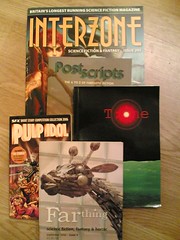
(AKA “Homework”. Top to bottom: Interzone, PostScripts, Triquorum, Pulp Idol and Farthing, continuing its run of lovely covers.)
(EDIT: 37 pieces of fiction, five women authors, of whom four are in Farthing. Just sayin’.)
(AKA “Homework”. Top to bottom: Interzone, PostScripts, Triquorum, Pulp Idol and Farthing, continuing its run of lovely covers.)
(EDIT: 37 pieces of fiction, five women authors, of whom four are in Farthing. Just sayin’.)
Origin Story
Revisions
Discussions
Maps
Suggestions for further additions welcomed.
Following on from his article in Vector 247, Nick Wood has been continuing his search for South African SF:
But it is also clear that the language of science (fiction) does not necessarily hold sway in South Africa. This is not to say that it is a primitive place, pre-scientific in understanding and experience – these are colonial notions based on beliefs of Western civilisation as a teleological end-point for socio-cultural development. There are a multitude of discourses operating in South Africa, as befits the diverse (and sometimes fractured) nature of experiences and cultural contexts, which underpins the diversity of the country’s human resources.
EDIT: Judith Berman also has some discussion of her article “Bears, Bombs and Popcorn“, here and here.
John Sutherland argues for fiction that can teach us things in the Guardian (via), including sf:
It is unfashionable to assert it, but the novel does, I believe, still have a socio-educational value. It is not just Miss Manners. Fiction can make us better, or at least, better informed citizens. In a technological age, for example, it is important that the population should know something about the machinery that makes modern life possible and how it works. Science fiction has done as much for the factual scientific education of the average reader as all the educational reforms introduced since CP Snow’s 1959 polemic The Two Cultures lamented his fellow Britons’ epidemic ignorance of the second law of thermodynamics. The fact, revealed in a survey by the magazine Wired in November 2005, that 40 per cent of Americans believe that aliens are in the habit of routinely visiting our planet and taking away sample earthlings for full body cavity probes, suggests that sf may also have a lot to answer for in dumbing down the citizenry.
This is also a post to say that my blogging frequency is likely to be somewhat reduced this month. I’ll be around, but I have some things I need to get written, the looming prospect of two weeks that are likely to be extremely work-heavy, and I really need to knuckle down on the Clarke reading front. When I get my life back: Spin. Or Twenty Epics. Or possibly the forever-delayed post on why “Magic for Beginners” is so wonderful. Bet you can’t wait.
Next week: all slipstream until the end. Oh yes.
At some point in the next few years, Paolo Bacigalupi is going to put together a very good collection of very grubby futures. It will not be a book for the faint-hearted. For starters, Bacigalupi’s stories, almost all of which are set in worlds coping with one or more varieties of ecological collapse, from the desertified midwest of “The Tamarisk Hunter” (2006) to the post-petroleum bioeconomy of “The Calorie Man” (2005), typically need unpacking. This is not to say they are linguistically complex—Bacigalupi’s prose can be striking, but it tends to be fluid rather than ornate—but more that they tend to be narrated by characters who have no reason to explain their assumptions to us. All science fiction stories offer that particular pleasure of unfamiliarity—the challenge of learning the ropes—but Bacigalupi’s stories are often more unfamiliar than most. At the start of “The People of Sand and Slag” (2004), for instance, the characters jump from a hovering airship and land in a pile of breaking bones with no suggestion that this is any more remarkable than the bleak weather. By the time they’re eating sand for dinner, if not before, we’ve worked out that we’re in a world where humans have been rendered virtually invincible through the judicious use of nanotech, but for a few paragraphs we’re in free-fall. Moreover, Bacigalupi can be stunningly unsentimental: where similar technology in a story by Cory Doctorow might lead to a post-scarcity utopia, in “The People of Sand and Slag,” with no need to preserve the land for their own benefit, humanity has allowed all to fall into ruin.
“Pop Squad,” from the October/November issue of F&SF, is in a similar vein. It reads like the work of a writer playing chicken with the abyss. I don’t usually have much time for spoiler warnings, on the grounds that if a piece of prose fiction can be truly spoiled by knowing what happens, then it’s probably not a very good example of the form. But there are a couple of first-rate jolts in “Pop Squad”; I’m going to have to talk about them, because they’re integral to the story’s success or failure, but it would be unfair to deny anyone the chance to experience them first-hand. So here’s the warning: to say what I want to say about the story I’m going to talk about all of it, up to and including the ending. If you were planning to read it, skip this post for now, and come back when you’re done.
For everyone who’s left, here’s the opening paragraph:
The familiar stench of unwashed bodies, cooked food, and shit washes over me as I come through the door. Cruiserlights flicker through the blinds, sparkling in rain and illuminating the crime scene with strobes of red and blue fire. A kitchen. A humid mess. A chunky woman huddles in the corner, clutching closed her nightgown. Fat thighs and swaying breasts under stained silk. Squad goons crowding her, pushing her around, making her sit, making her cower. Another woman, young-looking and pretty, pregnant and black-haired, is slumped against the opposite wall, her blouse spackled with spaghetti remains. Screams from the next room: kids.
My comments about unfamiliarity above notwithstanding, this scene, and the confident rhythm with which it’s sketched, are basically familiar. The narrator is a police officer, possibly slightly shady, and he’s visiting a slumland crime scene. We don’t know the nature of the crime, or why the kids are screaming, but that’s ok; these are things we expect to not know. We do know how this sort of procedural unfolds. And we could easily be in the here-and-now. The narrator’s judgement on the women (“It amazes me that women can end up like this, seduced so far down into gutter life that they arrive here, fugitives from everyone who would have kept them and held them and loved them and let them see the world outside”) has a depressing familiarity about it. The only indications that we’re in an elsewhen are a passing reference to wallscreens and, a few paragraphs later, a suggestion of high-tech uniformity in the flat’s design.
Needless to say, this opening is a trap. In retrospect the signs are there: in the way the narrator’s partner hustles the women, but not their children, out the door, for instance, and in the reference to a toy dinosaur as funny “because when you think about it, a dinosaur toy is really extinct twice.” But even on a second reading, we’re not ready for what happens next. The narrator stands in front of the children:
I pull out my Grange. Their heads kick back in successive jerks, bang bang bang down the line, holes appearing on their foreheads like paint and their brains spattering out the back. Their bodies flip and skid on the black mirror floor. They land in jumbled piles of misaligned limbs. For a second, gunpowder burn makes the stench bearable.
With the possible exception of some of Joe Hill’s work, I can’t recall having experienced such a spectacularly effective drop-kick of readerly sympathies for years. We can’t see it coming, because Bacigalupi plays the lead-in straight. But he gives us just enough hints to develop, in the aftermath, a suspicion—which is quickly confirmed—that this isn’t a depiction of a maniac, it is normal. This is his job. While we’re in free-fall, the narrator is going up in the world. Literally: in a vertiginous paragraph he rushes from the slum out of the urban sprawl, out of the jungle, up one hundred and eighty-eight stories of an immense spire, where his girlfriend Alice is playing lead viola in a classical concert. We follow in his wake, dazed. The music is beautiful; notes “spill like water and burst like ice flowers”. The contrast with the scene we have just left could not be more brutal. And it sinks in that the trap has sprung: we are caught in a world we don’t understand with a reliable narrator we absolutely cannot trust.
Inevitably, the story calms down a bit. We start to get more information. Details here and there allow us to build up a picture of how the world is and, maybe, how it got to be that way. It’s a darker, more damaged world than our own; it has warmed, and New York has flooded—hence the spires and the slums. And, via the revelation that Alice’s concert was much like a world-record challenge, an attempt to knock the acknowledged virtuoso from his pedestal, we learn that this is a world of immortals, which in turn suggests a reason for the kid-killing. The price of eternal life is voluntary sterility. But for the people at the concert, the narrator’s job is remote, its implications abstract:
Alice makes a face of distaste. “Can you imagine trying to perform Telogo without rejoo? We wouldn’t have had the time. Half of us would have been past our prime, and we’d have needed understudies, and then the understudies would have had to find understudies. Fifteen years. And these women throw it all away. How can they throw away something as beautiful as Telogo?”
I said that Bacigalupi was playing chicken with the abyss, and I think passages like the above make the point. The incomprehension demonstrated of the true choice being made is chilling, the more so because the authorial handling of the conversation is so deadpan: despite the yawning gap between the story’s world and ours, we are never nudged towards an opinion. The facts of the case speak for themselves. Combined with the memory of the narrator’s murderous actions, we are left thoroughly unsettled.
Unfortunately for the story, however, Bacigalupi ultimately blinks first. In the second half of “Pop Squad”, the narrator makes two more home visits. In the first, he kills a baby—but this time the kill is less because he believes in his job, and more because he can’t work out what else to do with the child. It’s more instinctive, an attempt to ignore the doubts growing inside him. He attempts to rationalise the actions of the women his squad tracks down, arguing to himself that “the whole breeding thing is an anachronism—twenty-first century ritual torture we don’t need anymore”, but we can see that it’s not working. (As an aside, we only ever see single mothers: the men, it is implied, are cowards who prefer to participate in the process from afar, by donation, rather than risk pop squad retribution themselves.) To quash the nag in the back of his mind, he sets out to track down the supplier of the toy dinosaur he saw at the start of the story. These days, it seems, they’re marketed as “collectibles,” at which point we understand why it was extinct twice: once as a dinosaur, once as a toy. The third home visit occurs when the narrator decides to track down a woman he bumps into in the collectible shop, and is the climactic scene of the story.
There are good things about this confrontation. It is tense. The inevitable cute child is not unrealistically or unbearably cute. The scene doesn’t break character, and indeed continues to reveal character: confronted with an obviously fertile woman, the narrator responds with involuntary sexual attraction that we can understand (and find somewhat disturbing, admittedly), but which he is only confused by. “She sags,” he observes, “she’s round, she’s breasty and hippy and sloppy, I can barely sit because my pants are so tight.” The mother doesn’t waste time asking the narrator why because she already knows, even if we don’t. The incomprehension is all on the narrator’s side. And the mother’s outrage is delivered with a conviction that frees it from cliche:
She looks at me, hard. Angry. “You know what I’m thinking? I’m thinking we need something new. I’ve been alive for one hundred and eighteen years and I’m thinking that it’s not just about me. I’m thinking I want a baby and I want to see what she sees today when she wakes up and what she’ll find and see that I’ve never seen before because that’s new. Finally, something new. I love seeing things through her little eyes and not through dead eyes like yours.”
But at the end of the confrontation, the narrator walks away, leaving mother and child unharmed. “And for the first time in a long time,” he tells us, “the rain feels new.” We should be relieved: this sort of awakening is exactly the sort of ending we should want. It’s where the story has been obviously heading from around the half-way mark. The problem is that although seeing the dinosaur was clearly the trigger, it’s not clear why. Why does the narrator wake up now, why this case above all others?
In “The People of Sand and Slag,” the plot revolves around the discovery of a dog, an animal previously thought extinct. It has no place in the new world, and the characters don’t know what to do with it or how to care for it; in a beautifully alien sentiment, one of them describes it as being “as fragile as a rock.” So at the end of the story, they eat it. Bacigalupi allows his protagonists the hint of a realisation that something valuable might have been lost, but that’s all: they never wake up to the state of the world. The narrator of “Pop Squad” does, but he seems to do so only because to not do so would be unthinkable. He wakes because morality demands it, not because the story does. The result is that the obvious skill employed in the first half of the story in creating the world, the situation, and the character feels somewhat wasted. Bacigalupi has done such a good job of interrelating the three that to short-change one is to short-change them all, and what could have been truly haunting becomes a momentary discomfort, not so unfamiliar after all. “Pop Squad”, we realise, is just another story about the development of conscience in a fallen world. We don’t need to struggle out of the trap; we are let out and, despite the narrator’s claims, it feels quite the opposite of new.
Paula Guran explains Fantasy Magazine‘s reviews policy:
The idea here is to review anonymously (like Publishers Weekly) while still saying exactly who the reviewers are — just not who wrote exactly what. I feel it frees the reviewer while still assuring the reader that a variety of respected opinion is being presented. (Issue #4 has two “featured” reviews with bylines, btw. )
Why? The number one reason is that this way the reviews are seen as “Fantasy” magazine reviews. The second reason is that genre is a small world and few of its knowledgeable reviewers live in ivory towers so it sometimes helps you be a better reviewer if your name is not on a review. That being said, it is only fair to the reader to know s/he can have confidence that a review is written by someone whose opinion they respect — thus the list of reputable reviewers doing the reviews.
She asks for opinions. I’m ambivalent. On the one hand, as was covered at tedious length in last week’s discussions, I’m all for honest negative reviews. Not only do I think they’re good for the health of the field, but I enjoy reading discussions of books people didn’t like just as much as I enjoy reading discussions of books they liked. So if an anonymised reviews section creates an environment that encourages that, I’m for it. On the other hand, though, I can’t see an particular reason why it should be necessary. I know a similar desire for freedom was behind the Dark Cabal (remember them?), for instance, but magazines like Interzone don’t seem to have had trouble recruiting a group of people who are prepared to say what they think under their own bylines.
And anonymity could also be frustrating. Some readers may not notice who writes a review, but I tend to; in part, admittedly, because I write reviews myself, but that’s not the only reason. Pretty much everyone who reviews for either Locus or NYRSF presumably falls into the category of ‘respected reviewer’, but I don’t agree with anyone who writes for either venue all the time, and some of them I disagree with frequently. I have no reason to expect that Fantasy Magazine‘s reviewers are any different, but because most of the reviews are quite short, and therefore don’t have the space to develop a detailed argument, there’s more of an element of taking what the review says on trust. I take Paula’s point about creating trust in a more general reviews ‘brand’, but it still looks a bit like an attempt to claim objectivity for an activity which is, by definition, subjective.
UPDATE: Further discussion here.
If you watch the Strange Horizons reviews RSS feed you may well have already seen this, but if not: the review of Idolon that I mentioned last week is now up, along with an interview with Mark Budz. (Plus the usual fiction, column and poetry.)
So after being cheered by Ian. R Macleod’s Sidewise Award for the wonderful The Summer Isles, and wryly amused that Ken Macleod picked up a third Prometheus Award with Learning the World, I woke up this morning (absurdly early, considering what time I got home last night) anticipating the main event: the Hugo Award results.
It’s not as satisfyingly rightheaded a slate of winners as we got last year. The short fiction categories are a bit of a mess—the idea that Connie Willis’ “Inside Job” and David Levine’s “Tk’tk’tk” are better than, respectively, Kelly Link’s “Magic for Beginners” and Margo Lanagan’s “Singing My Sister Down” is, without wishing to offend, ludicrous; Peter S. Beagle’s novellette win is defensible, but it wouldn’t have been my pick—but other than that it’s not too bad. Serenity‘s win in Best Dramatic Presentation: Long Form is well-deserved, and Steven Moffatt’s Doctor Who two-parter was the best thing on its ballot. Kate Wilhelm’s Storyteller wasn’t (I was rooting for Gary K. Wolfe’s Soundings), but it is a good book—and perhaps more impressively, it beat a book by The Mighty Langford.
Actually, it seems to have been a year for results that go against the common complaint that Hugo voters are swayed by name recognition, at least in some categories. Sure, Locus and Langford picked up their annual awards, but David Hartwell, editor of everyone from James Tiptree Jnr to David Marusek, finally converted a nomination to a win, and in doing so became the first second non-dead book editor to win a Hugo (somewhat ironically, given that his omission from the winners’ list was one of the reasons behind the motion to split Best Editor into two categories).
More refreshingly still, the Best Novel winner is impossible to snidely dismiss as having gone to the author with the biggest publicity campaign, or the most vocal fanbase, or the most popular blog, as has become somewhat de rigueur when discussing recent winners, or when trying to predict this year’s (I was not immune to this). The award has gone to a book that I haven’t read, but which I have heard almost exclusively good things about from people I trust who have; which is to say that it seems to have gone to a book that (get this) can only have won because a population of informed voters liked it best. Whether or not I end up agreeing that Robert Charles Wilson’s Spin was the most deserving book on the shortlist, it strikes me as, at the very least, a good result for the health of the Hugos as an institution.
EDIT: the nomination and voting stats. Headlines: Neil Gaiman declined a nomination for Anansi Boys; World of Warcraft and Lego Star Wars were the top nominees in the ‘Interactive Video Game’ category that was dropped due to lack of interest; in the final vote, “Magic for Beginners” ran “Inside Job” pretty darn close, but Spin had a comfortable lead from the start and John Scalzi wasn’t far off winning the Campbell Award outright; and Andrew M. Butler’s last year on Vector got six nominations for Best Fanzine, which is nice to see. Further commentary here and here.
Tonight’s BSFA meeting features Chaz Brenchley, interviewed by Iain Emsley.
The meeting takes place in the upstairs room of the Star Tavern in Belgravia; there’s a map here. EDIT: the interview starts at 7, but there are usually people around from shortly after 5.
BSFA members and non-members alike are welcome, and there’s no entry charge (but there is a book raffle).
 vector-bsfa.com