By Dev Agarwal

Currently, the horror renaissance sweeps through mainstream cinema and television at a pace that’s hard to keep up with. Horror narratives have always been out there, lurking in popular culture, but until recently they felt like a niche interest, ghettoised with fantasy monsters played by actors in thick make-up and rubber suits, tucked alongside the bug-eyed aliens of science fiction.
However, like science fiction, by the mid-2010s, horror is everywhere, reaching huge cinema audiences and, through Netflix and terrestrial television, coming right into our homes. The horror genre, appropriately enough, has now infected a wider host body, and it is mutating, challenging viewer expectations as to what horror is and what it is capable of. I would suggest that horror as a genre has always carried the power to challenge our thinking, to make us consider what defines a monster, and to pull back the veneer of everyday life to expose what’s going on underneath. However, you once had to be a horror aficionado to appreciate that the genre was more than just jump scares and screams. What’s new is that, by busting out of its culturally marginal position, horror is now expanding its narrative, satirical, and critical powers in front of the very mainstream society that it challenges.
Continue reading “Us: A film about ‘Them’?”ConZealand Recap
‘On Afrofuturism’ was an important topic at the virtual 2020 WorldCon in New Zealand. The conversation paid attention to the term generally applied to embrace literary works that use the frame of science fiction, fantasy or horror to re-imagine the past and present experiences of the African diaspora, and to explore what black futures could look like.
On the panel were Suyi Davies Okungbowa—a renowned Nigerian author of fantasy, science fiction and horror inspired by his West-African origins, including David Mogo, God Hunter; Brandon O’Brien—a writer, performance poet and game designer from Trinidad and Tobago, also the editor of Fiyah Magazine; Ekpeki Oghenechovwe—a Nigerian writer with honourable mention (twice) by the L. Ron Hubbard Writers of the Future Contest, and an award-winning best story in the Nommo Awards for speculative fiction by Africans; myself; and skilfully moderated by Maquel A. Jacob—a multi-author and owner of MAJart Works—who propagated stimulating questions, many from the audience, across the panel.
The introduction to the session stated:
According to Yes! magazine, the concept of Afrofuturism may only go back to 1966, when the Black Panther first appeared in a Marvel comic and Lt. Uhura appeared first appeared on Star Trek. The recent MCU movie, Black Panther, shone a bright light onto this subgenre. Our panel explores its origins, what it encompasses and what works they recommend for getting more familiar worth the subgenre.
I was enthralled to enter this hearty dialogue, taking in the divergent views on the term ‘Afrofuturism’ from my fellow panellists. Continue reading “Afrofuturism: A WorldCon Recap, and Some Thoughts”
Vector would like to express our solidarity with the anti-racism protests currently occurring in the USA, UK, and around the world. The BSFA Chair will be doing the same, in the newsletter this week, on behalf of the BSFA.
For those of us in the UK who would like to find out more ways of offering practical support, but don’t know where to start, a few useful resources relating to anti-racism, policing, courts, and prisons are:
See also: #BlackOutTuesday
By Bruce A. Beatie
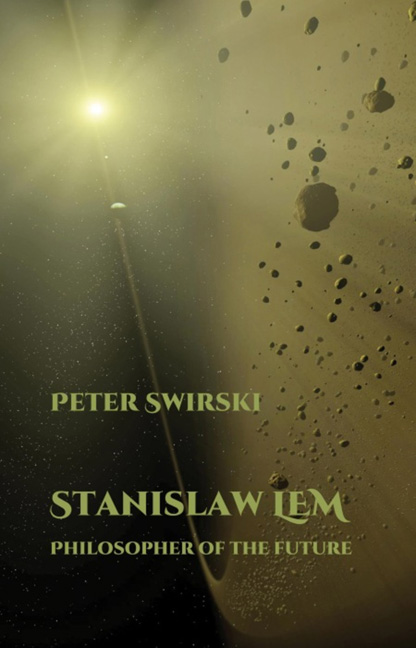
Peter Swirski, Stanisław Lem: Philosopher of the Future. Liverpool University Press, 2015 (Liverpool Science Fiction Texts and Studies, 51). ISBN 978-1-789620-54-2. Paperback, $35.41 / £19.95.
Memory tells me that I started reading science fiction in the late 1940s in the form of Heinlein stories that had appeared in Boys Life, which I subscribed to as a boy scout. When I started college at Berkeley in 1952, I discovered the Elves, Gnomes, and Little Men’s Science Fiction, Chowder and Marching Society. By the time I’d spent four years in the Air Force and finished my graduate studies at Harvard, I had collected a large SF library, including an almost complete run of Astounding. The point of this narrative is that my deepest knowledge of SF was the so-called Golden Age. Though I’ve continued reading SF and fantasy, and have published over fifty reviews of SF and fantasy books in the last twenty years, the renowned Polish writer Stanisław Lem has remained on the borderline of my reading.
When Vector (the journal of the British Science Fiction Association) solicited reviewers for this book, I offered because I wanted to learn about Lem. For readers who share my previous ignorance, Lem was born in 1921 in Lwów, Poland (now Lviv in the Ukraine), and died in Krakaw in 2008. According to Swirski’s bibliography, Lem’s first published science fiction story appeared in 1946 (Man from Mars—translated title); his first collection of SF stories appeared in 1957 (translated in 1977 as The Star Dairies). Fiasco, his final SF publication, appeared in 1987, translated with the same title in 1988.
Peter Swirski himself was born in Canada in 1966 but has spent most of his professional life elsewhere; presently a distinguished visiting professor in China, he has also taught in Finland and Hong Kong. His preoccupation with Stanisław Lem began with a 1992 article in Science Fiction Studies; the monograph reviewed here is the latest of Swirski’s six book publications on Lem. His other publications are on aspects of American literature and culture. Continue reading “A review of Stanisław Lem: Philosopher of the Future”
In this article, Eugen Bacon reflects on her journey of discovery into AfroSF. Meanwhile, Ivor W. Hartmann’s groundbreaking AfroSF anthologies are currently included in the African Speculative Fiction bundle from Story Bundle.
By Eugen Bacon
It was a love and hate relationship with M. The brusque and direct nature of this editorial colleague of mine every so often came across as pomposity, and I knee-jerked. So much that I nearly fell in wonder when M approached me asking for a favour.
“How about a pitch?” he said. “I’ve seen this AfroSF thing on Amazon a couple of times, it would be great to write an article.”
M was offering an olive branch. He wanted me to write for his nonfiction section of a popular magazine. And I had just the title for this piece: “What is AfroSF?” To put it in context, this was a few years ago.
It was a journey of discovery that led me to a community. The African Australian in me was curious to unearth AfroSF, an inquisitive quest to decipher this literary movement, this subgenre of science fiction—what was it exactly? Yes, I anticipated that it had some derivation from hard or soft science fiction, cyberpunk, mutant fiction, dystopian or utopian fiction, pulp, space opera, and the like, and that it had something to do with Africa. What else would I discover?
An online search steered me to a 406-paged anthology published in December 2012 by StoryTime, a micro African press dedicated to publishing short fiction by emerging and established African writers. The StoryTime magazine was formed in 2007 in response to a deficit of African literary magazines.

Some readers described it as a ‘ground-breaking anthology’ of diversity and hope, an ‘African Genesis’ that was intense and varied in its fresh viewpoints. Editor and publisher Ivor W. Hartmann spoke of his dream for an anthology of science fiction by African writers, and his realisation of this vision in a call for submissions that birthed original stories published as AfroSF. Illuminating his fascination with the collection, Hartmann said, ‘SciFi is the only genre that enables African writers to envision a future from our African perspective.’
Bravo, I thought of this Zimbabwean writer, editor, publisher, visual artist and author of Mr Goop (2010)—an award-winning post-apocalyptic short story of a boy who struggles with coming-of-age concerns like bullies and scholarly performance, in a science fiction society called the United States of Africa, guarded by robots and chaperoned by humanoid genoforms.
Best Novel
WINNER: Children of Ruin, Adrian Tchaikovsky (Tor)
The Green Man’s Foe, Juliet E. McKenna (Wizard’s Tower)
Atlas Alone, Emma Newman (Gollancz)
Fleet of Knives, Gareth L. Powell (Titan)
The Rosewater Insurrection, Tade Thompson (Orbit)
Best Shorter Fiction
WINNER: This is How You Lose the Time War, Amal El-Mohtar & Max Gladstone (Jo Fletcher)
To Be Taught, If Fortunate, Becky Chambers (Hodder & Stoughton)
“Jolene”, Fiona Moore (Interzone 9-10/19)
Ragged Alice, Gareth L. Powell (Tor.com Publishing)
The Survival of Molly Southbourne, Tade Thompson (Tor.com Publishing)
“For Your Own Good”, Ian Whates (Wourism and Other Stories)
Best Non-Fiction
WINNER: The Pleasant Profession of Robert A. Heinlein, Farah Mendlesohn (Unbound)
Sideways in Time: Critical Essays on Alternate History Fiction, Glyn Morgan & C. Palmer-Patel (eds) (Liverpool University Press)
About Writing, Gareth L. Powell (Luna)
HG Wells: A Literary Life, Adam Roberts (Palgrave Macmillan)
“Away Day: Star Trek and the Utopia of Merit”, Jo Lindsay Walton (Big Echo)
Best Artwork
WINNER: Cover of Wourism and Other Stories by Ian Whates, Chris Baker (Luna)
Cover of Deeplight by Frances Hardinge, Aitch & Rachel Vale (Macmillan)
Cover of Fleet of Knives by Gareth L. Powell, Julia Lloyd (Titan)
Cover of The Rosewater Redemption by Tade Thompson, Charlotte Stroomer (Orbit)
Cover of Interzone 11-12/19, Richard Wagner
The awards were voted on by members of BSFA and the British Annual Science Fiction Convention (Eastercon). Congratulations to all the winners and all the shortlistees.
The BSFA Awards were administered by Awards Administrator Clare Boothby, with help from Allen Stroud, Luke Nicklin, Karen Fishwick, and others.
Earlier / Elsewhere:

The BSFA would like to invite everyone to attend our award ceremony for works published in 2019. Join us on Youtube at https://tinyurl.com/BSFAawards on Sunday 17th May. We will be announcing the winners of Best Novel, Best Shorter Fiction, Best Non-Fiction, and Best Artwork from 7pm BST. Come along to hear about – and from – the winners.
As an African Australian who’s grappled with matters of identity, writing black speculative fiction is like coming out of the closet. It’s a recognition that I’m Australian and African, and it’s okay—the two are not mutually exclusive. I am many, betwixt, a sum of cultures. I am the self and ‘other’, a story of inhabitation, a multiple embodiment and my multiplicities render themselves in cross-genre writing. As a reader, writer and an editor, I’m increasingly noticing black speculative fiction, and it’s on the rise.
Continue reading “Becoming Visible: The Rise of Black Speculative Fiction”


 vector-bsfa.com