Laurie Penny interview

In August we caught up with Laurie Penny at Nine Worlds in London.

How’s your con?

Oh, well, I’ve always liked Nine Worlds! I missed last year, but that’s the first year I’ve missed. This year, there have been some fantastic panels – the Hidden Histories panel was a favourite. But probably my highlight was playing four hours of The Good Society. It’s a Jane Austen based tabletop RPG. And it was really intense.

Who were you?

I played the heiress, the daughter of the lady of the manor. You know, beset by suitors, having to choose the one that was least awful … and you can’t choose nobody.

Oh my God. What happened?

Well, the misconception is that in Austen novels nothing happens. But imagine if you watched somebody trying to defuse a bomb, and you didn’t know what they were doing …

You’d assume they were doing nothing?

Yes! Every tiny movement in Austen is immensely high stakes. Everything is life or – okay, if not death, then at least permanent disgrace and penury. It’s massively mercenary and exciting. What’s really interesting was watching people who are used to playing swords‑and-sorcery games adapt to those mechanics. And we had a fantastic game as well.

That sounds so cool. I wanted to ask you, actually, about the role of conflict when you write fiction. In a lot of writing advice, we’re told how important conflict is. I wonder what you think about that from a craft perspective?

I mean, I’m not the most accomplished fiction writer. We’re sitting at Nine Worlds here, and I guarantee you that within this three-hundred square metres, there are people …

We stare in quiet awe at a nearby group of people.

I don’t know these people here, but I absolutely guarantee you that there’s probably somebody better to ask just sitting around.

We’re all fucking brilliant.

Everybody’s fucking brilliant. But to answer your question, I guess ‘tension’ is as good a word as ‘conflict.’ If you’re writing about something that’s problematic, something that’s tense …

Continue reading “Laurie Penny interview”

Florence Okoye interview

In August we caught up with Florence Okoye at Nine Worlds in London.

Related image

How are you enjoying the con?

I loved how you get a proper introduction to everything when you come in. They’re so considerate of every single thing, from pronouns, to whether you want to be spoken to, whether you want to be photographed – like, every single thing! And also accessibility allies, which is a fantastic concept. So I’m actually very impressed.

I came fairly late, so I’ve only had time to get to one panel before the one I was on. That was ‘Let The Past Die: Sacrificing Sacred Cows in Star Wars The Last Jedi.’ It was a really interesting panel – a lot of unexpected connections being made by the panellists, some great questions being asked.

So tell us about Afrofutures UK.

It’s a very informal collective I started up in 2015 with some friends, back when I was living in Manchester. We were just like, ‘Well, we’re really interested in Afrofuturism, and nobody around us really talks about it … so let’s just do a thing about it.’ We started with a conference in October 2015, where over a hundred people turned up, which was amazing. It was just the power of Black Tumblr and Twitter at work to be honest.

Since then Afrofutures UK have done conferences and events, working with other organisations, trying to raise discussions at that intersection of race, technology, and speculative fiction from a variety of different perspectives. We tend to make sure that there are practical things like workshops – Arduino and programming or zine making workshops, for instance – really going for an approach that is intersectional, holistic, and creative.

Creating cultural infrastructure, as well as talking about culture that already exists. Awesome. So the theme of our next issue of Vector (#288) is economics. Would you like to talk a bit about Afrofuturism and economics?

I think at some point you realise how much everything is dependent on economic infrastructure. So you might say, okay, we want more Black people to be writers. Then you think, hang on, this is also to do with funding, this is also to do with levels of education attainment, this is also to do with just having spare time. I know plenty of creative people who have literally no time to do their creative work. So if the funding isn’t there, could Black communities provide funding ourselves? Oh, but we don’t have the money either, because we’re historically disenfranchised! And so very quickly you come back to this question of economics and the impact of institutionalised racism.

One thing I’ve found really interesting – really through Tumblr at first – was how Black people have been really good at taking advantage of digital infrastructure. So that might be someone using Patreon to fund their education, for example. And that can be a very practical quid pro quo: ‘You’re giving me money to help with my education, I’m going to make sure I write this number of books, and share them.’ Or that might be somebody using Etsy, and saying clearly, ‘Look, this is a Black-owned business, this is how we work, come and support us.’ So there are all of these interesting things that have happened through the internet. It’s really about people saying, ‘Okay, how do we support each other, in financial terms?’

Circumventing structures that might have systemic bias.

Well, yes, even though we’re still all using those systems in a sense. It’s about doing what we can. And maybe one day, as we have more amazing software developers specialising in financial software, maybe there will be like, say, a Black, co-operative version of PayPal. So we can be like, ‘Actually, yes, this is the right infrastructure to use to share our work.’ Personally, I like to think what you’re seeing now are prototypes.

Right, because the big tech companies that provide this infrastructure are still problematic. They’re still bound up in various ways in systemic racism. But the model is there.

Exactly. The co-operative model is there.

So tell us about what you’ve been working on recently.

Continue reading “Florence Okoye interview”

Dave Hutchinson interview

In August we caught up with Dave Hutchinson at Nine Worlds in London. 

Image result for dave hutchinson

Are you enjoying the con so far?

I always enjoy Nine Worlds. It’s different to Eastercon of course. The emphasis isn’t quite so much on fiction – it’s more multimedia and general culture. Just saw a panel about villains, which was good … that was Adrian Tchaikovsky, Jeannette Ng, Anna Stephens and Mike Brooks.

Oh yeah, I saw that. That was good.

There was some conversation there about the Bond franchise, and the way the villains are frequently ‘othered,’ whether that’s a racialized other, or what-have-you. It struck me that it’s always been that way. Bond was always fighting the Russians, it was always the West versus the East. The Russians disappeared as the geopolitical other, although perhaps that dynamic has returned to some extent. But we are sort of looking for different ‘others.’

And meanwhile, there are increasingly plausible rumours about getting our first Black Bond.

Idris Elba? He’s a terrific actor. He’d be really good. One of the many reasons I hated Prometheus is that it totally wasted him.

I’ll watch anything that’s got him in it.

Y-y-yeah …

Haven’t seen Prometheus though! Maybe that’s …

You may want to draw the line with Prometheus. [Laughs]. It really is a terrible film.

What else do you plan to see at Nine Worlds? Continue reading “Dave Hutchinson interview”

Conference Report: Sublime Cognition 2018

By Eli Lee

sc

Sublime Cognition, the second annual conference of the London Science Fiction Research Community, was held on 14-15th September at Birkbeck, University of London. Over two days, its attendees looked at the theme of science fiction and metaphysics from an enormous, and often highly original, variety of perspectives. As its organisers Aren Roukema, Francis Gene-Rowe, Rhodri Davies and Katie Stone outlined in the conference programme: ‘the functional and thematic relationship of the metaphysical to SF is now widely acknowledged, but the roles played by such phenomena – and their implications for a wider understanding of SF as genre or mode – have yet to be subject to significant interrogation or debate.’ Sublime Cognition set out to address this, by way of presentations and discussions that ranged from evolutionary metaphysics to satanic socialism to artificial intelligence, Buddhism and Chinese SF. It was a fascinating two days covering a huge amount of fertile ground – this conference report outlines at least some of it, with apologies to those whose presentations I missed.

When the LSFRC 2017-18 reading group announced the Sublime Cognition theme a year ago, the reference to Darko Suvin’s sense of the ‘cognitive’ was clear – Suvin understood SF as guided by a ‘rational empiricist epistemology that separates it from the spiritual, supernatural and numinous concerns of other literatures of the fantastic.’ The conference showed just how much this rational, empiricist epistemology is troubled by, as the LSFRC puts it, ‘a long history of engagement with myth, religious imagery, magic and mysticism’. The conference participants were looking to further unpack this relationship between the two, as well as investigate what might be in that ‘tertiary space’ that exists between their oppositional pulls.

Continue reading “Conference Report: Sublime Cognition 2018”

Chinese SF at the Southbank Centre

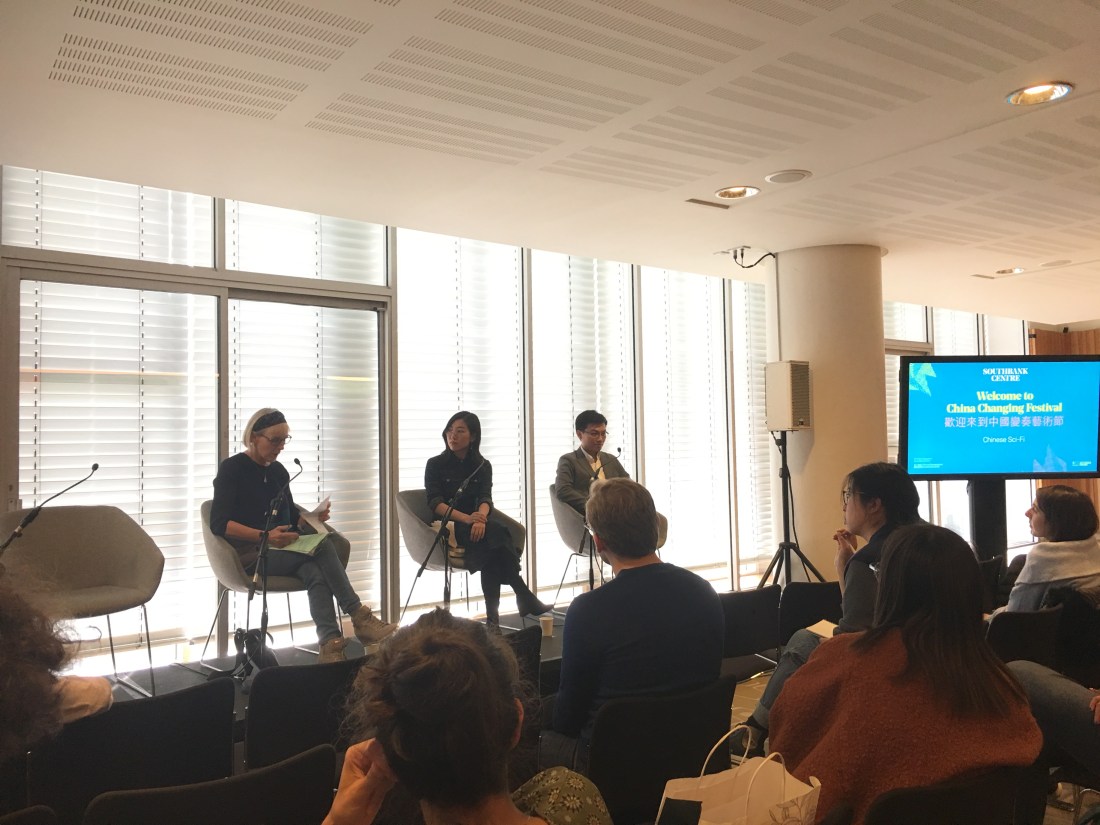
A couple snaps from the Changing China Festival in early October, where there were two items on Chinese science fiction. The first was a session devoted to discussing the work of Jin Yong, author of the Legends of the Condor Heroes wuxia series.

In the second item, two Chinese SF authors, Wang Yao (aka Xia Jia) and Chen Quifan (aka Stanley Chan), discussed their work with Nicky Harman.

IMG_0358

IMG_0374.jpg

Right to left: Nicky Harman, Wang Yao, Chen Qiufan, and BSFA Membership Officer Dave Lally (photograph: Lyu Guangzhao)

Conference Report: Utopian Acts 2018

UA-poster-med

By Sasha Myerson

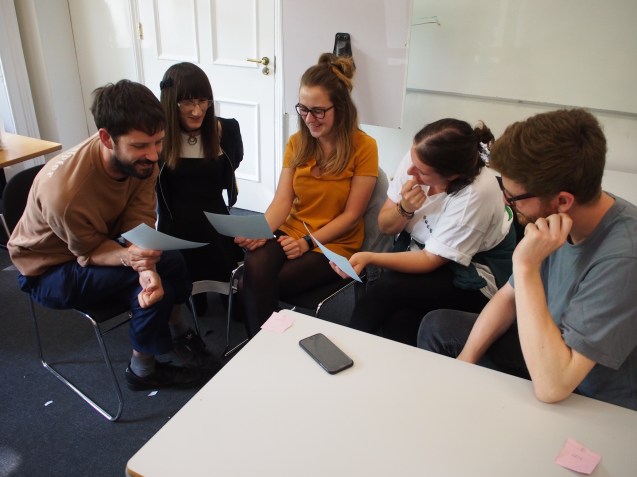
Organised by Katie Stone and Raphael Kabo, ‘Utopian Acts’ was a one-day mix of art, activism and utopia hosted by Birkbeck at the beginning of September. The conference provoked us to explore ideas set out by Ruth Levitas in ‘Utopia as Method’ and consider utopia as an act. Aiming to challenge the dystopian pessimism of our current moment, it asked whether examining the intersection of academia and activism might provide a way forward, out of our current impasse, towards a better future. Such thinking informed the structure of the conference, which included a mix of interactive workshops alongside talks by artists, activists and more conventional academics. In a welcome break from the norm at conferences, the event was free and substantive effort was made to ensure inclusivity and accessibility. This included grants to reimburse speakers, step free access to the building, gender-neutral bathrooms, a policy on pronouns and encouragements to keep academic language clear and intelligible. Overall, the conference made an ambitious attempt to relate its content to its form, putting some of its ideas into practice.

OLYMPUS DIGITAL CAMERA

Continue reading “Conference Report: Utopian Acts 2018”

Surveillance Capitalism and the Data/Flesh Worker in Malka Older’s Infomocracy

By Esko Suoranta

This academic article explores themes of algorithmic governmentality, data surveillance, labour and embodiment in Malka Older’s Infomocracy, drawing in particular on Shoshana Zuboff’s theories of surveillance capitalism.


The cyberpunk dystopia is already here, it’s just unevenly distributed. Western democracies appear to be in crisis. Populist nationalisms are on the rise, while an ever-so-free market tightens its grip on our everyday existence, building vast private siloes of personal data. Climate change is spurred on by the rise of new imaginary currencies, mined from pure mathematics and pumping tens of millions of tons of carbon into the sky. Technologies from space travel to nanotechnology take unprecedented leaps. Meanwhile, in fiction, nostalgia appears to be a prime directive. The imagined futures of the 1980–90s receive reboots which appropriate the aesthetics of the past, but often fail to update its politics in the process: see Blade Runner 2049 (2017) and Ghost in the Shell (2017). Against such future-washed conservatism, a counter-project is also emerging. Critics and authors like Monika Bielskyte and Nnedi Okorafor sound the clarion for new ways to imagine the future, and to pave the path for a more equal and sustainable world.[1]

Infomocracy

In this context, Malka Older’s debut novel Infomocracy (2016) explores progressive political and economic alternatives in a near-future setting. Part political techno-thriller, part thought-experiment on global micro-democracy, the novel follows four protagonists in the 22nd century as the third global elections loom. In the micro-democratic system, each geographic “centenal,” a unit of 100,000 people, chooses their representatives from a myriad of parties ranging from PhillipMorris and Liberty, to Earth1st and YouGov. Nation states have practically disappeared and the global election process is governed by Information, a descendant of the internet giants of yore, seemingly fused with something like the United Nations. The organization strives for neutral and truthful management of information and a fair administration of the micro-democratic process.

Predictably, political rivals try to play the system for their own benefit, and much of the plot revolves around such schemes. Through their twists and turns, Older highlights the precariousness of information labor in highly networked societies as workers become interfaces of bodies and computer networks, producing a distributed subjectivity. These themes become clear through an analysis of Older’s treatment of her protagonists and her depiction of Information’s custodianship of networked data. Infomocracy conducts an optimistic thought-experiment on the future of what Shoshana Zuboff calls “surveillance capitalism.” I aim to show how, for Older, there are two keys to diverting surveillance capitalism in a more optimistic direction. First, the democratization of skills related to information work. Second, the not-for-profit management of data.

Continue reading “Surveillance Capitalism and the Data/Flesh Worker in Malka Older’s Infomocracy

Science Friction

By Robert Kiely and Sean O’Brien

This academic article explores what it describes as ‘science friction,’ relatively recent near future SF depicting the intensification of contemporary economic tendencies, including increased automation and the spread of digital platforms. The bitterly critical tone and concerns of these works is in marked tension with the techno-utopianism prevalent within much twentieth-century science fiction, within contemporary literary science fiction studies, and within the uses of science fiction within contemporary political theory, including left accelerationism broadly construed. Such techno-optimist thinking is not naively enamoured of detailed, inflexible plans for what the future should look like, but it arguably leans too heavily on a vision of technology as a relatively neutral, repurposable and ever-proliferating resource, paying insufficient attention to its historical contingencies. The article ends by contending that there are material reasons why techno-optimist SF was readily available in the twentieth century, just as there are material reasons why it is less readily available now. Perhaps then ‘science friction’ invites us to contemplate the exhaustion of such thinking, an exhaustion that correlates with the closure (or at least profound transformation) of the radical political opportunities in which it was once rooted.


  • Review: This article underwent editorial review by two editors.
  • License: Copyright Robert Kiely and Sean O’Brien, all rights reserved.
  • Citation: Kiely, R and O’Brien, S. 2018. Science Friction. Vector #288. https://vector-bsfa.com/2018/11/16/science-friction/
  • Keywords:  algorithmic governmentality, economics, labour, near future SF, platform capitalism, post-scarcity, science friction, techno-utopianism

This article examines a series of near-future SF stories that offer snapshots of an immediate future dominated by the intensification of contemporary economic tendencies, including increased automation and the rise of digital platforms. Much twentieth century SF tends to traffic in a certain techno-optimism in its outlook, not so much to suggest that technological advances would produce positive outcomes but that they would continue to develop and expand in their complexity and productivity. Today this utopian legacy is carried forward both by literary science fiction studies and by the uses of science fiction within contemporary political theory. In a different vein, and in tension with this outlook, is what we call ‘science friction’: a literary practice of slowing down visions of technological and social progress.

econSF

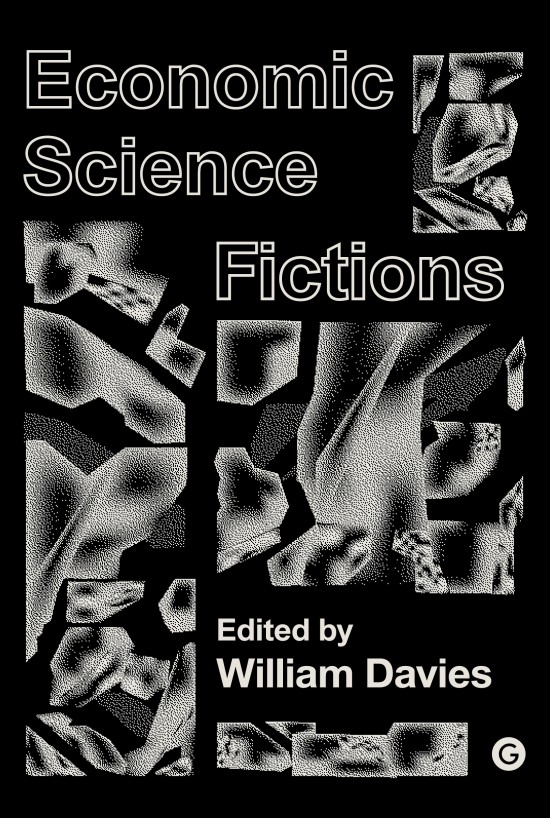
Two recent collections, Futures and Fictions (2017) and Economic Science Fictions (2018), look to SF to counter the dominant cultural narrative of what Mark Fisher calls ‘capitalist realism’—the Thatcherite idea that ‘there is no alternative’ to capitalism—with alternative visions of the future based largely on emerging technological innovations [1]. To puzzle over this position, as we’ll do below, is not to be fatalistic or to concede political ground on the terrain of the imaginary. Rather, it is to question the capacity of capitalist technology to usher in a postcapitalist future, especially under contemporary conditions of stagnation and precarity. As these works of science friction suggest, further development of capitalist technologies are likely to offer more of the same, but worse.

Critics such as Simon O’Sullivan, William Davies and Peter Frase have argued that a visionary SF can offer much-needed screenshots of a postcapitalist future, challenging the neoliberal status quo and bolstering a left that suffers from a perceived poverty of imagination. [2] In the discussion that opens Futures and Fictions, for example, O’Sullivan argues that ‘future fictions have a more general traction on the real, not least insofar as they can offer concrete models for other ways of life in the present.’ [3] Several of the essays in the collection suggest that the intensification of late capitalist technological developments will provide the means to realize a postcapitalist utopia if the economy were managed by a socialist state. Here, full automation and universal basic income (UBI) constitute transitional demands on the way to what Aaron Bastani brands ‘fully automated luxury communism’ [4].

Continue reading “Science Friction”