The Other Shore by Hoa Pham(Goldsmiths Press, 2023)
Review by Harry Slater
The Other Shore, by Hoa Pham, winner of the Viva La Novella prize, deals with some of the biggest questions there are. It’s about life and death and legacy, about power and control, colonisation and oppression, ancestry and the price we pay for the future we want. And it’s all told from the perspective of a sixteen-year-old Vietnamese girl, Kim Nguyen. That makes for some interesting stylistic choices; the prose can sometimes feel stilted, lacking in the emotional clout that an older voice might add. At the same time, though, there’s a visceral naivety at play here, the realisations of the state of the world are ever more compelling because they’re wounds delivered fresh, for the first time. In one way, then, The Other Shore is a coming-of-age story, and at the same time a brutal indictment of human cruelty, an examination of the structures of power that bind Vietnam, and the world, and how they’ve come to be. After a brush with death, Kim discovers that she can read people’s minds by touching them, a gift bestowed upon her by the goddess Quan Âm. More than that, she now has contact with the titular Other Shore, the place where the dead go after passing on. At first her father uses her newfound powers to earn money from his business associates, but it isn’t long before the government comes knocking. Kim is taken to a mass grave by Bác Phuc, another apparent psychic working for the communists. There she’s tasked with reconnecting buried soldiers with their families, giving their restless spirits the chance to finally find some solace. But there’s a catch – if she discovers southern Vietnamese remains, they’re tossed to the side, left to their haunted afterlife. This forms one of the core moral quandaries of the book; Kim knows she should be helping everyone to find peace, but the powers-that-be simply won’t stand for it. This burgeoning sense of responsibility, of behaving in ways that shake off the ideas of the past, leads her to Khôi, a second-generation Vietnamese American working as an interpreter for a US MIA mission. There’s an idealism to him, and a freedom, that Kim finds alluring. Interspersed with this trauma is a strange love triangle between Kim, Bác Phuc and Khôi that doesn’t quite ring true, feeling more like an extended metaphor for the possibilities that are opening and closing in Kim’s life. The Other Shore deals with complex cultural issues with a deft hand, showing Kim’s innocence slipping away as she starts to confront decades-old actions that have shaped the life she lives today. At times it can be quite clunky, though, and there are decisions and story beats that seem to come too quick, sometimes occurring in the space of a paragraph. Kim’s relationship with her dead grandmother is the beating heart of the story, tying together the past, present and future with a kindness and a spirituality that the modern world Kim inhabits appears to have left behind. There are heartbreaking moments, and the confusion, excitement and terror of adolescence is captured within the staccato rhythms of the piece. While The Other Shore might lack fluidity and fluency, it poses its questions with a steady hand and doesn’t flinch away from showing us Kim’s strife in harrowing, gut-wrenching close-ups. There’s no easy ending here, no final resolution, and that’s fitting for a book that confronts such fundamental and difficult topics. This is a book layered with the spiritual and the political, a meditation not just on life and death, but on our attitudes towards them. It’s hard going sometimes, in several different ways, but The Other Shore leaves you with deep questions about what it means to be human, and for that alone it’s worth checking out.
Imagine fighting your way across dangerous terrain to finally enter The Library, a vast stronghold containing thousands upon thousands of priceless arcane tomes, each one filled with the world’s most valuable knowledge… and then imagine that you can’t look at any of the books. Most of them have no titles on their spines, the majority are identical copies of each other, and the only one you can read opens to a single page, containing a single paragraph of text that immediately sends you away on yet another quest.
The above description applies to any number of digital games, in which impressively beautiful libraries are common but functional ones are rare. Most in-game libraries exist as graphically interesting settings with little-to-no interactivity, and those with readable books or bookcases present only snippets of information, often limited to minor world lore, game hints, or easter eggs. Players rarely interact with an in-game library in a meaningful way, and more rarely still take any game actions that mimic or simulate the way libraries are used in real life. In short, libraries as a concept are underused by speculative game developers.
Fortunately, a small but growing sub-genre of games center on library-like mechanics, in which players spend most of their time collecting, organizing, and distributing or protecting information about the game world. In these games, players are not using an in-game library as much as they are creating and maintaining one, and can even be seen as embodying the library itself. Two recent examples are In Other Waters (2020), in which the player helps a xenobiologist explore, catalogue, and understand an alien ecosystem; and The Return of the Obra Dinn (2018), in which the player must extrapolate the names, positions, and ultimate fates of the crew and passengers of a missing merchant vessel, information they are responsible for reporting, or choosing not to report. These examples and others suggest the existence of a “library game,” in which the player’s interactive experience focuses on collecting, organizing, and distributing in-game information, regardless of whether a traditional library appears in the game at all. The library game makes use of the naturally archival structure of digital games, in which massive amounts of in-game information and content is organized and efficiently presented to players, and allows for game experiences focused on the aggregation and understanding of knowledge, as well as the player’s ethical responsibility as the curator of that knowledge. Ultimately, the library game is an appealing new direction for speculative game design, and is particularly effective when it positions the player not as a patron but as the librarian, or the library itself.
Obra Dinn logbook
Libraries in Speculative Digital Games
The relationship between libraries and games is less straightforward than it seems. An online search for the term “library games” often turns up libraries looking to add digital and analog games to their collections (Snyder Broussard 2012; Forsythe 2021; Haasio, Madge, and Harviainen 2021), or discussions about the difficulties of archiving and cataloging games for reference (Kaltman, Mason, and Wardrip-Fruin 2021; Sköld 2018; McDonald et al. 2021). In game development, a “game library” is a collection of code or assets intended for reuse, often as part of a larger framework or game engine (“GameDev Glossary: Library Vs Framework Vs Engine” 2015; Unity Technologies 2022). Additionally, game engines can be used as platforms for large-scale projects in citizen science such as Foldit (2008), an experimental puzzle game in which thousands of users folded protein structures and catalogued their results; or for the curation and dissemination of real-world information. The most famous of these is the Uncensored Library, a collection of banned reporting from countries without press freedoms that exists in a free-to-access Minecraft server (Maher 2020; Gerken 2020). Libraries also make for popular content for analog and other non-digital games, including Biblios (2007), Ex Libris (2017), Gutenberg (2021), and The Big Book of Madness (2015).
In addition to the above, there are a remarkable number of fictional libraries in digital games, especially those with speculative content. Libraries appear in games as varied as the action-horror game Bloodborne (2015), indie games Night in the Woods (2017) and Undertale (2015), classic platformers like Castlevania: Symphony of the Night (1997), action games like Assassin’s Creed Origins (2017) and Shadow of the Tomb Raider (2018), adventure games like The Longest Journey (1999) and Darkside Detective (2017), numerous role-playing games from Chronotrigger (1995) to Octopath Traveler (2018), nearly every game in the Final Fantasy series, most games in the Legend of Zelda series, and most major ongoing massively multiplayer role-playing games from World of Warcraft (2004) to Final Fantasy XIV (2014). Dungeons & Dragons’ Candlekeep Library appears in multiple digital games, mostly notably Baldur’s Gate (1998). An accurate recreation of the Boston Public Library appears in the post apocalyptic Fallout 4 (2015). Even Halo: Combat Evolved (2001), best known as a fast-paced multiplayer shooter, includes the infuriatingly difficult and famously reviled level “The Library” in its single-player campaign (Burford 2016). In short, libraries are so common in digital games that they are arguably harder to avoid than to seek out.
In-game libraries vary widely in both content and use. Games with fantasy settings often include a traditional book-and-scroll-laden library inhabited by scholars or spellcasters who provide information, share secrets, and send players on quests. In these non-technological spaces, books are valued as physical objects that can be retrieved, collected, or stolen, as with the lost tome that begins Cyrus’ story in Octopath Traveler (2018) or the numerous books that can be collected, read, and organized in the player’s home in The Elder Scrolls V: Skyrim (2011). In addition to physical libraries, science fiction games often also feature a digital archive that serves as either an extension of the player’s user interface or a technological macguffin that must be found, hidden, repaired, or destroyed. All three are present in Horizon Zero Dawn (2017), in which heroine Aloy uses a Focus, an information-gathering augmented reality device, to uncover the Zero Dawn project, both a digital archive and physical library space that originally protected the core knowledge of human civilization from an extinction-level event. Horror games commonly present libraries as ruined or abandoned spaces in which the player’s only goal is to survive, as with the Duke’s Archive in Dark Souls (2011). As with much popular media, games rarely make a distinction between libraries and archives (Buckley 2008), but both are prevalent in speculative digital games, regardless of whether they are appropriately labeled.
Despite their prevalence, most in-game libraries exist more as graphical backgrounds than truly interactable spaces. Generally, players can interact with only one or two plot-important books or with bookcases that provide a single relevant paragraph of information, as in Garregh Mach Library in Fire Emblem: Three Houses (2019). It is also common for a game’s books to be represented by a few duplicate art assets, as with the beautiful but heavily replicated piles of books in What Remains of Edith Finch (2017). Few games present libraries of a specific type: exceptions include the explicitly academic library that serves the students of the College of Winterhold in Skyrim (Lai 2022) and the rural, small-town library in Stardew Valley (Lai 2021). Even fewer games allow players to take library-like actions, such as checking out books or searching through the stacks for specific pieces of information.
“The computer” – a character unnamed save its technological form – is one of the most enduring characters of Star Trek, spanning multiple generations of hardware and software over a 250-year period ranging from Enterprise in the 2150s to Picard in 2399. The prominence of the computer as an information agent, and the repeated deployment of “the archive” as a mysterious space of potential discovery[1] has the effect of overshadowing a more familiar figure from our own era: the librarian. In this article, we take the librarian as the starting point for understanding the information landscape of Star Trek. What, in the universes of Star Trek, do librarians do, and how do those activities relate to the scope of librarianship in the real 21st century? We find the visible librarian pushed into a stereotyped corner, where a large swath of activities associated in particular with modern data librarians simply disappear from view. In this future landscape, it is as if data organizes itself – or at least, we are led to assume as much. We see the utopian embodiment of this process through Data, who both has access to these vast knowledge stores, and a positronic brain to deploy that data and interact with the world at a level where he is deemed sentient. But another form that data takes is “the computer”, which is narratively relegated to the background as a service worker, however complex that service may be upon closer interrogation. As one of the services computers perform, often hyper-invisibly, in the Star Trek universe is translation, we conclude with a case study of how translation depends not only on advanced computation, but an enormous amount of data – including cultural and linguistic information we might assume resists datafication. We pair examples from a few novels with a corpus of 774 Star Trek novels, using digital humanities text analysis methods to draw together those examples – much as one might do by calling upon the computer.
We open issues to the public after about two years. An index of back issues of Vector can be found at the ISFDB. For the availability of individual print issues, please contact us.
To subscribe to Vector, join the British Science Fiction Association. Membership is open to anyone in the world. Members receive Vector, FOCUS, the BSFA Review, special one-off publications, and other benefits. The BSFA is a nonprofit organisation, entirely run by volunteers.
Vector 294, SFF and Class, is guest-edited by Nick Hubble. Featuring ksenia fir on labour in outer space, Paul Kincaid on Priestley’s An Inspector Calls, GuangzhaoLYU on Wei Ma’s “Formerly Slow” and Hao Jingfang’s “Folding Beijing,” So Mayer on Star Trek: Discovery, Marie Vibbert‘s survey of class representation in SFF, Farah Al Yaquot on Petrosyan’s The Gray House, Ali Baker on de Larrabeiti’s Borribles, Andi C. Buchanan on Cipri’s Finna, and an extensive guest editorial from Nick Hubble.
By Linna Fredström, Laura Pereira, Simon West, Andrew Merrie and Joost Vervoort
Examples from a small city in the middle of a Swedish forest
‘We live in capitalism. Its power seems inescapable. So did the divine right of kings. Any human power can be resisted and changed by human beings. Resistance and change often begin in art, and very often in our art, the art of words.’ Ursula K Le Guin
Intro and motivation for study
A growing body of research is calling for radical transformation of society to avoid catastrophic levels of climate change and create a more sustainable and just future (Adger et al., 2009; Westley et al., 2011; Kates, Travis and Wilbanks, 2012; Patterson et al., 2017; Fazey, Moug, et al., 2018). Such transformation will disrupt political and economic structures as well as knowledge and value systems, and require fundamentally changing “norms, values, and beliefs; rules and practices, such as laws, procedures, and customs; and the distribution and flow of power, authority, and resources” (Moore et al., 2014).
Many researchers studying such transformations are also acknowledging that their own role must change: rather than simply producing knowledge, they are beginning to actively participate in making knowledge actionable, with the explicit goal of enabling radical change (Cornell et al., 2013; Sala and Torchio, 2019; Fazey et al., 2020). In this new task, the social sciences can offer valuable insights on how to approach the value-laden and political dimensions of using science to bring about change (Wittmayer and Schäpke, 2014; Fazey, Schäpke, et al., 2018; Vervoort and Gupta, 2018; Woroniecki et al., 2019; Miller and Wyborn, 2020; Scoones et al., 2020; West et al., 2020). Critical social theory and critical perspectives in particular are believed to offer tools for sustainability transformation research (Death, 2014; Lövbrand et al., 2015; Stirling, 2015; Blythe et al., 2018). Critical social theory focuses on illuminating and challenging the power dynamics and hidden biases of science and knowledge itself. This focus on reflexive and critical perspectives is now gaining traction within the field of transformation toward sustainability. Conversely, researchers within the field of sustainability are reaching conclusions that point toward the need for critical theory. It’s becoming clear that to enable transformation to a more sustainable and just society we must be willing to challenge not only political and economic systems, but also the value and knowledge systems that brought us to this point in history (Stirling, 2015, 2019; Gottschlich and Bellina, 2017; Fazey et al., 2020).
Scenarios have become a frequently used approach to explore radically different futures and to identify transformative potential in the present (Pereira et al., 2019). As a tool, scenario development is versatile and allows for transdisciplinary exploration, combining scientific, local, practical, and emotional insights (Oteros-Rozas et al., 2015; Merrie et al., 2018; Pereira et al., 2018; Sweeney, 2018; Wangel et al., 2019). Scenario exercises in times of impending climate crisis can be a way to practice imagining the future, and through this practice to see potentialities in the here and now. We need new understandings of the world, new stories: alternatives to both climate catastrophe and naïve never-ending growth narratives. But how do we make space for such visions?
Beyond the Library as Utopia: Conditional Belonging, Representative Collections and Science Fiction Librarianship
Gina Bastone and Adriana Cásarez
Introduction
When we tell strangers or new acquaintances that we are librarians, we hear reactions like “Oh, how wonderful that you get to read books all day!” Sometimes, we might get the response, “You’re doing such important work. The public library changed my life as a kid!”
While we much prefer the latter response, both reflect a stereotype of libraries as utopian institutions necessary for a healthy democracy and immune from criticism. Some people even hold libraries in holy regard, comparing librarians to clergy with a vocational calling, as Fobazi Ettarh notes in her groundbreaking article on vocational awe.[1] For many readers and SF fans, the library is a sacred place where knowledge is preserved and where they have treasured memories of encountering their favorite books for the first time or discovering their favorite SF authors.
We share a love for books, particularly SF stories, but we have a realistic view of libraries beyond these utopian visions. Margaret Atwood discusses the paradoxical nature of a similar utopia/dystopia binary in her book, In Other Worlds: SF and the Human Imagination. She says, “[W]ithin each utopia, a concealed dystopia; within each dystopia a concealed utopia. …”[2] It is from this tension that we draw similarities in libraries. Our idealized values of unfettered, egalitarian access to information and strong nostalgia for the love of books have a shadow side, especially when interrogated around white supremacy and patriarchy.
In her article “Concealing White Supremacy through Fantasies of the Library: Economies of Affect at Work”, Michele R. Santamaria describes “The Library” as “a fantasy space that denies its role in white supremacy.”[3] Santamaria builds on Gina Schlesselman-Tarango’s work on the concept of cuteness and how it insidiously reinforces the status quo in libraries. Schlesselman-Tarango says,
“By promising safety through gesturing to a pre-technological past, books preclude exposure to and engagement with the nasty realities of contemporary society. Inasmuch as they are associated with books, libraries too might be understood to provide an outlet for this sentimental yearning. …”[4]
We see library nostalgia as a crucial underpinning to the romanticized utopian stereotype of libraries, yet Santamaria, Schlessleman-Tarango, and Ettarh all point to the dystopian shadow side of our shared profession. We will explore this further as we unpack our collecting philosophy.
Additionally, Santamaria’s use of “The Library” denotes a sense of institutional authority and is a direct reference to librarian, writer, and poet Jorge Luis Borges’ concept of the “library as a universe”.[5] In particular, Borges’ famous short story The Library of Babel comes to mind. The Library of Babel has dystopian elements, such as meaningless books that are never accessed, used, or even seen by the librarians doomed to wander its endless halls.[6] This Borgesian “library as universe” may seem the product of a dark fantasy far from the reality of working in libraries, but it is a helpful metaphor for challenging the equally unrealistic stereotypes underpinning library nostalgia and vocational awe.
“Extracting Humanity and Other Stories” by London-based SF writer Stephen Oram was officially launched at an in-person event at Burley Fisher independent bookshop, Dalston on Thursday 3 August 2023. Attendees included Geoff Ryman, along with some of the scientists Oram has worked with over the years in his roles with the “Virtual Futures” and “Cybersalon” projects – notably Christine Aicardi and Luke Robert Mason, who took part in an interview with the author during the second part of the evening. I mention these details because they speak to where Stephen Oram has placed himself over the past few years as a facilitator of closer links between SF authors and practising scientists as well as carving out a distinct near-future take on current trends, resulting in what I would term as the gradual creation of the “Oramverse”. Many of us authors strive to have a recognisable style and a recognisable palette of concerns; I would say that with this current collection and his two well-received previous offerings – “Eating Robots and Other Stories” (Silverwood Books, 2017) and “Bio-hacked & Begging and Other Stories” (Silverwood Books, 2019) – Stephen has succeeded in that aim.
There are twenty stories in this collection, some flash length, others more developed. Only one is set off-Earth – “Far Side Whispers”, an inventive evocation of civilisation on Luna. The remaining nineteen all present a vision of the UK a few or several years from now, integrating technological advances and societal change as drivers of the plot. It’s an old adage that the SF written about the future is actually a comment on our world today; with Stephen Oram’s work, this intention is often foregrounded. If you’re worried about how AI algorithms have the capacity to negatively affect you, and you probably should be, opener “Poisoning Prejudice” shows how the individual can fight back. The next story, “Haptic Father”, is one that Stephen read at the launch and is a standout, a compelling Oedipal tragedy. Other notable moments include my personal favourite “Adtatter Love” based on a totally plausible concept of people earning money by riding the tube trains all day sporting an electronically embedded advertisement on their forehead. Am I giving too much away if I say that Stephen Oram manages something of an uplift at the end? Closing the collection, title story “Extracting Humanity” is a moving piece that, with its protestors Madeleine and Sara, reminded me somewhat of the sacrifices made by the indomitable Greenham Common women of the 1980s.
Elsewhere along the way, you will find the author raising pertinent questions about what it means to be human / alive / real in “Chimy and Chris” (which was published in “The Best of British Science Fiction 2020”); “Keeping Family”, a bitter, short piece which focuses on the future of pregnancy and birth and yes the process is as sterile and heartless as we might fear; as well as “Standard Deviations”, which is another story pointing out the dangers of AI control, specifically predicting a person’s “unknown risk of future mental health issues” and, by extension, limiting that person’s life choices and liberty. A sort of minor “Minority Report” if you will.
Reading the whole collection again, one can see regular themes emerging – “Be Aware, The Hand That Feeds” starts with a common Stephen Oram trope, that the lead character has to somehow make their daily wage and put a meal in their stomach. Oram is telling us that life is likely to get ever more precarious and hand to mouth for the working class. The gig economy is a recurrent concern – “Adtatter Love”, “William Dreams” – and economics itself rears its head on several occasions. “In Trust We Trust” is a clever examination of what Oram calls near-future “Currency commonality” – an expansion of the current range of Sterling, PayPal / Google Pay, Bitcoin, etc into a myriad of potential mini-streams of finance. This being the Oramverse, of course, our hero’s credit is “Refused”. There is wit, too: “Bits ‘N’ Bacon” has the lines: “Each pre-packaged piece of food would have contained nanobots that registered its passage through the human, providing the health company with certainty on who was eating what.” Beware, folks, our only value in the near-future is as repositories of harvestable data.
As with most collections, there are a couple of pieces that don’t quite live up to the rest. This may be a consequence of four of the stories having emerged fairly quickly or to very tight guidelines from scientist-author link-ups and being previously published in “22 Ideas About the Future” (Cybersalon Press, 2022). And although Stephen is a great writer (and a great friend), I would have to say that the opening line of “John Doyle Remains” – “I had a girlfriend who ate my scabs” – feels like a misstep.
Overall, this is a great collection of short speculation on the near-future of urban society. I lie awake at night sometimes wondering if these are predictions as well as warnings. Read carefully, be prepared to fall brain-first into the Stephen Oram world.
You can watch Luke Robert Mason interviewing Stephen Oram and Christine Aicardi on You Tube:
About the reviewer: Allen Ashley is a British Fantasy Aawrd winner and is the founder of the advanced science fiction and fantasy group Clockhouse London Writers. His latest book is the atom punk chapbook “Journey to the Centre of the Onion” (Eibonvale Press, UK, 2023).
We open issues to the public after about two years. An index of back issues of Vector can be found at the ISFDB. For availability of individual print issues, please contact us.
To subscribe to Vector, join the British Science Fiction Association. Membership is open to anyone in the world. Members receive Vector, FOCUS, the BSFA Review, special one-off publications, and other benefits. The BSFA is a nonprofit organisation, entirely run by volunteers.
Cover: Cao Fei, Blueprints (Installation view, Serpentine Gallery, 2020). Photo credit: Gautier Deblonde. Inside page: Cao Fei, Nova, 2019, Video, 109’. Courtesy the artist, Vitamin Creative Space and Sprüth Magers. Back cover: Cao Fei, Asia One, 2018, Video, 63’20”. Courtesy the artist, Vitamin Creative Space and Sprüth Magers
Vector 293 is a collaboration with guest editors Yen Ooi and Regina Kanyu Wang. Yen Ooi introduces the issue as well as many of its recurring concepts, such as techno-orientalism. Regina Kanyu Wang takes us through the history of women writing SF in China. Artist and curator Angela Chan interviews Beatrice Glow about her work with colonial histories and the ability of science fiction to ‘tell truthful histories and envision just futures together’ through art. The conversation about history, futures, science fiction and art continues in Dan Byrne-Smith’s interview with Gordon Cheung. Chinese SF scholars Mia Chen Ma, Frederike Schneider-Vielsäcker and Mengtian Sun offer glimpses of their recent and ongoing research. Authors Maggie Shen King (An Excess Male) and Chen Qiufan (Waste Tide) interview each other about their recent novels. Feng Zhang introduces us to the SF fandom in China, while Regina Kanuy Wang brings us up to speed with accelerating Chinese SF industry. Dev Agarwal questions the maturity of the Chinese SF blockbuster as can be judged from Shanghai Fortress and The Wandering Earth (both available on Netflix). Virginia L. Conn explores Sinofuturism, while Emily Xueni Jin delves into the implications of translating a growing body of SF work from Chinese into English. We learn about the global perspectives on Chinese SF from an illustrious panel assembled at WorldCon 2019, and about transnational speculative folklore of the Uyghur people from Sandra Unerman. Niall Harrison completes the issue with an illuminating survey of Chinese short SF in the 21st Century.
Front and back cover images by Cao Fei (front photo credit: Gautier Deblonde), courtesy of the Serpentine Gallery.
We’re crowdsourcing a list of recommendations for this year’s awards. Please do add to this list with some of your favorite texts that were published in 2023. You don’t need to be a BSFA member: anyone can send their recommendations, so do share widely.
We look forward to celebrating another year of science fiction excellence!
Hoa Pham is the author of eight books and a play. Her last book Empathy is also out with Gold SF. Her first novel Vixen won the Best Young Writer Award from the Sydney Morning Herald and was shortlisted for the Best Fantasy Novel Aurealis Award. Her novella Wave was translated into Vietnamese. Her play Silence was on the VCE Drama List. More about her work can be found at www.hoapham.net.
Spoiler alert: for the end of The Other Shore
Does your novel The Other Shore have an origin story, what inspired the book?
The Other Shore was inspired by the existence of a Vietnamese government psychic bureau who reunited the remains of the war dead with their descendants. A BBC documentary was made about it in 1996 – so it must be true. I haven’t seen the documentary so I have been free to make up my own world of psychics and spirits. To me the very existence of the bureau poses interesting questions about the Communist government, when they first came to power they denounced all ancestral worship and Buddhism as being contrary to the creed of the new nation. However this stance has softened as it has become evident that the spirituality of the Vietnamese people is not easily oppressed. There is now state sanctioned Buddhist monasteries and other religions are tolerated such as the Cao Dai and Christianity. The government has done a U turn, inviting formerly exiled Zen Master Thich Nhat Hanh to teach on pilgrimage in the country in 2007, in order to be admitted to the UN security council- they could not be seen to be oppressing religious activities.
How are the wishes of the dead taken into account? Is it always clear who wants to be reunited with whom?
My questions in the novella revolved around a single premise- how can you reconcile the ethics of the dead where there are no sides, with working for the communist government as a psychic? The stance of the Vietnamese government regarding the Vietnam/American War is complex, they have made peace with the Americans but have not laid aside enmity towards the South Vietnamese war veterans that fought alongside them-the so called Imperial puppet forces. So if a government employed psychic came across the remains of the Southern dead what is s/he to do? All ghosts wish to be reunited with their descendants so they can look out for them and receive offerings in the cosmology of the novella.
It is interesting that the story is told from the perspective of the mediator, please tell us more about her.
I made my protagonist Kim a young girl of 16, naïve to Vietnam’s recent history to navigate through this ethical minefield. Her guides include Ba- her grandmother, and Buddhist abbots and abbesses that she meets through her work as a psychic. She chooses to reunite the Southern Vietnamese war dead with their descendants against her orders and she ends up defecting to America with an American “missing in action” team including a Vietnamese-American psychic. Finding the remains of the American soldiers “missing in action” issue is also a live one for the US administration today.
Defecting in the actual or to the psychic America? Is the psychic world as divided as the real one?
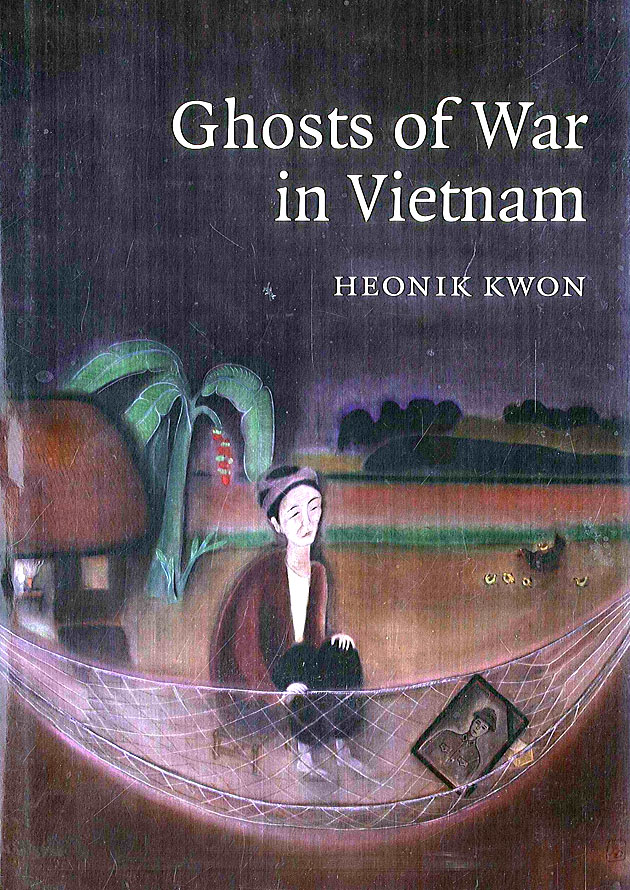
I built the psychic world drawing heavily from “Ghosts of war in Vietnam” by Henrik Kwon a Korean anthropologist who spent two years researching war ghosts in villages. He ascertained that the war dead did not hold sides in Central Vietnam where he investigated, and emphasised the importance of the war dead remains to be reunited with their descendants where possible. With the existence of mass graves holding bodies from all sides of the conflict, local domestic shrines in people’s homes also have altars for wandering ghosts to receive offerings and some measure of peace.
An ancestral family shrine
That is a moving image of hospitality. Are there no fears that ghosts seeking revenge might show up?
Ghosts seeking revenge are termed “hungry ghosts” and there is a special day for them in mid August where people give offerings to the restless undead.
What of the Buddhism in the book? What philosophy underlies the narrative?
The philosophy of the Buddhists in the story come from Thich Nhat Hanh teachings (called Thay meaning teacher), the Zen Buddhist Master I follow. Thay teaches that mankind are not the enemy, fear and anger are the enemy. He travelled to America in the sixties to lobby for peace in Vietnam and was nominated for the Nobel Peace Prize by Martin Luther King. His pilgrimage in 2007 included Great Ceremonies of Mourning for all those who have suffered in the war. He has said that the Vietnam/American War was a war of ideology pitting brother against brother. He has established monasteries of practice around the world including in America.
The protagonist is responsible for guiding others through a very complicated terrain, what about her own journey?
Kim undergoes an awakening in the book to the possibilities of being a psychic in a democratic country and her potential as a woman. At the beginning of the book she is defined by what she doesn’t have, good looks or a boyfriend. Her sister is getting married and that seems to be Kim’s destiny too. But being a psychic complicates this future She discovers her Buddhist spiritual heritage through her grandmother and the Buddhist abbot she comes into contact with while working for the Communist government. She chooses a Buddhist ethical way to practice as a psychic but it goes against the government orders she has. She ends up marrying a Vietnamese American psychic for her defection to America rather than for love.
The statue is of Quan Am the female Buddha
You allude to the role of storytelling in Buddhism, how would you position your novel in relation to Buddhism?
The Other Shore aims to be an exploration of ethics and the spiritual, pragmaticism and Buddhism. It is a tale whose second edition is dedicated to Thich Nhat Hanh who passed away in 2022 in Hue at his root temple in Vietnam.
Ghosts are conventionally transparent – you can walk through them – but they’re also opaque because they are radically Other to our lived experience. How did you try to capture that tension of creating characters that are human and yet not entirely knowable?
The benign ghosts I write about are archetypal the wise woman, the maiden etc They all have knowledge of the spiritual realm that Kim as a naive protagonist does not have (and one assumes the reader does not have). In the cosmology that I write from ancestral ghosts are their human selves except they are on the other shore in the spiritual realm. I do not explain every manifestation, Kim takes it on faith and I ask the reader to as well.









 vector-bsfa.com