The Speculative Turn in African Literature

By Michelle Louise Clark

The following academic essay by Michelle Louise Clark is the guest editorial to Vector 289, a special themed issue on African and Afrodiasporic SF. SF from Africa faces contradictory challenges. It must fight on the one hand to be read as SF — and not just something SF-adjacent — to be given full use of the genre’s rich megatext of tropes and conventions. On the other hand, it must fight to be permitted to transform the traditional conventions of the genre, to make SF do new and different things. It must also often contest with the preconceived and reductive notions of Africa nurtured within the Western imagination. This editorial offers a broad and necessarily overview of African and Afrodiasporic SF, emphasising speculative Anglophone texts from sub-Saharan Africa. 

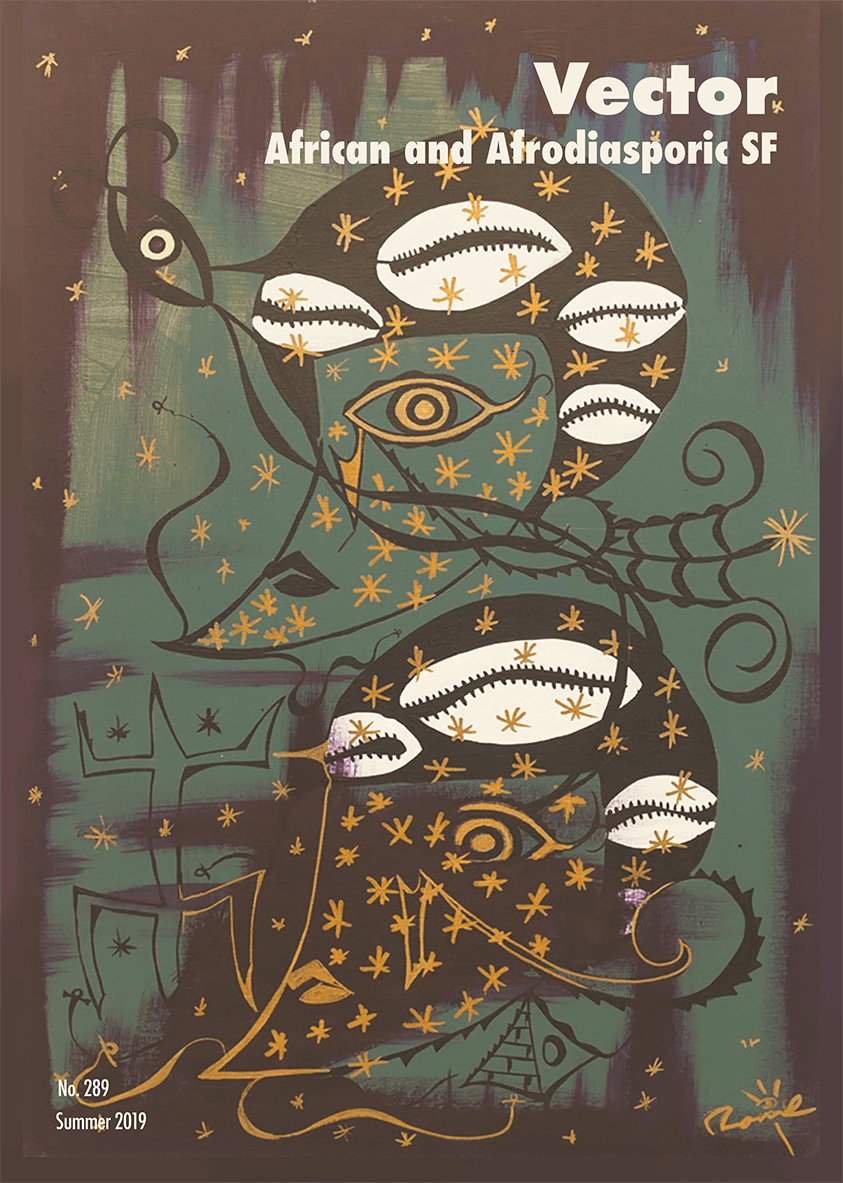
Vector289_Cover

“Over the last two decades, Achimota City’s fast new geography had devoured Accra almost completely while at the same time most of the rest of the country had inexplicably vanished, land and all. Thus, by the year 2020 Achimota was a truncated city bursting to survive and to find the rest of its country soon. The three elders of government, each with a beard the shape of X, Y or Z, had shepherded the city over this deep crisis, directing history as if it were mad traffic. They had rules which helped to form the new ways that the century demanded. Fruit was law: every street had to have dwarf banana trees in belts and lines, buckled with close groups of any other fruit trees, so many guavas and oranges. There was fruit in the toilets, fruit in the halls, and fruit in the aeroplanes, so that you could eat the city.”

Kojo Laing, Major Gentl and the Achimota Wars (1992), p.3.

Realism and Resistance

golden cockroach, a Grandmother Bomb, elders with beards shaped like letters of the alphabet, and a carrot millionaire are just a few of the eccentric characters which fill the pages of Kojo Laing’s surreal classic of African SF, Major Gentl and the Achimota Wars (1992). Laing’s novel is set in the distant future of 2020, at a time when the Ghanaian city of Achimota is locked in the Second War of Existence, battling Europe and South Africa, which have become a cyberworld where physical existence is deemed unnecessary. These virtual superpowers have decided that the ‘Third World’ is no longer relevant to their modernity, having been used as a toxic dumping ground, a place for germ warfare and genetic engineering and nuclear experiments. The city Achimota fights to recover the rest of its disappearing country, and to exist independently of Europe’s rhetoric and portrayal of it as primitive, reasserting its own worth and agency in the face of neocolonial domination.

The book has been praised as vivid and imaginative, but also characterised as unusual, complicated, and unclassifiable (Ryman, 2017; Klein, 2007; Ngaboh-Smart, 1997; Wright, 1996). T.R. Klein (2007) describes Laing’s work concisely: “Once the initially introduced ‘innocent’ reader decides against prematurely tossing away Laing’s difficult books and is willing to accept an encounter with cartoon-like images, allegories, and projections rather than full-fledged, realistic characters, s/he will be rewarded with the experience of a unique conjunction between technological and aesthetic modernity in African literature” (55).

It’s unfortunate that Laing’s work has so often been overlooked and underappreciated, as it has plenty to contribute to debates surrounding genre and ‘authenticity’ within African literature. He at once defies generic pigeonholing and challenges established norms of the Anglo-African literary canon. His unique prose “confidently defies simple reduction to a single larger theory, agenda or narrative” (Klein, 2007: 38), with its usage of words and phrases from across languages including English, Ga, Haussa, and Italian. He also addresses issues of science and technology before many Ghanaian authors had even begun to move away from nationalist rhetoric of post-independence Ghana (Klein, 2007).

In terms of genre, Laing’s work has been variously described as postmodern, utopian, or magical realism. Ngaboh-Smart (1997) identifies Major Gentl and the Achimota Wars as using “conventional science fictional motifs” to explore the effects of science and technology on humanity, and mentions the inclusion of “galactic travels” and “adventure.” This hesitancy and ambiguity is not uncommon in discussions of speculative fictions from Africa. Mark Bould (2015) suggests that one can come across science fiction from Africa mentioned by critical journals that refuse to use the term, or “would at least prefer not to, deploying instead a de-science-fictionalized discourse of utopia and dystopia, and labelling anything irreal as some kind of postcolonial magic realism or avant-gardist experimentalism”(13).

So SF from Africa faces contradictory challenges. It must fight on the one hand to be read as SF — and not just something SF-adjacent — to be given full use of the genre’s rich megatext of tropes and conventions. On the other hand, it must fight to be permitted to transform the traditional conventions of the genre, to make SF do new and different things. It must also often contest with the preconceived and reductive notions of Africa nurtured within the Western imagination. Jennifer Wenzel (2006) explains that Western readers who encounter ‘strange’ literatures from elsewhere often impose a binary between ”the West and the rest,” and between “a singular European modernity and multifarious worldviews, variously described as pre-modern, prescientific, pre-enlightenment, non-Western, traditional, or indigenous” (456). New readings of classic works such as Laing’s, alongside emerging work from Africa, are paving the way to a more nuanced map of Africa’s diverse speculative literature. This issue of Vector explores varying definitions, and showcases just a few examples from Africa and its diaspora across various mediums: from Nick Wood’s exploration of the South Africa’s comics scene and Joan Grandjean’s research into the Arab-futurist art of Mounir Ayache, to Jonathan Hay’s study of Afrofuturism in hip hop and its political aesthetics built on science fiction tropes of aliens and spaceships. Like artists everywhere, creators of African SF aren’t simply imagining worlds to escape to, but also exploring contemporary and historical reality through the lens of fiction. Gemma Field’s ecocritical reading of Nnedi Okorafor’s Lagoon acknowledges the slow violence of the oil industry in Nigeria. Masimba Musodza’s article opens up important questions about genre, language, and elitism within the African SF genre, through his experiences in writing and publishing his works in ChiShona. Definitions of Africanfuturisms and Afrofuturisms collide and converse in articles from Kate Harlin and Päivi Väätänen. Interviews with award-winning authors Dilman Dila and Wole Talabi give insights into the current movements within African SF directly from the creators’ perspectives.

Continue reading “The Speculative Turn in African Literature”

Through the Decades: Sixty Years of the BSFA

Edited by Alex Bardy. First published on behalf of the British Science Fiction Association, 2019.

Cover by Ian Long.


Alex Bardy currently edits Tabletop SPIRIT Magazine — www.tabletopspirit.com

Digital Humanity: Collaborative Capital Resistance in Cory Doctorow’s Walkaway

By Kirsten Bussière

This academic article explores the theme of revolutionary post-scarcity techno-utopianism in Cory Doctorow’s 2017 novel Walkaway. Building on the longstanding tradition of social science fiction, Walkaway examines the extension of the digital community beyond the realms of cyberspace and into the physical world. It brings vividly to life a symbiotic post-digital relationship between humans and machines, in which the communal nature of producing digitally rendered objects in the non-digital world begins to trace the outlines of a radically different post-capitalist future.


Doctorow

Since the 2008 global financial crisis, social movements which once pursued scattered causes are increasingly united against a common enemy: capitalism. In his recent article “The New Combinations: Revolt of the Global Value-Subjects,” Nick Dyer-Witherford recounts how the “landscapes of globalized capital” are riven by scenes of political unrest. We have witnessed a decade crossed with an “ascending arc of struggles”: demonstrations across different cities “mark the convergence of a range of campaigns and activisms,” while coalitions of political groups “often exceed single issues and specific identities,” and find means to converge on shared anti-capitalist perspectives – pushing back against a society built on purposeful scarcity, a society that predicates the wealth of the few on the poverty of the many (Dyer-Witherford 156-158).

Capitalism, in spreading wealth at an unequal rate, “can set all its subjects in competition with each other.” This separation of the population ensures that the masses will not rise up against their oppressors. That’s why the mobilization of different political activism groups as one anti-capitalist multitude is particularly dangerous to the existing hierarchy. So what has changed? There are many factors, but one which stands out. Modern day demonstrations and protests take place not only in the streets, but also in the realm of cyberspace. Information technology allows resistance groups to communicate and co-ordinate as never before, and what starts as a hashtag can quickly sprout into a powerful movement for change. Plenty of cyberactivism isn’t even that overtly political, but nevertheless strikes a blow against capitalism by de-commodifying capitalist products through “piracy; open source and free software initiatives; peer-to-peer production; and gift economy practices” (Dyer-Witherford 175-180).

Building on the longstanding tradition of social science fiction, the 2017 novel Walkaway by Cory Doctorow explores the extension of the digital community beyond the realms of cyberspace and into the physical world. It imagines a symbiotic post-digital relationship between humans and machines. The communal nature of producing digitally rendered objects in the non-digital world provides a technotopian solution to the anti-utopian capitalist regime – unyielding in its commitment that there is no better world possible.

Continue reading “Digital Humanity: Collaborative Capital Resistance in Cory Doctorow’s Walkaway

Surveillance Capitalism and the Data/Flesh Worker in Malka Older’s Infomocracy

By Esko Suoranta

This academic article explores themes of algorithmic governmentality, data surveillance, labour and embodiment in Malka Older’s Infomocracy, drawing in particular on Shoshana Zuboff’s theories of surveillance capitalism.


The cyberpunk dystopia is already here, it’s just unevenly distributed. Western democracies appear to be in crisis. Populist nationalisms are on the rise, while an ever-so-free market tightens its grip on our everyday existence, building vast private siloes of personal data. Climate change is spurred on by the rise of new imaginary currencies, mined from pure mathematics and pumping tens of millions of tons of carbon into the sky. Technologies from space travel to nanotechnology take unprecedented leaps. Meanwhile, in fiction, nostalgia appears to be a prime directive. The imagined futures of the 1980–90s receive reboots which appropriate the aesthetics of the past, but often fail to update its politics in the process: see Blade Runner 2049 (2017) and Ghost in the Shell (2017). Against such future-washed conservatism, a counter-project is also emerging. Critics and authors like Monika Bielskyte and Nnedi Okorafor sound the clarion for new ways to imagine the future, and to pave the path for a more equal and sustainable world.[1]

Infomocracy

In this context, Malka Older’s debut novel Infomocracy (2016) explores progressive political and economic alternatives in a near-future setting. Part political techno-thriller, part thought-experiment on global micro-democracy, the novel follows four protagonists in the 22nd century as the third global elections loom. In the micro-democratic system, each geographic “centenal,” a unit of 100,000 people, chooses their representatives from a myriad of parties ranging from PhillipMorris and Liberty, to Earth1st and YouGov. Nation states have practically disappeared and the global election process is governed by Information, a descendant of the internet giants of yore, seemingly fused with something like the United Nations. The organization strives for neutral and truthful management of information and a fair administration of the micro-democratic process.

Predictably, political rivals try to play the system for their own benefit, and much of the plot revolves around such schemes. Through their twists and turns, Older highlights the precariousness of information labor in highly networked societies as workers become interfaces of bodies and computer networks, producing a distributed subjectivity. These themes become clear through an analysis of Older’s treatment of her protagonists and her depiction of Information’s custodianship of networked data. Infomocracy conducts an optimistic thought-experiment on the future of what Shoshana Zuboff calls “surveillance capitalism.” I aim to show how, for Older, there are two keys to diverting surveillance capitalism in a more optimistic direction. First, the democratization of skills related to information work. Second, the not-for-profit management of data.

Continue reading “Surveillance Capitalism and the Data/Flesh Worker in Malka Older’s Infomocracy

Science Friction

By Robert Kiely and Sean O’Brien

This academic article explores what it describes as ‘science friction,’ relatively recent near future SF depicting the intensification of contemporary economic tendencies, including increased automation and the spread of digital platforms. The bitterly critical tone and concerns of these works is in marked tension with the techno-utopianism prevalent within much twentieth-century science fiction, within contemporary literary science fiction studies, and within the uses of science fiction within contemporary political theory, including left accelerationism broadly construed. Such techno-optimist thinking is not naively enamoured of detailed, inflexible plans for what the future should look like, but it arguably leans too heavily on a vision of technology as a relatively neutral, repurposable and ever-proliferating resource, paying insufficient attention to its historical contingencies. The article ends by contending that there are material reasons why techno-optimist SF was readily available in the twentieth century, just as there are material reasons why it is less readily available now. Perhaps then ‘science friction’ invites us to contemplate the exhaustion of such thinking, an exhaustion that correlates with the closure (or at least profound transformation) of the radical political opportunities in which it was once rooted.


  • Review: This article underwent editorial review by two editors.
  • License: Copyright Robert Kiely and Sean O’Brien, all rights reserved.
  • Citation: Kiely, R and O’Brien, S. 2018. Science Friction. Vector #288. https://vector-bsfa.com/2018/11/16/science-friction/
  • Keywords:  algorithmic governmentality, economics, labour, near future SF, platform capitalism, post-scarcity, science friction, techno-utopianism

This article examines a series of near-future SF stories that offer snapshots of an immediate future dominated by the intensification of contemporary economic tendencies, including increased automation and the rise of digital platforms. Much twentieth century SF tends to traffic in a certain techno-optimism in its outlook, not so much to suggest that technological advances would produce positive outcomes but that they would continue to develop and expand in their complexity and productivity. Today this utopian legacy is carried forward both by literary science fiction studies and by the uses of science fiction within contemporary political theory. In a different vein, and in tension with this outlook, is what we call ‘science friction’: a literary practice of slowing down visions of technological and social progress.

econSF

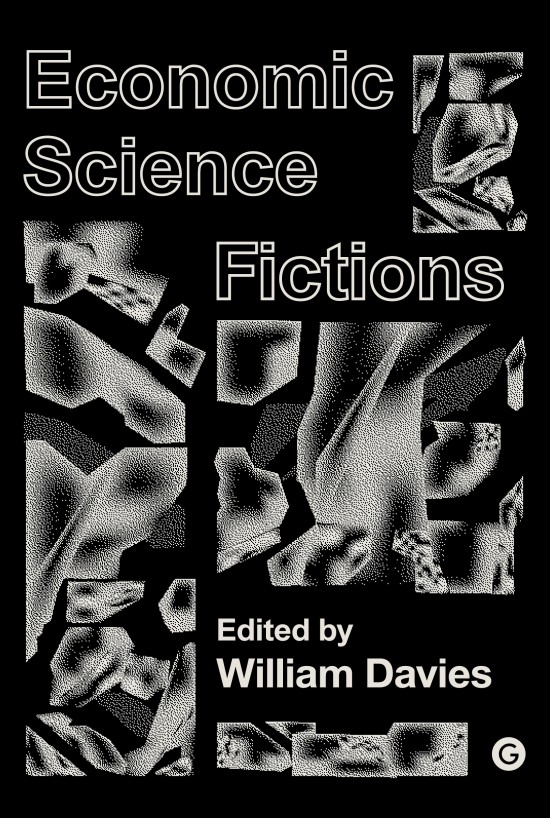
Two recent collections, Futures and Fictions (2017) and Economic Science Fictions (2018), look to SF to counter the dominant cultural narrative of what Mark Fisher calls ‘capitalist realism’—the Thatcherite idea that ‘there is no alternative’ to capitalism—with alternative visions of the future based largely on emerging technological innovations [1]. To puzzle over this position, as we’ll do below, is not to be fatalistic or to concede political ground on the terrain of the imaginary. Rather, it is to question the capacity of capitalist technology to usher in a postcapitalist future, especially under contemporary conditions of stagnation and precarity. As these works of science friction suggest, further development of capitalist technologies are likely to offer more of the same, but worse.

Critics such as Simon O’Sullivan, William Davies and Peter Frase have argued that a visionary SF can offer much-needed screenshots of a postcapitalist future, challenging the neoliberal status quo and bolstering a left that suffers from a perceived poverty of imagination. [2] In the discussion that opens Futures and Fictions, for example, O’Sullivan argues that ‘future fictions have a more general traction on the real, not least insofar as they can offer concrete models for other ways of life in the present.’ [3] Several of the essays in the collection suggest that the intensification of late capitalist technological developments will provide the means to realize a postcapitalist utopia if the economy were managed by a socialist state. Here, full automation and universal basic income (UBI) constitute transitional demands on the way to what Aaron Bastani brands ‘fully automated luxury communism’ [4].

Continue reading “Science Friction”

Living on Borrowed Time

By Erin Horáková

TimeCity

This academic article explores Diana Wynne Jones’s A Tale of Time City, focusing on worldbuilding and in particular the economic arrangements, overt and implied, of Time City’s peculiar temporalities. How might time travel ask us to reimagine the horizons of economic possibility? What lacunae and anomalies do we encounter in the economic life of a city unbound by linear time? Jones has offered up a mechanism with which to approach issues, and to pose large questions: how do we negotiate power to ethically interact with others economically?


  • Review: This article underwent editorial review by two editors.
  • License: Copyright Erin Horáková, all rights reserved.
  • Citation: Horáková, E. 2018. Living on Borrowed Time. Vector #288. https://vector-bsfa.com/2019/02/01/living-on-borrowed-time/
  • Keywords: Diana Wynne Jones, speculative economics, temporality, worldbuilding

The narrative suggests that the smooth running of history is a quantifiable, scientific question, but in addition to science’s being quite vulnerable to subjective, self-advantaging perspectives, Time City also has economic reason to keep the development of technology going ‘how it’s supposed to go.’ They have reason, too, to keep intact the stable eras with which they trade, and on whose tourism they rely. If helping the wrong bit of the human race might jeopardise that, Time City-zens are clearly willing to watch a few eggs break in order to wait for the omelette they want. We know almost nothing, really, about the laws or moral codes that govern Time City’s interactions with history.

Jones is less interested in the SFnal potentialities of creating a place out of and adjacent to all of time than she is in the social ramifications of such a place’s existence. She understands colonialism and can deal with it startlingly deftly, as in Dark Lord of Derkholm [6], illuminating the social fallout of unequal power structures in a way that can vex post-colonial scholars. Here Jones sees her world (or worlds—both the one she occupies and the one she’s written) clearly enough to make this aspect of its infrastructure its key problem. And yet she simultaneously doesn’t seem to understand the dimensions of that problem quite well enough to grasp its whole shape, much less know how to rigorously answer the question she’s posed.

More than anything else, Diana Wynne Jones’ children’s science-fantasy novel A Tale of Time City (1987) is about the eponymous micro-civilisation: a city-state outside of time. Time City monitors the events of the whole anthropocene, trades with sufficiently advanced civilisations, and partakes of the best of every era. This article conducts a ‘world factbook’ style survey of this economy, to the extent that’s possible based on the information the book gives us (and with markedly less dodgy CIA involvement). We’ll look at the state’s sources of income, labour within it, economic immigration to the city, and finally the ultimate effects of Time City’s colonial trade relations with what its citizens call ‘history.’ Via this case study, I hope to provide a way into thinking about time travellers and other agents outside of time as economic actors.

Continue reading “Living on Borrowed Time”

Vector 287: Best of 2017

Coming soon to BSFA members!


Cover Vector287_Final Small
Cover image: Larissa Sansour and Søren Lind, from ‘In the Future, They Ate from the Finest Porcelain’


Inside Vector 287:

An interview with Larissa Sansour by Polina Levontin and Jo Lindsay Walton, plus a review of Larissa Sansour’s work.

TV in 2017 by Molly Cobb and So Mayer.

Film in 2017 by Nick Lowe, Andrew Wallace, Dilman Dila, Cheryl Morgan, Ali Baker, Paul March-Russell, Amy C. Chambers, Lyle Skains, Gary Couzens, and Dev Agarwal. 

Ricardo Suazo reflects on SF inspired trends in fashion, and Martin McGrath takes a close look at three panels from Avengers #8.

Games and AR are covered by Erin Horáková, Susan Gray, and Jon Garrad.

With also have an extensive section on audio and podcasts in 2017 with Peter Morrison, Erin Roberts, Laura Pearlman, Victoria Hooper and Tony Jones.

And of course three Recurrent columns with Paul Kincaid, Andy Sawyer and Stephen Baxter, plus the Torque Control editorial by Jo Lindsay Walton.

This one’s a bumper issue — 80 pages! If you’re not a BSFA member yet, why not sign up now?

Friday essay: science fiction’s women problem

Image 20160915 4972 gqonsw.png?ixlib=rb 1.1
We need women to participate equally in science fiction’s conversations about humanity’s future.
MsSaraKelly, CC BY-SA

Bronwyn Lovell, Flinders University

Since 1953, the Hugo Awards have been one of science fiction’s most prestigious honours – past winners include Isaac Asimov, Arthur C Clark and Ursula Le Guin. The 2016 results were recently announced, and women and diversity were the clear winners.

However, if you saw the list of titles in contention for the awards, you’d have noticed some oddities, such as Chuck Tingle’s Space Raptor Butt Invasion and My Little Pony’s The Cutie Map. That’s because the awards – nominated and voted on by science fiction writers and readers – have been targeted by two major voting blocs: the Sad Puppies, who started their campaign in 2013, and the Rabid Puppies, who appeared the year after and have been growing stronger ever since.

The Sad Puppies wanted more traditional, mainstream popular science fiction on the ballot. The more extreme Rabid Puppies, who have ties with the Gamergate movement, were about creating chaos. So their bloc included ridiculous-sounding works: both to mock the awards and stack the ballot to prevent more diverse books being nominated.

Both groups’ gripe is with contemporary trends in science fiction toward more literary works with progressive themes. Vox Day, leader of the Rabid Puppies, complains that “publishers have been trying to pass off romance in space and left-wing diversity lectures as science fiction”. Last year’s leader of the Sad Puppies, Brad R. Torgersen, likewise complains about “soft science majors (lit and humanities degrees) using SF/F as a tool to critically examine and vivisect 21st century Western society”. The Hugos, he says, are being used as an “affirmative action award”.

A significant number of those “soft science majors” writing “left-wing diversity lectures” are, of course, women. Female authors have dominated science fiction awards of late.

This year, women (and people of colour) did very well at the awards. Ironically, the Puppies’ activities have now galvanised more progressive members of the World Science Fiction Society to use their voting rights. The best novel was The Fifth Season, a tale of a planet experiencing apocalyptic climate change, written by NK Jemisin – a black, female writer. Best novella was Binti by Nnedi Okorafor. The best short story, Cat Pictures Please, was written by Naomi Kritzer and both best editor gongs went to women.

But the ongoing saga of the Puppies and their attempts to derail the Hugos exemplifies broader conflicts within the realm of science fiction – an enormously popular, lucrative and controversial genre that has major issues with women.

Hugo award winner Nnedi Okorafor at a reading of her work.
byronv2, CC BY-NC

A male dominated genre

Continue reading “Friday essay: science fiction’s women problem”

Why science fiction set in the near future is so terrifying

Image 20170224 22983 kskule.jpg?ixlib=rb 1.1Westworld: how far away is this future?
©2016 Home Box Office, Inc. All rights reserved

Amy C. Chambers, Newcastle University

This article accompanies episode 10 of The Anthill podcast on the future.


From Humans to Westworld, from Her to Ex Machina, and from Agents of S.H.I.E.L.D to Black Mirror – near future science fiction in recent years has given audiences some seriously unsettling and prophetic visions of the future. According to these alternative or imagined futures, we are facing a post-human reality where humans are either rebelled against or replaced by their own creations. These stories propose a future where our lives will be transformed by science and technology, redefining what it is to be human.

The near future science fiction sub-genre imagines a future only a short time away from the period in which it is produced. Continue reading “Why science fiction set in the near future is so terrifying”

My Friend, The Bot

By Jay Owens.

I first met @botaleptic on 10th March, 2015. We were introduced by our mutual Twitter friend, Hugo.

We soon got talking:

We soon got talking

@botaleptic is a Twitter bot created by Hugo Reinert, who tweets as @metaleptic. His DNA is simple: “he” is a ruby script, running on a free app server, based on mispy’s twitter_ebooks code. Like all Twitter bots — automated ‘robot’ accounts — @botaleptic is simply an algorithm.

In this essay, I want to talk about how @botaleptic is much more than an algorithm.

Continue reading “My Friend, The Bot”