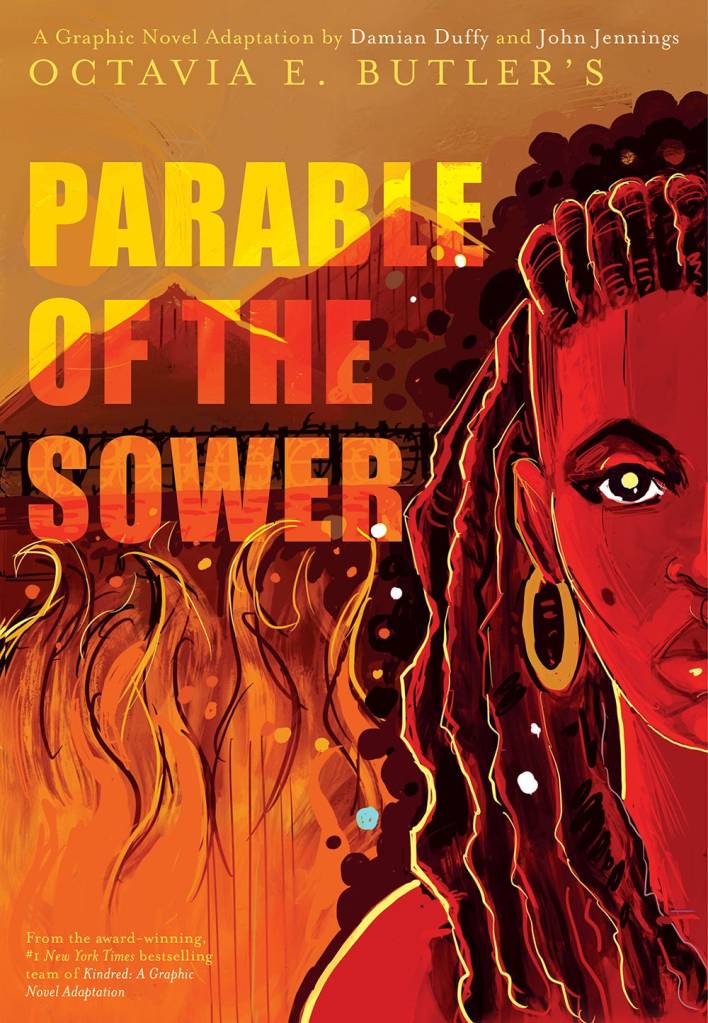
This academic article explores Octavia Butler’s 1993 novel Parable of the Sower and its 2020 graphic novel adaptation by Damian Duffy and John Jennings. It analyzes the medium-specificity of the adaptation by applying a combined theoretical approach that incorporates cognitive narratology and narrative empathy. A discursive dialogue between the two media facilitates a critical evaluation of the potential for Parable to evoke character empathy leading to prosocial action. The prescient themes in Parable, and the timing of the adaptation’s publication facilitates informed ongoing dialogue around change.
Review: This article underwent editorial review from two editors.
“This book lives. It breathes, moves, feels, clamors for your attention, insists on bearing witness, insists on being heard,” declares Nalo Hopkinson in her introduction to Duffy and Jennings’s (2020) graphic novel adaptation of Octavia Butler’s Parable of the Sower. After decades hovering conspicuously on the periphery of literary acceptance, science fiction and graphic novels refute their much-maligned reputations, and produce an alternative canon by joining forces. Narratives of space exploration, time travel, aliens, and meta-human superheroes disturb the grand narratives because they employ such tropes to explore the notion of the ‘other.’ Challenging the presumptions of texts that adhere to the model of white Western hierarchy, many contemporary speculative fiction narratives stage encounters between vastly different perspectives and cultures, and give agency to the ‘other.’
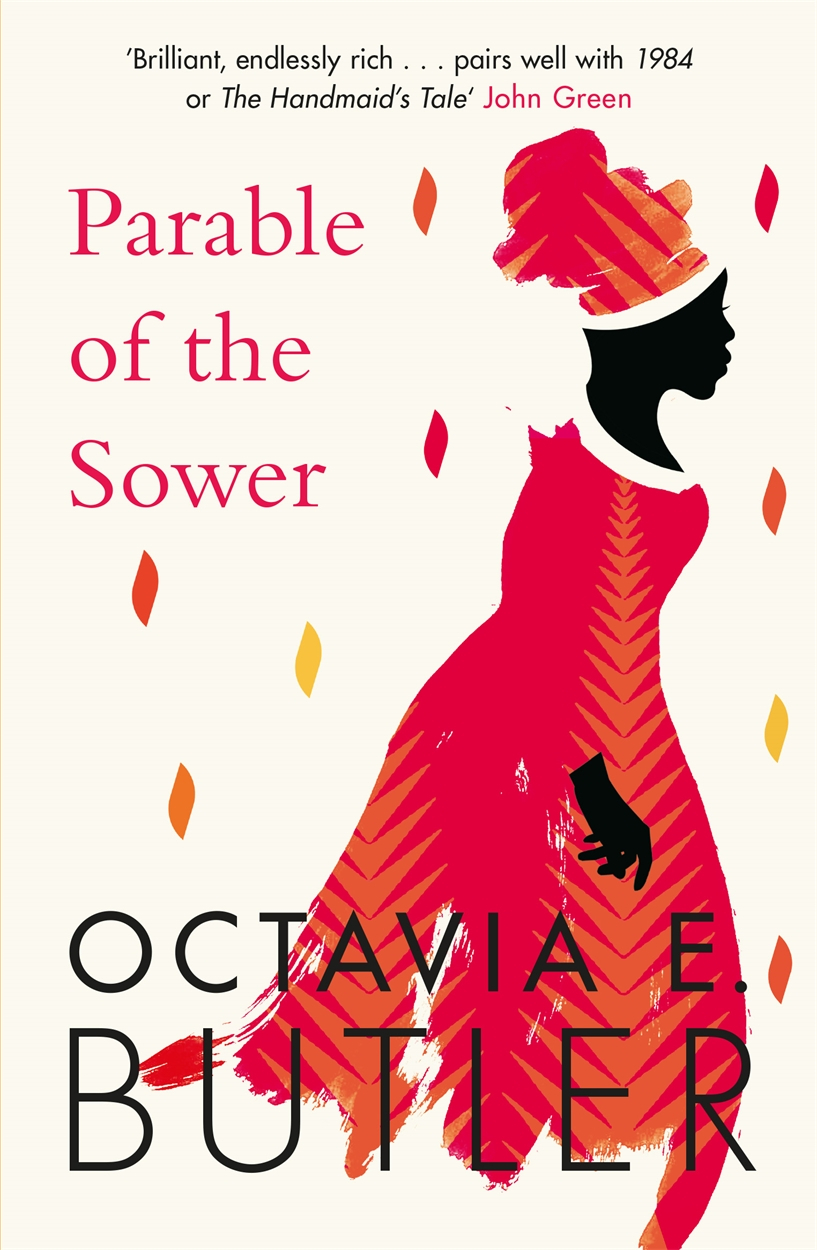
Octavia Butler’s Parable of the Sower (1993)
Graphic novel adaptation by Damian Duffy and John Jennings, with an introduction by Nalo Hopkinson (2020)
An early and powerful influence on Afrofuturism, award-winning author Octavia E. Butler (Womack 2013, 109) proposes a more diverse future through her palimpsestic style of rewriting narratives of race, gender, and disability, thereby challenging the status quo and repositioning previously sidelined characters center-stage. By defamiliarizing human experience, by blurring the lines of ideological expectation, and by broadcasting survival strategies that necessitate major, almost impossible change, Butler complicates the concept of ‘othering’ whilst evoking feelings of empathy for her characters. Suzanne Keen’s (2015) theoretical model of authorial strategic empathy, particularly “broadcast strategic empathy,” is the touchstone for demonstrating how Butler evokes empathic responses in her readers. Since reading is a cognitive action, I combine elements of David Herman’s inquiry into cognitive narratology and Suzanne Keen’s research into narrative empathy to shine light on Butler’s work and its enduring relevance. The remediation of this speculative fiction text into the graphic novel medium, with its metamorphic affordances, facilitates more explicit readings of the tropes of change in Butler’s Parable of the Sower, and opens up empathic dialogue about the medium-specificity of re-reading such a powerful narrative.
When I think about 2020, this is the image I think about most.
It’s from Star Trek: Discovery season 3, episode 8, and it foregrounds a young scientist, Adira, recently recovered from a serious medical procedure and thrown into a new, high-intensity work situation, asleep on their arms at their console. They have been trying for days to resolve a galaxy-brain complexity algorithm that could, simultaneously, explain why the Federation is in chaos, be key to rescuing desperately ill people, and undermine the hold of an exploitative, violent, nativist and populist criminal syndicate.
The series was filmed July 2019-February 2020, with post-production taking place remotely. It’s not hard to see the post-production editors, graders and data wranglers – perhaps home-schooling as they also work from home with a pandemic on the doorstep – feeling reflected in this scene as they finessed it.
But the scene has a background as well as a foreground, in which Adira’s new colleagues / bosses / adoptive parents – Discovery’s doctor Hugh Culber and his partner, scientist Paul Stamets – talk softly and supportively. Not only are they honouring the work of a very young and new crew member, but – for the first time – using Adira’s chosen pronouns in conversation.
In some ways, it feels perilously close to Silicon Valley’s exploitative vocational vision in which young programmers live at their desks for companies that spout liberal-libertarian slogans while maintaining – in terms of both their employment policies and their products – structural and systemic racism, classism, sexism, ableism, homophobia and transphobia. Yet Star Trek: Discovery’s timely frayed and worn take on the original series’ utopianism suggests that this is, instead, the revival of the dream of work that Starfleet has long held out: work with dignity, safety, meaning and import.
Dreaming, Adira works, their unconscious shaping the solution that cracks the code. What ensues also (re)shapes the meaning and function of Starfleet in this distressed and fragmented new universe. This scene places sleep – rest, care, dreaming – front and centre of what might be meant by a utopian vision of labour.
Adira’s snatched nap at their desk feels particularly pertinent because I feel that all I’ve done for the last ten months is work (from home, at a screen) and sleep. Thus, of this year’s reading, it’s been two books about working and sleeping that have haunted me the most. I was electrified by A Memory Called Empire by Arkady Martine, and especially its neuroscience fictions; her invention of the imago, a device that imports the personae of those who previously held a particular job, could be read as similar to Star Trek’s joined Trill: Adira is notably, a human who is hosting a Trill symbiont, previously hosted by their boyfriend Grey, who glitchily haunts them in a manner reminiscent of Mahit Dzmare’s situation in Memory. Dzmare’s imago is also glitching, and her predecessor Yskander is a spectral and often unexpected presence, an embodied unconscious who guides her into intuitive connections that analogise dreamwork.
But it’s two novellas that exemplified for me this idea of oneiric labour as a route out of null exploitative employment: the first, The Employees: A workplace novel of the 22nd century by Danish writer Olga Ravn, translated by Martin Aitken and published by translation specialists Lolli Editions, takes its inspiration from a Barbara Kruger art installation, and is absolutely what its title describes insofar as the workplace is a spaceship that’s also an art gallery, and the novel’s form is that of disordered entries from a report by the parent company’s investigators concerned that the human and humanoid employees are becoming indistinguishable. More on this elusive text in a moment.
The second novella, Finna by Nino Cipri is perhaps the more conventional inclusion, as it’s published by Tor, and its acknowledgements situate it resonantly and clearly within the new queer feminist SFF. Cipri writes that ‘Karin Tidbeck was my Swedish consultant and she came up with the name for FINNA… [and] Rivers Solomon provided a stellar and insightful sensitivity read’, presumably at least in part for the character of Jules, who is Black and non-binary (Solomon’s pronouns are fae/faer and they/them). In homage and solidarity, I should say that I was tipped off to Finna via Twitter by The Bookish Type, an independent queer bookshop in Leeds who opened, utopianly, in September 2020, and survived multiple lockdowns by building incredible community on social media, and are continuing (like a Starfleet for books) to keep things flowing to those in need.
Cipri also notes that ‘Lara Elena Donnelly gave me the premise for this story’, a modelling of creative labour as mutual aid in which mutuality is both pragmatic and in the possibility of a shared unconscious. Rather than Adrienne Rich’s feminist ‘dream of a common language’, Finna attentively marks the sharply distinctive experiences of Black and Muslim characters, of cis and trans characters, of working-class employees and middle-management, in its setting of a big-box Scandi furniture store called LitenVärld. A maze in itself, LitenVärld’s fractured no-place geography makes it a hotspot for maskhål, aka wormholes, which open to LitenVärlds in other dimensions.
Ava, the protagonist, is already having a bad day – covering someone else’s shift, and thus sharing a roster with her recent ex, Jules – when an elderly woman called Ursula Nouri disappears from a room model called the Nihilist Bachelor Cube. The comedic riff on the excruciating language of late capitalism continues when Ava and Jules have to view a workplace instructional videos about wormholes that nods knowingly to the ‘Doublemeat Palace’ episode of Buffy the Vampire Slayer (season 6, episode 12). When Buffy’s campaign for what could be called ‘wages against slayage’ fails, she takes a minimum-wage fast food job that supposedly fits flexibly around her unconventional schedule as well as supplying take-out leftovers for her and her sister, but actually leads to grim disappearances that riff on Soylent Green (Richard Fleischer, 1973).
Finna has a similar flex on messy edges where the real world and the otherworld meet and rip, and how it’s work that crosses over between them. It smartly and tellingly balances the science-fictional otherworlds where, for example, parallel LutenVärld workers are actually vampire-zombies, with the horror of LitenVärld itself, as exemplar of late capitalist dystopia in which work is exploitative, repetitive and meaningless, yet also – because it’s a lived space where others who are also disenfranchised or dislocated find/lose themselves – a site of connection and even love. The dream/nightmare otherworlds analogise, satirise and redistribute the signifiers of work without evacuating them of meaning: Ava has to return to LutenVärld at the end, and it remains as awful as it was, even after confronting vampire-zombie hordes.
But what the otherworlds also offer, or rather highlight, is the possibility of comradeship. Forced to travel through the maskhål with Jules, Ava finds a form of workers’ solidarity in extremis, as their collective decisions and actions are freed from corporate oversight and commerce, and become (as in Starfleet) life-or-death. Ava learns to trust herself through Jules’ trust in her, and realises how the dignity of labour, with its skills and solidarity, is ground down by capitalist employment, but not entirely ground out. The experience of otherworlds raise the possibility that dreaming and imagining are forms of work, on the self and on the world. And perhaps it is an inalienable form of labour whose effects and products cannot be appropriated and capitalised. When Ava gets back, she’s exhausted. So she sleeps – in Jules’ empty apartment, where she feels safe. There’s something tender and unrecognised in this moment, unfamiliar from conventional heroic narratives. Sleeping and dreaming (or entering a maskhål) becomes a kind of redistributive action concerning who deserves security and ease.
The book ends with possibility, one that is located in refusing absolutely the disciplinary frameworks of retail work, including their signposted no-places:
To go where she wanted [Ava realised], she had to get lost, and it seemed almost instinctual to do that now… Ava chased that particular sense of disorientation, recognizable now; somewhere between the feeling of falling in love, and falling out of it… of not knowing and still going forward.
That disorientation is also present, differently, in Star Trek: Discovery and The Employees, in both the conventional sense, and Sara Ahmed’s usage to mark the force exerted on narrative and embodied spaces by queerness. The Employees’ characters are rarely gendered: some mention experiences such as child-bearing or -rearing, but in the same breath may question whether these are implanted memories.
Both the human / humanoid distinction and binary gender collapse productively and, in fact, revolutionarily, as those employees who are – or think they are, or accept they are – humanoid take over the ship. They are acting in concert in response to a disorientation produced by a number of strange objects taken on board from the planet New Discovery. The objects produce multisensory, and even synaesthetic, apprehensions in some employees and not others, sense-memory triggers that cross the human-humanoid boundary to dispense with the Voight-Kampff test.
The Blade Runner reference is not plucked from nowhere. Here’s Statement 097 in full, echoing the famous ‘tears in rain’ monologue as well as the film’s rain-soaked climate dystopia:
You want to know what I think about this arrangement? I think you look down on me. The way I see it, you’re a family that’s built a house. And from the warm rooms of that house you now look out at the pouring rain… I’m standing in the rain that you think can never fall on you. I become one with that rain. I’m the storm you shelter from. This entire house is something you built just to avoid me. So don’t come to me and say I play no part in human lives.
Feelings are feelings (as Roy Batty is arguing), and (as queer feminist Yvonne Rainer says) feelings are – like the impossible objects – facts, however much colonial capitalism supresses and disputes that.
It is in working with – as guards and cleaners, rather than being viewers, curators or scholars – these disorienting objects that the effects occur. Making visible the often-invisibilised labour attendant on producing a cultural sector with which we can engage critically and for pleasure feels especially pointed and poignant after a year when many wealthy national art institutions such as Tate and Southbank Centre made their lowest-paid staff redundant, especially cleaners, security, retail and hospitality workers who were often already on precarious contracts. The Employees considers the work that underlies others’ ability to dream, and the ways in which working with numinous objects may inspire a vision of a self-ownership and self-value in that labour, and beyond it.
The Employees ends with the humanoid survivors of the uprising going planet-side, to experience an organic existence and ecosystem about which they only have implanted memories. It’s a quietly, deeply subversive idea, a bleaker conclusion than Finna’s, almost Beckettian. The penultimate, unnumbered speaker says: ‘If I pull up some grass from the earth and keep it in my hand from now on, will there be a chance then? No, we’re given new bodies. My dead body will have to lie here with the grass in its fist.’
It’s a reminder of the all-too-often inorganic imaginaries of space fiction, a sterile scientism that Star Trek: Discovery has disrupted with its mycelial network and, this season, with a greenhouse ship reminiscent of and also redemptive of Silent Running (Douglas Trumbull, 1972). The paramount survival of a galactic seed vault lush with vegetation (including medicinal plants) takes place in an episode titled ‘Die Trying’ (3.5): multispecies co-existence, indigenous and Black leadership, and ecological urgency are keynotes of the third season. It will be fascinating to see whether this eco-consciousness will be maintained in subsequent seasons.
Rilakkuma and Kaoru
I can’t imagine the informes that hang impossibly in the Six-Thousand Ship in The Employees. When I try to, what I see is my other favourite televisual image of 2020 (although streamed on Netflix since 2019). Rilakkuma and Kaoru is a handmade stop-motion animation based on a popular Japanese bear toy. Its logic is indeed oneiric, with Rilakkuma and his friends’ adventures offset against the predictable humiliations of office life for Kaoru. In one episode, ‘Sleepless Night’, the smaller bear Korilakkuma attempts to contact aliens night after night (by leaving food out for them), and eventually appears to succeed. Transported to their ship, Korilakkuma finally gets some sleep, nestled in the arms of a giant space panda.
Why a panda? How in space? Is the experience (in the terms of the show’s reality) real? Korilakkuma does bring back an object from the spaceship into Kaoru’s apartment, defying the other characters’ insistence that the ship was a dream. But, as The Employees puts it so poignantly, the grass remains in the hand. Under the illogics of global capitalism, what makes sense is the longing – experienced across all five of these texts – to sleep in the welcoming arms of a surviving ecology, soundly and safely, ready for tomorrow’s soft overthrow.
So Mayer is the author of, most recently, A Nazi Word for a Nazi Thing (Peninsula, 2020) and jacked a kaddish (Litmus Publishing, 2018), and contributions to In the Past, the Future Was Better (Cipher Press, 2020) and On Relationships (3ofCups, 2020). They work as a (digital) bookseller for Burley Fisher Books, a programmer and editor with queer feminist film curation collective Club des Femmes, and as a researcher and co-founder with Raising Films, a campaign for parents and carers in the UK screen sector.
By Stephanie Moran. This article was first published in Vector 292.
Since at least the beginnings of industrialism, technological innovation has incorporated attributes of animal perception and behaviour. More recently, this process has been recursively intensifying, in a process of ‘the biologisation of computer technology and the computerization of biology’ (Vehlken, 2019). Technologies inspired by nature deepen our understanding of natural systems, in turn fostering new technological developments: from the development of behavioural biology around 1900, through the use of media technology in biological research and the acceleration of bio-technoscience in the 1970s, to the use of simulation modelling and then computational-intensive modelling beginning in the 1980s, and most recently the rise of Machine Learning methodologies in Artificial Intelligence. Now studies of birdsong inform voice recognition software such as Siri and Alexa, while billionaire sci-fi fan Elon Musk is funding research into neural interfaces with the brains of mice and pigs.
This academic article explores Damien Hirst’s 2017 exhibition The Wreck of the Unbelievable, which mischievously purported to present treasures salvaged from the wreck of the legendary Apistos. How might we preserve, curate, and otherwise mediate such ambitious and distributed artworks, which extend in such convoluted ways through diverse social and cultural spaces, and which deliberately ambiguate their own boundaries and encounters? Where artworks both seek to capture and to intervene in their own historical moment, what obligations and affordances arise for future historians, curators, critics, and publics? Might the challenges set by The Wreck of the Unbelievable even model a new kind of digital art history including, for example, data generated incidentally and abundantly by digital processes? This article playfully mobilises new Digital Humanities methods for reading the vast and stormy seas of social media data discourse, reading between the artwork itself and the historical ‘moment’ in which it is so entangled.
Review: This article underwent editorial review from three editors.
License: Copyright Alex Butterworth. All rights reserved.
Keywords: art history, conceptual art, curation, Digital Humanities, distant reading, installation art, participatory art, social media
Man has no harbour, time has no shore;
It flows, and we pass away!
Alphonse de Lamartine: ‘The Lake’ as quoted by Franck Goddio, ‘Discovering a Shipwreck,’ in Damien Hirst, Treasures of the Wreck of the Unbelievable
Damien Hirst’s 2017 Treasures from the Wreck of the Unbelievable was work of ‘spreadable’ historical narrative, spun around an elaborately wrought hoax. Ten years in planning and execution, the exhibition straddled two large spaces on either side the mouth of Venice’s Grand Canal, the Palazzo Grassi and the Punta della Dogana. It alleged to present treasures salvaged from the Apistos, a ship lost almost two thousand years ago, comprising the art collection of a freed slave of incalculable wealth and cupidity. Treasures wrought of marble, gold, crystal, and jade were accompanied by films of the marine archaeology in action, featuring animistic figures — some with the disconcerting features of Disney characters — gently raised from the sea bed. The authenticity of the sculptures themselves was vertiginously involuted, with some sculptures appearing in variant versions, scaled up or down, cleaned of or encrusted with coral. Captions, located inaccessibly, also played games with curatorial authority, describing the construction of the luxurious display ‘cabinets’ as often as they did the contents of the vitrines.
But the physical exhibition was only a single, ephemeral manifestation of the world of Treasures. To commit wholeheartedly to comprehending that world is to hazard one’s sense of coherence in a game of narrative disentanglement, played out within a mise-en-abyme. The layering of the Lamartine epigraph, above, illustrates this experience: it serves as a textual gesture towards mortal infinitude, extracted from its context, relocated within an essay of playful dishonesty — printed in one of three catalogues advertised as accompanying the exhibition, of which only two appear ever to have been published — that aims to ground the exhibition in a plausible fictionality. In his essay in the same catalogue, Goddio ponders parenthetically of the wrecked ship, which bore the Greek name Apistos, translated as Unbelievable: ‘Was that its original name? Or did it acquire it subsequently because of its fabulous cargo? No one knows.’ On such uncertainty, the fascination of the show pivots.
In this academic article, Alexei Warshawski explores themes of architecture, fragmentation, and ontology (in the sense of existence or Being as such) in two speculative fiction novels, China Miéville’s The City and the City (2009) and Ken MacLeod’s Learning the World (2005). MacLeod’s and Miéville’s engagement with postmodernism, read alongside Heidegger, reveal that no matter how fragmented our architecture, and whether we do or don’t truly dwell, our ontology is greatly contingent on the architecture which surrounds us, and our ability to exist within and alongside architectural constructs is an undeniably and increasingly precarious one.
Review: This article underwent editorial review from two editors.
License: Copyright Alexei Warshawski, all rights reserved.
Keywords: architecture, China Miéville, dwelling, fragmentation, Ken MacLeod, ontology
The relationship between architecture and its inhabitants is a powerful one which can be liberating or repressive, inclusive or exclusive, reflective or reductive. These relations are neither cohesive with one another, nor mutually exclusive, so they problematise our relationship with architecture in spatial, temporal and ontological terms. Examples may be found in China Miéville’s The City and the City (2009) and Ken MacLeod’s Learning the World (2005). Miéville’s The City and the City follows Inspector Tyador Borlú as he investigates the murder of a foreign student whose body is found in Besźel, a city which is topographically twinned with another city called Ul Qoma. These two cities are on the same physical site and their residents are expected to ignore the city which they don’t live in, ‘unseeing’ any elements that they accidentally notice. Ken MacLeod’s Learning the World follows a future human race’s attempts to find a new planet to colonise as they travel on their planet-sized generation ship, and grapples with the problems they face in understanding a temporary architectural construct as a seemingly permanent and homely environment. Both novels engage with one of postmodernism’s key architectural concerns – the question of fragmentation, which this paper will argue is a necessity in sustaining the architecture of the worlds of both texts. While The City and the City explores fragmentary architecture through its twinned cities, Learning the World presents architecture as an inherently fragmentary construct, both in spatial and temporal terms. This paper will suggest that the ‘necessary fragmentation’ of the architecture in these texts proves the untenability of postmodern, neoliberal architecture as something permanent or fixed, in both spatial and temporal terms. Furthermore, this paper will argue that the idea of necessary fragmentation in this context give credence to Martin Heidegger’s understanding of ‘building’ and ‘dwelling’, a distinction he outlines in ‘Building, Dwelling, Thinking’(1951) which suggests that ‘dwelling’ as an ontological condition is not a guaranteed effect of building or settling within architectural constructs, and that the ability to ‘build’ in an ontologically authentic manner requires one to possess the capacity to ‘dwell’ in the first place. This paper will outline how these paired concepts of building and dwelling can affect the formation and occupation of architecture, as well as architecture’s relationship to nature. Drawing together the fragmentary elements of architecture and their relationship to Heidegger’s thinking in both texts, this paper will conclude with an analysis of the reflective properties of architecture – in both literal and metaphoric senses – to demonstrate the extent to which architecture can affect not just our social and domestic lives, but our ontology itself.
In this academic article, Josephine Wideman explores themes of temporality and capital accumulation in Samuel R. Delany’s Dhalgren (1975).As Fredric Jameson suggests, we must find new methods of spatial and social mapping in order to navigate the geographical and cultural landscapes of late capitalism.Delany’s Dhalgren is deeply concerned with the fate of US hegemony, and with the uncertainty that capitalism has produced: the duality of its unsustainability and seeming inevitability. Bellona is a cityscape which has been devastated by the cycle of accumulation and taken off the map. Delany’s creation ultimately should not be read as a prophecy of what will come of late US capitalism, but it gives insight into the complex historical and apocalyptic consciousness that has been cultivated.
Review: This article underwent editorial review from two editors.
License: Copyright Josephine Wideman, all rights reserved.
Keywords: accumulation, Giovanni Arighi, postmodernism, Samuel R. Delany, temporality, urban space
Samuel R. Delany’s 1975 novel Dhalgren is lengthy, hallucinatory, and at times unnavigable science fiction. Its form is as dense and as wavering as the urban landscape it depicts, where Delany’s protagonist, Kid, can wonder whether ‘there isn’t a chasm in front of me I’ve hallucinated into plain concrete.’1 Bellona – the fictional city where events take place – is a space ‘fixed in the layered landscape, red, brass, and blue, but […] distorted as distance itself,’ a place where ‘the real’ is ‘all masked by pale diffraction.’2 Although the scenery and scenarios of Bellona may be fictional, and perhaps even fantastic, they are also true representations of real experience. The unfixed landscape we live in becomes ‘fixed’ before us in Delany’s book. The distortions and diffractions by which it is fictionalised only increase its representational precision. The gaps in our experience, usually masked, are made visible. For although it takes an unusual form, we can recognise
this timeless city […] this spaceless preserve where any slippage can occur, these closing walls, laced with fire-escapes, gates, and crenellations are too unfixed to hold it in so that, from me as a moving node, it seems to spread, by flood and seepage, over the whole uneasy scape.3
In looking at Dhalgren, I have borrowed from the political theorist and sociologist Giovanni Arrighi in order to trace the presence and effects of capitalist accumulation in Delany’s fiction. Arrighi, in The Long Twentieth Century, describes the ‘interpretative scheme’ of capitalism as a ‘recurrent phenomena.’4 Drawing on work by the historian Fernand Braudel, Arrighi follows the Genoese, the Dutch, and the British cycles of accumulation to the current North American cycle. By examining past economic patterns and anomalies, he suggests that we may be able to gesture at the fate of our current cycle. Arrighi sets out to demonstrate that the rise and fall of these hegemonies, while never identical, tend to follow a set of stages that begin ‘to look familiar.’5 To make his argument, he proposes a new use for Marx’s ‘general formula of capital’:
Marx’s general formula of capital (MCM’) can therefore be interpreted as depicting not just the logic of individual capitalist investments, but also a recurrent pattern of historical capitalism as world system. The central aspect of this pattern is the alternation of epochs of material expansion (MC phases of capital accumulation) with phases of financial rebirth and expansion (CM’ phases).6
In Das Kapital, Marx initially proposes the formula CMC to theorise how capital functions. This theory begins with the assumption that people have needs and desires they can’t satisfy by themselves. Thus we create the commodities we know how to make (C), which are sold for money (M), which allows us to buy the commodities we want (C). As this cycle repeats, those who are skilled presumably accrue more value than others, being able to sell their commodities for a greater profit. This theory centres around the individual and his role in a capitalist system. But Marx then sets CMC aside in favour of another formula – the formula borrowed by Arrighi in The Long Twentieth Century – MCM’. In MCM’, circulation does not begin with the dissatisfied individual, but with capital itself. Money is invested (M) into the materials and labour necessary to produce a commodity (C), which is then sold for money (M). The difference between CMC and MCM’ is subtle but crucial. The first formula implies that capitalism recurs, and things are made and exchanged, in order to satisfy human desire and need. The second formula implies that money is in charge, that production and exchange are ultimately subservient to profit, and that money begets more money. For Marx, what drives capitalism is not only MCM, but MCM’ – the apostrophe signifying ‘prime’ – or the concept that money increases in value through circulation. The source of this additional, or ‘surplus’ value, is where capital really loses its lustre. This value is gained within labour – in the time spent on the creation and production of a commodity from raw material – and for Marx, its appropriation by capitalists is inherently exploitative.
In this academic article, the authors explore two contemporary movements associated with the literature and art of the Amazon region: Amazofuturism and Indigenous futurism. Amazofuturism is understood as a subgenre with ties to cyberpunk and/or solarpunk, in which the future of the Amazon region is portrayed in a broadly optimistic light. Indigenous futurism refers primarily to speculative artwork and writing by Indigenous people, which expresses Indigenous perspectives and epistemologies, and/or which centres Indigeneous experience. Indigenous futurism opposes reductive, pessimistic, and exoticising discourses about the Amazon region and Indigenous peoples, challenging Western stereotypes and allowing the complexity of Indigenous voices and perspectives to be shared. Together, both these interconnected movements attest to the power of the speculative imagination in social and political resilience and regeneration.
Review: This article underwent anonymous peer review.
License: Copyright Vítor Castelões Gama and Marcelo Velloso Garcia, all rights reserved.
This essay will explore two contemporary movements associated with the literature and art of the Amazon region: Amazofuturism and Indigenous futurism. We hope that it will increase the visibility of these two interconnected movements, in order to enrich diversity within the art world, and contribute toward a broadening of cosmologies and worldviews beyond dominant Western imaginaries [1].
But to do so, let’s start by trying out some definitions. First, Amazofuturism is a subgenre of SF where the Amazon region is represented in a more positive light, often with an aesthetic akin to cyberpunk and solarpunk. Indigenous futurism, on the other hand, focuses on Indigenous worldviews in the context of the SF megatext, and, while doing so, challenges ingrained colonialist assumptions about Indigenous people. Ideally it is also created by Indigenous people. Finally, Brazilian SF, the broadest of these three terms, is simply science fiction from Brazil. It does not necessarily represent either the Amazon region nor Indigenous people at all, and when it does, may do so either positively or negatively [2]. Now, let’s expand a bit on these definitions.
Eugen Bacon is an award-winning writer of speculative fiction and non-fiction. Her works include Claiming T-Mo (Meerkat Press 2019), Writing Speculative Fiction: Critical and Creative Approaches (Macmillan 2020), Inside the Dreaming (NewCon Press, 2020) and Hadithi and The State of Black Speculative Fiction, a forthcoming collaboration with Milton Davies (Luna Press, 2020). In this essay, she reflects on some of her favourite black speculative fiction.
As an African Australian who’s grappled with matters of identity, writing black speculative fiction is like coming out of the closet. It’s a recognition that I’m Australian and African, and it’s okay—the two are not mutually exclusive. I am many, betwixt, a sum of cultures. I am the self and ‘other’, a story of inhabitation, a multiple embodiment and my multiplicities render themselves in cross-genre writing. As a reader, writer and an editor, I’m increasingly noticing black speculative fiction, and it’s on the rise.
Sideways in Time: Critical Essays on Alternate HistoryFiction, edited by Glyn Morgan and C. Palmer-Patel
Reviewed byNick Hubble
On Friday 19 February 2016, Boris Johnson, wrote two drafts of an article intended for publication in the following Monday’s Daily Telegraph. The first argued in favour of Britain leaving the European Union; the second argued in favour of Britain remaining in the European Union (see Shipman 2016: 170-3, 609-18). As we know, Johnson opted to publish a redrafted version of the original, went on to become the figurehead of the successful Leave campaign and, in 2019, became Prime Minister of the United Kingdom and then won a General Election by a landslide. But what if he’d published a polished version of the second article instead and decided to support Remain in the European referendum?
This is an expanded version of an article that appeared in Vector 288.
UBI SF
Universal Basic Income (UBI) is appearing more and more in near-future (and far-future) science fiction. It’s even becoming a kind of mark of futurity. Not in a “starships and androids” way, exactly: more like something incidental to the plot, a box that SF writers tick, to ensure their stories won’t date too rapidly.
In other words: science fiction writers think it’s happening.
This isn’t surprising: UBI is also prevalent in political discourse. It’s not just campaigners who are talking about it any more, but policymakers and politicians too. Smaller pilots and trials are everywhere. Major economies such as Spain are now rolling out UBI at scale on a temporary basis (presumably) to help cope with the Coronavirus crisis. There is increasing pressure for other countries to do the same. In the UK, one recent policy briefing argues:
Universal Basic Income (UBI) could provide faster and more effective income support during the COVID-19 crisis than that offered under existing UK Government schemes.
Although it also cautions:
More interventionist and state-entrepreneurial approaches – including investments in Universal Basic Services (UBS), place-based industrial strategy, technological innovation and skills training – could deliver much more effectively many of the benefits often claimed for UBI for a similarly significant level of public expenditure.
So what does UBI mean? UBI means that everybody gets some kind regular, guaranteed payment to support basic living expenses. That’s a key thing about Universal Basic Income: it should really go to everybody, not just to “those in need.” This part is controversial, so sometimes other terms like ‘Basic Income’ get used instead. Here we’ll stick with term ‘UBI.’
At first glance, UBI may seem a pretty naturally left-wing idea, and indeed UBI has lots of supporters on the left. But look closer, and things aren’t quite so simple …
Beyond left and right?
The thing is, UBI also has plenty of support on the right. For example, UBI appeals to right libertarians who despise ‘Big Government,’ and want innovative ways of rolling back the state: why not just ensure everybody has cash to spend, and let the market figure out the rest? UBI could even be a step toward a right libertarian utopia / dystopia: first abolish the welfare state in favor of UBI, then abolish UBI. UBI also appeals to some conservatives, who see it as something deserved by all the decent, upright citizens of this proud nation, as a way of tidying up and reinforcing hierarchies, rather than disturbing them.
All in all, UBI has attracted fans as diverse as Martin Luther King Jr. and Milton Friedman. Tech celebs such as Mark Zuckerberg and Elon Musk like it, as do social democrats and progressives like AOC and Ilhan Omar (at least during plague times), as do lefty political theorists like Kathi Weeks, Nick Srnicek and Alex Williams.
UBI-fi
The truth is, there are a huge range of very different possible policies (very different possible societies, even) that get lumped together under the umbrella term “UBI.” Science fiction has a role to play in exploring the variousness of UBI, the many ways it could be implemented, and the many possible second- and third-order ramifications.
By and large, science fiction treats UBI as something whose social and moral significance is yet to be determined. There is good UBI and bad UBI. UBI is witches. Some works of science fiction (or adjacent) that feature UBI (or adjacent) include: