Issue 302, ‘Zoefuturism’—Call for proposals

“Scavengers reign” (2023)

Vector 302 is guest-edited by Yen Ooi and Stephen Oram, with Phoenix Alexander as the editor-in-chief.

Zoefuturism takes its name from the Greek word for life, zoe (ζωή, zoí). It is a futurism of connectedness, engagement, and relationality, a futurism of ‘life-becomings.’ Inspired by the study of zoetology that was coined by Prof Roger Ames, and the fact that DNA in all living things are bringers of change, zoefuturism explores the reality of human nature as human ‘becomings’ (rather than ‘beings’) where constant change rooted in all nature is acknowledged as fundamental to living. Though this inspiration is from ancient East Asian philosophy, zoefuturism doesn’t belong within one culture or philosophy. It is a concept that is shared throughout innumerable teachings around the world that is ancient and new, encompassing many philosophies, knowledge systems, teachings, way of lives, and religions.

Continue reading “Issue 302, ‘Zoefuturism’—Call for proposals”

Issue 301, ‘The Future of Food’—Call for proposals

Alien (1979), Dir. Ridley Scott 


From Soylent Green to Slusho!, Okja to Isserley, food is an often central, if not always visible, aspect of SF/F world-building. How human societies feed themselves characterises futures as dystopian or utopian as scarce or abundant, as just or exploitative – imbricating issues of climate change, bioethics, animal rights and the rights of nature, systems of labor and resource distribution. While food and food webs are often associated with structural violence in SF/F, the genre also provides examples of ‘model’ futures through feminist utopias such Woman on the Edge of Time, technological imaginaries such as Star Trek’s replicators, and the various agricultural and societal revolutions posited by an entire genre: solarpunk. 

For its 301st issue, the Vector editorial team is seeking contributions that explore the multifaceted and nuanced ways that speculative genres imagine the future of food. As we try to implement technologies that enable us to make food out of air,1 plastic,2 or, more prosaically, algae, as we 3-D print steaks or make ‘beef rice’3 (without a single cow), what role does science fiction play in shaping attitudes or conversations around such technologies? When we try to figure out how to provide for a growing global population in the face of the climate crisis and biodiversity loss (largely driven by agriculture), should we turn to science fiction for help with reimagining food cultures?

Suggested questions / topics
Food products of the future   
Synthetic, lab-grown meat 
Animal farming and ethics 
Terraforming for agriculture 
Growing food in space 
Eating practices 
The human body 
Health 
Slaughtering practices  
Imagining post-scarcity futures
Eating others 

Please submit your proposal by Dec 14, 2024 to vector.submissions@gmail.com, including:


A 150-500 word proposal, including estimated length;
Something about yourself, either a 50-100 word bio or a CV.

Articles should be between 1,000 and 8,000 words. Please let us know your estimated word count. We seek articles that are carefully grounded in scholarly research, while also being clear, engaging, and suitable for a broad audience (including non-academics). Articles will be due by March 30th, 2025.  

Please also feel free to make queries about other formats, e.g. reviews, interviews, curated reading lists, roundtable discussions, unusual / innovative formats. 

  1.  https://www.esa.int/Applications/Technology_Transfer/Food_out_of_the_thin_air
    ↩︎
  2. https://www.mtu.edu/magazine/research/2022/stories/plastic-trash-protein/ ↩︎
  3. https://www.theguardian.com/environment/2024/feb/14/lab-grown-beef-rice-could-offer-more-sustainable-protein-source-say-creators
    ↩︎

Issue 300, ‘Community’— Call for proposals

Solaris (1972), Andrei Tarkovsky

Science fiction, for all it encompasses strange new worlds and fantastical creatures, is a literary genre that is built and sustained by human communities. Writers, artists, and creators have imagined new social formations, technologies, economic, ecological, and sociopolitical systems for centuries; indeed, science fiction may be the most nakedly political of all literary genres, as thought-provoking as it is beguiling. Who is present in narratives of futurity? What kinds of technologies enable—or stymie—human connection? How can inter-species communities develop and flourish? 

Pre-internet, fanzines and conventions were the spaces where editors, authors, and fans met, shaping the genre in new and exciting ways. Praise and critique and conflict and collaboration were equally already common before social media. Some landmark dates include: the first WorldCon (1939), the first British science fiction convention, Eastercon (1937), the Maleyevka seminars, Nihon SF Taikai (from 1962), and many others, around the globe.

In 2024, the ideologies of ‘community’ are under pressure and scrutiny. Violent geopolitical events shadowplay on smartphone screens, small enough to fit in the palm of our hands, fulfilling the most dystopian dreams of the genre; we venture to fight and commiserate and celebrate with people from all over the world, instantly. Where wealthy industrialists were (and are) once praised as saviors of humanity with the glittering promise of their space programs, now SF tends to show how the relentless logics of capitalism undermine any notions of transcendence. The challenge of space travel was supposed to unite us. What would the pioneers of SF make of the now-straining politics around the International Space Station, scheduled for dismantling by 2030? 

In light of these challenges, the Vector team—for the journal’s milestone 300th issue—invites contributions that reify the notion of ‘community’ as it manifests in speculative cultures. What tools can SF offer us to construct better tomorrows, together? How can we innovate new ways of collaborating, such as the world-building projects of Syllble? What does ‘community’ look like in fiction, non-fiction, conventions, awards, conferences, collaborations, online spaces, and other literary and paraliterary formations?

Suggested questions / topics

  • history of fandom/conventions 
  • the practice of writing: zines, magazines, letters 
  • science fiction publishing: editors and collaborators on the printed page 
  • utopias and dystopias 
  • terraforming
  • defining personhood 
  • future societies 
  • sex and sexuality 
  • navigating conflict 
  • political divides, past and present 
  • interspecies alliances
  • the posthuman 
  • the future of communication 
  • translating SF 

Please submit your proposal by June 15th, 2024 to vector.submissions@gmail.com, including:

  • a 150-500 word proposal, including estimated length;
  • something about yourself, either a 50-100 word bio or a CV.

Articles should be between 1,000 and 8,000 words. Please let us know your estimated word count. We seek articles that are carefully grounded in scholarly research, while also being clear, engaging, and suitable for a broad audience (including non-academics). Articles will be due by July 31st, 2024.

Please also feel free to make queries about other formats, e.g. reviews, interviews, curated reading lists, roundtable discussions, unusual / innovative formats. 

CfP: Speculative Modernisms

Ibrahim El-Salahi: Behind the Mask series 2020-2021

Vector invites proposals for articles on speculative modernisms, exploring modernist, experimental, and avant-garde literary and artistic traditions in relation to science fiction, fantasy, and cognate genres and modes.

The inspiration for this topic arises from Nina Allan’s nomination, in Strange Horizons, of Nicola Barker’s H(A)PPY as her favourite novel of 2017. As Allan writes, the ‘profound’ and ‘unsettling’ experience of reading Barker’s experimental text is ‘inextricably bound up in the novel’s innovative use of form’. Although the apex of science fiction’s interaction with literary modernism is often identified with Michael Moorcock’s tenureship of New Worlds, we argue that not only is there a more sustained relationship but that modernism was not confined solely to the literary. In its political guises, modernism also imagined new social and technological regimes in ways that complemented, utilised and informed SF’s utopian visions. As Ali Smith has proposed, modernism ‘broke everything up and everything could start all over again. So you could understand both reality and books from a new angle, a renewed angle’. Disruption, novelty, estrangement, defamiliarization – these too are often regarded as characteristics of science fiction. As Virginia Woolf wrote to Olaf Stapledon, on receipt of Star Maker (1937), ‘it seems to me that you are grasping ideas that I have tried to express, much more fumblingly, in fiction.’ Woolf, like Stapledon, was fascinated by discoveries in physics and biology that fundamentally changed our understanding of reality, as well as its artistic representation. From H.G. Wells’s influence on the European avant-garde to contemporary slipstream novels, such as Ned Beauman’s Venomous Lumpsucker (2022), we can see that ongoing interaction. ‘Speculative modernisms’, though, are not confined solely to literature – they can also be found in art, architecture, film, music, design and photography. As the critical focus on postmodernism wanes, we perhaps now have ‘a renewed angle’ on a half-buried history of modernism and SFF. 

We are open to submissions from academics from any discipline and at any career stage, from independent scholars, as well as from SFF writers, fans, and others. We especially welcome voices from marginalized groups. All contributions will automatically be considered for publication in a special issue of Vector (guest-edited by Paul March-Russell) as well as Vector’s digital platform.

Please submit your proposal by 4 September 2023 to vector.submissions@gmail.com, including:

  • a 150-500 word proposal, including estimated length;
  • something about yourself, either a 50-100 word bio or a CV.

Articles should be between 1,000 and 8,000 words. Please let us know your intended word count. We seek articles that are carefully grounded in scholarly research, while also being clear, engaging, and suitable for a broad audience (including non-academics). Articles will be due by 29 January 2024.

Please also feel free to make queries about other formats, e.g. reviews, interviews, curated reading lists, roundtable discussions, unusual / innovative formats. 

Suggested questions / topics

  • Science fiction and literary experiment
  • Global modernisms and science fiction
  • Modernism and techno-culture
  • Modernist utopias/dystopias
  • Science fiction and the visual arts
  • Science fiction and modernist architecture
  • Science fiction and modernist cinema
  • Modernism and SF theatre
  • Scientific influences on modernism and science fiction
  • Language, modernism and science fiction
  • Science, modernist poetics and science fiction
  • Modernism and Afrofuturism, Africanfuturism, and other regional futurisms
  • Modernism and Indigenous futurisms
  • Modernism, science fiction and non-Western knowledges
  • Modernism, science fiction and sexual expression
  • SF fanzines, modernism and science communication
  • Politics, modernism and science fiction
  • Coteries in modernism and science fiction

Bibliography

Tim Armstrong, Modernism, Technology and the Body: A Cultural Study (CUP, 1998)

Gunter Berghaus, ed. Futurism and the Technological Imagination (Rodopi, 2009)

Matthew Biro, The Dada Cyborg: Visions of the New Human in Weimar Berlin (University of Minnesota Press, 2009)

David Brittain, Eduardo Paolozzi at New Worlds: Science Fiction and Art in the Sixties (Savoy Books, 2013)

Ian Christie, The Last Machine: Cinema and the Birth of the Modern World (BBC Books, 1994)

Seo-Young Chu, Do Metaphors Dream of Literal Sleep? A Science-Fictional Theory of Representation (Harvard University Press, 2010)

Sara Danius, The Senses of Modernism: Technology, Perception, and Aesthetics (Cornell University Press, 2002)

James Gifford, A Modernist Fantasy: Modernism, Anarchism, and the Radical Fantastic (ELS Editions, 2018)

Alex Goody, Technology, Literature and Culture (Polity, 2011)

Linda Dalrymple Henderson, The Fourth Dimension and Non-Euclidean Geometry in Modern Art (Princeton University Press, 1983)

Holly Henry, Virginia Woolf and the Discourse of Science (CUP, 2003)

Stephen Kern, The Culture of Time and Space, 1880-1918 (Harvard University Press, 1983)

Roger Luckhurst, ‘Laboratories for Global Space-Time: Science-Fictionality and the World’s Fairs, 1851-1939’, Science Fiction Studies 39.3 (2012)

—– Science Fiction (Polity, 2005)

Paul March-Russell, Modernism and Science Fiction (Palgrave, 2015)

—– ‘Science Fiction, Modernism, and the Avant-Garde’, in Gerry Canavan and Eric Carl Link, eds. The Cambridge History of Science Fiction (CUP, 2019)

Sarah J. Monstross, ed. Past Futures: Science Fiction, Space Travel, and Postwar Art of the Americas (MIT Press, 2015)

Mark S. Morrisson, Modernism, Science and Technology (Bloomsbury, 2017)

Adam Roberts, The History of Science Fiction (Palgrave, 2006)

Andrew Ross, Strange Weather: Culture, Science and Technology in the Age of Limits (Verso, 1991)

Charlotte Sleigh, ‘“Come on you demented modernists, let’s hear from you”: Science Fans as Literary Critics in the 1930s’, in Robert Bud et al, eds. Being Modern: The Cultural Impact of Science in the Early Twentieth Century (UCL Press, 2018)

Richard Stites, Revolutionary Dreams: Utopian Vision and Experimental Life in the Russian Revolution (OUP, 1989)

Adam Stock and Miranda Iossifidis, eds. ‘Modernism and Science Fiction’, Modernism/Modernity Print + 6.3 (2022), https://modernismmodernity.org/forums/modernism-and-science-fiction

Cecelia Tichi, Shifting Gears: Technology, Literature, Culture in Modernist America (University of North Carolina Press, 1987)

Philip E. Wegner, Shockwaves of Possibility: Essays on Science Fiction, Globalization, and Utopia (Peter Lang, 2014)

Michael H. Whitworth, Einstein’s Wake: Relativity, Metaphor, and Modernist Literature (OUP, 2001)

Call for Submissions: SFF and Libraries

Vector invites invites proposals for articles for a #298, a special issue on speculative fiction and libraries, as well as adjacent themes, e.g. speculative angles on archives, collections, repositories, simulations, antilibraries, catalogues, metadata, preservation, curation, media archaeology, literary publics, open access, search, big data, taxonomies, folksonomies, epistemes, architectures of knowledge, hypomnemata, the history and future of print, oral traditions, embodied knowledge, book stores, index cards, bibliographic management, scholarly apparatuses, indexes, performance archiving, back-ups, more-than-human knowledge systems, data futures, code libraries, toy libraries, tool libraries, etc.

See the full call here for more information.

Abstracts due 30 April 2022. Guest editors Stewart Baker and Phoenix Alexander.

Fission + Longlist

Two news items. First, the BSFA Awards longlists are out today. BSFA members can vote for the shortlists here (or check your January newsletter for a link). See also Nicholas Whyte’s heroic work enriching the list with hyperlinks and raising some eligibility queries (which will be reflected in the official list soon).

Second, Fission, the new annual fiction anthology from the BSFA, will shortly open to submissions. Editors Eugen Bacon and Gene Rowe say:

We’re excited to read your original science fiction stories (genre benders welcome)! The submissions window opens at midnight on 1 February, and closes at 11:59 pm on 15 March. Please submit to fission@bsfa.co.uk and put “Fission #2 submission” in the subject header. We invite original stories of up to 5,000 words, and offer a contributor payment rate of 2 pence per word. You don’t need to be a BSFA member to submit. We will also be inviting submissions for cover art.

Call for Submissions: Prediction, Innovation, & Futures

Vector and Focus invite proposals from academics of all disciplines, and from industry, policy, and practice backgrounds, on the theme of speculative fiction in relation to prediction, innovation, and futures. Please see here for the full call.

The principal output will be a special issue of Vector, guest edited by Stephen Oram, and relevant proposals will also be considered for publication in Focus (ed. Dev Agarwal), and/or for online publication. Prospective contributors are encouraged to move conversations forward; to challenge received wisdom; to historicise the use of speculative fiction within science communication, policy, foresight, innovation, education, and research contexts; and/or to reflect in detail on your own personal experiences of using speculative fiction. Contributions may take the form of:

  • articles of any length;
  • snapshots / key findings / lightning summaries of your research or activities;
  • methods and tools, and/or reports on their use;
  • interviews, roundtables;
  • other formats — be as innovative and imaginative as you like!

We especially welcome proposals from BIPOC contributors, and/or proposals which connect applied speculative fiction to themes of diversity, decoloniality, and social, environmental, and economic justice. Priority fields of interest include futures studies, innovation studies, Science and Technology Studies, applied ethics, and the history and philosophy of science. Topics might include prediction, modelling, decision analysis and decision support, hacking and makerspaces, speculative design, critical design including Critical Race Design, anthropological futures, design fiction, diegetic prototyping, strategic foresight, wargaming, anticipatory governance, predictive data analytics, algorithmic governmentality, speculative fiction as technology, speculative fiction and aspects of methodology such as reproducibility and validation, user stories as a form of speculative fiction,  science communication, protoscience, exploratory engineering, design futurescaping, experiential futures, serious gaming or participatory scenario workshopping, financial modelling and financial activism, creative disruptions, future fabbing, the use of speculative fiction to engage communities and stakeholders, the ethical obligations of the speculative fiction writer, the use of speculative fiction to facilitate interdisciplinary encounters, the use of speculative fiction to model risk and uncertainty, issues around speculative fiction and Intellectual Property, the sci-fi-industrial complex, Indigenous futurisms, energy futures, education futures, all kinds of futures, and the history and future of the future. 

Submission details

Please submit proposals by 5 September 2021 to vector.submissions@gmail.com. Very early proposals very welcome. A proposal should typically contain:

  • a 150-500 word proposal;
  • an estimated word count; and
  • some information about you, e.g. a 50-100 word bio or a CV.

We seek contributions that are carefully grounded in research, while also being clear, engaging, and suitable for a broad audience (including non-academics). Articles will be due by 1 February 2022.

Links

SFF and Justice

UPDATE: Deadline extended to July.

Vector and Focus invite submissions on the theme of SFF and Justice. The call is open to all, but we have an explicit preference for hearing from authors from BIPOC backgrounds and other historically marginalized voices. Please send your proposals to vector.submissions@gmail.com by 9 May 9 July. Vector will be publishing a special themed issue, with Stewart Hotston as guest editor. For more information see the Call for Submissions, and the supplementary list of suggestions and inspiration.

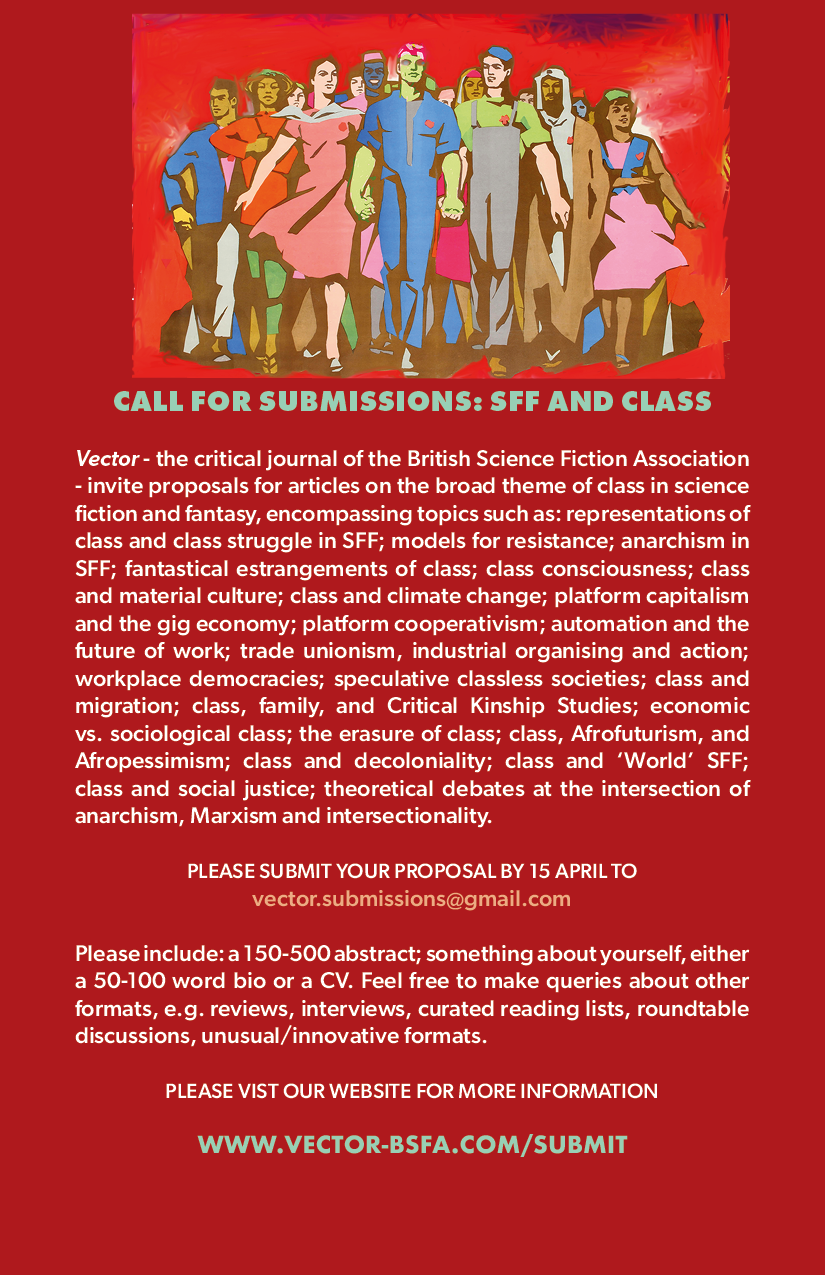
SFF and Class

Vector and Focus are inviting submissions on the theme of class, with proposals due 15 April, and articles due 15 July. Please see the full call for more information. Vector will be publishing a special themed issue, guest-edited by Nick Hubble.

Keep an eye out for more CfPs for future special issues to be edited by Stewart Hotston, Stephen Oram, Phoenix Alexander, and Nina Allan.

Fission

The BSFA publishes Vector (the critical journal), Focus (the magazine for writers), and The BSFA Review (reviews of the latest SFF). This year we’ll also launching something new: Fission, an anthology of original SFF.

Submit your short stories of up to 3,000 words to Allen Stroud at chair@bsfa.co.uk. This submission window closes 15 February 2021. The anthology will focus on science fiction; other than that, there are no particular constraints as to theme or style, so go wild!

Fission is something of an experiment: let’s see where it leads. The plan is to publish on an annual basis. Fission will also be a collaboration with Celsius 232: it will bring work of Spanish SFF writers to an Anglophone audience, and one story from the Fission anthology will be chosen to be translated into Spanish and published in Celsius.

Multiple submissions and simultaneous submissions are just fine, but please mention it in your email.

You don’t need to be a member of the BSFA to submit a story.

Submissions of reprints are also welcome.

Fission is not currently a paying market.