Reviewed by Nick Hubble.This review first appeared in The BSFA Review.
The Left Hand of Darkness is set on the planet Gethin, also known as Winter where there is no sexual difference between people apart from a monthly period of kemmer. When the androgynous Gethenians meet in kemmer, hormonal secretions increase so that either male or female dominance is established in one and the partner takes on the other sexual role:
Normal individuals have no predisposition to either sexual role in kemmer; they do not know whether they will be the male or the female and have no choice in the matter. (Otie Nim wrote that in the Orgoreyn region the use of hormone derivatives to establish a preferred sexuality is quite common; I haven’t seen this done in rural Karhide.). Once the sex is determined it cannot change … If the individual was in the female role and was impregnated, hormonal activity of course continues, and for the 8.4 month gestation period and the 6 to 8 month lactation period this individual remains female. … With the cessation of lactation the female … becomes once more a perfect androgyne. No physiological habit is established, and the mother of several children may be the father of several more. (91)
Thus read the field notes of Ong Tot Oppong of the Hainish Ekumen on her initial observations concerning the sexual life of the Gethenians. These notes are in the possession of Genly Ai, who has openly come to Gethen as an ambassador from the Ekumen with the purpose of inviting the Gethenians to join the wider interstellar community. ‘The Question of Sex’ – as the chapter in which Ong’s notes appear is titled – is the aspect of The Left Hand of Darkness which has attracted most attention over the near half century since its original publication.
I was going to begin this review by arguing that ‘if Heinlein’s line “the door dilated” is often presented as an example of the cognitive estrangement of 1940s Golden Age SF, then Le Guin’s “The king was pregnant” is representative of a more profound late 1960s countercultural and feminist defamiliarisation’. But then I read China Miéville’s introduction to this new edition of Le Guin’s 1969 classic and discovered to my horror that not only does he make the exact same comparison, he also sums up its significance more effectively: ‘Heinlein renders one corridor strange: Le Guin reconfigures society’. For Miéville, the novel’s defamiliarisation of gender makes it unquestionably a precursor of the gender queerness and sexual fluidity of our twenty-first-century present.
However, as he acknowledges, it was not always seen in such a radical light. Le Guin’s use of universal male pronouns to denote a society without a permanent sexual divide and therefore without a gender division, led to Joanna Russ, among others, criticising The Left Hand of Darkness for only containing men in practice. In In the Chinks of the World Machine (1988), Sarah Lefanu argues that the lack of sexual difference means that there is no historical dialectic and that the novel’s popularity is due to it simultaneously offering women a retreat from conflict back to the pre-Oedipal imaginary order while offering men the opportunity to roam freely unconstrained by the difficulties that arise from sexual difference. Adam Roberts went as far as to say, in Science Fiction (2000), that The Left Hand of Darkness is remarkably non-binary as a novel, with an appealing spirituality but an unengaging storyline, and mainly dependent on the quality of its world-building to attract readers’ imaginative and emotional investment.
In fact, The Left Hand of Darkness has long had all the hallmarks of one of those novels which one feels guiltily ashamed of uninhibitedly enjoying in private while publicly pretending indifference in order to fit in with the apparent critical consensus. There is something about all that apparently non-existent narrative tension concerning the fate of Genly’s mission and his relationship with the mysterious and enigmatic King’s Ear, Estraven, that makes one need to keep turning the pages even on the umpteenth rereading. The plot is not negligible by any means. The central irony that the rather backward kingdom of Karhide does eventually turn out to be more important to Genly than the apparently more modern and democratic Orgoreyn, is the inspiration for Iain M. Banks’s Culture-related planetary romance, Inversions (1998). And, of course, the Culture is also a society in which it is possible for the mother of several children to become the father of several more.
Reviewed by Eugen Bacon. This review first appeared in The BSFA Review.
“Making things is a matter of hands and eyes.
All my daughters are makers of things.”
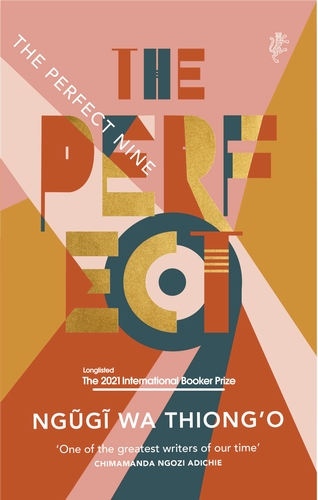
If you’ve read Ngũgĩ wa Thiong’o’s fiction, comprising Wizard of the Crow, Petals of Blood, The River Between—some curriculum in African literature, seen his plays, like The Black Hermit, or read his essays and memoirs, you know to expect the unexpected. This preps you for his black speculative fiction The Perfect Nine: The Epic of Gĩkũyũ and Mũmbi, on the founding of the nine clans of the Gĩkũyũ people of Kenya.
The verse narrative borrows from the mythology of Gĩkũyũ and Mũmbi, the male and female forebearers created by the god of the mount, the giver supreme, the god of many names, also known as Mulungu, Unkulunku, Nyasai, Jok, Ngai, Yahweh, Allah. He/She is a unifying god, a being and nonbeing of distance and nearness, the here and there, the stars, moon and sun, the mother of the soil, water and wind. The giver grants Gĩkũyũ and Mũmbi nine perfect daughters, and a tenth with a disability, and now the daughters have come of age.
In this mightily feminist story that blends folklore, mythology, adventure and allegory, translated from its original Gĩkũyũ version titled Kenda Mũiyũru(2018), the daughters are self-sufficient women who till the land, build their own huts, are self-reliant yet united in mind, heart and kinship.
There’s Wanjirũ, who put a curse on the hyena to smother greed. Wambũi, who rode a zebra to war, led an army to victory. Wanjikũ, who has a fierce love for personal freedom and self-reliance, and a healing power of peace. Wangũi, whose lullabies can dispel a war. Waithĩra, who resolves disputes with the wisdom of the mount. Njeri, whose power of glance is a quest for justice. Mwĩthaga, who can make rain. Wairimũ, who sculpts and invents life, can trap souls. Wangarĩ, whose courage of a leopard protects the powerless from the powerful. And Warigia, the unspoken tenth, born with a disability, but she charms animals, so much joy in her laughter, the whiteness of her teeth lights a path in the darkness, and her arrow never misses an eye.
Suitors arrive from far afield, lured by the silhouettes of the daughters’ beauty in their dreams, girls in fantasies who lead them down valleys to rivers with song. The suitors perform their own songs and dances of their regions, some picked up on the way, and they’re willing to serve the trinity of life—birth, life, death; the trinity of day—morn, noon and evening; the trinity of time—yesterday, today, tomorrow.
But with its caution on the lure of strangers, the cunning of ogres, the folly of greed and the ugliness of discord, the philosophical story tosses up challenges and much peril to the daughters and their ninety-nine suitors, until only the worthy remain.
With its inclusion of no distinction between man or woman, its inspiration on care of the land, its adages on the power of nature, and knowing to listen to the dictates of the heart, The Perfect Nineis an accomplished work that’s deeply cultural. It platforms the importance of naming in African tradition, the place of ceremony and the heart of kinship, bonded by blood or marriage—as one groom says to Gĩkũyũ and Mũmbi:
“I want to talk to you, my father and my mother,” he said,
“For I cannot call you by any other name, given that
You received me and accepted me as your son.”
In this lush chronicle on the genesis of Gĩkũyũ clans through valour, family, nature and nurture, Ngũgĩ wa Thiong’o shows how supremely he’s a leading literary African author and scholar, a recipient of twelve honorary doctorates, and a nominee for the Man Booker International Prize.
“Life has and has not a beginning.
Life has and has not an end.
The beginning is the end and the end is the beginning.”
Reviewed by Graham Andrews.This review first appeared in The BSFA Review.
In Jack Williamson’s thought variant short story, ‘Born of the Sun’ (Astounding, March 1934), Sol – like possibly every other star in the universe – is a sentient being and the planets are its incubating eggs. Well, you can’t get much more “thought variant” than that! But since the Sun didn’t give birth by self-genesis, Mike Ashley has excluded it from his whistle-stop tour of the solar system. (I would have plumped for ‘The Golden Apples of the Sun’ – which is neither here, there, nor anywhere else.)
Ashley explains in his general introduction that the stories will deal with “the old solar system, beloved of writers of science fiction, before the space probes discovered what was really out there.” His Planetary Exclusion Order also applies to the Moon (but then he had placed Luna-set stories in the BL Moonrise: The Golden Age of Lunar Adventures anthology). Mars, however, could hardly have been left out of the batting order (see below). Following my usual form, I started by reading Ashley’s erudite* prologues before reading the actual stories.
*A redundant adjective, if ever there was one.
“So strap yourself in and prepare for a kaleidoscope of worlds!” (ibid.).
I’ll get the Golden Oldies – or at least Silveries – out of the way first. ‘Sunrise on Mercury’ (1957), by Robert Silverberg, takes place on the hot-side/twilight zone/cold-side innermost planet that we used to know and love so well. It’s one of his best early stories that never stops moving – or thinking. ‘Garden is the Void’ (1952) is Poul Anderson’s haunting exploration of an asteroid: “A green asteroid.” James Blish went over all Joycean again with ‘How Beautiful with Banners’ (1966), set on Titan, if not Saturn itself. Par example: “Feeling as naked as a peppermint soldier in his transparent film wrap, Dr. Ulla Hillstrom watched a flying cloak swirl away toward the black horizon with a certain consequent irony.” ‘Wait It Out’ (1968) is a marooned-on-Pluto story that shows how well Larry Niven could write hard science fictioon when he used to work at it. [And I, for one, will never accept Pluto as a ‘dwarf’ planet.] But my favourite classic story – and also my favourite story in the whole book – is Clifford Simak’s ‘Desertion’ (1944).
‘Desertion’ (1944). Set on and around Jupiter, it became an integral part of the fix-up novel City (1952) and inspired a crucial plot device in Avatar (watch and compare). The last four understated lines of this story never fail to move me. I envy anyone reading them for the first time.
As usual with Mike Ashley, however, it’s the little-known or even unknown stories by ditto authors that make these BL anthologies so worthwhile. Leslie F. Stone (1905-1991) was one of the “pioneer women” contributors to the dawn-age sf pulp magazines. She set ‘The Hell Planet’ (1932) on the “real” Vulcan, once thought to lie between Mercury and the Sun. Background reading: The Hunt for Vulcan (2015), by Thomas Levenson. ‘Foundling on Venus’ (1954) by John and Dorothy De Courcy has a stinging twist in the tale. John Ashcroft (1936-1997) does Mars proud with ‘The Lonely Path’ (1961). ‘Where No Man Walks’ (1952), by E. R. James (1920-2012), about mining for industrial diamonds on the “surface” of Uranus, could well have been expanded to novella, or even novel-length. It’s the strongest story in the book, in my opinion, after ‘Desertion’. By the same token, ‘A Baby on Neptune’, a collaboration between Claire Winger Harris (1891-1968) and Miles J. Breuer (1889-1945) is by far the worst story in the book. “Ye Gods!” shouted Kuwamoto. “Just at the crucial moment, like a cheap novel serial! I suppose all we can do is nothing, and Elzar’s child has been devoured by the filthy beast.”
It just remains for me to say thatBorn of the Sun is yet another excellent theme anthology edited by Mike Ashley for the British Library. Buy it! Read it! Keep it!
It’s become almost a cliché of conversations in sf circles: someone says that they would love to read more works by authors from non-Western, non-White, and/or postcolonial origins, but, they add, “I don’t really know where to start.” While the recent rise to prominence of African and African-diaspora authors like NK Jemisin, Nnedi Okorafor and Tade Thompson has been welcome, potential readers might still wonder where to look for writers in other sub-genres of sf, such as horror, Weird fiction, or post-apocalyptic fiction.
Dominion: An Anthology of Speculative Fiction from Africa and the African Diaspora provides a suitable answer to this question, being a sampler of a diverse range of stories by established African and African Diaspora authors, covering a startling range of genres that provides something for everyone. At the same time, however, there is plenty for those with a good understanding of Afrofuturism and Africanfuturism to appreciate.
All the stories were, however, at the very least interesting and in most cases very enjoyable to read. Some fit comfortably within familiar sf categorisations. “Trickin’”, by Nicole Givens Kurtz, is a Hallowe’en-set horror piece which develops both the vampire and demonic-possession subgenres. “Sleep, Papa, Sleep” by Suyi Okungbowa Davies is also on the conventional horror spectrum, a Lagos-set story involving necromancy and revenant corpses to explore family relationships. On the science fiction side, “Red_bati” by Dilman Dila, about a former robot pet now repurposed as a mining robot after the death of its human owner, fits into the growing genre of stories exploring the morality of creating AI for human use; this example does a good job of handling the balance between making the AI sympathetic and not obscuring his non-human mindset.
Other stories engage more directly with colonialism and postcolonialism. “A Maji Maji Chronicle” by Eugen Bacon is a fantasy about a mage who meddles with African colonial history, exploring questions about power, corruption and legitimate leadership. “To Say Nothing of Lost Figurines” by Rafeeat Aliyu is a mixed genre SF/fantasy, giving us a wizard from Earth tracking a magical object to an alien society and retrieving it with the aid of a half-human-half-alien woman. The idea of magic-as-science, a feature of much postcolonial sf including that from Africa and its diaspora, arises both as an embracing of the indigenous logics dismissed as superstition in a colonial context, and a challenge to the idea of “Western” science as hegemonic and objective. Here, it is counterpointed by the narrative of a mixed species character finding an escape from her oppressive birth society.
“The Unclean” by Nuzo Onoh is a genuinely terrifying horror fantasy about an Igbo woman in the 1950s in an abusive marriage; the best horror for me is always that which works as a metaphor for real-life issues, and the way in which the protagonist struggles against not just her husband and his family but the patriarchy of 1950s Nigeria in general is both reflected and amplified by the supernatural terrors she encounters (and sometimes brings into being herself). Mame Bougouma Diene’s “The Satellite Charmer” engages directly with Chinese neo-colonial activities in Africa, the background involves two Chinese mining companies using satellite technology for resource extraction in Senegal, our foreground is the life of one man, Ibrahima, affected by the satellites in unexpected ways and how he, and they, converge to an explosive meeting.
History, and more specifically the loss of (and recovery of) history, also emerges as a key theme. “A Mastery of German” by Marian Denise Moore is a near-future hard-science story whose protagonist is an American project manager tasked with evaluating (and possibly cancelling) a project meant to enable the transfer of human memory for profit; at the same time, we have the counter-narrative of the protagonist’s father attempting to trace the family history, thwarted by the invisibility of Black, enslaved and working-class people. The end result explores the meaning of individual and social memory not just in the USA, but any postcolonial country. “Emily,” also by Marian Denise Moore, is the shortest piece in the book, a poem starting with a historical advertisement for the return of an escaped enslaved girl and imagining different parallel futures for her, picking up on the theme of lost history in Moore’s earlier piece for the volume. “Thresher of Men” by Michael Boatman is a deeply satisfying revenge narrative: as a goddess takes vengeance on the White residents of an American town for past atrocities, we see the hidden history of the seemingly idyllic community emerge, beginning with a recent police shooting of a young Black man but going deeper into the past as the story unfolds, revealing the murder as one horror in a long chain of atrocities extending back decades, if not centuries.
Finally, some stories in this collection cross genres or defy classification. “Convergence In Chorus Architecture” by Dare Segun Falowo is a strange and surreal Weird fiction piece involving quests, boneships, human-arthropod fusions; the prose is beautiful and haunting and the imagery lingers. “Clanfall: Death of Kings” by Odida Nyabundi is a post-human post-apocalyptic adventure story, which reads like the setup to what could be a very interesting series, and one hopes the author develops this universe further. Finally, “Ife-Iyoku, The Tale of Imadeyunuagbon” by volume coeditor Ekpeki Oghenechovwe Donald tells the story of a society undone by its own essentialism; as the narrative twists and turns unexpectedly, so the story shifts genre, beginning as an epic heroic fantasy, before shifting into a postapocalyptic story with echoes of The Chrysalids, and shifting again into another divine revenge narrative.
Dominion is a worthy addition to volumes like Walking the Clouds and So Long Been Dreaming which serve as introductions to postcolonial and indigenous science fictions and fantasies. The interesting range of stories, genres and themes provides a clear guideline for people looking for new work by African and African Diaspora writers in their favourite subgenres. However, the exploration and development of themes of colonialism, history, and memory, as well as the re-interpretation of colonialist sf tropes such as vampires and AI through African and/or Afrofuturist lenses, means that the volume also contributes to the ongoing dialogue on decolonising science fiction.
To understand Gross Ideas, start with the Oslo Architecture Triennale to which this book is a companion. The Triennale is “a member organization that unites the major architecture and urban planning networks in Norway” for conversations and public programs about the role of architecture in society. Participants and supporters include national associations of design professionals, architecture schools, Norwegian government agencies, and international architecture firms with Norwegian roots. The 2019 Triennale in the fall of 2019, was the seventh iteration.
Some of the contributors identify as writers and some as architects, and a few work both sides. There are two poems, one graphic narrative, and fourteen prose narratives of widely differing character …
The book itself is a miscellany of contributions that is more a curated exhibit in verbal form than a tightly edited collection, a characterization that I suspect the curator-editors would find quite acceptable. Some of the contributors identify as writers and some as architects, and a few work both sides. There are two poems, one graphic narrative, and fourteen prose narratives of widely differing character. Some of these latter are stories that could easily find homes in science fiction magazines. Others range from Will Self’s takeoff on Invisible Cities to Lesley Lokko’s essay on women and transnational remittances that includes a fictional vignette, a short factual summary, and scholarly endnotes (it is quite effective).
Architects have long delighted to imagine grand buildings and building schemes—Arturo Soria y Mata’s Ciudad Lineal, the arcologies of Paolo Soleri, Walking City and other thought experiments of the Archigram group, a linear supercity from Michael Graves, the mile-high skyscraper of Frank Lloyd Wright (even Burj Khalifa gets only halfway there). Science fiction has appropriated the taste for the grandiose from Trantor and Coruscant to countless artists’ depictions of imagined urban futures full of soaring towers in shimmering color.
What naïve readers might expect from the “architecture” in the subtitle is often absent …
There is no such here. What naïve readers might expect from the “architecture” in the subtitle is often absent. Instead we get one story in which the largest building is a village house (Sophie Mackintosh, “Placation”), a second set in a caricature of a dusty, unchanging town of the old American Southwest (Joel Blackledge, “Fountainwood”), and another in derelict and abandoned Edinburgh (Camilla Grudova, “Deliberate Ruins’). The only story to center a single building uses an unfinished and abandoned Persian Gulf skyscraper (Deepak Unnikrishnan, “Cat”). The other entry in which architecture is the explicit focus is the graphic narrative “Exile’s Letter” by Mill + Jones, which chronicles efforts to build in a low-technology future (temple, town, giant fishing pier) that are laid low by fire and flood and end with the triumph of unbuilding in a sort of Nature-driven version of the Tower of Babel.
Some of the entries posit future engineering rather than architecture—a distinction that the curators and the Triennale folks would likely disregard anyway. For example, Robin Nicholson projects the green retrofitting of London in 2039. I had the most fun with “The Aqueduct,” which presents a scenario for replacing Britain’s rail and road transportation with a set of canals. It is a fascinating think-piece that painlessly introduces elementary physics to extrapolate from Britain’s current restored canals. If he hasn’t, author Steve Webb should look up Railroads and American Economic Growth by my old graduate professor Robert Fogel, which includes a long counterfactual to test whether the United States might have had the same robust economic growth had it invested in canals and river improvements rather than railroads in the nineteenth century.
As she starts work and experiments on her own small house, she finds herself slowly absorbed by the microbes …
The contributors took to heart the theme of the 2019 Triennale—“Enough: The Architecture of Degrowth.” Some stories imagine the built world in decay (Grudova, Unnikrishnan), others the natural world actively triumphant (Mackintosh). Lev Bratishenko, “You Wanted This,” reports a future United Nations conference at which national representatives offer their own favored ways to drastically reduce the world population—the Russians want to use thermonuclear bombs, the Japanese want to weaponize the Internet of Things, the Americans want to drug everyone to euphoric death (cue up Serenity). One of the most powerful stories is Rachel Armstrong’s “Bittersweet Building.” A new architecture graduate in desperate need of a job catches on with a Norwegian firm that is trying to incorporate bacteria as part of a building’s metabolism (waste into clean water, heat, oxygen). As she starts work and experiments on her own small house, she finds herself slowly absorbed by the microbes into their own complex world and finally merging fully into the “metabolic community of the landscape.” It is both a chilling and a comforting variation on the natural process of bodily decay. For the theme of degrowth, score a big one for the Earth.
Having considered the “architecture” half of “tales of tomorrow’s architecture,” what about the “tales” part? To no surprise, the pieces run a wide span from interesting but undramatic speculation to engaging story. For an example from the didactic side, Edward Davey, “Oli Away,” uses the mechanism of a report on a gap year journey to explicate some favored energy and transportation options. The entries by Nicholson, Bratishenko, and Webb are additional examples of scenario-building rather than storytelling. They have a lot of information without much surrounding story, which is not to say that we should not think about the ideas they present. After all, nobody read Looking Backward for its compelling characters and plot, but it had enormous influence.
Several of the contributions that are strong as stories are, not surprisingly, by people with lots of writing experience who know how to create engaging characters. For many Vector readers, the biggest name in the collection is Cory Dotorow, who contributes an interesting variation on his Disneyland obsession with “Materiality.” He posits a theme park in which high school classes spend a week inhabiting reconstructed towns from different eras. Think Main Street USA meets the living displays of colonial “savages” found at early twentieth century world’s fairs (also see the living diorama in Colson Whitehead’s fantastic alternative view of American history in The Underground Railroad). The theme park contrasts with a present in which recycling and three-dimensional printed make the objects of everyday life ephemeral if not immaterial. Doctorow’s teenaged protagonist indirectly confronts the lasting imprint that seriously stupid Old Timey People left on the landscape by considering whether his favorite old tee shirt is still cool (it is).
… architecture as a practice of designing individual buildings should be and is being swallowed up by the all-consuming impacts of climate change and necessary transformations in global energy systems.
Maria Smith in “Lay Low” uses the familiar frame of singles gossiping in a bar to introduce a society of scarcity in which everyone has monetized allowances for necessities like water, food, and electricity. Her variation on a familiar science fiction future is a new way to get ahead on your budget—perhaps—by going into hibernation for a few months to lower your consumption levels and build up points. The women in the bar, who are just learning about the new option, don’t think that monetizing unconsciousness is going to go well.
Jo Lindsay Walton contributed the longest, most complex, and perhaps most readable story (no, there was collusion with your book review editor). “In Arms” is cleverly constructed with two parallel threads—a woman waiting for a date to show up and an ecoterrorist launching an operation—that slowly grow more complex and intertwine in unexpected ways. Radical changes in building styles are slipped in as background, including the cool idea that rising seas have forced the seat of British government to shift to a mobile seastead platform nicknamed Wetminster.
Without the subtitle and the wraparound material describing the Triennale, someone who casually reads through Gross Ideas would think it is about economic transition and “degrowth” in general, with architecture one of many avenues of exploration. The overall message is that architecture as a practice of designing individual buildings should be and is being swallowed up by the all-consuming impacts of climate change and necessary transformations in global energy systems. Some contributors see a complete devolution to a nonindustrial future, others a society of scarcity, and still others an adapting world. Tomorrow’s architecture, the book suggests, will be valuable to the extent that it is subordinated not just to social needs—an architectural truism, if not always heeded—but rather to fundamental institutional and social transformation.
Carl Abbott is author of The Metropolitan Frontier: Cities in the Modern American West, The New Urban America: Growth and Politics in Sunbelt Cities, and Political Terrain: Washington, D.C., from Tidewater Town to Global Metropolis.
Cargo (Arati Kadav 2019 Hindi): A meandering rumination about the weightlessness of human existence
Reviewed by Abhishek Lakkad
Please note that this review contains spoilers.
Death can be understood as a scientific/biological phenomenon, but its gravity is experienced as a spiritual phenomenon. Both the scientific and the spiritual perspectives allow one to contemplate death. But when the makers of Cargo (2019) choose science as merely a veil for religious/spiritual ideas in order to comment on alienation and abandonment rampant in contemporary societies, they could have made sure that the film is passionate (or at least compassionate) enough to sustain its slow-paced narrative. Cargo (now available on Netflix) is the first feature length film of Arati Kadav, although she has written and directed several science fiction shorts in the last decade. Cargo highlights the theme of ‘loneliness’ in these times of pervasive social media that creates the impression that one is always connected and hence never alone. Hindu spiritual/religious ideas about karma and the cycle of life, death and rebirth are central to the narrative. The action mostly takes place on a spaceship orbiting Earth where human-like demons called rakshasas are essentially technicians enabling the transition from death to rebirth in a mundane, technocratic and institutionalised process — reminiscent of an airport security checkpoint, medical lab or a prison admissions office. The film terms this process as “post-death transition”, supervised by a department called Post-Death Transition Services (PDTS) that operates under the aegis of Inter-Planetary Space Organisation (IPSO) that has been established by the rakshasas. Owing to the film’s stance of deriving its fictional futuristic technology from elements of Hindu spirituality and mythology, the film has a distinct retro-futuristic feel. Perhaps the datedness of the film’s visual effects is meant to reinforce the 80s inspired aesthetics.
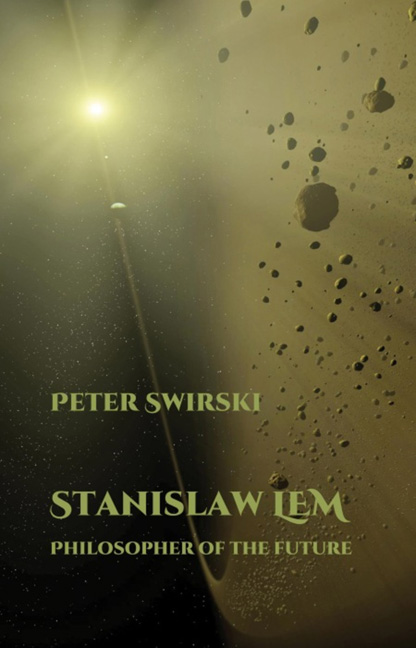
Peter Swirski, Stanisław Lem: Philosopher of the Future. Liverpool University Press, 2015 (Liverpool Science Fiction Texts and Studies, 51). ISBN 978-1-789620-54-2. Paperback, $35.41 / £19.95.
Memory tells me that I started reading science fiction in the late 1940s in the form of Heinlein stories that had appeared in Boys Life, which I subscribed to as a boy scout. When I started college at Berkeley in 1952, I discovered the Elves, Gnomes, and Little Men’s Science Fiction, Chowder and Marching Society. By the time I’d spent four years in the Air Force and finished my graduate studies at Harvard, I had collected a large SF library, including an almost complete run of Astounding. The point of this narrative is that my deepest knowledge of SF was the so-called Golden Age. Though I’ve continued reading SF and fantasy, and have published over fifty reviews of SF and fantasy books in the last twenty years, the renowned Polish writer Stanisław Lem has remained on the borderline of my reading.
When Vector (the journal of the British Science Fiction Association) solicited reviewers for this book, I offered because I wanted to learn about Lem. For readers who share my previous ignorance, Lem was born in 1921 in Lwów, Poland (now Lviv in the Ukraine), and died in Krakaw in 2008. According to Swirski’s bibliography, Lem’s first published science fiction story appeared in 1946 (Man from Mars—translated title); his first collection of SF stories appeared in 1957 (translated in 1977 as The Star Dairies). Fiasco, his final SF publication, appeared in 1987, translated with the same title in 1988.
Peter Swirski himself was born in Canada in 1966 but has spent most of his professional life elsewhere; presently a distinguished visiting professor in China, he has also taught in Finland and Hong Kong. His preoccupation with Stanisław Lem began with a 1992 article in Science Fiction Studies; the monograph reviewed here is the latest of Swirski’s six book publications on Lem. His other publications are on aspects of American literature and culture.Continue reading “A review of Stanisław Lem: Philosopher of the Future”→




![Dominion: An Anthology of Speculative Fiction from Africa and the African Diaspora by [Zelda Knight, Marian Denise Moore, Eugen Bacon, Nicole Givens Kurtz, Dilman Dila, Rafeeat Aliyu, Suyi Davies Okungbowa, Michael Boatman, Odida Nyabundi, Ekpeki Oghenechovwe Donald]](https://m.media-amazon.com/images/I/51ykGGZ8LJL.jpg)