The panel, left to right: Claire Steves, Elizabeth Black, Christine Aicardi, Benjamin Greenaway, Stephen Oram
What could the future look like? What do we want it to look like? ‘All Tomorrow’s Futures: scientists meet sci-fi writers to invent possible futures’ hosted by the King’s Institute for Artificial Intelligence attempts, if not to answer, then to explore how we might try.
Bringing together creatives and experts, All Tomorrow’s Futures is a project in foresight, attempting to provide plausible (or at least thought-provoking) narratives for how technologies may change our society. What makes it different from other projects is its methodology tying experts and creators together from the very start of the process to bounce ideas off each other and bring in research and creative resources. The panel was chaired by Dr. Christine Aicardi, senior research fellow in science and technology studies (STS) from King’s College London, and included editors and writers Benjamin Greenaway and Stephen Oram, with contributions from Dr. Elizabeth Black and Professor Claire Steves, and the discussions focused more on the process and intent of the project rather than the content of the book which contained resulting stories.
So, what is foresighting? Let’s start with what it isn’t: a definitive prediction. Foresighting isn’t about saying what will happen. It’s about saying what could happen. More importantly than that, it is about the skill of asking important questions and developing ideas to support future possibilities. Interestingly, the panellists emphasized the importance of participatory foresight, bringing in perspectives beyond the usual ‘experts’. The panellists emphasized the importance of asking who is envisioning these futures in the status quo right now and the need to actively include those in society who feel, in the main quite rightly, that they do not have agency in the decisions being made that will affect their futures.This also goes beyond the UK, for example, the future is African – it is the youngest continent, yet our global future imaginaries in the field of science fiction and beyond are not yet shaped in a way representative of people who will live in those futures.
Science fiction, for all it encompasses strange new worlds and fantastical creatures, is a literary genre that is built and sustained by human communities. Writers, artists, and creators have imagined new social formations, technologies, economic, ecological, and sociopolitical systems for centuries; indeed, science fiction may be the most nakedly political of all literary genres, as thought-provoking as it is beguiling. Who is present in narratives of futurity? What kinds of technologies enable—or stymie—human connection? How can inter-species communities develop and flourish?
Pre-internet, fanzines and conventions were the spaces where editors, authors, and fans met, shaping the genre in new and exciting ways. Praise and critique and conflict and collaboration were equally already common before social media. Some landmark dates include: the first WorldCon (1939), the first British science fiction convention, Eastercon (1937), the Maleyevka seminars, Nihon SF Taikai (from 1962), and many others, around the globe.
In 2024, the ideologies of ‘community’ are under pressure and scrutiny. Violent geopolitical events shadowplay on smartphone screens, small enough to fit in the palm of our hands, fulfilling the most dystopian dreams of the genre; we venture to fight and commiserate and celebrate with people from all over the world, instantly. Where wealthy industrialists were (and are) once praised as saviors of humanity with the glittering promise of their space programs, now SF tends to show how the relentless logics of capitalism undermine any notions of transcendence. The challenge of space travel was supposed to unite us. What would the pioneers of SF make of the now-straining politics around the International Space Station, scheduled for dismantling by 2030?
In light of these challenges, the Vector team—for the journal’s milestone 300th issue—invites contributions that reify the notion of ‘community’ as it manifests in speculative cultures. What tools can SF offer us to construct better tomorrows, together? How can we innovate new ways of collaborating, such as the world-building projects of Syllble? What does ‘community’ look like in fiction, non-fiction, conventions, awards, conferences, collaborations, online spaces, and other literary and paraliterary formations?
Suggested questions / topics
history of fandom/conventions
the practice of writing: zines, magazines, letters
science fiction publishing: editors and collaborators on the printed page
utopias and dystopias
terraforming
defining personhood
future societies
sex and sexuality
navigating conflict
political divides, past and present
interspecies alliances
the posthuman
the future of communication
translating SF
Please submit your proposal by June 15th, 2024 to vector.submissions@gmail.com, including:
a 150-500 word proposal, including estimated length;
something about yourself, either a 50-100 word bio or a CV.
Articles should be between 1,000 and 8,000 words. Please let us know your estimated word count. We seek articles that are carefully grounded in scholarly research, while also being clear, engaging, and suitable for a broad audience (including non-academics). Articles will be due by July 31st, 2024.
Please also feel free to make queries about other formats, e.g. reviews, interviews, curated reading lists, roundtable discussions, unusual / innovative formats.
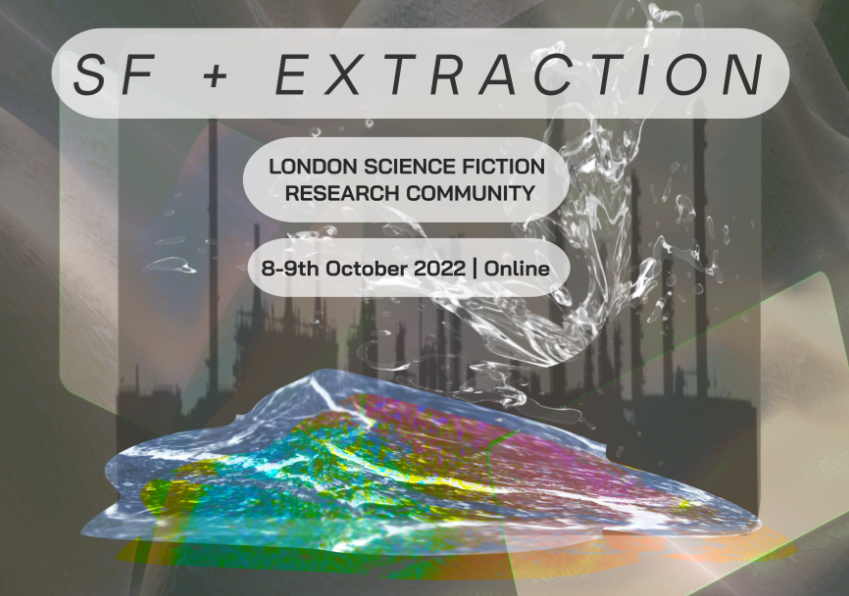
This two-day conference was organised by the London Science Fiction Research Community (LSFRC), with support from Birkbeck, University of London. This was the third wholly online annual conference held by the LSFRC since the beginning of the pandemic, although this event was somewhat smaller than its predecessors. Making use of the online technology, speakers and audience were again drawn from across the world, and from many different perspectives.
Although the notion of ‘extraction’ was interpreted broadly, at its heart it was located in a series of exploitative colonialist, capitalist practices. The original call for papers sought:
… contributions that think with, through and about extraction in all its forms – as extraction of human and nonhuman subjects; appropriation of knowledge and indigenous practices; instrumentalization of landscapes beneath, upon and beyond the Earth; parasitism; pollution as colonialism; the accumulative schematisation of linear temporal frames; forcefully extracted emotional labour; legacies of trauma and more – and its relationship with sf both as an extractive form of fiction and as a corrective/counter to extraction. From asteroid mining to dream harvesting, we want to engage with sf texts and ways of thinking across all media that explores, unravels and seeks to push beyond extraction’s mastery of the past, present and future.
The LSFRC runs a regular reading group exploring the same themes as the conference during the year leading up to each annual event. I attended a few of these, which were very productive, and encouraged a broader consideration of the subject. Despite its name, the reading group covered a range of media, including graphic novels, films and games as well as written sf, and the same was true of the conference.
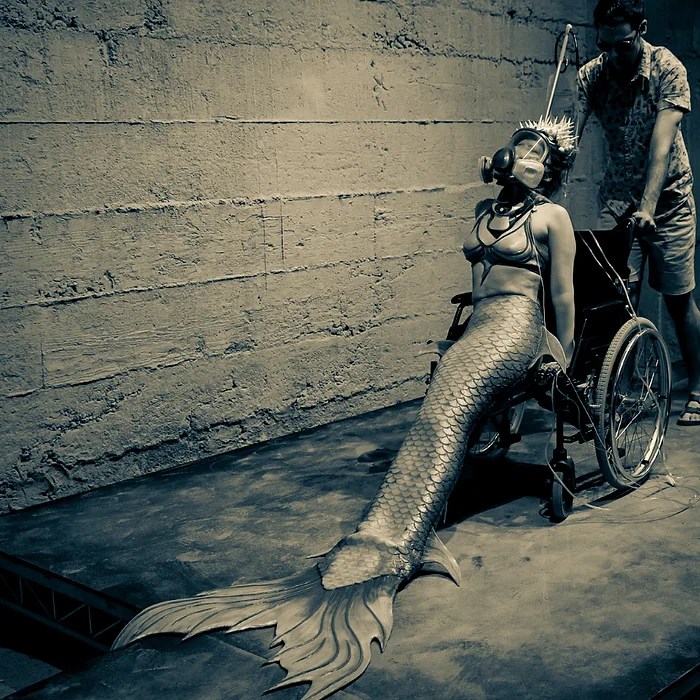
Rather than cover every item I attended, I will concentrate on those papers that were my personal highlights, although I realise that in taking this approach, I will doubtless fail to mention some fine presentations. The first day began well, with two papers that I particularly enjoyed in the first panel, on ‘Human and Nonhuman Entanglements.’ Iuliia Ibragimova’s paper on ‘Space-Faring Animals and Their Humans’ looked at the sentient spaceship trope in sf literature and tv. Developing a brief survey of examples, including the Spline in Stephen Baxter’s Xeelee sequence, the insect/machine hybrid Lexx, and the Miri ships in Nnedi Okorafor’s Binti series, in a series of ravishing slides, she considered the relations between the human/humanoid aliens and the sentient spaceships presented as non-human animals. Ibragimova suggested that alongside more hierarchical and exploitative depictions, some of these examples also offered an opportunity to challenge anthropomorphic assumptions, and pointed towards more positive models of co-existence. Alongside this paper, Chiara Montalti’s ‘The Ecology of a Mermaid’ explored the notion of the mermaid to discuss the relationship between disability and environmental (in)justice, notably using the performance piece The Mermaid by the Australian artist and dancer Hanna Cormick. The latter has a cluster of medical conditions that require the use of a wheelchair, braces, respirator mask and oxygen when outside. The figure of the mermaid, as one who is differently abled in different environments, is used to suggest that the perspectives of disabled people can help address environmental toxicity and injustice. There was a need for this to be reflected more often in sf. The various papers delivered on this panel opened a space for a fruitful discussion, with the notion of ‘super-abled’ insectoidal non-humanness compared to the aqueous mermaid (with the waterborne mermaid as possibly still-disabled), and questions about individuality in the framing of the insectoidal ships.
The Mermaid by Hanna Cormick
Amy Cutler’s paper, ‘“[dying words] More light…” : Anti-Cinema and Black Hole Fishing’ described a creative experiment, her work ‘7 Ways of Exploiting A Black Hole’ (2022). She explored techniques for decentering cinema, moving away from the single-screen display to a fixed audience, and discussed the use of cinematic techniques to present and comment on astrophysics and future visions of extraction. The latter was pictured in terms of Roger Penrose’s ‘The Lost Art of Fishing in a Black Hole (1971)’ – in which he considered how energy might be extracted from a spinning black hole – as well as other interventions. How to exploit the least exploitable thing in the universe? Yet the black hole can also be considered an archive of the past, and hence a form of cinematic library. Conceived as a commentary on the languages of astrophysics and future visions of extraction, and a form of cinema deliberately inverted to curb storytelling practices of ‘eternal growth’, Cutler’s cinematic installation engaged with multiple readings of the Penrose process for geostationary energy extraction as well as the notion of the black hole, also touching, along the way, on the myth of Icarus, Clarke’s The Fountains of Paradise (1979) and Disney’s film The Black Hole (1979).
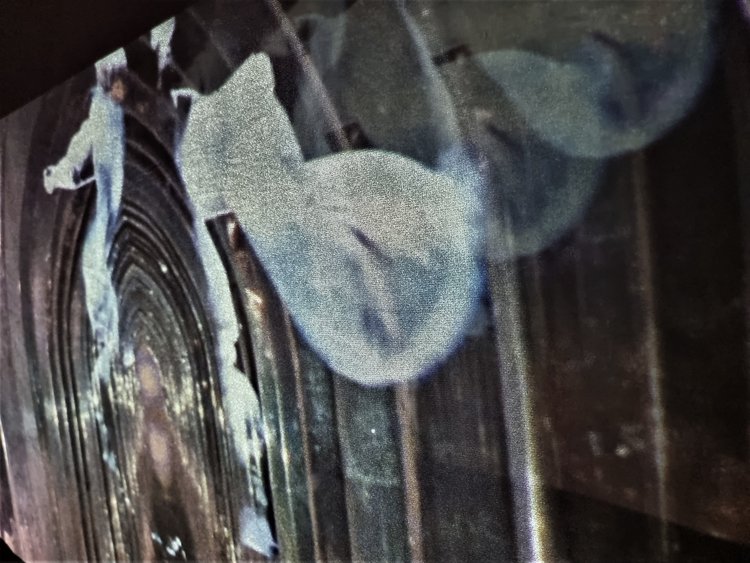
Lorrie Blair’s presentation on the same panel, ‘An artist’s response to living on a damaged planet: An Appalachian ghost story’ brought together three strands from Appalachian Ohio: a historic mine disaster, acid drainage from abandoned coal mines, and her own lived experience as a child and a young teacher. She described how she played in creeks near the mines as a child, and as a teacher learned of the Hocking Valley coal strike, which resulted in an extensive mine fire in November 1884. Burning coal cars, filled with oil-soaked wood, were pushed into the mines in response to the company’s use of scab workers during the strike. Flames burned into the coal seams, and over time the ground collapsed under buildings and roads, and mine gases escaped into local towns. Residents were evicted and homes demolished. The fires are still burning below ground: steam comes from wells, roses bloom in Winter and snow does not settle. Blair creates subtle and complex photographs to tell the story of this ongoing environmental disaster, using digital photography and paint sourced from the toxic run-off from streams near the abandoned mines, combined with cyanotype chemistry. Her images are palimpsests of old and new images, creating ghost-like collages echoing the past and present, combining the dead with the living. I found these images quite haunting, and a compelling reflection on the damaged and damaging, complex pasts she described. The manner in which each of these papers used various technologies of image-making and sharing to tell their stories opened a rich discussion. It created a materiality of storytelling, but there was also cultural cost, for example, photography also pollutes. Lorrie suggested the making of small work was key as a hope that the resulting artwork’s environmental footprint could be lessened.
Science fiction often pictures astronomical observatories, and the astronomers therein, in a positive light. They are the first to spot the Armageddon meteor or alien invader, and they tend to symbolise a pure, disinterested science. The latter is also emphasised by their frequent remote, mountaintop locations. One such location is the contested site discussed in Teresa Shewry’s paper, ‘”Making Things Look Bad”: Extraction, Humor and Science Fiction at Mauna a Wākea’, which provided a constructive counterargument to such views. A new Thirty Meter Telescope (TMT) is proposed for the Hawaiian mountain of Mauna a Wākea, whose potential cultural and environmental impact is significant. The mountain has an alpine ecosystem, and the attempt to use Crown lands for the observatory is seen by many as an act of expropriation and accumulation by the settler state, in aid of militarisation and the exploitation of space. Shewry explored some of the artistic responses to the proposals, introducing the short comic film ‘TMT-5000’ by Rian Basilio and Conrad Ikaika Lihilihi, (see on YouTube), which compressed the debate over the new device into a domestic setting. The adult child begs for a new toy telescope while his father tells him off for having already messed up the house with thirteen previous toy instruments. This referenced the thirteen astronomical telescopes already installed on the mountain, while ridiculing them as simply toys – and there were other, similar reflections, undercutting the project. The crude and sometimes slapstick humour was also an interesting weapon of resistance to the corporate planners. It worked to undermine the seeming seriousness of the astronomical community, the architects and engineers, and opened up the opportunity for different conversations about the contested spaces.
In the same section of the conference, on ‘Blue SFs/Oceanic/Coastal’, Peggy Riley also focused on a specific place, discussing the writing of her latest novel in her paper ‘Uncanny Intimacies: Writing Seasalter’. Riley, who lives in Whistable, just down the coast from Seasalter, wrote the novel for her MFA dissertation at Birkbeck. She described the colonisation of the shoreline by aggressive oyster farming, extraction of the estuary by dredgers and the coastal erosion brought on by drought and rising tides. A landscape of sewage, unexploded bombs and of power lines to wind turbines. The locals in the town must deal with this landscape and these issues, as well as the increase in migrant crossings in East Kent. One character in her story keeps a monster’s tail, as a memorial of a battle in 1953, in the last great flood. When he dies, and his son returns, the monster comes to claim its tail, and calls upon the sea to rise again, and drown all the lands. In describing her approach, Riley referenced Donna Haraway and LeGuin, as well as Amitav Ghosh’s linking of the idea of the Uncanny with climate change, and the sense of menace and uncertainty it engenders. Her story was also inspired by the landscape itself. A tale where the human and nonhuman meet and both are in crisis. I found Riley’s slow and careful description of her work entrancing, as it interlaced the landscape with the forces that had created it, and the theoretical arguments and positions that had inspired her. This was my favourite presentation. Riley also ran a creative workshop later in the conference, which, sadly, I couldn’t attend.
Much of the conference was multi-stranded, with two or three panels of thematically-linked papers given in parallel. Often, at such events, whatever presentations I attend, I remain slightly haunted by a sense of regret, perhaps akin to buyer’s remorse or just a simple fear of missing out, about choices I have made. The feeling that ‘over there’ is a shadow conference made up of all the panels I didn’t see, that is marginally better than the one I am actually attending. And it is one I might actually have been at, if I’d only chosen differently. That feeling was entirely absent here. Perhaps because I had purposefully chosen a number of papers that were slightly out of my comfort zone. Certainly I found myself concentrating harder than usual to appreciate and understand the papers of Blair and Montalti, to their certain benefit. There was also a strong sense that the conference had been carefully curated. There were strong synergies and resonances between the papers, which opened up a number of spaces for the subsequent discussion. Many focused on contested landscapes and spaces, as might have been expected, given the theme of the event. Even so, the panels were exceptionally diverse in subject and treatment.
All conferences, it seems, have challenges to overcome. Sadly, due to illness, the keynote speech by Kathryn Yusoff (Professor of Inhuman Geography at QMUL) had to be cancelled at short notice. The organisers did manage to substitute a selection of short films related to the conference theme in the same slot, including Pumzi (Wanuri Kahiu, 2009), The 6th World (Nanobah Becker, 2012), Three Thousand (Asinnajaq, 2017), and an extract from Tarkovsky’s Stalker (1979). While this was of course a poor substitute, it did at least provide further perspectives on the theme. Technical issues also intruded: at least one presenter had problems with the Blackboard software used for the conference. This resulted in a successful switch of the presenter, moderator and the whole audience to Zoom. Everyone involved moved across just for that paper. Which arguably demonstrated how au fait we have all become with conferencing technologies over the last three years. However, in another paper I attended the sound was so poor that, despite the work of the organising team, I could hear nothing of what was said. And as someone who also gave a paper at the conference, I can vouch for the efficiency and helpfulness of the LSFRC team. This online conference was also the first such in which I felt the planned social event actually worked. The Conference chat system was extensively used, with the screen offering slow-moving, immersive images, and background music playing. The atmosphere was relaxed and the ‘conversation’ seemed to flow spontaneously, albeit limited by the software. Nevertheless, I feel it still didn’t match up to the full richness of an in-person event; so, if the risks of Covid continue to fade, I’m hoping that next year the organisers will offer the opportunity to attend the conference in the flesh.
“Futures from the Margins”—the theme of this year’s annual conference of Science Fiction Research Association (SFRA)—reminds me immediately of Paul Kincaid’s review of The Cambridge History of Science Fiction (2019) co-edited by Gerry Canavan and Eric Carl Link, published in Extrapolation 61.1. Kincaid claims that this anthology challenges the American-centric history of sf and re-writes it with a hope of amplifying the previously repressed voices from the “unseen” worlds—voices from China, South and South-Eastern Asia, Eastern Europe, Middle East, Latin America, and Africa. “Such cultural differences give this sf a different feel from the Campbellian hard sf we are used to, but it is sf nonetheless” (217), and they all respond in various ways to the socio-political condition in the related countries, regions, and nations at a specific moment.
No matter how global or how planetary sf appears, it is always anchored in the soil of particular places. Although the diversity of sf has been disguised under the ostensible universality formed pretty much in accord with the American tradition, localised interpretations are waiting to be discovered. “Once the will was there,” writes Kincaid, “it didn’t really take long to start unearthing them” (216). In line with Kincaid’s comments, I believe the conference “Futures from the Margins” also indicates such a will of unearthing, of amplifying the previously muffled voices, and—as demonstrated in the programme—of foregrounding the issues of those whose “stakes in the global order of envisioning futures are generally constrained due to the mechanics of our contemporary world” (CoFUTURES).
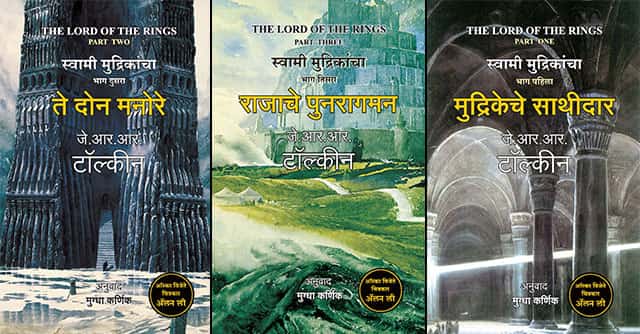
Following the interest generated by the Tolkien and Diversity panel at Oxonmoot 2020, (hosted by Sultana Raza), another panel on Global Tolkien was proposed and accepted by the Tolkien Society for Oxonmoot 2021. The idea for this panel was formed because of a troubling trend among some SFF and Tolkien enthusiasts against diversity in fandoms and interpretations of SFF writers. Luckily, the Tolkien Society doesn’t seem to ascribe to this view, and has been encouraging further dialogue on this topic.
The panelists included Sultana Raza (also the Moderator), Ali Ghaderi (Iran), María FernandaChávez Guiñez (Chile), and Gözde Ersoy (Turkey). Gözde Ersoy (assistant-professor of English Literature at Muğla Sıtkı Koçman University, Turkey) also briefly presented a video of an online event she had organized with school children in Turkey, on the Tolkien Reading Day, where they’d read an excerpt from The Hobbit in Turkish.
The following roundtable was written after Oxonmoot was over, and is an approximation of some of the points discussed during the Global Tolkien panel, which was accompanied by comments in the chat from the lively audience. A hybrid event, the Global Tolkien panel took place via Zoom (with 300+ viewers), while the organizers and a few participants logged in from Oxford where they were attending Oxonmoot in person. While there was quite a bit of interaction amongst the panellists, it’s not possible to re-create it in this written format, as the texts were sent in by email. The following roundtable contains spoilers for all of Tolkien’s stories mentioned below. Disclaimer: The opinions presented in this roundtable are those of the speakers, and not necessarily of the Tolkien Society.
The abstract of Global Tolkien was sent to the panellists beforehand, in form of broad but poignant questions:
Why does Tolkien’s fiction have a global appeal? Why are people from all continents drawn to Tolkien’s stories? What does that tell us about common human values? Only works of depth and substance can garner such a massive following all over the world. Conversely, have the 6 Peter Jackson films, and various games drawn in fans who’re more interested in the action/adventure or violence, and war aspects of the films and games than in the core values embedded in the stories? Should we encourage diverse readings of Tolkien from different geographical locations? Can this coming together of readers from different countries foster an international fellowship, as outlined in his books? Or conversely, should his fans be confined to people of just one race or ethnicity? If the interpretations, readings, or ideas of POC readers are not acceptable by some fans, then should these POC readers be allowed to consume these books/films/games? Should POC fans be limited to being consumers, but not commentators or scholars of Tolkien? Is it even possible to limit POC fans from engaging with, and commenting upon Tolkien’s works? Due to the recent wave of cancel culture, to what extent can we re-read or re-contextualize Tolkien’s works to fit in with our fluctuating world view?
Guangzhao Lyu, Angela Chan and Mia Chen Ma. Published as part of Vector 293 exploring Chinese SF. If you’d like to receive the issue, join the BSFA.
This is a transcription of Chen Qiufan’s public talk at Goodenough College, London, invited by London Chinese Science Fiction Group (LCSFG), on 12th August 2019, which is followed by a conversation with Angela Chan and Mia Chen Ma. This was originally published in Chinese on LCSFG’s WeChat account.[1]
The London Chinese Science Fiction Group (LCSFG) is a community for people interested in Chinese languages (sinophone) science and speculative fiction. Since it was founded in April 2019, LCSFG has been organising monthly reading groups focusing on short stories available both in Chinese and English and has been inviting established/emerging Chinese SF writers to participate in online discussions following the pandemic lockdown since March 2020. During our meetings, we explore the story’s themes, literary styles and even translation techniques and choices, as a way to better understand the piece, as well as the evolving field of contemporary Chinese SF.
Chen Qiufan:
Firstly, many thanks to the London Chinese Science Fiction Group for inviting me here, and to Goodenough College for providing such a gorgeous place. Today, I would like to talk about my debut novel, and only novel to date, Waste Tide. And don’t worry, there won’t be any spoilers. Before I discuss the story itself, let me give some general background information and my inspiration, that is, why I wanted to write a science fiction novel about China’s near-future in conjunction with e-waste recycling.
Over the past month or so, the British Science Fiction Association (BSFA) has been hosting a series of livestream readings from SFF authors in the UK and beyond. We’re calling them the Lockdown Solidarity Salons or, if you prefer, Very Extremely Casual Tales of Optimism and Resilience (VECTOR). Authors, you are all such charmers!
You can find out more about the series on the Facebook page or YouTube channel. We hope you’ll join us this Thursday (8.15pm UK time) for Chinelo Onwualu, Fiona Moore, and on later dates for Naomi Foyle, Lauren Beukes, Temi Oh, Ian R. MacLeod, and more. Here’s Adam Roberts:
See below for Foz Meadows, Stew Hotston, Valerie Valdes, Adrian Tchaikovsky, Malka Older, Tiffani Angus, Stephen Oram, Geoff Ryman, Wole Talabi, and Andrew Wallace. This Sunday, the BSFA will be holding our annual BSFA Awards ceremony (usually held at Eastercon, the UK’s annual national SF convention) on YouTube at 7pm BST.
Productive Futures: The Political Economy of Science Fiction
12- 14 September 2019
Bloomsbury, London
By Jasmine Sharma
“The history of science fiction (SF) is the history of unreal economics: from asteroid mining to interstellar trade, from the sex work of replicants to the domestic labour of housewives of galactic suburbia, from the abolition of money and property to techno- capitalist tragedies of the near future.”
The opening statement of the Call for Papers caught the attention of researchers, scholars, artists and authors engaged with the central theme of the conference: science fiction. The connection between science fiction and economics broadened the dynamics of multidisciplinary interaction, encouraging presentations not only from literary studies, but also from architecture, arts and aesthetics, cultural studies, film studies, law, history, politics and international relations, media studies, philosophy, science and technology studies, social anthropology and many more.
Organized by the London Science Fiction Research Community (LSFRC), and held within the heart of the city, that is the School of Arts Building, Birkbeck, the conference witnessed an exciting exchange of ideas and an orientation to global participation. UK delegates were joined by those from other European countries like Denmark, Germany, Finland and Netherlands, from Canada and the USA, and finally from institutes as distant as The University of Wollongong, Australia, The Chinese University of Hong Kong, and The Indian Institute of Technology, India. It was suggested at the end of the conference, only half-jokingly, that LSFRC now stood for Large Science Fiction Research Community.
The Science Fiction Research Association has just released the call for its annual conference, which this year takes place in Indiana. Abstracts are due 15 March. The conference title is ‘Forms of Fabulation,’ and the full call can be read here.
Although this Worldcon had about 5,500 paying members who divided their time between, on average, ten simultaneous program items, many sessions, especially the ones connected to Irish mythologies and history’s connection to SF, garnered enthusiastic interest. This provided a chance for academic fans and general fandom to interact and share their expertise. Most of the presenters also tailored their content to a larger audience […]





 vector-bsfa.com