Vector, Blind Submissions, and Gender Balance

A slew of commentary, mostly thought-provoking, has come out of Paul Cornell’s declaration yesterday that he would, as a panelist at a convention, actively work towards achieving gender parity on panels he’s on, even if it required taking himself off of the panel. It’s a lovely gesture, but there are all sorts of complications in the details of implementing it and what it requires of women participating in genre.

One of these complications is that, on average, women are less likely to volunteer to be put on panels in the first place.

I can’t speak to panel volunteers, but I can speak to those who volunteer for Vector.  The majority of articles which appear in Vector are commissioned. That means that I ask for them, or, more specifically, talk people into writing them.

A minority of the articles are blind submissions, already-written articles which are sent to Vector on the chance that it’s a suitable home for them. It often is. Vector isn’t that high profile, so it doesn’t receive all that many blind submissions – perhaps eight or so last year.

Every last blind submission I have received – and even, in addition to those, all the articles proposed, unwritten, without prior contact – were all sent or proposed by men.

This was my first year editing the magazine, so I can’t say if this is a necessarily a longer-term trend. I can say that this is consistent with what’s been reported by larger convention organizers, that men are more likely to put themselves forward, rather than waiting for an invitation.

Don’t get me wrong – I appreciate the blind submissions just as much as I appreciate all the people, regardless of gender, who have been willing to write for Vector by request. They all go into making the magazine’s features what they are. And some particular men may be in need of active recruitment, just as some particular women readily volunteer.

Part of the challenge of those working to improve the gender balance of participants, regardless of medium, can be in needing to be more pro-active in recruiting women, and the limited evidence of the blind submissions I’ve received is consistent with that tendency.

Science Fiction Foundation SF Criticism Masterclass 2012

This year’s class leaders for the Science Fiction Foundation Masterclass will be
• Edward James
• M. John Harrison
• Kari Sperring

The Science Fiction Foundation (SFF) will be holding the sixth annual Masterclass in sf criticism in 2012.
Dates: June 22nd, 23rd, 24th 2012.
Location: Middlesex University, London (the Hendon Campus, nearest underground, Hendon). Delegate costs will be £190 per person, excluding accommodation. 
Accommodation: students are asked to find their own accommodation, but help is available from the administrator (farah.sf@gmail.com)
Applicants should write to Farah Mendlesohn at farah.sf@gmail.com. Applicants are asked to provide a CV and a writing sample; these will be assessed by an Applications Committee consisting of Farah Mendlesohn, Graham Sleight and Andy Sawyer. Completed applications must be received by 28th February 2012.

BSFA London Meeting – January 25th: CHRISTOPHER PRIEST interviewed by Paul Kincaid

On Wednesday 25th January 2012 from around 7pm:

Christopher Priest (Author and critic)
will be interviewed by Paul Kincaid (Critic and author)

Location:
Cellar Bar, The Melton Mowbray Public House
18 Holborn, London EC1N 2LE
Map here

(Note that this is now the new permanent home for the London meetings.)

Nearest Tube: Chancery Lane (Central line)

All welcome! (No entry fee or tickets. Non-members welcome.)
Interview will commence at 7pm, but the room is open from 6pm (and fans will very likely be in the ground floor bar from 5pm).
There will be a raffle (£1 for five tickets), with a selection of sf novels as prizes.

FUTURE EVENTS:

22nd February 2012* – Liz Williams interviewed by Ian Whates
28th March 2012 – BSFA Awards Meeting
25th April 2012 – Sharyn November interviewed by Farah Mendlesohn

* Note that this is a month with five Wednesdays. The meeting will be on the fourth, not the last, Wednesday of the month.

Science Fiction Foundation SF Criticism Masterclass 2012

Class Leaders:
Edward James
M. John Harrison
Kari Sperring

The Science Fiction Foundation (SFF) will be holding the sixth annual Masterclass in sf criticism in 2012.

Dates: June 22nd, 23rd, 24th 2012.

Location: Middlesex University, London (the Hendon Campus, nearest underground, Hendon).
Delegate costs will be £190 per person, excluding accommodation.
Accommodation: students are asked to find their own accommodation, but help is available from the administrator (farah.sf@gmail.com)

Applicants should write to Farah Mendlesohn at farah.sf@gmail.com. Applicants are asked to provide a CV and a writing sample; these will be assessed by an Applications Committee consisting of Farah Mendlesohn, Graham Sleight and Andy Sawyer. Completed applications must be received by 28th February 2012.

Out of this World: Last Day / Gift Shop

One of the things that the British Library does fairly well is providing a decent range of things to buy in conjunction with a given major exhibit.  Thanks to Out of this World: Science Fiction but not as You Know It, for the last several months, the British Library has been selling a good range of science fiction novels and criticism; “Destruction of Earth” magnets; War of the Worlds tote bags and posters; and lots of posters of mostly out-of-copyright science fiction illustrations and book covers.

There’s Mike Ashley’s book which accompanies the show, but the same name, and, from the BL venture The Spoken Word, CDs of interviews with modern science fiction authors and H.G. Wells.

There was also, to my surprise, a postcard of the cover art for an early Rondò Veneziano album, an album not otherwise represented anywhere in the show as far as I noticed. Rondò Veneziano was a group I discovered by wandering into a shop in the late ’80s, being struck by the baroque-electronica-rock music playing, and asking what it was.  For years afterward, I would buy their cassettes whenever I ran across them. I ended up with 12-15 albums, but only realized this week, after running across that postcard, that they’d gone on to do around 70 (!) albums in total so far.

The ’80s cover art of Venezia 2000 shows a pair of humanoid robots, dressed up in baroque finery, playing their stringed instruments in a gondola while an entirely unfamiliar, presumably futuristic Venice, overshadows them across the waves. It was absolutely in keeping with the range of old predictive prints and books on display in the exhibit. If you like old future predictions and don’t already know it, you should be reading the blog Paleofuture.

Today is the very last day to catch Out of this World: Science Fiction but not as You Know It at the British Library.  It’s open until 17:00.

Out of this World: Two Days Left / A Signal from Mars

Inamongst all the books in display cases in Out of this World: Science Fiction but Not As You Know It at the British Library were things which which were not books: K-9, a space ship crashing into the wall, works of science fictional art work blown up to a large scale, snippets from movies and documents, and a fairly large number of headphones.

Listening to pieces of music or interviews takes several minutes at a time. It’s a commitment which the majority of visitors to the exhibit didn’t make. And so they missed out how things like a recording of the original Dr. Who theme song; an excerpt from an experimental music/voice album called Return to the Centre of the Earth (1999); and a 1910 recording of John Lacalle’s band playing Raymond Taylor’s tune, “A Signal from Mars”, set next to its sheet music.

If you have the time today or tomorrow to see the exhibit before it closes, you can listen to these yourself. If not, here’s the John Lacalle band playing “A Signal from Mars”; and a modern piano cover of it.

It’s fascinating to think of this as founding science-fictional in its time, and how much our conception of science fictional music has changed since then.

Out of this World: Three Days Left / El Anacronópete

I made it back to Out of this World at the British Library for a last look yesterday. The room was relatively crowded, enough so that there were plenty of cases I skipped and came back to when space became available.

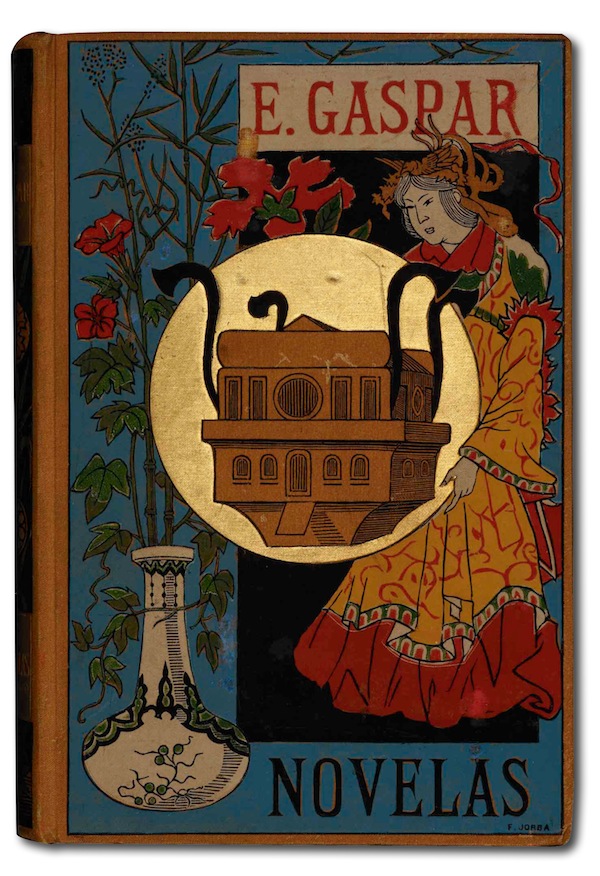
The one I had to check on more than once before I could come back, thus seeing it toward the very end of my time in the show, was Enrique Gaspar’s 1887 story, “El Anacronópete”, collected in Novelas. The reason the book as garnering so much attention is because it’s the oldest known story involving a time machine. The BBC posted a fairly extensive article on the story and its translation back in April.

It is forthcoming in English for the first time in 2012 from Wesleyan University Press as The Time Ship: A Chrononautical Journey, translated by Yolanda Molina-Gavilan and Andrea L Bell. In the meantime, those of you who read Spanish can download a digitized version here.

Good to see so many people at the show!

Out of this World: Science Fiction but Not As You Know It is available to see for free for three more days, including day, at the British Library.

Out of this World: Four Days Left / Frankenstein

Until I started reading up for my short presentation on Lucian and Mary Shelley’s Frankenstein for the “Science Fiction and Religion” panel* at Bradford the other weekend, I had no idea that Shelley had notably revised the text between its first 1818 edition and the better-known 1831 edition.

Small, frequent amendations and revisions** altered the text’s focus towards a much greater concern with Christianity, in particular, giving Victor Frankenstein a greater religious consciousness. Frankenstein, in the later text, refers at various points to a guardian angel, and to an angel of destruction leading him on. Although these need not necessarily have come at the cost of sacrificing descriptions of Frankenstein’s scientific practice, they have, such as a youthful scene in which he experiments with electricity, cut from the later version. Even the references to historical practices of natural magic are revised, in order to cast them in a more negative light.

I was conscious that there were many versions of Frankenstein simply because it has been memorably reworked in film numerous times over the years. I hadn’t realized how much the focus of the story was adjusted in Mary Shelley’s own revisions as well.

Some edition of Frankenstein (offhand, I cannot tell you which one!) is currently on display at the British Library as part of the Out of this World: Science Fiction But Not As You Know It exhibition. You have four days left, including today until 18:00, to see it.

*  See also the contents of the talk which Una McCormack gave, on sf and religion in Dr Who and Star Trek, for the same panel.

** I used the Oxford World’s Classics edition of the 1818 text with its list of changes by Marilyn Butler in Appendix B.

Out of this World: Five Days Left / More’s Utopia

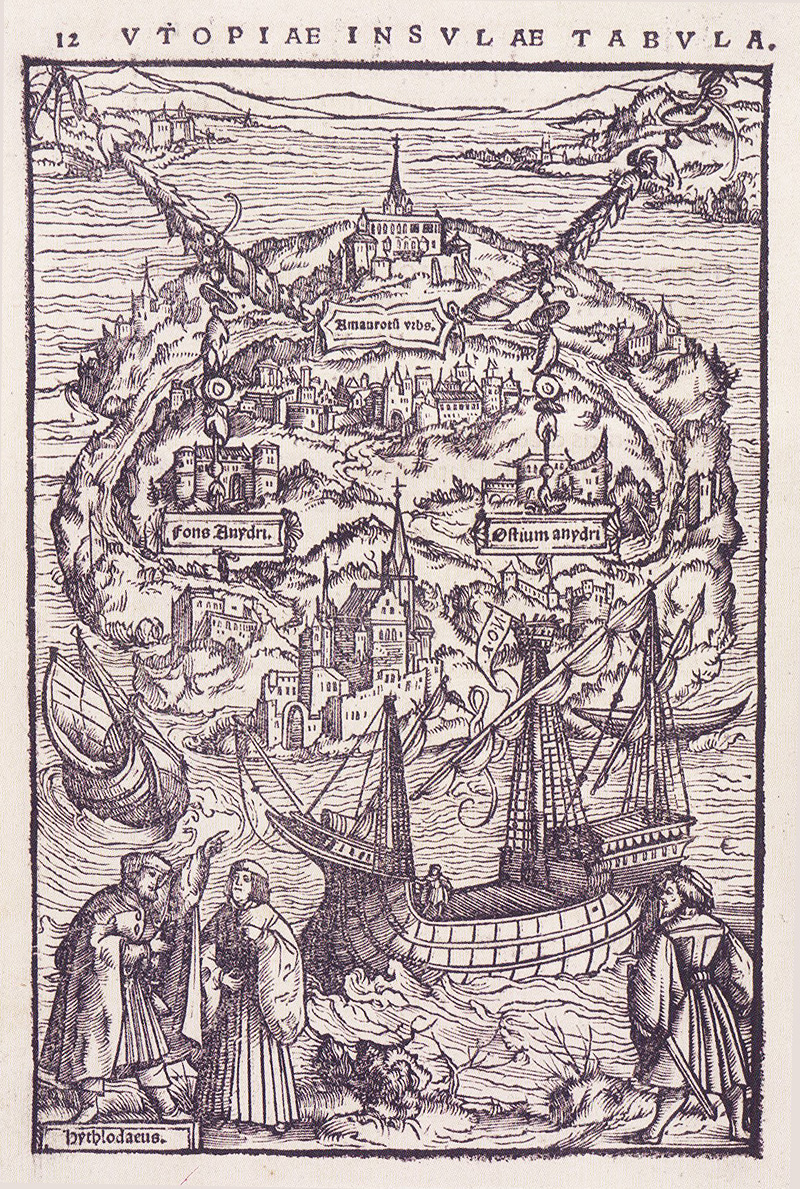
What I love most about Thomas More’s Lucian-inspired (among other sources) text Utopia isn’t the descriptive text, the building of a somewhat egalitarian community, the observations on crafts, the framing narrative, or its dual-purpose as satire. It’s all of the visual world-building which it, in turn, inspired.

There are earlier maps of imaginary places, although I love the ones made for Utopia, this one from 1516this one from 1518 edition, or these later ones. (The 1518 Ambrosius Holbein edition is available online for browsing in its entirety. See also this selection of eighteenth-century illustrations of Utopia.)

But I know of no earlier instance of an alphabet being developed for a fictional world. Either More, or his friend Peter Giles, developed it for the book. You can see the full version of his Utopian alphabet and a sample use of it on the British Library’s website. And, if you really like fictional languages, the alphabet is even available to download as a True Type Font.

Utopia is on display currently at the British Library as part of its Out of this World: Science Fiction But Not As You Know It show which is available, for free, until this Sunday. The library is open until 18:00 today.