In Conversation: Passing the Baton of Egyptian Science Fiction, Post-Arab Spring 

Organized and translated by Emad El-Din Aysha. Emad comments:

This is a roundtable discussion among several members of لجمعية المصرية لأدب الخيال العلمي‎, the Egyptian Society for Science Fiction (ESSF). The ESSF was founded in 2012 shortly after the Egyptian January 2011 revolution. In that moment, a group of people who had largely lost hope of all change in Egyptian life—scientists, academics, artists, writers, poets—felt that everything had changed, and that they could now make a constructive contribution towards building the future. This conversation took place in late 2018, and was conducted predominantly in Arabic. Discussants were Manal Abd Al-Hamid, Ahmed Al-Mahdi, Emad El-Din Aysha, Hosam El-Zembely, Muhammad Naguib Matter, and Kadria Said.

Thank you all for participating. First off, how did you learn of the ESSF and the Shams Al-Ghad [‘Sun of Tomorrow’] series of anthologies?

Muhammad Naguib Matter: Via the internet! I saw an advert for an ESSF salon and I attended it, and since then I haven’t missed an event. For me, something like the ESSF, such a group, used to be pure fantasy. The literary scene here in Egypt is completely void of SF workshops. Yes, there are some cultural salons, like the one in Giza, dedicated to the memory of Nihad Sharif, the dearly departed pioneer of Egyptian science fiction. There’s also a salon for science fiction in Aswan, in southern Egypt. But these events are lacking: they essentially do one thing, which is to host big names in the world of literature to talk about their works. They leave no room at all to learn something. There are no workshops. So that’s what drew me straight away to the ESSF. It’s filling that gap.

Continue reading “In Conversation: Passing the Baton of Egyptian Science Fiction, Post-Arab Spring “

An Interview with Sandra Newman

Sandra PictureSandra Newman’s fourth novel, The Heavens, is just out from Granta and Grove Atlantic. We think it’s a remarkable book, and we’re not alone. The New York Times has called The Heavens “heady and elegant … a chameleon, a strange and beautiful hybrid.” Tor.com says, “How rare and wonderful it is to find a book that surpasses already high expectations.” The Washington Independent Review of Books praises the book for its humour and style, but above all for its knack for portraying the unstable reality of its two central characters. Vector recently got the chance to chat to Sandra about her writing …

Continue reading “An Interview with Sandra Newman”

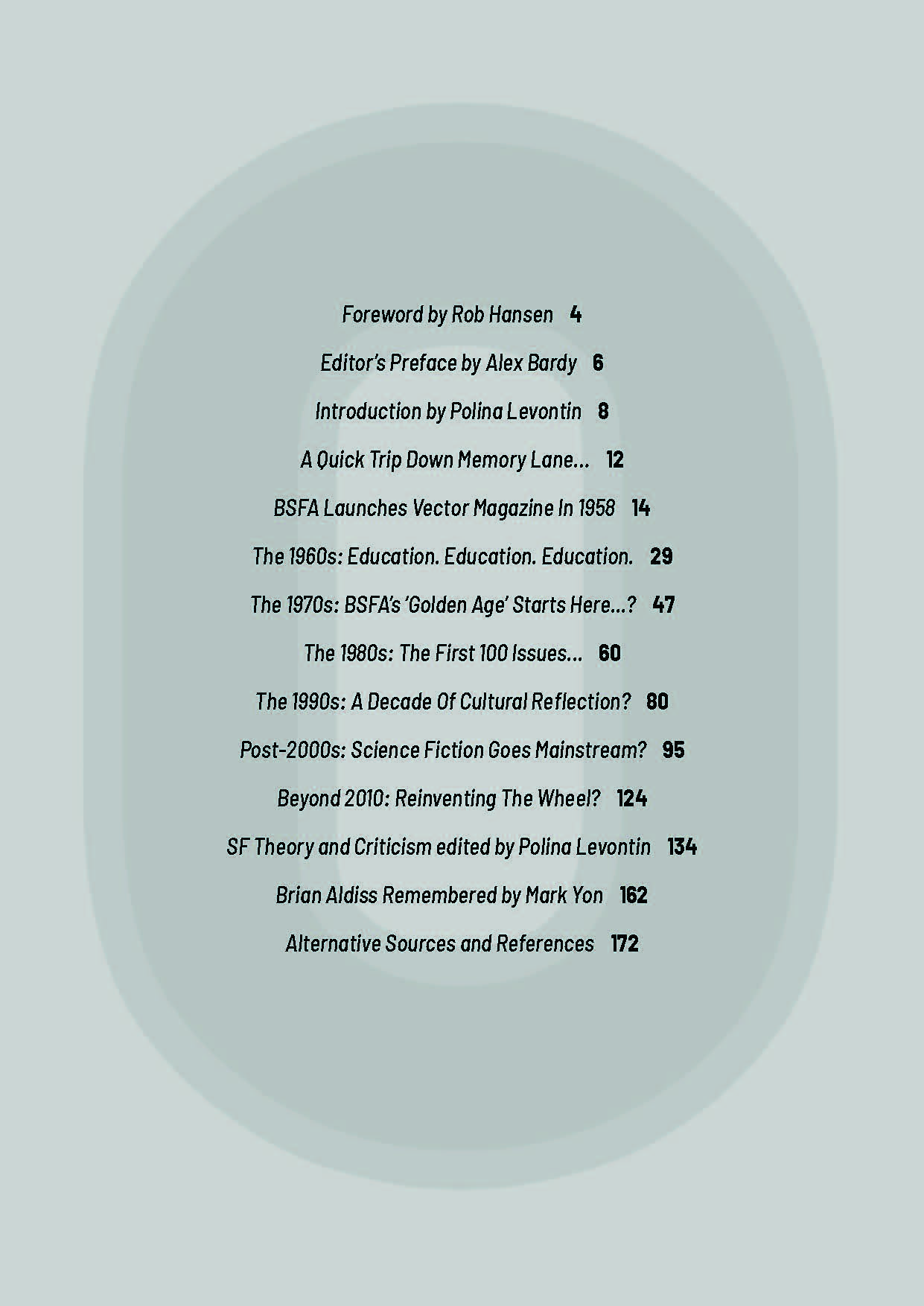
Through the Decades: Sixty Years of the BSFA

Edited by Alex Bardy. First published on behalf of the British Science Fiction Association, 2019.

Cover by Ian Long.


Alex Bardy currently edits Tabletop SPIRIT Magazine — www.tabletopspirit.com

Laurie Penny interview

In August we caught up with Laurie Penny at Nine Worlds in London.

How’s your con?

Oh, well, I’ve always liked Nine Worlds! I missed last year, but that’s the first year I’ve missed. This year, there have been some fantastic panels – the Hidden Histories panel was a favourite. But probably my highlight was playing four hours of The Good Society. It’s a Jane Austen based tabletop RPG. And it was really intense.

Who were you?

I played the heiress, the daughter of the lady of the manor. You know, beset by suitors, having to choose the one that was least awful … and you can’t choose nobody.

Oh my God. What happened?

Well, the misconception is that in Austen novels nothing happens. But imagine if you watched somebody trying to defuse a bomb, and you didn’t know what they were doing …

You’d assume they were doing nothing?

Yes! Every tiny movement in Austen is immensely high stakes. Everything is life or – okay, if not death, then at least permanent disgrace and penury. It’s massively mercenary and exciting. What’s really interesting was watching people who are used to playing swords‑and-sorcery games adapt to those mechanics. And we had a fantastic game as well.

That sounds so cool. I wanted to ask you, actually, about the role of conflict when you write fiction. In a lot of writing advice, we’re told how important conflict is. I wonder what you think about that from a craft perspective?

I mean, I’m not the most accomplished fiction writer. We’re sitting at Nine Worlds here, and I guarantee you that within this three-hundred square metres, there are people …

We stare in quiet awe at a nearby group of people.

I don’t know these people here, but I absolutely guarantee you that there’s probably somebody better to ask just sitting around.

We’re all fucking brilliant.

Everybody’s fucking brilliant. But to answer your question, I guess ‘tension’ is as good a word as ‘conflict.’ If you’re writing about something that’s problematic, something that’s tense …

Continue reading “Laurie Penny interview”

Florence Okoye interview

In August we caught up with Florence Okoye at Nine Worlds in London.

Related image

How are you enjoying the con?

I loved how you get a proper introduction to everything when you come in. They’re so considerate of every single thing, from pronouns, to whether you want to be spoken to, whether you want to be photographed – like, every single thing! And also accessibility allies, which is a fantastic concept. So I’m actually very impressed.

I came fairly late, so I’ve only had time to get to one panel before the one I was on. That was ‘Let The Past Die: Sacrificing Sacred Cows in Star Wars The Last Jedi.’ It was a really interesting panel – a lot of unexpected connections being made by the panellists, some great questions being asked.

So tell us about Afrofutures UK.

It’s a very informal collective I started up in 2015 with some friends, back when I was living in Manchester. We were just like, ‘Well, we’re really interested in Afrofuturism, and nobody around us really talks about it … so let’s just do a thing about it.’ We started with a conference in October 2015, where over a hundred people turned up, which was amazing. It was just the power of Black Tumblr and Twitter at work to be honest.

Since then Afrofutures UK have done conferences and events, working with other organisations, trying to raise discussions at that intersection of race, technology, and speculative fiction from a variety of different perspectives. We tend to make sure that there are practical things like workshops – Arduino and programming or zine making workshops, for instance – really going for an approach that is intersectional, holistic, and creative.

Creating cultural infrastructure, as well as talking about culture that already exists. Awesome. So the theme of our next issue of Vector (#288) is economics. Would you like to talk a bit about Afrofuturism and economics?

I think at some point you realise how much everything is dependent on economic infrastructure. So you might say, okay, we want more Black people to be writers. Then you think, hang on, this is also to do with funding, this is also to do with levels of education attainment, this is also to do with just having spare time. I know plenty of creative people who have literally no time to do their creative work. So if the funding isn’t there, could Black communities provide funding ourselves? Oh, but we don’t have the money either, because we’re historically disenfranchised! And so very quickly you come back to this question of economics and the impact of institutionalised racism.

One thing I’ve found really interesting – really through Tumblr at first – was how Black people have been really good at taking advantage of digital infrastructure. So that might be someone using Patreon to fund their education, for example. And that can be a very practical quid pro quo: ‘You’re giving me money to help with my education, I’m going to make sure I write this number of books, and share them.’ Or that might be somebody using Etsy, and saying clearly, ‘Look, this is a Black-owned business, this is how we work, come and support us.’ So there are all of these interesting things that have happened through the internet. It’s really about people saying, ‘Okay, how do we support each other, in financial terms?’

Circumventing structures that might have systemic bias.

Well, yes, even though we’re still all using those systems in a sense. It’s about doing what we can. And maybe one day, as we have more amazing software developers specialising in financial software, maybe there will be like, say, a Black, co-operative version of PayPal. So we can be like, ‘Actually, yes, this is the right infrastructure to use to share our work.’ Personally, I like to think what you’re seeing now are prototypes.

Right, because the big tech companies that provide this infrastructure are still problematic. They’re still bound up in various ways in systemic racism. But the model is there.

Exactly. The co-operative model is there.

So tell us about what you’ve been working on recently.

Continue reading “Florence Okoye interview”

Dave Hutchinson interview

In August we caught up with Dave Hutchinson at Nine Worlds in London. 

Image result for dave hutchinson

Are you enjoying the con so far?

I always enjoy Nine Worlds. It’s different to Eastercon of course. The emphasis isn’t quite so much on fiction – it’s more multimedia and general culture. Just saw a panel about villains, which was good … that was Adrian Tchaikovsky, Jeannette Ng, Anna Stephens and Mike Brooks.

Oh yeah, I saw that. That was good.

There was some conversation there about the Bond franchise, and the way the villains are frequently ‘othered,’ whether that’s a racialized other, or what-have-you. It struck me that it’s always been that way. Bond was always fighting the Russians, it was always the West versus the East. The Russians disappeared as the geopolitical other, although perhaps that dynamic has returned to some extent. But we are sort of looking for different ‘others.’

And meanwhile, there are increasingly plausible rumours about getting our first Black Bond.

Idris Elba? He’s a terrific actor. He’d be really good. One of the many reasons I hated Prometheus is that it totally wasted him.

I’ll watch anything that’s got him in it.

Y-y-yeah …

Haven’t seen Prometheus though! Maybe that’s …

You may want to draw the line with Prometheus. [Laughs]. It really is a terrible film.

What else do you plan to see at Nine Worlds? Continue reading “Dave Hutchinson interview”

Interview with Larissa Sansour

IntheFuture2
‘In the Future, They Ate From the Finest Porcelain’ by Larissa Sansour and Søren Lind.

Larissa Sansour is an artist working across video, photography, sculpture and installation, often to create political artworks that explore life in Palestine. Our cover image for Vector No. 287 is taken from her recent film installation, ‘In the Future, they Ate from the Finest Porcelain’, a collaboration with the artist Søren Lind.

An interview with Larissa Sansour first appeared in the same issue, Spring 2018.

Vector: In an interview for “Reorient”, you talk about how your piece uses SF to address the ongoing trauma that is both national and personal. The film swerves away from a documentary approach, yet you leave room for it to be interpreted as a realistic narrative by using a framing device common to 19th and early 20th century SF. It is possible to imagine our world just off screen. On the soundtrack we hear a conversation between a woman and her therapist – they can be in the here‑and‑now; the visual narrative of the film can be interpreted to describe an imaginary world of the patient’s mind, her dreams, her hopes, fears and fantasies. Was this ambiguity intentional? Was there a decision not to commit fully to science fiction?

Larissa Sansour: Working with science fiction offers a lot of malleability in how I choose to comment on present day issues. There is a tendency when addressing heated or urgent political topics to fall into an already established and non-flexible discourse. One then generally has to accept the premise of the arguments that preceded your contribution. Science fiction helps me posit a new equation in which a new approach to can be formulated. So, the trauma, fear and fantasies are intended to occupy the blurry space between fantasy and reality and, like in most of my work, to question the basis of our understanding of what reality means. In In the Future They Ate From the Finest Porcelain, this focus is very much on historical narratives, and how much of that is really based on truth value.

The anachronism in the film is also very intentional. It is hard to talk about the Palestinian trauma without addressing several tenses. The Palestinian psyche seems to be planted in the catastrophic events of 1948 and is tied to a constant projection of the future, yet the present is in a constant limbo. Continue reading “Interview with Larissa Sansour”

Queer Muslim Futurism: Alif Para La Revolución

Imagining a Queer Muslim Futurism 

From the interview with Zulfikar Ali Bhutto [GARAGE]

What are you working on right now?
I’m working on a few new projects, including Queer Muslim Futurism, which is about creating future queer landscapes through a Muslim lens. The narrative is about my drag character who, as a rebel leader, talks about contemporary politics in a future that signals a different dimension. This is a world in which the marginalized fights back. I create future guerrilla Muslim drag warriors on the front of resistance and blur the line between a revolutionary and a terrorist. The gaze of the Muslim male subject is queered, not in a docile way but to challenge the Western perspective of Muslim maleness. I’m doing films and performances in which gender and sexuality are undefined and identities are left unclear.

via Queer Muslim Futurism: Alif Para La Revolución

SF and the future of security: an interview with Ping Zheng

Defiant Today
‘Defiant Today’ Phil Jones

In late December 2017, a group of writers and scholars of SF, scientists and technologists, and defence analysts and policymakers, gathered at Dstl (UK government’s defence science and technology laboratory) in Salisbury to explore science fiction’s contribution to defence policy. Vector caught up with Dr Ping Zheng from Canterbury Christ Church University Business School, to ask her about her impressions of the day, and a few other things …

During the first breakout session, you were in the Human Behaviour in Smart Environments group. How did that go?

ping 1
Dr Ping Zheng

We had some inspiring discussions about how humans may react in smart environments. I think the group dynamics probably extended the scope of planned discussions, and allowed us to engage in more diversified discourse, ranging from individual perspectives, to emergent impacts at a societal level, and also to policy perspectives. For example, two prominent issues were debated: national and cultural differences, and ethical concerns such as privacy.

Perhaps the value of events like these is that you might discover that your original questions can be re-framed, or that your stakeholders are not precisely who you imagined them to be. Your other breakout session was ‘Defence (In)efficiency: What Does the Future Hold?’?

Continue reading “SF and the future of security: an interview with Ping Zheng”

From our archive: An interview with Saul Williams by Richard Howard

slamSaul Williams is a poet, hip-hop M.C., producer and actor who first came to prominence through his victory at the poetry Grand Slam at the Nuyorican Poets Café in 1996. This event kick-started an acting career for Williams with the lead role in the feature film Slam in 1998, and a music career in which Williams began to blend his poetry with his love of hip-hop. What makes Williams’ work interesting from a science fiction standpoint is the obvious affinity he has with the genre, evident in his lyrics and the soundscapes that he chooses to rhyme over. From the outset, Williams wrote and produced with a speculative bent. In the song ‘Ohm’ from 1998’s Lyricist Lounge compilation, Williams announced ‘I am no Earthling, I drink moonshine on Mars/And mistake meteors for stars ‘cause I can’t hold my liquor/But I can hold my breath and ascend like wind to the black hole/And play galaxaphones on the fire escapes of your soul’. The glimmering production on ‘Ohm’ is no less science fictional, especially as it accelerates at around the three-minute mark.

Continue reading “From our archive: An interview with Saul Williams by Richard Howard”