I Went Looking for AfroSF 

In this article, Eugen Bacon reflects on her journey of discovery into AfroSF. Meanwhile, Ivor W. Hartmann’s groundbreaking AfroSF anthologies are currently included in the African Speculative Fiction bundle from Story Bundle.

By Eugen Bacon

It was a love and hate relationship with M. The brusque and direct nature of this editorial colleague of mine every so often came across as pomposity, and I knee-jerked. So much that I nearly fell in wonder when M approached me asking for a favour. 

“How about a pitch?” he said. “I’ve seen this AfroSF thing on Amazon a couple of times, it would be great to write an article.” 

M was offering an olive branch. He wanted me to write for his nonfiction section of a popular magazine. And I had just the title for this piece: “What is AfroSF?” To put it in context, this was a few years ago. 

It was a journey of discovery that led me to a community. The African Australian in me was curious to unearth AfroSF, an inquisitive quest to decipher this literary movement, this subgenre of science fiction—what was it exactly? Yes, I anticipated that it had some derivation from hard or soft science fiction, cyberpunk, mutant fiction, dystopian or utopian fiction, pulp, space opera, and the like, and that it had something to do with Africa. What else would I discover?

An online search steered me to a 406-paged anthology published in December 2012 by StoryTime, a micro African press dedicated to publishing short fiction by emerging and established African writers. The StoryTime magazine was formed in 2007 in response to a deficit of African literary magazines.

Picture1

Some readers described it as a ‘ground-breaking anthology’ of diversity and hope, an ‘African Genesis’ that was intense and varied in its fresh viewpoints. Editor and publisher Ivor W. Hartmann spoke of his dream for an anthology of science fiction by African writers, and his realisation of this vision in a call for submissions that birthed original stories published as AfroSF. Illuminating his fascination with the collection, Hartmann said, ‘SciFi is the only genre that enables African writers to envision a future from our African perspective.’

Bravo, I thought of this Zimbabwean writer, editor, publisher, visual artist and author of Mr Goop (2010)—an award-winning post-apocalyptic short story of a boy who struggles with coming-of-age concerns like bullies and scholarly performance, in a science fiction society called the United States of Africa, guarded by robots and chaperoned by humanoid genoforms.

Continue reading “I Went Looking for AfroSF “

Ten Literary Plagues

Ten literary plagues (and plenty of honourable mentions).

Screenshot 2020-06-05 at 12.41.05
Michel Foucault, Abnormal: Lectures at the College de France 1974-1975

This list has spread here from its original posting at All That Is Solid Melts Into Argh.

Image result for thackery t lambshead diseases

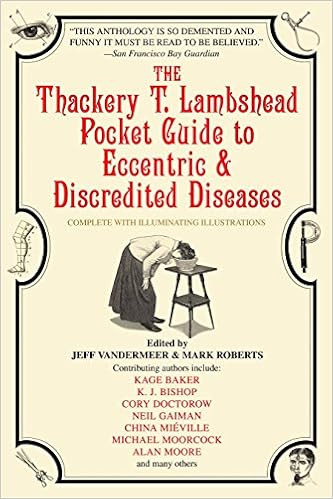
10) Hsing’s Spontaneous Self-Flaying Sarcoma, documented by Liz Williams in The Thackery T. Lambshead Pocket Guide to Eccentric and Discredited Diseases, ed. Jeff VanderMeer and Mark Roberts.

A day or so later, the outer layer of the epidermis splits at the temple into a series of lotus-like petals, apparently causing the victim to force his/her head into the nearest narrow gap (such as a window frame) rather in the manner of a snake attempting to aid the shedding of its skin. Rejecting all offers of help and attempts at restraint, the victim bloodlessly sloughs the skin, ‘scrolling it down the torso and limbs in the manner of a tantalizingly unrolled silk stocking’ (Mudthumper, p.1168).

OK, we’re starting with one that’s not really contagious (as far as I know). So it only manages to scraape its way onto the top ten. But it can also be considered a calling card for Thackery’s, which is a good source of plagues generally. But is whimsy what we need now? I’m not sure. Continue reading “Ten Literary Plagues”

Jonathan Holloway’s The Time Machine

With H.G. Wells’s classic and hugely influential work The Time Machine celebrating its 125th anniversary, Creation Theatre has teamed up with Jonathan Holloway, The London Library, and a host of consultant scientists and experts from The Wellcome Trust, to create an immersive theatrical experience inspired by Wells’s work. The Time Machine is on Wednesday through Sunday till the 5th of April at The London Library, with a future run taking place in Oxford. We asked playwright Jonathan Holloway to reflect on his process for Vector. Here’s what he had to say … 

Jonathan Holloway in The London Library.jpg
Jonathan Holloway

Creation’s production of THE TIME MACHINE at the London Library is billed as an ‘adaptation’. That’s not really quite what it is. When I was asked to do it, I hadn’t re-read the book for more than forty years, and on doing so, my heart sank.  There isn’t really enough story to allow for an ‘adaptation’ as such. To make something that was going to be worthwhile, the task needed a different approach. The original is basically a yarn about a man who builds a time machine in his conservatory, travels forwards in time, finds the human race has evolved into two halves, one of which lives underground and eats those who live on the surface, then travels back to the present appalled by what he found. The theatre can’t do what a movie can – it doesn’t present ‘actuality’, instead it’s about a collusive relationship with the audience which forefronts ideas. We don’t necessarily ‘show’ it, we describe it, and you create the pictures in your head.  

Copy of IMG_6528.jpg
On the set of The Time Machine (Photo by Richard Budd)

Creation Theatre Company put me in touch with the Wellcome Centre in Oxford and I visited on several occasions, meeting scientists, philosophers and ethicists, and hearing what they had to say about the future – over roughly the next fifty years. So, inspired – as it were – by H.G. Wells’ THE TIME MACHINE, I penned a journey through the labyrinth of the iconic London Library, where the author was a member, and imagined a future in which time travel has generated thousands of parallel universes.  Effectively, I rather unceremoniously pulled apart this classic sci-fi novel, re-invented it, and pieced it back together to create a world in which the present is endlessly shifting, and the future is strange and uncertain. Travellers have tinkered with timelines causing people’s names, faces and indeed the colour of their socks to change without warning.  It is a very ‘theatrical’ evening which requires that we suspend our disbelief and enter into the fanciful creation of an alien dramatic world. Humour sits alongside appalling predictions. It’s a hybrid kind-of show wherein dramatic situations surrender ground to an event that alternates between being a play and something approximating to a TED talk. The script was pretty much done by the end of October, but alarmingly some of the material that seemed farfetched back then concerning climate change and the possible threat of pandemics has subsequently appeared on our TV’s in the form of Australian wild-fires and the spread of Coronavirus. Wells has offered myself and Creation an opportunity to work the fantasy of time travel into a theatrical event that now sometimes feels more like a documentary.

The audience are divided into groups, each of which is accompanied by a time travelling guide.  This character bears more than a passing resemblance to Wells’ protagonist – The Time Traveller –  and s/he leads our groups through the wonderfully atmospheric interior of the London Library, where they meet other characters, see projected images and listen to recorded speech as if it’s leaking from the many thousands of books on the shelves. The logistics of a show like this are themselves mind-bending. Each group will see the same show, but staggered, as they process in series from room to room. Each group must be kept separate from the others. It’s a theatrical Rubric’s Cube which, thank Heavens, is organised by a wonderful director called Natasha Rickman.

Wells’ THE TIME MACHINE remains one of the great science fiction novels of all time. In this production we have to demonstrate how important a thinker like Wells is to the fabric of how we see ourselves, the purpose we find in existence and what we bequeath to our children. So, I’d ask you please to leave your preconceptions at the door. Yes, you will receive something of Well’s brown furniture and tobacco-soaked club-land atmospherics … but more importantly, we hope you may feel a connection being made between the socialist author and today’s activists.

Personally I can’t believe my luck as I add THE TIME MACHINE to a list of adaptations of great science fiction I have done for the theatre and the BBC including Alfred Bester’s TIGER TIGER, Philip K. Dick’s DO ANDROIDS DREAM OF ELECTRIC SHEEP, Waugh’s BRAVE NEW WORLD and Orwell’s NINETEEN EIGHTY-FOUR.

Terminator Dark Fate reviewed

By Dev Agarwal

Image result for terminator dark fate

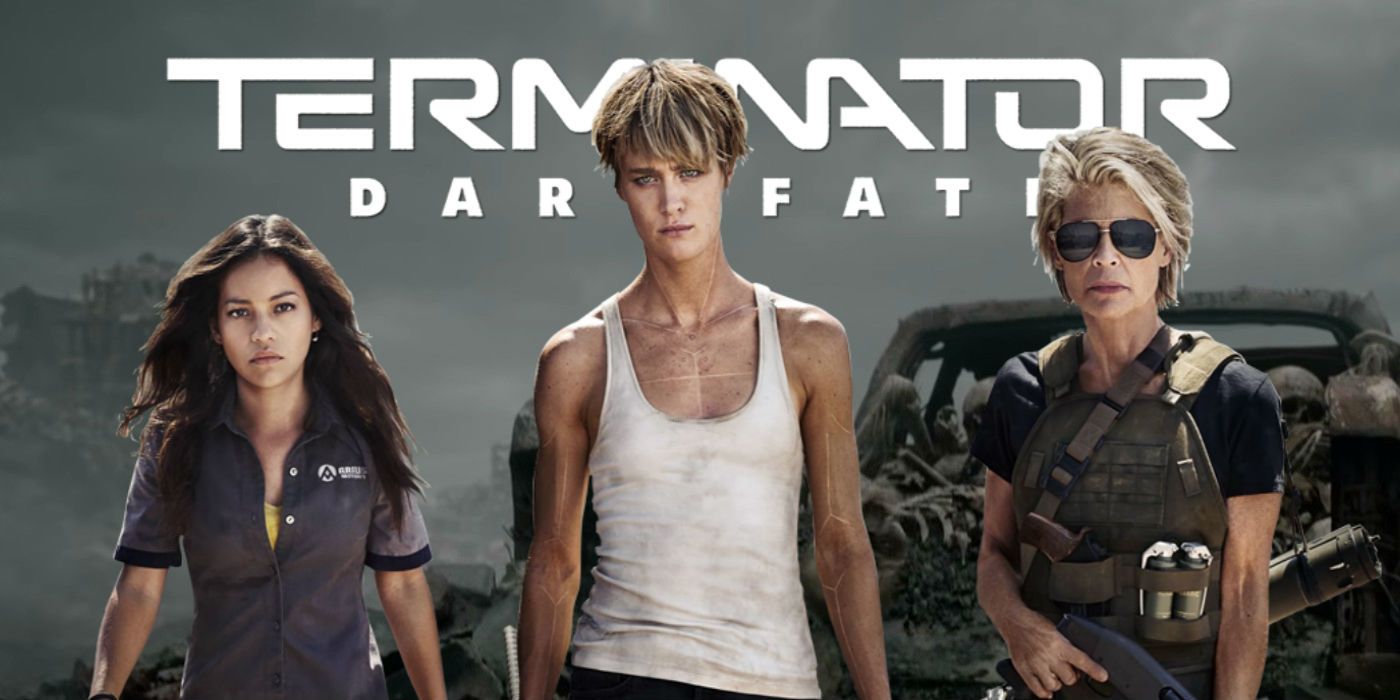
I went to see Terminator Dark Fate with my regular film going friend, Nik.  Despite going to the cinema together since we were kids, we worked out that this was the first time we’d been to see a Terminator film together in the cinema.  Given Dark Fate’s poor box office and the fact that Schwarzenegger is 72 years old, this felt like our last chance saloon.  

I’ll state my positions now. Firstly, it’s impossible to discuss this film without spoilers, so don’t read further if you don’t want any.  Second, I’m a big fan of the original film and have watched it many times. I had been disappointed in different ways by many of the films in the series and I had high hopes of Dark Fate.  It came with a pedigree of James Cameron’s blessing, the strategic rejection of the dead ends of earlier films, and it was made by the director behind the popular film, Deadpool, Tim Miller.

Like most franchises that have survived decades, The Terminator films are no longer about one single thing, they combine and rework themes and cultural and social issues.  While a principal concern is time travel and the paradox of changing the present by altering the past, the films are also commentaries on machine intelligence, nuclear destruction and individuals striving against a faceless powerful enemy.  

Continue reading “Terminator Dark Fate reviewed”

Ten Years, Ten Books

By Paul Kincaid.

What a long strange decade it has been. Ten years ago it looked as if social democracy was in the ascendant around the world; today, populist, nationalist, right-wing governments are in power in Britain, the USA, Australia, Israel, India, Hungary, Italy and elsewhere. The world has become a scary, unwelcoming, unpleasant place to live. Politicians took the voters for granted, and voters became tired and disdainful of the politicians, so real life is coming more and more to resemble the dystopias we used to read. Which may be why there are no dystopias on my list of the ten books that I have chosen as representative of the last ten years in science fiction.

Which is not to suggest that politics is absent from the list. Far from it, in fact I begin with what is, I think, the most politically acute novel science fiction has produced this decade: Europe in Autumn by Dave Hutchinson (2014). Published two years before the Brexit referendum, it captures with uncanny prescience the mood of fragmentation and disintegration that Brexit embodies. Startlingly, the three subsequent volumes, which I don’t think Hutchinson had even conceived at the time he wrote the first book, maintain the awareness and the quality of the first. And in the final volume, Europe at Dawn (2018), there is a passage set among refugees on a Greek island that perfectly encapsulates the damage that fear of the other has done to Europe.

Continue reading “Ten Years, Ten Books”

2019

By Ian R. MacLeod

It was a pleasure and a privilege to attend this year’s Worldcon in Dublin, and find myself surrounded by friendly, intelligent and well-informed people from across the globe, and in a European city which has clearly risen far above the sour heritage of its theocratic and colonial past. It was also great to meet the many Americans wearing I’m From The USA But I Didn’t Vote For Trump ribbons on their lanyards. What a shame so much of the rest of humanity doesn’t seem to be heading along the same path!

SF for me has always had its heart in the liberal values of the enlightenment, but perhaps right now, with truth seemingly regarded as a mere matter of opinion, and science as just another way of looking at the world, and with our planet heading toward ecological catastrophe as us humans stand passively by in a way which would never convince in any self-respecting novel or disaster movie, it’s time to speak to the future and the things that should matter with an even stronger and angrier voice. If this isn’t the signal for a new New Wave or Golden Age in the genre, I don’t know when we’ll ever get one.

Vector 290

Vector 290 is out:

Vector 290 version 8M

The last two issues of Vector had themes — #288’s ‘Future Economics’ and #289’s ‘African and Afrodiasporic SF’ — but this issue is once more a Deck of Many Things. Andrew Wallace reveals all about judging the Clarke Award. Christina Scholz recounts linguistic revolutions in Milton and Miéville. Stephen Baxter reflects on AI and Thunderbirds and Paul Kincaid discusses the late great Iain [M.] Banks. Katie Stone reviews Sophie Lewis’s Full Surrogacy Now, while Vector Recommends brings you Paul Graham Raven on Nick Harkaway’s Gnomon and Nick Hubble on Ursula K. Le Guin’s The Left Hand of Darkness. We’ve got interviews with Emma Newman and Yoon Ha Lee, and glimpses from SF fandom around the world with reports from WorldCon 2019 and IceCon 2018. We hope you enjoy. 

Cover by Andrea Morreau.

A personal perspective on South African Comics: From Superheroes to Ordinary heroes

By Nick Wood 

The sun darkened and the sky burned. 

Sirens and smoke filled the air. 

I stood in my family’s garden in Pinelands, Cape Town, watching the red horizon blaze and shift, as the neighbouring black townships of Athlone, Langa, and Nyanga were consumed by bullets, tear-gas, and flames. The Soweto Uprising had swept down from Jo’burg in 1976, from a nationwide youth protest opposing the teaching of Afrikaans in schools – which had been met with brutal police killings.

To me, then, as a young white teenage male, facing military conscription, it was as if the whole world could go up in flames.

Not known to me at the time, though, was that the destruction in Soweto included the burning down of the publishing house Africomic. Africomic was the home of South Africa’s first black comics superhero, Mighty Man. 

The Mighty Man stories unravelled over seventeen issues, featuring the exploits of a policeman called Danny Ndhlomo, who was injected with a secret alien serum. The serum gave him superhuman strength and speed … and he became Mighty Man. 

Superheroes often have secret identities. In the case of Mighty Man, there was a lot more than met the eye. Mighty Man was funded by the Apartheid government, with money shifted from the Defence budget [1].

Continue reading “A personal perspective on South African Comics: From Superheroes to Ordinary heroes”