As technology gets smarter and smarter, the human brain is forced to reflect on itself in the mirror of the future and question what value it will have in a world in which wet tech, cerebral hacking and commodified consciousness could reign. A world not of enhancement or augmentation, but replacement. Authors will enquire what the future of our most precious organ will be, while they still have one.Virtual Futures
Bea meets Aaron. He’s intelligent, handsome, makes her laugh and, most importantly, has a high rating on his genetic profile. What’s not to like?
Char is on the brink of landing her dream job and has big plans to start a family – but her blood rating threatens it all.
In a world where future happiness depends on a single, inescapable blood test – which dictates everything from credit rating to dating prospects – how far will people go to beat the system and let nature take its course?
Apparently, some of the technologies that The Phlebotomist presupposes are already here, it was disconcerting noticing the Tube ad for a blood testing company called Medichecks right after seeing the play:
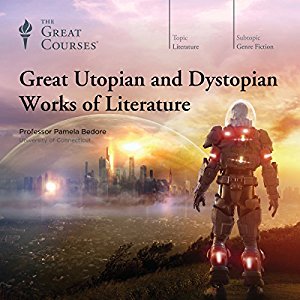
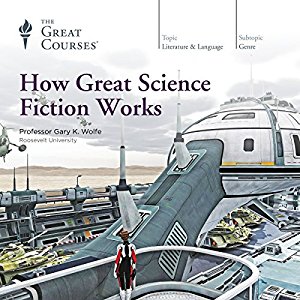
Here are a few of the recent history of science fiction overviews that are available in audio format.
Gary K. Wolfe’s 24-lecture series as also available as video lectures. David Seed’s introduction is the most succinct – it is about 5 hours as opposed to about 12 hours for each of ‘The Great Courses’ series.
Glasgow-based DJ Sophie Reilly, aka ‘Sofay’, talks about her love of science fiction and the connections that exist between some of her favourite records and novels such as Ursula Le Guin’s ‘The Left Hand of Darkness’ and Stanislaw Lem’s ‘Solaris’ (the interview was removed from YouTube at the request of the artist).
You can listen to Sophie’s set for NTS radio on Soundcloud:
The call opens on 19th February and ends on 1st April 2018.
Poets are invited to send in up to 3 poems about the future, to be considered for an anthology launching in January 2019. The anthology will be edited by Suzannah Evans and Tom Sastry.
The guidelines explain: ‘A future poem could be a warning, a protest, a promise of salvation or a prediction of the end of the world. It could be a short history of everything or a snapshot from the 25th century kitchen sink.’
Suzannah Evans, editor, says: ‘I’d like to read poems that are: inventive, paranoid, animatronic, intergalactic, revolutionary and empathetic. There’s definitely room for darkness. I’ve got a lot of time for poems that seem silly but are deadly serious, and vice versa, and a special respect for poems which manage to be both at once.’
Tom Sastry, editor, adds: ‘I’m excited to read poems about imaginary catastrophes, dystopian nightmares and the glimpse our strangest fears give us into our craziest selves. I hope the call will attract funny poems, mythic poems, loud and quiet poems and poems in which ridiculous fears have real consequences.’
Team Zeus at Worldcon 75 in Helsinki. From left to right: Stanley Chen Qiufan, Adrian Tchaikovsky, Nicolas Cheetham, Baoshu, Liu Cixin and Ken Liu.
Head of Zeus is an independent publishing house, based in London. It started publishing in 2012 and won Independent Publisher of the Year in 2017.
In the essay ‘Journey to the West’ published in SFMagazine [click on the link to download the issue] Head Of Zeus publisher Nicolas Cheetham points out that Chinese genre fiction arrived on Western markets only in the last couple of years – it was not until 2015 that a Hugo award was won by a work that has been translated from the Chinese (or any other language). At the same time, he asserts that SF is the most universal of the literary genres, quoting Liu Cixin:
SF is the most global, the most universal storytelling vessel, with the capability to be understood by all cultures. SF novels are concerned with problems faced by all of humanity. Crises in SF usually threaten humanity as a whole. It is a unique and treasurable trait inherent in the genre – that the human race is perceived as a single entity, undivided.
Why then is genre fiction lagging behind literary fiction in achieving a globalised presence? In tracing the history of Weltliteratur, n+1 contends that ‘certain texts have always circulated among geographically broad but socioeconomically thin strata’. Is a taste for globalism something that is more characteristic of the literary fiction readership rather than those who read genre fiction? Although genre boundaries between literary fiction and SF have become more permeable and fuzzier than in the past, is SF fandom demographically different from the consumers of literary fiction, or at the very least, less globalised?
Nicolas Cheetham mentions several pre-conditions for Chinese SF entrance to the West: an emergence of local fandom, revival of local critical SF journals, and the establishment of a financially successful local publishing industry. All of these of course did not emerge independently from the economic growth in China, a society that in recent decades started investing heavily in science and technology research, transforming itself into a world leader in tackling global crises such as a climate change. Looking to other global regions, such as sub-Saharan Africa, would the same pre-conditions apply? Namely, would the local fandom, criticism traditions and publishing houses need to reach a critical mass before we can expect to read a greater offering of African SF in the West, in translation or otherwise? Recently established organisations such as the African Speculative Fiction Society, as well as a myriad of new journals that publish African SF and criticism, such as Omenana, BrittlePaper, Chimurenga, Saraba and Jalada, augurs well for African SF. Hopefully, pioneering publishers like the Head Of Zeus will be bringing more of World SF to UK markets – Nicholas Cheetham is certainly interested in science fiction writers from various countries in Africa. Nigeria, Kenya, Uganda and SA are among the most prolific in terms of SF, for more information see Geoff Ryman’s brilliant series of interviews with 100 African writers of science fiction and fantasy.
But who should define the global limits of the genre, especially when the power to impose a definition is centred in the Global North? The definition of the sf genre varies across time and cultures; various writers (e.g. Dilman Dilla, Nisi Shawl, Nnedi Okorafor) report contesting the definition of SF with the Western publishing and film industry whenever spirits or other traditional beliefs are in the fabric of the narrative.
In the Head Of Zeus SFMagazine, Nicolas Cheetham raises an important question ‘What is Chinese SF?’ and shows the pitfalls of essentialising – how does a publisher balance the reader’s expectations of ‘pleasingly exotic colour’ with the needs of the writers to be free from having to ‘perform otherness’ in order to get a publishing deal in the West?
Readers in the West are limited (as far as having access to a wider range of voices) by the lack of diversity within the publishing industry, editors and critics, and creative writing programs. This problem is particularly urgent in SF, since the genre is concerned with the imaginaries of humanity’s future. Missing African writers is an especially regrettable situation since the future of humanity depends very much on what will happen on the continent which is projected to contain 40% of the global population by 2100.
On the final day of this year’s Gallifrey One convention in Los Angeles, fifteen women stepped on to the main stage for a monster of a panel titled “Gallifrey Waits No More.” […] What occurred over the next hour was an experience that was simultaneously harrowing and cathartic as a #MeToo moment unfolded on stage.
Check out the expanded and updated website of the African Speculative Fiction Society here.
“The ASFS will provide a place where writers, readers, and scholars can come together to find information, connect with each other, and act as watchdogs for their collective interests.”
Chinelo Onwualu, chief spokesperson, ASFS.
The African Speculative Fiction Society is an organization of African
Writers
Editors
Comic and graphic artists
Filmmakers
in the fields of speculative fiction such as fantasy, science fiction, stories that draw on traditions, horror and philosophical fiction.
Members nominate any published work for one of the four Nommo Awards. They are given free access to many of the nominated works. And they vote for the winners of the Nommo awards.
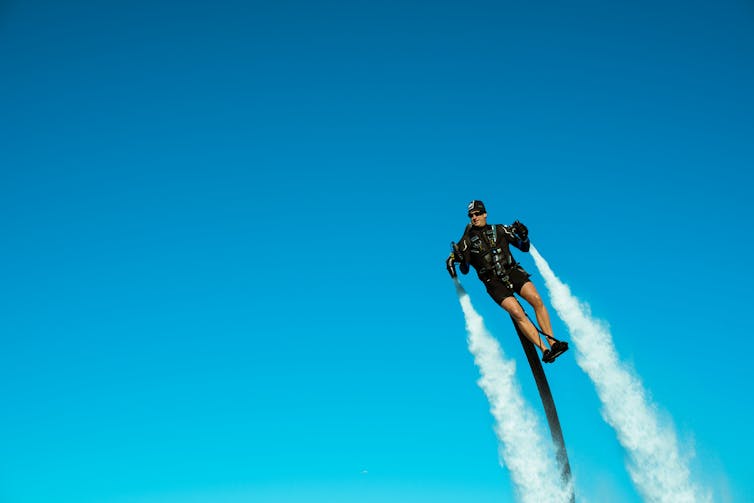
The race is on to bring a jetpack to market. New Zealand-based Martin Aircraft has a jetpack which is due to go on sale this year and US-based JetPack Aviation is working on a more streamlined offering. So aviation junkies with the cash to spare will soon be able to get their hands on what has long been the preserve of science fiction.
Jetpacks follow a long line of sci-fi inspired innovation. E M Forster’s novel The Machine Stops is often credited as a source of inspiration for, or at least a predictor of, the internet. The idea of 3D printing was foreshadowed in numerous books and, most famously, in Star Trek in the guise of “replicators”. Then you have more frivolous ideas such as the self-lacing shoes worn by Mart McFly in Back to the Future, which shoemaker Nike plan to bring out this year.





 vector-bsfa.com