The British Science Fiction Association holds regular events in London, usually on the last Wednesday of the month, at the Artillery Arms near Old Street. These events are free, and open to members and non-members alike. Keep an eye on the BSFA website for news of future events. In September, award-winning author Lavie Tidhar was interviewed by critic and editor Konrad Walewski.
Andrew Wallace engages the metadata…
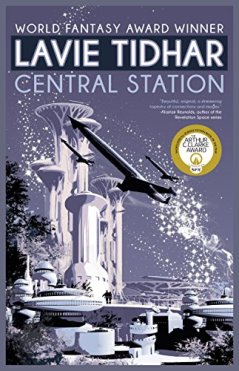 Lavie Tidhar’s style is well-suited to original narrative forms that subvert Western genre fiction tropes, while still engaging with them almost as props. For example, he says this year’s Clarke Award-nominated ‘Central Station’ gave him the opportunity to employ Golden Age imagery, like the action around a spaceport, and then let it fade into the background as if it’s being ignored. However, it’s an approach that can backfire. Another twentieth-century genre that appeals to Lavie is noir detective fiction, and he recalls a synopsis he wrote using the idea of a gumshoe searching for his niece, only for the story’s editor to point out that Lavie had forgotten to include the fate of the girl at any point in the story.
The noir angle could be the reason Lavie has been linked with cyberpunk, although he considers the association inaccurate, describing ‘Neuromancer’ as ‘Chandler with computers’. He decries the ten years between that novel and ‘Snow Crash’, in which people emulated what they thought was a new formula for success. Also, there is nothing hard-boiled about ‘Central Station’. While cyberpunk is about cool, hi-tech cowboys saving the world from a rogue AI, Lavie’s books are about people who get the kids to school and then go to work defeating the AI. Indeed, he sees ‘Central Station’ as a romance novel; its wedding-and-funeral climax more Richard Curtis than William Gibson.
 vector-bsfa.com