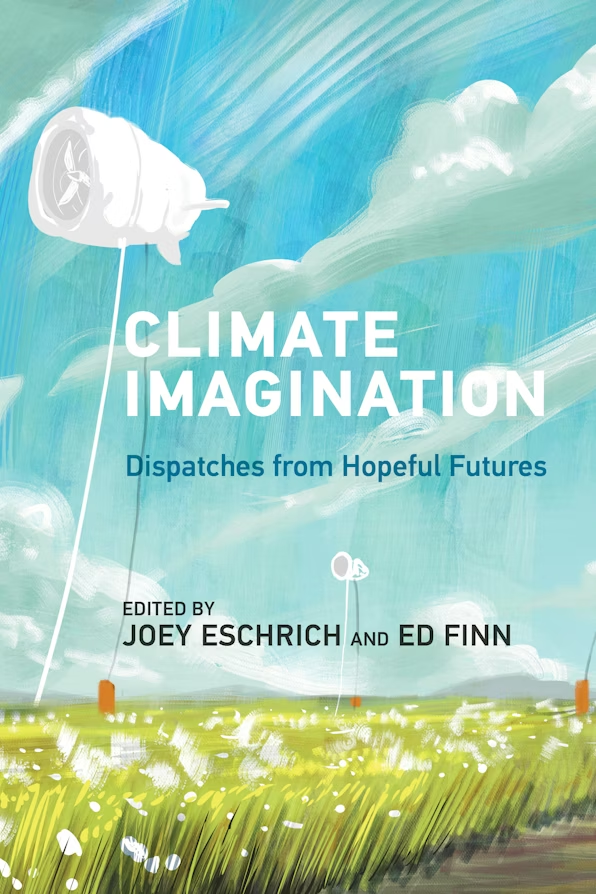
Climate Imagination: Dispatches from Hopeful Futures edited by Joey Eschrich and Ed Finn has 23 chapters with a preface, introduction, and afterword. The book started its life as a part of The Climate Action Almanac. “The book grew out of the Climate Imagination Fellowship, started at Arizona State University’s Center for Science and the Imagination in 2021” (2026:ix). In its preface, the book announces that it foregrounds hopeful stories about climate imagination. The dominant climate narrative, it argues, is full of doom stories, which leave people feeling ‘hopeless, helpless, and disillusioned’ (Eschrich and Finn 2025: ix). This stand echoes Mark Fisher’s Capitalist Realism:Is There No Alternative?(2014). For Fisher, fear and cynicism do not inspire bold thinking; they form a bedrock of conformity and conservatism that hampers action and change. For Fisher, hopefulness changes the situation from one in which nothing can happen to one that allows for the actualisation of possibilities. Fisher’s stand can be traced to a theorist such as Fredric Jameson (2005), and further back, to Thomas More, the first known utopian novelist.
However, the word ‘utopia’ was hardly mentioned in the introduction or the preface framing Climate Imagination: Dispatches from Hopeful Future, and it appears sparingly throughout the collection. This may be intended or unintended. However, there could be a good reason why the book was framed this way. Utopia has a bad reputation. An early criticism of it could be seen from Karl Marx in Manifesto of the Communist Party published in 1848. Marx accuses utopia of lacking materialism. More recently, Karl Popper (1945) links the concept of utopia to totalitarianism. As Julien Kloeg notes, ‘Utopianism’s bad reputation is partly due to its association with the attempt to realize communism in the Soviet’ as such it is considered ‘politically dangerous’ (2016: 451). Current criticism on Utopia is such that were directed to hopeful climate narrative such as carbon removal technology. Matt Simon (2023:online) argues that “carbon removal might even encourage the continued burning of fossil fuels, if countries can say they’re sucking carbon out of the atmosphere to offset their emissions” they could end up burning more fossil fuels instead of looking for clean energy. This, in turn, sustains the capitalist structure that privileges fossil fuel consumption. Perhaps these criticisms have led the collection to shy away from exploring the book’s connection to utopian unconsciousness, even though the book draws heavily from this tradition. Unconscious here “consists of those repressed impulses, desires, drives, wishes… that the conscious mind does not care to acknowledge” (Mark Bould 2021:15). Utopian unconsciousness is defined here as those hidden utopian ideological impulses of a text.
Climate Imagination: Dispatches from Hopeful Futures is a mixed bag of memoirs, interviews, scholarly articles, and fiction. This disparity in the creative expressions employed by the authors in the book, luckily, does not result in a disjointed book. I think there is something symbolic about it, reflected in both the form and the content of the collection, namely: that the book champions diversity. Diversity in its form allows it to incorporate different styles of artistic expression under the umbrella of a single edited volume. This, in a way, is a stand it takes outside the totalitarian accusation levelled against the utopian unconscious in which plurality of forms, ambitions and aspirations is suppressed under the so-called singularity of purpose termed the ‘common good.’ A character in “City of Choice” by Gu Shi, translated by Ken Liu, a story within this anthology being reviewed here shares this sentiment thus ‘Should I really go forward? All choices come with costs. If the cost is the lives of those who are powerless, is it right to sacrifice them in the name of some greater “good”? (113). “City of Choice” is a type of story you read and reread, and it makes you angry and happy and angry again because life is messy and every decision comes with a cost, including the decision to freedom.
It is not only the style of the book that is diverse; the contributors come from different localities of the globe: “China to Wales, Germany to Nigeria, Sri Lanka to Mexico, Malaysia, India, the United States, and more” (Eschrich and Finn 2025:ix) to articulate different climate challenges of what is being done, what could be done, and the potential ‘becomings’ of climatic futures. A lot of the climatic ‘becomings’ shared by a good number of the authors in the collection are akin to what Bodhisattva Chattopadhyay and Jade Taylor call ‘co-futurism.’ Taylor defines it as a future that is interconnected and overlaps, also recognising “ethnic specific and regional specific futurisms” (2024: 1). Taylor’s definition is not specific to climate futurism; the collection, which focuses on climate, is part of futurism in general.
My first direct encounter with the Sauútiverse was in 2022 when, at the Ake Books and Arts Festival in Lagos, panellists Wole Talabi, Dare Segun Falowo, Stephen Embleton, and Cheryl Ntumy, members of the Sauúti Collective, introduced the shared world project. I sat there in the audience, watching as the lights dimmed and a video of the Sauúti creation myth was played to us. Over the animated visuals was an echoing voice apparently merged from the real voices of the Sauúti founding members. This voice, supposedly that of the Mother, the chief deity of Sauúti lore, told the story of the universe’s birth from a single Word.
The two-minute clip entranced me, and, long after the lights had been turned back on and the applause had faded, I was still transfixed by its power. There, on stage, the panellists introduced several aspects of this vast, sprawling secondary world featuring a two-star system, five planets, and three moons. Since then, the Sauútiverse has exploded, birthing two anthologies, three novellas, numerous short stories and poems, a novel, and additional works in the pipeline, all set in and exploring the diverse cultures, science, belief systems, and history of this intricately built shared world inspired by Africa. It has also been picked up and nominated for various awards, including the Nommos and the BSFA.
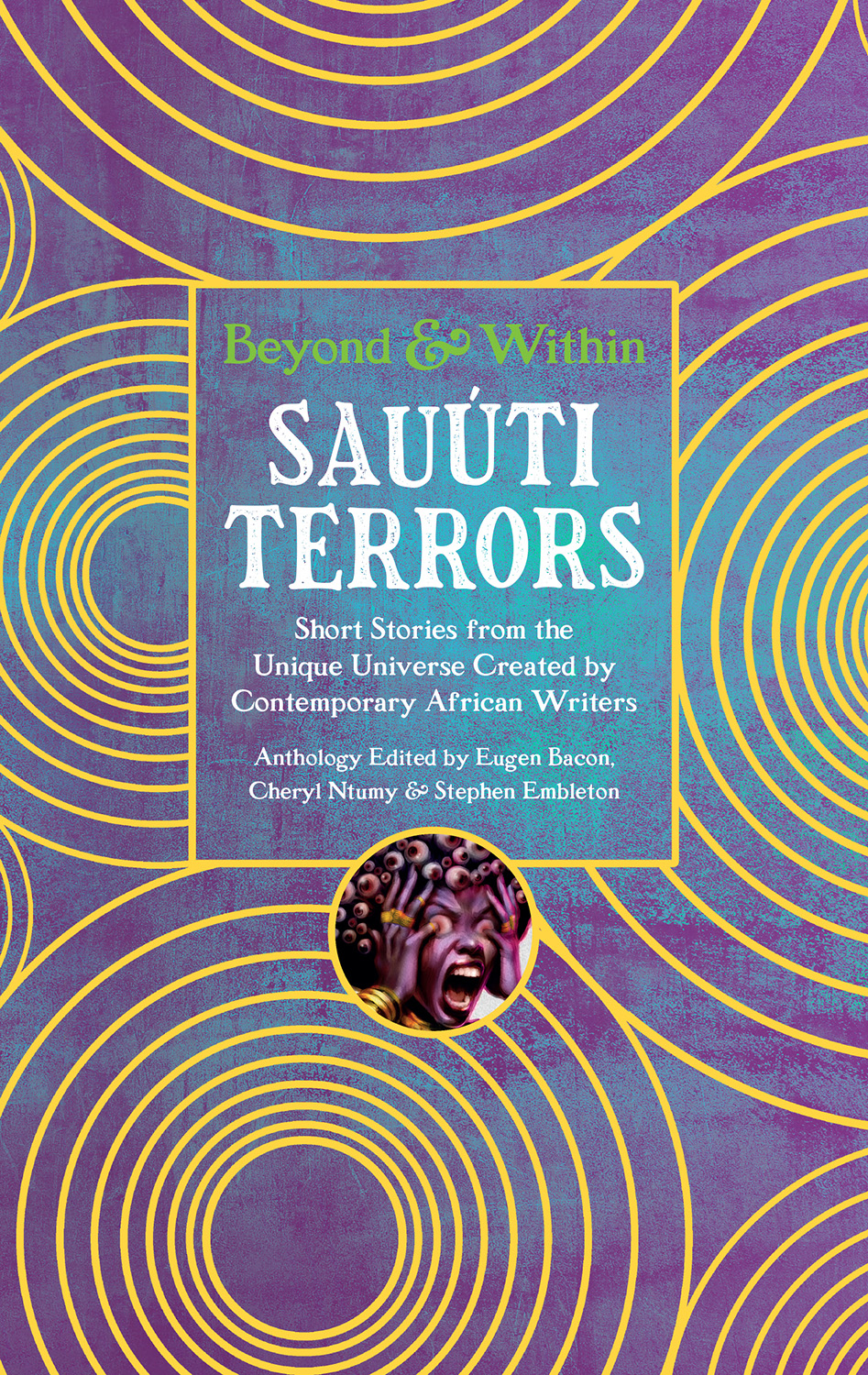
In this latest anthology, we’re shown a dark and terrible aspect of this world, not as a mere scare tactic, but to remind us that a universe this wide and sprawling wouldn’t be remotely realistic if it didn’t possess a horrific underbelly. Stories here do not shy away from the unsettling, the bone-chilling, the hair-raising, and the blood-curdling. The writers are super inventive in the ways they describe horror and fright. Across 18 short stories and poems, they boldly unleash all manner of terror. The writers commit strongly to Sauúti lore, which includes new words and Sauúti-specific terminologies. This, of course, can be a bit difficult for a new reader to grasp. But if they endure and get beyond that, they’d see that it adds to the overall uniqueness and beauty of the Sauútiverse.
Adedapo Adeniyi (also goes by Dapo The Abstract) is a Nigerian artist working in literature, film and photography, music (DJ) as well as art curation and counterculture archiving. He expresses his art through abstract avant-garde sensibilities. His debut novel, Wanderer, is available in stores. You can read an excerpt of his novel below, courtesy of the author.
Chisom Umeh is a Nigerian fiction writer and poet. His short stories have been featured in Omenana, Apex, Clarkesworld, Year’s Best African Speculative Fiction 2023, African Ghosts anthology, Isele, Mythaxis, Scifi Shorts, and elsewhere. His short story, “Ancestor’s Gift”, won the 2024 Tractor Beam short story contest. He was a finalist for the Seattle Worldcon Short Story Contest and is the winner of the 2025 Nommo Award for Best African Speculative Fiction Short Story.
Chisom, holding a copy of the Wanderer. Image: African Imaginary
Chisom: Hey Dapo.
Nice to have you do the interview.
I finished reading your novel Wanderer a couple of days ago, and I must say, the journey feels like one long dream. It’s a steady flow of alternating sentences and logic that sometimes contradict each other and yet, strangely enough, feels complete and cohesive. Can you tell me how you were able to keep the story you were trying to tell in focus, even while spinning such a wild tale?
Dapo: Thank you, Chisom. I’m excited to have this interview with you.
I want to start by saying the story mostly wrote itself; I was just a conduit. Most of this book was written in an automatist, stream-of-consciousness style. They were retellings of dreams, memories, and reality, and I wanted them to appear that way. I never lost sight of the story because I welcomed getting lost as I was writing it to find myself.
Chisom: Oh, that’s pretty interesting. To me, the novel reads like Amos Tutuola’s The Palmwine Drinkard crossed with Vajra Chandrasekera’s luminous prose. It definitely felt like older hands were guiding yours on the page. Were there literary influences you were channeling when writing the book?
Dapo: Yeah, I mean, I try to stay away from direct influences while I’m writing, and I didn’t read The Palmwine Drinkard until after I wrote Wanderer. I took influences more from films and cinematic sensibilities than literary, but in that regard, Borges, Philip K. Dick, Timothy Leary, André Breton’s Surrealist Manifesto, Aldous Huxley’s The Doors Of Perception, and my editor and friend, Manuel Marrero. I think these are the ones I can remember right now, plus I don’t want to go overboard. But these people and their works across surrealism, psychedelia, paranoid fiction, sci-fi, metafiction, and so on influenced me in many ways and were formative for how I approached writing and this book.
Chisom: It’s interesting that you mentioned Surrealist Manifesto, psychedelia, and paranoid fiction, because in an essay in Medium titled Abstractism Manifesto, you talked about how ‘abstractism’ is a term that subsumes all of these concepts and more. I like the way you explained it in the essay and how it relates to your work. But could you do a quick description of the term (abstractism) so we could understand it in relation to your work?
Dapo: Absolutely! So when I wrote the Abstractism Manifesto in early 2023, I defined it as being an amalgamation of solipsism, surrealism, psychedelia, subjective reality, and the physics of psychosis. I believe abstractism brings these concepts together to take reality and the world around us from a state of form to an abstract sensory state of formlessness, and that’s what I try to do with my work — the dissolution of some absolute real into an abstract cosmic real.
Chisom: In your experience as a filmmaker, what is the major difference between visual storytelling and written one? Do you prefer one medium over the other?
Dapo: I mean, writing is definitely cheaper. Making films is more expensive and taxing. I also think it’ll kill me faster so that might be why right now it excites me more than writing does. But, frankly, the major difference is the painting. With words, I’m guiding the readers’ imagination. At the end of the day, everyone will come out of it with different images. But with film, I have to literally represent those images on the screen. I’m doing the painting for the audience, they just have to watch and engage.
Chisom: Besides making movies, I know that you do some DJ work on the side. You had a collaboration with NTS, which is really great. How did that happen?
Dapo: Let me put it in context: I work with this new-age collective called Freewater, which was founded by my friends. I serve as its curator and co-director. Freewater secured a residency with NTS Radio, and since I also DJ, they featured one of my mixes as part of the collective. We’re having an underground, new wave music festival/concert on the 11th of December (I think the interview will be out after it?), and NTS is our major partner.
Chisom: That’s incredible, actually. So, does your music influence your writing in any way? Some writers like to curate playlists for particular writing projects. Something they listen to just to put themselves in the mood. Are you that kind of writer?
Dapo: Music definitely plays a huge part in my process. When I was writing Wanderer, all I listened to was shoegaze. I found a shoegaze playlist that had over a hundred songs and it was all I listened to while I slept and dreamt and while I wrote as well. I’ve been DJing for almost 2 years now, and it’s made me understand music as well as how different people interact with it. There are sensibilities of transience I borrowed from writing and translated to how I DJ.
Chisom: I kept wondering about the shoegaze reference when I was reading the book. Something told me there was more to it than just being an element in the story, and I’m glad you just confirmed that. Which brings me to your process with writing your stories and how you edit them. Do you edit while writing or after?
Dapo: Oh yeah, shoegaze has a very dreamlike, haze-inducing feeling and I wanted the book to feel like that. I do very minimal editing while writing. I finished the entire thing then read it over a couple of times before sending it to my editor, and we had this period of sending drafts back and forth and conversations on the subject matter.
But enough about me, I want to hear what type of music you listen to and how editing works for you. I mean, you just won the Nommo, haha.
Chisom: Oh, lol.
Well, I’m very mundane with my music. I don’t have any playlists or do any sort of curation. In fact, when I’m writing, I wouldn’t want to hear any music at all as it easily interferes with my thought processes and breaks my stream-of-consciousness, AKA “flow”. But when I do listen to music, outside writing, it’s very Davido and Asake and Victony, and whatever Dlala Thukzin just released. For edits, I can’t move forward with writing if I feel like there’s something wrong with a previous sentence. So I tinker with that till it feels fine to me. So we’re maybe kind of opposites on this.
Dapo: Correct me if I’m wrong but you seem like a very calculated writer. You’re delicate about detail, you’re careful. I think it’s beautiful. I wish I could be that type of writer. Like I said before (this may sound a little pretentious but I fully believe it), I don’t really do any writing, these things write themselves and use me as a conduit. I don’t know where they come from or where they are going or why; they come raw and I write in real time. My flow can be erratic most times.
Chisom: I like to think I have an eye for detail, but, trust me, I’m not really that meticulous. I know writers who would draw up elaborate plots that cover the first scene to the last, and fill up a board with sticky notes. Me? I mostly just sit down and write a story as it comes into my head. I think both our approaches are valid, so long as the outcome is something folks can read and enjoy. When I’m done writing and send the work out, that’s where my effort ends. But I’ve seen you go through hell and high water to publicize your book. And it has really paid off. Maybe that’s something you’d teach me someday?
Nardwuar holding a copy of Dapo’s first novel, Wanderer
Dapo: You’re amazing, so we’re kin.
Thank you, I think it’s been a learning curve. A lot of how this book has been handled is experimental, constantly trying to see how to reinvent whatever a rollout is supposed to be. Some days before the book came out I’d post videos of just my legs as I was walking around. Wandering, if you will. I made cards and handed out googly eyes. I’ve had readings and talks. I even had an abstractism lecture and played a psychedelic techno set. I keep thinking of ways to present a work of literature outside of just the confines of literature, especially as a multimedia artist. I look forward to reinterpreting the book and presenting it in so many other formats: photograph, sound, installation, you name it.
Chisom: Say I wanted to try my hand at writing abstractism, are you holding one of those lectures anytime soon?
Dapo: Hopefully sometime early next year. I’m working on writing another edition of the manifesto that’s more professional, but I think that through reading the manifesto that’s up right now, as well as Wanderer and some of my short stories, anyone could get the gist of what abstractism is.
What’s next for you now Chisom? In the world of African Speculative Fiction.
Chisom: For me, I’m also trying to piece together a collection of short stories that hopefully might be my debut in the book-publishing space. I want most of the stories in the collection to be centered around two themes, so that means I’m writing mostly new stories.
Anyway, it’s really been wonderful having this chat with you. I’m looking forward to reading more of your stuff in the future.
Dapo: Sending you love and the best of wishes Chisom, excited to see your collection. I’ll send you mine as it comes along. You’re a refreshing voice in the scene here.
The Bone River by Nkereuwem Albert is an urban fantasy published by Phoenix, an imprint of Ouida Books focused on Science Fiction and Fantasy stories.
There are many things to love about The Bone River.
There is the magic system, the sense of a thick and present world bubbling away beneath the fabric of our own world. In Nkereuwem’s Calabar, miracles are the work of Pastors contorting magic in front of a blind congregation, and penises can, in fact, be stolen. By virtue of your initiation and belonging to one of four houses, you become a conduit to magic and mystery seeping out of the earth. You can command the dead, kindle fire from within you, and form familiars out of bone. You can shape it into beasts and seal gods. It is a land of infinite possibility. If you’re creative enough, you can conjure magic in service of peace—or to deceive.
This brings me to the story itself. By the time you put down Nkereuwem’s The Bone River, you would have witnessed how fragile peace can be, while war remains a latent possibility. This in itself should not be a discovery. We are well familiar with the flexibility of politicised narratives, the speculative reality of a truth wielded by authority. Surely, it should not take too much imagination to condense the abstraction of the lie beneath Calabar’s secret peace into a manner of critique about the cities we inhabit or the stories we tell about the blood that soaks our collective memories. After all, there is even greater violence than a certain bastard’s deception that is used every day as a tool to maintain a semblance of “status quo,” a peace with which no one is comfortable. And yet, the discovery of deception, as you read, grabs you. You know things like this happen, and yet, you are shocked. Why wouldn’t you be? It is the job of good fantasy to re-expose us to reality afresh. When you have seen and seen and seen with all your seeing eyes, the world unseen can and should shock you in new ways.
Undugu—it’s a Swahili term for kindredship. It’s not far off from “ujamaa,” a premise of sharing and togetherness that was President Julius Kambarage Nyerere’s socialist experiment when the United Republic of Tanzania first gained colonial independence. Ideally, ujamaa should have worked—it’s a beautiful and generous concept. In practice, it wasn’t quite the success it was meant to be. So there are also inherent risks with “undugu”—because kindredship means inviting others into your personal space. It’s a trust relationship founded on goodwill. And this is what it means to collaborate: to trust, to respect, to have goodwill in the understanding that all participants are beneficiaries of the outputs, that we all put in effort for the best outcome(s).
Undugu—this is what I aim to achieve in my collaborations. And they’re many.
The most powerful and, hopefully, the longest lasting of them is the Sauútiverse. Back in November 2021, Wole Talabi, one of the founding members of the Sauútiverse, reached out to African writers for expressions of interest in becoming part of a collective, to create a shared world using the Syllble platform. A bout of brainstorming sessions followed, in which we determined our vision as holding the key tenets of collaboration, support, creativity and Afrocentric-based storytelling. The Sauúti Collective, as we named the founding members, comprised ten African writers and creators from Ghana, Nigeria, South Africa, Tanzania and the diaspora—Haiti. Together, we created a new world, the Sauútiverse: an Africa-inspired secondary world with humanoid and non-humanoid creatures in a five-planet, binary star system with a shared history, and the presence of sound magic.
The name Sauúti is inspired by the Swahili word “sauti” which means voice or sound.
The five main planets, each named after the words for ‘song’ in various African languages, are:
Zezépfeni—from the Amharic word “zefeni”
Wiimb-ó—from the Swahili word “wimbo”
Órino-Rin—from the Yoruba word “orin”
Ekwukwe—from the Igbo word “ukwe” meaning “song” or “anthem”
Mahwé (before its destruction)— from the Kirundi word “mawe” meaning “mother”
There is also an inhabited moon, Pinaa, from the Setswana word “pina,” meaning “song.”
Illustrated by Akintoba Kalejaye and Stephen Embleton
Founded by Dr Kadija George Sesay, the International Black Speculative Writing Symposium and Festival was a three-day in-person event at Goldsmiths, University of London, held in February 2024, alongside a single-day online event for global audiences. The festival offered workshops for writers, readings and performances, speakers’ panels, interviews, and group discussions. The festival’s many partners included Comma Press, Spread The Word, New Writing South, Writing East Midlands, TLC, Writing Our Legacy, Peepal Tree Press and Yaram Arts. The event was supported by Arts Council England, Professor Deidre Osborne and the Department of English and Creative Writing at Goldsmiths. The festival’s authorised bookseller was This is Book Love. The BSFA had a stall featuring its publications, showcasing African writers from the Luna Press and launching Kampala Yénkya – an applied African speculative culture project on imagining climate futures by Dilman Dila and Vector editors.
As the first of its kind, the festival promised all the thrills of a new experience, alongside the anticipation of a skilfully curated event. Across its online and in-person events, titans of Black Speculative Fiction abounded, including Sheree Renée Thomas, Professor Reynaldo Anderson, Dr. Karen Lord, Dr. Courttia Newland, and Leone Ross. I spent three days at Goldsmiths absorbing new fiction in all its forms, building new personal and intellectual connections, and exploring new ways of thinking about Black Speculative Fiction.
In this article, Eugen Bacon reflects on her journey of discovery into AfroSF. Meanwhile, Ivor W. Hartmann’s groundbreaking AfroSF anthologies are currently included in the African Speculative Fiction bundle from Story Bundle.
By Eugen Bacon
It was a love and hate relationship with M. The brusque and direct nature of this editorial colleague of mine every so often came across as pomposity, and I knee-jerked. So much that I nearly fell in wonder when M approached me asking for a favour.
“How about a pitch?” he said. “I’ve seen this AfroSF thing on Amazon a couple of times, it would be great to write an article.”
M was offering an olive branch. He wanted me to write for his nonfiction section of a popular magazine. And I had just the title for this piece: “What is AfroSF?” To put it in context, this was a few years ago.
It was a journey of discovery that led me to a community. The African Australian in me was curious to unearth AfroSF, an inquisitive quest to decipher this literary movement, this subgenre of science fiction—what was it exactly? Yes, I anticipated that it had some derivation from hard or soft science fiction, cyberpunk, mutant fiction, dystopian or utopian fiction, pulp, space opera, and the like, and that it had something to do with Africa. What else would I discover?
An online search steered me to a 406-paged anthology published in December 2012 by StoryTime, a micro African press dedicated to publishing short fiction by emerging and established African writers. The StoryTime magazine was formed in 2007 in response to a deficit of African literary magazines.
Some readers described it as a ‘ground-breaking anthology’ of diversity and hope, an ‘African Genesis’ that was intense and varied in its fresh viewpoints. Editor and publisher Ivor W. Hartmann spoke of his dream for an anthology of science fiction by African writers, and his realisation of this vision in a call for submissions that birthed original stories published as AfroSF. Illuminating his fascination with the collection, Hartmann said, ‘SciFi is the only genre that enables African writers to envision a future from our African perspective.’
Bravo, I thought of this Zimbabwean writer, editor, publisher, visual artist and author of Mr Goop (2010)—an award-winning post-apocalyptic short story of a boy who struggles with coming-of-age concerns like bullies and scholarly performance, in a science fiction society called the United States of Africa, guarded by robots and chaperoned by humanoid genoforms.
This academic article contrasts Afrofuturism and Africanfuturism through an exploration of two works by Nnedi Okorafor. Writers like Okorafor are expanding and radically transforming the worlds of speculative fiction to be more representative of the world we live in. “The Magical Negro” is a comic vignette in which the central character rebels against his subservient role, referred to in the title, and is revealed by the end of the story as a powerful Afro-Caribbean spirit. “The Magical Negro” subverts stereotypes and exposes racist conventions in the speculative genres of fantasy and science fiction. “Mother of Invention,” on the other hand, severs ties with the Anglo American historical context by moving its storyworld to the futuristic, technologically advanced Nigerian city of New Delta.
Review: This article underwent editorial review from three editors.
License: Copyright Päivi Väätänen, all rights reserved.
Adilifu Nama notes how “[i]n America, there is a dubious history of presenting Africa as a primitive and backward nation in books, television and film” (137). But with the emergence of writers like Nnedi Okorafor and films like Black Panther, the association of Africa with technology is changing rapidly. In this article, I discuss two short stories by Okorafor, a Nigerian-American who has based much of her fiction in Africa and has also written for Marvel Comics (most recently as the sole writer for Shuri). The two stories I will discuss are “The Magical Negro” (2004) and “Mother of Invention” (2018). “The Magical Negro” is a comic vignette in which the central character rebels against his subservient role, referred to in the title, and is revealed by the end of the story as a powerful Afro-Caribbean spirit. “The Magical Negro” subverts stereotypes and exposes racist conventions in the speculative genres of fantasy and science fiction. “Mother of Invention,” on the other hand, severs ties with the Anglo American historical context by moving its storyworld to the futuristic, technologically advanced Nigerian city of New Delta.
During the fourteen years between the two stories, much has changed in the field of speculative fiction, and these stories reflect it. Okorafor insists in a recent Native interview that what she does is “Africanfuturism, not Afrofuturism” (Okolo et al. n.p.). Whereas “The Magical Negro” can be read as an Afrofuturist text in its engagement with American culture via direct critique of stereotypes and racist genre conventions, “Mother of Invention” more strongly suggests the newer designation of Africanfuturism, rooted both geographically and culturally on the continent.


 vector-bsfa.com