Chisom Umeh in Conversation with Adedapo Adeniyi

Adedapo Adeniyi (also goes by Dapo The Abstract) is a Nigerian artist working in literature, film and photography, music (DJ) as well as art curation and counterculture archiving. He expresses his art through abstract avant-garde sensibilities. His debut novel, Wanderer, is available in stores.

Dapo holding his novel, Wanderer

Chisom Umeh is a Nigerian fiction writer and poet. His short stories have been featured in Omenana, Apex, Clarkesworld, Year’s Best African Speculative Fiction 2023, African Ghosts anthology, Isele, Mythaxis, Scifi Shorts, and elsewhere. His short story, “Ancestor’s Gift”, won the 2024 Tractor Beam short story contest. He was a finalist for the Seattle Worldcon Short Story Contest and is the winner of the 2025 Nommo Award for Best African Speculative Fiction Short Story.

Chisom, holding a copy of the Wanderer. Image: African Imaginary

Chisom: Hey Dapo.

Nice to have you do the interview.

I finished reading your novel Wanderer a couple of days ago, and I must say, the journey feels like one long dream. It’s a steady flow of alternating sentences and logic that sometimes contradict each other and yet, strangely enough, feels complete and cohesive. Can you tell me how you were able to keep the story you were trying to tell in focus, even while spinning such a wild tale?

Dapo: Thank you, Chisom. I’m excited to have this interview with you.

I want to start by saying the story mostly wrote itself; I was just a conduit. Most of this book was written in an automatist, stream-of-consciousness style. They were retellings of dreams, memories, and reality, and I wanted them to appear that way. I never lost sight of the story because I welcomed getting lost as I was writing it to find myself.

Chisom: Oh, that’s pretty interesting. To me, the novel reads like Amos Tutuola’s The Palmwine Drinkard crossed with Vajra Chandrasekera’s luminous prose. It definitely felt like older hands were guiding yours on the page. Were there literary influences you were channeling when writing the book?

Dapo: Yeah, I mean, I try to stay away from direct influences while I’m writing, and I didn’t read The Palmwine Drinkard until after I wrote Wanderer. I took influences more from films and cinematic sensibilities than literary, but in that regard, Borges, Philip K. Dick, Timothy Leary, André Breton’s Surrealist Manifesto, Aldous Huxley’s The Doors Of Perception, and my editor and friend, Manuel Marrero. I think these are the ones I can remember right now, plus I don’t want to go overboard. But these people and their works across surrealism, psychedelia, paranoid fiction, sci-fi, metafiction, and so on influenced me in many ways and were formative for how I approached writing and this book.

Chisom: It’s interesting that you mentioned Surrealist Manifesto, psychedelia, and paranoid fiction, because in an essay in Medium titled Abstractism Manifesto, you talked about how ‘abstractism’ is a term that subsumes all of these concepts and more. I like the way you explained it in the essay and how it relates to your work. But could you do a quick description of the term (abstractism) so we could understand it in relation to your work?

Dapo: Absolutely! So when I wrote the Abstractism Manifesto in early 2023, I defined it as being an amalgamation of solipsism, surrealism, psychedelia, subjective reality, and the physics of psychosis. I believe abstractism brings these concepts together to take reality and the world around us from a state of form to an abstract sensory state of formlessness, and that’s what I try to do with my work — the dissolution of some absolute real into an abstract cosmic real.

Chisom: In your experience as a filmmaker, what is the major difference between visual storytelling and written one? Do you prefer one medium over the other?

Dapo: I mean, writing is definitely cheaper. Making films is more expensive and taxing. I also think it’ll kill me faster so that might be why right now it excites me more than writing does. But, frankly, the major difference is the painting. With words, I’m guiding the readers’ imagination. At the end of the day, everyone will come out of it with different images. But with film, I have to literally represent those images on the screen. I’m doing the painting for the audience, they just have to watch and engage.

Chisom: Besides making movies, I know that you do some DJ work on the side. You had a collaboration with NTS, which is really great. How did that happen?

Dapo: Let me put it in context: I work with this new-age collective called Freewater, which was founded by my friends. I serve as its curator and co-director. Freewater secured a residency with NTS Radio, and since I also DJ, they featured one of my mixes as part of the collective. We’re having an underground, new wave music festival/concert on the 11th of December (I think the interview will be out after it?), and NTS is our major partner.

Chisom: That’s incredible, actually. So, does your music influence your writing in any way? Some writers like to curate playlists for particular writing projects. Something they listen to just to put themselves in the mood. Are you that kind of writer?

Dapo: Music definitely plays a huge part in my process. When I was writing Wanderer, all I listened to was shoegaze. I found a shoegaze playlist that had over a hundred songs and it was all I listened to while I slept and dreamt and while I wrote as well. I’ve been DJing for almost 2 years now, and it’s made me understand music as well as how different people interact with it. There are sensibilities of transience I borrowed from writing and translated to how I DJ.

Chisom: I kept wondering about the shoegaze reference when I was reading the book. Something told me there was more to it than just being an element in the story, and I’m glad you just confirmed that. Which brings me to your process with writing your stories and how you edit them. Do you edit while writing or after?

Dapo: Oh yeah, shoegaze has a very dreamlike, haze-inducing feeling and I wanted the book to feel like that. I do very minimal editing while writing. I finished the entire thing then read it over a couple of times before sending it to my editor, and we had this period of sending drafts back and forth and conversations on the subject matter.

But enough about me, I want to hear what type of music you listen to and how editing works for you. I mean, you just won the Nommo, haha.

Chisom: Oh, lol.

Well, I’m very mundane with my music. I don’t have any playlists or do any sort of curation. In fact, when I’m writing, I wouldn’t want to hear any music at all as it easily interferes with my thought processes and breaks my stream-of-consciousness, AKA “flow”. But when I do listen to music, outside writing, it’s very Davido and Asake and Victony, and whatever Dlala Thukzin just released. For edits, I can’t move forward with writing if I feel like there’s something wrong with a previous sentence. So I tinker with that till it feels fine to me. So we’re maybe kind of opposites on this.

Dapo: Correct me if I’m wrong but you seem like a very calculated writer. You’re delicate about detail, you’re careful. I think it’s beautiful. I wish I could be that type of writer. Like I said before (this may sound a little pretentious but I fully believe it), I don’t really do any writing, these things write themselves and use me as a conduit. I don’t know where they come from or where they are going or why; they come raw and I write in real time. My flow can be erratic most times.

Chisom: I like to think I have an eye for detail, but, trust me, I’m not really that meticulous. I know writers who would draw up elaborate plots that cover the first scene to the last, and fill up a board with sticky notes. Me? I mostly just sit down and write a story as it comes into my head. I think both our approaches are valid, so long as the outcome is something folks can read and enjoy. When I’m done writing and send the work out, that’s where my effort ends. But I’ve seen you go through hell and high water to publicize your book. And it has really paid off. Maybe that’s something you’d teach me someday?

Nardwuar holding a copy of Dapo’s first novel, Wanderer

Dapo: You’re amazing, so we’re kin.

Thank you, I think it’s been a learning curve. A lot of how this book has been handled is experimental, constantly trying to see how to reinvent whatever a rollout is supposed to be. Some days before the book came out I’d post videos of just my legs as I was walking around. Wandering, if you will. I made cards and handed out googly eyes. I’ve had readings and talks. I even had an abstractism lecture and played a psychedelic techno set. I keep thinking of ways to present a work of literature outside of just the confines of literature, especially as a multimedia artist. I look forward to reinterpreting the book and presenting it in so many other formats: photograph, sound, installation, you name it.

Chisom: Say I wanted to try my hand at writing abstractism, are you holding one of those lectures anytime soon?

Dapo: Hopefully sometime early next year. I’m working on writing another edition of the manifesto that’s more professional, but I think that through reading the manifesto that’s up right now, as well as Wanderer and some of my short stories, anyone could get the gist of what abstractism is.

What’s next for you now Chisom? In the world of African Speculative Fiction.

Chisom: For me, I’m also trying to piece together a collection of short stories that hopefully might be my debut in the book-publishing space. I want most of the stories in the collection to be centered around two themes, so that means I’m writing mostly new stories.

Anyway, it’s really been wonderful having this chat with you. I’m looking forward to reading more of your stuff in the future.

Dapo: Sending you love and the best of wishes Chisom, excited to see your collection. I’ll send you mine as it comes along. You’re a refreshing voice in the scene here.

Wanderer, cover art

Destroying ‘Centuries of Evil Work’: Female-Authored Dystopian Science Fiction in Spain

By Angela Acosta 

The Speculative and Surrealist Origins of Spanish Modernism 

Ángeles Santos’s painting, Un mundo [A World] (1929), is a large surrealist composition one may easily miss if one is too eager to reach Pablo Picasso’s Guernica (1937) in Madrid’s Reina Sofia Museum. In 1929, at the age of seventeen, Santos presented Un mundo at the Ninth Autumn Salon of Madrid where prominent Spanish intellectuals like Ernesto Giménez Caballero, Vicente Huidobro, and Federico García Lorca noticed her work. The three-by-three metre painting projects a surrealist world not unlike literary utopias of the early twentieth century. A world in the shape of a cube hangs suspended by angels in the sky. Female figures clad in dark dresses race down a staircase, reaching towards stars that serve as anchors for this small world. The image is equally precarious as it is carefully crafted. Santos painted the self-sufficient world with the same dark, muted palette as the cloudy blue sky. There, one can see into buildings as miniature humans go to work, play sports, and ride the steam train that snakes its way across each side of the cube. What lives do these people lead? What references to modern Spain can be found in this painting and similar works of literature? How might we recognize the contributions of women within this milieu? 

“Un mundo” by Ángeles Santos (1929) photographed by eckelon is licensed under CC BY-NC-ND 2.0.
Continue reading “Destroying ‘Centuries of Evil Work’: Female-Authored Dystopian Science Fiction in Spain”

Duchamp’s time machines: Paul Minott in discussion with James Gillham

Paul Minott worked as a leading graphic designer for over thirty years, working for
numerous international design consultancies in London and abroad. He ran a
successful partnership in London before embarking on a teaching career at Bath Spa University. He now works making one-off abstract prints using an etching press.

James Gillham completed a practice-led Ph.D. in Fine Art at the University of Reading in 2014, researching capability via the intersection of institutional demands and intersubjective expectation. He continues this research by painting the Humpty character from Olaf Stapledon’s Last Men in London, and by seeking similar representations in Science Fiction.  James lives and works in Wiltshire, and is the cover artist for the latest issue (299) of Vector.

Marcel Duchamp, The Bride Stripped Bare by her Bachelors, Even (The Large Glass), 1915–23. VIA CREATIVE COMMONS/COURTESY PHILADELPHIA MUSEUM OF ART

Marcel Duchamp’s famous work The Large Glass (1915-23) has been duplicated numerous times, by artists such as Richard Hamilton (1965) and Ulf Linde (1961).  Duchamp’s approval of these pieces emerges from his established interest in the ready-made, but also points to a more nuanced conception of time situated in popular contemporary European Modernist thought.  

Nude Descending a Staircase, No 2 (1912) is perhaps the most explicit example of this interest with temporality, but the glass mechanisms such as Rotary Demisphere (Precision Optics) (1925) bring these engagements into clearer focus.  These spinning devices suggest an investigational approach to time’s passage – expansions and contractions operating between objective measurement and subjective experience.

Duchamp’s ludic approach to time has interested artist and printmaker Paul Minott for many years, and is the impulse behind Minott’s latest work: Portrait de Voyage dans le TempsPortrait de Voyage dans le Temps is an Artificially Generated visual essay, showing Marcel Duchamp alongside his various time machines.

Minott discusses Duchamp’s Modernist conception of time and how this appeared in Duchamp’s artwork – while finding parallels with contemporary use of Artificial Intelligence to generate images – with fellow artist James Gillham.

Continue reading “Duchamp’s time machines: Paul Minott in discussion with James Gillham”

Adventures in Science Fiction Prototyping

Andrew Merrie and Pat Keys in conversation with Jo Lindsay Walton (and briefly Polina Levontin) about science fiction prototyping and the Radical Ocean Futures project. 


Radical Ocean Futures project

JW: We’re lucky enough to be joined by Andrew Merrie and Pat Keys. Andrew is a Research Liaison Officer at the Stockholm Resilience Centre, Stockholm University (Sweden) and the Head of Futures at Planethon. Pat is an Assistant Professor in the Department of Atmospheric Science at Colorado State University (USA).

We want to find out more about your very intriguing Radical Ocean Futures project, and Science Fiction Prototyping in general—as well as adjacent ideas like applied science fiction, critical design fiction, diegetic prototyping, speculative design, all part of the theme of this special issue. But I guess let’s start with the high seas themselves. How do we define the high seas? What are some of the issues that arise in their governance? Surely mighty Poseidon is ungovernable? To me, those words already feel strange in a sentence together: ‘governing the high seas.’ 

AM: The high seas are areas of the ocean that are not managed by any single authority. In some ways they represent this largely unexplored ‘wild west’ of the global ocean. When you’re trying to think about how to govern the high seas, you are thinking about things like climate change, overfishing, deep sea mining, genetic resources and so on. But you also have to contend with the pace of change. The ecosystems are changing, and the technology is changing, and companies and other kinds of actors can basically take advantage of these gaps or delays in regulation, and sort of do what they want in this ocean space. Interestingly enough, just a few weeks before this issue of Vector went live, a historic deal was made, after nearly 20 years of talks to put in place a legal framework, the UN High Seas Treaty. That said, monumental governance challenges remain and though very consequential, this is really the start of another 20 years of work.

JW: In this context, does ‘governance’ refer to international law?

AM: Partly. Governance is actually broader than that. It refers to a variety of laws, regulations, institutions, certifications, norms and so on. It’s everything that is relevant to how we look after the oceans, or fail to look after them. For example, for the governance of marine ecosystems, computer modelling is very important. But you can’t just look at a model and go, ‘OK, here is what will happen, if we follow this management strategy.’ There are all kinds of questions about what is possible or plausible. About what models to use, what their assumptions are, how you should interpret and use their outputs. All that could be part of governance. 

JW: OK. And these questions are more than technical questions, right? They quickly get us into the realm of politics and ethics. But sticking with ocean ecology for a moment. Honestly, when I think of the ocean, I mostly think, ‘I have no idea what’s going on in there.’ I want to quote a 2016 WIRED article about your project. ‘Earth’s oceans are having a rough time right now. They’re oily, hot, acidic, full of dead fish—and their levels are rising.’ Can you tell us a bit more?

Continue reading “Adventures in Science Fiction Prototyping”

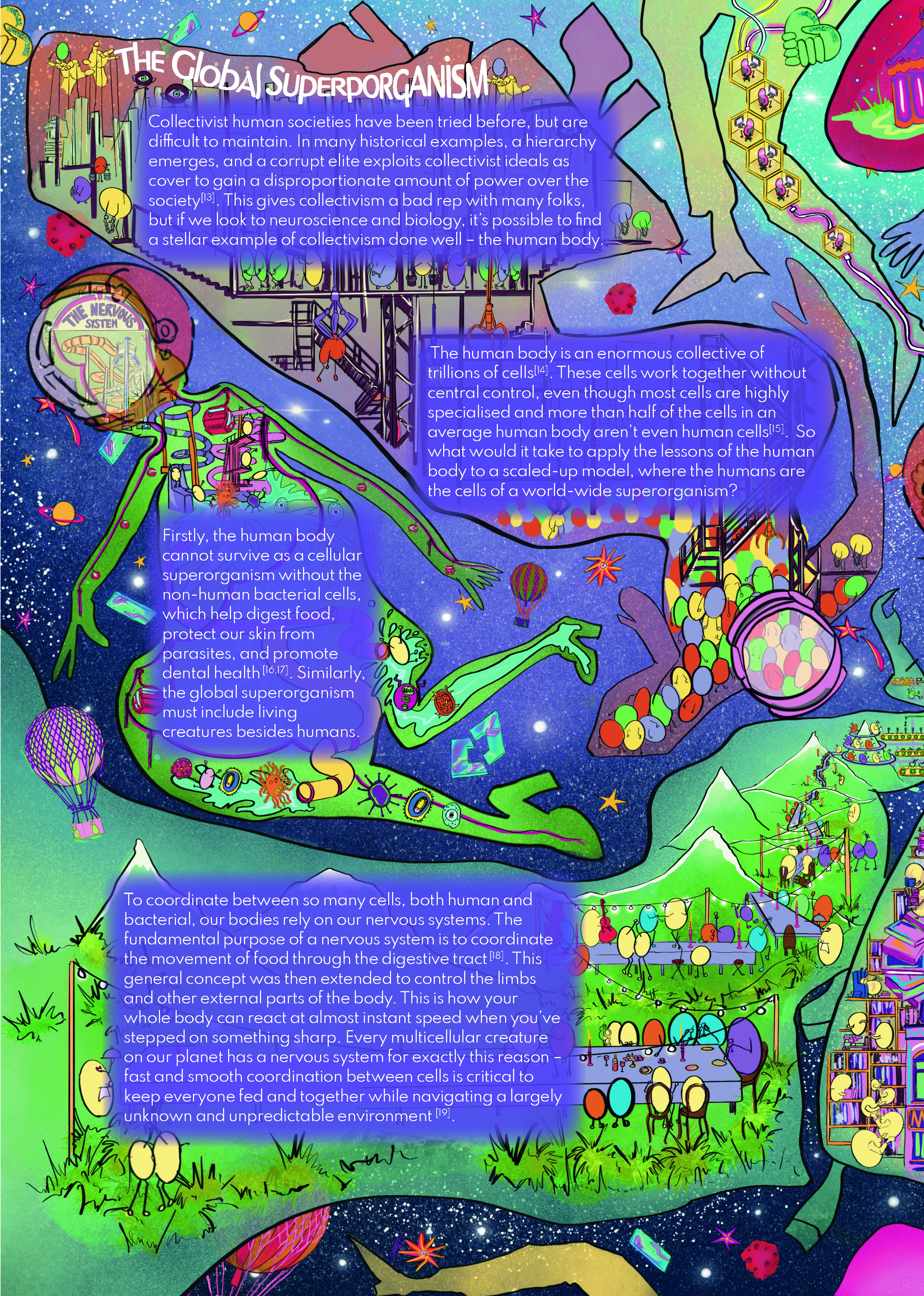
A Solarpunk Nervous System

Danbee ‘Tauntaun‘ Kim, PhD; Xiao Xiao, PhD; and Amelia Goldie, MArch


This artwork-essay first appeared in Vector: Futures, a publication in part supported by the PASTRES programme (Pastoralism, Uncertainty, Resilience: Global Lessons from the Margins, www.pastres.org), funded by the European Research Council (ERC) (Grant No. 70432). PASTRES is co-hosted by the Institute of Development Studies (IDS) and the European University Institute (EUI).

Mikhail Karikis: Activism and audiotopia

Phoenix Alexander interviews Mikhail Karikis

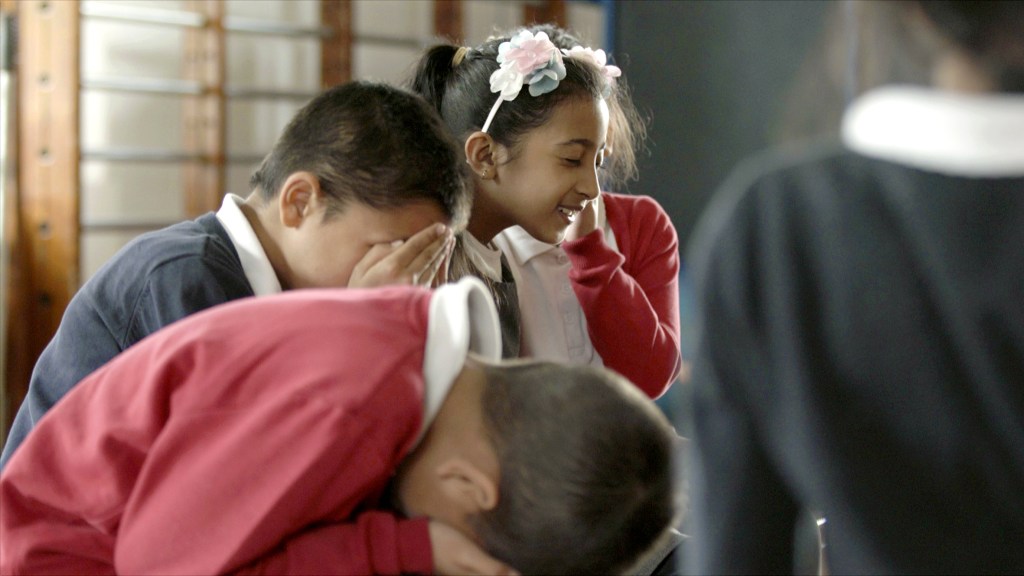
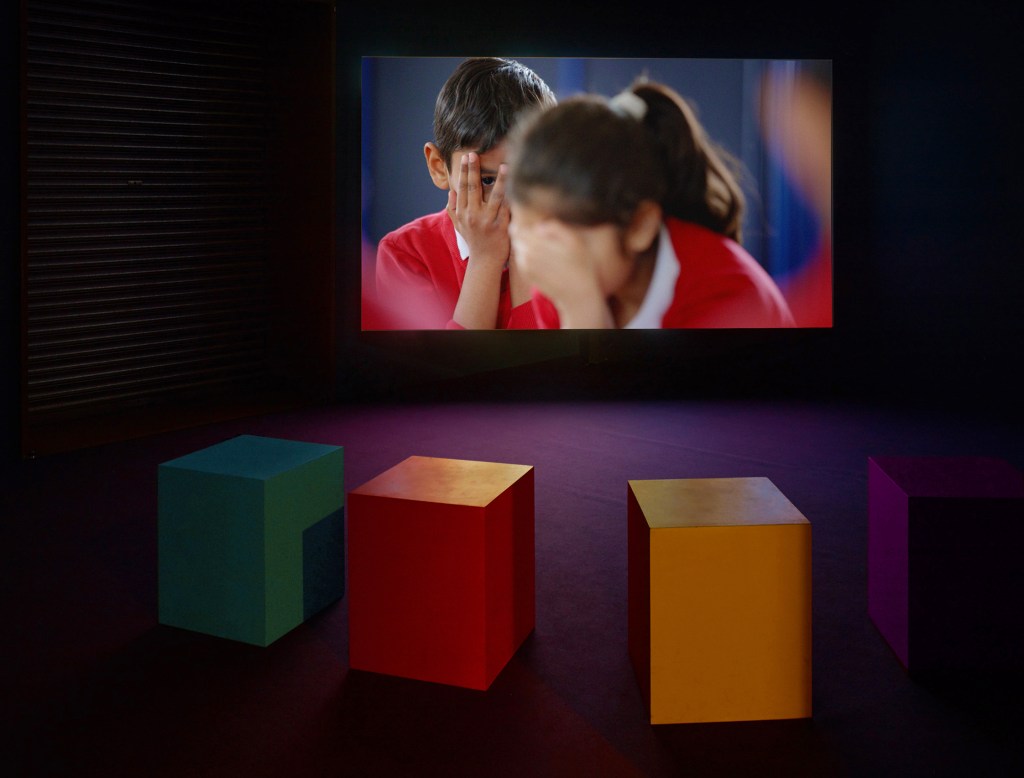
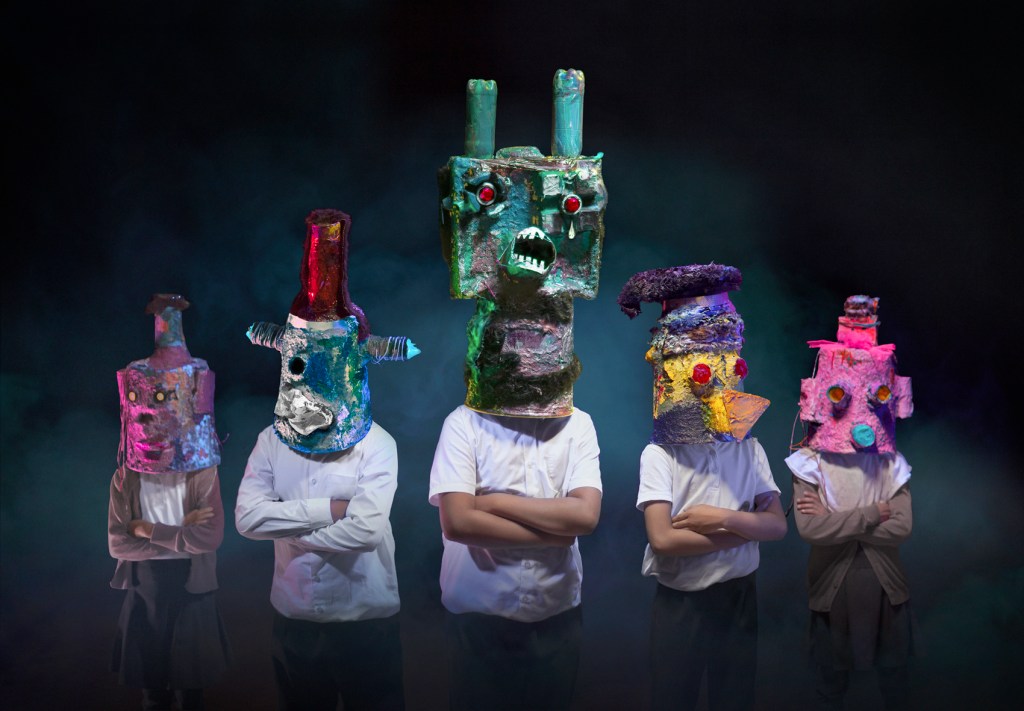
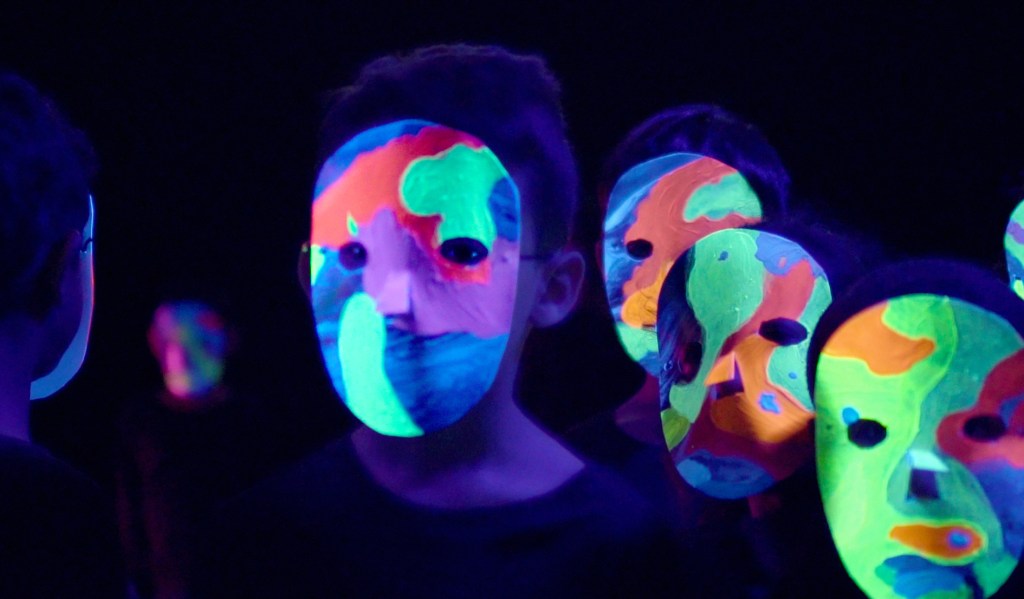
All images are part of No Ordinary Protest project, with permission from Mikhail Karikis.

Please briefly introduce yourself.

I am a Greek-born artist based in London and Lisbon. I work mostly in moving image, sound and performance. I develop projects through collaborations with individuals, collectivities and communities that are often located beyond the circles of contemporary art. In recent years, I have been working extensively with children, teenagers, young adults and people with disabilities. 

Since the early stages of my practice, the politics and materiality of the voice have been key concerns, while at the same time engaging with themes that give voice to different ways humans relate to the environment. There has been an instinctive journey that I began with films exploring voicing conditions of labour in the context of extractivist practices. This moved forward by looking at models of sustainability and eco-feminism, and more recently eco-activism and emerging forms of labour that service nature. 

I would say that my works prompt an activist imaginary and rouse the potential to imagine possible audiotopias (i.e. speculative places invoked through sound) and desired futures. I employ listening as an artistic strategy to help determine the content of my projects with the aim to highlight alternative modes of human action and solidarity, and to nurture critical attention and tenderness.

To what extent do you consider your work and practice to be ‘science fictional,’ if at all? Do you actively think about genre in your work, or do the labels come after the fact? (Surrealism, social realism, performance etc.)

I find science fiction and fantasy literature inspiring, but I do not think of my own artistic work through the lens of a specific genre. Perhaps where some science fiction literature and my art practice align is the way I employ my work to imagine and propose different worlds. I often start projects by embedding myself in different community contexts, and as such, social realism is always my starting point. Reflection, imagination and fantasy play an important role as I develop the themes and the projects mature and take shape. A decade ago and after I’d spent several years producing work that was furious and acutely critical, I took the decision to go further and invest my energy and imagination to proposing ‘better’ alternatives. My use of the word ‘better’ here implies a world with social and environmental justice, egalitarianism and practices of care. 

Sounds plays a central role in much of your work. Can you say a little bit more about how you see the relationship between the sonic and visual aspects of a new project?

I am currently developing a project which explores our relationship to weather phenomena. I am approaching it from three sonic perspectives: folk songs that call out to the elements, capture and transmit traditional knowledge about seasonal change and meteorology; a second angle is that of music instruments that imitate the sounds of weather and bring the environment into the concert hall through sound, like, for example, wind machines and thunder sheets; and a third perspective is the acoustics of resistance generated through eco-activism and protest. I am working with folk singers, professional experimental musicians and young school children on this project to bring together these three different forms of auditory culture that are testimony to our profound connection and entanglement with the weather. As is common in my work, the performance of these different forms of sound will determine the visual dimension of the project. Be it on a macroscopic or microscopic dimension, all my films capture acts of communal sound-making, resonance and vibration, and document the power sound has to set into motion the material universe, activate our sentiments and mobilise political thinking and action. 

Are there any works of science or speculative fiction (in any medium!) that have particularly inspired you?

Every child and teenager should read The Iron Woman by Ted Hughes for its environmental focus, for empowering children heroes with activist ecological thinking and rebelling against adults, and for the central role listening and noise play in the story as superpowers that activate empathy toward more than human beings. The Dispossessed by Ursula Le Guin is a book everyone ought to read for its acute reflections on capitalism, gender politics and anarcho-communism. 

“Part of the attraction was fear…” an interview with Alexis Panayiotou

Interviewed by Phoenix Alexander and Jo Lindsay Walton

This interview first appeared in Vector 295.

Hi Alexis. Could you introduce yourself and say a little bit about your background?

Hello, my name is Alexis Panayiotou. I’m a fine artist and a drawing tutor on the BA: Fashion course at Central St. Martins.

As you know, this is a special issue of Vector focused on Greek SFF. So our first question is: do you consider yourself a Greek artist?

I think of my identity as mixed or somewhere between cultures. I was born and raised in London. My parents are both Greek, from Cyprus, both came to London very young, my mum nine and dad fourteen. They have lived here ever since. I have never been to Cyprus so I only have a vicarious idea of the place, through my parents and other relatives, and a bit from TV and radio. 

I grew up in a Greek household, eating Greek food, hearing Greek music every day. Greek was my first language until I started school, although now I only have a rudimentary grasp. At home I was steeped in Greek culture and as a young man I would have described myself as solely Greek, and I remember feeling very lucky and proud to be so.

As for ‘artist,’ I’ve only recently started being comfortable using the term — it comes with lots of lofty aspirations! When I was young I drew a lot, like most kids, so there were always parents or teachers telling me I was an artist, or that I would be one. 

Mother pinching her baby affectionately while breastfeeding
Continue reading ““Part of the attraction was fear…” an interview with Alexis Panayiotou”

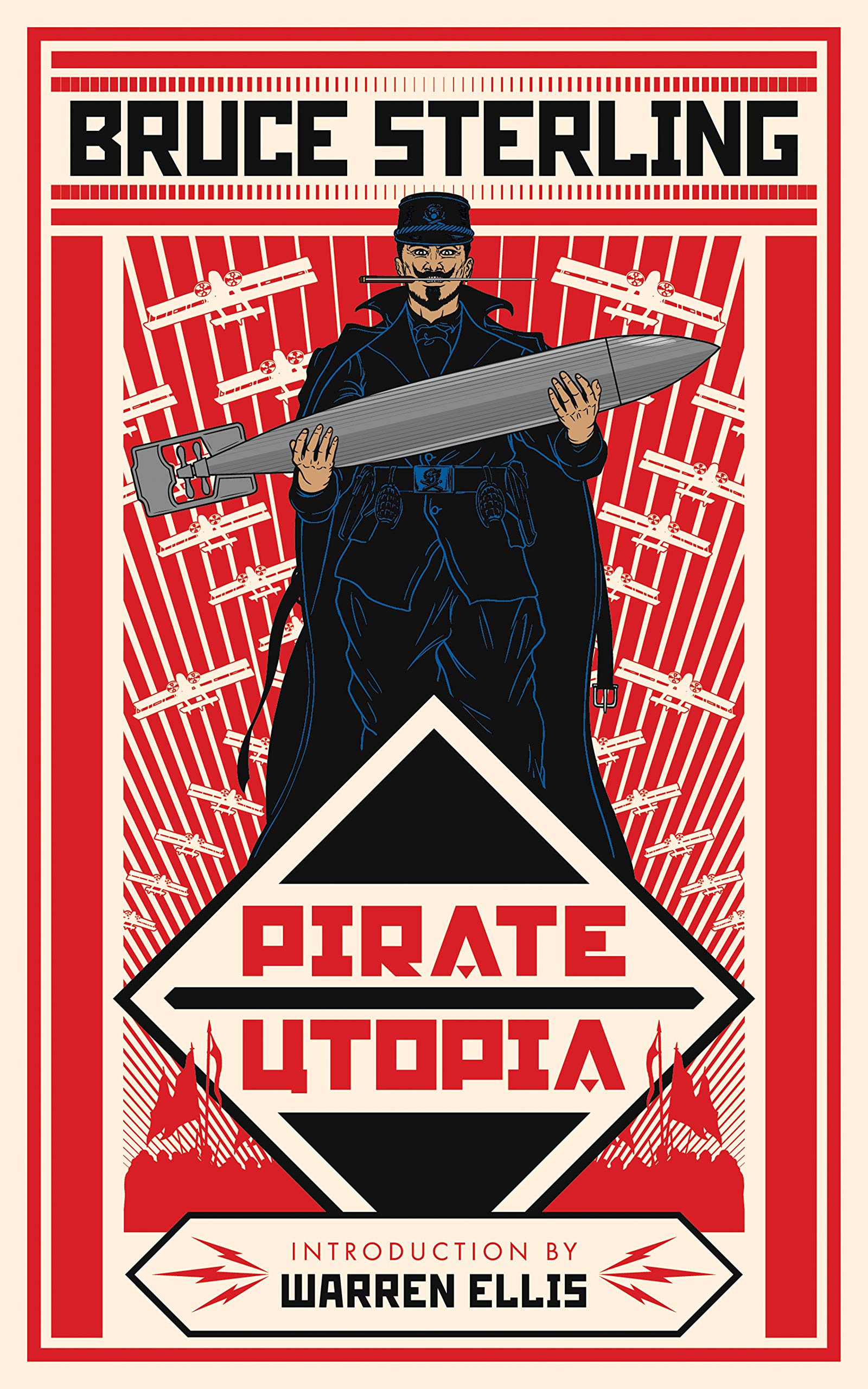
Pirate Utopia by Bruce Sterling and Normal by Warren Ellis

Reviewed by Paul Graham Raven. This review first appeared in The BSFA Review.

If you ever publicly identify as a futurist, you will eventually be asked what contemporary futurism – an admittedly vague term which somehow covers everyone from tech-centric venture capital strategists and Pentagon policy wonks to Ray “Singularity” Kurzweil and the snake-oil Barnums of Silicon Valley – has to do with the proto-fascist 1920s Italian art movement of the same name. Bruce Sterling’s latest novella, Pirate Utopia, is (in part) an attempt to answer that question.

Written in the bombastic style that animates much of Sterling’s more recent short fiction, Pirate Utopia is populated by characters whose larger-than-lifeness is predominantly a function of their unfettered will-to-power (but also cocaine). In this alternate Adriatic, minor historical figures and allegorical types rub shoulders in Fiume, the little city at the heart of the breakaway microstate known as the Republic of Carnaro, where Futurist poets and artists work side by side with rogue military leaders and mercenary engineers to establish a proto-fascist entrepôt with its own hi-tech missile factory.

Identified by glamorous (and thus ridiculous) nicknames – “the Poet”, “the Ace of Hearts”, “the Art Witch” – the heroes of capital-F Futurism unwittingly slip into the narrative space occupied, in our own timeline, by the more fully developed European fascisms of the early 20th Century: Mussolini, a magazine editor, is emasculated in his office chair by Syndicalist women with single-shot handguns, while a former Austrian art student takes someone else’s bullet during a failed putsch in a Bavarian beer-hall. But Carnaro is doomed not to last – for as Peter Lamborn Wilson has observed, the pirate utopia is always-already temporary and contingent; the polder cannot hold.

The arrival of “the Magician” – one Harry Houdini, squired by two USian pulp fiction  pioneers – and his inviting of Lorenzo Secondari the Pirate Engineer to the States completes the story of Futurism and futurism. Both are essentially poetic movements fuelled by utopian genres of writing and the creative arts, and powered by the modernist legacy of a lust for power, velocity and creative destruction. Which is not to claim that small-f futurism is necessarily fascist, of course – but the same desires and fetishes can be found the manifestos of both, and today’s self-styled “neoreactionaries” (a small but scary intellectual splinter of the soi disant “alt-right”, fond of cool tech, racist pseudoscience and the presumed meritocracy of enlightened dictatorship) mark the ideological space where futurisms past and present overlap. Both futurism and Futurism are far less about the future than they are about a present in the perpetual process of radical sociotechnical reconfiguration, and the possibilities of power in times of flux.

Warren Ellis’s Normal begins with an ageing academic demanding cat gifs with menaces (assuming “menaces” can stretch to include a shank whittled from the handle of a ten-buck toothbrush), and the story only gets darker and weirder, unfolding around a plot featuring “a missing guy, a locked-room mystery out of Agatha Christie, and a pile of insects.” Normal Head is a retreat facility for burned out futurists – not the “woo, flying cars!!” sort of futurist, but the strategists and forecasters who have learned the truth of Nietzsche’s old aphorism about gazing into the abyss, and learned it the hard way. The abyss in question is the light-cone of increasingly plausible and probable end-games facing a civilisation whose ability to generate interesting new technologies has far outpaced their ability to plan, predict or control the consequences – and speaking from beneath my own futurist’s hat, I assure you it can best a basilisk when it comes to lookin’ back atcha.

In contrast to the pulpy swaggerdocio of Sterling’s story, Normal has a stark style and shape, tracing a bleakly Ballardian arc which, plotted on paper, would resemble a stock-market chart during a bank run: a justifiably and self-consciously doomed male Western professional attempts a heroic final act of self-abnegating redemption, only to reveal in doing so the even more comprehensive fuckedupness of, well, pretty much everything. Mercifully, Ellis leavens his grim prognosis with gallows humour, and with his well-tuned ear for the contemporary vernacular: you may be headed for a boot-on-a-human-face-forever sort of an ending, but you’ll find yourself smiling as an academic from a rival discipline describes economics as “a speeding death kaleidoscope made of tits” – particularly if you know anything about economics. (Or about academics, for that matter.)

Taken together, these two books shine a light on the intimate but often occluded kinship between science fiction and futurism, rooted in a shared ideology and teleology. I am reminded of a recent Clute riff, in which he observes – and I paraphrase – that in “the old sf” (which is to say, roughly speaking, 20th century sf) the reward for saying ‘yes!’ was the future, while in “new” sf, the reward for saying ‘yes!’ is death; this reflects and reproduces a recent tectonic slippage in our attitude to change, and to technological change in particular. The Republic of Carnaro may be doomed in Sterling’s story, but as Houdini and friends say ‘yes!’ to Futurism and smuggle its Promethean flame back to their homeland, they mark the beginning of a hegemonic American century – albeit one which seems to be drawing to a shuddering halt even as I type. But Adam Dearden and the other inmates of Normal Head, after long careers of saying ‘yes, but…’ to the future, suddenly find that it’s too late for questions and analysis, let alone for saying ‘no’. 

Things being what they are, I think we’re all victims of #abyssgaze to some extent … and yet the dream of Carnaro lives on in the tax-exempt sea-steading fantasies and vaporware Martian colonies of libertarian millionaires. Perhaps, then, we could say that Futurism’s greatest trick was – and still is – making the capital disappear.

Copyright Paul Graham Raven. All rights reserved.

Science Fiction edited by Dan Byrne-Smith

The MIT Press/Whitechapel Art Gallery (2020), 240 pp

Reviewed by Andrew M. Butler. This review first appeared in Vector 292.

There is a moment in an 1836 lecture at the Royal Institution when John Constable argues that “Painting is a science, and should be pursued as an inquiry into the laws of nature. Why, then, may not landscape be considered as a branch of natural philosophy, of which pictures are but experiments?” Various nineteenth century artists actually made science-fictional paintings — John Martin and Thomas Cole spring to mind — and groups of artists such as the Futurists, the Vorticists and the Surrealists embraced the ambiguities of modern technology in the first half of the twentieth century. In 1956, the “This is Tomorrow” exhibition at the Whitechapel Art Gallery was opened by Robbie the Robot from Forbidden Planet and featured science-fictional imagery among its utopian and dystopian reactions to post-war, consumerist Britain. Among its many visitors was a new writer called J.G. Ballard. 

It is thus appropriate that this book on science-fiction art is published by the Whitechapel Art Gallery (in conjunction with MIT). As part of the Documents in Contemporary Art series — other titles include The Gothic, Beauty, Abstraction, The Sublime and Ruins— it brings together extracts from theoretical essays, academic journals, museum catalogues, interviews and written creative works, mainly produced in the last two decades. The book is arranged by theme rather than chronologically: “Estrangement”, “Future”, “Posthumanism” and “Ecology”, the first being driven by academic definitions of sf and the others by three broad areas of sf art. It is perhaps surprising that “Utopia”, “Dystopia”, “Technology” or “The City” are not sections, but it seems a reasonable breakdown. There is no editorial voice to situate each extract, beyond the bare fact of bibliography, and so most voices are gifted equal status, some contesting and others contradicting. Occasionally I longed for a map, or perhaps a clarification of whether, say, Afrofuturism starts in 1993 (South Atlantic Quarterly) or 1994 (that issue reprinted as Flame Wars) and I’m not clear whose typo M.R. Shiel was. And the volume assumes that you are familiar with the artists under discussion — a good many of them were names new to me, reflecting the eclectic range.

Across the volume there are some leading academic voices, such as Jean Baudrillard, Donna Haraway, N. Katherine Hayles and Darko Suvin — represented by judicious extracts from central works — and writers such as Margaret Atwood, J.G. Ballard, Ted Chiang, Tom McCarthy and Kim Stanley Robinson. Atwood is given prominence as someone who has been accused of committing science fiction and who begs off the label, as what she writes isn’t what she thinks science fiction is, and she apologises that we may have taken offence at being misled into thinking it is science fiction. This is nicely countered in the interview with Kim Stanley Robinson, “Whenever science fiction gets interesting, then people try to give it another name. […] If its content becomes relevant, you call it cyberpunk, cli-fi, Anthropocene literature or dystopian fiction” (195). Nevertheless, Atwood places herself in the Vernian rather than the Wellsian tradition. But, of course, she isn’t producing art, in the sense of the other practitioners in the book.

The heart of the “Estrangement” section is an extract from Darko Suvin’s Metamorphoses of Science Fiction, which situates science fiction as “the literature of cognitive estrangement” (36). It is estrangement that is picked up on by the rest of the book — the sense of the familiar becoming unfamiliar and the unfamiliar becoming familiar, which we can surely see in the dialectical dance between the artistic simulation of, say, a landscape in paint or the reimagining of a location thanks to its depiction. Estrangement is a socio-political act, persuading us to think about the real world in a new way. The cognitive part of the equation — loosely, the science — is not really discussed in the extract, although Sherryl Vint picks it up in the next one. Suvin’s formulation allows us to see art in Pawel Althamer’s salutation to the new millennium in a Warsaw housing estate and then the travels of its inhabitants in gold spacesuits to Brasilia, Belgium, Mali and Oxfordshire. It empowers Afrofuturism and a huge amount of non-Western art by reframing European colonialism as an alien invasion and opens the space for new myths and fables. For example, Amna Malik discusses Ellen Gallagher’s Ichthyosaurus installation at the Freud Museum as “the basis of a foundation myth in which the sea becomes an incubator for the potentiality of the future” (79) (and Nnedi Okorafor’s Lagoon is mentioned in an interview with Ama Josephine Budge [215]). Meanwhile Yinka Shonibare MBE’s Dysfunctional Family, featuring an alien family dressed in batik cloth imported to Nigeria from Indonesia, was on display at the “Alien Nation” exhibition at the ICA, reappropriating fabrics sold to that country because it was perceived to be African.

Continue reading “Science Fiction edited by Dan Byrne-Smith”

Treasuring the Wreck of The Unbelievable: Envisioning a future archive of contextualised contemporary art

By Alex Butterworth.

This academic article explores Damien Hirst’s 2017 exhibition The Wreck of the Unbelievable, which mischievously purported to present treasures salvaged from the wreck of the legendary Apistos. How might we preserve, curate, and otherwise mediate such ambitious and distributed artworks, which extend in such convoluted ways through diverse social and cultural spaces, and which deliberately ambiguate their own boundaries and encounters? Where artworks both seek to capture and to intervene in their own historical moment, what obligations and affordances arise for future historians, curators, critics, and publics? Might the challenges set by The Wreck of the Unbelievable even model a new kind of digital art history including, for example, data generated incidentally and abundantly by digital processes? This article playfully mobilises new Digital Humanities methods for reading the vast and stormy seas of social media data discourse, reading between the artwork itself and the historical ‘moment’ in which it is so entangled.


Treasures from the Wreck of the Unbelievable by Damien Hirst

Man has no harbour, time has no shore;

It flows, and we pass away!

Alphonse de Lamartine: ‘The Lake’ as quoted by Franck Goddio, ‘Discovering a Shipwreck,’ in Damien Hirst, Treasures of the Wreck of the Unbelievable

Damien Hirst’s 2017 Treasures from the Wreck of the Unbelievable was work of ‘spreadable’ historical narrative, spun around an elaborately wrought hoax. Ten years in planning and execution, the exhibition straddled two large spaces on either side the mouth of Venice’s Grand Canal, the Palazzo Grassi and the Punta della Dogana. It alleged to present treasures salvaged from the Apistos, a ship lost almost two thousand years ago, comprising the art collection of a freed slave of incalculable wealth and cupidity. Treasures wrought of marble, gold, crystal, and jade were accompanied by films of the marine archaeology in action, featuring animistic figures — some with the disconcerting features of Disney characters — gently raised from the sea bed. The authenticity of the sculptures themselves was vertiginously involuted, with some sculptures appearing in variant versions, scaled up or down, cleaned of or encrusted with coral. Captions, located inaccessibly, also played games with curatorial authority, describing the construction of the luxurious display ‘cabinets’ as often as they did the contents of the vitrines.

But the physical exhibition was only a single, ephemeral manifestation of the world of Treasures. To commit wholeheartedly to comprehending that world is to hazard one’s sense of coherence in a game of narrative disentanglement, played out within a mise-en-abyme. The layering of the Lamartine epigraph, above, illustrates this experience: it serves as a textual gesture towards mortal infinitude, extracted from its context, relocated within an essay of playful dishonesty — printed in one of three catalogues advertised as accompanying the exhibition, of which only two appear ever to have been published — that aims to ground the exhibition in a plausible fictionality. In his essay in the same catalogue, Goddio ponders parenthetically of the wrecked ship, which bore the Greek name Apistos, translated as Unbelievable: ‘Was that its original name? Or did it acquire it subsequently because of its fabulous cargo? No one knows.’ On such uncertainty, the fascination of the show pivots.

Continue reading “Treasuring the Wreck of The Unbelievable: Envisioning a future archive of contextualised contemporary art”