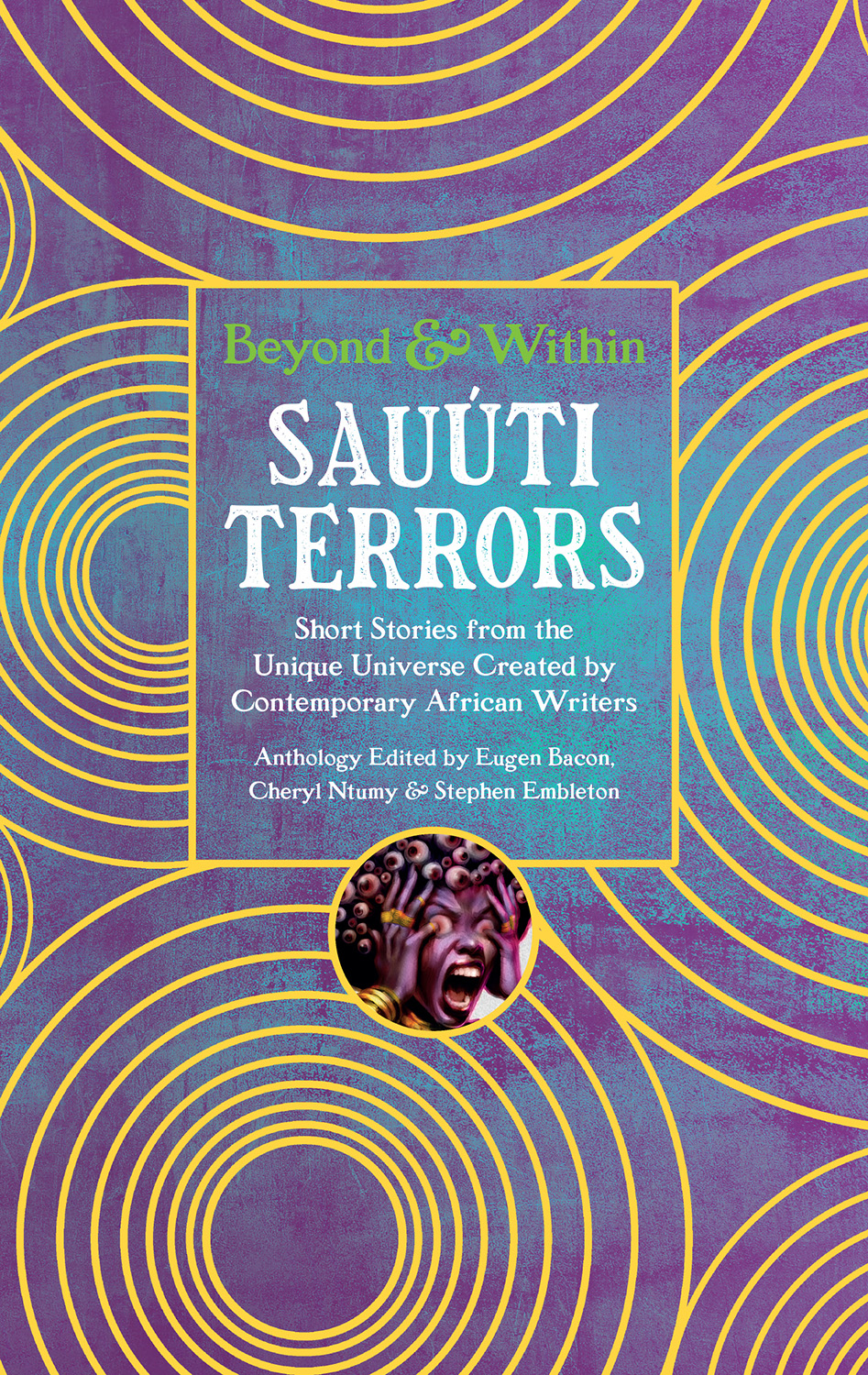
The Bone River by Nkereuwem Albert is an urban fantasy published by Phoenix, an imprint of Ouida Books focused on Science Fiction and Fantasy stories.
There are many things to love about The Bone River.
There is the magic system, the sense of a thick and present world bubbling away beneath the fabric of our own world. In Nkereuwem’s Calabar, miracles are the work of Pastors contorting magic in front of a blind congregation, and penises can, in fact, be stolen. By virtue of your initiation and belonging to one of four houses, you become a conduit to magic and mystery seeping out of the earth. You can command the dead, kindle fire from within you, and form familiars out of bone. You can shape it into beasts and seal gods. It is a land of infinite possibility. If you’re creative enough, you can conjure magic in service of peace—or to deceive.
This brings me to the story itself. By the time you put down Nkereuwem’s The Bone River, you would have witnessed how fragile peace can be, while war remains a latent possibility. This in itself should not be a discovery. We are well familiar with the flexibility of politicised narratives, the speculative reality of a truth wielded by authority. Surely, it should not take too much imagination to condense the abstraction of the lie beneath Calabar’s secret peace into a manner of critique about the cities we inhabit or the stories we tell about the blood that soaks our collective memories. After all, there is even greater violence than a certain bastard’s deception that is used every day as a tool to maintain a semblance of “status quo,” a peace with which no one is comfortable. And yet, the discovery of deception, as you read, grabs you. You know things like this happen, and yet, you are shocked. Why wouldn’t you be? It is the job of good fantasy to re-expose us to reality afresh. When you have seen and seen and seen with all your seeing eyes, the world unseen can and should shock you in new ways.
The longer I’ve sat with the assignment to write a column themed on community, the more daunting it has come to seem. This is, ironically, a personal problem: put very simply—and thus avoiding autobiographical sidequests—community is not something with which I am very well acquainted, and what acquaintance I have with it is tainted with distrust. Community has always shown itself to me as being concerned with who’s out as much as who’s in, if not perhaps more so; I thus tend to position community, from which one may be expelled, in contrast to the admittedly more abstract notion of society, of which one is a member by default (though one may of course be an unwilling and/or disenfranchised member of society).
Those who work with language face a perpetual dilemma in what we sometimes still call the ‘information age ’: on the one hand, words have meanings; on the other hand, meanings change with usage, and this process of semantic alteration (or evacuation) seems only to accelerate. In this particular case, I am rather stuck with “community,” but I can surface my discontent by suggesting a fresh distinction between community considered as a noun—a thing which one has or does not have—and community as a verb—a thing which one does, or in which one partakes.
(Readers who detect a Heraclitean distinction between being and becoming, respectively, are not imagining things; those whose philosophy tends more to the vernacular may prefer to think in terms of product and process.)
To be clear, I’m not out to position one or the other of these terms as being “the bad community;” indeed, that’s exactly the sort of monochromatic thinking that I’m trying to get away from in this piece. But I do want to highlight the way in which community-as-noun tends ineluctibly toward in-group-out-group dynamics, while community-as-verb puts the focus instead upon choices and compromises made in the face of constraints whose very commonality might conjure up the spectre of society which Margaret Thatcher once so successfully banished. More plainly, it seems to me that by paying more attention to what we are obliged to do, in the process of making, unmaking and remaking community through our actions, we might better recognise the greater societal ideal that community reproduces at a smaller and more limited scale.
ISSN 2662-8562 ISSN 2662-8570 (electronic) Palgrave Science Fiction and Fantasy: A New Canon ISBN 978-3-031-71566-2 ISBN 978-3-031-71567-9 (eBook)
A review by Dev Agarwal
With his latest work, Paul Kincaid looks critically and in-depth at Keith Roberts’s novel, Pavane.
Keith Roberts (20 September 1935 – 5 October 2000) was a science fiction writer and illustrator. His work on Pavane appeared first as a series of novellas from 1966 and then as a collected book in 1968.
Kincaid notes that Roberts’ work is often admired by his fellow writers but neglected more widely as science fiction. In part, this could be due to reactions to the artist rather than his art itself. While his work is respected by those already familiar with it, Roberts’s personality probably damaged his wider lasting recognition. Kincaid observes that Roberts may have been “incapable of friendship, someone who distrusted everyone on principle, and fell out with everyone who became close to him.”
We must go back a generation to find writers discussing Roberts’ work. Both AJ Budrys and Kingsley Amis lavished praise on Roberts. Trillion Year Spree by Brian Aldiss and David Wingrove also cites him positively, but Roberts is otherwise “almost entirely absent from other surveys of the genre.”
This deficit of attention has only grown in the years since Roberts’ death, which makes Kincaid’s literary appreciation particularly relevant. Kincaid speculates that Pavane may suffer in genre terms from being neither fish nor fowl. It does not sit easily “in the technological territory of science fiction,” yet it is also not modern fantasy. Pavane is a particularly British work, a book made up of a cycle of stories, and one imbued by religion, sense of place, and the mythical past of the English countryside.
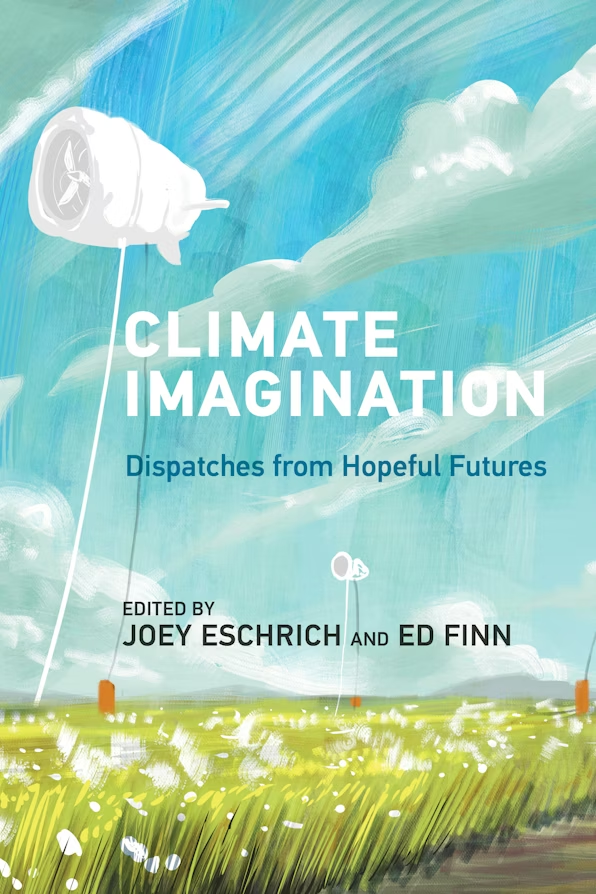
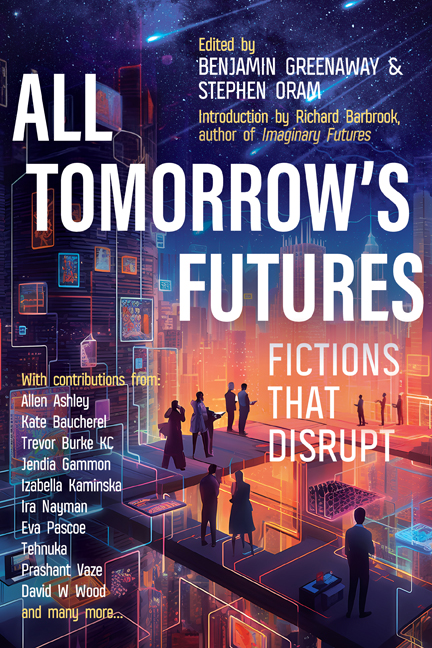
Explore where technology might take us and what that might mean for how we live with this anthology that brings together experts and writers.
It’s easy to view fiction as merely entertainment and escapism (both important in their own right), but stories – especially science and speculative fiction (SFF) – are also wonderful tools for exploring and learning, imagining possibilities and seeing how they might work. It is serious play and playful thinking.
It’s almost a tenet of SFF that technology is secondary to the story. While SFF writers tend to explore ideas and the stories those ideas generate, their technology may be plausible but there’s no requirement for it to be. There are, however, countless movies and TV shows where an interesting premise is undermined by technology that absolutely doesn’t work. Futurists and researchers explore possibilities and trends, making predictions that are intended as realistic extrapolations of real or expected technology, with none of the Hollywood handwaving and convenient MacGuffins, but while fictional case studies illustrating predictions are so common that you’ll find them in IKEA’s latest research about homes and living, they rarely have the kind of characters, plot and drama that makes for compelling fiction.
What if you could combine the two, with experts and authors collaborating to write about possible futures in ways that are not just plausible but creative, with equally strong stories and technical chops? Like Cybersalon’s previous anthology, 22 Ideas About the Future, All Tomorrow’s Futures is predicated on (mostly) plausible technology and the impacts such technological developments might have on justice, energy, digital money, health and education.
Samantha Mills is a Nebula, Locus, and Theodore Sturgeon Memorial Award winning author living in Southern California, USA. You can find her short fiction in Uncanny Magazine, Beneath Ceaseless Skies, Strange Horizons, and others, as well as the best-of anthologies The New Voices of Science Fiction and The Year’s Best Science Fiction & Fantasy 2023. Her debut science fantasy novel, The Wings Upon Her Back, is out now. You can find more at www.samtasticbooks.com.
JPG – The culture in The Wings Upon Her Back is a theocracy where labor and religion are intertwined, can you tell us about using this as a worldbuilding device?
SM – When developing The Wings Upon Her Back, I wanted a claustrophobic, monocultural setting to reflect the isolation of the main character and the fraught history of her city. Everything had to revolve around the five gods that are sleeping overhead.
In the book, the division of labor is a core tenet of their religious and social framework because they are emulating the gods, who arrived with very clearly defined roles. I ended up with five sects: the workers and farmers are the biggest groups, who keep the city running; the scholars and engineers are documenting and implementing the teachings of the gods; and the warriors keep the city isolated from outside forces. The primary conflict of the book comes from the unbalancing of these factions, as the warriors take more power over the others.
One of my favorite worldbuilding techniques is to build out social expectations – what everyone is supposed to believe, what everyone is supposed to do – and then to imagine the characters who do not fit the mold. I set a limit at five sects because it automatically creates tension: you can’t actually sort the breadth of humanity or the tasks needed to keep society running into such a small number of categories!
This tension permeates the book. There are jobs, such as medicine, that rely on teachings from multiple gods, and therefore arouse some unease. And there are many individuals who don’t fit neatly into their sect. My main character, Zemolai, was born into a family of scholars, but left them to be a warrior. The hodgepodge group of rebels she falls in with later in life have all either changed sects, or are revolting against the expectations placed on workers specifically. The right to question the division of labor (and therefore, the teachings of the gods) is central to the story.
“Extracting Humanity and Other Stories” by London-based SF writer Stephen Oram was officially launched at an in-person event at Burley Fisher independent bookshop, Dalston on Thursday 3 August 2023. Attendees included Geoff Ryman, along with some of the scientists Oram has worked with over the years in his roles with the “Virtual Futures” and “Cybersalon” projects – notably Christine Aicardi and Luke Robert Mason, who took part in an interview with the author during the second part of the evening. I mention these details because they speak to where Stephen Oram has placed himself over the past few years as a facilitator of closer links between SF authors and practising scientists as well as carving out a distinct near-future take on current trends, resulting in what I would term as the gradual creation of the “Oramverse”. Many of us authors strive to have a recognisable style and a recognisable palette of concerns; I would say that with this current collection and his two well-received previous offerings – “Eating Robots and Other Stories” (Silverwood Books, 2017) and “Bio-hacked & Begging and Other Stories” (Silverwood Books, 2019) – Stephen has succeeded in that aim.
There are twenty stories in this collection, some flash length, others more developed. Only one is set off-Earth – “Far Side Whispers”, an inventive evocation of civilisation on Luna. The remaining nineteen all present a vision of the UK a few or several years from now, integrating technological advances and societal change as drivers of the plot. It’s an old adage that the SF written about the future is actually a comment on our world today; with Stephen Oram’s work, this intention is often foregrounded. If you’re worried about how AI algorithms have the capacity to negatively affect you, and you probably should be, opener “Poisoning Prejudice” shows how the individual can fight back. The next story, “Haptic Father”, is one that Stephen read at the launch and is a standout, a compelling Oedipal tragedy. Other notable moments include my personal favourite “Adtatter Love” based on a totally plausible concept of people earning money by riding the tube trains all day sporting an electronically embedded advertisement on their forehead. Am I giving too much away if I say that Stephen Oram manages something of an uplift at the end? Closing the collection, title story “Extracting Humanity” is a moving piece that, with its protestors Madeleine and Sara, reminded me somewhat of the sacrifices made by the indomitable Greenham Common women of the 1980s.
Elsewhere along the way, you will find the author raising pertinent questions about what it means to be human / alive / real in “Chimy and Chris” (which was published in “The Best of British Science Fiction 2020”); “Keeping Family”, a bitter, short piece which focuses on the future of pregnancy and birth and yes the process is as sterile and heartless as we might fear; as well as “Standard Deviations”, which is another story pointing out the dangers of AI control, specifically predicting a person’s “unknown risk of future mental health issues” and, by extension, limiting that person’s life choices and liberty. A sort of minor “Minority Report” if you will.
Reading the whole collection again, one can see regular themes emerging – “Be Aware, The Hand That Feeds” starts with a common Stephen Oram trope, that the lead character has to somehow make their daily wage and put a meal in their stomach. Oram is telling us that life is likely to get ever more precarious and hand to mouth for the working class. The gig economy is a recurrent concern – “Adtatter Love”, “William Dreams” – and economics itself rears its head on several occasions. “In Trust We Trust” is a clever examination of what Oram calls near-future “Currency commonality” – an expansion of the current range of Sterling, PayPal / Google Pay, Bitcoin, etc into a myriad of potential mini-streams of finance. This being the Oramverse, of course, our hero’s credit is “Refused”. There is wit, too: “Bits ‘N’ Bacon” has the lines: “Each pre-packaged piece of food would have contained nanobots that registered its passage through the human, providing the health company with certainty on who was eating what.” Beware, folks, our only value in the near-future is as repositories of harvestable data.
As with most collections, there are a couple of pieces that don’t quite live up to the rest. This may be a consequence of four of the stories having emerged fairly quickly or to very tight guidelines from scientist-author link-ups and being previously published in “22 Ideas About the Future” (Cybersalon Press, 2022). And although Stephen is a great writer (and a great friend), I would have to say that the opening line of “John Doyle Remains” – “I had a girlfriend who ate my scabs” – feels like a misstep.
Overall, this is a great collection of short speculation on the near-future of urban society. I lie awake at night sometimes wondering if these are predictions as well as warnings. Read carefully, be prepared to fall brain-first into the Stephen Oram world.
You can watch Luke Robert Mason interviewing Stephen Oram and Christine Aicardi on You Tube:
About the reviewer: Allen Ashley is a British Fantasy Aawrd winner and is the founder of the advanced science fiction and fantasy group Clockhouse London Writers. His latest book is the atom punk chapbook “Journey to the Centre of the Onion” (Eibonvale Press, UK, 2023).
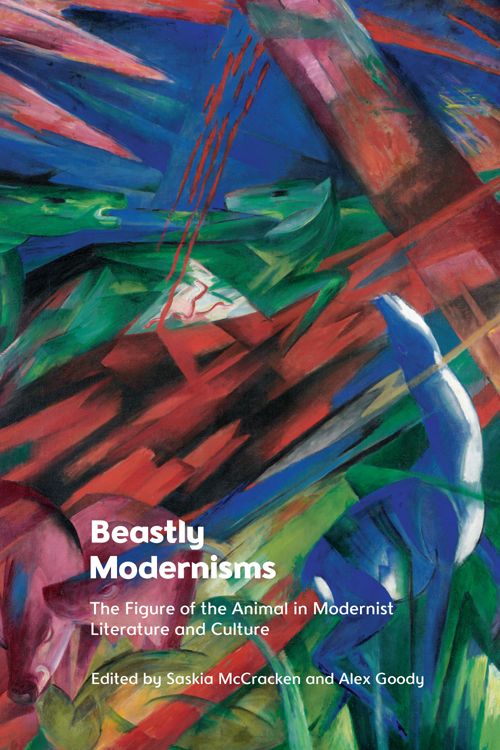
At face value, this collection of essays may not seem to be of immediate interest to the sf reader. It is primarily concerned with the development of Animal Studies – a sub-discipline that has already been significantly explored in relation to sf in the work of Sherryl Vint, Joan Gordon, and others – with reference to literary modernism, a diverse movement already noted for its challenge to traditional notions of identity and individual autonomy. The potential, though, for creative overlaps between modernism, sf and Animal Studies is already indicated by the fact that one of the co-editors, Alex Goody, was a keynote speaker at the 2019 Corroding the Now conference at Birkbeck College, London. Seen through a science-fictional lens, the encounter between human and non-human animals, the slippages between them, and their mutual affinities and kinships immediately invoke the First Contacts and uncanny relations between humans and aliens which are the stuff of genre sf. As the introduction’s reference to Jorge Luis Borges and Karen Eckersley’s chapter on Leonora Carrington make clear, imagined bestiaries are common to both Animal Studies and speculative fiction.
Without seeking to be a guide, the introduction nonetheless touches upon many of the key moments in the evolution of Animal Theory: from Peter Singer’s pioneering Animal Liberation (1975) and Donna Haraway’s ‘cyborg manifesto’ (1985) to Gilles Deleuze and Félix Guattari’s concept of ‘becoming animal’ (1982) and Jacques Derrida’s pivotal essay ‘The Animal That Therefore I Am’ (2002). The introduction also registers many of the other posthuman thinkers whose ideas have contributed both to Animal Studies and this volume in particular; from Giorgio Agamben and Rosi Braidotti to Michel Foucault and Cary Wolfe. The editors however, beginning their account with an exchange between Djuna Barnes and James Joyce (two modernists in exile, both of whom would flit between the centres and margins of the modernist canon), emphasise the affinities between Animal Studies, the revaluation of women’s writing and the decolonising of the curriculum. All such practices foreground and deconstruct the historic imposition of borders, the arbitrary gatekeeping that has characterised academic protocols and the maintenance of cultural shibboleths. To that end, the editors also note the collapsing boundary between ‘high’ and ‘low’ cultures, an elision that not only permits the entry of sf into the conversation, but which would also have appealed to such modernists as Barnes (boxing fan and purveyor of crime fiction) and Joyce (publican’s son, cineaste, and Anita Loos devotee).
“Abolish the family? You might as well abolish gravity.” (1)
It is with these words, spoken by an imagined, horrified reader, that Sophie Lewis begins their new book. From the outset, the magnitude of the task ahead for family abolitionists is clear. To abolish the family is to attempt something frightening, something unthinkable, something which requires one to challenge the fundamental rules which bind our world together. It is, then, no surprise that again and again Lewis reaches for science fiction (SF) to articulate this vision of a world beyond the family. For an SF creator, to abolish a so-called law of nature is not a ridiculous proposition which can be used to embarrass utopians into giving up on their belief that “things could be different” (4, emphasis in original). It is rather a serious undertaking which involves an investigation of those forces which hold life as we know it together, the willingness to experiment with those same forces, and the determination to remake the world, however alien what comes next might be. This is the spirit in which we, the Beyond Gender research collective, approach Lewis’ book. We are a group of SF fans, researchers and creators who are committed to tapping into the radical potential of SF to undo the supposed naturalness of such myths as the binary model of gender, cis- and heteronormativity and, now, the family.
“Abolish the family? You might as well abolish gravity.”
Isn’t capitalist system, which humans invented 200 years ago, growing into an uncontrollable beast that will devour human society?
Clock of Babel runs the whole world to the same rhythm of time.1]
The Cabinet
The Cabinet starts with a description of the cabinet. Inside, there are files of amazing people. A man who is turning into a tree, a woman who is growing a lizard instead of a tongue, and many more. This is not regarded as much of a mystery, and we never learn what is the mechanism of their transformation. The fantastic simply exists, not to be questioned, though for sure, in other respects this is our world. The protagonist could have come straight from the pages of David Graeber’s Bullshit Jobs. When he is not describing the fantastic files, he is ranting about his predicament: “As long as you don’t ask yourself what you are doing, you can keep doing it until the end of life” or “the only thing that capitalism ever produced is anxiety”. Reading The Cabinet from the perspective of Bullshit Jobs seems appropriate in more senses than one. The Cabinet is a multipronged critique of capitalism disguised as a fantasy novel.
Kingdoms of Elfin, Sylvia Townsend Warner’s 1977 short story collection, is one of her oddest and most fantastical works, the culmination of “a progressive shifting away from realism toward the explicitly anti mimetic modes of allegory and fable” (Castle, 1993), a departure which “seemed calculated to irritate and confuse a great many readers.” (Harman, 2015, p. 312) The tales were written over a period of several years, originally published separately in the New Yorker, before being published as a collection about a year before Townsend Warner’s death in 1978. They are loosely satires of class systems and aristocracy, as Harman describes: “She used Elfindom as a mirror to society, although all the satire in her elfin stories is very casually arrived at; she seems too uninterested in human dealings to aim at them with any care” (Harman, 2015, p. 313). Elfin (or fairy, the terms are often used interchangeably by both author and critics) society is portrayed as deeply decayed and corrupt, with a rigid class structure and archaic rituals dependent primarily on the whims of the powerful, disintegrating under the weight of their own isolationism and greed, and in opposition to the mortals of the tales, who are “almost universally working class”. (Priest, 2010)
There are two main layers to the class division in these stories. The most prominent is the division within Elfin society, between “flying servants [and] strolling gentry” (p.93). The division between Elfin and human society is also stratified along class lines, with the aforementioned working class mortals forming the main part of the human characters. The intersections between both of these stratifications will serve as the basis for my exploration of Warner’s treatment of class.
Claire Harman, in her 1989 biography of Sylvia Townsend Warner, describes the Elfins as “anarchic [and] amoral”. Harman is likely using ‘anarchic’ in the colloquial sense, to mean ‘chaotic’, however, in contrast to the literal sense of the word, we see that Elfin society is deeply hierarchical, and the power of flight, through the possession and usage of wings, is frequently employed as a symbol of the delineation of those hierarchies. It’s a physical power, an inherited characteristic, a visual marker to differentiate between Elfins and those they consider to be their human inferiors. It serves as a marker of the differences between Elfins and humans, a demonstration of Elfin superiority that is tied in with human religious symbolism. It also serves as a class marker within Elfin society, between the working classes who must rely on flight for labour and transport, and the upper classes who consider it beneath their dignity. We are told quite flatly of the theoretically simple social position of flight: Elfins “fly or don’t fly according to their station in life”, and the aristocrats “marked their social standing by scorning to use their wings” (p. 66). The stories frequently concern themselves with instances in which these social rules are transgressed.
I am resisting the impulse here to taxonomise every symbolic function of the power of flight in these stories, to fit them all into some universal system, since this runs counter to the playfully and deliberately contradictory nature of these stories. Partly this is due to their being written over a long period of time, changing style and tone to suit the needs of particular stories, and partly it is an artefact of the stories’ function as social satires. Though some critics have discussed her “attempt to construct a typology of fairies” (Simons in Davies & Malcolm eds. 2006), I would disagree that she makes any such attempt. It is possible to read a typology into the book, but I’d argue that this requires flattening a lot of the apparent contradictions. Flight is forbidden, except when it’s not. Contact with humans is forbidden, except when it’s not. Religion is irrelevant to them, except when it’s not. She sets out a theoretical typology, then throughout the collection she explores the complications and violations and contradictions of this typology. It might be more accurate to say that the book is a typology of contradictions, and in laying out the Elfin contradictions we are led to consider the human ones.
In writing about Warner’s treatment of animals in her fiction, Mary Sanders Pollock discusses Warner’s project to “suggest ways that Marxist thinking might permeate and complicate the boundaries […] between the “human” and the other lively beings” (2015), which I would suggest applies equally to her treatment of the Elfins as it does to her treatment of animals. We see a convergence of these two concepts in the tale ‘The Mortal Milk’, which concerns “the Royal Pack of Werewolves” (p. 68) in the Court of Brocéliande as they sicken and die. They are described as both men and beasts, as both unnatural and mortal, as a liminal state between sapient and animal, and their treatment mirrors the treatment of the human children raised in Elfin. Permeability is a recurrent symbol in these stories, be it the permeable geographical boundaries between the two worlds, the permeable species boundaries between humans and Elfins, or the resisted permeability of class boundaries.