The Resistance

By Nick Hubble 

It might seem rather strange to start writing a column for Vector focusing on sf as a fiction of practical resistance to capitalist realism and oppression in a special issue on sf and modernism. After all, isn’t modernism the literature of the metropolitan elites? Influential books such as John Carey’s The Intellectuals and the Masses (1992) and Jonathan Rose’s The Intellectual Life of the British Working Classes (2001) certainly make this case. The latter argues that writers from the educated classes sought to maintain their elite status in the face of challenges from the masses by creating modernism, ‘a body of literature and art deliberately made too difficult for a general audience’ (393). His illustrative list of such elitists includes T.S. Eliot and Ezra Pound, but also less obviously conservative writers, such as H.G. Wells and Virginia Woolf.

While Wells was educated, he was hardly from the educated classes, being the son of a shopkeeper and domestic servant. His brilliant novel Tono-Bungay, charting the rise and fall of a quack medicine, was serialised from 1908 in Ford Madox Ford’s English Review, one of the foundational modernist magazines. The lively style of first-person narrative Wells adopted for the novel was highly influential on the work of modernist writers, including Ford’s own The Good Soldier (1915). Yet far from being deliberately difficult in order to deter general readers, Wells was a popular writer who expressed the dreams of millions who aspired to escape from the class-bound hierarchies of the age  As George Orwell pointed out, reading Wells’s sf during the early years of the twentieth century at a time of lingering Victorian values and moral hypocrisy was a liberating experience because he ‘knew that the future was not going to be what respectable people imagined’ (171). 

One feature that modernism and sf share is a resistance to the capitalist conception of time: the relentless metronomic recording by the factory or office clock of the seconds, minutes and hours of empty time to be filled by work. Instead, both genres enable the depiction of time as elastic: moments that stretch to encompass the entirety of eternity and epochs that pass in the blinking of an eye. The archetypal example of this latter phenomenon is Well’s The Time Machine (1895), in which his protagonist fast-forwards from Victorian London into a distant class-flipped future in which the Morlocks, evolved offspring of the workers, hunt and eat the descendants of their former masters, the Eloi. While the satire is savage, the experience of time travel itself is recorded in aesthetic terms through the hero’s description of watching ‘the moon spinning swiftly through her quarters from new to full’ before blurring into a ‘fluctuating band’ faintly visible against a ‘wonderful deepness of blue’ (17). 

Continue reading “The Resistance”

Vector 294 SFF and Class

Vector 294 is now available to download.

We open issues to the public after about two years. An index of back issues of Vector can be found at the ISFDB. For the availability of individual print issues, please contact us.

Many earlier issues of Vector are also available for download on this site, or through FANAC. Digital editions of more recent issues are available to BSFA members.

To subscribe to Vectorjoin the British Science Fiction Association. Membership is open to anyone in the world. Members receive VectorFOCUS, the BSFA Review, special one-off publications, and other benefits. The BSFA is a nonprofit organisation, entirely run by volunteers.

Cover: Sinjin Li

Vector 294, SFF and Class, is guest-edited by Nick Hubble. Featuring ksenia fir on labour in outer space, Paul Kincaid on Priestley’s An Inspector Calls, Guangzhao LYU on Wei Ma’s “Formerly Slow” and Hao Jingfang’s “Folding Beijing,” So Mayer on Star Trek: Discovery, Marie Vibbert‘s survey of class representation in SFF, Farah Al Yaquot on Petrosyan’s The Gray House, Ali Baker on de Larrabeiti’s Borribles, Andi C. Buchanan on Cipri’s Finna, and an extensive guest editorial from Nick Hubble.

Cover by Sinjin Li.

Jobs and Class of Main Characters in Science Fiction

By Marie Vibbert.

This article first appeared in Vector #294.

I was at a massive mixer for members of the Science Fiction Writers of America, a group I had just joined, wondering how I could even talk with these big, important people. The question everyone asked when you walked up to them was, “What type of science fiction do you write?” After mumbling some self-deprecating responses like “bad” or “oh you know like … the kind with robots and spaceships?” I tried to express what made my work different. “I write working-class science fiction,” I told the next gentleman. “Stories with waitresses and janitors in space, you know? I feel like there’s too many stories about rich guys without real problems.”

I picked the wrong man to try this tactic on. He laughed condescendingly and said, “The opposite is true. Everything is about some worker everyman. There aren’t enough stories about rich characters!”

My first thought was, Ooookay time to start never talking to this dude ever again, but my second thought was a worried, Is he right? I had this gut feeling that a lot of the science fiction I had read didn’t represent my social class, but was I just biased?1

The only answer was, of course, to collect some statistics! This paper is the culmination of my efforts to answer the question for myself, “Is there a class bias in main characters in science fiction, and if so, are poor or wealthy characters more predominant?”

Methods

Choosing the Books

The first question I had to answer was, “How do I take a sample set of science fiction?” I limited myself to novels, because novels or their detailed discussions were easy to find, and that way I’d be comparing apples to apples.

Reading every science fiction novel ever would not be feasible, especially with a staff of just me. I searched for recommended reading lists, but which to choose? Many were simply “The Best of 2019” or such. While it would be interesting to look at a specific period of SF, I wanted a cross-section of what an average reader might have in mind, and that meant including recent books as well as old classics. I googled “Top Science Fiction Novels” in an incognito browser tab (so as not to bias the results with my search history) and took the first 50 novels the search returned. I liked that list better: it felt eclectic, and included recent novels as well as Mary Shelly’s Frankenstein. Of course, the Google search results, while incognito, still would be skewed toward my location in the Midwest United States.

The British Science Fiction Association’s magazine, Vector, announced a call for papers on class and science fiction. I could hardly contain my excitement (and imposter syndrome) as I typed and re-typed my email asking if this statistical analysis was the sort of thing that maybe they’d want to see? And so, my next data set was BSFA award winners. These would skew British to balance my American bias. How better to kiss up to the editors? I started my spreadsheet!

BSFA award winners include fantasy novels with no science fictional elements, however, maintaining genre purity would open up a can of worms (how to draw the lines? Who gets to say what is or isn’t SF?). I would keep the results of each list separate, to see if there was any bias.

On accepting the paper proposal, editor Polina Levontin suggested adding the titles from the Orion SF Masterworks book series, a somewhat curated list, limited only by what titles Orion had the rights to. So now I had three piles of representative works: award winners, a hodgepodge recommended by Google, and a curated list for a total of 194 separate titles. It seemed as close as I was going to get to a reasonable sampling of notable science fiction novels.

Continue reading “Jobs and Class of Main Characters in Science Fiction”

“Who do you think is powering that spotlight?”: Social mobility and resistance in Black Mirror‘s ‘Fifteen Million Merits’

By Ivy Roberts.

You live in a technological fishbowl. Your life is ruled by television screens. The walls of your room are painted in technicolor pixels. During the day, you pedal on your stationary bike while watching screens. At night, the screens watch over you as you sleep, simulating the sun setting and then rising on a new day to see you return to the bike, going nowhere. 

If this doesn’t sound like the most asphyxiating future to you, then you have become too accustomed to the daily grind. Such a live-work environment is depicted in the second episode of the first season of the sci-fi television series, Black Mirror: ‘Fifteen Million Merits’ (2011). In this dystopian future, the class structure of society is strictly hierarchical. The three classes even wear clothing denoting their social rank. Social mobility is possible, but only via a strictly monitored ‘merit-based’ system. Everyone dreams of becoming famous. So, what’s at stake here? Nothing less than our individual autonomy. 

Continue reading ““Who do you think is powering that spotlight?”: Social mobility and resistance in Black Mirror‘s ‘Fifteen Million Merits’”

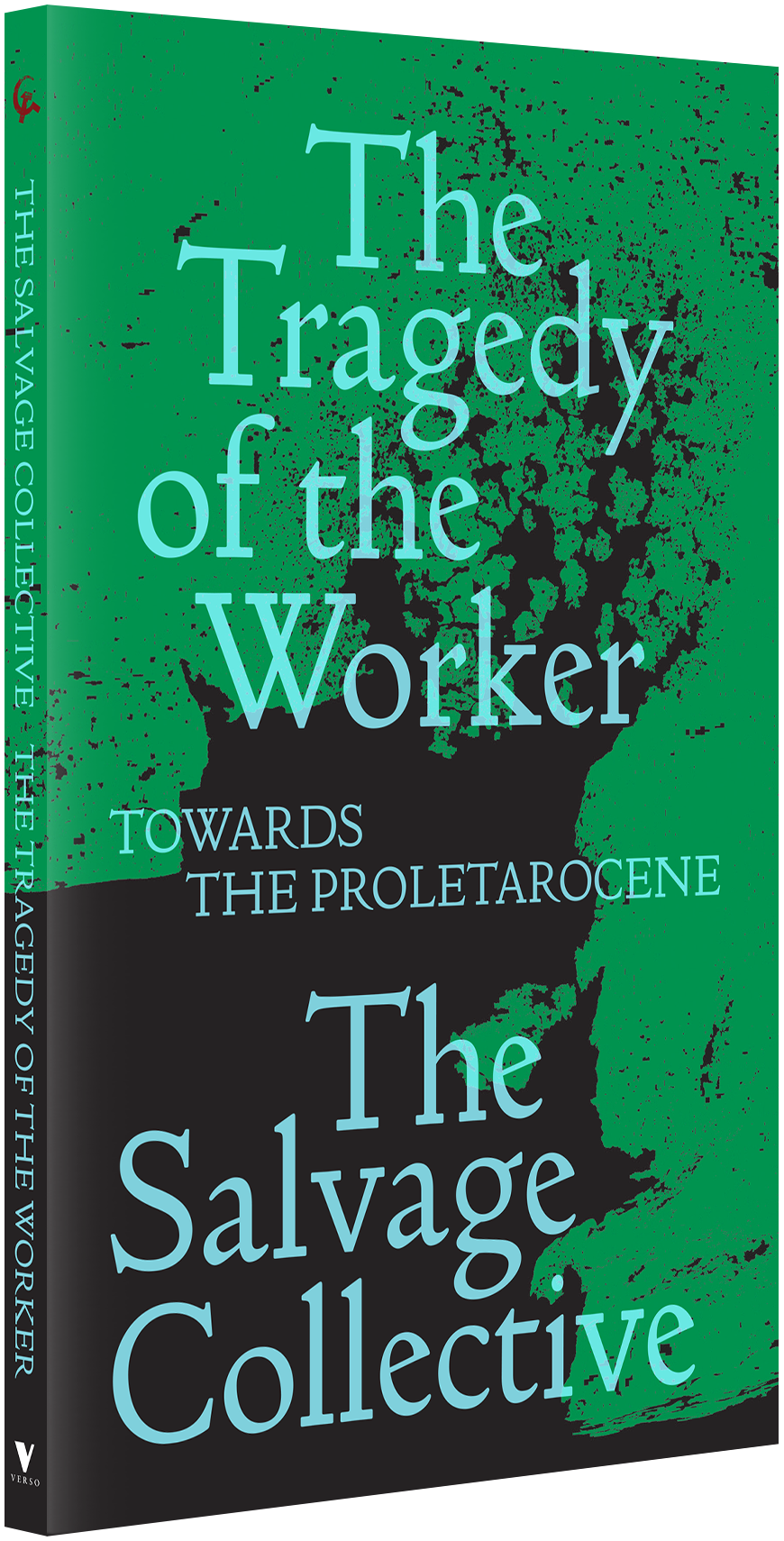
The Tragedy of the Worker: Toward the Proletarocene by The Salvage Collective

Reviewed by Lars Schmeink.

Tragedy-of-the-worker

The Tragedy of the Worker: Towards the Proletarocene. The Salvage Collective. Verso, 2021.

Julian Rosefeldt’s video installation Manifesto (2015) has Cate Blanchett reading out various manifestos from the 20th century, each of them declaring a specific artistic view on the world as central to its time and circumstances. From Futurism to Fluxus, from Dadaism to Situationism, from Vorticism to Dogme 95. The outlier in all of this, or maybe the underlying basis, seems to be the Manifesto of the Communist Party (1848) by Karl Marx and Friedrich Engels, which Blanchett intones as the film opens with the image of a lit fuse: “All that is solid, melts into air.” If Marx and Engels’ Manifesto is the spark that ignites the imagination of artists and writers to manifest their thoughts against the state of the world, that is against the capitalist system that subsumes us all, then maybe The Salvage Collective’s The Tragedy of the Worker is the moment that the fuse finally catches the powder and blows the system to bits and pieces. Well, probably not. Let’s be realistic. As the Salvage writers say themselves, the publication was “born out of defeat” (102) and carries with it a “certain political pessimism” (103), and it seems unlikely that one more left-wing publication about the climate crisis and its connection to the death cult of capitalism could make much of a difference. But it is a convincing one, one that is well-argued, poetically written, and with both dry cynicism and fiery revolutionary talk to light the spark in those still on the fence about how to change this world for the better.

So if you are looking to up your argument game for the next debate about capitalism, then here is your manifesto. Salvage Collective draw the connection between the climate catastrophe we are experiencing and the underlying mechanics of capitalism, revealing—you all guessed it—that within capitalism’s main logic of accumulation, the destruction of this planet is inevitable, it is part of the program. Working through different aspects of the issue, the essay explores the deceiving promises of “Green Capitalism,” the historic failure of generating a “Red Plenty” after the October Revolution, the upcoming fight for Arctic resources and the “Politics at the Poles”, as well as the need to be watchful of the establishing of a “Green Fascism” erupting as climate migration grows. Overall, The Tragedy of the Worker is a manifesto of sorts, rallying those on the left to see centrist politics as part of the problem, calling for more radical visions, claiming the need to stop capitalist’ accumulation dead in its tracks, or else … Or else—and that might be the issue of why Tragedy is not igniting the powder keg—it is simply too late. The writers close with acknowledging that it is already too late, that systems are too entrenched, and that left-wing politics would need to be so radical that they are “unrealistic […] an indication of how much would have to be achieved, and how quickly consent gained for radical new ideas, coalitions assembled, tactics innovated, the unthinkable realised” (86). For a manifesto, this is too dark. There is no call to arms, no utopian moment of hope. And that in itself might be why the essay is even more necessary, why we need to realize the catastrophic path we are on. Not to make it all better, but to stop it from becoming even worse. That is the tragedy of us all.  


Lars Schmeink is Leverhulme Visiting Professor at the University of Leeds and project lead “Science Fiction” for the federally funded “FutureWork” research network at the Karlsruhe Institute of Technology. He inaugurated the Gesellschaft für Fantastikforschung and served as its president until 2019. He is the author of Biopunk Dystopias (Liverpool UP, 2016) and most recently the co-editor of Fifty Key Figures in Cyberpunk Culture (Routledge 2022) and New Perspectives on Contemporary German Science Fiction (Palgrave 2022).


Copyright Lars Schmeink. All rights reserved.

SFF and Class

Vector and Focus are inviting submissions on the theme of class, with proposals due 15 April, and articles due 15 July. Please see the full call for more information. Vector will be publishing a special themed issue, guest-edited by Nick Hubble.

Keep an eye out for more CfPs for future special issues to be edited by Stewart Hotston, Stephen Oram, Phoenix Alexander, and Nina Allan.