Jean-Paul Garnier interviews Tara Campbell

Tara Campbell is an award-winning writer, teacher, Kimbilio Fellow, fiction co-editor at Barrelhouse, and graduate of American University’s MFA in Creative Writing. Publication credits include Masters Review, Wigleaf, Electric Literature, CRAFT Literary, Uncharted Magazine, Daily Science Fiction, Strange Horizons, and Escape Pod/Artemis Rising. She’s the author of the eco sci-fi novel TreeVolution, two hybrid collections of poetry and prose, and two short story collections from feminist sci-fi publisher Aqueduct Press. Her sixth book, City of Dancing Gargoyles, was released by Santa Fe Writers Project (SFWP) in September 2024. She teaches creative writing at venues such as Johns Hopkins University, Clarion West, The Writer’s Center, and Hugo House. Find her at www.taracampbell.com

Jean-Paul L. Garnier is the owner of Space Cowboy Books bookstore and publishing house, producer of Simultaneous Times Podcast (2023 Laureate Award Winner, 2024 BSFA, Ignyte, and British Fantasy Award Finalist), and was the editor of the SFPA’s Star*Line magazine from 2021-2025. He is also the poetry editor of Worlds of IF & Galaxy magazines. In 2024 he won the Laureate Award for Best Editor. He has written many books of poetry and science fiction. https://spacecowboybooks.com/

JPG – CITY OF DANCING GARGOYLES has a really interesting format: it switches between epistolary and more traditional novel narratives. What made you decide to mix these formats to tell your story, and what advantages did it provide you?

TC – Well, I hadn’t actually planned on writing a novel. During COVID I was having a hard time concentrating enough just to read, let alone write, but I was inspired by a novel pre-writing technique by Michael Moorcock that centered on imagery containing deliberate paradoxes. The image he gave as an example was “In the city of screaming statues.” That image created so many questions in my mind: I had to know what the city looked like, what it sounded like, what set these statues off, were they screaming words or just sounds, did they ever stop, etc. I was excited at how many questions that one image created, so I created a writing exercise for myself based on nouns and verbs, putting together words that absolutely do not belong together, like floating wolves and sailing statues and glaring chocolates and all of these things that simply can’t be.

I wound up writing a couple dozen stories, and when I started thinking about how to bring them together in a collection, I created a chart to figure out how to group them, looking at commonalities of theme or tone or perspective or any way they would cohere. Then a writer friend suggested using an element I mentioned in one of the stories—alchemical testing—to imagine all of the stories as part of the same universe.

Once I started thinking in terms of a novel, I had to be more ruthless in how to change or cut stories for the purposes of the narrative. Some of the stories turned into setting or characters instead of self-standing works. But on the other hand, the epistolary sections let certain stories be as weird as they wanted to be in this future US that’s been that’s been altered by climate change and alchemical testing.

Continue reading “Jean-Paul Garnier interviews Tara Campbell”

Interview with Renan Bernardo

By Jean-Paul L. Garnier 

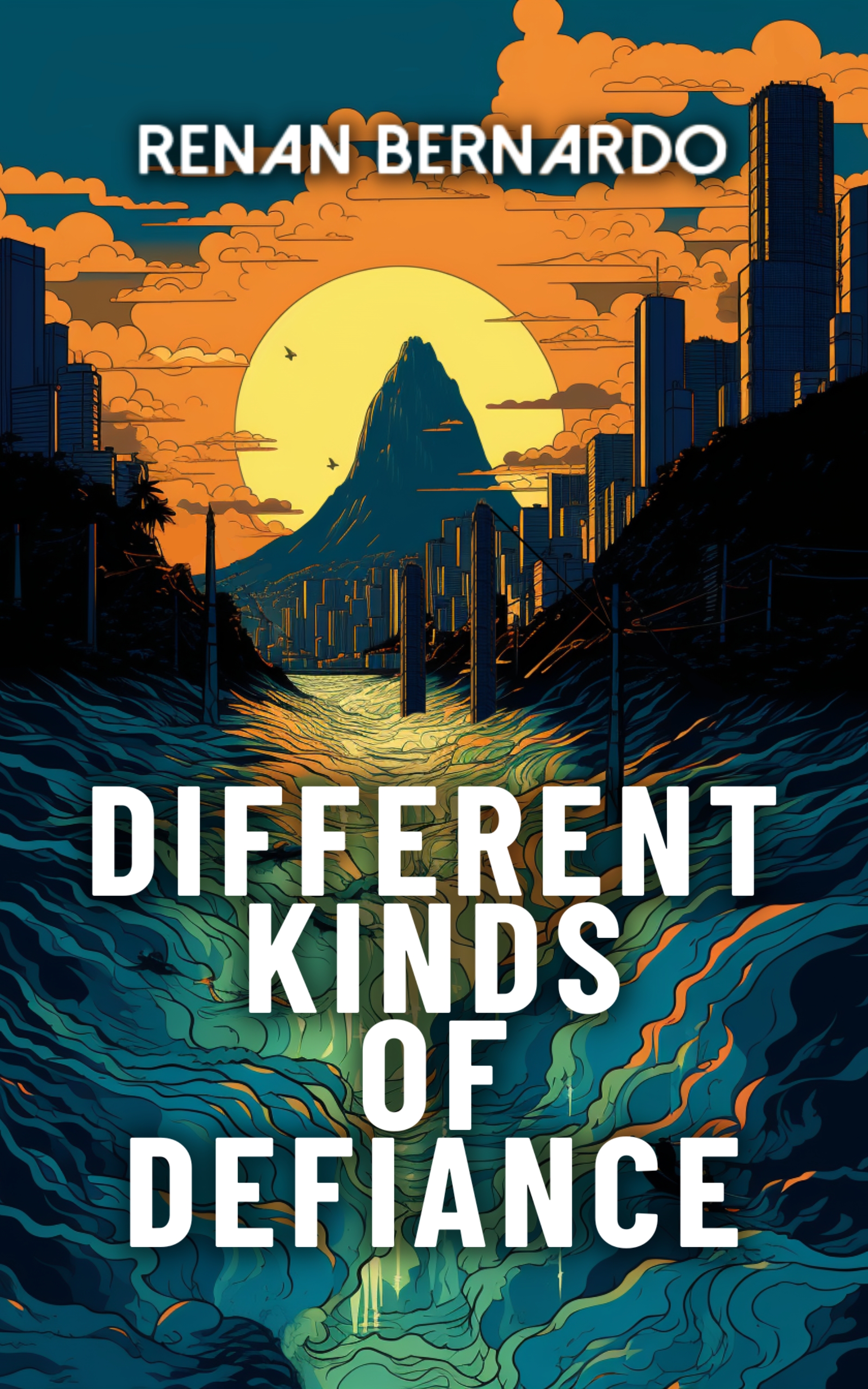
Renan Bernardo is a Nebula finalist author of science fiction and fantasy from Brazil. His fiction appeared in Reactor/Tor.com, Apex Magazine, Podcastle, Escape Pod, Daily Science Fiction, Samovar, Solarpunk Magazine, and others. His writing scope is broad, from secondary world fantasy to dark science fiction, but he enjoys the intersection of climate narratives with science, technology, and the human relations inherent to it. His solarpunk/clifi short fiction collection, Different Kinds of Defiance, was published in 2024. His fiction has also appeared in multiple languages, including German, Italian, Japanese, and Portuguese. He can be found at Twitter (@RenanBernardo), BlueSky (@renanbernardo.bsky.social) and his website: www.renanbernardo.com

Jean-Paul L. Garnier is the owner of Space Cowboy Books, producer of Simultaneous Times Podcast (2023 Laureate Award Winner, BSFA Finalist), and editor of the SFPA’s Star*Line magazine. He is also the deputy editor-in-chief of Worlds of IF magazine & the soon to be relaunched Galaxy magazine. He has written many books of poetry and science fiction. https://spacecowboybooks.com/

JPG – In many of your stories you juxtapose the past with the present, layering multiple times together, tell us about using this narrative device, and how you use it for emotional effect? 

RB – Layering past and present together without necessarily resorting to flashbacks is an excellent device to make the reader flow along with the main character’s feelings without breaking the pace of the story. I believe the past has a lot of things to say. Our past shapes who we are, so it always adds an interesting layer to my stories. Many answers to the present and the future are in the past. I believe that you were thinking of “Soil of Our Home, Storm of Our Lives” when you thought about that question. In this story, there are three timelines layered separately: past, present, future, each with different things to say about the characters, different emotional cores to introduce that end up fusing in the end. The challenge is always to weave them all together, so they don’t feel detached from each other, but I like to believe that I achieved it in this particular story.

JPG – Your stories often present utopias, but as you mention in your forwards, one person’s utopia can be another person’s dystopia. Can you speak about this concept and why cultures have a difficult time envisioning positive futures that include everyone?

RB – There are two stories in the collection that introduce this concept: “Anticipation of Hollowness” and “To Remember the Poison.” In “Anticipation of Hollowness,” there’s a sustainable city where everything seems perfect but the city is extremely gentrified and no one from lower or middle class is able to live in it anymore. And “To Remember the Poison” is an extreme version of it: a society based on justice, sustainability, and equality that got so detached from the rest of the world that it became an exclusive haven closed to the world. And though its focus is on education and expanding their “green” world, its inhabitants tend to follow a line of thought not so different from what billionaires imagine with their projects of selective bunkers or space stations. And given the concentration of resources and knowledge of Verdoá (the city in the story), it becomes a colonizing power in the region.

Continue reading “Interview with Renan Bernardo”

Interview with Eve Smith

By William Davies

Eve Smith is the author of three speculative thrillers. Her latest novel, ONE, published in 2023, is set in a one-child policy Britain that has been ravaged by climate change. It was longlisted for the 2023 British Science Fiction Association Best Novel award. Her debut, The Waiting Rooms, set during an antibiotic crisis, was shortlisted for the Bridport Prize First Novel Award and selected as a Guardian Book of the Month. Off Target, her second novel, imagines a world where genetic engineering of children has become the norm. It was a Times Book of the Month, who described it as ‘an astute, well-researched and convincing novel of ideas.’ Eve’s books are published by Orenda Books. Her website is www.evesmithauthor.com 

Before writing full-time, Eve worked for an environmental charity on research projects across Asia, Africa and the Americas. 

This interview developed out of an in-person event held at Ewell Library, UK, in September 2023. 

Thanks for your time, Eve. Let’s start with ONE. It’s a chilling speculative thriller that covers many themes, from climate change to women’s rights. How did the novel come about and what was your process for writing it? 

The premise for ONE was born out of two ideas. First, what if birth was a crime? How might a one-child policy play out in Britain? Second, how might the climate emergency change the UK, not only in terms of environmental impacts, but also the social and political ramifications? How would it affect how we’re governed and how we treat people?

During my research, I read Shen Yang’s More Than One Child, a powerful memoir about growing up as an illegal excess child in China under their one-child policy. The author had committed a crime just by being born. During China’s one-child policy over half a billion birth control procedures were carried out over more than three decades. Many of those sterilisations and terminations were forced. Given the recent abuses of abortion rights in the US, with Roe vs Wade being overturned, the fact that such a thing could happen today in a Western democracy made me question what else a government in the West might do to curtail reproductive rights.

In ONE, I also wanted to explore how a totalitarian party might take advantage of the climate crisis to secure power. In Europe, several far-right groups have adopted the clothes of an environmental agenda to promote nationalist policies. In my novel, on the surface, the UK appears to be doing pretty well. Through climate tech investment and radical shifts in policy and laws, the country has adapted to cope with many climate change effects. Britain is self-sufficient in food, water and energy. Jobs are plentiful. Healthcare is good. But it has come at a cost: freedom and choice. 

Continue reading “Interview with Eve Smith”

Deconstructing the myths and stories we tell ourselves about the future

By Linna Fredström, Laura Pereira, Simon West, Andrew Merrie and Joost Vervoort

Examples from a small city in the middle of a Swedish forest

‘We live in capitalism. Its power seems inescapable. So did the divine right of kings. Any human power can be resisted and changed by human beings. Resistance and change often begin in art, and very often in our art, the art of words.’ Ursula K Le Guin

Intro and motivation for study

A growing body of research is calling for radical transformation of society to avoid catastrophic levels of climate change and create a more sustainable and just future (Adger et al., 2009; Westley et al., 2011; Kates, Travis and Wilbanks, 2012; Patterson et al., 2017; Fazey, Moug, et al., 2018). Such transformation will disrupt political and economic structures as well as knowledge and value systems, and require fundamentally changing “norms, values, and beliefs; rules and practices, such as laws, procedures, and customs; and the distribution and flow of power, authority, and resources” (Moore et al., 2014).

Many researchers studying such transformations are also acknowledging that their own role must change: rather than simply producing knowledge, they are beginning to actively participate in making knowledge actionable, with the explicit goal of enabling radical change (Cornell et al., 2013; Sala and Torchio, 2019; Fazey et al., 2020). In this new task, the social sciences can offer valuable insights on how to approach the value-laden and political dimensions of using science to bring about change (Wittmayer and Schäpke, 2014; Fazey, Schäpke, et al., 2018; Vervoort and Gupta, 2018; Woroniecki et al., 2019; Miller and Wyborn, 2020; Scoones et al., 2020; West et al., 2020). Critical social theory and critical perspectives in particular are believed to offer tools for sustainability transformation research (Death, 2014; Lövbrand et al., 2015; Stirling, 2015; Blythe et al., 2018). Critical social theory focuses on illuminating and challenging the power dynamics and hidden biases of science and knowledge itself. This focus on reflexive and critical perspectives is now gaining traction within the field of transformation toward sustainability. Conversely, researchers within the field of sustainability are reaching conclusions that point toward the need for critical theory. It’s becoming clear that to enable transformation to a more sustainable and just society we must be willing to challenge not only political and economic systems, but also the value and knowledge systems that brought us to this point in history (Stirling, 2015, 2019; Gottschlich and Bellina, 2017; Fazey et al., 2020).

Scenarios have become a frequently used approach to explore radically different futures and to identify transformative potential in the present (Pereira et al., 2019). As a tool, scenario development is versatile and allows for transdisciplinary exploration, combining scientific, local, practical, and emotional insights (Oteros-Rozas et al., 2015; Merrie et al., 2018; Pereira et al., 2018; Sweeney, 2018; Wangel et al., 2019). Scenario exercises in times of impending climate crisis can be a way to practice imagining the future, and through this practice to see potentialities in the here and now. We need new understandings of the world, new stories: alternatives to both climate catastrophe and naïve never-ending growth narratives. But how do we make space for such visions?

Continue reading “Deconstructing the myths and stories we tell ourselves about the future”

Mosquitoes, mushrooms, magic: Africanfuturist SF for nature’s futures

Charne Lavery [1,2], Laura Pereira [3,4], Bwalya Chibwe [4], Nedine Moonsamy [1], Chinelo Onwaulu [5], Naomi Terry [4].

1 Department of English, University of Pretoria, South Africa

2 WiSER, University of the Witwatersrand, South Africa

3 Global Change Institute, University of the Witwatersrand, South Africa

4 Stockholm Resilience Centre, Stockholm University, Sweden

5 Independent author and editor of African speculative fiction

It is widely recognised that nature must be valued in ways that go beyond narrow  economic perspectives, and accommodate the interconnected social, cultural, aesthetic, and spiritual dimensions of nature.  There is also now growing interest in futures that value nature in its own right, independent of the many benefits that nature provides to humans. How we imagine the future shapes what and how we value, and the decisions we make in the present. The Nature Futures Framework (NFF) offers high-level guidance for imagining nature futures that acknowledge the complex and interconnected values of nature. While there are many narratives and practices focused on valuing Nature-for-Society, there are fewer which value Nature-as-Culture or Nature-for-Nature. This article explores the potential for Africanfuturist science fiction to address these gaps in the NFF construct. Africanfuturist science fiction can provide visions of the future which embody the priorities and the lived experience of their African authors. This article explores a sample of Africanfuturist texts to highlight both their diversity and to draw out some significant commonalities.

  • Review: This article underwent editorial review from three editors.
  • License: CC BY-NC-ND 4.0.
  • Citation: Lavery, Charne, Laura Pereira, Bwalya Chibwe, Nedine Moonsamy, Chinelo Onwaulu, Naomi Terry. 2022. Facing the Strategic Sublime: Scenario Planning as Gothic Narrative. Vector, 27 September 2022.  https://vector-bsfa.com/2022/09/27/mosquitoes-mushrooms-magic-africanfuturist-sf-for-natures-futures/
  • Keywords: Africanfuturism; SDGs; nature futures; science fiction; futures; ecosystems services; relational value; Nature Futures Framework
  • DOI: 10.5281/zenodo.7625005
  1. Introduction

The future is African: by 2100 one in three people are projected to be from the African continent (Council on Foreign Relations 2020). And yet the stories that the world tells itself about this future are decidedly not African — or at least not of a prosperous, plausible future Africa (Pereira et al. 2021). In a post-colonial world, Africa continues to be colonised by dominant perspectives that dictate what to aspire to and which values are important (Oelofsen 2015). This is to the detriment not only of the continent but the world. It misses the diverse possibilities that local cultures and traditions could offer in terms of preferable futures, drawing on pasts that are deeply connected to the land and ancestors. Addressing this marginalisation of knowledge systems and the people who practice them is of critical importance in the shift towards a more equal development agenda that values diversity (Tengo et al. 2014). The Sustainable Development Goals (SDGs) are a set of objectives set up by the United Nations to improve quality of life around the world, protect the environment, and promote peace and prosperity. There are seventeen SDGs, including the eradication of poverty and hunger, the spread of health and wellbeing, quality education, gender equality, and climate action. Governments, businesses and non-profits use the SDGs as a framework for understanding their broader purpose and impact. Are the SDGs fit-for-purpose? It’s a controversial question, but one thing is for sure: as the world struggles to meet these goals, fresh ideas, and bold pathways away from current trajectories, need to be explored.

Speculative fiction has a role to play in this. How we think about and imagine the future is an important aspect of decision-making in the present (Vervoort and Gupta 2018). As Lao Tzu says, “if you don’t change direction, you may end up where you are headed.” When we are continually confronted by stories of doom and gloom, these can often be self-fulfilling (Evans 2016). We end up where we are headed.  We are currently experiencing overlapping global environmental crises. The most recent is the  Covid-19 pandemic (zoonotic diseases are fundamentally linked to human-environment interactions). The most existentially threatening is climate change. The most ethically compromising is, arguably, the human-induced sixth mass extinction. A business-as-usual trajectory is suicide for humanity. However, what are the futures towards which we do want to navigate? And how might we begin to imagine them?

Part of the answer lies with how we value nature. Calls are growing to reimagine transformative futures for nature using more than just positivist science (Wyborn et al. 2020). Traditional environmental policy has often treated nature as a realm whose laws we can know and master, to maximise its economic benefits to humans. In recent years, there has been more recognition that economic benefits are interconnected with social, cultural, and even spiritual benefits. The beauty and abundance of nature give inspiration and solace to humans in ways that are hard to quantify, let alone control, ways that are grounded in the diverse values that people find in nature. Yet perhaps this still doesn’t go far enough. There is now growing interest in futures that value nature in its own right, independent of the many benefits that nature provides to humans.

Continue reading “Mosquitoes, mushrooms, magic: Africanfuturist SF for nature’s futures”

Facing the Strategic Sublime: Scenario Planning as Gothic Narrative

By Matt Finch and Marie Mahon.

Scenario planning refers to methods used by decision-makers to enhance their strategic thinking, especially in situations characterised by turbulence, uncertainty, novelty, and ambiguity. Scenario planning is therefore particularly relevant in the context of climate change, which is complex, unprecedented, and potentially presents us with difficult-to-predict risk cascades and tipping points. Climate change may also present us with “feral futures”, in which our own interventions cause or exacerbate severe turbulence within a system or situation. In the face of such uncertainty, scenario planning enables users to generate new ideas, develop or test strategic options, establish monitoring and early warning processes for emergent issues, and enhance decision-making. 

Scenarios are not forecasts that predict likely futures, but spaces in which unexamined assumptions can be confronted and potentially suspended or transformed. They are aesthetic depictions of plausible futures that enable us to re-examine our current understanding of our environment, appreciating the power of uncertainty and its capacity to inspire fear and wonder. 

The affinity between scenario planning and science fiction has been widely remarked on in the literature, but in this paper we draw a novel connection between scenario planning and Gothic literature. In particular, we examine how scenarios, as Gothic narratives, provide conceptual resources to make sense of the experience of the “strategic sublime”: that which has been excluded from our frame of understanding. The art of scenario planning, like that of Gothic literature, lies in balancing anxiety, insight, and agency in our encounter with that which had previously seemed beyond discussion. 

Facing the Strategic Sublime: Scenario Planning as Gothic Narrative

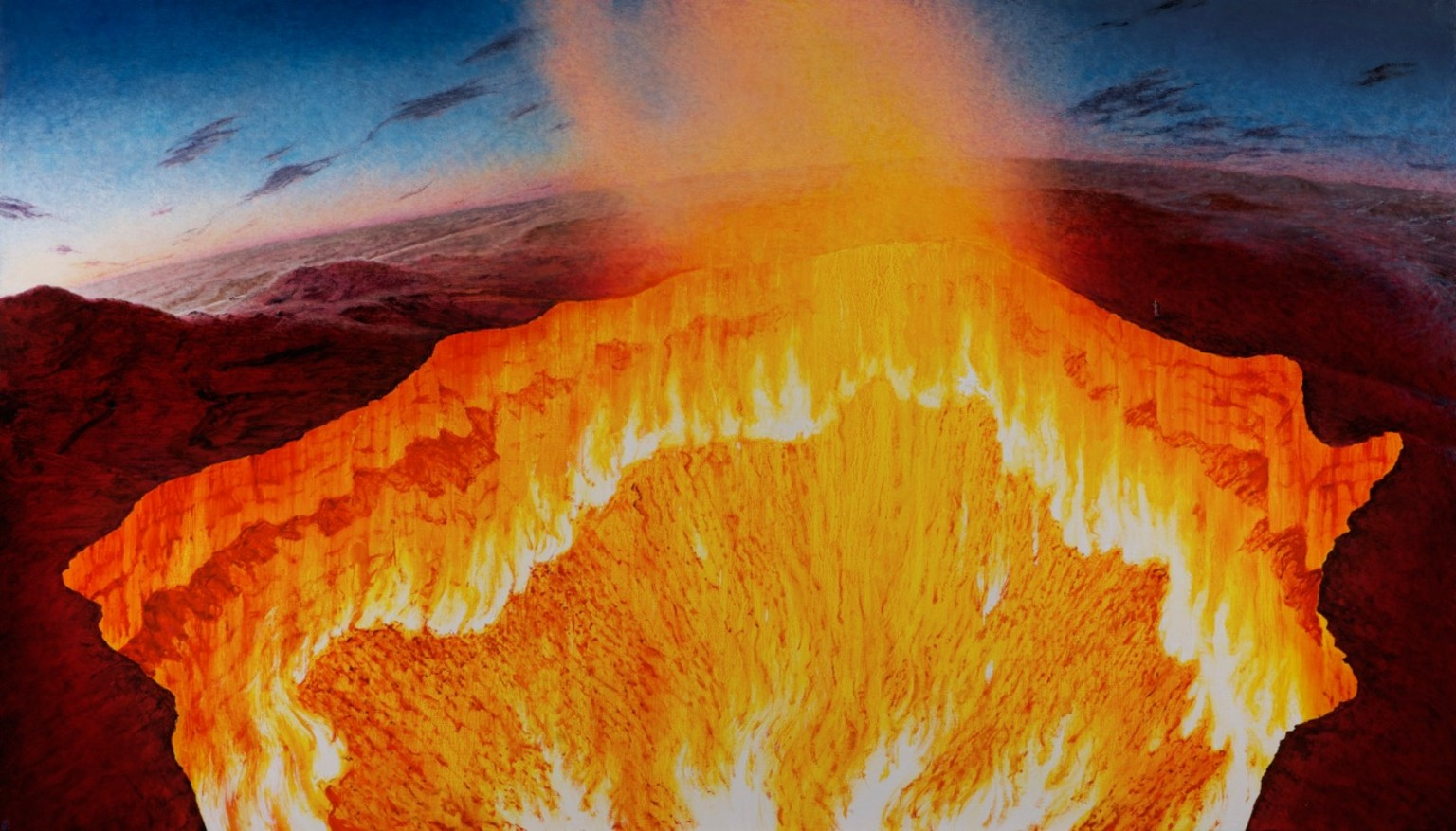
The earth is split open. A vast, blazing pit disgorges luminous gas over a barren landscape. The sky is deep blue, pale at the horizon; it could be dawn or dusk. From our vantage point, the fire could be bottomless. Look carefully: at the edge of the pit, a tiny human figure stands, palms raised to the heat.

Julian Bell, Darvaza, 2010

The earth is split open. A vast, blazing pit disgorges luminous gas over a barren landscap
From Bell, Julian. (2013). Contemporary Art and the Sublime. Tate Gallery

This is Julian Bell’s 2010 painting Darvaza. It depicts a site the artist visited in Turkmenistan; its name, in Persian, means “the door to hell” (Garzemi & Garsanti, 2019). As Bell (2013) recounts, the blazing pit was inadvertently created by Soviet engineers in 1971 while seeking oil drilling sites. Striking a gas-filled cavity, the engineers chose to burn off its contents, only to find the resulting inferno beyond their control. It has burned ever since.

Bell locates his painting in a tradition of artists seeking to convey a sense of the sublime, an intense aesthetic experience in which “the self becomes a mere ingredient in the landscape, feeling insignificant, overwhelmed and humbled by nature” (Brady, 2013, p.199). 

Yet, in Bell’s account, this hellish phenomenon was created by human, technocratic actions, and his story of Darvaza also serves as an example of what Ramírez and Ravetz (2011) have called “feral futures”. Drawing an analogy to domesticated animals that revert to the wild, Ramírez and Ravetz describe how “human intervention create[s] an unwanted unfolding situation that could not have occurred in the wild” (p.480), offering examples such as the nuclear incident at Three Mile Island and the Deepwater Horizon oil spill in the Gulf of Mexico.

The idea of the “feral future” is useful in helping us understand how wicked, complex problems can stem from our own actions. In the Anthropocene, feral futures are increasingly prevalent. Even the impact of something as apparently “wild” as COVID-19 has feral aspects, as the ways in which the pandemic has played out are entwined with globalisation, climate change, urbanisation, and wide variations in responses by governments, institutions, and communities.

In this paper, we explore scenario planning as a tool for coping with the “strategic sublime” in feral situations characterised by turbulence, uncertainty, novelty, and ambiguity. Scenarios are not forecasts, but plausible stories of the futures which we may face (Spaniol & Rowland, 2019). We follow Ramírez and Wilkinson (2016) in understanding them as assessments of the future context for a given question or issue, designed to contrast with the way that context is currently being framed. As a brief case study, we include the four IMAJINE scenarios exploring the future of European regional inequalities.

By offering thought-provoking future contexts, such scenarios enable their users to generate new ideas, develop or test strategic options, establish monitoring and early warning processes for emergent issues, and enhance decision-making. Ramírez and Wilkinson argue that, by challenging current assumptions and offering alternative framings from the vantage point of multiple imagined futures, scenarios support good judgement across the three areas identified by Geoffrey Vickers (1965): What is really going on around us? What are we able to do about it? And what does the issue mean for us?

Continue reading “Facing the Strategic Sublime: Scenario Planning as Gothic Narrative”

Review: Gross Ideas: Tales of Tomorrow’s Architecture

Edwina Attlee, Maria Smith, and Phineas Harper, eds.  Gross Ideas: Tales of Tomorrow’s Architecture (London: The Architecture Foundation and Oslo Architecture Triennale, 2019)

Reviewed by Carl Abbott

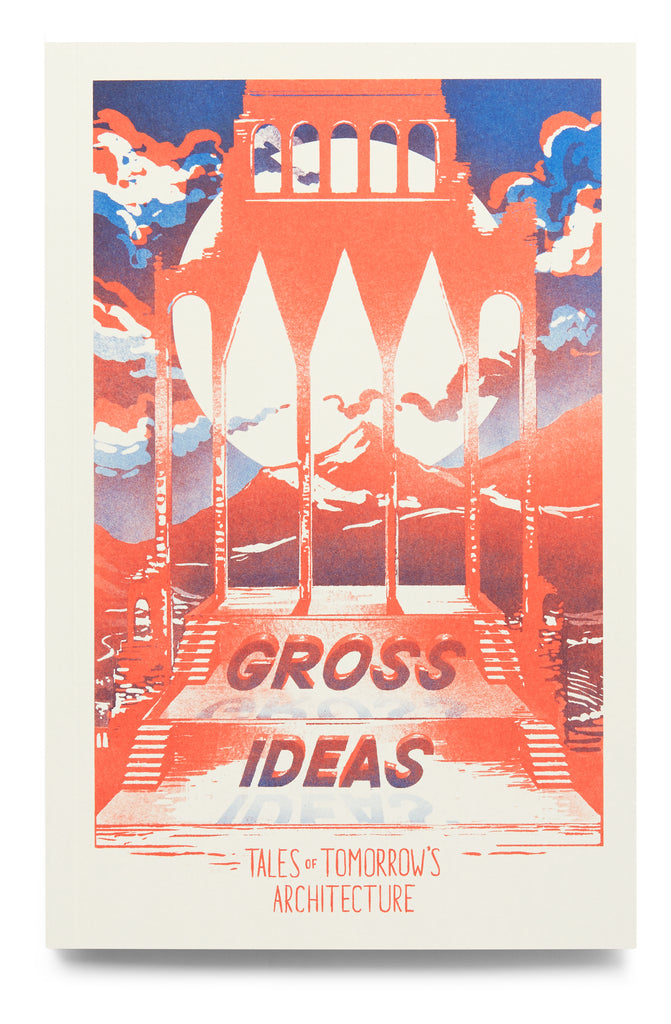
Cover of Gross Ideas: Tales of Tomorrow's Architecture. Stairs and columns against a backdrop of mountains, under a huge sun or moon, everything soaked in bloody light

To understand Gross Ideas, start with the Oslo Architecture Triennale to which this book is a companion. The Triennale is “a member organization that unites the major architecture and urban planning networks in Norway” for conversations and public programs about the role of architecture in society. Participants and supporters include national associations of design professionals, architecture schools, Norwegian government agencies, and international architecture firms with Norwegian roots. The 2019 Triennale in the fall of 2019, was the seventh iteration.

Some of the contributors identify as writers and some as architects, and a few work both sides. There are two poems, one graphic narrative, and fourteen prose narratives of widely differing character …

The book itself is a miscellany of contributions that is more a curated exhibit in verbal form than a tightly edited collection, a characterization that I suspect the curator-editors would find quite acceptable. Some of the contributors identify as writers and some as architects, and a few work both sides. There are two poems, one graphic narrative, and fourteen prose narratives of widely differing character. Some of these latter are stories that could easily find homes in science fiction magazines. Others range from Will Self’s takeoff on Invisible Cities to Lesley Lokko’s essay on women and transnational remittances that includes a fictional vignette, a short factual summary, and scholarly endnotes (it is quite effective). 

Architects have long delighted to imagine grand buildings and building schemes—Arturo Soria y Mata’s Ciudad Lineal, the arcologies of Paolo Soleri, Walking City and other thought experiments of the Archigram group, a linear supercity from Michael Graves, the mile-high skyscraper of Frank Lloyd Wright (even Burj Khalifa gets only halfway there). Science fiction has appropriated the taste for the grandiose from Trantor and Coruscant to countless artists’ depictions of imagined urban futures full of soaring towers in shimmering color. 

What naïve readers might expect from the “architecture” in the subtitle is often absent …

There is no such here. What naïve readers might expect from the “architecture” in the subtitle is often absent. Instead we get one story in which the largest building is a village house (Sophie Mackintosh, “Placation”), a second set in a caricature of a dusty, unchanging town of the old American Southwest (Joel Blackledge, “Fountainwood”), and another in derelict and abandoned Edinburgh (Camilla Grudova, “Deliberate Ruins’). The only story to center a single building uses an unfinished and abandoned Persian Gulf skyscraper (Deepak Unnikrishnan, “Cat”). The other entry in which architecture is the explicit focus is the graphic narrative “Exile’s Letter” by Mill + Jones, which chronicles efforts to build in a low-technology future (temple, town, giant fishing pier) that are laid low by fire and flood and end with the triumph of unbuilding in a sort of Nature-driven  version of the Tower of Babel. 

Some of the entries posit future engineering rather than architecture—a distinction that the curators and the Triennale folks would likely disregard anyway. For example, Robin Nicholson projects the green retrofitting of London in 2039. I had the most fun with “The Aqueduct,” which presents a scenario for replacing Britain’s rail and road transportation with a set of canals. It is a fascinating think-piece that painlessly introduces elementary physics to extrapolate from Britain’s current restored canals. If he hasn’t, author Steve Webb should look up Railroads and American Economic Growth by my old graduate professor Robert Fogel, which includes a long counterfactual to test whether the United States might have had the same robust economic growth had it invested in canals and river improvements rather than railroads in the nineteenth century.  

As she starts work and experiments on her own small house, she finds herself slowly absorbed by the microbes …

The contributors took to heart the theme of the 2019 Triennale—“Enough: The Architecture of Degrowth.” Some stories imagine the built world in decay (Grudova, Unnikrishnan), others the natural world actively triumphant (Mackintosh).  Lev Bratishenko, “You Wanted This,” reports a future United Nations conference at which national representatives offer their own favored ways to drastically reduce the world population—the Russians want to use thermonuclear bombs, the Japanese want to weaponize the Internet of Things, the Americans want to drug everyone to euphoric death (cue up Serenity). One of the most powerful stories is Rachel Armstrong’s “Bittersweet Building.” A new architecture graduate in desperate need of a job catches on with a Norwegian firm that is trying to incorporate bacteria as part of a building’s metabolism (waste into clean water, heat, oxygen). As she starts work and experiments on her own small house, she finds herself slowly absorbed by the microbes into their own complex world and finally merging fully into the “metabolic community of the landscape.” It is both a chilling and a comforting variation on the natural process of bodily decay. For the theme of degrowth, score a big one for the Earth.

Having considered the “architecture” half of “tales of tomorrow’s architecture,” what about the “tales” part? To no surprise, the pieces run a wide span from interesting but undramatic speculation to engaging story. For an example from the didactic side, Edward Davey, “Oli Away,” uses the mechanism of a report on a gap year journey to explicate some favored energy and transportation options. The entries by Nicholson, Bratishenko, and Webb are additional examples of scenario-building rather than storytelling. They have a lot of information without much surrounding story, which is not to say that we should not think about the ideas they present. After all, nobody read Looking Backward for its compelling characters and plot, but it had enormous influence. 

Several of the contributions that are strong as stories are, not surprisingly, by people with lots of writing experience who know how to create engaging characters. For many Vector readers, the biggest name in the collection is Cory Dotorow, who contributes an interesting variation on his Disneyland obsession with “Materiality.”  He posits a theme park in which high school classes spend a week inhabiting reconstructed towns from different eras. Think Main Street USA meets the living displays of colonial “savages” found at early twentieth century world’s fairs (also see the living diorama in Colson Whitehead’s fantastic alternative view of American history in The Underground Railroad). The theme park contrasts with a present in which recycling and three-dimensional printed make the objects of everyday life ephemeral if not immaterial. Doctorow’s teenaged protagonist indirectly confronts the lasting imprint that seriously stupid Old Timey People left on the landscape by considering whether his favorite old tee shirt is still cool (it is). 

… architecture as a practice of designing individual buildings should be and is being swallowed up by the all-consuming impacts of climate change and necessary transformations in global energy systems.

Maria Smith in “Lay Low” uses the familiar frame of singles gossiping in a bar to introduce a society of scarcity in which everyone has monetized allowances for necessities like water, food, and electricity.  Her variation on a familiar science fiction future is a new way to get ahead on your budget—perhaps—by going into hibernation for a few months to lower your consumption levels and build up points. The women in the bar, who are just learning about the new option, don’t think that monetizing unconsciousness is going to go well.

Jo Lindsay Walton contributed the longest, most complex, and perhaps most readable story (no, there was collusion with your book review editor).  “In Arms” is cleverly constructed with two parallel threads—a woman waiting for a date to show up and an ecoterrorist launching an operation—that slowly grow more complex and intertwine in unexpected ways. Radical changes in building styles are slipped in as background, including the cool idea that rising seas have forced the seat of British government to shift to a mobile seastead platform nicknamed Wetminster.  

Without the subtitle and the wraparound material describing the Triennale, someone who casually reads through Gross Ideas would think it is about economic transition and “degrowth” in general, with architecture one of many avenues of exploration. The overall message is that architecture as a practice of designing individual buildings should be and is being swallowed up by the all-consuming impacts of climate change and necessary transformations in global energy systems. Some contributors see a complete devolution to a nonindustrial future, others a society of scarcity, and still others an adapting world. Tomorrow’s architecture, the book suggests, will be valuable to the extent that it is subordinated not just to social needs—an architectural truism, if not always heeded—but rather to fundamental institutional and social transformation. 

Carl Abbott is author of The Metropolitan Frontier: Cities in the Modern American West, The New Urban America: Growth and Politics in Sunbelt Cities, and Political Terrain: Washington, D.C., from Tidewater Town to Global Metropolis.

Year of the Floods

Interesting review-feature by Robin McKie in yesterday’s Observer:

Today, in these more strained ecological times, this kind of storytelling has taken on a harder edge and eco-thrillers have become a more robust genre – both on the page and on the screen. Upcoming films such as 2012 and The Book of Eli portray ecological and technological catastrophes like those depicted in The Day After Tomorrow (2004) and I Am Legend (2007). At the same time, plays such as Resilience and On the Beach have explored environmental issues with considerable success, while forthcoming novels from William Boyd, Margaret Atwood and Ian McEwan will also pursue ecological themes.

In short, environmental fiction is moving away from its roots in science fiction and is becoming part of mainstream literature – as is revealed by some of the most recent novels to tackle themes of climate change and the like.

I have both Cold Earth and The Rapture on my (unwieldy) TBR pile at the moment, and while McKie’s argument isn’t as rigorously argued as perhaps it might be, I do think he’s on to something. I’ve thought for a while that if I had a spare year or two, a project I would like to tackle is an analysis of the development of treatments of climate change — as distinct from disaster stories — in science fiction, both because I think it’s an interesting marker of how genre sf has engaged (or failed to engage) with the future in which we are actually living, and because I think it’s an interesting marker of the relationship between genre sf and mainstream-published sf, as McKie suggests. It seems to me there is are interestingly intertwined stories to be told there, and that the body of work that would need to be covered is not entirely unmanageable. [EDIT: I completely forgot that we’d discussed some of these issues before.]

Also, from the end of the article:

Solar by Ian McEwan. The idea for Solar (working title, due out in 2010) came to McEwan while stuck on a boat in the Arctic. His subject is climate change, considered through a central character who “steadily gets fatter through the novel” and the innate inability of human nature to counter it

Hmmm.