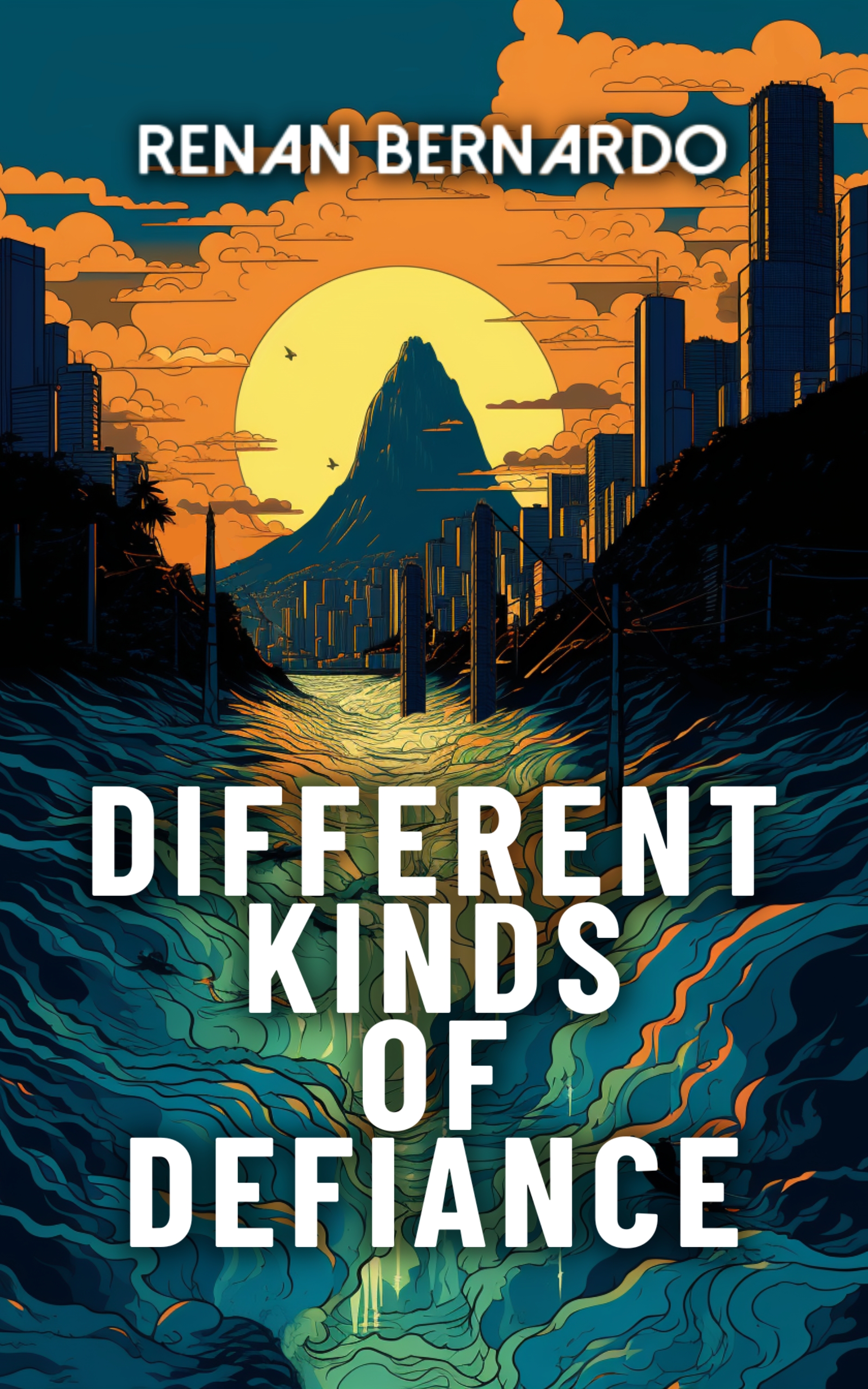
Renan Bernardo is a Nebula finalist author of science fiction and fantasy from Brazil. His fiction appeared in Reactor/Tor.com, Apex Magazine, Podcastle,Escape Pod, Daily Science Fiction, Samovar, Solarpunk Magazine, and others. His writing scope is broad, from secondary world fantasy to dark science fiction, but he enjoys the intersection of climate narratives with science, technology, and the human relations inherent to it. His solarpunk/clifi short fiction collection, Different Kinds of Defiance, was published in 2024. His fiction has also appeared in multiple languages, including German, Italian, Japanese, and Portuguese. He can be found at Twitter (@RenanBernardo), BlueSky (@renanbernardo.bsky.social) and his website: www.renanbernardo.com
Jean-Paul L. Garnier is the owner of Space Cowboy Books, producer of Simultaneous Times Podcast (2023 Laureate Award Winner, BSFA Finalist), and editor of the SFPA’s Star*Line magazine. He is also the deputy editor-in-chief of Worlds of IF magazine & the soon to be relaunched Galaxy magazine. He has written many books of poetry and science fiction. https://spacecowboybooks.com/
JPG – In many of your stories you juxtapose the past with the present, layering multiple times together, tell us about using this narrative device, and how you use it for emotional effect?
RB – Layering past and present together without necessarily resorting to flashbacks is an excellent device to make the reader flow along with the main character’s feelings without breaking the pace of the story. I believe the past has a lot of things to say. Our past shapes who we are, so it always adds an interesting layer to my stories. Many answers to the present and the future are in the past. I believe that you were thinking of “Soil of Our Home, Storm of Our Lives” when you thought about that question. In this story, there are three timelines layered separately: past, present, future, each with different things to say about the characters, different emotional cores to introduce that end up fusing in the end. The challenge is always to weave them all together, so they don’t feel detached from each other, but I like to believe that I achieved it in this particular story.
JPG – Your stories often present utopias, but as you mention in your forwards, one person’s utopia can be another person’s dystopia. Can you speak about this concept and why cultures have a difficult time envisioning positive futures that include everyone?
RB – There are two stories in the collection that introduce this concept: “Anticipation of Hollowness” and “To Remember the Poison.” In “Anticipation of Hollowness,” there’s a sustainable city where everything seems perfect but the city is extremely gentrified and no one from lower or middle class is able to live in it anymore. And “To Remember the Poison” is an extreme version of it: a society based on justice, sustainability, and equality that got so detached from the rest of the world that it became an exclusive haven closed to the world. And though its focus is on education and expanding their “green” world, its inhabitants tend to follow a line of thought not so different from what billionaires imagine with their projects of selective bunkers or space stations. And given the concentration of resources and knowledge of Verdoá (the city in the story), it becomes a colonizing power in the region.
By Linna Fredström, Laura Pereira, Simon West, Andrew Merrie and Joost Vervoort
Examples from a small city in the middle of a Swedish forest
‘We live in capitalism. Its power seems inescapable. So did the divine right of kings. Any human power can be resisted and changed by human beings. Resistance and change often begin in art, and very often in our art, the art of words.’ Ursula K Le Guin
Intro and motivation for study
A growing body of research is calling for radical transformation of society to avoid catastrophic levels of climate change and create a more sustainable and just future (Adger et al., 2009; Westley et al., 2011; Kates, Travis and Wilbanks, 2012; Patterson et al., 2017; Fazey, Moug, et al., 2018). Such transformation will disrupt political and economic structures as well as knowledge and value systems, and require fundamentally changing “norms, values, and beliefs; rules and practices, such as laws, procedures, and customs; and the distribution and flow of power, authority, and resources” (Moore et al., 2014).
Many researchers studying such transformations are also acknowledging that their own role must change: rather than simply producing knowledge, they are beginning to actively participate in making knowledge actionable, with the explicit goal of enabling radical change (Cornell et al., 2013; Sala and Torchio, 2019; Fazey et al., 2020). In this new task, the social sciences can offer valuable insights on how to approach the value-laden and political dimensions of using science to bring about change (Wittmayer and Schäpke, 2014; Fazey, Schäpke, et al., 2018; Vervoort and Gupta, 2018; Woroniecki et al., 2019; Miller and Wyborn, 2020; Scoones et al., 2020; West et al., 2020). Critical social theory and critical perspectives in particular are believed to offer tools for sustainability transformation research (Death, 2014; Lövbrand et al., 2015; Stirling, 2015; Blythe et al., 2018). Critical social theory focuses on illuminating and challenging the power dynamics and hidden biases of science and knowledge itself. This focus on reflexive and critical perspectives is now gaining traction within the field of transformation toward sustainability. Conversely, researchers within the field of sustainability are reaching conclusions that point toward the need for critical theory. It’s becoming clear that to enable transformation to a more sustainable and just society we must be willing to challenge not only political and economic systems, but also the value and knowledge systems that brought us to this point in history (Stirling, 2015, 2019; Gottschlich and Bellina, 2017; Fazey et al., 2020).
Scenarios have become a frequently used approach to explore radically different futures and to identify transformative potential in the present (Pereira et al., 2019). As a tool, scenario development is versatile and allows for transdisciplinary exploration, combining scientific, local, practical, and emotional insights (Oteros-Rozas et al., 2015; Merrie et al., 2018; Pereira et al., 2018; Sweeney, 2018; Wangel et al., 2019). Scenario exercises in times of impending climate crisis can be a way to practice imagining the future, and through this practice to see potentialities in the here and now. We need new understandings of the world, new stories: alternatives to both climate catastrophe and naïve never-ending growth narratives. But how do we make space for such visions?
Charne Lavery [1,2], Laura Pereira [3,4], Bwalya Chibwe [4], Nedine Moonsamy [1], Chinelo Onwaulu [5], Naomi Terry [4].
1 Department of English, University of Pretoria, South Africa
2 WiSER, University of the Witwatersrand, South Africa
3 Global Change Institute, University of the Witwatersrand, South Africa
4 Stockholm Resilience Centre, Stockholm University, Sweden
5 Independent author and editor of African speculative fiction
It is widely recognised that nature must be valued in ways that go beyond narrow economic perspectives, and accommodate the interconnected social, cultural, aesthetic, and spiritual dimensions of nature. There is also now growing interest in futures that value nature in its own right, independent of the many benefits that nature provides to humans. How we imagine the future shapes what and how we value, and the decisions we make in the present. The Nature Futures Framework (NFF) offers high-level guidance for imagining nature futures that acknowledge the complex and interconnected values of nature. While there are many narratives and practices focused on valuing Nature-for-Society, there are fewer which value Nature-as-Culture or Nature-for-Nature. This article explores the potential for Africanfuturist science fiction to address these gaps in the NFF construct. Africanfuturist science fiction can provide visions of the future which embody the priorities and the lived experience of their African authors. This article explores a sample of Africanfuturist texts to highlight both their diversity and to draw out some significant commonalities.
Review: This article underwent editorial review from three editors.
The future is African: by 2100 one in three people are projected to be from the African continent (Council on Foreign Relations 2020). And yet the stories that the world tells itself about this future are decidedly not African — or at least not of a prosperous, plausible future Africa (Pereira et al. 2021). In a post-colonial world, Africa continues to be colonised by dominant perspectives that dictate what to aspire to and which values are important (Oelofsen 2015). This is to the detriment not only of the continent but the world. It misses the diverse possibilities that local cultures and traditions could offer in terms of preferable futures, drawing on pasts that are deeply connected to the land and ancestors. Addressing this marginalisation of knowledge systems and the people who practice them is of critical importance in the shift towards a more equal development agenda that values diversity (Tengo et al. 2014). The Sustainable Development Goals (SDGs) are a set of objectives set up by the United Nations to improve quality of life around the world, protect the environment, and promote peace and prosperity. There are seventeen SDGs, including the eradication of poverty and hunger, the spread of health and wellbeing, quality education, gender equality, and climate action. Governments, businesses and non-profits use the SDGs as a framework for understanding their broader purpose and impact. Are the SDGs fit-for-purpose? It’s a controversial question, but one thing is for sure: as the world struggles to meet these goals, fresh ideas, and bold pathways away from current trajectories, need to be explored.
Speculative fiction has a role to play in this. How we think about and imagine the future is an important aspect of decision-making in the present (Vervoort and Gupta 2018). As Lao Tzu says, “if you don’t change direction, you may end up where you are headed.” When we are continually confronted by stories of doom and gloom, these can often be self-fulfilling (Evans 2016). We end up where we are headed. We are currently experiencing overlapping global environmental crises. The most recent is the Covid-19 pandemic (zoonotic diseases are fundamentally linked to human-environment interactions). The most existentially threatening is climate change. The most ethically compromising is, arguably, the human-induced sixth mass extinction. A business-as-usual trajectory is suicide for humanity. However, what are the futures towards which we do want to navigate? And how might we begin to imagine them?
Part of the answer lies with how we value nature. Calls are growing to reimagine transformative futures for nature using more than just positivist science (Wyborn et al. 2020). Traditional environmental policy has often treated nature as a realm whose laws we can know and master, to maximise its economic benefits to humans. In recent years, there has been more recognition that economic benefits are interconnected with social, cultural, and even spiritual benefits. The beauty and abundance of nature give inspiration and solace to humans in ways that are hard to quantify, let alone control, ways that are grounded in the diverse values that people find in nature. Yet perhaps this still doesn’t go far enough. There is now growing interest in futures that value nature in its own right, independent of the many benefits that nature provides to humans.
Scenario planning refers to methods used by decision-makers to enhance their strategic thinking, especially in situations characterised by turbulence, uncertainty, novelty, and ambiguity. Scenario planning is therefore particularly relevant in the context of climate change, which is complex, unprecedented, and potentially presents us with difficult-to-predict risk cascades and tipping points. Climate change may also present us with “feral futures”, in which our own interventions cause or exacerbate severe turbulence within a system or situation. In the face of such uncertainty, scenario planning enables users to generate new ideas, develop or test strategic options, establish monitoring and early warning processes for emergent issues, and enhance decision-making.
Scenarios are not forecasts that predict likely futures, but spaces in which unexamined assumptions can be confronted and potentially suspended or transformed. They are aesthetic depictions of plausible futures that enable us to re-examine our current understanding of our environment, appreciating the power of uncertainty and its capacity to inspire fear and wonder.
The affinity between scenario planning and science fiction has been widely remarked on in the literature, but in this paper we draw a novel connection between scenario planning and Gothic literature. In particular, we examine how scenarios, as Gothic narratives, provide conceptual resources to make sense of the experience of the “strategic sublime”: that which has been excluded from our frame of understanding. The art of scenario planning, like that of Gothic literature, lies in balancing anxiety, insight, and agency in our encounter with that which had previously seemed beyond discussion.
Review: This article underwent editorial review from three editors.
Facing the Strategic Sublime: Scenario Planning as Gothic Narrative
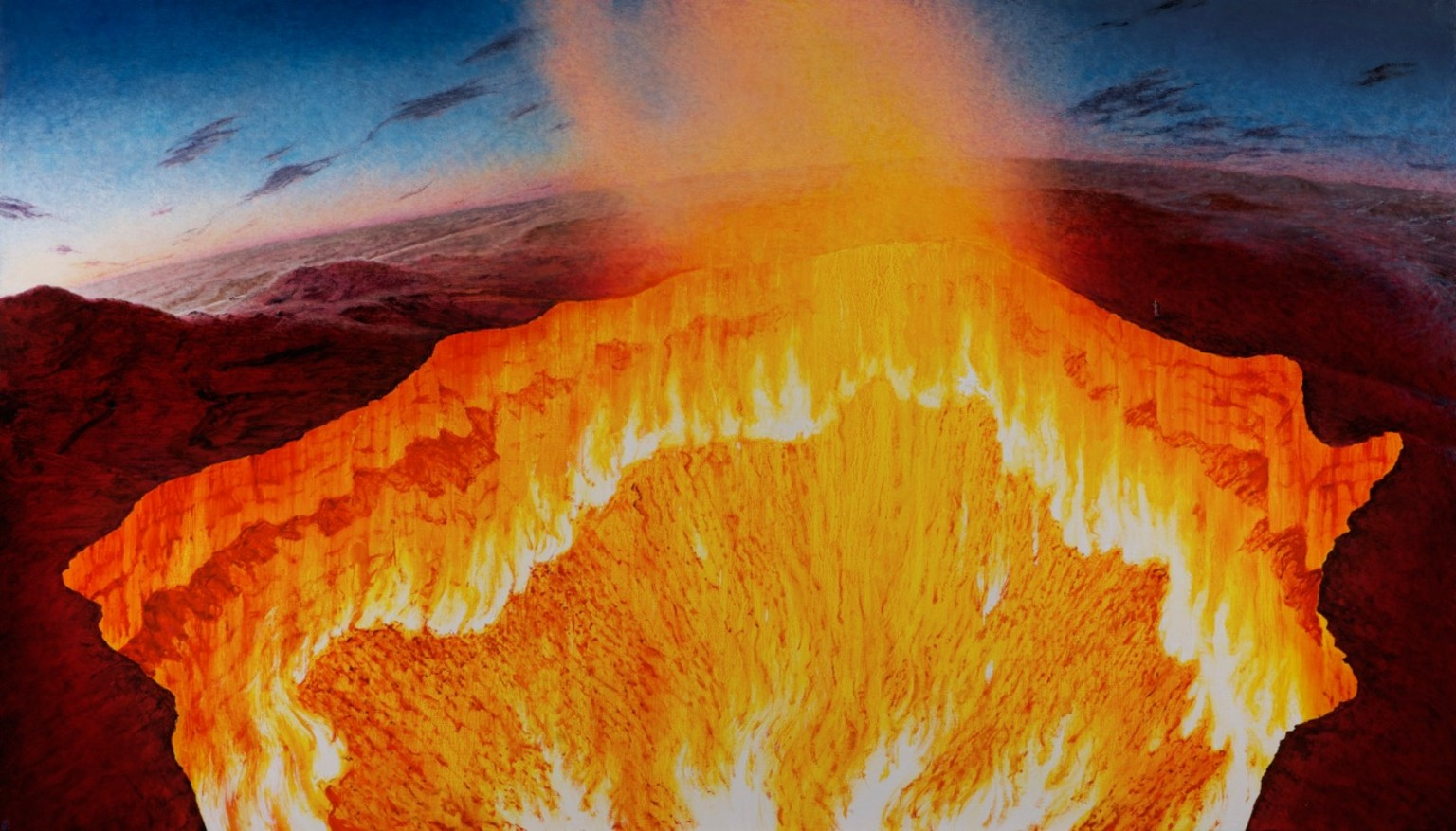
The earth is split open. A vast, blazing pit disgorges luminous gas over a barren landscape. The sky is deep blue, pale at the horizon; it could be dawn or dusk. From our vantage point, the fire could be bottomless. Look carefully: at the edge of the pit, a tiny human figure stands, palms raised to the heat.
This is Julian Bell’s 2010 painting Darvaza. It depicts a site the artist visited in Turkmenistan; its name, in Persian, means “the door to hell” (Garzemi & Garsanti, 2019). As Bell (2013) recounts, the blazing pit was inadvertently created by Soviet engineers in 1971 while seeking oil drilling sites. Striking a gas-filled cavity, the engineers chose to burn off its contents, only to find the resulting inferno beyond their control. It has burned ever since.
Bell locates his painting in a tradition of artists seeking to convey a sense of the sublime, an intense aesthetic experience in which “the self becomes a mere ingredient in the landscape, feeling insignificant, overwhelmed and humbled by nature” (Brady, 2013, p.199).
Yet, in Bell’s account, this hellish phenomenon was created by human, technocratic actions, and his story of Darvaza also serves as an example of what Ramírez and Ravetz (2011) have called “feral futures”. Drawing an analogy to domesticated animals that revert to the wild, Ramírez and Ravetz describe how “human intervention create[s] an unwanted unfolding situation that could not have occurred in the wild” (p.480), offering examples such as the nuclear incident at Three Mile Island and the Deepwater Horizon oil spill in the Gulf of Mexico.
The idea of the “feral future” is useful in helping us understand how wicked, complex problems can stem from our own actions. In the Anthropocene, feral futures are increasingly prevalent. Even the impact of something as apparently “wild” as COVID-19 has feral aspects, as the ways in which the pandemic has played out are entwined with globalisation, climate change, urbanisation, and wide variations in responses by governments, institutions, and communities.
In this paper, we explore scenario planning as a tool for coping with the “strategic sublime” in feral situations characterised by turbulence, uncertainty, novelty, and ambiguity. Scenarios are not forecasts, but plausible stories of the futures which we may face (Spaniol & Rowland, 2019). We follow Ramírez and Wilkinson (2016) in understanding them as assessments of the future context for a given question or issue, designed to contrast with the way that context is currently being framed. As a brief case study, we include the four IMAJINE scenarios exploring the future of European regional inequalities.
By offering thought-provoking future contexts, such scenarios enable their users to generate new ideas, develop or test strategic options, establish monitoring and early warning processes for emergent issues, and enhance decision-making. Ramírez and Wilkinson argue that, by challenging current assumptions and offering alternative framings from the vantage point of multiple imagined futures, scenarios support good judgement across the three areas identified by Geoffrey Vickers (1965): What is really going on around us? What are we able to do about it? And what does the issue mean for us?
Vector editors are bringing their Communicating Climate Risk: A Toolkit to COP26 in Glasgow. You can register here to watch Jo Lindsay Walton at the launch, live-streamed from the Science Pavilion. We talk about science fiction in a chapter on communicating around the tipping points.
The science of tipping points can lend itself to apocalyptic storytelling. What are some of the pros and cons?
“Are you getting this on camera, that this tornado just came and erased the Hollywood sign? The Hollywood sign is gone, it’s just shredded.”
— Character in The Day After Tomorrow (2004)
From the perspective of climate risk communication, tipping points can be associated with apocalyptic and cataclysmic narratives. The tipping points session at the COP26 Universities Network Climate Risk Summit, late 2021, provides an illustration (Mackie 2021). The session opened with a slide alluding to the 2004 Hollywood blockbuster The Day After Tomorrow.Of course, this movie stretches science in ways that are regrettably familiar. “Scenarios that take place over a few days or weeks in the movie would actually require centuries to occur” (National Snow & Ice Data Center 2004). Nonetheless, The Day After Tomorrow does represent a real tipping element: the potential shutdown of AMOC, a large system of ocean currents that conveys warm water from the tropics northwards, which is responsible for the relative warmth of the North Hemisphere.
Movies like The Day After Tomorrow vividly communicate the fragility of human lives — as tornadoes tear apart the Los Angeles skyline and toss cars through the air, as New Yorkers scramble down narrow streets from oncoming tsunami-like waves — in ways that are not always captured by terminology such as “extreme weather events.” In the broader context of climate action, is it useful to tug on the heartstrings in this way? Much of the literature on catastrophic narratives and climate storytelling focuses on a distinction between fear and hope. An overreliance on fear has been quite widely criticised.
[…] some studies suggest that there are better chances to engage an audience by including positive messages in film narratives about environmental risks, especially climate change, rather than adopting the strategy of fear, which would instead distance and disengage them, making them feel overwhelmed and helpless […]
However, one thing we should remember is that apocalypses are about many more emotions than fear and hope. A movie like The Day After Tomorrow showcases a range of emotions including exhilaration, confusion, companionship, desire, curiosity, anger, encounters with the sublime, and even moments of humour, both grim and sweet. As many scriptwriters will tell you, an immersive narrative needs emotional variety, or the audience will introduce variety of their own — they will daydream, feel bored, pick holes in the plot, or find their own things to laugh about. Apocalyptic hearts are full hearts: there is probably no human emotion that cannot find some niche in narratives of disaster and collapse. Indeed, the end of the world can feel alluring. The more dissatisfied people are with their existing lives, the more alluring it may feel. As the recent ASU Apocalyptic Narratives and Climate Change project describes (focusing on the US context):
From infectious disease to war, a broad swath of the public has long interpreted social and environmental crisis through the prism of apocalypse, casting potential catastrophes and their causes in religious and moral terms. These apocalyptic visions are often narrated from the point of view of the survivors (the “elect”), thus reinforcing a sense that the end times need to be survived by remaining among the elect, rather than prevented through pragmatic action.
Alternatively, an apocalyptic or eschatalogical idiom can sometimes make climate change feel like nothing special. When has the world not been ending? “For at least 3,000 years, a fluctuating proportion of the world’s population has believed that the end of the world is imminent” (Garrard 2004). Insofar as apocalyptic framings feel extreme yet in a familiar way, they can be counterproductive, especially with audiences who are already wary. This includes those who are ready to view anthropogenic climate change as a left wing conspiracy (perpetrated by charlatan scientists to secure themselves power and funding, in cahoots with governments that aim to justify increasingly authoritarian, totalitarian, and unjust policies) or as a neocolonialist agenda (perpetrated by the rich countries of the world to impose new forms of domination, indebtedness, and exploitation on the Global South).
De Meyer et al. (2021) offer an intriguing spin on the respective merits of fear, hope, and other emotions: they suggest that current debates on climate communication have exaggerated the role of emotions altogether. Instead they advocate for a focus on practice, by storytelling (and doing other things) to create spaces where new audiences can experience agency in relation to the climate, at many different scales and in many different circumstances. People should be able to see what they can do.
Here, we propose that both place-based, localized action storytelling, and practice-based action storytelling have a role to play in expanding climate agency. As examples of the latter, for creative writers and journalists the required agency would be about knowing how to make action on climate change part of their stories; for architects, how to bring climate change into building design; for teachers, how to teach about climate action within the constraints of the curriculum; for fund managers, how to bring climate risk into their investment decisions; for health professionals, to support the creation of place-based community systems that respond to the health impacts of climate change. These examples of communities of practice provide different opportunities and challenges to expand the notions of climate action beyond the current notions of consumer choice and activism.
De Meyer et al. (2021)
Let’s summarise, then, some approaches to effective climate risk communication. One approach is to focus on information. How can information be clearly expressed and tailored for users to easily incorporate it into their decision-making? A second approach (partly in response to perceived shortcomings of the first) places more emphasis on emotion. What mixture of emotions should be appealed to in order to motivate action? This focus on emotion is also implicitly a focus on moral normativity, an appeal to the heart rather than the head (there is of course a great body of literature deriding this split between reason and emotion, which in reality are always mutually entangled). More recently we are seeing the emergence of a third approach, not strictly supplanting but rather complementing the other two, which focuses on practice.
The distinction between a “practice” focus vs. a focus on “informative and tailored stories” or “stories of hope not fear” is a bit subtle. Of course the three may often overlap. It may be helpful to think about what the “practice” focus means in the longer term. In the longer term, each new representational domain of climate agency will not emerge solely through hopeful portrayals of an agent (e.g. journalist, architect, teacher, fund manager) exemplifying an orthodox version of their role-specific climate action, however cognitively and affectively well-judged. Telling these stories may certainly be the priority in the short term. But what they should hope to kickstart are diverse stories filled with diverse agents, affects, and values: stories which superficially contradict each other in many ways, but whose deeper presuppositions mesh to create fields of imaginable action that can accommodate the particularity and the creativity of real people. “Environmental activist” is a social role that is available for real people to fill precisely because it can be filled in many ways (not just one way) and because it means many contradictory things (not just one thing). The same is true of the figure of the ethical consumer.
Audiences are more likely to engage with stories about the world they live in, than about who they must be in that world. Successful rapid mitigation and adaptation entails shifting to more participatory and equitable societies. Many audiences with centrist or conservative leanings may struggle to see themselves accepted within such societies. They may reject realistic climate narratives as hoaxes, or even welcome the end times: revel in fantasies of courage, ingenuity, largesse and revenge, set amid the ruins of civilisation. More can be done to create narratives that accommodate a range of self-reported aspirational virtues across the political spectrum, in ways that are cohesive with an overall just transition. Storytelling that focuses on multiplying domains of agency also entails interventions beyond representational techniques altogether, transforming the material contexts in which people seek to exercise agency.

 vector-bsfa.com