Reviewed by Chukwunonso Ezeiyoke
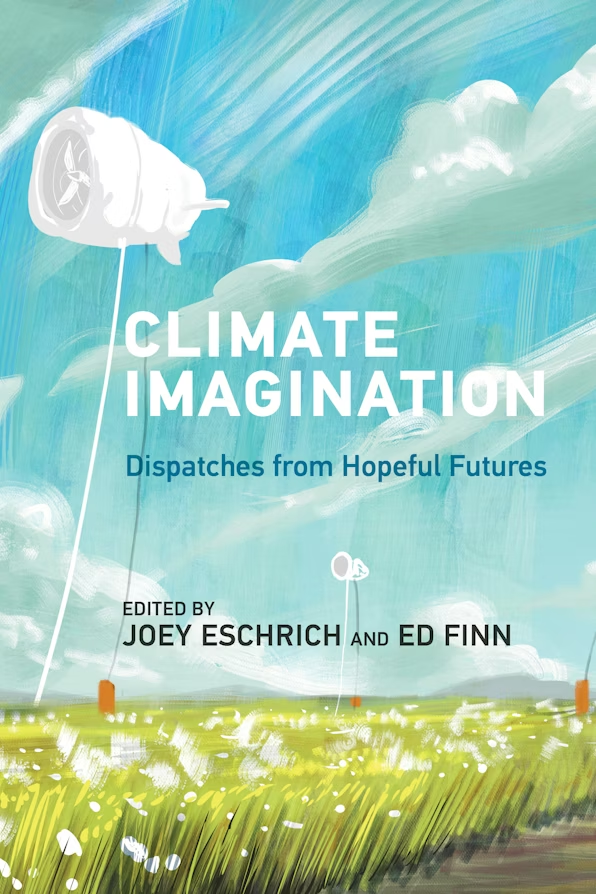
Climate Imagination: Dispatches from Hopeful Futures edited by Joey Eschrich and Ed Finn has 23 chapters with a preface, introduction, and afterword. The book started its life as a part of The Climate Action Almanac. “The book grew out of the Climate Imagination Fellowship, started at Arizona State University’s Center for Science and the Imagination in 2021” (2026:ix). In its preface, the book announces that it foregrounds hopeful stories about climate imagination. The dominant climate narrative, it argues, is full of doom stories, which leave people feeling ‘hopeless, helpless, and disillusioned’ (Eschrich and Finn 2025: ix). This stand echoes Mark Fisher’s Capitalist Realism:Is There No Alternative?(2014). For Fisher, fear and cynicism do not inspire bold thinking; they form a bedrock of conformity and conservatism that hampers action and change. For Fisher, hopefulness changes the situation from one in which nothing can happen to one that allows for the actualisation of possibilities. Fisher’s stand can be traced to a theorist such as Fredric Jameson (2005), and further back, to Thomas More, the first known utopian novelist.
However, the word ‘utopia’ was hardly mentioned in the introduction or the preface framing Climate Imagination: Dispatches from Hopeful Future, and it appears sparingly throughout the collection. This may be intended or unintended. However, there could be a good reason why the book was framed this way. Utopia has a bad reputation. An early criticism of it could be seen from Karl Marx in Manifesto of the Communist Party published in 1848. Marx accuses utopia of lacking materialism. More recently, Karl Popper (1945) links the concept of utopia to totalitarianism. As Julien Kloeg notes, ‘Utopianism’s bad reputation is partly due to its association with the attempt to realize communism in the Soviet’ as such it is considered ‘politically dangerous’ (2016: 451). Current criticism on Utopia is such that were directed to hopeful climate narrative such as carbon removal technology. Matt Simon (2023:online) argues that “carbon removal might even encourage the continued burning of fossil fuels, if countries can say they’re sucking carbon out of the atmosphere to offset their emissions” they could end up burning more fossil fuels instead of looking for clean energy. This, in turn, sustains the capitalist structure that privileges fossil fuel consumption. Perhaps these criticisms have led the collection to shy away from exploring the book’s connection to utopian unconsciousness, even though the book draws heavily from this tradition. Unconscious here “consists of those repressed impulses, desires, drives, wishes… that the conscious mind does not care to acknowledge” (Mark Bould 2021:15). Utopian unconsciousness is defined here as those hidden utopian ideological impulses of a text.
Climate Imagination: Dispatches from Hopeful Futures is a mixed bag of memoirs, interviews, scholarly articles, and fiction. This disparity in the creative expressions employed by the authors in the book, luckily, does not result in a disjointed book. I think there is something symbolic about it, reflected in both the form and the content of the collection, namely: that the book champions diversity. Diversity in its form allows it to incorporate different styles of artistic expression under the umbrella of a single edited volume. This, in a way, is a stand it takes outside the totalitarian accusation levelled against the utopian unconscious in which plurality of forms, ambitions and aspirations is suppressed under the so-called singularity of purpose termed the ‘common good.’ A character in “City of Choice” by Gu Shi, translated by Ken Liu, a story within this anthology being reviewed here shares this sentiment thus ‘Should I really go forward? All choices come with costs. If the cost is the lives of those who are powerless, is it right to sacrifice them in the name of some greater “good”? (113). “City of Choice” is a type of story you read and reread, and it makes you angry and happy and angry again because life is messy and every decision comes with a cost, including the decision to freedom.
It is not only the style of the book that is diverse; the contributors come from different localities of the globe: “China to Wales, Germany to Nigeria, Sri Lanka to Mexico, Malaysia, India, the United States, and more” (Eschrich and Finn 2025:ix) to articulate different climate challenges of what is being done, what could be done, and the potential ‘becomings’ of climatic futures. A lot of the climatic ‘becomings’ shared by a good number of the authors in the collection are akin to what Bodhisattva Chattopadhyay and Jade Taylor call ‘co-futurism.’ Taylor defines it as a future that is interconnected and overlaps, also recognising “ethnic specific and regional specific futurisms” (2024: 1). Taylor’s definition is not specific to climate futurism; the collection, which focuses on climate, is part of futurism in general.
 vector-bsfa.com