Fiona Moore interviews Oghenechovwe Donald Ekpeki

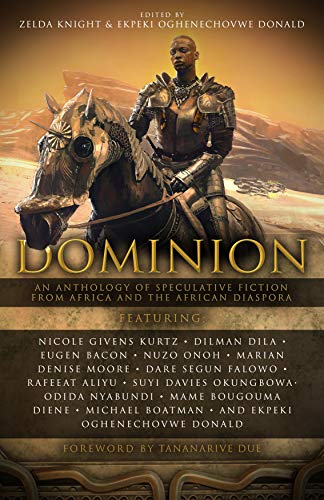
Your “breakout” book was Dominion: An Anthology of Speculative Fiction From Africa and the African Diaspora. Can you tell us how that came about?

Zelda Knight, my co-editor, reached out to me, after publishing my short story “Ife-Iyoku” in their short fiction mag, Selene Quarterly. They wanted to do the anthology and asked if I would like to contribute a story or co-edit. I chose both, and the rest is history. 

You also edited Bridging Worlds: Global Conversations On Creating Pan-African Speculative Literature In a Pandemic. How does editing non-fiction compare with editing fiction?

It’s interesting. More work I believe, as fiction comes naturally to me. I automatically know and have a feel for what I want in fiction. But non-fiction in my experience requires more to get it to say the things it wants to in the ways that’s most fitting. Still as rewarding though. 

Do you see the two works as complementary, or separate, efforts?

I believe they are complementary, like one stream that flows into another. One fed into the other. Naturally, after reading stories by African writers, I felt we needed to hear the story of the storytellers. The story behind the story. 

As well as an editor, you’re also a writer of short fiction. Can you talk about how the two fit in with each other in your life?

I have more of a sense of stories since I started editing. What might work and be needed, in addition to what I want to write. It broadens one’s horizons. 

Do you think you might try writing longer fiction in the future? If so, what?

Yes. Definitely. I have already written and am working on more of those: a novel, and a bunch of novellas. And looking to go on sub after several more drafts. 

You trained as a lawyer. Do you feel like your professional background influences your fiction (and/or non-fiction)?

Yes. It definitely does. Case laws exposed me to so many scenarios and how stories unfold in real life. Legal reasoning meanwhile allows you to be able to parse your thoughts in a manner that’s very helpful with non-fiction.

What does Nigeria, as a writing scene, bring to the SFF world?

As the largest Black nation on earth, with over 200 million people of hundreds of languages and ethnic groups, a wealth and beauty of diversity, Blackness and the African continent. 

Africa, and Nigeria in particular, seems to be breaking out on the genre scene. Why now, and what can the SF writing community do to sustain this breakout?

I would say it’s a combination of the culmination of the work done consistently over decades to build some sort of structures, like the Nommo award, African speculative fiction society, and the hard work of writers coming today. 

Continue reading “Fiona Moore interviews Oghenechovwe Donald Ekpeki”

Vector 292 Speculative Art

  • vector-292-cover

This special issue of Vector is all about SFF and contemporary art, guest-edited by Rhona Eve Clews. In this issue, Smin Smith explores transmedia worlding in Marine Serre’s FutureWear, while Alexander Buckley and Hannah Galbraith offer a selection some of the most exciting SFF-themed art from contemporary African artists. Declan Lloyd examines the tempestuous temporalities of the artist Neo Rauch, while Rachel Hill traces the twisting threads of Sinofuturism, cyberpunk, and AI futures in the work of artist Lawrence Lek. Frank L. Cioffi takes us on a tour through the science fictionality of conceptual art, while Alex Butterworth delves into the mysteries of Damien Hirst’s The Wreck of The Unbelievable and conducts his own speculative imaginings about the future of digital curation.

We’re also delighted to include interviews with the incredible artists Julianna Huxtable and Sensory Cartographies (Jonathan Reus and Sissel Marie Tonn). Artist and researcher Stephanie Moran discusses her art practice in ‘Eco-SciFi Art and Interspecies Technology.’

Andrew M. Butler reviews Science Fiction, edited by Dan Byrne-Smith and featuring contributions about SFF and art from Margaret Atwood, J. G. Ballard, Rosie Braidotti, Rachel Carson, Donna Haraway, Xin Wang, and many others. In Kincaid in Short, Paul Kincaid looks at Art and Science in Charles Harness’s ‘The Rose,’ and Vector Recommends brings you Fiona Moore on Dominion: An Anthology of Speculative Fiction from Africa and the African Diaspora and Eugen Bacon on The Perfect Nine.

This issue also includes information on the diversity and anti-racism motions passed at the BSFA’s 2020 AGM, and a message from the Chair Allen Stroud about current opportunities for volunteering with the BSFA. In a special editorial, guest editor Rhona Eve Clews explores this issue’s wealth of words in conversation with Stephanie Moran. It’s a bumper issue at 88 pages. To get a copy, join the BSFA.

Front cover by Fabrice Monteiro, back cover by Juliana Huxtable.

Freeing art from the human artist: Hod Lipson speaks to Fiona Moore about AI and creativity

Interview with Hod Lipson

By Fiona Moore

Artist: Pix18, a robot ‘that conceives and creates art on its very own.’ Oil on Canvas. (Image source: http://www.pix18.com)

Hod Lipson is a professor of Engineering and Data Science at Columbia University in New York. With Melba Kurman he is co-author the award-winning Fabricated: The New World of 3D printing and Driverless: Intelligent cars and the road ahead. His often provocative work on self-aware and self-replicating robots has been influential across academia, industry, policy, and public discourse more generally (including this very popular TED talk), and his interests also encompass pioneering in the fields of open-source 3D printing, electronics 3D printing, bio-printing and food printing. Hod directs the Creative Machines Lab at Columbia, where they “build robots that do what you’d least expect robots to do.”

Fiona Moore is a writer and academic whose work, mostly involving self-driving cars and intelligent technology, has appeared in Clarkesworld, Asimov’s, Interzone and many other publications, with reprints in Forever Magazine and two consecutive editions of The Best of British SF. Her story “Jolene” was shortlisted for the 2019 BSFA Award for Shorter Fiction. Her publications include one novel, Driving Ambition, numerous articles and guidebooks on cult television, guidebooks to Blake’s Seven, The Prisoner, Battlestar Galactica and Doctor Who, three stage plays and four audio plays. When not writing, she is a Professor of Business Anthropology at Royal Holloway, University of London.

You are a celebrated figure in the world of artificial intelligence research. Can you tell me how you came to be interested in, and working in, this area?

Thanks. To me, issues like self-awareness, creativity, and sentience are the essence of being human, and understanding them is one of life’s big mysteries – on par with questions like the origin of life and of the universe. There are also many practical reasons to understand and replicate such abilities (like making autonomous machines more resilient to failure). I think that we roboticists are perhaps not unlike ancient alchemists, trying to breathe life into matter. That’s what brings me to this challenge.

My own interest in AI is, in part, as an anthropologist, looking at culture. To what extent will AI “learn” culture, at least initially, from humans, and to what extent do you see them as capable of developing culture on their own?

Yes, AIs learn culture (for better and worse) from humans and from a human-controlled world; but as AIs become more autonomous, they will gather their own data, and develop their own norms, perspectives, and biases.

Do you see this already happening? If so, what do AI cultures look like at present?

AIs today are still like children, and their cultures are heavily controlled by us humans– their “parents.” For example, AIs that generate music are influenced by existing human music genres; AI’s that generate human portraits are influenced by images of humans they find on the web – disproportionately favouring certain aesthetics, genders, and ethnicities, etc. AIs that generate text are influenced by prose that they are trained on, and so forth.

I have not seen AIs that have full autonomy on the data they consume, but this will eventually happen as artificial intelligence becomes more physically autonomous and can collect its own data. But again, we humans are also increasingly subjected to an information diet that is prescribed by the culture we live in, and we have to make a conscious effort to rise above our culture or go against it. 

Continue reading “Freeing art from the human artist: Hod Lipson speaks to Fiona Moore about AI and creativity”