Harry Slater reviews The Other Shore by Hoa Pham

The Other Shore by Hoa Pham (Goldsmiths Press, 2023)

Review by Harry Slater

The Other Shore, by Hoa Pham, winner of the Viva La Novella prize, deals with some of the biggest questions there are. It’s about life and death and legacy, about power and control, colonisation and oppression, ancestry and the price we pay for the future we want. And it’s all told from the perspective of a sixteen-year-old Vietnamese girl, Kim Nguyen. That makes for some interesting stylistic choices; the prose can sometimes feel stilted, lacking in the emotional clout that an older voice might add. At the same time, though, there’s a visceral naivety at play here, the realisations of the state of the world are ever more compelling because they’re wounds delivered fresh, for the first time. In one way, then, The Other Shore is a coming-of-age story, and at the same time a brutal indictment of human cruelty, an examination of the structures of power that bind Vietnam, and the world, and how they’ve come to be. After a brush with death, Kim discovers that she can read people’s minds by touching them, a gift bestowed upon her by the goddess Quan Âm. More than that, she now has contact with the titular Other Shore, the place where the dead go after passing on. At first her father uses her newfound powers to earn money from his business associates, but it isn’t long before the government comes knocking. Kim is taken to a mass grave by Bác Phuc, another apparent psychic working for the communists. There she’s tasked with reconnecting buried soldiers with their families, giving their restless spirits the chance to finally find some solace. But there’s a catch – if she discovers southern Vietnamese remains, they’re tossed to the side, left to their haunted afterlife. This forms one of the core moral quandaries of the book; Kim knows she should be helping everyone to find peace, but the powers-that-be simply won’t stand for it. This burgeoning sense of responsibility, of behaving in ways that shake off the ideas of the past, leads her to Khôi, a second-generation Vietnamese American working as an interpreter for a US MIA mission. There’s an idealism to him, and a freedom, that Kim finds alluring. Interspersed with this trauma is a strange love triangle between Kim, Bác Phuc and Khôi that doesn’t quite ring true, feeling more like an extended metaphor for the possibilities that are opening and closing in Kim’s life. The Other Shore deals with complex cultural issues with a deft hand, showing Kim’s innocence slipping away as she starts to confront decades-old actions that have shaped the life she lives today. At times it can be quite clunky, though, and there are decisions and story beats that seem to come too quick, sometimes occurring in the space of a paragraph. Kim’s relationship with her dead grandmother is the beating heart of the story, tying together the past, present and future with a kindness and a spirituality that the modern world Kim inhabits appears to have left behind. There are heartbreaking moments, and the confusion, excitement and terror of adolescence is captured within the staccato rhythms of the piece. While The Other Shore might lack fluidity and fluency, it poses its questions with a steady hand and doesn’t flinch away from showing us Kim’s strife in harrowing, gut-wrenching close-ups. There’s no easy ending here, no final resolution, and that’s fitting for a book that confronts such fundamental and difficult topics. This is a book layered with the spiritual and the political, a meditation not just on life and death, but on our attitudes towards them. It’s hard going sometimes, in several different ways, but The Other Shore leaves you with deep questions about what it means to be human, and for that alone it’s worth checking out.
Vector interviews Hoa Pham

Hoa Pham is the author of eight books and a play. Her last book Empathy is also out with Gold SF. Her first novel Vixen won the Best Young Writer Award from the Sydney Morning Herald and was shortlisted for the Best Fantasy Novel Aurealis Award. Her novella Wave was translated into Vietnamese. Her play Silence was on the VCE Drama List. More about her work can be found at www.hoapham.net.

Spoiler alert: for the end of The Other Shore

Does your novel The Other Shore have an origin story, what inspired the book?

The Other Shore was inspired by the existence of a Vietnamese government psychic bureau who reunited the remains of the war dead with their descendants. A BBC documentary was made about it in 1996 – so it must be true. I haven’t seen the documentary so I have been free to make up my own world of psychics and spirits. To me the very existence of the bureau poses interesting questions about the Communist government, when they first came to power they denounced all ancestral worship and Buddhism as being contrary to the creed of the new nation. However this stance has softened as it has become evident that the spirituality of the Vietnamese people is not easily oppressed. There is now state sanctioned Buddhist monasteries and other religions are tolerated such as the Cao Dai and Christianity. The government has done a U turn, inviting formerly exiled Zen Master Thich Nhat Hanh to teach on pilgrimage in the country in 2007, in order to be admitted to the UN security council- they could not be seen to be oppressing religious activities.

How are the wishes of the dead taken into account? Is it always clear who wants to be reunited with whom?

My questions in the novella revolved around a single premise- how can you reconcile the ethics of the dead where there are no sides, with working for the communist government as a psychic? The stance of the Vietnamese government regarding the Vietnam/American War is complex, they have made peace with the Americans but have not laid aside enmity towards the South Vietnamese war veterans that fought alongside them-the so called Imperial puppet forces. So if a government employed psychic came across the remains of the Southern dead what is s/he to do? All ghosts wish to be reunited with their descendants so they can look out for them and receive offerings in the cosmology of the novella.

It is interesting that the story is told from the perspective of the mediator,  please tell us more about her.

I made my protagonist Kim a young girl of 16, naïve to Vietnam’s recent history to navigate through this ethical minefield. Her guides include Ba- her grandmother, and Buddhist abbots and abbesses that she meets through her work as a psychic. She chooses to reunite the Southern Vietnamese war dead with their descendants against her orders and she ends up defecting to America with an American “missing in action” team including a Vietnamese-American psychic. Finding the remains of the American soldiers “missing in action” issue is also a live one for the US administration today.

Defecting in the actual or to the psychic America? Is the psychic world as divided as the real one? 

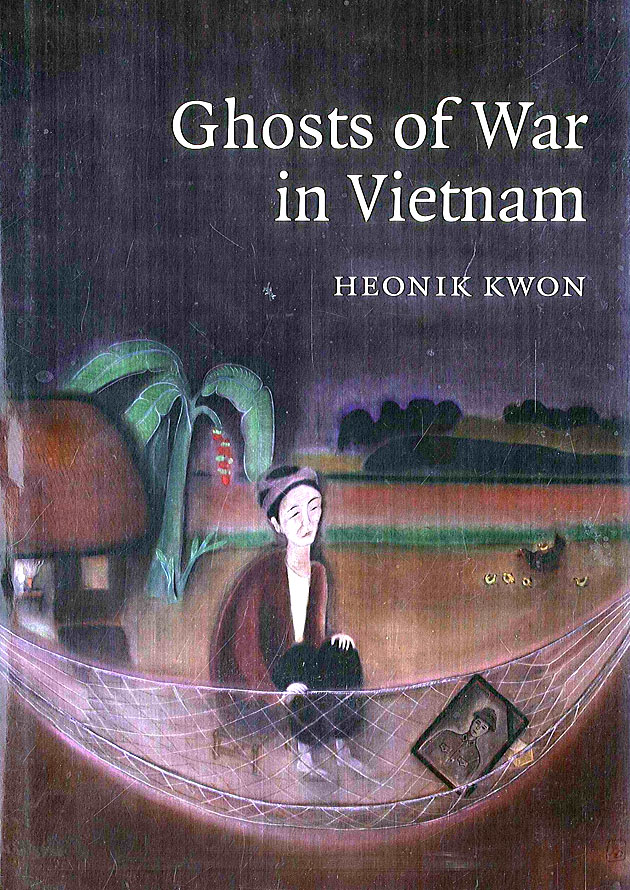
I built the psychic world drawing heavily from “Ghosts of war in Vietnam” by Henrik Kwon a Korean anthropologist who spent two years researching war ghosts in villages. He ascertained that the war dead did not hold sides in Central Vietnam where he investigated, and emphasised the importance of the war dead remains to be reunited with their descendants where possible. With the existence of mass graves holding bodies from all sides of the conflict, local domestic shrines in people’s homes also have altars for wandering ghosts to receive offerings and some measure of peace. 

An ancestral family shrine

That is a moving image of hospitality. Are there no fears that ghosts seeking revenge might show up?

Ghosts seeking revenge are termed “hungry ghosts” and there is a special day for them in mid August where people give offerings to the restless undead.

What of the Buddhism in the book? What philosophy underlies the narrative?

The philosophy of the Buddhists in the story come from Thich Nhat Hanh teachings (called Thay meaning teacher), the Zen Buddhist Master I follow. Thay teaches that mankind are not the enemy, fear and anger are the enemy. He travelled to America in the sixties to lobby for peace in Vietnam and was nominated for the Nobel Peace Prize by Martin Luther King. His pilgrimage in 2007 included Great Ceremonies of Mourning for all those who have suffered in the war. He has said that the Vietnam/American War was a war of ideology pitting brother against brother. He has established monasteries of practice around the world including in America.

The protagonist is responsible for guiding others through a very complicated terrain, what about her own journey?

Kim undergoes an awakening in the book to the possibilities of being a psychic in a democratic country and her potential as a woman. At the beginning of the book she is defined by what she doesn’t have, good looks or a boyfriend. Her sister is getting married and that seems to be Kim’s destiny too. But being a psychic complicates this future She discovers her Buddhist spiritual heritage through her grandmother and the Buddhist abbot she comes into contact with while working for the Communist government. She chooses a Buddhist ethical way to practice as a psychic but it goes against the government orders she has.  She ends up marrying a Vietnamese American psychic for her defection to America rather than for love. 

The statue is of Quan Am the female Buddha

You allude to the role of storytelling in Buddhism, how would you position your novel in relation to Buddhism? 

The Other Shore aims to be an exploration of ethics and the spiritual, pragmaticism and Buddhism. It is a tale whose second edition is dedicated to Thich Nhat Hanh who passed away in 2022 in Hue at his root temple in Vietnam. 

Ghosts are conventionally transparent – you can walk through them – but they’re also opaque because they are radically Other to our lived experience. How did you try to capture that tension of creating characters that are human and yet not entirely knowable?

The benign ghosts I write about are archetypal the wise woman, the maiden etc They all have knowledge of the spiritual realm that Kim as a naive protagonist does not have (and one assumes the reader does not have). In the cosmology that I write from ancestral ghosts are their human selves except they are on the other shore in the spiritual realm. I do not explain every manifestation, Kim takes it on faith and I ask the reader to as well.