Over the course of the last thirty years, the standard model of literary modernism has eroded.
This model offered an origin story, beginning with the fiction of Joseph Conrad and Henry James and the poetry of W.B. Yeats; a consolidation in the figure of Ford Madox Ford and the ethos of Impressionism; a quickening in the face of war and the avant-garde, as represented by Imagism and Vorticism; a fluorescence in the post-war aftermath of T.S. Eliot, James Joyce, and Virginia Woolf; and then a slow decay during the 1930s and `40s, culminating in the endgames of Samuel Beckett. What this narrative described was the rise and fall of a literary doctrine – art for art’s sake – in which the fever dream of history could be cooled by the impersonal application of myth and symbol. The type of artist this narrative valued was austere, detached, ironic and analytical. For John Carey, in his jeremiad The Intellectuals and the Masses (1992), such an image was but an excuse for elitism, social prejudice, and even fascism.
For an undergraduate like myself, though, it seemed a bit rich for the Merton College Professor of English Literature to be condemning other writers as elitists, especially when he pronounced that what the masses really wanted was the middlebrow novels of Anita Brookner. Growing up in working-class Gillingham, in a single-parent family that barely kept itself above the breadline, what I wanted was not Brookner’s insufferable Hotel du Lac but J.G. Ballard’s Empire of the Sun, outmanoeuvred on the 1984 Booker Prize shortlist by that year’s Chair, Professor Richard Cobb.When eight years later I was studying Joyce’s A Portrait of the Artist as a Young Man (1916) and realised that a whole passage had been parodied by Alfred Bester in The Stars My Destination (1955), this received history about modernism and mass culture began to smell decidedly fishy.
It might seem rather strange to start writing a column for Vector focusing on sf as a fiction of practical resistance to capitalist realism and oppression in a special issue on sf and modernism. After all, isn’t modernism the literature of the metropolitan elites? Influential books such as John Carey’s The Intellectuals and the Masses (1992) and Jonathan Rose’s The Intellectual Life of the British Working Classes (2001) certainly make this case. The latter argues that writers from the educated classes sought to maintain their elite status in the face of challenges from the masses by creating modernism, ‘a body of literature and art deliberately made too difficult for a general audience’ (393). His illustrative list of such elitists includes T.S. Eliot and Ezra Pound, but also less obviously conservative writers, such as H.G. Wells and Virginia Woolf.
While Wells was educated, he was hardly from the educated classes, being the son of a shopkeeper and domestic servant. His brilliant novel Tono-Bungay, charting the rise and fall of a quack medicine, was serialised from 1908 in Ford Madox Ford’s English Review, one of the foundational modernist magazines. The lively style of first-person narrative Wells adopted for the novel was highly influential on the work of modernist writers, including Ford’s own The Good Soldier (1915). Yet far from being deliberately difficult in order to deter general readers, Wells was a popular writer who expressed the dreams of millions who aspired to escape from the class-bound hierarchies of the age As George Orwell pointed out, reading Wells’s sf during the early years of the twentieth century at a time of lingering Victorian values and moral hypocrisy was a liberating experience because he ‘knew that the future was not going to be what respectable people imagined’ (171).
One feature that modernism and sf share is a resistance to the capitalist conception of time: the relentless metronomic recording by the factory or office clock of the seconds, minutes and hours of empty time to be filled by work. Instead, both genres enable the depiction of time as elastic: moments that stretch to encompass the entirety of eternity and epochs that pass in the blinking of an eye. The archetypal example of this latter phenomenon is Well’s The Time Machine (1895), in which his protagonist fast-forwards from Victorian London into a distant class-flipped future in which the Morlocks, evolved offspring of the workers, hunt and eat the descendants of their former masters, the Eloi. While the satire is savage, the experience of time travel itself is recorded in aesthetic terms through the hero’s description of watching ‘the moon spinning swiftly through her quarters from new to full’ before blurring into a ‘fluctuating band’ faintly visible against a ‘wonderful deepness of blue’ (17).
Paul Minott worked as a leading graphic designer for over thirty years, working for numerous international design consultancies in London and abroad. He ran a successful partnership in London before embarking on a teaching career at Bath Spa University. He now works making one-off abstract prints using an etching press.
James Gillham completed a practice-led Ph.D. in Fine Art at the University of Reading in 2014, researching capability via the intersection of institutional demands and intersubjective expectation. He continues this research by painting the Humpty character from Olaf Stapledon’s Last Men in London, and by seeking similar representations in Science Fiction. James lives and works in Wiltshire, and is the cover artist for the latest issue (299) of Vector.
Marcel Duchamp, The Bride Stripped Bare by her Bachelors, Even (The Large Glass), 1915–23. VIA CREATIVE COMMONS/COURTESY PHILADELPHIA MUSEUM OF ART
Marcel Duchamp’s famous work The Large Glass (1915-23) has been duplicated numerous times, by artists such as Richard Hamilton (1965) and Ulf Linde (1961). Duchamp’s approval of these pieces emerges from his established interest in the ready-made, but also points to a more nuanced conception of time situated in popular contemporary European Modernist thought.
Nude Descending a Staircase, No 2 (1912) is perhaps the most explicit example of this interest with temporality, but the glass mechanisms such as Rotary Demisphere (Precision Optics) (1925) bring these engagements into clearer focus. These spinning devices suggest an investigational approach to time’s passage – expansions and contractions operating between objective measurement and subjective experience.
Duchamp’s ludic approach to time has interested artist and printmaker Paul Minott for many years, and is the impulse behind Minott’s latest work: Portrait de Voyage dans le Temps. Portrait de Voyage dans le Temps is an Artificially Generated visual essay, showing Marcel Duchamp alongside his various time machines.
Minott discusses Duchamp’s Modernist conception of time and how this appeared in Duchamp’s artwork – while finding parallels with contemporary use of Artificial Intelligence to generate images – with fellow artist James Gillham.
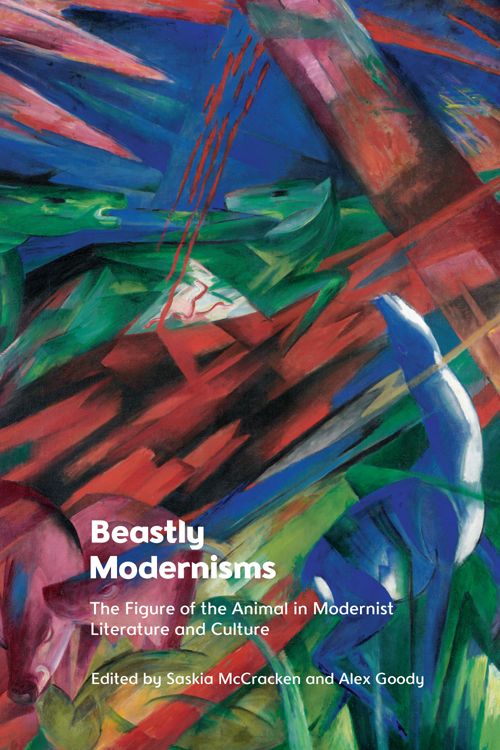
At face value, this collection of essays may not seem to be of immediate interest to the sf reader. It is primarily concerned with the development of Animal Studies – a sub-discipline that has already been significantly explored in relation to sf in the work of Sherryl Vint, Joan Gordon, and others – with reference to literary modernism, a diverse movement already noted for its challenge to traditional notions of identity and individual autonomy. The potential, though, for creative overlaps between modernism, sf and Animal Studies is already indicated by the fact that one of the co-editors, Alex Goody, was a keynote speaker at the 2019 Corroding the Now conference at Birkbeck College, London. Seen through a science-fictional lens, the encounter between human and non-human animals, the slippages between them, and their mutual affinities and kinships immediately invoke the First Contacts and uncanny relations between humans and aliens which are the stuff of genre sf. As the introduction’s reference to Jorge Luis Borges and Karen Eckersley’s chapter on Leonora Carrington make clear, imagined bestiaries are common to both Animal Studies and speculative fiction.
Without seeking to be a guide, the introduction nonetheless touches upon many of the key moments in the evolution of Animal Theory: from Peter Singer’s pioneering Animal Liberation (1975) and Donna Haraway’s ‘cyborg manifesto’ (1985) to Gilles Deleuze and Félix Guattari’s concept of ‘becoming animal’ (1982) and Jacques Derrida’s pivotal essay ‘The Animal That Therefore I Am’ (2002). The introduction also registers many of the other posthuman thinkers whose ideas have contributed both to Animal Studies and this volume in particular; from Giorgio Agamben and Rosi Braidotti to Michel Foucault and Cary Wolfe. The editors however, beginning their account with an exchange between Djuna Barnes and James Joyce (two modernists in exile, both of whom would flit between the centres and margins of the modernist canon), emphasise the affinities between Animal Studies, the revaluation of women’s writing and the decolonising of the curriculum. All such practices foreground and deconstruct the historic imposition of borders, the arbitrary gatekeeping that has characterised academic protocols and the maintenance of cultural shibboleths. To that end, the editors also note the collapsing boundary between ‘high’ and ‘low’ cultures, an elision that not only permits the entry of sf into the conversation, but which would also have appealed to such modernists as Barnes (boxing fan and purveyor of crime fiction) and Joyce (publican’s son, cineaste, and Anita Loos devotee).
In this academic article, Josephine Wideman explores themes of temporality and capital accumulation in Samuel R. Delany’s Dhalgren (1975).As Fredric Jameson suggests, we must find new methods of spatial and social mapping in order to navigate the geographical and cultural landscapes of late capitalism.Delany’s Dhalgren is deeply concerned with the fate of US hegemony, and with the uncertainty that capitalism has produced: the duality of its unsustainability and seeming inevitability. Bellona is a cityscape which has been devastated by the cycle of accumulation and taken off the map. Delany’s creation ultimately should not be read as a prophecy of what will come of late US capitalism, but it gives insight into the complex historical and apocalyptic consciousness that has been cultivated.
Review: This article underwent editorial review from two editors.
License: Copyright Josephine Wideman, all rights reserved.
Keywords: accumulation, Giovanni Arighi, postmodernism, Samuel R. Delany, temporality, urban space
Samuel R. Delany’s 1975 novel Dhalgren is lengthy, hallucinatory, and at times unnavigable science fiction. Its form is as dense and as wavering as the urban landscape it depicts, where Delany’s protagonist, Kid, can wonder whether ‘there isn’t a chasm in front of me I’ve hallucinated into plain concrete.’1 Bellona – the fictional city where events take place – is a space ‘fixed in the layered landscape, red, brass, and blue, but […] distorted as distance itself,’ a place where ‘the real’ is ‘all masked by pale diffraction.’2 Although the scenery and scenarios of Bellona may be fictional, and perhaps even fantastic, they are also true representations of real experience. The unfixed landscape we live in becomes ‘fixed’ before us in Delany’s book. The distortions and diffractions by which it is fictionalised only increase its representational precision. The gaps in our experience, usually masked, are made visible. For although it takes an unusual form, we can recognise
this timeless city […] this spaceless preserve where any slippage can occur, these closing walls, laced with fire-escapes, gates, and crenellations are too unfixed to hold it in so that, from me as a moving node, it seems to spread, by flood and seepage, over the whole uneasy scape.3
In looking at Dhalgren, I have borrowed from the political theorist and sociologist Giovanni Arrighi in order to trace the presence and effects of capitalist accumulation in Delany’s fiction. Arrighi, in The Long Twentieth Century, describes the ‘interpretative scheme’ of capitalism as a ‘recurrent phenomena.’4 Drawing on work by the historian Fernand Braudel, Arrighi follows the Genoese, the Dutch, and the British cycles of accumulation to the current North American cycle. By examining past economic patterns and anomalies, he suggests that we may be able to gesture at the fate of our current cycle. Arrighi sets out to demonstrate that the rise and fall of these hegemonies, while never identical, tend to follow a set of stages that begin ‘to look familiar.’5 To make his argument, he proposes a new use for Marx’s ‘general formula of capital’:
Marx’s general formula of capital (MCM’) can therefore be interpreted as depicting not just the logic of individual capitalist investments, but also a recurrent pattern of historical capitalism as world system. The central aspect of this pattern is the alternation of epochs of material expansion (MC phases of capital accumulation) with phases of financial rebirth and expansion (CM’ phases).6
In Das Kapital, Marx initially proposes the formula CMC to theorise how capital functions. This theory begins with the assumption that people have needs and desires they can’t satisfy by themselves. Thus we create the commodities we know how to make (C), which are sold for money (M), which allows us to buy the commodities we want (C). As this cycle repeats, those who are skilled presumably accrue more value than others, being able to sell their commodities for a greater profit. This theory centres around the individual and his role in a capitalist system. But Marx then sets CMC aside in favour of another formula – the formula borrowed by Arrighi in The Long Twentieth Century – MCM’. In MCM’, circulation does not begin with the dissatisfied individual, but with capital itself. Money is invested (M) into the materials and labour necessary to produce a commodity (C), which is then sold for money (M). The difference between CMC and MCM’ is subtle but crucial. The first formula implies that capitalism recurs, and things are made and exchanged, in order to satisfy human desire and need. The second formula implies that money is in charge, that production and exchange are ultimately subservient to profit, and that money begets more money. For Marx, what drives capitalism is not only MCM, but MCM’ – the apostrophe signifying ‘prime’ – or the concept that money increases in value through circulation. The source of this additional, or ‘surplus’ value, is where capital really loses its lustre. This value is gained within labour – in the time spent on the creation and production of a commodity from raw material – and for Marx, its appropriation by capitalists is inherently exploitative.




 vector-bsfa.com