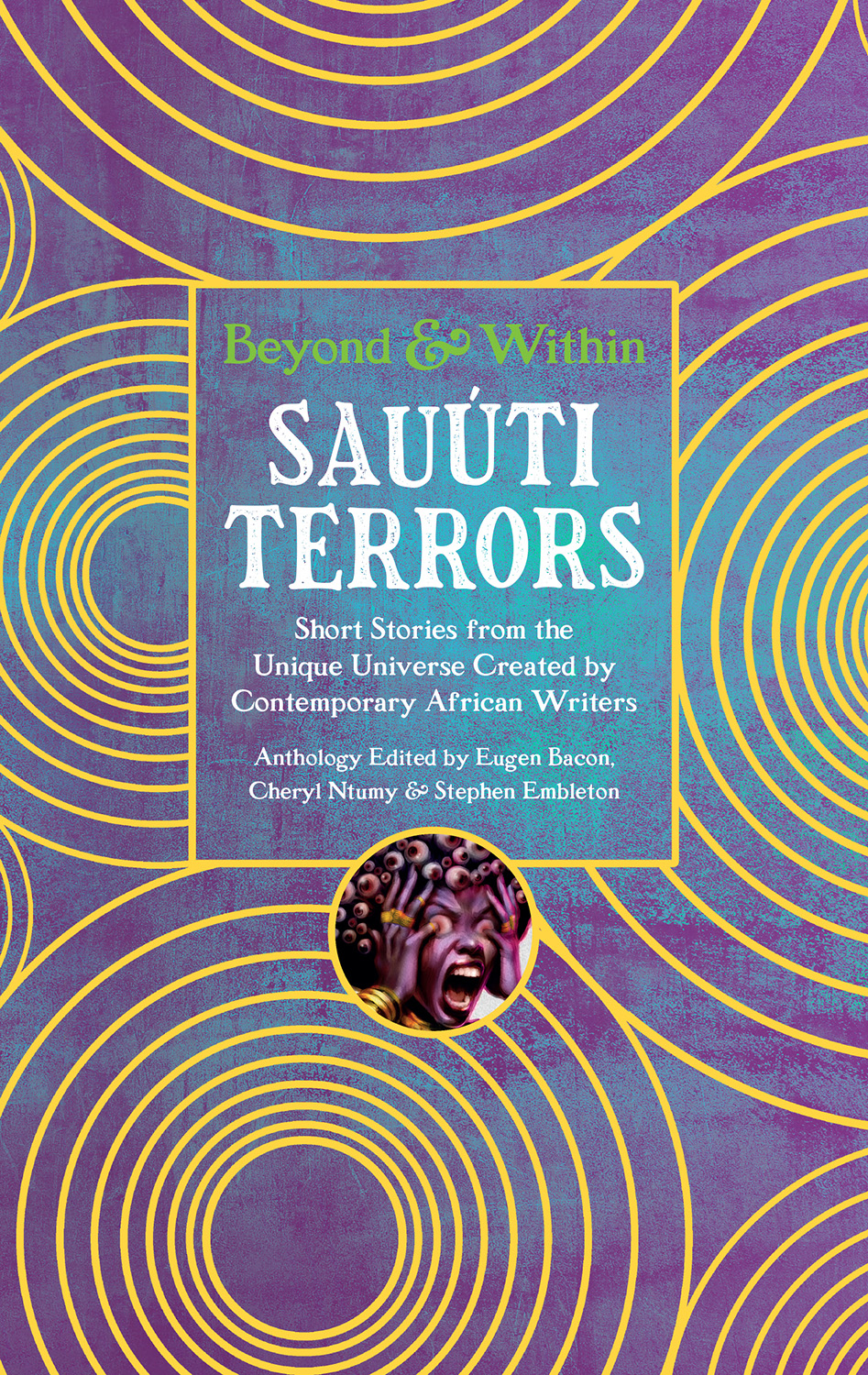
My first direct encounter with the Sauútiverse was in 2022 when, at the Ake Books and Arts Festival in Lagos, panellists Wole Talabi, Dare Segun Falowo, Stephen Embleton, and Cheryl Ntumy, members of the Sauúti Collective, introduced the shared world project. I sat there in the audience, watching as the lights dimmed and a video of the Sauúti creation myth was played to us. Over the animated visuals was an echoing voice apparently merged from the real voices of the Sauúti founding members. This voice, supposedly that of the Mother, the chief deity of Sauúti lore, told the story of the universe’s birth from a single Word.
The two-minute clip entranced me, and, long after the lights had been turned back on and the applause had faded, I was still transfixed by its power. There, on stage, the panellists introduced several aspects of this vast, sprawling secondary world featuring a two-star system, five planets, and three moons. Since then, the Sauútiverse has exploded, birthing two anthologies, three novellas, numerous short stories and poems, a novel, and additional works in the pipeline, all set in and exploring the diverse cultures, science, belief systems, and history of this intricately built shared world inspired by Africa. It has also been picked up and nominated for various awards, including the Nommos and the BSFA.
In this latest anthology, we’re shown a dark and terrible aspect of this world, not as a mere scare tactic, but to remind us that a universe this wide and sprawling wouldn’t be remotely realistic if it didn’t possess a horrific underbelly. Stories here do not shy away from the unsettling, the bone-chilling, the hair-raising, and the blood-curdling. The writers are super inventive in the ways they describe horror and fright. Across 18 short stories and poems, they boldly unleash all manner of terror. The writers commit strongly to Sauúti lore, which includes new words and Sauúti-specific terminologies. This, of course, can be a bit difficult for a new reader to grasp. But if they endure and get beyond that, they’d see that it adds to the overall uniqueness and beauty of the Sauútiverse.
Adedapo Adeniyi (also goes by Dapo The Abstract) is a Nigerian artist working in literature, film and photography, music (DJ) as well as art curation and counterculture archiving. He expresses his art through abstract avant-garde sensibilities. His debut novel, Wanderer, is available in stores. You can read an excerpt of his novel below, courtesy of the author.
Chisom Umeh is a Nigerian fiction writer and poet. His short stories have been featured in Omenana, Apex, Clarkesworld, Year’s Best African Speculative Fiction 2023, African Ghosts anthology, Isele, Mythaxis, Scifi Shorts, and elsewhere. His short story, “Ancestor’s Gift”, won the 2024 Tractor Beam short story contest. He was a finalist for the Seattle Worldcon Short Story Contest and is the winner of the 2025 Nommo Award for Best African Speculative Fiction Short Story.
Chisom, holding a copy of the Wanderer. Image: African Imaginary
Chisom: Hey Dapo.
Nice to have you do the interview.
I finished reading your novel Wanderer a couple of days ago, and I must say, the journey feels like one long dream. It’s a steady flow of alternating sentences and logic that sometimes contradict each other and yet, strangely enough, feels complete and cohesive. Can you tell me how you were able to keep the story you were trying to tell in focus, even while spinning such a wild tale?
Dapo: Thank you, Chisom. I’m excited to have this interview with you.
I want to start by saying the story mostly wrote itself; I was just a conduit. Most of this book was written in an automatist, stream-of-consciousness style. They were retellings of dreams, memories, and reality, and I wanted them to appear that way. I never lost sight of the story because I welcomed getting lost as I was writing it to find myself.
Chisom: Oh, that’s pretty interesting. To me, the novel reads like Amos Tutuola’s The Palmwine Drinkard crossed with Vajra Chandrasekera’s luminous prose. It definitely felt like older hands were guiding yours on the page. Were there literary influences you were channeling when writing the book?
Dapo: Yeah, I mean, I try to stay away from direct influences while I’m writing, and I didn’t read The Palmwine Drinkard until after I wrote Wanderer. I took influences more from films and cinematic sensibilities than literary, but in that regard, Borges, Philip K. Dick, Timothy Leary, André Breton’s Surrealist Manifesto, Aldous Huxley’s The Doors Of Perception, and my editor and friend, Manuel Marrero. I think these are the ones I can remember right now, plus I don’t want to go overboard. But these people and their works across surrealism, psychedelia, paranoid fiction, sci-fi, metafiction, and so on influenced me in many ways and were formative for how I approached writing and this book.
Chisom: It’s interesting that you mentioned Surrealist Manifesto, psychedelia, and paranoid fiction, because in an essay in Medium titled Abstractism Manifesto, you talked about how ‘abstractism’ is a term that subsumes all of these concepts and more. I like the way you explained it in the essay and how it relates to your work. But could you do a quick description of the term (abstractism) so we could understand it in relation to your work?
Dapo: Absolutely! So when I wrote the Abstractism Manifesto in early 2023, I defined it as being an amalgamation of solipsism, surrealism, psychedelia, subjective reality, and the physics of psychosis. I believe abstractism brings these concepts together to take reality and the world around us from a state of form to an abstract sensory state of formlessness, and that’s what I try to do with my work — the dissolution of some absolute real into an abstract cosmic real.
Chisom: In your experience as a filmmaker, what is the major difference between visual storytelling and written one? Do you prefer one medium over the other?
Dapo: I mean, writing is definitely cheaper. Making films is more expensive and taxing. I also think it’ll kill me faster so that might be why right now it excites me more than writing does. But, frankly, the major difference is the painting. With words, I’m guiding the readers’ imagination. At the end of the day, everyone will come out of it with different images. But with film, I have to literally represent those images on the screen. I’m doing the painting for the audience, they just have to watch and engage.
Chisom: Besides making movies, I know that you do some DJ work on the side. You had a collaboration with NTS, which is really great. How did that happen?
Dapo: Let me put it in context: I work with this new-age collective called Freewater, which was founded by my friends. I serve as its curator and co-director. Freewater secured a residency with NTS Radio, and since I also DJ, they featured one of my mixes as part of the collective. We’re having an underground, new wave music festival/concert on the 11th of December (I think the interview will be out after it?), and NTS is our major partner.
Chisom: That’s incredible, actually. So, does your music influence your writing in any way? Some writers like to curate playlists for particular writing projects. Something they listen to just to put themselves in the mood. Are you that kind of writer?
Dapo: Music definitely plays a huge part in my process. When I was writing Wanderer, all I listened to was shoegaze. I found a shoegaze playlist that had over a hundred songs and it was all I listened to while I slept and dreamt and while I wrote as well. I’ve been DJing for almost 2 years now, and it’s made me understand music as well as how different people interact with it. There are sensibilities of transience I borrowed from writing and translated to how I DJ.
Chisom: I kept wondering about the shoegaze reference when I was reading the book. Something told me there was more to it than just being an element in the story, and I’m glad you just confirmed that. Which brings me to your process with writing your stories and how you edit them. Do you edit while writing or after?
Dapo: Oh yeah, shoegaze has a very dreamlike, haze-inducing feeling and I wanted the book to feel like that. I do very minimal editing while writing. I finished the entire thing then read it over a couple of times before sending it to my editor, and we had this period of sending drafts back and forth and conversations on the subject matter.
But enough about me, I want to hear what type of music you listen to and how editing works for you. I mean, you just won the Nommo, haha.
Chisom: Oh, lol.
Well, I’m very mundane with my music. I don’t have any playlists or do any sort of curation. In fact, when I’m writing, I wouldn’t want to hear any music at all as it easily interferes with my thought processes and breaks my stream-of-consciousness, AKA “flow”. But when I do listen to music, outside writing, it’s very Davido and Asake and Victony, and whatever Dlala Thukzin just released. For edits, I can’t move forward with writing if I feel like there’s something wrong with a previous sentence. So I tinker with that till it feels fine to me. So we’re maybe kind of opposites on this.
Dapo: Correct me if I’m wrong but you seem like a very calculated writer. You’re delicate about detail, you’re careful. I think it’s beautiful. I wish I could be that type of writer. Like I said before (this may sound a little pretentious but I fully believe it), I don’t really do any writing, these things write themselves and use me as a conduit. I don’t know where they come from or where they are going or why; they come raw and I write in real time. My flow can be erratic most times.
Chisom: I like to think I have an eye for detail, but, trust me, I’m not really that meticulous. I know writers who would draw up elaborate plots that cover the first scene to the last, and fill up a board with sticky notes. Me? I mostly just sit down and write a story as it comes into my head. I think both our approaches are valid, so long as the outcome is something folks can read and enjoy. When I’m done writing and send the work out, that’s where my effort ends. But I’ve seen you go through hell and high water to publicize your book. And it has really paid off. Maybe that’s something you’d teach me someday?
Nardwuar holding a copy of Dapo’s first novel, Wanderer
Dapo: You’re amazing, so we’re kin.
Thank you, I think it’s been a learning curve. A lot of how this book has been handled is experimental, constantly trying to see how to reinvent whatever a rollout is supposed to be. Some days before the book came out I’d post videos of just my legs as I was walking around. Wandering, if you will. I made cards and handed out googly eyes. I’ve had readings and talks. I even had an abstractism lecture and played a psychedelic techno set. I keep thinking of ways to present a work of literature outside of just the confines of literature, especially as a multimedia artist. I look forward to reinterpreting the book and presenting it in so many other formats: photograph, sound, installation, you name it.
Chisom: Say I wanted to try my hand at writing abstractism, are you holding one of those lectures anytime soon?
Dapo: Hopefully sometime early next year. I’m working on writing another edition of the manifesto that’s more professional, but I think that through reading the manifesto that’s up right now, as well as Wanderer and some of my short stories, anyone could get the gist of what abstractism is.
What’s next for you now Chisom? In the world of African Speculative Fiction.
Chisom: For me, I’m also trying to piece together a collection of short stories that hopefully might be my debut in the book-publishing space. I want most of the stories in the collection to be centered around two themes, so that means I’m writing mostly new stories.
Anyway, it’s really been wonderful having this chat with you. I’m looking forward to reading more of your stuff in the future.
Dapo: Sending you love and the best of wishes Chisom, excited to see your collection. I’ll send you mine as it comes along. You’re a refreshing voice in the scene here.
Alexander Zelenyj is the author of the books Blacker Against the Deep Dark, Songs for the Lost, Experiments at 3 Billion A.M., Black Sunshine, and others. His most recent book is These Long Teeth of the Night: The Best Short Stories 1999-2019. His books and stories have been translated into several languages, including German, French, Romanian, Italian, Spanish, and Ukrainian. He has a collection of brand new stories forthcoming from Eibonvale Press in Fall 2024.
Zelenyj lives in Windsor, Ontario, Canada with his wife and their growing menagerie of animals. Visit him online at alexanderzelenyj.com.
Alexander Zelenyj
David Rix: Thank you for taking the time to talk! How are you finding this new year so far?
Alexander Zelenyj: My pleasure, thanks! I’m finding the year so far very busy. Busy with mostly good things. We have a new kitten and she’s a handful. She adopted us. Showed up at our back porch door on a cold night, tiny and frail. How could we turn her away?
DR: I feel we may need some kind of ‘cat tax’ here – that would definitely get all this off to a good start! But anyway – I have been involved with your writing in various ways for quite a long time now and I have published several of your books, so this is a good chance to dig in a bit and explore what is going on – what makes you tick, as it were.
When reading your stories, one gets the feeling of a lot of different threads coming together, from nostalgia for classic forms of writing to the much more surreal and experimental. Can you tell us a bit about the influences that came together to make you? And maybe which ones came first and which were added later?
AZ: My home library tells the story most clearly, I suppose because I’ve always bought a lot of books and rarely get rid of them. This means I still have all the ones I had when I was a young boy, certain of which had the most profound influence on me. I was most drawn to the stranger books, which turned out to be a lot of science fiction, fantasy and horror. Those genres and many key works from each became foundational influences for me. Especially authors like Robert E. Howard, who has stood the test of time, still has a primal power and weaves a very strong spell. I remember reading Howard’s story, “The Tower of the Elephant” as a boy and having a true moment of clarity—one of just three such moments I’ve ever had in my life—and understanding that I’d just discovered something magical and very powerful, something that called to me in such a strong way that I knew I had to write stories, too.
Authors like Arthur Machen, Ray Bradbury, Edgar Allan Poe, Richard Matheson, and James Tiptree Jr. also had a huge impact on me, and continue to do so. Harlan Ellison as well. His The Beast That Shouted Love at the Heart of the World was a revelation for me. All of his collections are amazing but this one has a huge amount of variety between its covers that I’m not sure he matched anywhere else, and it’s some of his most original work. The novella “A Boy and his Dog” does a wonderful job of establishing the lead character’s amoral motivations within a post-apocalyptic wasteland, which turns out to be the most disturbing aspect to the story because it asks (and answers) the question with a kind of unerring logic: how far away are we from being this boy, in this world?
Going back even further, I have an early memory of my mother reading to me from a book of Czech fairy tales by Karel Jaromír Erben. One story in particular, called “Otesánek”, really frightened me—it was about a couple who cares for a baby that has come to life from an inanimate piece of wood.
DR: Yes, people might be more familiar with this story from the film by Jan Švankmajer – Little Otik. That had quite an effect on me as well.
Jan Švankmajer – Little Otik
AZ: Yes, that’s the one. The baby’s appetite soon becomes much more voracious than its adoptive parents could have foreseen. Looking back on it, I see a deep pathos to this story about a childless couple wanting so desperately to have a baby that, through some magical means, the universe seemingly grants them their wish, only to have their dreams turn into this deeply disturbing, nightmarish scenario. I still have my childhood copy of the book, and it has a special place on my shelves. This might have been one of my earliest exposures to the supernatural, or the unknowable.
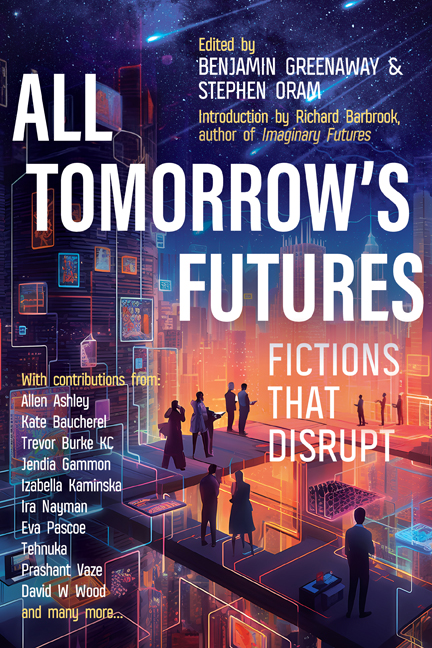
Explore where technology might take us and what that might mean for how we live with this anthology that brings together experts and writers.
It’s easy to view fiction as merely entertainment and escapism (both important in their own right), but stories – especially science and speculative fiction (SFF) – are also wonderful tools for exploring and learning, imagining possibilities and seeing how they might work. It is serious play and playful thinking.
It’s almost a tenet of SFF that technology is secondary to the story. While SFF writers tend to explore ideas and the stories those ideas generate, their technology may be plausible but there’s no requirement for it to be. There are, however, countless movies and TV shows where an interesting premise is undermined by technology that absolutely doesn’t work. Futurists and researchers explore possibilities and trends, making predictions that are intended as realistic extrapolations of real or expected technology, with none of the Hollywood handwaving and convenient MacGuffins, but while fictional case studies illustrating predictions are so common that you’ll find them in IKEA’s latest research about homes and living, they rarely have the kind of characters, plot and drama that makes for compelling fiction.
What if you could combine the two, with experts and authors collaborating to write about possible futures in ways that are not just plausible but creative, with equally strong stories and technical chops? Like Cybersalon’s previous anthology, 22 Ideas About the Future, All Tomorrow’s Futures is predicated on (mostly) plausible technology and the impacts such technological developments might have on justice, energy, digital money, health and education.
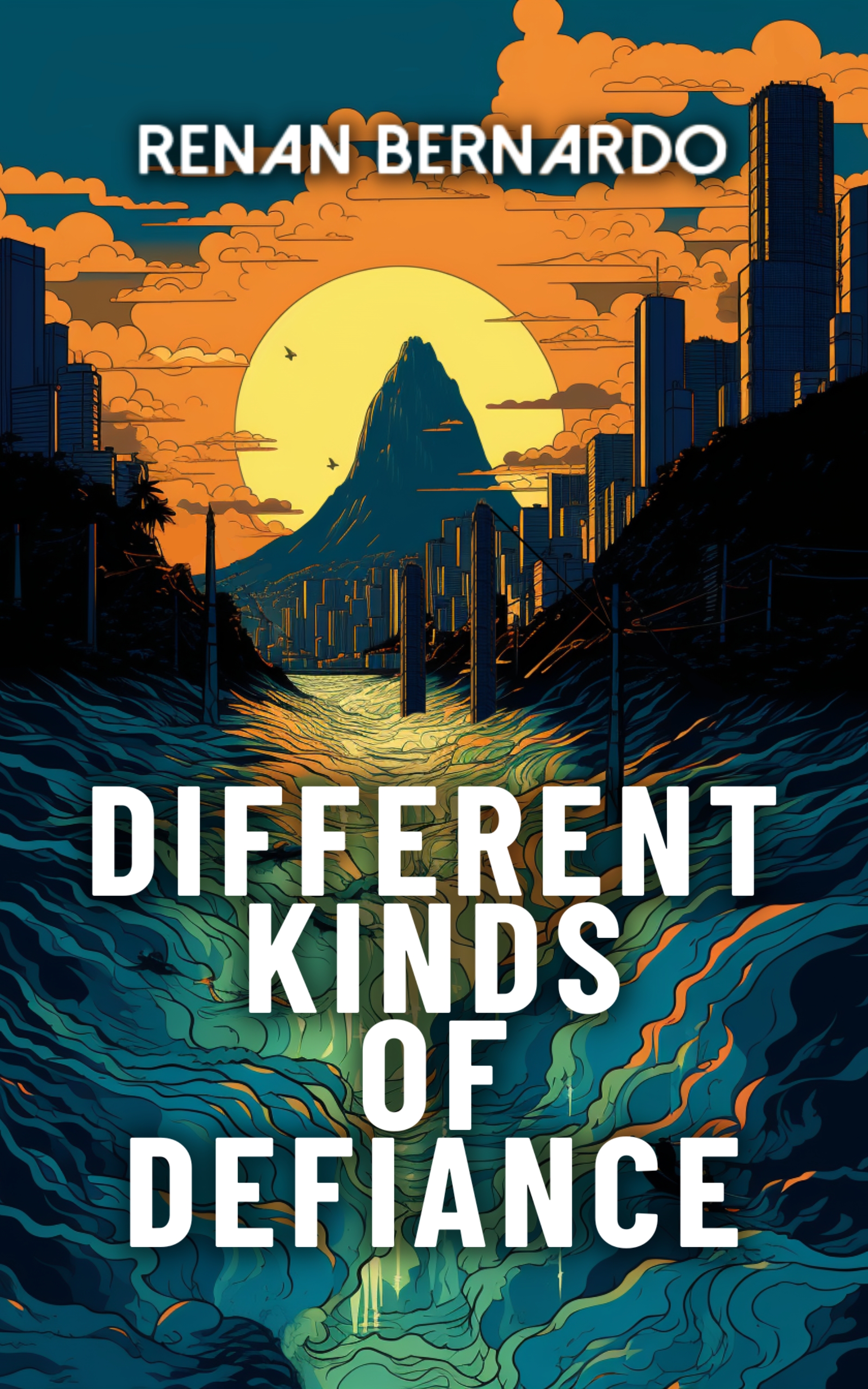
Renan Bernardo is a Nebula finalist author of science fiction and fantasy from Brazil. His fiction appeared in Reactor/Tor.com, Apex Magazine, Podcastle,Escape Pod, Daily Science Fiction, Samovar, Solarpunk Magazine, and others. His writing scope is broad, from secondary world fantasy to dark science fiction, but he enjoys the intersection of climate narratives with science, technology, and the human relations inherent to it. His solarpunk/clifi short fiction collection, Different Kinds of Defiance, was published in 2024. His fiction has also appeared in multiple languages, including German, Italian, Japanese, and Portuguese. He can be found at Twitter (@RenanBernardo), BlueSky (@renanbernardo.bsky.social) and his website: www.renanbernardo.com
Jean-Paul L. Garnier is the owner of Space Cowboy Books, producer of Simultaneous Times Podcast (2023 Laureate Award Winner, BSFA Finalist), and editor of the SFPA’s Star*Line magazine. He is also the deputy editor-in-chief of Worlds of IF magazine & the soon to be relaunched Galaxy magazine. He has written many books of poetry and science fiction. https://spacecowboybooks.com/
JPG – In many of your stories you juxtapose the past with the present, layering multiple times together, tell us about using this narrative device, and how you use it for emotional effect?
RB – Layering past and present together without necessarily resorting to flashbacks is an excellent device to make the reader flow along with the main character’s feelings without breaking the pace of the story. I believe the past has a lot of things to say. Our past shapes who we are, so it always adds an interesting layer to my stories. Many answers to the present and the future are in the past. I believe that you were thinking of “Soil of Our Home, Storm of Our Lives” when you thought about that question. In this story, there are three timelines layered separately: past, present, future, each with different things to say about the characters, different emotional cores to introduce that end up fusing in the end. The challenge is always to weave them all together, so they don’t feel detached from each other, but I like to believe that I achieved it in this particular story.
JPG – Your stories often present utopias, but as you mention in your forwards, one person’s utopia can be another person’s dystopia. Can you speak about this concept and why cultures have a difficult time envisioning positive futures that include everyone?
RB – There are two stories in the collection that introduce this concept: “Anticipation of Hollowness” and “To Remember the Poison.” In “Anticipation of Hollowness,” there’s a sustainable city where everything seems perfect but the city is extremely gentrified and no one from lower or middle class is able to live in it anymore. And “To Remember the Poison” is an extreme version of it: a society based on justice, sustainability, and equality that got so detached from the rest of the world that it became an exclusive haven closed to the world. And though its focus is on education and expanding their “green” world, its inhabitants tend to follow a line of thought not so different from what billionaires imagine with their projects of selective bunkers or space stations. And given the concentration of resources and knowledge of Verdoá (the city in the story), it becomes a colonizing power in the region.
Samantha Mills is a Nebula, Locus, and Theodore Sturgeon Memorial Award winning author living in Southern California, USA. You can find her short fiction in Uncanny Magazine, Beneath Ceaseless Skies, Strange Horizons, and others, as well as the best-of anthologies The New Voices of Science Fiction and The Year’s Best Science Fiction & Fantasy 2023. Her debut science fantasy novel, The Wings Upon Her Back, is out now. You can find more at www.samtasticbooks.com.
JPG – The culture in The Wings Upon Her Back is a theocracy where labor and religion are intertwined, can you tell us about using this as a worldbuilding device?
SM – When developing The Wings Upon Her Back, I wanted a claustrophobic, monocultural setting to reflect the isolation of the main character and the fraught history of her city. Everything had to revolve around the five gods that are sleeping overhead.
In the book, the division of labor is a core tenet of their religious and social framework because they are emulating the gods, who arrived with very clearly defined roles. I ended up with five sects: the workers and farmers are the biggest groups, who keep the city running; the scholars and engineers are documenting and implementing the teachings of the gods; and the warriors keep the city isolated from outside forces. The primary conflict of the book comes from the unbalancing of these factions, as the warriors take more power over the others.
One of my favorite worldbuilding techniques is to build out social expectations – what everyone is supposed to believe, what everyone is supposed to do – and then to imagine the characters who do not fit the mold. I set a limit at five sects because it automatically creates tension: you can’t actually sort the breadth of humanity or the tasks needed to keep society running into such a small number of categories!
This tension permeates the book. There are jobs, such as medicine, that rely on teachings from multiple gods, and therefore arouse some unease. And there are many individuals who don’t fit neatly into their sect. My main character, Zemolai, was born into a family of scholars, but left them to be a warrior. The hodgepodge group of rebels she falls in with later in life have all either changed sects, or are revolting against the expectations placed on workers specifically. The right to question the division of labor (and therefore, the teachings of the gods) is central to the story.
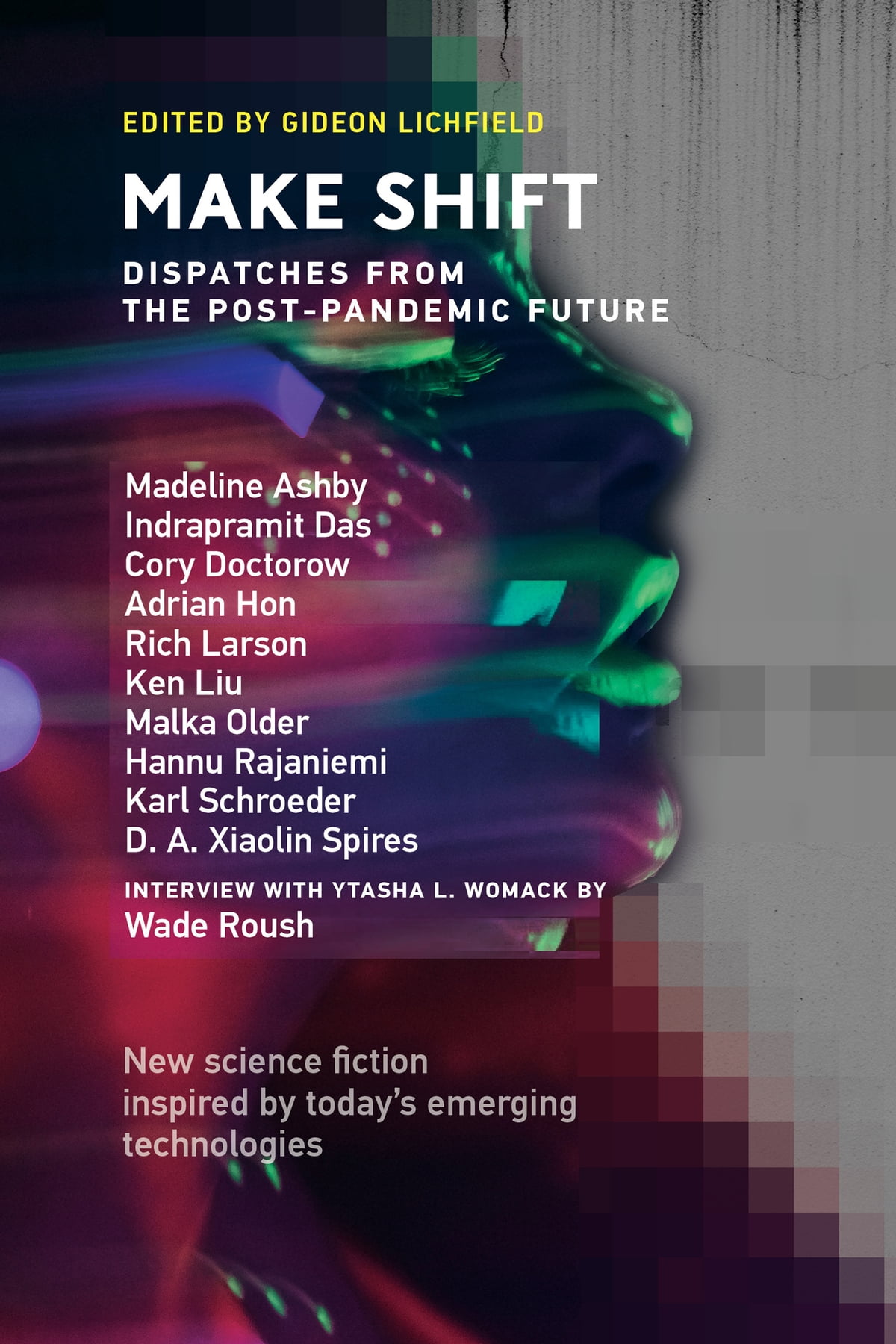
In my head, collections of short stories are proof of the many-world interpretation of quantum mechanics – once an experiment with different possible outcomes is performed, all outcomes are obtained, each in a different newly created world. To a certain extent, this is the starting point for the Twelve Tomorrows project – an annual anthology of science fiction short stories, published by MIT Technology Review – but unlike in physical experiments, it allows us to observe all of the alternative worlds.Make Shift: Dispatches from the Post-Pandemic Futureis the 2021 addition to this project, and it appeared in the most difficult times. The world, having gone through all types of lockdowns, quarantines, social restrictions, furlough policies, has irrevocably changed, and eleven contributors to the book led by the editor Gideon Lichfield are trying to chart out those changes into newly opened futures.
It’s a great challenge to prepare such a collection of short stories still in the midst of the pandemic (May 2021). It takes the honed instinct of a veteran of MIT Technology Review and, currently, WIRED editor to make sure that these stories still ring pitch-perfectly a year later. When Lichfield wrote in the preface how coronavirus “has ripped open a gaping hole in [capitalist liberal democracy] that may never be closed up,” he could not have possibly known that a year later Europe would be plunged into a war, and that the future would seem even darker, even more dystopian than through the lens of the pandemic alone. Now the world is once again lost in dis-es and mis-es of discord, displacement, dysfunction, misunderstanding, mistreatment and misery, and we struggle to see our place in it.
Nonetheless, the authors gathered under this cover are not new to imagining futures that embody resistance, resilience and hope. They are, in Lichfield’s words, “known for their ability to imagine a plausible future in realistic detail,” and they carve out new possibilities from the minutest details of our everyday life. Professional futurists, skilled world-builders and word-weavers, the volume’s writers are also journalists, sociologists, biotech consultants, activists, lawyers – they both shape the world, and care for the future with an intensity that burns through their words. More than once I finished reading a story in this collection with my eyes wet and my heart beating fast – a testament that the writing is wholehearted, earnest, relevant. It strikes a fighting chord with me despite the fact that there are no wars in these narratives, no large acts of heroism or self-sacrifice. Through the stories of ordinary people, in undramatic settings, they give you hope that, quoting Lichfield again, “the new normal, though forged in pain and suffering, could be a healthier, more robust, and in some ways more creative society.” They give you hope that your life matters.
“No one is more important than you are,” says Chela in Malka Older’s “Interviews of Importance.” Chela works as operator for a new digital technology that records the memories of the elderly. Her job is to talk to them about their past. But what Chela wants most is to talk to her own mother, and to learn the story she never shared. Chela’s clients love talking to her, she is good at her job, yet somehow she can’t find the right words for the one person who is so important to her. She is afraid that she will never know her mother’s life story, and “there is a difference between knowing the outlines and understanding why things had happened and what it felt like.” COVID had an enormous impact on all emotional bonds that hold us together. Due to travel restrictions, I haven’t seen my mother for over two years now. I know how it feels – the slow erosion of intimacy, the blinding worry that you will be too late to say the right words.
Family relationships are in the centre of Indrapramit Das’s “A Necessary Being,” a beautiful and sad story about bonding and parting. Our ruined world is being slowly tended back to life by giant omnipotent robots, doing all the menial tasks to make the planet livable again. They are operated by people who inhabit their mechanical bodies and give up on all human connection. But one day one of the operators rescues a little girl. She has nowhere to go, so he adopts her and lets her live with him inside the machine and pilot it. Together they become “heart” and “soul” of the robot. But is this life too much or not enough for a human child? The fragile ecosystem of father-daughter relationship unfurls against the background of the recovering world, and raises questions about gratitude, loyalty and our future survival.
Stories like this are read through empathy and contemplation instead of adrenaline, as befits a collection of stories about futures after pandemics. Little happens in terms of the plot, or even character development. Yet they can still connect emotionally, and they are a treasure trove of inspirational ideas for the tech-savvy reader. The quadratic voting system in Karl Schroeder’s Sherlockian “The Price of Attention” is presumably unhackable and ensures fair votes by making people invest in the issues that matter the most to them; the system evolved out of the same mechanisms as COVID track-and-trace system. The Nene Huddle network in Ken Liu’s palimpsestic “Jaunt” allows people to establish a secure, yet anonymous and hard-to-trace connection with a telepresence robot and enables virtual travel in a world where conventional travel is extinct, and governments try to lock down and control population in the name of the common good. Such innovations are explained in exhaustive and plausible detail, which gives the stories a certain solidity, while serving as a reminder for us to pay attention to science and technology developments, spurred on by pandemic.
Some of the stories ring hilariously – and dangerously – true to our early pandemic experiences. Confusion, anger, and victimization were part of our initial reaction to COVID, and they are not easy to dispense with. Madeline Ashby’s “Patriotic Canadians Will Not Hoard Food!” recall empty shelves in London supermarkets during the first lockdown and anti-mask riots, as in her post-pandemic Canada, a farmer participates in a government ration exchange program and is persecuted by her neighbours for putting disposable masks on her scarecrows. Lockdowns gave us a chance to rediscover our creative side – and D.A. Xiaolin Spires picks up on this surge of DYI and innovation. In her “Mixology For Humanity’s Sake” the main protagonist is a sake brewer who helps with vaccination delivery – a story that acquires new layers of meaning once you remember the volunteers who were part of the NHS vaccination campaign. Ken Liu’s story with its xenophobic surveillance-obsessed president Bombeo and his anti-immigration policies holds a distorted mirror to both Priti Patel’s and Donald Trump’s agendas, while Adrian Hon’s “Little Kowloon” addresses the challenges faced by Hong Kongers settling in the UK after the 2021 Chinese crackdown on civil rights. Yet through those dark glimpses of our reality shines an unshakeable belief in humanity – in our ability to overcome our troubles without losing our feelings of compassion. It does not matter that our future may not literally resemble the worlds portrayed in Make Shift, since there’s one thing that the collection aptly and truthfully demonstrates: human beings are not neat pieces of a jigsaw puzzle. We never fully fit into any imaginary world, but are constantly adjusting and looking for solutions: political, technological, and above all emotional.
In one sense, the opening conversation between Wade Roush (a technology journalist and editor of the 2018 edition of Twelve Tomorrows) and Ytasha L. Womack (author, filmmaker and Afrofuturist scholar) stands apart yet defines the tone of the book. Not only does it put this quantum multi-world experiment into the context of racial and social injustice, it also brings out hope for rebuilding from within, or, using Womack’s apt description, for “collective acknowledgement of life.” And this is probably the book’s most important message.
By Niall Harrison. Published as part of Vector293 exploring Chinese SF.
1. Introduction
This coming August will mark the tenth anniversary of Clarkesworld Magazine’s English-language publication of “The Fish of Lijiang” by Chen Qiufan. It’s the first-person account of a middle-aged businessman sent to a commercial beauty spot for some forced rest; he is recovering from “time sense compression,” an experimental procedure to make him a more productive employee. He meets a woman who has undergone the reverse procedure, enabling her to work as a carer for rich old men who are having their last days stretched out to subjective years. They bond; they go their separate ways.
“The Fish of Lijiang” was not, of course, the first translation of genre science fiction from China into English — there have been occasional stories for decades; just a couple of years earlier, in the first Apex Book of World SF, Lavie Tidhar included stories by Han Song and Yang Ping — but it was still a milestone. It’s a neat if-this-goes-on commentary on class, wealth, and labour conditions, and as an ambassador story for Chinese SF, I think it was a smart pick: following on from novels like Lauren Beukes’ Moxyland (2008), Paolo Bacigalupi’s The Windup Girl (2009) and Ian McDonald’s The Dervish House (2010), its sardonic take on a near-future non-Western setting felt comfortably familiar. It went on to win the (short-lived) Science Fiction and Fantasy Translation Award the following year.
It also became the foundation for Clarkesworld’s ongoing collaboration with Storycom, a Chinese ‘story commercialization agency’ with a focus on SF; and it was the first published translation by Ken Liu. Many readers of Vector will be familiar with the outline of what happened next. Liu became a powerhouse of translation — according to his website, he has translated over 50 works to date — and when his translation of Liu Cixin’s novel The Three-Body Problem was published in 2014, it became not just the first translated novel to win a Hugo, but a genuine commercial success. A trickle of Chinese SF has become a healthy and continuous flow, with the volume of new stories, collections and novels probably exceeding the ability of most readers to keep up with it (Figure 1).
The BSFA publishes Vector (the critical journal), Focus (the magazine for writers), and The BSFA Review (reviews of the latest SFF). This year we’ll also launching something new: Fission, an anthology of original SFF.
Submit your short stories of up to 3,000 words to Allen Stroud at chair@bsfa.co.uk. This submission window closes 15 February 2021. The anthology will focus on science fiction; other than that, there are no particular constraints as to theme or style, so go wild!
Fission is something of an experiment: let’s see where it leads. The plan is to publish on an annual basis. Fission will also be a collaboration with Celsius 232: it will bring work of Spanish SFF writers to an Anglophone audience, and one story from the Fission anthology will be chosen to be translated into Spanish and published in Celsius.
Multiple submissions and simultaneous submissions are just fine, but please mention it in your email.
You don’t need to be a member of the BSFA to submit a story.





 vector-bsfa.com