We can play more than fantasy cops: An interview with Gabriel Caetano

Hi Gabriel, thanks so much for chatting today. Why don’t you start by introducing yourself and your background in roleplaying games?

Sure. I’ve loved roleplaying games since I was a kid, maybe ten or twelve years old. My first experience was with a Brazilian system called 3D&T. There were a couple of games like World of Darkness that were available too. 

After a break, I eventually got into D&D 5e. I enjoyed it for a while, but I became disillusioned for various reasons. Especially issues with representation. I got involved with communities such as Three Black Halflings. At some point I just realised that D&D was a corporate product that would never actually be any good. It was fundamentally flawed, and couldn’t be fixed, because the people making the money didn’t care.

Then I discovered Wanderhome by Jay Dragon, which uses the Belonging Outside Belonging design approach. That’s a token-based system, that allows for collaborative storytelling without relying on constant dice rolls. Dungeons & Dragons really sets the tone for what many people think roleplaying games can be, but Wanderhome showed me that roleplaying games could be something entirely unique — not just another battle simulator, or game of colonizer make-believe. The community was part of that as well, such as the Wanderhome unofficial Discord (kisses and hugs, if you are reading this!).

So Wanderhome became a way for me to explore more games, and eventually get into game design myself. My first reaction was to go to almost the polar opposite of D&D. Even designing Roots & Flowers, and getting into Solarpunk, was kind of a rebound from D&D. “Let me get this shit out of my system!” Since then I’ve drifted in a few different directions. Now it’s more of a personal, mindful effort to create things I enjoy.

Brilliant, thanks! I want to get into your game design work soon. I enjoyed the recent Game Master Monday actual play of Roots & Flowers. But first, can we talk a bit more about D&D’s issues with representation?

You know, these games often involve stories of venturing into perilous wilderness and grabbing everything you find. It’s a structure that can perpetuate colonialist attitudes. You just take up your weapons, go into someone else’s house, tear shit down, kill everybody, pick up relics and stuff. Then you come back, call everybody you just killed ‘monsters,’ and call it a day. Then the cycle begins again.

Of course Wizards of the Coast will say, “We can improve this, we can fix it.” No, you can’t. It is the core premise of your game. You may be able to make it more and more palatable to certain sensibilities, but it will fundamentally be the same thing. At the end of the day, it’s just about D&D making money, and Hasbro shareholders lining their pockets. It’s for the benefit of a couple white billionaires somewhere. You’ve got to trash it.

You’ve got to trash it, and make something new. You can’t fix it. 

Continue reading “We can play more than fantasy cops: An interview with Gabriel Caetano”
Bittersweet Utopias: An interview with Kellynn Wee

We were lucky enough to chat with Kellynn Wee, researcher and designer of tabletop roleplaying games, about solarpunk, utopia, memory, narrative and chance, the TTRPG scene in Singapore, and much more.

Hi Kellynn. Why don’t you start by introducing yourself?

Sure, my name is Kellynn Wee, and I’m currently a PhD candidate at UCL. I’ve been looking at play communities in Singapore, and how players relate to fantasy and speculative worldbuilding in tabletop roleplaying games. I have a background in anthropology, so I’m interested in the social relationships and meanings that emerge from these play communities – in how games can become sites to explore different relationships and identities, and how games allow us to deal with different forms of value, different approaches to uncertainty, or new ways of imagining the self. I’ve also been working on a climate futures game, Move Quietly and Tend Things, which I describe as a bittersweet utopia. 

This research involves a lot of playing games, right?

Oh for sure. I’ve never played so many games in my life! I recently calculated and it was nearly 250 games in about twenty months of ethnography, which should kill my passion for games, but somehow hasn’t. And I think that’s a good sign.

Wow! Has the play sometimes felt like work?

It’s a good question. There are always interesting tensions between play and work, right? Have you read Play Money by Julian Dibbell? It’s about quitting his day job and becoming a full-time loot farmer …

No, but that sounds kind of up my street.

Well, there were definitely games that felt like drudgery. I think it’s because of the volume of games I played. Some games just didn’t spark. It might be the dynamics of the players at the table, the kind of energy people are bringing to it. Roleplaying games are so dependent on the particular constellation of individuals at that point in time. 

Right.

But even when they don’t quite spark, it’s not exactly like work. I mean, I still had fun!

That’s good! I guess ‘work’ and ‘play’ is one wobbly binary, and then ‘work’ and ‘fun’ is another wobbly binary? There is some interesting writing by Bo Ruberg about the variety of emotions associated with play — fun is an important one, but it’s not the only one.

Sure.

You are researching the games and the players and the communities. But can I ask about games themselves as research tools? I’m wondering how games and play have been used in anthropological research historically, and whether you see potential for using them in new ways in the future.

Well, it’s pretty common for games to be pedagogical tools, right? They’re ways to place students into an anthropological frame of mind. I know that games have been successfully used to reframe research findings beyond textual outputs. For instance, I recently attended a talk by Andrea Pia, who designed a game for students to explore the topic of Chinese rural migration. They transformed their research into an interactive digital narrative where you’d make choices for a migrant character to proceed through the world, and it used photos, videos, quotes and characters that derived from Pia’s fieldwork. 

That sounds interesting.

Yes, it was really interesting. Using games as research methodologies though? Maybe that’s something that hasn’t been explored all that much, or at least it’s something I’ve yet to fully grasp myself. I wonder why not though, right? Playing, especially role-playing, and ethnography share many principles. The first thing that comes to mind is the art of asking questions well. There’s this act of iteration, of only understanding whether a method works by doing it, and then coming back to ask what sort of tools or approaches you need to get to an understanding that you want. There’s the act of making the implicit explicit, of paying attention to what is unsaid as much as what is said. There’s the consideration of different relationships, different identities, how people are going to come together and interact in the same space. There’s this element of sharing sensorial or bodily space. 

These are all aspects that anthropologists pay attention to. And so do tabletop roleplayers. A roleplaying game can also make aspects of relationships and elements of social currency visible. I also think games can act almost like a kind of meta-reality tool. While anthropologists and other social scientists often act on the principle of making the familiar strange when thinking about their work, I think games can often carry out the opposite act of making the strange familiar–exploring peculiar worlds and peculiar viewpoints by using everyday tools that help us frame our capacity for action regardless of the circumstances. So yes, many game practices resemble ethnographic practices and ethnographic thinking. It’s exciting to think what might be done with that, but it’s still a question I’m exploring. 

Your answer is making me think of this interview as a very rules-lite roleplaying game.

Should I roll some dice?

Continue reading “Bittersweet Utopias: An interview with Kellynn Wee”

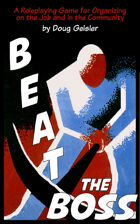
Beat the Boss: An interview with Doug Geisler

Hi Doug, thanks for talking to us today. You are the creator of Beat the Boss, a TTRPG about union organising. You’re also a union organiser yourself. Can you tell us a bit about your background? What first drew you to organising?

I started organizing in 2001. I had gone to the World Trade Organization protest in Seattle, which is a short drive for me. The labor unions that showed up on the front line really made a significant impact on me. I was with this group of ten folks that were holding down an intersection, and the steel workers broke away from the big AFL-CIO march and pushed the cops back a block. Just physically confronted them. It was like nothing that I’d experienced before. 

After the protests, I wanted to figure out a way to get more actively engaged in making big changes. I was looking around, and it was clear that labor unions were one big, structured way to make an impact. 

That’s an interesting answer. You were kind of thinking of unions as agents of broad social change right from the start.

Well, changing the material conditions of workers became kind of a guiding orientation for me. For example, there’s not enough leisure time in industrialized America for people to even appreciate the woods or the outdoors. So how are you going to have a conversation with someone about environmental protection, if they don’t have any experience of nature in their everyday lives?

Continue reading “Beat the Boss: An interview with Doug Geisler”

Finding Utopia in the Failures and Lost Languages of Dialect

By Ben Platt

It seems that the utopian imagination is trapped, like capitalism and industrialism and the human population, in a one-way future consisting only of growth. All I’m trying to do is figure out how to put a pig on the tracks.

Ursula K. Le Guin, “A Non-Euclidean View of California as a Cold Place to Be”

What happens when we combine TTRPGs, an artistic medium that often depends on the productive forces of failure, with utopianism, a ‘philosophy of hope’[1]that expresses the ‘desire for a better way of being’[2] but which has been undermined by its ties to the social and political failures of the 20th century?

TTRPGs often build their mechanical foundations on the bedrock tension between success and failure through action-resolution systems that some game studies scholars identify as one of ‘three key design areas […] relevant for all types of RPGs.’[3] Failure, for many players, makes the eventual successes that emerge through these improvisational stories all the sweeter. As Sarah Lynne Bowman remarks, ‘even players who enjoy various types of games for entertainment… locate their pleasure as rooted in the mental challenges necessary for success and the competitive gratification inherent to outwitting an opponent.’[4]

Utopianism, on the other hand, seems to have been undermined in the popular imagination due to its association with failure. In our current socio-political climate, ‘to call a political ideology or project “utopian” in this context was not only to signal that it was unrealistic or unrealizable,’ but also that utopianism as a whole is ‘irresponsibly and actively dangerous, an effort to exert political control over whole societies, freeze history, deny social complexity, and treat human beings as so much raw material for the fulfillment of grand philosophical visions.’[5] These visions were more often than not ‘the emanation of a single, individual will, a fantasy of total control.’[6] Remnants of a utopian desire persist, but have to contend with the bleak socio-political landscapes where they are often drowned out by the ‘empty din of globalized neoliberal capitalism’ and the general consensus within ‘mature capitalist liberal democracies’ that the ‘prospect of gradual progress under consensual, relatively depoliticized, liberal or social-democratic governance’ is the best path forward.[7] Because of its perceived failures, utopianism as a method of representing and bringing about concrete ‘replacement ideologies’[8] and ‘full-fledged alternative communities ready to supplant existing institutions’[9] has lost much of its foothold in the contemporary imagination, despite the urgent feeling that we need a better world now more than ever.

Continue reading “Finding Utopia in the Failures and Lost Languages of Dialect

Utopian Drama: An interview with Siân Adiseshiah

In your book Utopian Drama: In Search of a Genre, you distinguish two wellsprings of utopian thought. There is the early prose tradition, which includes texts like Christine de Pizan’s The Book of the City of Ladies, Thomas More’s Utopia, and perhaps also Plato’s Republic. Your research focuses on the second tradition — the theatrical tradition. This is something you trace back to the Old Comedy of Ancient Greece, and something that has been comparatively less studied. How do you think that the priority on prose has shaped Utopian Studies?

The frameworks of Utopian Studies, as they have developed over recent decades, have typically assumed the object of study to be prose fiction. So features of this early prose tradition have of course informed how interpretation has operated within Utopian Studies. Utopia, at least by default, is something described. It also generally gets constructed by a gaze that is located outside of that utopia. Thomas More’s Utopia, for example, needs to be set within the context of early modern travel narratives, and the whole range of colonial encounters which these describe. 

Right, the traveller who visits a far away place or time, sees strange things, and learns just to rethink the institutions back home. Presumably that has played into the high regard with which defamiliarization is held, certainly within adjacent fields like Science Fiction Studies?  But then, does it need to be that way? Couldn’t we get to know utopia through the experiences of characters who have always lived there and are deeply familiar with different aspects of utopia?

Another feature of the early prose tradition is that assumption of anonymity. More’s Utopia is again a good example. There’s a striking shift between Book One, where there is a conversation of sorts among various real and fictional people, and what happens in Book Two. In Book Two, Raphael recounts his travels on the island of Utopia, and suddenly all sense of character disappears! 

So I think that’s very much a feature of the early prose fictional examples of utopia, and absolutely not in the case of dramas. In More’s Utopia, you don’t get to know individual Utopians. In later prose utopias, that does change, partly due to the emergence and development of the novel, but also as a response to accusations of the genre being boring — but even in the later utopias, there isn’t very much character interiority, or much of  a sense of agency, et cetera

You do sometimes get defences of a utopian rhetoric of generality, abstraction, anonymity. Like the idea that a wide range of readers will identify with an Everyman narrator. But of course, every ‘Everyman’ is really an ‘Actually Pretty Specificman.’ He is a particular subject position, elevated in a way that rejects the reality of other subject positions, or suggests that such differences are negligible. On stage, I suppose that Everyman myth might be even harder to sustain? Simply because there is always a very specific voice, face, body, occupying that role?

Yes, absolutely. The particularity. But also just the fact of a body on stage at all!— people on stage, humans, rather than a kind of distant description, a kind of external gaze. Another feature of the early prose fiction tradition is using setting as foreground. So in More’s Utopia you have long descriptions of the number of districts and the way that towns are laid out, housing, agriculture, et cetera. What’s usually registered as background setting in the novel becomes part of the foregrounded narrative in utopian prose. Character, if it figures at all, is there as background. So again, this is something that’s immediately reversed when you’re looking at a play, when you’re looking at stage drama. 

Continue reading “Utopian Drama: An interview with Siân Adiseshiah”

‘Putting Racism Aside’: Dungeons & Dragons, Ancestry & Culture, and Race Discourse in the Homebrew Community

By Jess Wind

In spring 2020, amid the global COVID-19 pandemic and the reignited Black Lives Matter movement, institutions were being called on to respond to deeply ingrained structural racism. Media organizations drafted commitments towards building more equitable and inclusive spaces for both creators and audiences. Dungeons and Dragons (D&D)publisher Wizards of the Coast (WotC) issued their version of a commitment to anti-racism on June 17, 2020. The announcement, ‘Diversity in Dungeons and Dragons’[1] led to varied responses online, from praise and excitement for the coming changes[2], to warnings that WotC risks harming its product and alienating ‘true players’ to appease the current social conflict[3]. The responses illustrate a familiar tension within ‘geek culture’ and gaming communities, marred by racist gatekeeping, and yearning for an imagined past[4] where social and cultural diversity are conversations for ‘the real world’ and the fantasy worlds of games and play are for escape.[5]

Some players appealed to their agency to adapt and extend official rules (‘homebrew’) to create the fantasy worlds they want to play in, partly, as some have suggested, to distance themselves from the conversation regarding diversity in D&D[6]. Yet as well as the risk of foreclosing diversity, homebrew content can allow players to develop characters and worlds in ways not offered by D&D’s standard rules[7], an opportunity which for marginalized individuals allows for a kind of visibility and player agency still rarely seen in mainstream media, and going substantially further than the changes made by WotC so far. While some responses to WotC’s commitment to diversity suggest a player’s relationship to homebrew content insulates them from shifts towards more inclusive content, I argue the practice of developing homebrew content positions players as active participants in D&D’s political and cultural economy, and that they are therefore affected by similar tensions around diversity and inclusion that WotC has committed to addressing.

Roleplaying game scholarship has focused on the history of racism in D&D‘s commercial content and other RPG products[8] or on the experiences of players during gameplay[9]. In her examination of gamers with marginalized identities, Adrienne Shaw argues ‘representation is part of a process of meaning making, but textual analyses tend to focus on the finished product’[10] and proposes that more attention should be paid to representation within play practices. Tanner Higgin urges that research about racism in representation must turn its focus toward the industry that produces content rather than only documenting and evaluating practices of racial representation.[11] Antero Garcia similarly argues that games ‘cannot be studied as if [they] are isolated from the cultures that influence them or in which they are embedded.’[12] Yet there is a paucity of research that addresses the community of homebrew creators despite their crucial role in the development of D&D content and culture. 

I situate this research between well-developed feminist game studies scholarship which critiques the long-standing tradition of white cishetero patriarchy[13], and critical fan studies scholarship engaged with unpacking racism and marginalization in fan spaces and cultural production,[14], to examine the vast community of D&D players that tell stories based on rules in a book, extending those rules to create sprawling social cultural fantasy worlds.

I begin by framing the discussion within broader contexts of racism in the fantasy genre, and within D&D specifically, through the case study example of Arcanist Press’ Ancestry & Culture: An Alternative to Race in 5e (A&C). While A&C is by no means the only homebrew publication that responds to social issues in D&D in this way, it has been chosen as a relatively recent and popular example  — at the time of writing, it is listed fifth among the most popular titles on DriveThruRPG with the ‘Dungeons and Dragons’ tag. 

Homebrew is distinctly part of tabletop roleplaying games, and has long been an encouraged practice in D&D. Where video game modding and writing fanfiction have at times been clouded by conversations about authorial control and copyright infringement[15], homebrewing elements of your D&D game is part of creating new and different worlds to play and tell stories in. The Player’s Handbook and Dungeon Master’s Guide, official rulebooks published by WotC,both include caveats that the rules are guidelinesmeant to give your game a sense of structure and balance. With the release of the third edition, WotC went further, encouraging third-party publishers to create content based on D&D‘s ruleset using their Open Gaming License (OGL)[16]. This is distinctly different from players deciding among their friends at the table to adopt certain ‘house rules’ or abandon published rules that don’t fit with their home game. The System Reference Document offers D&D players foundations that they can develop into their own commercial D&D products. WotC makes space for the active homebrew community through their partnership with OneBookShelf on the homebrew marketplace Dungeon Masters Guild, and the Guild Adept program. Homebrew is not only encouraged as a legitimate way to engage with D&D products, but includes a significant proportion of the D&D player community. Therefore, while WotC’s diversity statement addresses the changes they’re making to their commercially available products, this only goes part of the way in addressing discourses of harm and marginalization in the D&D player community. By examining homebrew content as a legitimate extension of D&D’s transmediated franchise, and by positioning creators within the wider D&D labour economy, we are better able to examine discourses surrounding inclusion and diversity in the D&D player community.

Continue reading “‘Putting Racism Aside’: Dungeons & Dragons, Ancestry & Culture, and Race Discourse in the Homebrew Community”

Just Make-Believe: Assumed Neutrality, Archetypical Exceptionalism, and Performative Progressivism in Dungeons and Dragons

By Kelsey Paige Mason

In a shareholder ‘fireside chat’ with Hasbro CEO Chris Cocks (former president of Wizards of the Coast from 2016-2022), and Cynthia Williams, the current CEO and president of WotC, both parties outlined Wizards’ four-quadrant strategy for investment growth with D&D: offering blockbuster entertainment, AAA high-end gaming, products for tabletop gamers, and products for the more casual fan.[1] Williams begins her response about Dungeons and Dragons by saying, ‘D&D has never been more popular, and we have really great fans and incredible engagement, but the first thing I saw with it is the brand is really under monetized.’[2] From their new acquisition of D&D Beyond giving them market insights into personal games,[3] to creating an environment which encourages ‘recurrent spending,’ much like paid DLCs and pay-to-play models of digital games,[4] Wizards is working towards taking advantage of D&D’s 50-year legacy but also its position as ‘a cultural phenomenon right now.’[5] By ‘engaging and surrounding the consumer’[6] with game products, entertainment media, and personal accessories and collectables, Wizards is building a unified lifestyle brand, under the codename One D&D. Wizards has already seen the success of D&D becoming a ‘generic trademark,’ where Dungeons and Dragons has colloquially become the shorthand or stand-in for the genre of tabletop roleplaying games. With more brand recognition than their most profitable property, Magic: The Gathering,[7] Wizards is working to expand beyond manufacturing simply TTRPG ‘products,’ and instead capitalize on fandom in all its forms – from film and video games to actual play performances[8] and lifestyle accessories.

While the shareholder seminar focused on how to increase spending opportunities for consumers to increase profits, WotC’s outward facing PR has instead – since at least 2014 – marketed the D&D lifestyle as a community, one which sees Wizards’ products as secondary to fostering a community of players and game masters (GMs). In the opening pages of the 5th Edition Player’s Handbook, Mike Mearls writes, ‘Above all else, D&D is yours.’[9] After the recent controversy with proposed replacement of the Open Gaming License (OGL), Kyle Brink echoed a more sheepish form of this sentiment, saying, regardless of whether the community trusts Wizards again or not, “either way, play your game with your friends. You don’t need to have [Wizards] at the table if you don’t want to. You know, your game is for you. We’ll make stuff for it, and if you want it, we’ll be over here making it. You can come get it. But, honestly, we should not be messing up your game. You should be playing your game.’[10] Statements put out by Wizards, Dungeons and Dragons, and D&D Beyond often invoke the community, while often simultaneously diminishing their own role in shaping that community. Wizards of the Coast (WotC) is actively and aggressively working towards, not just strengthening Dungeons and Dragons as a brand, but more importantly, pushing towards greater monetization of Dungeons and Dragons as a lifestyle. The first part of my work in this chapter is an analysis of published game materials, public statements, and recent events since Wizards of the Coast’s commitment to diversity in 2020.

Ultimately, this work aims to uncover what benefits are afforded to Wizards as a result of their push towards diversity and inclusion as part of rebranding and how this commitment allows greater control over reconciling D&D’s problematic history with monetization plans for the future. This reconciliation, tied with a unification and tightening of the ‘community’ of D&D fans, works more towards the security of D&D’s brand than as a platform for political progressivism. While there should not be any expectation for social change emerging out of a multi-million dollar corporation, the importance of my chapter’s intervention is to demonstrate how Wizards has used the language of social justice and progressivism to create an appearance of a utopian D&D community. My focus in analyzing WotC and D&D is not whether WotC’s revisions of game materials to move away from their racist, sexist, and ableist origins are beneficial to the brand. Rather, I investigate whether these utopian moves are demonstrably present in D&D products, in WotC as a workplace, and in the types of social relationships the game promotes.

Continue reading “Just Make-Believe: Assumed Neutrality, Archetypical Exceptionalism, and Performative Progressivism in Dungeons and Dragons”

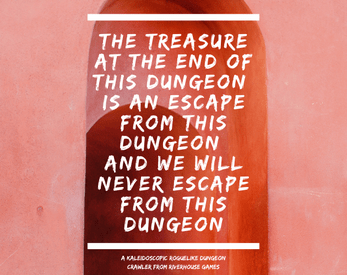
We Will Never Escape Utopia: Gender, Queer, Pragmatic, and Hopeful Utopia in The Treasure at the End of the Dungeon is an Escape From This Dungeon and We Will Never Escape From This Dungeon

By Grace A.T. Worm

The Treasure

Long game title, white text on red

In the tabletop roleplaying game The Treasure at the End of the Dungeon is an Escape From This Dungeon and We Will Never Escape From This Dungeon (hereafter The Treasure), players enter the game’s imagined world, a dungeon, knowing that the ‘treasure’ they seek by playing the game is impossible to acquire. The game cannot be won, only perhaps eventually abandoned. It may seem counterintuitive to discuss utopia in a game that announces from the beginning that its systems and structures are permanent, and that any attempt to escape them is ultimately futile. However, it is through this surrender to the process that players learn the lessons of continued hope, perseverance, and community that serve as a foundation for much of contemporary utopian thinking. For these reasons, in this chapter I describe The Treasure as a utopia, while also recognising that it may appear dystopian.

The Treasure can be understood as a process for utopia that, through play, invites the players to build their own counternarratives about what is valuable in the world they enter into, and also work together to change that world, even knowing that practically they will never ‘win’ the game. It is necessary to adapt an in-flux knowledge of utopia through a queer and feminist understanding of a future that will never reconcile the painful past. If the players cannot escape the dungeon, then the focus shifts to developing their characters’ relationships through roleplaying. The absurdity of the players’ situation, the cycle of endless dungeon rooms, and the descriptions of characters and rooms, encourage a sense of camaraderie and community. In this sense, the game reflects the structure of utopian hope. For the players, the importance lies in fighting the cycle even when the outcome may never change for, as the game states in the world description, ‘We will never escape this dungeon. We will always try to escape this dungeon.’[1] It is possible to work towards utopia while being pragmatic in the knowledge that a perfect future does not exist. In the rest of this chapter, I examine the function of archetypal characters, the utopian dimensions of the players’ roleplaying, and how the game mobilises themes of pragmatism in relation to its feminist and queer utopian ideals.

Utopia is a complex term, and how different pieces of media create and present utopia varies wildly. For this chapter, I approach utopia as a practice stemming from discontent that arises from problems in the present, and exploration of possible futures where these problems are solved or nonexistent. Later in this chapter, I will explore how this vision of utopia shifts into focus through a queer and feminist lens. As suggested by Lucy Sargisson’s Fool’s Gold?: Utopianism in the Twenty-First Century (2012)and Erin McKenna’s The Task of Utopia: A Pragmatist and Feminist Perspective (2001), utopia can present visions of a future in which deeply entrenched social, economic and political problems are resolved or transformed. Sargisson writes that utopia is working towards ‘identifying core problems with today […] and placing them in a new imaginary context. They thus imagine how the world might be if the core “wrongs” identified by the author were transformed.’[2] McKenna explores utopia in relation to the philosophical tradition of pragmatism, and also emphasizes the centrality of hope in interacting with utopian ideals: ‘Utopian visions are visions of hope that can challenge us to explore a range of possible human conditions.’[3]

Utopia is ostensibly where problems are fixed. The creation of a completely separate and carefully integrated fantasy world has often been central to utopian thinking; and not just that it is separate, but that it is totalising. Fredric Jameson describes the movement away from causal utopias as either obsolete due to an inability to solve any and all social disintegration or due to the unparalleled global wealth and technology; however he argues using utopia as an idea to examine politics is still useful.[4] Thomas Moylan in Demand the Impossible similarly describes this developing idea of utopia as imperfect and rejects utopia as blueprint, he describes utopia as ‘[f]igures of hope’ through opposition where utopia is ‘produced through the fantasizing powers of the imagination, utopia opposes the affirmative culture maintained by dominant ideology’.[5] The completely separate utopian world — with readily available solutions for all the problems it seeks to overcome — has fallen out of favor. As Sargisson writes, ‘Most contemporary utopias tend not to offer visions of complete worlds. And most contemporary utopias avoid depicting a single solution; they decline to offer one complete and finished vision of the good life.’[6] In contemporary society, where political, religious, social, and environmental issues have remained at least as divisive as they have been historically, the idea of a perfect utopia that solves all the major conflicts of our current society seems impractical. The Treasure is fundamentally focused on creation and exploration, while providing enough character descriptions to spurn new identity formation without homogenising identity experiences. For example, there is no perfect solution to climate change, and scientific consensus on its causes has not translated to broad political and public agreement, but this does not preclude the struggle for environmental justice. So progress must be made in a more improvisatory, patchwork way. Similarly, contemporary utopias usually don’t try to articulate one single vision of society that is so compelling nobody could refuse it.

Continue reading “We Will Never Escape Utopia: Gender, Queer, Pragmatic, and Hopeful Utopia in The Treasure at the End of the Dungeon is an Escape From This Dungeon and We Will Never Escape From This Dungeon

On Tabletop Roleplaying Games and Fictioning 

By Simon O’Sullivan 

Seven purple polyhedral dice

What is at stake with tabletop roleplaying games? That is, besides the entertainment they offer (or besides their status as games)? Although I no longer play them as immersively as I once did (the phase of truly being in those worlds was relatively short, perhaps four years from age twelve or so to sixteen), they have had a determining effect on my imaginary and, I think, on the various life choices I have made (in many ways the art and ‘theory’ worlds I have lived in and moved through seem—in retrospect—a logical progression from those other worlds, albeit these latter worlds are more ‘worldly’ if sometimes less vivid). That said, I have recently taken on the role of a Games Master for my own two sons and have now watched them enter into what always seemed to me another space-time. Put simply they too have become caught up in exploring these other parallel worlds. Indeed, I remember clearly when, as it were, the penny dropped. When the two of them suddenly realised that this was not simply a game, but something else altogether.[1] Something much stranger, but also more magical. It was as if they had gone through a gate and, with that, had entered more fully into the characters (and the landscapes) they were playing. Since then, the eldest of them has been hooked and the refrain that I once spoke is now on their lips: Dungeons and Dragons (which is what we were playing) is not simply a game. It’s a way of life. Quite an over-the-top statement, but for a time it really was as if this were the case for me (as it is for them now). There is much more I could say here about their adventures. About how easy it is for them and their friends to enter these worlds, switch perspectives and so forth (and then also deeply experience various emotions within the game). About the importance of preparation, of setting a context, in order to allow this other kind of inhabitation to effectively take place (although I am also often surprised at how few ‘props’ are needed for the shift in perspective to be made).[2] And then also about how these games relate to other games—that are also more than games—that they play ‘outside’[3] (what is now called LARPing, although, for them, there are not necessarily any costumes or other props, besides that which is found lying around).[4] Some of those observations and reflections might appear in some other writing—some fiction perhaps?—that is, in a more appropriate form to what is happening in those worlds and with those children (and in my own late childhood) especially when on the cusp of adolescence (which, it seems to me, is when our imaginaries are predominantly formed).

In fact, my own experiences with roleplaying games was also split between live play—out on the moors in the North of England in my case—and then playing various tabletop roleplaying games themselves which, in many ways—when I first encountered them—somehow extended that live play and, again, made it more vivid (despite it coming after and being one step removed from the live play). I remember like it was yesterday the first actual tabletop roleplaying experience, which was Dungeons and Dragons. This was the most important game, though others followed.[5] The slight puzzlement about what we were doing (the game was initiated by an older boy) and then the moment it all fell into place—again, the penny dropped. I was hooked. Or we were. For this history I am briefly laying out is not just about me but about my twin brother too. We both entered that world—as we did many others—together.[6] There is also much more to say about this, but it is not just my own story and so I leave it to one side—except to draw something important from this determining factor: there were always two of us (at least) and so there was always already a community and a discourse happening around these experiences and this world creation.[7] The experience of roleplaying was precisely shared (I will, in fact, return to this).

Enough biography. I want, if I can, to move a little deeper in, to shift, perhaps, from the realm of memories and images into something more theoretical. Or, as I said at the beginning of this essay, to think about the importance of these games beyond the games themselves. So, first of all, I mentioned ‘world creation’ above and, clearly, with tabletop roleplaying games there is a kind of world making that goes on beyond fiction per se. In these games one is actually living ‘in’ the fiction to some extent (or, at least, shuttling between the fiction and the reality outside of this). Certainly, as a character in the game one is making decisions that determine outcomes. In fact, even here things are a little more complex as there are two positions to occupy. One is the Games Master who has initially built or, really, written the world—even if they are using a pre-prepared scenario, they need to add detail, narrate the encounters, bring the world to life (I should also say here that my experience was that these worlds were always more successful when written by the Games Master). And then there are the players who then enter into that world and, with that, continue the world building or give it another dimension.

In passing it is interesting—for me at least—that universally it was my twin brother who would function as Game Master whereas I would be the player (or one of them). I think this determines a certain take on the imagination. A focus on construction and a generosity in building a world for another (and then, presumably, the satisfaction of seeing that world being interacted with). And then the other position, more oblivious to the scaffolding and the ‘behind the scenes’ work and so forth. More a sense—and perspective—of just being thrown in. In fact, both are—of course—needed, and, in fact, the two make the game, which is to say without the Game Master there is no world, or if there is, it is one that is chaotic, too spontaneous; and without the players the Game Master has simply penned a fiction.[8] These worlds need building and animating. They need to be invented and then believed in—interacted with ‘as if’ real—in order that everything can take off and, with that, become something that is greater than its parts.

Continue reading “On Tabletop Roleplaying Games and Fictioning “

Dimension 20’s The Unsleeping City: Fantasy and Play as Means of Claiming Agency in Modern Dystopias

By Emma French

Although the degree to which a game of Dungeons & Dragons (D&D) is required to contain a meaningful narrative differs amongst player groups, D&D’s facilitation of storytelling is now widely acknowledged.[1] According to Jennifer Grouling, ‘something about the TTRPG [tabletop roleplaying game] invites a narrative response’.[2] This is especially true of livestreamed, podcasted, or edited ‘actual play’ D&D – games that often include actors, comedians or other creative professionals, and that are consciously performed, recorded, produced, and distributed as a serialised fictional narrative for their audiences.

If ‘play’ is often associated with make-believe and the unreal, could there be something oxymoronic about the term ‘actual play’? It implies some kind of authenticity, but the nature of this claim cannot be easily summarised. Evan Torner traces the term’s origin to indie game design discussions in the 2000s on the influential forum The Forge. During this time, ‘actual play’ referred to written reports, used for ‘seeing the system in action through the lens of a game facilitator or player […] public, critical probing of a game’s text and rules through play.’[3] More recently, the term has come to refer to TTRPG gameplay as a kind of performance: players still enjoy a game amongst friends, but the act of play is also ‘geared toward an outside audience who become invested in the characters, narrative, storyworld, and meta-play behaviours of the players.’[4] These actual play broadcasts tell two stories at once, the story set in an imaginary world, and the story of that story being created. The blurring of these two kinds of stories can open up new creative possibilities. While any D&D game can provide an avenue for storytelling, Matthew Mercer – whose own livestream Critical Role is perhaps the most famous game of its kind – argues that games are often broadcast when ‘people […] find something that’s lacking in the space of storytelling, that they want to convey’ (10:17-10:22).[5] The known presence of an audience and ‘reader’ means that some streams use D&D for the creation of narrative with deliberate authorial intent, for instance to address real world issues and political concerns.

Continue reading “Dimension 20’s The Unsleeping City: Fantasy and Play as Means of Claiming Agency in Modern Dystopias”