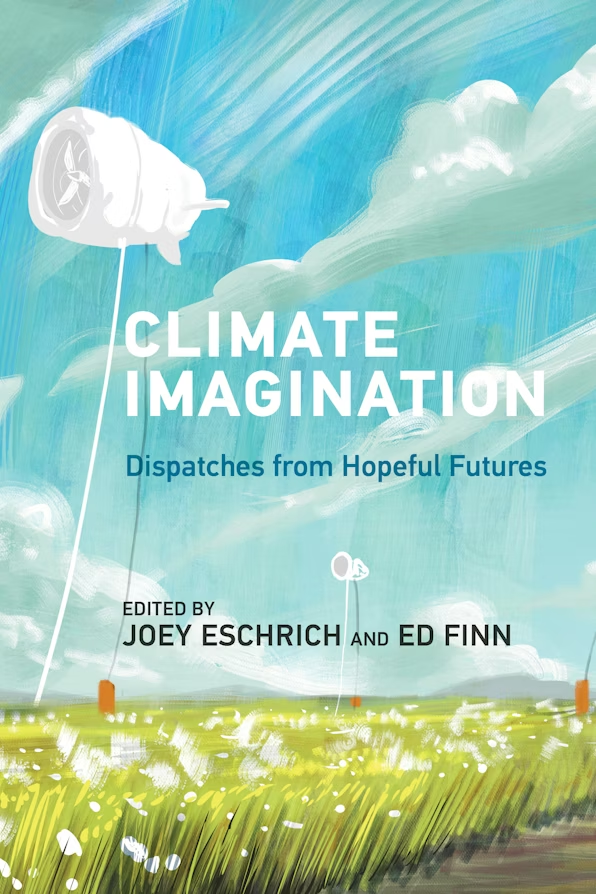
Ambitopia: Futures Beyond the Binary

By Redfern Jon Barrett

We live in a golden age for speculative fiction. Futurist novels, shows, and movies have achieved a cultural saturation which would have been difficult to foresee just a couple decades ago, largely thanks to our increasingly unpredictable and perilous world. But rather than simply doling out temporary escapist relief, speculative stories help us comprehend our own cultures and their problems. Often, contemporary issues are approached via one side of a binary: either they’re exaggerated, showing us their destructive potential via a dystopia, or else they’re understood via their solution, producing a utopia.

So far, so obvious. But why are utopia and dystopia the genres we use to exaggerate and comprehend our own societies? Human communities are not structured according to a simplistic binary, instead being dependent on ever-changing laws, ideas, and social conventions. We know that truth ultimately lies in shades of grey, so why do black and white narratives still predominate in speculative fiction? Is this binary still useful as we wade deeper into the 21st century? What alternatives are out there?

Binary Problems

A few years ago the speculative writer Laurie Penny and I were interviewed on the subject of utopia. Penny, who is also a prominent journalist, posited a serious problem with utopias: namely, that the desire to create an idealised society has been used to justify numerous atrocities throughout our own history. Considering the many massacres committed in the name of a perfect world – theocratic, eugenicist, nationalist, agrarian, or Communist – it’s a difficult point to argue with. In Penny’s words, “true utopia is fascism”, underscored by a rigid set of idealised rules, unable to ever truly change or adapt; at best stagnant, and at worst, totalitarian.

Continue reading “Ambitopia: Futures Beyond the Binary”

Black Utopias: Speculative Life and the Music of Other Worlds

Reviewed by Rebecca Hankins

Black Utopias: Speculative Life and the Music of Other Worlds by Jayna Brown. Duke University Press, 2021. Paperback 212 pg. $24.95. ISBN: 978-1478010548

Brown’s Black Utopias is one of the most scholarly and comprehensive works exploring Black Utopian futures. Very apt for a Covid-19 pandemic period that has seen the initial overwhelming loss of Black and Brown lives. In light of this mass death, Brown’s study asks — and through this work, answers — “What might Black futures mean, and how might we challenge our imaginations to create futures that are not only different to what we know and what we expect, but even allows us to evolve beyond our physical existence? Packed into these pages is a narrative that encompasses Afro-futurism, death, theology, spirituality, music, philosophers, science fiction, fantasy, and gender, stories that had to be absorbed, analyzed, and contemplated before beginning the review. There were layers after layers of new ideas packed into a narrative that also centered the stories of Black women’s religious and cultural beings in which they constantly sought a physical and metaphysical utopia within an Afro-futurist and Afro-centric framework. 

Cultural critic Mark Dery is credited with coining the term Afro-futurism as “techno cultural aesthetic that blends science fictional imagery, technology, philosophy, and the imagery, languages, and cultures of Africa and the worldwide African diaspora.” Scholar Yusuf Nuruddin also notes that Afrofuturism “includes black science fiction or Afrocentric science fiction, more broadly defined as African American signification about culture, technology and things to come” (or, in the case of alternative histories, “things that might have come” from a reconfigured past). Brown’s adds to our understanding of Afro-futurism that undergirds her work: Brown defines Afro-futurism as “a program for recovering the histories of counter-futures […] most notable for resisting disciplinary boundaries” (p17). Moreover, combined with this Afro-centric, interdisciplinary attitude toward futures and counter-futures, the genre of Afro-futurism centers works of science fiction, fantasy, and other speculative fiction created by African Americans, Africans and the African diaspora. Afro-centricity embodies works that are often critical writings that focus on race, the institution of slavery, class, gender, oppression, inequality, and sexuality, all woven throughout Brown’s book. 

Continue reading Black Utopias: Speculative Life and the Music of Other Worlds

Utopian Drama: An interview with Siân Adiseshiah

In your book Utopian Drama: In Search of a Genre, you distinguish two wellsprings of utopian thought. There is the early prose tradition, which includes texts like Christine de Pizan’s The Book of the City of Ladies, Thomas More’s Utopia, and perhaps also Plato’s Republic. Your research focuses on the second tradition — the theatrical tradition. This is something you trace back to the Old Comedy of Ancient Greece, and something that has been comparatively less studied. How do you think that the priority on prose has shaped Utopian Studies?

The frameworks of Utopian Studies, as they have developed over recent decades, have typically assumed the object of study to be prose fiction. So features of this early prose tradition have of course informed how interpretation has operated within Utopian Studies. Utopia, at least by default, is something described. It also generally gets constructed by a gaze that is located outside of that utopia. Thomas More’s Utopia, for example, needs to be set within the context of early modern travel narratives, and the whole range of colonial encounters which these describe. 

Right, the traveller who visits a far away place or time, sees strange things, and learns just to rethink the institutions back home. Presumably that has played into the high regard with which defamiliarization is held, certainly within adjacent fields like Science Fiction Studies?  But then, does it need to be that way? Couldn’t we get to know utopia through the experiences of characters who have always lived there and are deeply familiar with different aspects of utopia?

Another feature of the early prose tradition is that assumption of anonymity. More’s Utopia is again a good example. There’s a striking shift between Book One, where there is a conversation of sorts among various real and fictional people, and what happens in Book Two. In Book Two, Raphael recounts his travels on the island of Utopia, and suddenly all sense of character disappears! 

So I think that’s very much a feature of the early prose fictional examples of utopia, and absolutely not in the case of dramas. In More’s Utopia, you don’t get to know individual Utopians. In later prose utopias, that does change, partly due to the emergence and development of the novel, but also as a response to accusations of the genre being boring — but even in the later utopias, there isn’t very much character interiority, or much of  a sense of agency, et cetera

You do sometimes get defences of a utopian rhetoric of generality, abstraction, anonymity. Like the idea that a wide range of readers will identify with an Everyman narrator. But of course, every ‘Everyman’ is really an ‘Actually Pretty Specificman.’ He is a particular subject position, elevated in a way that rejects the reality of other subject positions, or suggests that such differences are negligible. On stage, I suppose that Everyman myth might be even harder to sustain? Simply because there is always a very specific voice, face, body, occupying that role?

Yes, absolutely. The particularity. But also just the fact of a body on stage at all!— people on stage, humans, rather than a kind of distant description, a kind of external gaze. Another feature of the early prose fiction tradition is using setting as foreground. So in More’s Utopia you have long descriptions of the number of districts and the way that towns are laid out, housing, agriculture, et cetera. What’s usually registered as background setting in the novel becomes part of the foregrounded narrative in utopian prose. Character, if it figures at all, is there as background. So again, this is something that’s immediately reversed when you’re looking at a play, when you’re looking at stage drama. 

Continue reading “Utopian Drama: An interview with Siân Adiseshiah”

Citadel of Chaos: an art practice to materialise an alternate present

By Mark Rohtmaa-Jackson & Allan Hughes / Blue Mountain Arcturus

When not in the tower he haunted the room where he had set up his War Tables – high benches on which rested models of cities and castles occupied by thousands of other models of soldier. In his madness he had commissioned this huge array from Vaiyonn, the local craftsman. […] And Dorian Hawkmoon would move all these pieces about his vast boards, going through one permutation after another; fighting a thousand versions of the same battle in order to see how a battle which followed it might have changed.

Michael Moorcock, ‘The Champion of Garathorm’[1]

In Moorcock’s The Chronicles of Castle Brass, Hawkmoon is consumed by a madness to commission his miniature armies, and finds their permutations and predictions more absorbing than the fine day outside his room of tables. Rather than turning inward like Hawkmoon, we, under the guise of the parafictional games company Blue Mountain Arcturus, find ourselves examining tabletop gaming as a means to turn our inward selves toward the wider world: as a language through which we try to alleviate our anxieties of the fine day. This text is a summary of how we hope to achieve alterations to our conditions through an experimental practice. It hopefully points towards areas of study that might be useful to others working with tabletop games as a means to learn strategies for survival: the challenge to critical games design in the wake of Guy Debord and Alice Becker-Ho’s Game of War (1987).

Citadel of Chaos (2019) is our case study for this article, an artwork made for the exhibition Polymorph Other at Queens Hall Arts Centre, Hexham, that same year. It was conceptualised, designed and built as a large piece of scenery or terrain for a hypothetical wargame table. It is a background rather than a focus; something that gives a place an environment that enables other things to happen. As such it is about the possibilities of things happening because of what we might have made. But this is not just on the small scale (a piece of scenery allows a story to be told between players through a game being played) but in the belief that this kind of work can change things outside of the system in which their world is contained (that such stories can lead to possibilities elsewhere).

Continue reading Citadel of Chaos: an art practice to materialise an alternate present

Post-it Utopia: The Promises and Pitfalls of Arium’s Lean Worldbuilding

By Nicholas L. Stefanski 

Arium: Create

The worldbuilding TTRPG Arium: Create by Adept Icarus promises a utopian procedure for creating gameworlds that are generative, safe, and liberating environments for roleplayers, an undertaking animated by recent debates over the prevalence of harmful, stereotypical, or simply repetitive tropes throughout the TTRPG industry. While the shift away from these problematic tropes is admirable and perhaps overdue within the industry, Arium’s approach to addressing this issue is also notable for its enthusiastic endorsement of creativity techniques stemming from the world of corporate management and innovation consulting. Specifically, Arium’s Lean Worldbuilding approach shares many commonalities with the Lean management philosophy that emerged in the 1990s, largely inspired by Toyota’s operating model. Both Arium’s Lean, and Lean as it is now understood in business, are associated with the pervasive use of Post-it notes for ideation and collaboration.

Image Credit: Shutterstock

This article explores how Arium’s utopian solutionism and endorsement of a signature technique of post-Fordist management presents both pitfalls and opportunities for inventive, utopian roleplay. Beginning in the critical mode, I suggest that by adopting techniques that reduce the art of imaginative worldbuilding to a ritualized formula, Arium: Create risks building worlds that are creative merely for the sake of creativity, and consensual mainly in their appeal to the lowest common denominator. Inspired by Adorno and Horkheimer’s critiques of jazz and the culture industry, and following Eitan Wilf’s ethnography of Post-its and critiques of the innovation and creativity industry, the first movement of the article asks whether such strategies of routinized, commodified creativity can only ever produce the ‘freedom to choose what is always the same.’[i] Nevertheless, while this danger should not be ignored, I argue that it would be wrong to dismiss Arium or to label it as utopian in only the pejorative sense. Taking cues from theorists responding to Adorno’s pessimistic stance toward popular culture, notably Adorno’s Frankfurt School colleague and interlocutor Walter Benjamin, the second movement of the article suggests that despite its embrace of corporate solutionism, Arium’s collaborative worldbuilding contains a generative kernel, revealing an additional movement in the dialectic between oppressive technologies of control and the utopian impulse.

Continue reading “Post-it Utopia: The Promises and Pitfalls of Arium’s Lean Worldbuilding”