I was at a massive mixer for members of the Science Fiction Writers of America, a group I had just joined, wondering how I could even talk with these big, important people. The question everyone asked when you walked up to them was, “What type of science fiction do you write?” After mumbling some self-deprecating responses like “bad” or “oh you know like … the kind with robots and spaceships?” I tried to express what made my work different. “I write working-class science fiction,” I told the next gentleman. “Stories with waitresses and janitors in space, you know? I feel like there’s too many stories about rich guys without real problems.”
I picked the wrong man to try this tactic on. He laughed condescendingly and said, “The opposite is true. Everything is about some worker everyman. There aren’t enough stories about rich characters!”
My first thought was, Ooookay time to start never talking to this dude ever again, but my second thought was a worried, Is he right? I had this gut feeling that a lot of the science fiction I had read didn’t represent my social class, but was I just biased?1
The only answer was, of course, to collect some statistics! This paper is the culmination of my efforts to answer the question for myself, “Is there a class bias in main characters in science fiction, and if so, are poor or wealthy characters more predominant?”
Methods
Choosing the Books
The first question I had to answer was, “How do I take a sample set of science fiction?” I limited myself to novels, because novels or their detailed discussions were easy to find, and that way I’d be comparing apples to apples.
Reading every science fiction novel ever would not be feasible, especially with a staff of just me. I searched for recommended reading lists, but which to choose? Many were simply “The Best of 2019” or such. While it would be interesting to look at a specific period of SF, I wanted a cross-section of what an average reader might have in mind, and that meant including recent books as well as old classics. I googled “Top Science Fiction Novels” in an incognito browser tab (so as not to bias the results with my search history) and took the first 50 novels the search returned. I liked that list better: it felt eclectic, and included recent novels as well as Mary Shelly’s Frankenstein. Of course, the Google search results, while incognito, still would be skewed toward my location in the Midwest United States.
The British Science Fiction Association’s magazine, Vector, announced a call for papers on class and science fiction. I could hardly contain my excitement (and imposter syndrome) as I typed and re-typed my email asking if this statistical analysis was the sort of thing that maybe they’d want to see? And so, my next data set was BSFA award winners. These would skew British to balance my American bias. How better to kiss up to the editors? I started my spreadsheet!
BSFA award winners include fantasy novels with no science fictional elements, however, maintaining genre purity would open up a can of worms (how to draw the lines? Who gets to say what is or isn’t SF?). I would keep the results of each list separate, to see if there was any bias.
On accepting the paper proposal, editor Polina Levontin suggested adding the titles from the Orion SF Masterworks book series, a somewhat curated list, limited only by what titles Orion had the rights to. So now I had three piles of representative works: award winners, a hodgepodge recommended by Google, and a curated list for a total of 194 separate titles. It seemed as close as I was going to get to a reasonable sampling of notable science fiction novels.
Scenario planning refers to methods used by decision-makers to enhance their strategic thinking, especially in situations characterised by turbulence, uncertainty, novelty, and ambiguity. Scenario planning is therefore particularly relevant in the context of climate change, which is complex, unprecedented, and potentially presents us with difficult-to-predict risk cascades and tipping points. Climate change may also present us with “feral futures”, in which our own interventions cause or exacerbate severe turbulence within a system or situation. In the face of such uncertainty, scenario planning enables users to generate new ideas, develop or test strategic options, establish monitoring and early warning processes for emergent issues, and enhance decision-making.
Scenarios are not forecasts that predict likely futures, but spaces in which unexamined assumptions can be confronted and potentially suspended or transformed. They are aesthetic depictions of plausible futures that enable us to re-examine our current understanding of our environment, appreciating the power of uncertainty and its capacity to inspire fear and wonder.
The affinity between scenario planning and science fiction has been widely remarked on in the literature, but in this paper we draw a novel connection between scenario planning and Gothic literature. In particular, we examine how scenarios, as Gothic narratives, provide conceptual resources to make sense of the experience of the “strategic sublime”: that which has been excluded from our frame of understanding. The art of scenario planning, like that of Gothic literature, lies in balancing anxiety, insight, and agency in our encounter with that which had previously seemed beyond discussion.
Review: This article underwent editorial review from three editors.
Facing the Strategic Sublime: Scenario Planning as Gothic Narrative
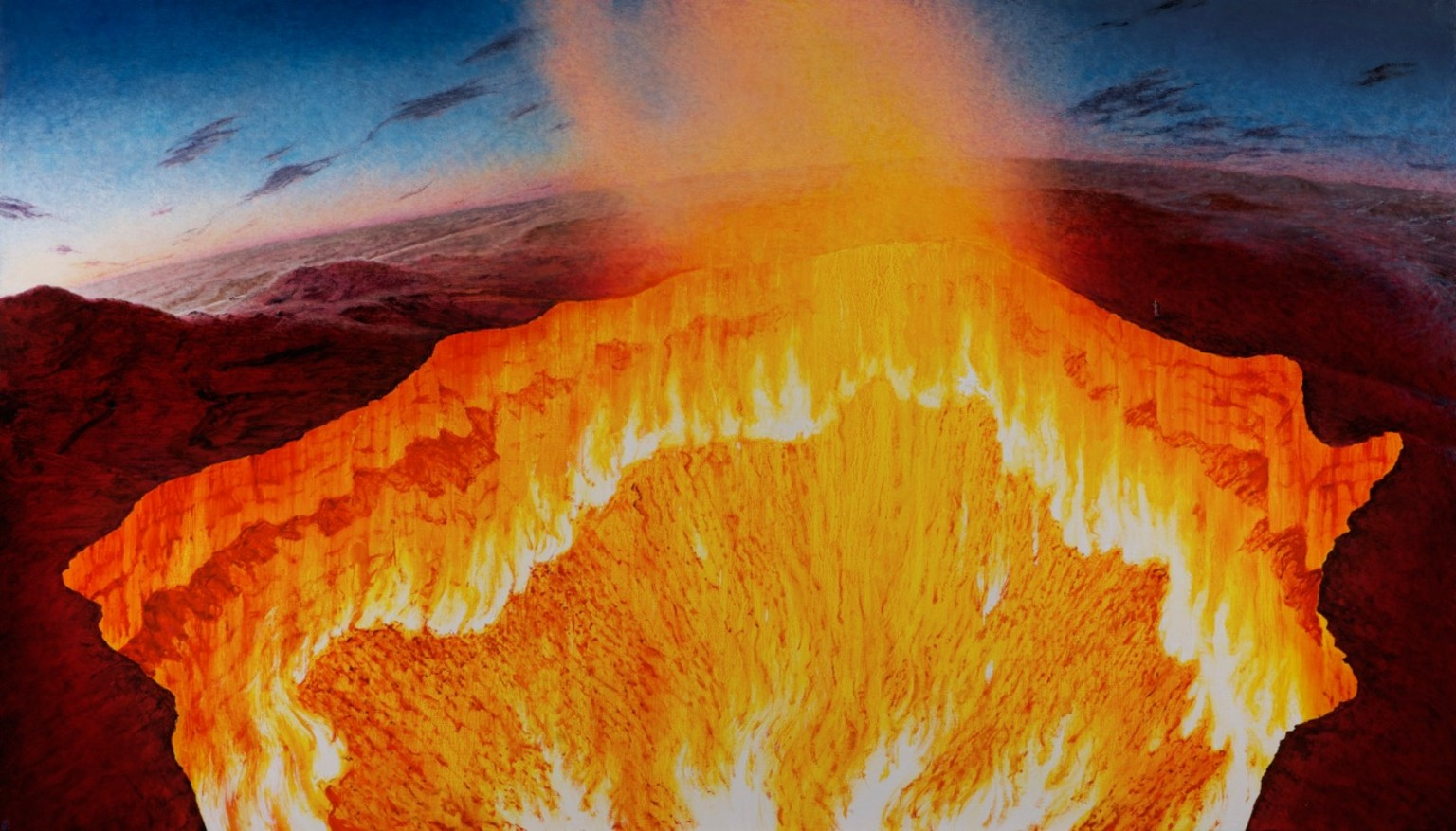
The earth is split open. A vast, blazing pit disgorges luminous gas over a barren landscape. The sky is deep blue, pale at the horizon; it could be dawn or dusk. From our vantage point, the fire could be bottomless. Look carefully: at the edge of the pit, a tiny human figure stands, palms raised to the heat.
This is Julian Bell’s 2010 painting Darvaza. It depicts a site the artist visited in Turkmenistan; its name, in Persian, means “the door to hell” (Garzemi & Garsanti, 2019). As Bell (2013) recounts, the blazing pit was inadvertently created by Soviet engineers in 1971 while seeking oil drilling sites. Striking a gas-filled cavity, the engineers chose to burn off its contents, only to find the resulting inferno beyond their control. It has burned ever since.
Bell locates his painting in a tradition of artists seeking to convey a sense of the sublime, an intense aesthetic experience in which “the self becomes a mere ingredient in the landscape, feeling insignificant, overwhelmed and humbled by nature” (Brady, 2013, p.199).
Yet, in Bell’s account, this hellish phenomenon was created by human, technocratic actions, and his story of Darvaza also serves as an example of what Ramírez and Ravetz (2011) have called “feral futures”. Drawing an analogy to domesticated animals that revert to the wild, Ramírez and Ravetz describe how “human intervention create[s] an unwanted unfolding situation that could not have occurred in the wild” (p.480), offering examples such as the nuclear incident at Three Mile Island and the Deepwater Horizon oil spill in the Gulf of Mexico.
The idea of the “feral future” is useful in helping us understand how wicked, complex problems can stem from our own actions. In the Anthropocene, feral futures are increasingly prevalent. Even the impact of something as apparently “wild” as COVID-19 has feral aspects, as the ways in which the pandemic has played out are entwined with globalisation, climate change, urbanisation, and wide variations in responses by governments, institutions, and communities.
In this paper, we explore scenario planning as a tool for coping with the “strategic sublime” in feral situations characterised by turbulence, uncertainty, novelty, and ambiguity. Scenarios are not forecasts, but plausible stories of the futures which we may face (Spaniol & Rowland, 2019). We follow Ramírez and Wilkinson (2016) in understanding them as assessments of the future context for a given question or issue, designed to contrast with the way that context is currently being framed. As a brief case study, we include the four IMAJINE scenarios exploring the future of European regional inequalities.
By offering thought-provoking future contexts, such scenarios enable their users to generate new ideas, develop or test strategic options, establish monitoring and early warning processes for emergent issues, and enhance decision-making. Ramírez and Wilkinson argue that, by challenging current assumptions and offering alternative framings from the vantage point of multiple imagined futures, scenarios support good judgement across the three areas identified by Geoffrey Vickers (1965): What is really going on around us? What are we able to do about it? And what does the issue mean for us?
Gautam Bhatia is a science fiction writer, reviewer, and an editor of the award-winning STRANGE HORIZONS magazine. His duology THE WALL and THE HORIZON tell the story of Mithila and her quest to discover what lies beyond the impassable Wall that surrounds the city of Sumer.
In the afterword of The Wall you thank your parents for setting you down a lifetime’s science fiction journey. And you mentioned Golden Age stories, and you mentioned The Hobbit and Foundation. Which early influences had the biggest impact on you as you were growing up?
So, quite a bit, actually. I think the really interesting thing about growing up in India in the mid-nineties, in a big city—I grew up in Delhi—in an upper-middle class family where both parents were academically oriented, was that you ended up getting exposed to a whole range of influences. So as I spoke about in the acknowledgements of The Wall, my dad and mum got me The Hobbit and Foundation when I was 10 or 11 years old, which set me down the path of science fiction and fantasy. They also got me a set of books on Greek mythology, Roger Lancelyn Green’s retelling of the Greek myths. So I grew up reading stories about Icarus, which you may have seen some influence of that in The Wall. Although that particular story is more in the domain of Indian myths—there is a very similar story in the Indian mythology, it’s in The Rāmāyana. And the story in The Wall involving flying up to the sun is based more on that than on Icarus. But it’s an interesting how different cultures end up with very similar myths. It’s just impossible to grow up in an Indian house without being immersed in The Rāmāyana and The Mahābhārata. You just know those stories so well because they are part of everything you know growing up.
And at around the time I was born, the Soviet Union hadn’t yet collapsed, its collapse was still a couple of years away. And the Soviet Union had this kind of cultural exchange program with India where Soviet books, story books and fairy tales, were available at extremely cheap prices in Indian book shops and in book fairs. So when I was born, my mom basically bought a huge stack of Soviet books and I grew up reading that. And there were lots of fairy tales. And the one thing that I remember is that along with Baba Yaga there was always this royal family with three sons, the elder two being fine and strapping young men, and the third being a fool, and the fool always thrives at the end. And of course in any post-colonial Commonwealth country, you know, Enid Blyton, English books. So there was always a melange of influences that I was exposed to when I was growing up and all of it basically pointed towards really loving fairy tales, and escapist literature, like borderline fantasy, magical realism, of different traditions, and just always being steeped in that. And that translated into a desire to write that kind of stuff.
You live in a technological fishbowl. Your life is ruled by television screens. The walls of your room are painted in technicolor pixels. During the day, you pedal on your stationary bike while watching screens. At night, the screens watch over you as you sleep, simulating the sun setting and then rising on a new day to see you return to the bike, going nowhere.
If this doesn’t sound like the most asphyxiating future to you, then you have become too accustomed to the daily grind. Such a live-work environment is depicted in the second episode of the first season of the sci-fi television series, Black Mirror: ‘Fifteen Million Merits’ (2011). In this dystopian future, the class structure of society is strictly hierarchical. The three classes even wear clothing denoting their social rank. Social mobility is possible, but only via a strictly monitored ‘merit-based’ system. Everyone dreams of becoming famous. So, what’s at stake here? Nothing less than our individual autonomy.
By Wole Talabi. This article originally appeared here.
Problems.
2021 was full of them. And as we say in Nigeria, problem no dey finish. But not all problems are created equal. Take for example the good problem of African SFF, or to be clearer, the good problem of keeping up with African SFF. I try to maintain a working list of (almost) all African SFF published for the ASFS at this LINK (I’d also like to encourage you to please fill THIS FORM with any works that might have been missed out) and this may have been the hardest year to keep up with especially with constraints on my time forever tightening. There were so many good stories put out in 2021, it’s an uptick in both quantity and quality and is something I am particularly glad to see. This is especially true in the short fiction category which I have repeated multiple times is the category I enjoy writing, reading and keeping up with most because I basically grew up on SF short fiction: Asimov’s Hugo winners collections and Dozois’s Years Best SF, etc. I have been working on a novel but also finally returned to publishing short fiction myself in 2021 with two stories, after a dry 2020:
You can take a look at my ELIGIBILITY POST for details on those, my own contribution to the good problem of Short African SFF.
And now for another contribution: as it is now basically tradition, I’d like to highlight the African speculative fiction short stories I read and enjoyed most from the year gone by.
[Before we begin, as always, a few notes: these are my personal favourites, those that left a lasting impression on me based on my own tastes – for example, I lean more Sci-Fi than Fantasy although I love both. Also, while I’ve read a lot of the African SFF short work put out this year, I’m sure I haven’t read everything. I am also really restricting myself to just 10 in this list, as difficult as that is so naturally many stories I enjoyed just missed out. So, without further ado, here are my 10 favourite African speculative fiction short stories of 2020, in no particular order.]
“Undercurrency” by Sam Beckbessinger (South Africa), UPSHOT: Stories of Financial Futures
This is one of my favourite stories in an exceptionally strong anthology. Edited by Lauren Beukes, for the investment services company, RisCura, working with their investment experts and a star-studded team of African authors, the anthology explores a range of important financial and economic concepts through science fictional, near-future extrapolation. I enjoyed every story in this anthology and I really recommend you read them all but this one stood out to me. A brilliant story focused on climate change, energy transition and sustainable investment, “Undercurrency” follows a South African woman’s attempt to build her company, growing underwater kelp for biofuel on the coast while falling in love and learning about the complexity of doing the right thing in a world of complex and competing drivers. The voice in the story is strong, the description of the romance, while quick, feels natural and the descriptions of the science and the diving are vivid, accurate and wonderful. Full disclosure: I am an engineer in the energy industry and an avid diver, therefore naturally biased or as we say in Nigeria, I am the story’s target market. Consider me sold. Highly Recommended.
Thanks for chatting! How are you? Are you working on anything at the moment?
Well, I haven’t gotten COVID and my son didn’t get COVID and my parents didn’t get COVID and my sister didn’t get COVID. I am purposefully not working on anything at the moment. I’m watching deadlines crumble like empires.
Back in the past, you wrote on Livejournal: “A subculture is not a counterculture. A consumer culture is not a subculture. We are not all in this together.” Recently there were ripples in SFF writer communities over the term “squeecore.” Raquel S. Benedict and JR talk about it on an episode of Rite Gud. They weren’t expecting their words to get fine-toothed, so their description of squeecore is a grab-bag of gripes and jibes, not some kind of elaborate legal case. But the core of squeecore, as I understand it, is something like a “subculture that thinks it’s a counterculture.” What do you think of the term?
Squeecore seems to be a name for the commercially published writing created by authors who got interested in writing by participating in post-fanfiction.net fan fiction cultures. So, it reads differently from previous writing, including previous fanfic-inflected writing from, say, the K/S photocopy generation. I think the podcasters were essentially right, but made the error of creating a taxonomy in order to dismiss a particular taxon as bad and their own stuff as good.
Yes, there was a lot about the episode I liked — and I fully get why they would want to move from critique to pointing out alternatives — but I did find the recommendations list a wee bit less convincing. To their credit, they are upfront about the personal connections.
This is every new writer’s impulse. I was teaching at an MFA program a decade ago, and had to sit through a meeting of students pitching their academic theses. They had to write one academic thesis, and one creative thesis. Every thesis was “Why do all these books suck, except for the ones that inspired me?” I once asked Rudy Rucker why he created “transrealism” and he said that it was because he was just starting out and hadn’t been published much, so he wanted to get some extra attention. It works every time!
I used to invent a new genre every Wednesday, and none of mine caught on. So not every time. Can squeecore claim to any countercultural credentials?
This article reframes a prefatory essay that was first published in Fafnir – Nordic Journal of Science Fiction and Fantasy Research
Notable Black Speculative Fiction
Eugen Bacon
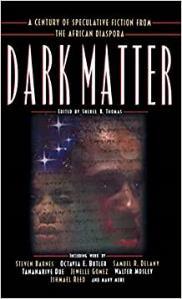
More than two decades after the publication of Dark Matter: A Century of Speculative Fiction from the African Diaspora (2000), an anthology of short stories, black speculative fiction continues a powerful conversation in genre fiction on culture and identity, and increasingly tackles themes pertaining to colonialism, as well as feminist and queer themes that engage with difference.
Anthologies and collections have become instrumental in the proliferating Afrofuturistic writing that heroes black people in stories from Africa and the diaspora, stories whose visibility is increasingly evident in award nominations and reading list recommendations. For example, Dominion: An Anthology of Speculative Fiction from Africa and the African Diaspora– with its stories of gods, demons, magicians, dead children, refugees, taboos, apocalyptic worlds, and more – saw nominations, finalists and winners in the Hugo, British Science Fiction Association, British Fantasy, and Nommo Awards….
This warm reception of black writing in the speculative-fiction industry and readership could be attributed to the calibre of stories and authors, as well as the continued response to global events, including Black Lives Matter, that demand radical new stories. In 2018, the New York Times determined N. K. Jemisin as the most celebrated science fiction and fantasy writer of her generation, with the staggering success of her Dreamblood duology, and the Broken Earth and Inheritance trilogies, all books that have received recognition in Hugo, Locus, Nebula, World Fantasy, Tiptree, and British Science Fiction Association (2020 BSFA) awards.
Second, Fission, the new annual fiction anthology from the BSFA, will shortly open to submissions. Editors Eugen Bacon and Gene Rowe say:
We’re excited to read your original science fiction stories (genre benders welcome)! The submissions window opens at midnight on 1 February, and closes at 11:59 pm on 15 March. Please submit to fission@bsfa.co.uk and put “Fission #2 submission” in the subject header. We invite original stories of up to 5,000 words, and offer a contributor payment rate of 2 pence per word. You don’t need to be a BSFA member to submit. We will also be inviting submissions for cover art.
Timothy Morton is best known for their writing on ecology and as a philosopher who gave us the concept of ‘hyperobject’. While Spacecraft (2021) is only a small book of 129 pages, including index and notes, Morton has nevertheless written a dense but enjoyable book with a glittering insight on almost every page. Reviewing any book crammed with so many ideas is a challenge. Spacecraft is a heady mix of pop culture and philosophy, where it is difficult to pick out the unifying theory amidst the glare.
On one level, Morton has written a performative history of spacecraft, both speculative and real, in the media, with a particular focus on Star Wars. The book examines the role played by these vehicles, not the method of portraying them or the nuances of their design. While the principles may apply to all spacecraft, Morton’s sources are primarily drawn from within Western cultures, especially American. Essentially, spacecraft representations, according to Morton, performed one of the following functions:
the ark, carrying all remaining life forms, such as in Silent Running or the Jupiter ship in 2001
the juggernaut, destroying all before it, such as the Death Star and Imperial Cruisers in Star Wars or the militarized version of the Enterprise from Into Darkness
the frigate, a standard SF warship
the fighter, small military vessels such as the X-wing and TIE fighter
the explorer, such as scouts or shuttles
the machina cum dea, Morton’s phrase inverting the traditional deus ex machina, meaning an alien vessel that sweeps in to dispense justice. Examples being the UFO at the end of Monty Python’s Life of Brian or the TARDIS
the coracle, where the spacecraft is a spiritual craft on a mystical journey, such as the EVA pod in 2001 or the real Voyager I probe.
Morton makes a distinction between spacecraft and spaceship, for example, with respect to size, with starships being much larger. Furthermore, starships such as the Enterprise and an Imperial Cruiser are part of an established fleet with a large crew in a fixed hierarchy. In contrast, spacecraft are smaller, often with a fluctuating crew roster: people simply climb aboard one and fly away, such as happens repeatedly with the Millennium Falcon over many films, or The Heart of Gold in The Hitchhiker’s Guide to the Galaxy. Morton notes the “craft” aspect of the name, reflecting the skill required to fly the vessel. There is also a sense that these ships are being crafty, meaning cunning.
Starship Enterprise U.S.S. Enterprise NCC 1701-D, Star Trek series
Imperial Cruiser, Star wars
While Spacecraft draws on many sources, the book is at its heart a love letter to the Millennium Falcon. Morton clearly sees this vessel as the archetypal spacecraft as each chapter casts the Falcon in a new light. Spacecraft highlights the Falcon as a feminist vessel because when the revolutionary feminist robot L3-37 is damaged beyond repair, her data and personality are incorporated into the Falcon’s electronics in the Solo prequel: “The Falcon is then really a ‘she’ insofar as the Falcon is a feminist robot keen to liberate other robots from their status as slaves.”
The Millennium Falcon is also the third important non-human to appear in A New Hope. Moreover, the Falcon is adept at defying the forces of gravity in a film series all about the use of the force. Morton also highlights how the Millennium Falcon is the plot pivot in The Empire Strikes Back. Once the Falcon functions properly and engages the hyperdrive, with the help of R2-D2, the film is emotionally “over” and we await the sequel.
Millennium Falcon, Star Wars
Spacecraft includes only four chapters and an introduction. Each chapter explores one aspect of spacecraft and the Millennium Falcon in particular. In the first chapter, Morton notes a recurring trait of garbage, or the “found-ness of objects”: “we need to consider the Falcon as pure contingency, as something that just happens to you, garbage or not”. The Falcon demonstrates this trait when Rey initially refuses to escape on a ship located off-screen in The Force Awakens, dismissing it as “garbage”. When her first choice spacecraft is destroyed, she concedes “the garbage will do” and we see her and Finn escape on the Falcon. Indeed, through the whole franchise the Falcon is repeatedly found just when it is needed.
Morton specifically notes the role of dirt in the Star Wars series. Unusually, all the good vehicles in these films are dirty, a notable difference from the Imperial vessels or a spaceship like Star Trek’s USS Enterprise. Dirt seems to be used as a signifier for the rebellion, while at the same time making the setting appear more real. After all, what actually is dirt? Morton shares the definition given by Mary Douglas in Purity and Danger of “matter in the wrong place”. How often is the Falcon in the wrong place? Taking the viewpoint of the Empire, the Falcon is forever in the wrong place, typically waiting to be found by one rebel faction or another.
This aspect of stumbling upon the Falcon is a focus of chapter two of Spacecraft. Here Morton explores the concept of spacecraft as winnings, such as how Lando won the Falcon in a card game. More broadly, spacecraft are often outright stolen and become the trophy of the escape. Once again, the Falcon is the epitome of the getaway vehicle, repeatedly evading Imperial entanglements in almost every appearance. Other stolen spacecraft include The Heart of Gold, The Liberator in Blake’s 7 and the TARDIS. Yet, so often these thefts are justifiable and necessary to escape the crimes committed by the state.
Morton’s third and longest chapter deals with hyperspace, that common avenue of escape. One example of a coracle is a passage from Coleridge’s Rime of the Ancient Mariner, where the Mariner is taken through the netherworld. To Morton this netherworld reads a lot like hyperspace:
And soon I heard a roaring wind:
It did not come annear;
But with its sound it shook the sails,
That were so thin and sere.
The upper air burst into life!
And a hundred fire-flags sheen,
To and fro they were hurried about!
And to and fro, and in and out,
The wan stars danced between.
The opening credits of Vertigo (1958)
Modern film depictions of hyperspace turn “fire-flags sheen” into a familiar visual, argues Morton. The dominant method arose from the slit-scan technique of computer animation pioneer John Whitney for Hitchcock’s Vertigo in 1958, that impressed Douglas Trumbull who made similar visual effects for To the Moon and Beyond, which in turn brought Trumbull to Kubrick’s attention. Trumbull was thus engaged to create the stargate sequence for 2001. A similar slit-scan technique was developed by graphic designer Bernard Lodge for Doctor Who and was applied in Nolan’s Interstellar in the tesseract scene.
In Morton’s view, hyperspace is a place of bliss and sensuality. Hyperspace is an expression of Gaussian geometry – the term Morton uses for not Euclidean (but euphoric) space-time. When the Falcon “makes” hyperspace, it is catapulted into a whirling, glittering realm of beauty. The visuals of hyperspace are a liquid tunnel that whisks spacecraft off. Morton invokes the feminist term circlusion, coined by Bini Adamczak to describe these visualisations in the media as circlusion of a spacecraft by hyperspace. The verb circlude was defined by Adamczak as describing any process of enveloping one thing with another: “Indeed circlusion is an extremely common experience of everyday life. Think of how a net catches a fish, how gums envelop their food, how a nutcracker crunches nuts, or how a hand encircles a joystick”.
This random, democratic and almost chaotic nature of hyperspace is contrasted in the conclusion with the precise orderliness of the Death Star or the Enterprise. These spacecraft resemble giant, open-plan offices in space. Such “middle class” workspaces seem so unlike the rogue-ish Falcon and its crew of misfits.
Enterprise bridge
There are so many ideas in this small book that I have barely scratched the surface in this review, and I am sure that rereading it will uncover new ideas each time.




 vector-bsfa.com