The Afterlives of Greek Drama in Science Fiction Theatre: A Review on the Occasion of the 10-Year Anniversary of TALOS V
By Yichun Zhang
You are not just watching the fifth Talos Science Fiction Theatre Festival—you are in it. One moment you are a sailor aboard Odysseus’s ship, another you are playing an interactive survival game in a retrofuturistic city. Next, diaries are read alongside ancient Greek monstresses in the midst of a cabaret. With its immersive method, Talos V brings together Greek mythology, speculative futures, and urgent contemporary politics. The festival reaches into many dimensions to present an international group of works that are as evocative as they are unpredictable.
Organised by Artistic Director Christos Callow Jr (of the Greek theatre company Cyborphic & University of Derby) and Associate Producer Colleen Bowes (Central School of Speech & Drama), Talos V took place from 11–13 December 2025 at The Bread & Roses Theatre.
A total of five productions were selected for the 2025 festival: Odysseus, Not Your Hero, Assigned Earth at Birth, Babel Beast, The Failure of the Century (WIP), and Occasionally Gleeful Worms in Hell: PALESTINE BENEFIT EDITION. Each piece creatively incorporates sci-fi elements or engages with speculative ideas. To varying degrees, each piece also reflects on, deconstructs, or subverts established traditions, from ancient Greek myth, to patriarchal cultural structures, to the notion of the classic or Western canon itself.
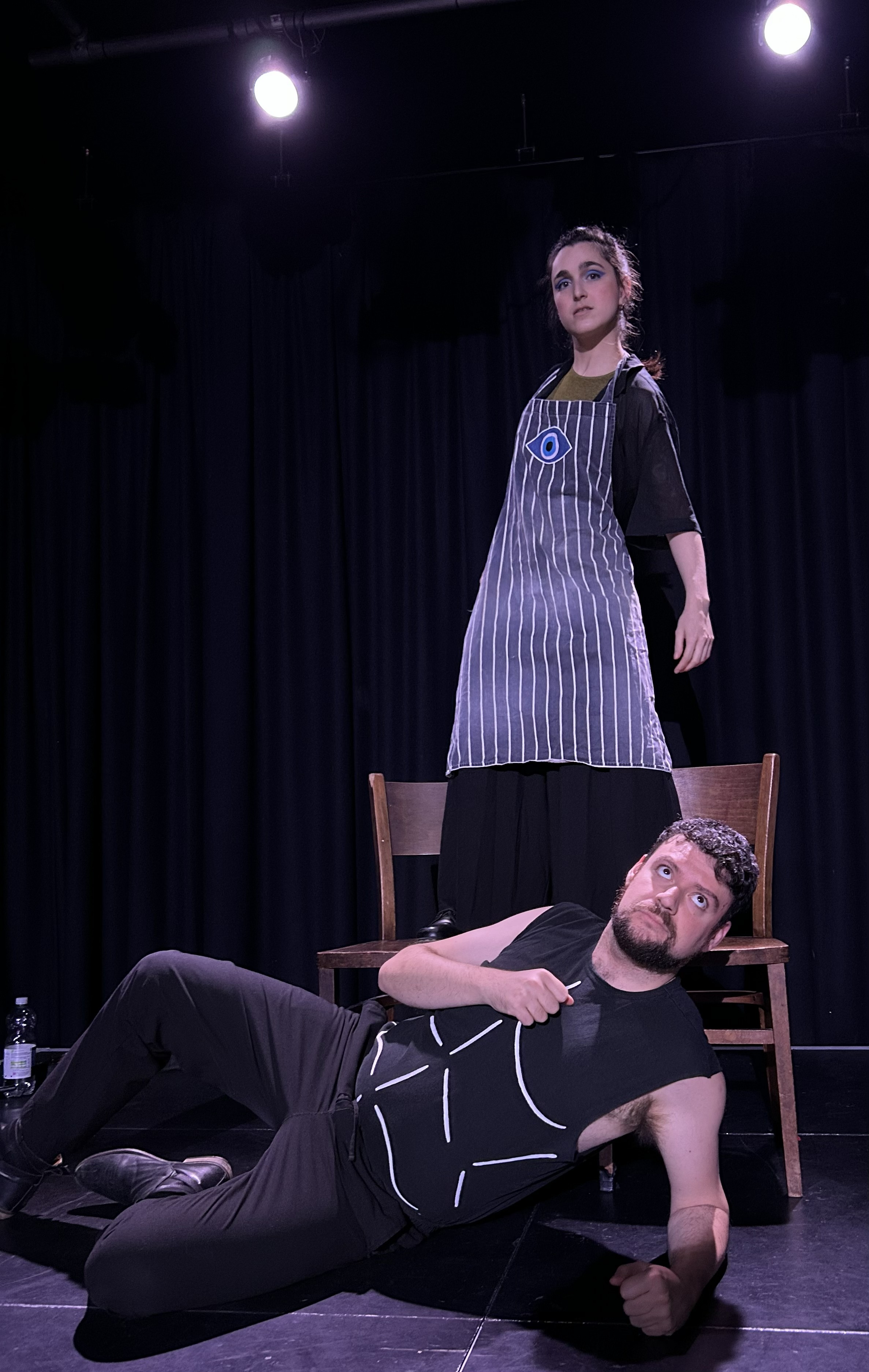
The festival opens with Odysseus, Not Your Hero, written by Christos Callow Jr, directed by Emma Kopf, and with tech/production assistance from Colleen Bowes. Set after the Trojan War, the story follows Odysseus (played by Yiannis Sykovaris) after he almost drowned on his journey home. Upon waking, the God of the Sea, Poseidon (played by Stephanie Christodoulidou), who later transforms into the forms of the Sirens and Cyclops, puts him to three trials to decide whether he deserves the title of a “hero” and is worthy of returning home.
This Odysseus, however, surely does not conform to the stereotype of an ancient Greek hero at all. Apart from a heavy beard that may loosely signal the image, he appears in a black-and-white vest printed with a six-pack and a pair of tapered tracksuit bottoms. One could easily feel the unseriousness as he occasionally nibbles at stage props. The trials set by the god also add to the comic effect: in the ‘cooking contest’, he is forced to turn a crew (audience) member into steamed meat; in the encounter with the siren monsters, he sacrifices half his crew through a ‘democratic,’ audience participation process. The play reaches its climax with the final question: will he choose to return home and become a nobody, or will he become a “hero”?
One of the pleasures of watching Odysseus is its live, on-stage soundscape. The performers make sound in real time with everyday objects such as delivery boxes, sauce jars, crisp packets, to mimic the sounds of storms, seagulls, monsters and waves on the spot with sound software. While the sound-making on stage had some challenges, its low-budget execution adds to the piece’s playful deconstruction, making the limitations feel deliberate and conceptually engaging.
The play is full of playful jabs at the British habit of adapting ancient Greek drama—like the way so many versions of Odysseus end up with English accents. It looks back on the epic tradition,twisting it in unexpected ways, and re-examines the complex relationship between the appropriation of classics and their global circulation.
The second show, Assigned Earth at Birth, takes a very different route. It explores the question of how individuals, within the context of the Anthropocene, confront fatalistic imaginaries and nihilistic tendencies. It follows a queer woman—assigned to Earth by an alien anthropologist for fieldwork—who becomes increasingly disheartened by humanity through Zoom discussions on patriarchy, queer identity, and climate change.
Directed by Zoyander Street and with D. Squinkifer as lead developer, the production revolves around their custom theatrical software, Intrapology. With this software, the script could show up in real time for the actors, while the audience contributes by writing dialogue or voting on the next course of action. Although the video call format is visually somewhat restrained for an in-person performance, the work is strikingly queer-futurist with a lot of potential in its interactive form. It invites the audience to embrace the fluidity of queer identity and actively think about imagining an inclusive and sustainable future.
Babel Beast was written and performed by Sofia Natoli, an Italian theatre artist who grew up in France and London. The show brings the audience into the monstrous, glittering world of ancient Greece’s Mount Olympus. The show moves with a fluid, cross-genre energy, sliding effortlessly between performance styles that range from striptease to burlesque. Along the way, it explores ideas of multiculturalism, identity, and exoticism, and questions what defines monstrosity.
The most compelling aspect of the show is the visual and symbolic tension created by the use of props. Sofia draws on the familiar cabaret vocabulary of corsets, stockings, and angel wings, but also disrupts it with the jarring inclusion of boxing gloves and a beaked mask. These humorous intrusions work to shatter the sexualised fantasies projected onto the bodies of foreign women within patriarchal narratives.
The show is delivered largely in monologue form, but this does not prevent its multilingual strategy from inviting English-speaking audiences to experience the disorienting vulnerability of being in-between cultural spaces. This is already evident in the earlier sonic collage: an overwhelming blend of French, Italian, and British pop music. It is echoed again in the performance’s later moments, where Sofia guides and corrects the audience’s pronunciation as they are asked to read non-English texts aloud with discomfort.
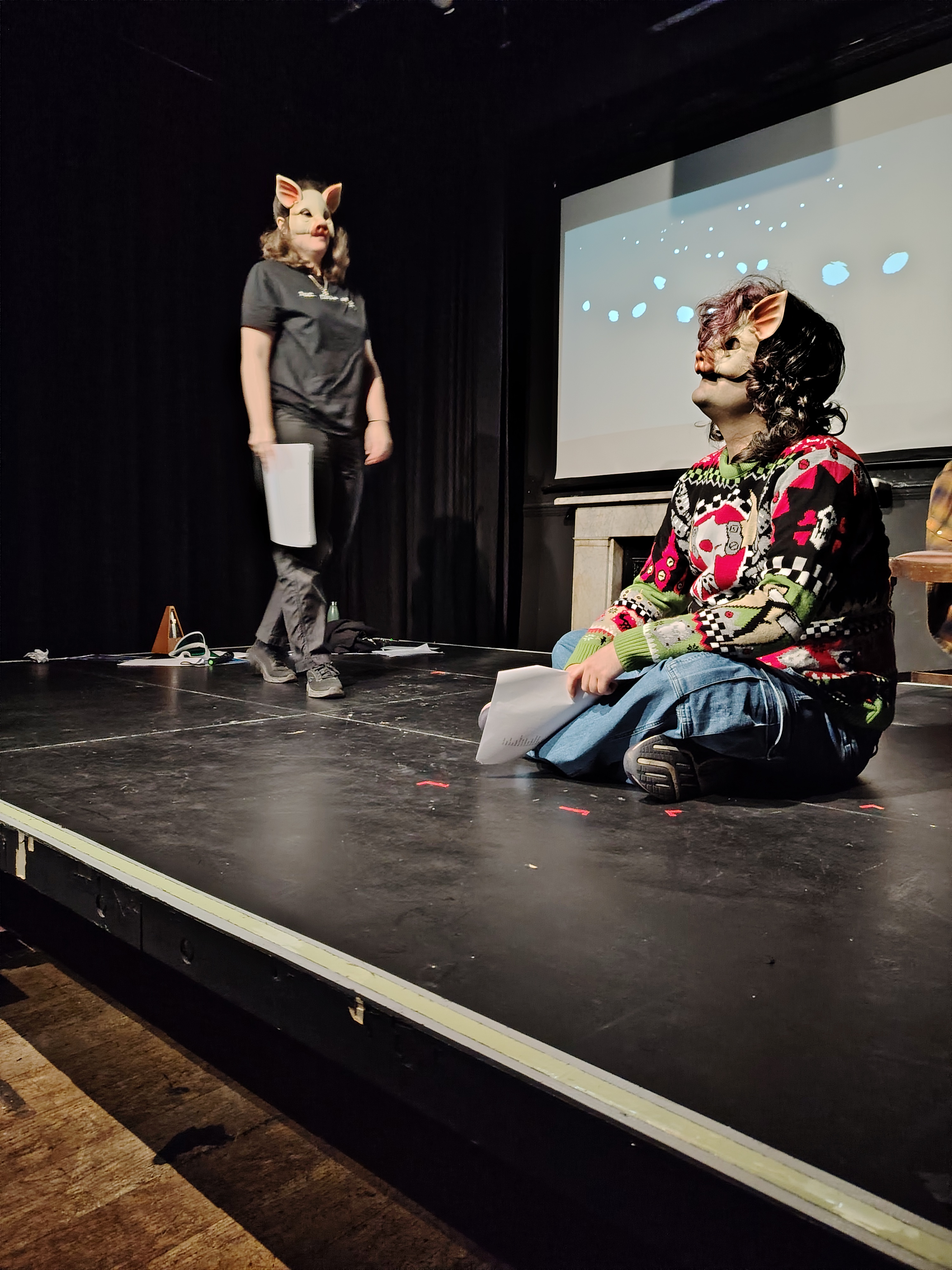
Occasionally Gleeful Worms in Hell: Palestine Benefit Edition is written and performed by Erica Masserano and Francis Gene-Rowe. As researchers and creative practitioners in game writing, they bring a philosophical and poetic texture to their work. The show opens with a satirical, viscerally grotesque depiction of Blenheim Palace, which takes an immediately absurd turn when Mr. Blobby appears on stage. There is surely a poetics of displacement that emerges through the musical language of two people reading poems out loud in a creative performance. This creates a chant-like repetition and a collective voice that breaks through the system.
One of the recurring themes is the class struggle and the inequality and precariousness of subaltern life in a hyper-technological society: a theme familiar in many apocalyptic narratives. Everything continues in a degraded, hyper-capitalist form, and the audience is invited to take part in an urban survival game in this retrofuturistic city. This stands in stark contrast to the show’s evocation of futuristic space travel and the ideological promise of a “beautiful new world” to come.
The last show, The Failure of the Century, is a play by writer Nick Mamatas and director Kira E. Wiggins and made its debut as a work-in-progress performance at the festival. Inspired by A Christmas Carol, the performance is structured by a sequence of absurd ghostly visitations to Lovecraft’s study. It is simply structured by encounters between H. P. Lovecraft (played by Kazuo Salazar) and figures drawn from both his life and his fiction, Frank Belknap Long, Sonia Greene, and Nyarlathotep (all played by Lou Belser).
The play is full of sharp, intelligent references to both Dickens and Lovecraft, and the dialogues are layered and thought-provoking. What I like about it is how the writer links Lovecraft’s thoughts on cosmic horror to the idea of failure, and that grants his ideas new resonance when set against the anxieties of wartime and post-war crises. The title “The Failure of the Century” is smart and works on many levels. Lovecraft is exhausted, financially strained, and creatively blocked. His personal struggles echo the wider chaos of a world on the brink of war. Beneath the weariness that permeates the performance, the comic moments stand out, particularly the ideological “contamination” suggested by the physical presence of Hitler’s book in Lovecraft’s study.
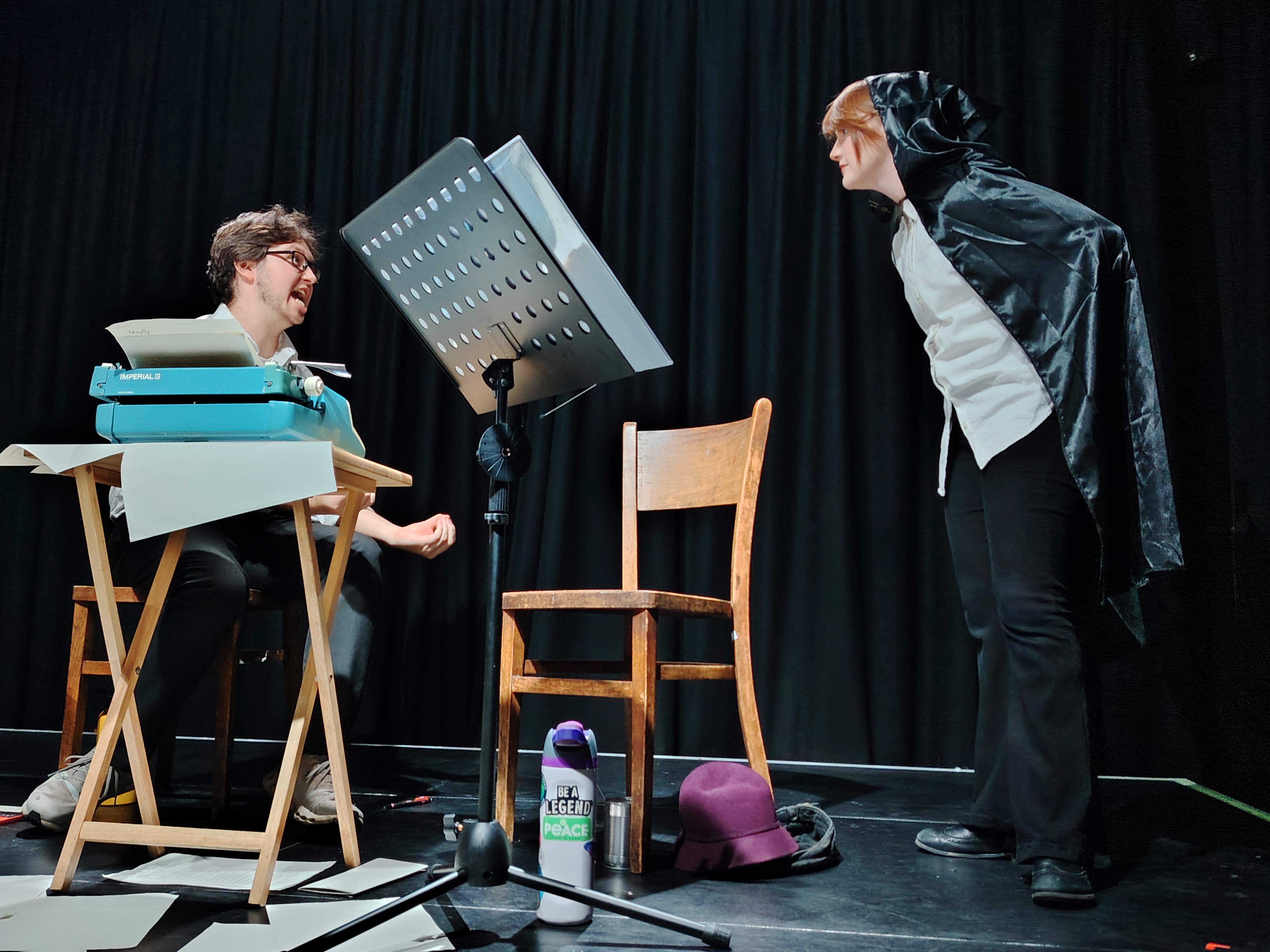
The lighting and sound design is simple but effective. They both help to shift dynamics and bridge dialogue. Without going into too much detail, the image of Lovecraft alone in a dim studio typing quickly establishes a mood of isolation, which is unsettled by the spectral arrivals of these figures. The play also cleverly intertwines the past, present and future. This is especially evident when Nyarlathotep urges Lovecraft to continue writing, insisting that the twentieth century demands it.
Overall, Talos V is a lively platform for young theatre artists to explore the boundaries of sci-fi on stage. What I really love about the festival is that, even on limited budgets, it provides a platform for these inventive and playful small productions to successfully combine the science fictional, the classical, and Greek theatre organically rather than forcing the blend. While it could benefit from more funding, the most important thing is that it remains the UK’s first and only festival devoted to sci-fi theatre. With these enthusiastic young writers and theatre artists dedicated to this unusual genre, I look forward to seeing more new productions in the years to come.
 vector-bsfa.com