Reviewed by Chisom Umeh
Is there a better time to talk about a less-warring, more prosperous, empathetic, and humane world than the present moment, where the militaries of powerful countries have taken up arms against each other, dropping bombs on civilians and tearing down cultural heritage that took decades to build?
Sadly, living in such a moment rarely engenders the appetite for dreams and imaginings of a better future. Rather, it makes us envision periods where the worst that could happen to humanity has happened: nuclear bombs have detonated, floods have sunk major cities, or an asteroid has lodged itself in the Earth’s crust. We see the presidents of powerful countries threatening or actually invading less powerful ones and that prompts us to take up pens and weave the most authoritarian panopticons we can imagine. We watch anti-science rhetoric spread in the media about climate change and we’re tempted to paint pictures of doomed, environmentally degraded futures.
The current happenings rarely inspire utopian stories in us. Instead, they often steer us toward the catastrophic.
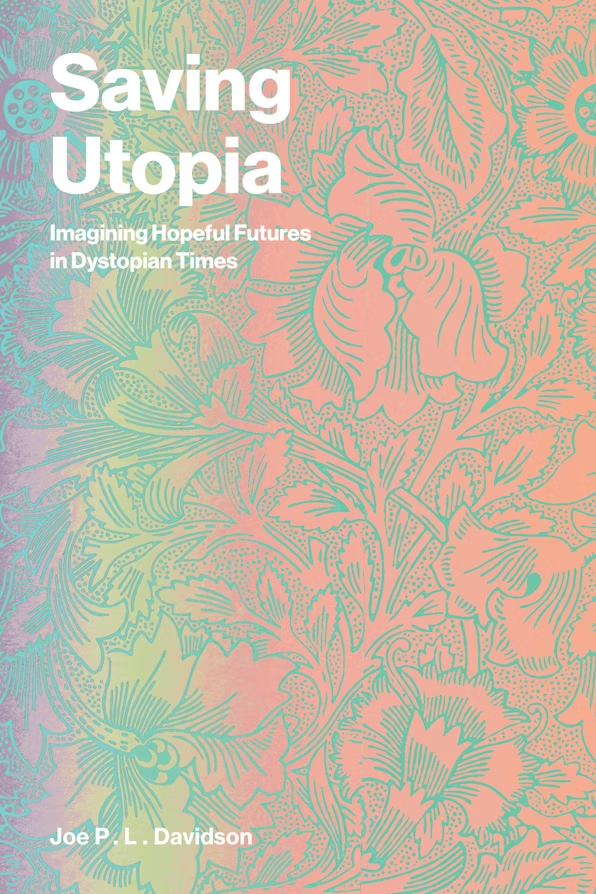
In Joe P. L. Davidson’s Saving Utopia: Imagining Hopeful Futures in Dystopian Times (The MIT Press), we learn that this way of thinking hasn’t always been the case. There has never been a time when there wasn’t some form of global turmoil. However, many writers of the late 19th and early 20th centuries were inclined to look beyond the specific troubles that plagued their era and envisioned possible futures where the problems had been solved. This period saw a blossoming of utopian fiction, coloring the literature of the time with visions of better and hopeful lives. Edward Bellamy’s Looking Backward (1888), William Morris’s News from Nowhere (1890), Sakhawat Hossein’s Sultana’s Dream (1905), Buchi Emecheta’s The Rape of Shavi (1983), and many more, are amongst the books Davidson touches on, in showing how writers of the past treated the situations around them.
Davidson shows us in this book that, even amidst the current horrors and seeming pessimism about the future, utopian stories can still be told and told well. He helps us see that, amidst the seeming dearth of utopian fiction, some writers are still standing up for the genre and putting in the work.
I particularly loved how the modern texts like Claire G Colman’s Enclave (2022), River Solomon’s The Deep (2019), Kim Stanley Robinson’s The Ministry for the Future (2020), were juxtaposed with older books like Ursula K. Leguin’s The Dispossessed (1974), Edward Bellamy’s Looking Backward (1888), and William Morris’ News From Nowhere (1890). This juxtaposition helps readers understand how utopian thinkers of the past viewed the concept, how they related it to their particular society and preoccupations, and how recent writers have engaged with the subject, noting the differences between both modes of approach.
While the older writers wrote utopian futures only as they could envision them, fashioning worlds imbued with whatever politics they liked, more recent authors take a different approach when crafting utopian stories. In Kathleen Hughes’ PhD thesis, Imagining the Future of Work (2024), she mentions that in William Morris’s News from Nowhere, “The past and the present, just as much as the future, are presented by Morris as temporary and transient.” But the more contemporary writers, according to Davidson, employ a method that he has come to call “postdystopian utopia.” This is a mode of writing utopias that doesn’t overlook the horrors of the present or the past, to weave into existence future worlds of abundance and peace. It acknowledges existing injustices and, rather than dismissing them in favor of an imaginary time, incorporates them into the story and uses them to make a point:
“What I call postdystopian utopia,” Davidson writes, “is a precarious balance between liberation and horror, in which the possibility of better worlds becomes apparent only by acknowledging worse worlds. The postdystopian utopia addresses the bad feelings that prevail in contemporary culture.”
The concept of postdystopian utopia is Davidson’s idea of how the genre of utopian fiction can be jump-started and reintroduced into global discourse meaningfully, as exemplified by recent books like Claire G. Coleman’s Enclave (2022), Rivers Solomon’s The Deep (2019), and Claire North’s Notes From A Burning Age (2021). It is not hungry to leap to a time when every problem of the day has been magically resolved. Rather, it approaches genre with the hope of “confronting and overcoming the skepticisms about the possibility of alternative worlds.”
A close reading of Claire G. Coleman’s Enclave (2022) in the book shows us exactly what a postdystopian utopia may look like in writing. Christine, the protagonist in the novel, is exiled from a community called Safetown where she has lived all her life and has been made to believe is the only safe place left in the world. True to her conviction, the outside world is indeed a hellscape. But, by chance, she gets a ticket to a train that takes her to a part of the country that has become a utopia in all practical sense. She is shocked beyond belief that such a place exists and yet she had lived in Safetown all the while with its segregation, discrimination, and 24-hour surveillance. Davidson uses this story to show us what a postdystopian utopian narrative is like, and how this category is distinct from both classic utopias or dystopias. In the novel, dystopian worlds are touched upon within the pages of utopia. Dystopian societies aren’t done away with, but are made to exist side by side with the utopian ones, though the latter is the more dominant force, persisting amidst other negative societies.
In Rivers Solomon’s The Deep, Davidson shows the same genre convention in how a seemingly utopian underwater society exists even though the world above is anything but perfect. “They are undisturbed by the outside world; their watery society is protected from the forces of white supremacy on the land. In fact, such is the happiness of the wajinru that they can almost forget the Middle Passage.”
Davidson succeeds at drawing parallels between the past and alternate futures, connecting one with the other through discussing nostalgia, apocalypse, and trauma. With a scholarly lens and strong research, the book, through the concept of postdystopian utopia, advocates for a way of approaching utopian fiction that could once again breathe life into the genre and, perhaps, give it its day in the sun once again. He shines a light on texts that have used this method in different ways, and shows that it is quite effective in our present time.
At the end of this book, I came away somewhat hopeful for new forms of utopian fiction. Before now, I had rarely encountered it in recent books amidst (relative to utopian fiction) the large numbers of dystopian works in the markets like Suzanne Collins’ Hunger Games (2008) and its many spawns, Cherie Dimaline’s The Marrow Thieves (2017), Matt Bell’s Appleseed (2021), and many more. I simply thought it was something people just didn’t engage with anymore. But Davidson’s clear-eyed writing in Saving Utopia has shown me that sometimes, we only need to change our sitting positions to see what has always been there in a new light.
Chisom Umeh is a Nigerian fiction writer and poet. His short stories have been featured in Omenana, Apex, Clarkesworld, Year’s Best African Speculative Fiction 2023, African Ghosts anthology, Isele, Mythaxis, Scifi Shorts, and elsewhere. His short story, “Ancestor’s Gift”, won the 2024 Tractor Beam short story contest. He was a finalist for the Seattle Worldcon Short Story Contest and is the winner of the 2025 Nommo Award for Best African Speculative Fiction Short Story.

