Interview with Tristan Evarts
Tristan Evarts is the editor of Utopia Science Fiction Magazine, and since 2019 he has overseen the publication of optimistic prose, poetry, non-fiction, and art. The magazine operates with a reverence for the classics of the SF canon while pushing to explore new ways of living, technology as a friend rather than enemy, and humanity adapting to present crossroads. Themes push writers to examine the different manifestations of utopia, ranging from language to disability to weird SF. Contributors include Beth Cato, Jean-Paul L. Garnier, and Bogi Takács. Cover artists range from Donato Giancola to Stephen Youll to Alyssa Winans. Every December, Utopia SF publishes an art special, showcasing a broad range of talent, with a portion of the profits donated to charity.
Tristan gave me my start as an SF interviewer when he took me on as outreach manager in 2023, so it’s a real pleasure to be sharing this interview with him now.
James Machell
JM: What do you think makes a really great utopian story?
TE: I think a great utopian story realizes that a utopian world isn’t the end game in and of itself, and that it’s really just a launching pad for truly discovering the universe and examining the more subtle but powerful aspects of what makes us human. It doesn’t accomplish this the way most people seem to want, by tearing down the utopia and setting us back to the apocalyptic and imperfect world we live in today, but by saying “Okay, we’ve gotten past our worst, childlike instincts. Not suppressed or ignored them, but actually learned to deal with them in a healthy way. What next?” We can still find conflict, but we get to solving it the right way in the end. We learn, we grow, we discover new mysteries, and when conflict arises, we show how to navigate it in a healthy way, even if it might take a while to get there. I’d point to many classic Star Trek episodes, or James White’s Sector General novels, as some good examples.
JM: Can you take us through how Utopia Science Fiction Magazine has developed since it was founded in 2019?
TE: It’s developed quite a lot. It went from a single-person, token-paying small operation in 2019 to what it is today: a globally staffed, pro-paying magazine. It’s been quite a journey and I owe an awful lot to all the staff and volunteer readers who have joined us over the years to help progress us to where we are today. And we’re not done yet! Our hope, as always, is to increase readership and subscribers, which helps drive up the amount we can pay authors and artists. We’ve come a mighty long way and there’s further still to go!
JM: What drew you to publishing utopian writing?
TE: Chiefly a desire to move away from the (at the time) crushing amount of dystopian fiction out there. You know the phrase: “You are what you eat.” The same is true that “you are what you read.” If all you read is dark, gritty, disparaging, cynical things about the world then that’s how you start to view it and, at least at an unconscious level, how you begin to shape the world around you. It’s a cyclical pattern—people who see the world as apocalyptic are more likely to see the darker things and when those get more attention, they take over our worldview. For a real-life example, just look at the news cycle and see how that affects people’s worldview and mental health. We need to see the good, the hopeful, especially when things are at their darkest. We need to know that we can (and will) overcome this and this is what it’s going to look like at the end. And seeing Utopia as a beginning and not an end is important too. I think, with the arrival of all the cozy books coming out, more people are starting to realize this. I think in the Encyclopedia of Science Fiction, we’re mentioned as part of the solarpunk movement and hearing that is quite an honor.
JM: In addition to publishing science fiction stories, poetry, non-fiction, and art, Utopia Science Fiction Magazine also offers a critique service, helping budding writers to find their feet. You’ve also recently taught an Apex creative writing class. Can you describe your approach to assessing a piece of writing, and some of the suggestions you’re most likely to make?
TE: Let’s start off with assessment. When I look at a story there are a few things I’m really hoping to see before I go on to accept it. The first is: does the story grip me from the first paragraph? If I make it to the end of the first page and am not thoroughly engrossed with a story or character, I’ll usually pass on it. Second is pacing and momentum. If a story starts off strong, does it carry through the rest of the piece? Sometimes, for short pieces, I’ll read through it entirely, but for longer pieces, there’s a trick to use. In the well-written, well-structured story, you can read the first and last sentences in each paragraph without reading anything in the middle and still walk away with all the essential information you need for plot and story. If you do that and stumble or get confused, it means the story has pacing issues and depending on how far from the mark that goes, I may decide it requires more editing than any of us have time to do before the next issue and pass on it. Third is the ending. The last line a person writes is the single most important line they will write. It’s going to decide if the story stays in my memory, awakens that feeling of wonder, or simply fizzles into the frustrating silence of unfinished or underdeveloped potential. So, if it’s got a strong start and consistent pacing, but the ending is flat or leaves us in a rather dismal or dystopian way, I’m liable to pass on it. If I accept it and decide to work with the author to edit it into shape, there are a lot of suggestions I might make depending on what the piece needs. My goal is always to elevate the writer – to get them to perfect their craft a bit more, to push harder and write better by cutting out extraneous words, adding complexity to the themes and ideas, and really project their message out into the world.
JM: Roughly, what is the acceptance rate for stories submitted to Utopia Science Fiction Magazine?
TE: We receive hundreds upon hundreds of submissions in a given year and only publish a total of 15 to 20 stories in a given year. So, like all magazines, there’s a small acceptance rate based largely on limited space. We have to reject a lot of great stories just based on that alone.
JM: Utopia Science Fiction Magazine has recently published its Weird Science Fiction issue. What themes can we be on the lookout for in the future?
TE: We have the cozy issue in June, and August is always an ‘anything goes’ field where we try to publish the best of the best. Every June/July the editors of Utopia meet up and discuss what we want the themes for the next volume to be. There are always a lot of good ideas passed around, but only a few issues we publish. So, what’s on the horizon for next volume’s themes? You’ll just have to stay tuned!
JM: What are some of the books and stories you wish you could travel back in time and publish yourself?
TE: That is a very good question and one I’m not sure I can answer. There are a lot of stories I love, but I’m glad they’ve been published elsewhere. It gives us a chance to read them, to learn from them and push the envelope farther in terms of ideas, technique, etc. We have a part of our magazine called The Vault where every issue I go back and find some amazing, public domain, stories to publish. So, in essence, if there are stories I really love I can go back in time and publish them in this manner (after a very exhausting and extensive search for the public domain and copyright registrations).
JM: When you’re not at the helm of Utopia Science Fiction Magazine, you’re running Castle Books & Tea. Can you tell us a bit about your life as a bookseller and are you offering any good deals on rare books at the moment?
TE: Castle Books and Tea was born out of a bizarre moment when I realized I had free time, and it felt so unnatural I panicked and decided to launch a side project. I’m happy to say I no longer have anything remotely considered free time anymore. But it’s a real passion project— one of our specialities is vintage science fiction books. I’ve been to a lot of places to stock books and bought some amazing collections from people to resell. We’ve had books signed by Isaac Asimov, Kurt Vonnegut Jr., Roger Zelazny, and a lot more. It’s fun to track down some of the harder to find books too, like Soviet Sci-Fi or the novels of Clifford D. Simak. We usually have a big sale in May to celebrate our anniversary (this year is the start of our 5th) and a lot of small sales throughout the year.
JM: What are some of the tropes and subjects that you’d prefer that authors avoid in submissions?
TE: I have read far more books about robots, AI, etc. than I ever hoped could have existed. While we find things about these books to like, it’s an exhausted topic and I find myself preferring more novel ideas. Otherwise, it’s a lot of what other sci-fi magazines hope to avoid seeing. We’re particular in that we really don’t need to see any dystopian, post-apocalyptic, shoot-em-dead stories. As our name suggests, these types of stories really aren’t for us.
JM: Any tips for budding writers who’d like to make Utopia Science Fiction Magazine their first place of publication?
TE: Write every day and read every day. Read the stories you like and read them for technique, not just for story. Read what Utopia has published. A lot of them are available for free through our site, Medium, and Substack. Also don’t get discouraged. You will get rejected. A lot. But that’s all just practice for when you get accepted. And you will. Just keep improving your craft.
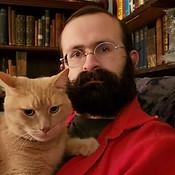
Tristan Evarts is the editor-in-chief of Utopia Science Fiction Magazine and has been for the past seven years. He has a Bachelor’s in English and Philosophy with a specialization in creative writing and a Masters in Library and Information Science. When not editing, he is working at the library or at his bookshop, Castle Books and Tea, or growing his eclectic collection of books.
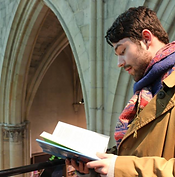
James Machell is a British writer. He contributes to The Encyclopedia of Science Fiction and curates its Substack. He also serves as Outreach Manager for Utopia Science Fiction Magazine and was the 2025 Contest Chair for the Science Fiction and Fantasy Poetry Association. Find him on Bluesky @jamesmachell.bsky.social or YouTube @Fell-Purpose.

