Science Fiction and the DSTL at Coventry University
by Allen Stroud
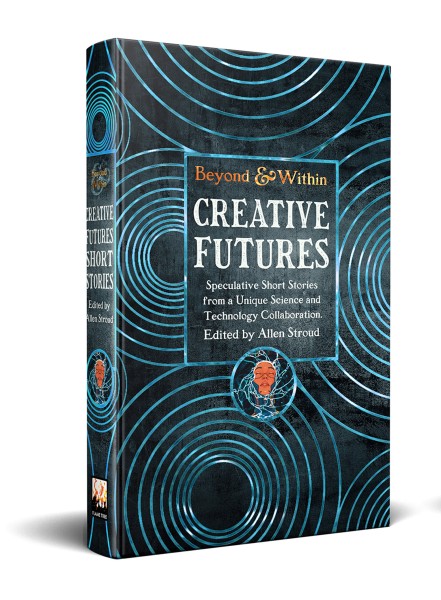
This article was first published in Vector #297 in 2023. Since then, the work of the Creative Futures project has been published in the anthology Creative Futures: Beyond and Within (2025) by Flame Tree Press.
We’re going to change the world.
Some children think that when they are young. There is a confidence in being that young and not really understanding just how big the world is.
As we get older, we become aware of our insignificance. One human being, amidst several billion who are living on this planet right now and several billion more who have ever lived.
That recognition can lay heavily upon us. It confines our thinking as we consider what we might create, what I might create, what you might create. Making a difference, making that change, as mentioned, is further out of reach.
When we consider the future, the inhibitions of our experience, of our awareness of being a tiny part of the world that we thought we might affect, can be an insurmountable burden in and of itself.
There are people who retain their imaginative passion. Some end up in the fields of science and technology. Others continue to wonder and decide to write books. They become science fiction authors, like me.
The future of our species retains a fascination for many of us, no matter what choices we make in life. We cannot know for certain what will happen, but we can imagine. Sometimes,we dwell a little too much on the great heroes, who might become great figures of history in other narratives, or the shapers of what will happen next.
The different paths of those interested in the future are roads to the same place, the world which will exist in the years ahead. Our priorities might be different, but we all want that world to be better than the one in which we live.
When I accepted the role of principal investigator on the Creative Futures project, a collaboration between Coventry University and the Defence Science and Technology Laboratory (DSTL), there were some concerns expressed around working with researchers from an organisation linked directly with the Ministry of Defence. A recent example cited was a comparison to the Raytheon sponsorship of the Hugo Awards at Worldcon 2021. Every individual needs to make an ethical choice for themselves in that regard, but that choice is not a simple or easy one no matter what decision is made. Being a part of any conversation allows you to contribute to it and shape it. The value of that cannot be understated.
DSTL is a research focused executive agency working inside the UK Ministry of Defence. Founded in 2001, supports the commissioning of research and the development of relevant projects that are in response to the UK Government’s strategic planning for defence.
It would be wrong to categorise the business of defence as being solely about weapons and wars. Planning, strategising, anticipating and preparing are all activities that can prevent conflict. Being knowledgeable and utilising that knowledge to assist in developing an understanding of the challenges the world may face can save lives. In fact, the Ministry of Defence has plenty of people who are far more capable of designing weapons than I am.
There is also the ‘Oppenheimer moment’, something of a fallacy, I believe. As a science fiction writer, am I going to have an idea that may lead to the development of a new technology that will endanger the world? Whilst J. Robert Oppenheimer himself, leading physicist on the Manhattan Project, may have had his turning point where he saw his actions in a different light, there is no direct comparison. The Manhattan Project was an incredibly involved scientific research programme. Our conversations do not involve applied science and experimentation and so could not possibly lead in the same direction.
Creative Futures is a series of discussion events between prominent science fiction writers and DSTL researchers. We are identifying and examining the challenges of the future. Our conclusions will not be precise — we are not prophets — but we are able to employ our knowledge in a way that is natural to the creation of science fiction, building ideas on top of what we know, adding to the empirical reality of our world in a way that seems logical and rational (Suvin, 1979: 7-8). We will identify events that may happen and examine their effect on society. We will try to anticipate those changes and suggest ways in which they can be supported. If those events do not occur, or become less likely, we will adjust, having already considered some alternatives and developed a framework that allows for change. Indeed, this is what science fiction writers do, but because it is such an intrinsic part of the creative process, we often forget that it is not how others necessarily think about the world.
Our methodology is to create discussion between individuals who are already thinking about the future and through discussion, build a projection of what that future might look like and what living in that future might be like. Our focus is on the informed creativity of the experience of those in the room. Some of the DSTL representatives are anthropologists, so in some respects this is an ethnographic study of the processes science fiction writers go through to create their work.
In terms of practical arrangements, the project involves six discussion groups around six themes drawn from existing DSTL research. These are broad areas that include the environment, economics, potential conflicts, governance, and more. Information packs that cover each theme and a set of related research into that area are sent to participants prior to the event. On the day, after an introductory presentation, the participants are asked to consider what will be the innovations in specific areas of the future over the next century. We break down the task into specific topics which are covered separately in each session. Specific scenarios are introduced to stimulate and structure the discussion. We use online tools to record ideas and have notetakers present to capture people’s responses. After the live session, these tools remain available for the participants to add and refine their ideas.
After the events, the briefing files are sent out to the writers and the online tools are developed. The notetakers submit their drafts and I write up the discussions and additional findings into an interim report for DSTL.
As the events are completed, the interim reports will be compiled into a full report, the online tools will be finalised and the creative writing associated with each topic will be published.
The objective here is part of DSTL’s ‘Unfogging the Future’ brief. There is a need to consider the future and to think about it from outside of the iterative processes of the defence industry. The findings of the project are then a roadmap that can be revised and adapted based on any circumstance or situation that may arise. We are very aware that the discussions and reports will be taken into a variety of different contexts and meetings, the details will be likely to be amended and changed as events move on, but the material provides a starting point for that process to happen.
Clause 3 of the BSFA’s Constitution (www.bsfa.co.uk/constitution) is very clear on the association’s mission, including “to heighten public knowledge, understanding, appreciation, and enjoyment of [science fiction]; to educate the public in connection with it; and to generally further the development of science fiction and allied arts, and of the communities surrounding it.” Whilst I am not running this research project in my role as BSFA Chair, I do take that clause very seriously as an individual, and as a BSFA member. The rise in popularity of futures research in all its manifestations is very much an opportunity for all of us to engage a wider audience with science fiction and to change the culture of our societies. We should be using our imaginations and discussing what will happen, using data and using ideas in equal measure to try and prepare everyone for the world that is to come. Once we engage with this process, we can then try to be a part of actively shaping that world for the better.
References:
BSFA. BSFA Constitution [Online] https://www.bsfa.co.uk/constitution [Accessed 11th December 2022].
DSTL: Unfogging the Future [Online]https://www.gov.uk/government/publications/unfogging-the-future-a-dstl-biscuit-book [Accessed 11th of December 2022].
DSTL: Global Strategic Trends – The Future Starts Today [Online] https://www.gov.uk/government/publications/global-strategic-trends [Accessed 11th of December 2022].
Suvin D. Metamorphoses of Science Fiction. (Yale: Yale University Press, 1979).
—
Dr Allen Stroud is a lecturer and Chair of the British Science Fiction Association (2019-2025). He has work published as novels, short stories and in computer games. His first novel with Flame Tree Press, Fearless was praised as “hard sf ”, offering glimpses of a vivid future for humanity as it colonises the solar system. His second novel Resilient, the second book in the Fractal series, was published in April 2022. The series now spans 4 books and 12 novellas. You can find them all on the Flame Tree Press website.
Allen works on computer games, roleplaying games and also composes music for audio dramas. He was the Chair of Fantasycon, the annual convention of the British Fantasy Society in 2017, 2018 and 2021 and 2023.

