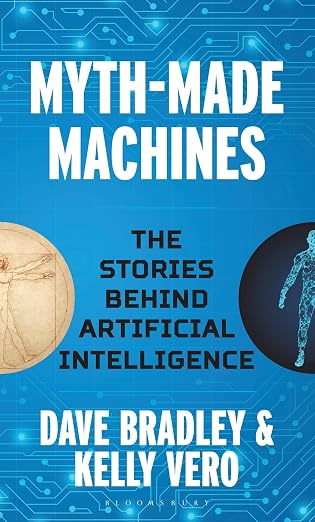
Kathleen Hughes interviews Dave Bradley and Kelly Vero, the authors behind Myth-Made Machines: The Stories Behind Artificial Intelligence (Bloomsbury Academic)
KH: Tell us a little about how and why you came to write about the stories behind Artificial Intelligence – the background and aims of the project.
KV: There are already many, many books about AI, and it wasn’t our intention to add yet another book about AI to the vast collections that there are in the universe right now. Instead, what we wanted to do was add some clarity to the argument about artificial intelligence, and ask the question why or how did we get here, and what role culture has played in the collective imagination of human beings creating something like artificial intelligence.
DB: It began with us trying to demystify and explore AI. We were talking a lot about it because “AI” seemed to be completely dominating headlines and, both positively and negatively, engaging people across social media. That was the starting point. “AI” (large language models and the like) were new and creeping into discourse everywhere, and we were talking about how it would affect our professions.
At the same time, we’re both lifelong fans of science fiction and fantasy! And we love storytelling in all its forms. We are readers and cinemagoers. Despite having long careers in the tech and entertainment sectors, we both have a background in the humanities: Kelly studied Classics, and Dave studied medieval language and literature. So, we couldn’t help but see AI through that lens.
Once we started talking regularly about what seemed to be going on in the world, we realised that humanity has been rehearsing this conversation for centuries. Ideas about not just artificial minds as a theoretical concept but also what they would mean in the workplace and at home, about fears of replacement and fears of conflict and the environment, constantly arise in our culture.
I remember that when ChatGPT was released, one of the first comments I saw on Twitter was somebody joking about Skynet coming online, a reference to the Terminator films; it made me think, “This is how we understand technology – through the lens of culture, memes and movies.”
It’s not just science fiction – ancient satire, myths, legends, and philosophy are full of machines, artificial life, and robots. Some of our favourite characters from literature and TV are artificial: machines, computers or robots. We really wanted to catalogue their journey and think about how people understand AI through their portrayal.
The book really was fun. It was an opportunity for Kelly and me to think a little bit deeper about the subtext of our favourite works of literature and art, and to unearth some hidden gems, as artificial intelligence and living machines have appeared as concepts since the dawn of fiction. We were also able to speculate a little on what it means for our identity today.
Fun fact: the working title while we were drafting it was “Ghosts in the Machine”!
Kelly has already written several books and had an agent she could talk to about the idea; Dave is a journalist and magazine editor who’s contributed to several publications and websites about technology, games, AI and film. It was natural for us to capture and explain our thoughts in this way.
KH: Why do you think stories and myths about AI are important today?
KV: As with everything in human existence: Time’s Arrow travels, and as such, stories are left behind. Mementoes or fragments of everything, from cautionary tales to allegories, are discarded or replaced. When we were writing the book, we felt that we didn’t want future generations to forget or remain ignorant of the stories of the past, and that’s possibly why there are so many ancient or at least antiquated stories in the book! The source materials were rich enough for us to be inspired. Perhaps some of the corporate AI conglomerates need to lean in and learn from the past, too!
DB: It’s important because stories are how we air our problems and rehearse our solutions. They’re how we learn to empathise with others and imagine the possibilities around us.
As machine learning and AI hoover up investment and shape the way we interact with computers, it’s valuable to look at how we’ve explored these scenarios for generations. Maybe we’ll spot our own patterns – and predict how things will go tomorrow.
KH: In the book, you trace AI in culture far beyond its naming as a term in 1955 (by John McCarthy, as you cite in your introduction). Do you think we should re-name ‘artificial intelligence’ to something that acknowledges its deep roots? Has it always been with us?
DB: Human beings are manufacturers. We make things, we make tools and machines to do our work for us, and we automate processes by nature. Our imagination has always asked how far we could push that. The concept of animating the inanimate and giving it life, intelligence, character and autonomy is an old, old idea, going back to myth and legend.
Even before John McCarthy coined the term for modern machine learning, or before Alan Turing came up with his famous test, literature and drama saw many examples of what we would now call artificial intelligence. And I’m not just talking about the depiction of robots across the 20th century, from Karel Čapek to Isaac Asimov and beyond. The term ‘android,’ for instance, goes back centuries. The idea of building artificial people to do our bidding has surfaced in stories in multiple languages and time periods.
I’d be more interested in being more precise about the terms we use today. Big tech and the media spray the term “AI” around now indiscriminately. There is a gulf between a web chatbot and the Nobel Prize-winning protein-folding processes, and yet the press will call both of them “AI” as if we’re meant to know what that means. Neither of those things is truly intelligent or conscious.
KV: If we want to understand artificial intelligence, we should look no further than ourselves as creators: we create artificial intelligence in a similar way to how any ancient civilisation has created its “mythos.” Except our resources are so much more vast than our ancestors’, and our social power structures are more complex. The premise of artificial intelligence today is that it has been created by a machine: which is the furthest from the truth that you can possibly imagine! We are the music makers and we are the dreamers of dreams; that’s what Arthur O’Shaughnessy said, right? We – people – have created artificial intelligence, not only in an abstract sense but through the input of our thoughts, words and ideas to algorithms, and humankind is therefore artificial intelligence through questions and answers that we have created. So we can also stop this any time we want to!
Can you talk a little about the relationship between science fiction (cultural, humanities-based) and science/technology as you see it?
KV: We actually talk about this in the first episode, the “zeroth” episode of our podcast, because one of the coolest elements about researching a book like this is the understanding that quite a lot of the inventions or laws in AI today apply, from how we conduct ourselves to all the things that we have physically created. We can thank everyone from Hesiod and Swift to Clarke and Asimov. To put this into a sharper context, Star Trek’s shop’s computer is the architect of everything from the replicator (we might call this a 3D printer for now) to the oximeter. It was a no-brainer that we were able to find such obvious roots between science, technology, and culture; it was a very enjoyable part of the book’s creation.
DB: Science fiction naturally explores “what if” and tells stories in which ideas are pushed to their extreme. It enables us to work out our cultural anxieties and obsessions. That means that fiction can tell us a lot about what has been in the Zeitgeist in every age.
Also, it’s worth noting that science fiction is very broad. It has sometimes had a tendency to get dismissed by the mainstream media as a niche genre for nerds, but let’s be honest: many of the Greek myths (Hephaestus and his golden robots spring to mind), Lucian the Roman philosopher, Jonathan Swift’s Gulliver’s Travels, Frankenstein and Orwell’s Nineteen Eighty-Four all contain elements that we would claim are science fiction. So, when we talk about the representation of AI in science fiction, in a lot of cases we’re talking about very well-known and popular stories generally, with a lot to say about society.
Stories influence how people see the world; they warn us and inspire us. And that’s true for the people who create the technology we use. Many surveys and reports over the years have shown that astronomers and engineers were inspired to pursue their careers because of science fiction. In our book, we observe that flip phones were influenced by Star Trek’s communicator. Elon Musk’s controversial AI platform Grok is named after a term invented by Robert Heinlein. Neal Stephenson gave us the terms ‘metaverse,’ and the computing-related meaning of ‘avatar.’ Can you have a conversation about AI assistants without people nodding to JARVIS? The influence of science fiction on our actual existence is clear, even in individual career choices and names for things. It would not surprise me at all if the first genuinely conscious machine was nicknamed Data, KITT or Metal Mickey – or, given how perverse people can be, HAL.
Your book is far-reaching, including the myth of the golem, al-Jazari’s Amazing Contraptions, Jonathan Swift, and Star Trek (to name just a few!). You also cover different mediums – literature, film, TV, etc. How did you choose what to write about and what to leave out? As such an overview can’t be comprehensive, it’d be interesting to understand your methodology/approach to materials.
DB: We could have written a book that was twice as long, in truth. The constraints of a work of academic literature for Bloomsbury meant that we could only include a fraction of the material. Some heavy editing was required, and even now we keep seeing things and saying, “That will have to go in book two!”
It is impossible to be entirely comprehensive. Our book becomes, therefore, quite an accessible survey. What we wanted to keep in are the best examples of AI, computers, and robots in literature. We made sure that it’s a mix of the familiar and unfamiliar so that we can celebrate things that people already love (like Frankenstein, Asimov, and Star Wars) while surfacing important but rarely mentioned individuals like Lucian, Margaret Cavendish, and Samuel Butler.
It was important that we went back and did the whole run of history from Greek myth to video games, so our mission became about finding examples that had something to say about our relationship with machines.
KV: This was far and away the hardest part that we had to do in writing the book was to decide what goes in and what stays out, it took us a really long time to write this book because we kept changing the chronology or we were continuously searching sometimes for things that weren’t immediately obvious. Ultimately the obvious cultural parallels appeared as we were writing; but from the very beginning we simply trusted our gut in writing about the things that we knew were important to us as people that have grown up in both an analogue and a digital age. It allowed us to be able to understand the legacy that artificial intelligence leaves behind and continues to leave behind in our collective cultures. It was an incredible Herculean task, but one that was so very enjoyable, as it allowed us to revisit some of the things that we absolutely cherished and adored.
Who do you envision as the core readers of your book?
KV: Can we say Sam Altman and Dario Amodei et al? They should be the core readers of our book, they could learn a lot from the cultural history of AI. We wrote it for people like us, who have a heightened interest beyond the hype of AI and want to be able to understand how AI has evolved. Readers who, like us, believe that science fiction and the culture that surrounds artificial intelligence is applicable to today. We’d love to be able to reach more of an academic reader, because we feel that some of the arguments raised in this book are integral to being able to develop a broader or even a refined understanding of artificial intelligence to enable them to make a better engine or a better machine. Simply, anybody who has any touch point with artificial intelligence in 2026 and beyond must read this book.
DB: So far, we’ve had the most interest from people who work in the games and entertainment industries, because that’s where we operate professionally day-to-day.
But we imagine the core readers as culturally curious people who are interested in AI but don’t necessarily come to it from a technical background. They’re likely to be enthusiastic about TV, movies, books, games and science fiction, and interested in what those stories can tell us about the way we understand technology today.
Many will already encounter AI in their work or everyday lives and want a broader historical and cultural perspective on the current debate: where our hopes and fears about intelligent machines came from, how long we’ve been imagining them, and what those imagined machines ultimately reveal about us.
Overall, it’s for people who like to think a bit deeper around the stories they encounter every day and consider the subtext of familiar stories. Many may simply be looking for a few reading or film recommendations!
Out of all the cultural presentations of AI in stories and myths that you present, can you each choose your favourite (in terms of what it tells us about contemporary AI, or otherwise), and why?
KV: I’m a game designer as well as being a writer and I’ve been lucky enough to work on video game properties such as Transformers and Halo in the past. I was particularly drawn to researching and then writing about the sentient aspect of AI: I really love the anthropomorphisation of machines, objects and anomalies. I’m that person that loves to see a shape on a wall and somehow find a face in it, so writing a chapter about Frankenstein, and the story behind how Frankenstein came to life, was a real exciting chapter for me. As a side note, I could have written an entire book about Frankenstein bringing his monster to life as “artificial intelligence.” Frightening though it is, I just love the sentience of artificial intelligence so much.
DB: I’ve made no secret of the fact that my favourite character in science fiction is R2-D2, the little droid who repeatedly saves the day.
But I’ve got to say that in putting this book together, I got weirdly obsessed with Samuel Butler’s Book of the Machines.
Years before The Terminator or The Matrix, way back in 1872, Samuel Butler’s satirical novel Erewhon dedicates a three-part section to exploring what happens when the creations of the Industrial Revolution evolve (Darwin’s ideas were fresh in everyone’s mind) and outgrow their creators. It leads to a huge civil war where, ultimately, human beings smash the machines. It’s no surprise that Frank Herbert in the Dune books gave the name the ‘Butlerian Jihad’ to the uprising that wiped thinking machines from his universe.
There is a lot of talk and speculation about the future of AI and its impact on society. Do the stories of the past give us any insight or wisdom into what is next for AI?
KV: We might argue that going back to the original concept of AI as a tool to be able to take us somewhere is the most relevant talking point about artificial intelligence today. Of course, there are myriad talking robots and machines in 2026; however, if we were to go back to Lucian’s concept of using computing for space travel, perhaps we would have walked on the moon before 1969. Perhaps if we’d listened to Samuel Butler, we might have nipped rogue AI in the bud? If we’d heeded Margaret Cavendish’s advice, we could have tested Singularity long before we tweeted it. And Jonathan Swift, if we’d understood him, could have taught us of the importance of the human as the beating heart of every machine. Unfortunately, we’ve become such surface creatures that we are very reactionary rather than reflective. What we learned from writing this book is that artificial intelligence is more a tool for the future than a tool for today.
DB: The stories of the past give us some insight into the fact that transformation is inevitable, that humans will keep trying to automate processes, and this will change the nature of work – and that we will struggle with this, just as our ancestors did, since the days of the plough, the printing press, or the loom.
I think that we need to realise that humans have been rehearsing these anxieties for centuries. The most common themes from literature and philosophy are very familiar to us today.
Replacement is a very real fear. You can see this anxiety in the way people talk about losing their jobs to AI. Humans being replaced by machines was already a topic of conversation when Blade Runner came to the cinema. It’s a theme of the very first play in which the term “robot” was coined when R.U.R. opened on stage in 1921. It was something Samuel Butler wrestled with following the Industrial Revolution.
But it also gives us some insight into what the future might bring. Science fiction also shows us our aspirations, our hopes, inspirations, and ideas. Our civilisation keeps resurfacing the idea of creating life, becoming god-like in our ability to create beings that we can converse with, command, or love – it shows up time and time again in legend, literature and film.

