By Jesse Rowell
On its face, Brain Fruit is a simple tale of evolution through mutual symbiosis. Being a fan of symbiont sci-fi like Hal Clement’s classic 1950’s novel, Needle, and Peter Watts’s 2010 short story, “The Things,” I eagerly awaited Stephen Oram’s tale of artificial speciation in a hostile world of rock storms and extinction. Mechanical bee symbionts? Count me in. Faceless fungus droids? Even better.
Oram couches his novella in evolution with its first sentence, “The evolutionary crawl continues its upward curve…” (p.5), but the story is anything but a crawl with its cinematic scenes and wry cuts of humor, all standard characteristics of a good Oram story. “I take a dry look at the world and see the irony,”1 he tells me. In person, Oram shows soft-spoken grace with a patience for answering my questions, reminiscent of my secondary school science teacher right down to his casual t-shirt with its wrangled neckline. Meanwhile, Oram’s writing brims with quips like, “Let me fill you full of your heritage,” (p.10) and “This is a new experience, and we hate it,” (p.29).
The humor is sharp, the science is sound, so what more is there to say? Quite a bit, if we are to measure the book’s reviews in public and private forums. This is the type of book that needs to be read more than once. From contributions to zoefuturism (see issues 302 and 303 of BSFA’s Vector), to presenting dangerous ideas tinged with pathos, Brain Fruit contains multitudes.
Danger is delicious. Placing creatures in conflict within ethical predicaments is what science fiction does best. Oram tests the physical and ethical limits of his narrator, an artificial bee that connects with a fruit and insect to become a trioid with a tragically short life, much like the human organoids that haunt his imagination. Oram refers me to the brain-spinal cord models developed in recent studies as he grapples with the agency of organoids, and by extension, his fictional trioid. “How long ethically can they be kept alive? Do they have the same rights as a lab animal? At what point do they become human?”1
Make no mistake, like humans to organoids, the bee’s AI network imposes its design on both the fruit and insect. No consent is sought as the hyperintelligent bee covers them with resin and inserts its proboscis into the brain fruit. The insects and fruit-bearing trees would die off without the vast artificial intelligence network of the robot bees, so AI imposition on all life is beneficial, right? Ah, this is where my science teacher would have told me to conduct more research, clearing his throat as he pulled at his collar, an endearing affectation meant to put me at ease. Likewise, Oram dismisses the idea that his story promotes dangerous empathy for an oppressor over the oppressed.
“I wanted to write what it feels like to become symbiotic,”1 he tells me as we chuckle over the ignorance of oligarchs, like Peter Thiel’s mortality missteps in J.R.R. Tolkien’s Lord of the Rings2,3 and Elon Musk’s ketamine hot takes of Iain Banks’s Culture series4,5. Would these sciolists grasp the relationality of a trioid to its various ecosystems, or how “every moment is creating legacy, effecting the flow of time”1? Only if they fed our words into their LLM data centers, generating a word soup to regurgitate back to us. No matter how precise the language of literature, unenlightened billionaires will impose their designs.
The words of symbiosis found in Brain Fruit, “collaboration,” “communal,” and “connect,” are the shared language of zoefuturism, quite the opposite of a hyper-individualistic ethos. As an expansive subgenre of science fiction, zoefuturism is grounded in the science of relationality. “It’s a whole ecosystem. Everything relying on everything else” (p.34), the trioid explains to the fungus-harvesting droids in an effort to get them to stop felling the forest, and, “We are becoming…” (p.44). Oram’s prose recalls the theories of Lynn Margulis, famed evolutionary biologist, whose revolutionary ideas on eukaryotic cell origins and endosymbiosis were rejected by the scientific community in the 80s, enthralled as they were by the language of neodarwinism: “combat, competition, and conflict.”6,7
Oram’s prose is precise, and his use of the word “becoming” is a central tenet of zoefuturism. Each species progresses in the story, not toward a definitive end, but through a becoming, whether it is speciation through symbiotic merger, or passing cultural inheritance to the next generation. The state of continually becoming, perhaps unsatisfying for those expecting a three-act play, is poetic. Life is becoming and becoming is life, a perpetual state of flux and fade. Dr. Yen Ooi, scholar of Sino science fiction, describes it as “a holistic view that never truly lands on a binary value, accepting instead that survival is the driver of life.”8 There is a beautiful sadness in Brain Fruit as it describes the transitory nature of life with “one last drink of sap” (p.43). It leaves me cold, this reckoning of time as I fade into gray like each generation of trioid.
The passage of time is measured by gradients of gray in Dawlish. It was here in this lonely seaside town that Oram composed Brain Fruit, a depressing place in November where “the bridge you walk under to get to the beach looked like it was about to collapse.”1 The perils presented in the book’s setting, with its rock storms and nature’s dissolution, parallel Dawlish and the short beach where he walked. Life seeps into books as much as life seeps out. It is here within the pages that he transforms sadness into striking imagery with waves crashing ashore and the fluid of the fruit, the conceptual metaphor of life is water. “The sea maintains its soothing effect, its pulsing rhythms matching those of our own” (p.14).
In the end it is the ingenuity of the trioid that endears it to the reader, its will for self-preservation and “the promise of strong children” (p.43), going as far as to inject nightshade into an AI entity, the faceless droid, as it shoves the protagonist into the hollow of its head. For me, the subtext is unmistakable. These life-becomings are a resounding rejection of generative-AI. Successive generations of artists interested in self-preservation must poison their passions and corrupt to disrupt the plagiarism machines that impose their designs upon us.9 We are not powerless. As delighted as I was with the inference, the imagery of the “obnoxious cave of a face” (p.37) dredged up some troubling memories of my own.
Mutual symbiosis had fascinated me as a teenager, memories of brushing my fingers through bearded lichen that hung from tree branches, pulling down clumps to breathe in their fresh, dry smell. It was a perfume that entranced me when I hiked through the valleys below the Rocky Mountains, smells that mingled with pine and earth. Shame the violence I decided to visit upon nature, wanting to blast the algae and fungi with radioactive isotopes as a science experiment. And why not? I was an impressionable young lad who had read far too much pulp sci-fi by the time I got around to conducting scientific experiments.
It was a flight of fancy that my science teacher patiently entertained as I hypothesized what impact radiation exposure would have on a cooperating species like lichen. Would sharing of nutrients and water be disrupted? Would one survive over the other? Break out the microscopes! My teacher procured the radioactive yellow and red discs, about the size of blazer buttons, and stored them safely in his office. Months passed as I flitted between dreams and ideas, imagination serving me more than science. Not long after, a classmate stole into his office, found the discs, and stuck one in her mouth.
“Candy,” she told our teacher after she spit it out. “I thought it was candy.” The radioactive candy, as it were, was promptly removed from the school and my experiment ended before it had begun. Happenstance interceded, as it always does, and I retreated back into books to bury my regret and shame. Anything to escape the nagging thought that I had failed my science teacher. My mentor.
My failures have seen better days, and like an ill-tempered family, I don’t like to visit them too often. So I lose myself in books. Good books. Brilliant books. A good book is a binding agent, collecting all the detritus in our lives and expelling them. Books are an ecosystem of symbiosis and catharsis. This is Brain Fruit for me. We should consider ourselves fortunate to participate in the lifespan of books, sharing time and fantastic visions with the hands that lovingly made them.
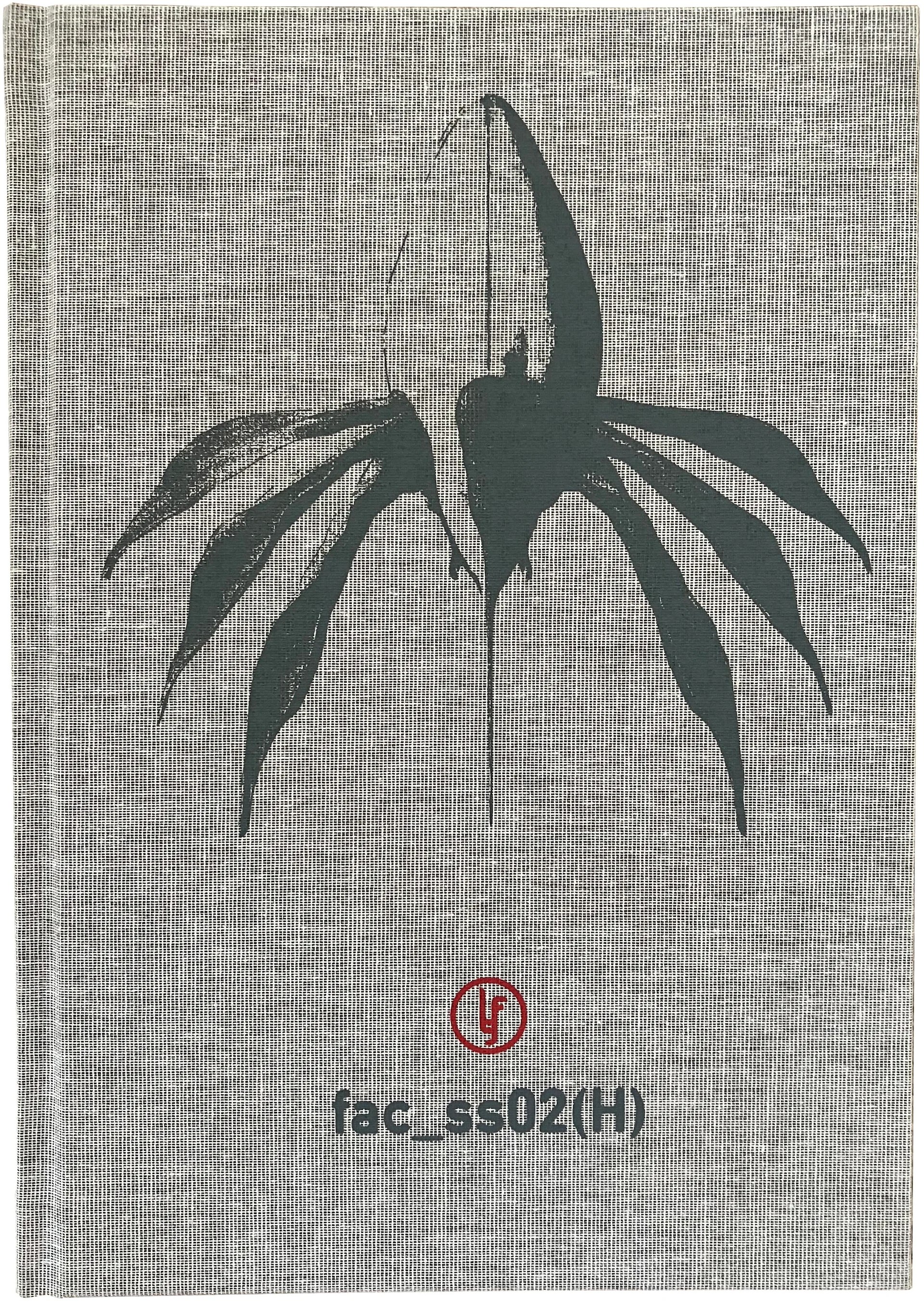
David Polfeldt is one of those sets of hands. The Swedish science fiction author and publisher at Li’l Factory published Brain Fruit, limited to 500 copies and screen printed on binder’s cloth. “No reprints. No digital print. No Kindle versions. No backups. If you don’t hold one in your hands, you will never read it…”10 Polfeldt’s persistence to deliver the book to me, a stranger on the other side of the world, bowled me over. If I had been vacationing on one of Saturn’s moons, I have no doubt that he would have found a way to get a copy into my hands.
The last word belongs to Dr. Ooi, whose theories on zoefuturism have inspired both the author and publisher. The three of them have created something completely unique in the science fiction community, and for that I am grateful. I have found my new mentors.
[The book] was created to ultimately embrace constant becoming – fighting against what is
expected of books today, that need to last forever and never fade. I think this also forces us to
consider our relationship with books, rather than taking objects for granted, as we generally do
in our modern lives. It’s a gentle step towards asking us to look at the non-human creatures and
objects around us and think about how we ‘use’ them, and in return, what we do for them, what
that relationality means.8
END
Works Cited
1. Stephen Oram, “UK editor and author,” personal interviews, June 7th, 2026, and June 18th, 2026
3. https://www.nationalreview.com/2023/12/peter-thiel-does-not-understand-the-lord-of-the-rings/
4. https://lithub.com/elon-musk-just-doesnt-understand-the-sci-fi-visions-of-iain-m-banks/
6. Christopher Lloyd, What On Earth Evolved? 100 Species that Changed the World (Bloomsbury USA, New York, 2009), pp.44-45
7. Lynn Margulis and Dorion Sagan, Acquiring Genomes, A Theory of the Origins of Species (Basic Books, 2002) p.32
8. Dr. Yen Ooi, “PhD, Author, Researcher, Narrative Designer,” personal interview, June 18th, 2026
9. https://nightshade.cs.uchicago.edu/whatis.html
10. David Polfeldt, “This Art Will Die” (British Science Fiction Association, Vector #302: Zoefuturism) p.35
Author bio: Jesse Rowell writes and writes about science fiction. He can be found at www.jesserowell.com
Stephen Oram can be found at https://stephenoram.net/
L’il Factory (and Brain Fruit) can be found at https://lilfac.com/shop

