By Matt Finch
What’s gone wrong with time? Once, we might tell ourselves, the lines of travel were straight, clean, and unambiguous, even if they diverged: Doc Brown might have been eccentric, but he was authoritative when he explained the idea of forking parallel universes to Marty McFly – and the cinema audience of 1989 – in Back To the Future II (Gale and Zemeckis).
In doing this, he was bringing a version of many-worlds theory (Gribbin, 2020) to popular audiences on a Hollywood scale, but also building upon prior notions of linear time travel which owed much to the Industrial Revolution, as Adam Roberts (2014) points out in a magisterial essay accompanying the British Film Institute’s season Days of Fear and Wonder. Considering the impact of Wells’ The Time Machine, Roberts notes that what
pre-Wells stories have in common is the arbitrariness of their temporal pretexts: magic, dreams, spirits. There’s no interest there in futurological speculation or historical research, and no sense that time travel could belong to the material world of science and technology […] One reason for this new focus on the machine part is that it makes dirigible something that had, hitherto, been imagined as beyond our capacity to control or steer. Dreams and magic happen to us, inflicting upon us a Scrooge-like passivity. Memory plagues us, or grants us wistful pleasure, but we can do nothing about the events that the memory recalls. A time machine, on the other hand, is something we can control. This, it turns out, is the specific dream that captures the imagination of the 20th century. (p.40)
Noting the arrival of a sophisticated time loop narrative in an episode of a My Little Pony TV show – where every attempt Twilight Sparkle makes to heed a warning from her future self seems to bring disaster closer – David Wittenberg addressed the evolution of Roberts’ dream in the 21st century, arguing that one can “reasonably surmise that the popular appreciation of time travel techniques has arrived at a certain denouement.” (2012, p.207) On the far side of that denouement in the 2020s, temporal shenanigans are both messier and more familiar than ever before.
Perhaps these narratives have arisen, not just because speculative genres, temporal theorising, and the tropes of the fantastic have so fully permeated mainstream pop culture, but also because of wider experiences which have shaken received notions of time and how we experience it. Pandemic lockdowns at the peak of the Covid-19 outbreak rendered life restricted and repetitive for many, and forced us to confront the fact that during a pandemic, its end – defined only in retrospect – is not clearly in sight (Charters and Heitman, 2021). Digital technologies’ pace of development and spread is faster than any previous innovation in human history, and yet many remain cut off, with connectivity slowing or even reversing in some parts of the world (United Nations, 2020). Climate change and its attendant uncertainties also attack previous understandings of time on multiple fronts, from aspirational long-term Net Zero visions which may also generate opposition (Valenzuela and Lezaun, 2024) to shifting warnings of how much time remains to avoid the worst impacts — as one report put it (McGrath, 2019), “Do you remember the good old days when we had ’12 years to save the planet’?”.
All this happens even as increasingly extreme events make the headlines in the here-and-now, and New Yorkers experiencing smoke from Canadian wildfires describe it in cinematic, apocalyptic terms:
“It felt like we were under attack, like if it was some other pandemic,” Ajche said of the smoke. The city, he added, “looked like a movie of what the future might look like.” (Chaffin, Lomeli, and Williams, 2023).
No wonder that more Americans now want to live in the distant past than the future (Hatfield, 2025), though the painful truth is, whichever direction in time they yearn to travel, the only moment one can ever live in is the present. The conditions of crisis set out by anthropologists of temporality Bryant and Knight – “moments when anticipation, and therefore the alleviation of anxiety, are not possible, and when as a result the present becomes uncanny to us in its present-ness” (2019, p.43) – seem ever more widespread, encouraging all kinds of idiosyncratic responses in our relationship to time.
How does this manifest in storytelling on the page and screen? The time machine of Bradley (2024)’s The Ministry of Time is plundered from Britain’s own future, its logic nonlinear and barely understood. Doctor Who‘s handwaving of paradoxes as “wibbly wobbly timey wimey” in 2007’s Blink (Moffat and Mcdonald) swiftly became a recurring catchphrase which has endured for almost two decades; in The Good Place, Doc Brown’s chalk lines gave way to a vision of time so arbitrarily tangled that it resembles a handwritten nonsense phrase:
MICHAEL: Happens to kind of look like the name “Jeremy Bearimy” in cursive English, so that’s what we call it.
ELEANOR: Sorry. I’m – my brain is melting. How can events happen before the ones that happened before?
MICHAEL: It’s just the way it works. It’s – it’s – Jeremy Bearimy. I don’t know what to tell you. That’s the easiest way to describe it.
(Amram and O’Donnell, 2018)
The Good Place writers are having fun with us, of course, but are hardly the only ones toying with contemporary audiences’ increasing familiarity with time travel tropes and dynamics, to the point that a character in Palm Springs (Siara and Barbakow, 2020) can nonchalantly reference “one of those infinite time-loop situations you might have heard about”, the creators fairly confident that between Groundhog Day (Ramis and Rubin, 1993), Russian Doll (Lyonne et al., 2019-2022), Meet Cute (Pnueli and Lehmann, 2022), and other screen depictions of time going out of joint, viewers are going to get it.
Time going awry is not just the stuff of high-concept comedies. See You Yesterday (Bailey and Bristol, 2019) reminds us that black teen time-travellers might experience challenges rather less fun than those faced by Marty McFly. Christopher Nolan’s Tenet (2020) sees causality inverted in an action thriller centred on a “temporal pincer movement” – though the po-faced Nolan dared not go as far as Philip K. Dick did in Counter-Clock World (1967) and suggest a mechanism for reversed excretion of bodily wastes. The final season of FX’s moody Legion (Hawley, 2017-2019) has its morally ambiguous, mentally ill lead use time loops as “do-overs” to thwart his opponents’ triumphs; he is, in turn, beset by “Time Demons” which thrive in the mess he has wrought, and, finally, accepts that the only hope for redemption lies in ending his personal timeline to relive his entire life afresh from birth.
Darker still, Nour Abi-Nakhoul’s disturbing novel Supplication (2024) uses a looped narrative to illustrate our enmeshment in patterns of gendered violence and abuse; its narrator awakens in a moment of absolute trauma, ventures on a phantasmagoric journey taking on roles of perpetrator and victim, only to return to the novel’s beginning in the concluding pages, leaving us unsure of whether she is trapped in some Sisyphean bind or merely hallucinating an escape in her final horrendous moments: “There, within the suddenness of the unending present, I was born – there I became I. That moment circled itself infinitely, spun on and on as though it would never end.” (p.1)
Speculative fictions, in and out of traditional genre settings, are helping artists, audiences, and societies to have a conversation about the uncertain and perilous era we inhabit – reflecting a shift in experiences of time and an increasing sense of crisis on Bryant and Knight’s terms.
Knight went on to gloss this condition as “vertiginous life”, “a transformative epoch where things feel different, lives take on strange and unexpected trajectories, folds and loops, and there is often the sense of stuckedness [sic] or hyperconsciousness.” (2023, p.26).
We are not merely seeing innovations in temporal theory being popularised in sitcoms, movies, dramas, books, and games, but also witnessing and participating in a wider and more profound cultural response to this vertiginous existence.
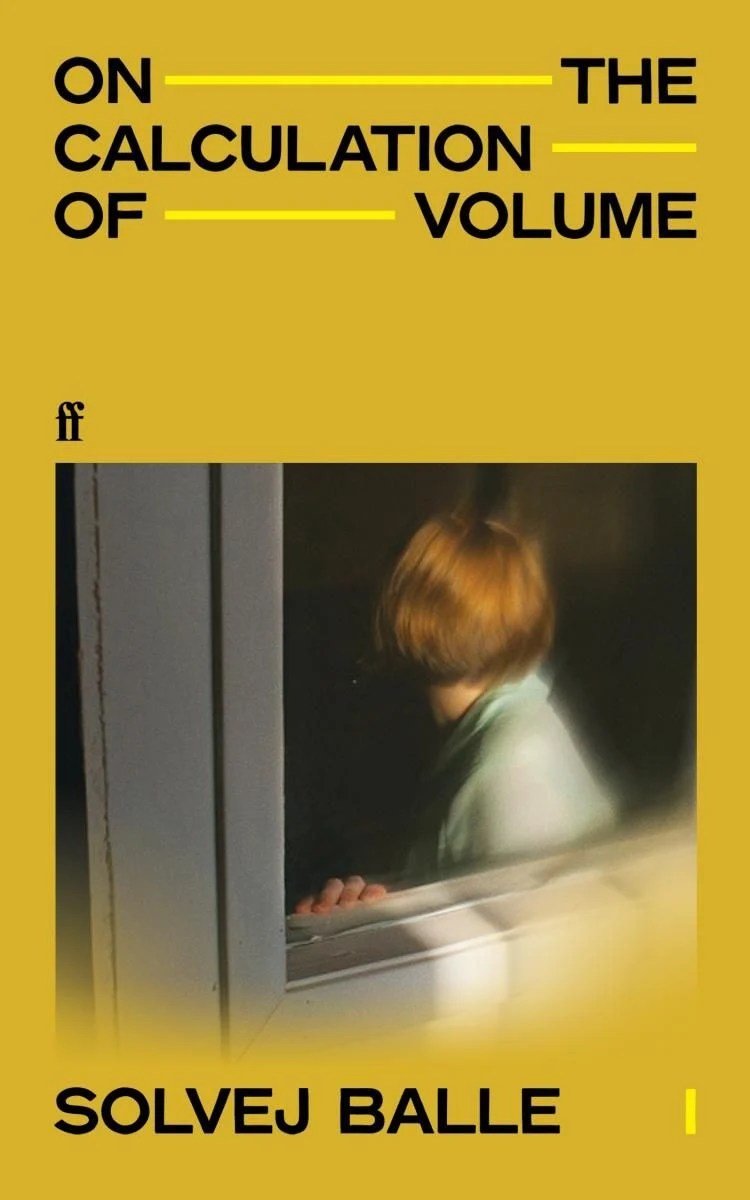
To focus this discussion, the present article examines Solvej Balle’s ongoing work On The Calculation of Volume (2020-2026; individual volumes referenced in this article with Roman numerals I-IV). This is an acclaimed multi-part novel about a bookseller who discovers during a business trip that she has become trapped in an endlessly repeating day. The work serves as a useful critical crux for explorations of genre tensions, popular philosophical storytelling, and contemporary anxieties over Western societies’ relationship to time in the Anthropocene.
Over the course of the four volumes translated into English at the time of writing, Tara Selter, a rare book dealer, discovers while visiting Paris that each day when she awakes, it is November 18th. Though that day’s events repeat identically for others in her world (except when she intervenes), she is able to travel, discovering that she begins each new November 18th wherever she finished the last. Some resources which she consumes, like food, are depleted and not restored in each reset; however, she finds she is able, unreliably, to arrange for objects to accompany her through the recurring days – most notably a Roman coin, a sestertius, which she acquired at the outset of her plight. The conceit of Balle’s tale is that we are reading the notebooks in which Tara has decided to keep a journal of her experiences.
In successive episodes, Tara explores the strange new existence which has been allotted to her. She returns to the rural home she shares with her husband Thomas; explains to him each day what has happened, finding him more or less accepting and empathetic; then reaches her limit of making such explanations and subsequently conceals herself within their family home, using her foreknowledge of his movements to avoid contact.
She reflects on her experience as being like a “door opening onto a world in which everything can be subject to change”:
Usually things close up again: it was a mistake. A simple explanation is found for the freak occurrence: our eyes deceived us, our memories were playing tricks on us, we had got things mixed up, got the days wrong. There is solid ground under our feet again, the incomprehensible makes sense after all, it was an optical illusion or a slip of the mind, it was a dream or a misunderstanding, the world is set to rights, the dizziness passes, we can breathe more easily.
But not this time. (pp.33-34)
Even so, beginning to find her way in the midst of repetition, Tara has “the feeling there’s something I should see, that something new will break through when the year is up […] I envisage a new eighteenth of November, but I don’t know how it will differ from the old one.” (I, p.147).
Significantly, she imagines not a nineteenth of November, but an altered eighteenth. It gives the sense that she is already adapting to her new existence; in the following volume, she will remark “I don’t know how one can grow used to a situation like this, but that’s what’s happening.” (II, p.35).
Tara’s situation exemplifies Knight’s description of
occasions when time becomes elastic, the world is spinning, there is an apparent shift in temporal rhythms, and material objects, sights and sounds become uncanny. There might be the sense, the feeling or atmosphere of epochal change, nothing will ever be the same…Out with the old and in with the something else. (2023, p.25).
Roaming ever more widely, riding trains and finding hotel rooms or empty houses to stay in, Tara crosses Europe, visits her family to hold an ersatz Christmas celebration, and, yearning for seasons, contrives voyages south to emulate a summer, and north for a winter. She discovers she is not alone in experiencing an endlessly repeating November 18th. Gradually a small community forms of people who are all trapped in the same day under the same conditions, arriving with their own stories and holding their own opinions on what is going on and what, if anything, must be done about it. Thus she finds belonging among those “joined together by the unpredictability of time” (IV, P.41) – a telling description, given that they are inhabiting indefinite repetitions of a single day.
As the fourth volume concludes, Tara leaves the community of repeaters, resolved to revisit her husband: “I feel uneasy when I think of Thomas, and mournful when I think of my friends in the eighteenth, because I do not know when I’ll see them again.” (IV, p.169).
Time gone wrong and the slipperiness of genre
What kind of story is this, anyway? Balle’s series has largely been treated as literary fiction rather than genre work, though its first volume was reviewed in Locus (Brookins, 2024). This positioning reminds us that fantastic fiction which deals with time sits in an odd place with regards to genre. Finney’s Time and Again (1970) and Grimwood’s Replay (1986) were republished as Gollancz Fantasy Masterworks, though the latter, especially, might equally be framed as science fiction. The previously mentioned Russian Doll and Supplication are no less difficult to categorise; Vonnegut’s Timequake (1997), in which humanity is forced to relive the years 1991-2001 without changing any of their actions, was referred to by its author himself as not even a novel but a “stew” incorporating autobiography and many tangents (Sayers, 1997).
One has no sense from Balle of the kind of genre snobbery expressed by Ian McEwan (Jordan, 2019; Ditum, 2019). Indeed, in an interview, Balle admits that Groundhog Day “felt as if someone had helped me with research by trying out some of the roads I did not want to take”, and goes on to say:
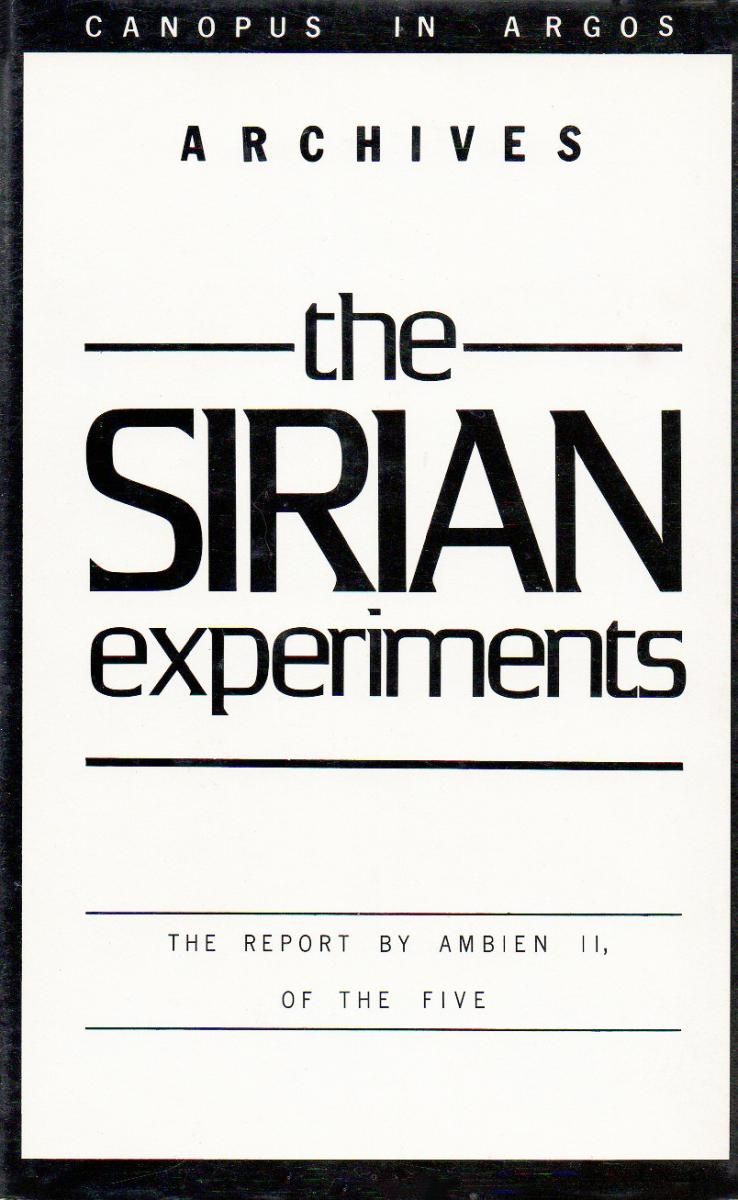
But it could also be nice if everybody read Doris Lessing’s The Sirian Experiments – or even better, her whole Canopus in Argos series.
I can imagine a version of Planet Earth where everyone just sits down reading those books for as long as it takes, doing nothing else except whatever is needed to stay alive and keep others alive when doing it. (Booker Prizes, 2025).
Lessing used her five-novel sequence, with Earth seen from several perspectives as the sick planet Shikasta, as “a framework that enables me to tell (I hope) a beguiling tale or two; to put questions, both to myself and to others; to explore ideas and sociological possibilities” (1994, p.11). Like On the Calculation of Volume, Lessing’s work is “a mainstream novel that uses SF ideas, because that is the best way for the author to tackle the themes she wants to tackle, rather than being a foray into SF style” (Hammersley, 2002).
Balle’s multi-volume tale has a similar diagnostic quality with regard to our present day, though it lies perhaps even farther from conventional science fiction than Lessing’s series; if anything, it resembles prior hard-to-categorise works such as Anna Kavan’s surreal Ice (1967), in which a shifting climate entangles with a dreamlike state of being which dissolves the protagonist’s identity, or – even more directly – Marlen Haushofer’s unusual and moving 1960s novel The Wall (translated in 1990).
This latter work sees its protagonist apparently separated from the rest of humanity by an invisible wall, beyond which the world seems to have entered a strange deathlike stasis; she is forced to draw on her own inner resources to find ways to survive, raiding cupboard supplies and figuring out how to keep animals and farm the land in the mountain landscape where she is now trapped.
While she never finds community of the kind which Tara does, the protagonist’s plight – and the opportunity she takes to rethink who she is and how she relates to the world – strongly resonates with Balle’s books. Indeed, the opening lines frame her problem in terms which are tellingly familiar:
Today, the fifth of November, I shall begin my report. I shall set everything down as precisely as I can. But I don’t even know if today really is the fifth of November. Over the course of the past winter I’ve lost track of a few days. I can’t even say what day of the week it is. But I don’t think that’s very important. (Haushofer, 1963/1990, p.1).
Examining this precursor helps us to place On the Calculation of Volume among other speculative and fantastic literary works, and specifically locate it among what Wittenberg calls
non-science-fictional narrative experiments that might be called time travel either in their specific confrontation with the significance of temporal ordering or in their experimental construction of narrative viewpoint (2012, p.210).
Indeed, the slipperiness of categorisation when it comes to stories like Balle’s happens because of the way we understand temporality.
As Wittenberg notes,
since all narratives do something like “travel” through time or construct “alternate” worlds – one could arguably call narrative itself a “time machine,” which is to say, a mechanism for revising the arrangements of stories and histories. In this more expansive view, literature itself might be viewed as a subtype of time travel, rather than the other way around, and time travelling might be considered a fundamental condition of storytelling itself, even its very essence. (p.1).
The phenomenon of time passing is almost inextricable from our experience of consciousness and our capacity to narrate it; it’s hard to think about time the way we think about, say, spatial dimensions, because we constitute and experience ourselves, individually and collectively, as beings in time. If I’m weightless and adrift in space, I’m still evidently me; if I’m no longer anchored in time, that’s unnervingly not so certain – and even the possibility of telling a coherent story, let alone aligning to the conventions of a single genre, is under threat.
As Greenhouse has it, time is cultural; it is “what makes acts relevant in relation to social experience, however conceived” (1996, 1). This is the raw nerve on which Balle seeks to press. She is happy to use conceits which arise in genre works – the repeating-day concept, of course, but also the sense of resources being irreversibly used up by time-displaced people in King’s “The Langoliers” (1990) – but she is less interested in having her characters unearth a fully articulated novum of the kind defined by Suvin (1979), which lays bare the premise behind what is happening.
In the volumes published to date, Balle has proved unconcerned about revealing the exact speculative mechanics of the time loop; questions of how the loop has formed are mostly laid aside to explore, instead, what the loop does to those within it – and their relationships to those outside it. In this regard, Balle’s narrative harks back to an earlier time when “the scientific machinery of travel itself would more likely have remained incidental or subordinate to the writer’s presentation of an alternative sociopolitical milieu.” (Wittenberg, 2012, p. 15).
Indeed, the closest her tale gets to conventional science fiction is the dryly funny fourth volume, in which the community of repeaters analyse their situation to the point of inanity.
Is this a “microburst in time” or a “localised time-tornado” (IV, p.20)? As the conventional calendar makes no sense any more, should a hundred repeated days be counted as a centium? The group hold meetings upon meetings:
There are too many things for which we lack terminology, and it is difficult to come to an agreement. Apparently, before we can discuss the right words, we must discuss everything at great length, with everyone speaking all at once. (IV, p. 70).
This culminates in the complex business of arranging a conference (no mean feat when one is trapped in a single repeating day) at which little of practical use emerges:
Along the way, many pointed out that our explorations lacked a theoretical foundation, that attempting to build hypotheses or explanations would be futile without a thorough understanding of past theories of time – from the Presocratic period to the twenty-first century […] Others, however, believed that it was precisely the temporal theories of the past that had fallen short, that the prevailing conception of time itself was fundamentally flawed [.] (IV, p.157)
Ill-informed temporal debates become the stuff of cringe comedy; it is as if the plucky, pragmatic survivors of John Wyndham’s The Day of the Triffids had been recast with characters from The Office.
If Balle cares little for how the repetition began, she’s even less keen to spend time on the drama of whether people believe Tara’s claims to be trapped in a single day, or whether there is a didactic or redemptive aspect to her condition – although some of the repeaters wonder if they have been granted this opportunity in order to achieve some benevolent purpose, Tara, and her author, keep their distance from any such notions.
More notable is the close attention Balle pays to the details of everyday life, which become magnified and luminous through their repetition. Indeed, within the text itself, it is such attention which allows the time-lost to find one another, when they notice something that is not repeating, and realise that this signifies another potential member of their company close by.
By rejecting trite forms of time-loop drama, even as she trades in tropes we can recognise from genre fiction, Balle, who was previously known for philosophical literature, is creating a kind of homebrew anthropology of time. After all, time travel fiction has been argued to be the “philosophical literature par excellence” (Wittenberg, 2012, p. 2).
Bryant and Knight argue that “expectation is the ground on which practices, orders, and hence the normative emerge”; Balle puts her characters, and the reader, in a distinctively weird position where the endlessly repeating day is packed with expectations – and yet all kinds of surprises, deviations, and interesting story developments may eventuate. If some researchers understand time in terms of a “thick present” (Sandford, 2023) incorporating anticipation and remembrance, then Tara and her fellow repeaters are trapped in the thickest present that ever there was.
Seen in this way, Balle’s series becomes a fictional construct, rooted in careful observation and description of contemporary life, within which we can explore questions of our agency, impact, and understanding. She imputes to the rhythm and routine of ordinary Western European life an alternative mode in which, as Bryant and Knight have it, “the present becomes uncanny to us in its present-ness” (p.43):
[O]ur arrested day had left us in an unusual position where we no longer had to constantly think about how to keep moving, whether we were lacking momentum, whether someone was in our way, whether we could keep up (IV, p.120).
In this way, Balle’s conceit offers the ultimate form of Haraway’s notion of “staying with the trouble”:
learning to be truly present, not as a vanishing pivot between awful or edenic pasts and apocalyptic or salvific futures, but as mortal critters entwined in myriad unfinished configurations of places, times, matters, meanings. (2016, p.1).
Balle invites us to surrender the anxieties which might arise from a sense that the future is unknowable, and to do without the various false comforts of utopian or anticipatory thinking, in favour of a more interrogative mode to existence in the here-and-now. This includes, for Tara, the pleasures of endless repetition as well as its terrors, burdens, laments, and frustrations. In its more idyllic moments, On the Calculation of Volume offers a beguiling quotidian solace.
Revisiting November 18th over and over yields opportunities to appreciate the tiniest details and subtlest patterns at every turn. The observation of a single fruit tree forms a significant element of the second volume:
Leaves against twigs, leaves against leaves, a medlar falling to earth. It lands with a little thud and rolls a short distance across the ground before it stops. It sounds as if the world is saying danke when the tree drops its fruit. (II, p.136).
In its leisured aspect, Tara’s existence also allows for devotion to intellectual pursuits, untroubled by material demands and the usual exigencies of passing time; when she spends an intense season reading about the ancient world, inspired by the sestertius which has accompanied her, one is reminded of Annie Dillard’s comment:
There is no shortage of good days. It is good lives that are hard to come by… Who would call a day spent reading a good day? But a life spent reading – that is a good life. (2016)
Ghosh, Balle, and the climate change novel
So where does Balle’s narrative take us, depicting a situation in which time seems to go nowhere? And what are we, as readers, getting from this, beyond watching people pore over history books and listen out for the sound of falling medlars?
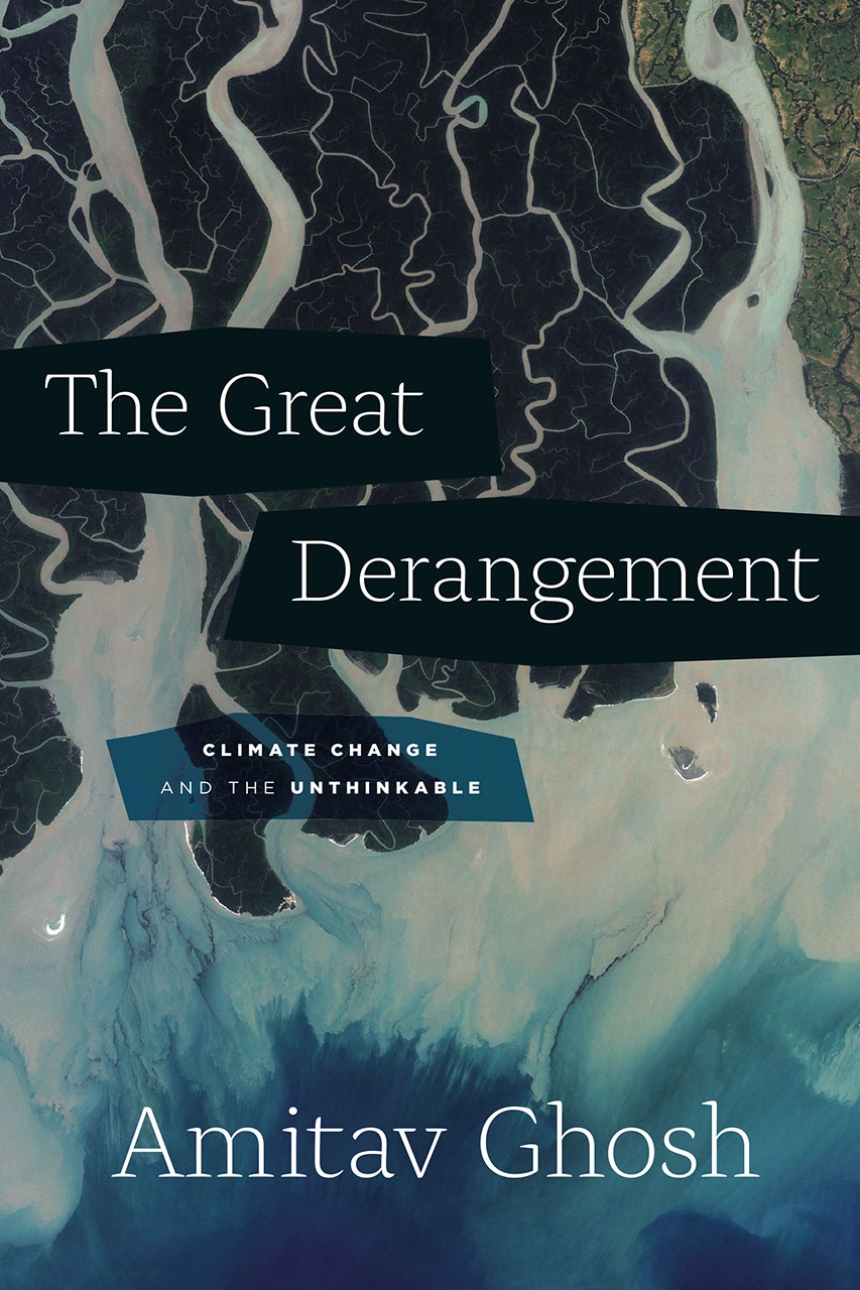
A clue lies in the changing scope of each volume, moving from an individual plight through the dynamics of a marriage into a wider sense of community and then a concern, broader still, with what has happened to the world. Balle’s books serve as a response to Amitav Ghosh’s argument, in The Great Derangement (2016), that the bourgeois novel, configured for the rhythm and routine of imperial and then post-colonial globalised capitalism, is inadequate to the challenges of our century, especially when it comes to environmental shifts.
For Ghosh,
the challenges that climate change poses for the contemporary writer, although specific in some respects, are also products of something broader and older; […] they derive ultimately from the grid of literary forms and conventions that came to shape the narrative imagination in precisely that period when the accumulation of carbon in the atmosphere was rewriting the destiny of the earth. (p.7).
He argues that a “cultural matrix […that is] intimately linked with the wider histories that have shaped the world” (p.10) has yielded literary forms and a literary culture incapable of apprehending a planetary ecosystem’s rebellion against the understandings, desires, and exploitations placed upon it, to the extent that it is “as though in the literary imagination climate change were somehow akin to extraterrestrials or time travel.” (p.7).
No wonder, then, that narratives of time misbehaving are proliferating across popular media on page and screen: time has gone out of joint and creators must reach for fantastic happenings to make sense of this world. If the era of climate crisis is too turbulent and uncertain to yield to technocratic tools like probabilistic forecasting (Scoblic, 2020), then perhaps it is also too much for the forms of storytelling which we have inherited:
Probability and the modern novel are in fact twins, born at about the same time, among the same people, under a shared star that destined them to work as vessels for the containment of the same kind of experience. Before the birth of the modern novel, wherever stories were told, fiction delighted in the unheard-of and the unlikely. (Ghosh, p.16)
Balle’s protagonist Tara, having experienced a near-miss accident on one of her repeated days, dislikes the “false safety” of cars (IV, p.41); Balle similarly dislikes the false safety of a conventional narrative vehicle, even if she is willing to appropriate components that suit her. As the inhabitants of the repeating day become progressively more estranged from what they once considered normal, so Balle’s story in turn moves towards a profound defamiliarisation of the everyday world, and begins to approximate something which might pass muster with Ghosh.
In its first book, On the Calculation of Volume functions as a portrait of what cannot be shared even in a successful intimate relationship, as Tara wearies of repeatedly explaining her plight to her sympathetic husband Thomas and begins to hide from him even while still living in their home; later, she forms a strange community with others whom she discovers are also subject to the same loop.
Additionally, because some consumables such as foodstuffs are run down in Balle’s time-loops, and because Tara travels between colder and warmer climes in order to simulate the changing seasons, the series can be directly read as climate fiction, written for an era in which resources are being squandered and the climate is itself out of joint.
Rather than offering speculative solutions to the problem of climate change, or proposing something like Robinson’s “Ministry for the Future” (2020), Balle’s tale operates in an exploratory and metaphorical, rather than didactic, mode, investigating how we might meaningfully inhabit a present moment of seemingly endless unsteadiness.
By the latest volume of the English-language translations, Balle’s small community of time-looped characters are hoarding food and resources in a shared house, unable to fully engage with the institutions and activities of mainstream society, living in a manner reminiscent of communities in crisis, with something of the quality of the “cosy catastrophe” which Brian Aldiss saw in John Wyndham (Aldiss and Wingrove, 1986).
In Balle’s tale, first the genuinely loving middle-class marriage can’t withstand the problems of time misbehaving; then broader and deeper frayings of the social fabric are revealed.
At the outset, we see how deeply Tara savours the experience of a healthy couple; spending an evening with booksellers Marie and Philip, she enjoys their closeness:
They had an air of peace about them […] which reminded me of the time, five years ago, when I first met Thomas. The sudden feeling of sharing something inexplicable, a sense of wonder at the existence of the other – the one person who makes everything simple – a feeling of being calmed and thrown into turmoil at one and the same time. Philip and Marie had clearly decided to spend the rest of their lives together, it was as simple as that, so what could they do but see what the future would bring. (I, p.19).
During one loop, after making love to Thomas on the living room floor, Tara reflects:
We have always had need of time together. We are not one of those couples that has to have time apart, to miss and rediscover one another, to go away then be reunited in a collision of love. Distance, leave-takings and reunions are not what bind us to one another. For us it has always been about the days together, day after day, night after night, again and again. (I, p.46).
In telling terms, given our reading through the prism of Ghosh, she sees their “strange bond” as “a quiet weather system with no natural disasters. Or a weather system which, until the eighteenth of November saw no disasters.” (p.46).
When Thomas refuses to attempt to travel with Tara – “He didn’t want to be part of my plans. He didn’t think it would do any good” (I, p.136) – she makes the decision to leave: “He wanted to stay in his pattern. I knew it and he knew it and there was no reason to contradict him.” (I, p.138).
By doing so, she finds her way into a community that the rest of the world can’t understand. When they share their experiences, the repeaters create a “room full of movement: time rushed by in our retellings, streams of eighteenths of November, we sped through our days” (IV, p.8); the act of retelling diverse experiences that inhabitants of regular time cannot hope to understand gives a sense of time moving forward.
“It feels,” Tara remarks, “as though we had each been walking along our own path in the same forest […] We think it begins when we meet, but in fact our stories were already entwined.” (IV, p.12).
Some repeaters have labelled this experience in a way which even removes the sense of plight:
An anastrophe, that’s what they had called the incident […] For it was no catastrophe, just an inversion, and that was what that meant: anastrophe. Their world had not ended, they had simply been sent back to the same day. Without tragedy, without any fallen or dead. (IV, p.20).
Thus hope is found even in the teeth of crisis, precisely because something is not fully understood, is unexpected. One repeater, Henry, refuses to believe that 19th November will ever come – yet Tara is able to point out that he had once believed he was alone as a repeater, so even within the confines of the endlessly recurring day, his assumptions have already been proved wrong, and things have gone better than expected.
That is not to say that Tara and the others are incapable of self-critique, particularly with regard to the way that they are irrevocably using up resources within the endless day:
I am a monster and I devour my world. There is no getting away from it. I can eat leftovers. I can go hungry all day, I can flit from place to place and leave the tiniest possible trace, I can spread my shopping […] but these are all simply attempts to conceal the truth, to make the monster smaller. I know. At some point it will be over. (II, p.140).
Seeing that she and those like her will eventually use up the world’s finite resources to sustain their existence, Tara invokes the trope of monstrosity time and again across the volumes, knowing that for all she may “try to get through the days without stepping too heavily”, she is a “monster playing at being a butterfly.” (II, p.140).
This predicament resonates with the condition of life in a wealthy nation during the era of climate change, apparently immunised from many of the direct impacts until a shortage, an inconvenience, or finally even an actual disaster arrives at your own door. Even if one shops ethically or subscribes to green principles like flight-shaming, one is still a “monster” imbricated in the systems of harm and profiting from their attendant inequalities.
Tara reports of Henry, who ventures out to source supplies:
He feels that we live in a sheltered world, and it’s only there – in front of the vegetable stand at the market, in the warehouses with unsold goods, in the small front offices of importers, in the cold storage rooms full of too much milk and yogurt – that you feel some slight connection to another world, he says. That’s where he accepts his losses. (IV, p.54).
This is an attempt to find a literary form worthy of Ghosh’s challenge, where it is not merely lip service to say, “Everyone knows that we are using up the world, that we must tread carefully if we are not to become monsters and ravaging locusts.” (IV, p.33).
But treading carefully does not mean avoiding all intervention. Two repeaters, Olga and Ralf, present alternative schemes as potential responses to the situation.
Ralf’s is to build a computer system, BeDaZy (the “Better-Day-Zystem”), which will identify all the accidents and misfortunes which happen on November 18th, so that the repeaters may intercede and avert them – though, interestingly, this scheme depends on the assumption that linear time will eventually resume, and a November 19th will materialise within which people will be grateful for these efforts:
It may be possible, he said, to initiate a series of repairs that create and reshape without destroying. It’s about creating space within the societal organism. About activating a kind of self-generating systemic transformation through changes to surface-level minutiae. (III, p.136).
Self-serious, technocratic Ralf can be read as a satire of male systems thinkers; with his jargon and his slide decks, his well-meaning proposal takes on something of a TED talk quality, and depends on the idea that the status quo ante will eventually return:
Let’s assume that time were to suddenly shift and we leapt into progressive time, that it becomes the nineteenth of November, for instance, and that everything that happened on this particular eighteenth of November, now replaced by the nineteenth, becomes the ultimate version – the reality we must live with. If we wake up one day and there are no more eighteenths of November, isn’t it our responsibility to ensure that the day we leave behind is the best of all possible eighteenths of November? (III, pp.136-137).
Ralf has “run the numbers” and offers a vision resembling a do-gooder version of startup culture:
The full digital setup wasn’t finished yet, but we could begin with a smaller version. He’d soon have a proposal ready to pilot-test it. He had analysed several models, as the best approach was not immediately obvious. Should we expand our radius of actions step by step? Should we prioritise specific geographic areas? Should we start by focusing on the incidents that were easiest to prevent? Or should we, on the contrary, tackle the most difficult ones first? (IV, p.43).
Against this stands seventeen-year-old Olga, for whom
Ralf was carrying around the world’s smallest sandbag, refusing to acknowledge that he was in the midst of a cataclysmic storm. He was patching tiny holes in the dyke […] Ralf wanted to correct details, Olga wanted to change the system, she insisted. She believed you had to find the root cause. Ralf thought Olga wanted to drain the sea of water. Olga asserted that Ralf wanted to correct commas. (III, p.124)
Yet Olga’s proposals are curiously airy and unspecific, though ultimately they nourish the design of BeDaZy. Tara feels “torn between [Ralf’s] urge to prevent very concrete incidents and Olga’s hope of changing something more fundamental: that it was about the structures and the future [.]” (IV, p.143).
Notably, when other repeaters admit to initially believing that perhaps some personal transgression had caused November 18th to recur, Olga
doesn’t understand how anyone could believe that the halting of time is their own fault. As if the world were a place that remained stable so long as you did the right thing. A fragile balance you mustn’t disturb. As if there were an instruction manual, and so long as you adhered to it, you could not be struck. (IV, p.105).
Debating these proposals, discussing what has happened to them, the repeaters draw on the tools of their milieu: what else is to be done by these Europeans but hold a conference? A great deal of effort goes into organising a gathering to discuss their situation, but a significant chunk of that gathering gets occupied with matters as trivial as the right names and even acronyms for what is going on:
[…S]omeone proposed we name the world we came from – the life we had lived before the eighteenth. TOL, for example, The Other Life. Gita suggested DAL, Das Andere Leben, but Henry didn’t like that.
One of the Val Benoît residents suggested that we call time before the eighteenth La Vie Avant and the time after La Vie Maintenant, that way we could talk about LaViA and LaViM. This led us back to the difference between acronyms and syllabic abbreviations, until Gita’s group pointed out that we also needed to address time after the eighteenth, La Vie Après, but that, too, would be LaViA, introducing unnecessary confusion – unless, of course, we expect these two to be the same: that the world we return to after our life in the eighteenth would be exactly as before. Then they could share a name (IV, p.77).
It is telling that Tara, habitually an observer of others and a marginal voice in the group, becomes a little more forceful when conversations head this way: “Maybe the issue wasn’t whether we understood or not, I said, but that it wasn’t something we could fix with agendas and scheduled meeting days ending in zero.” (IV, p.43) The conventional mechanisms for knowledge production in European societies prove inadequate in the face of the future’s unknowability, and attempts to intellectually codify what is going on stand in painfully funny contrast to the everyday experiences of those actually trapped in the endlessly repeating day.
The closest the conversation comes to something useful, to which Balle devotes a little more time, is when one repeater tells the group
about dadirri, a word she had learned of when visiting a friend in Darwin in Australia. It described a way of listening, she said: a peaceful attentiveness to one’s surroundings, to the forest or the water.
She had often listened in this way when travelling. Also to people’s voices. When the conversation becomes a form of music, she said. When you don’t interrupt or try to answer or contradict one another. When you don’t use language to agree or disagree or reach solutions and conclusions, but simply listen to what is being said. (IV, p.80).
It is as if Balle is telling the reader how to approach this section of her tale, with its shaggy-dog quality – but it also opens the door to a rare non-European reference in this exceedingly European narrative. Presenting dadirri at one remove, tentatively, she points to ways of thinking that might better apprehend what is going on for the repeaters – without succumbing to the common trope, sharply articulated by Okorafor (2004), where nonwhite figures serve as magical guides and redeemers for white characters.
Yet dadirri, whose mention creates a tiny ripple of potentially useful thought in this conference, only briefly captures the narrative, and the attention of its characters. After an instant of profound listening, the repeaters fall back into a pattern where “some listened and others offered more examples of words which did not readily translate between languages.” (IV, p.80).
In its own quiet and dryly funny way, Balle’s depiction of the conference can be understood as satirically capturing “the importance of the temporal imagination in understanding injustice in a warming world” (Facer, 2024) – and the inadequacy of institutional and community responses in developed countries to date.
Outside of the bloviating quasi-scholarly conference – which somehow renders an endlessly repeating day also irritatingly interminable – the repeaters’ time and efforts are organised by another structure beloved of the European middle class: the flatmate experience.
Balle devotes significant time to the mundane yet vital matters of how food is obtained and prepared, and by whom; how chores are allocated; and how the spaces used by the repeaters, including for car-parking and cycle storage, are organised. While the repeaters survive and muddle through, both their practical and intellectual efforts seem comically insufficient to the cosmic situation they find themselves in.
Yet still they are both “a swarm of monsters” and “a bag full of hope” (IV, p.95); Balle’s account is not scathing but attentive and empathetic. She does not model solutions but illustrates the experience of one’s understanding being reframed by extraordinary happenings. Tara’s thoughtful narration and her preference for observation over intervention lead her to a dawning realisation which brings us back, at last, to the question of how this odd tale sits within the realms of speculative fiction:
It’s difficult to know whether we’re still human. It was Sarah who started having doubts. She laughed, but she meant it: she felt like something else. She didn’t know what exactly – just something else. Not a human being. Not an animal. Not a ghost or a monster or some mythical creature, and then people began suggesting all sorts of things we might be if we were not human: witches and trolls, fairies and nymphs, cherubs, gods and goddesses, devils and vile beasts, miscreations, freaks, homunculi. There was also talk of aliens, cyborgs, clones, androids, that sort of thing, but Sarah said those weren’t it either. (IV, p.118).
To become unstuck in time, we remember, is more challenging to our identity than merely coming unstuck in space – the experience may even suffice to sever us from belonging to the same species as those who trudge through consecutive days. (One is reminded of Priest (1974)’s Inverted World, in which human beings seeming to transform into stunted, fast-talking troll-like figures are merely experiencing a compression of perspective in the eye of the beholder).
Tara finds herself asking, “But were we human before time ground to a halt? Maybe we haven’t changed, maybe we were something else all along?” (IV, p. 121). Already, simply as privileged Europeans in an age of global turbulence and looming climate catastrophe, before November 18th ever repeated, these people were both a swarm of monsters and a bag of hope.
Conclusion
If Freedman was able to claim that critical theory and science fiction are each “a version of the other” (2000, p.xv), then perhaps On the Calculation of Volume is simply Balle’s disciplined creative-critical way of having a lover’s quarrel – not only with the world, as Robert Frost suggested poets should have, but also with time itself.
The title of Balle’s series refers to Archimedes’ discovery that volume can be calculated by displacement. In her work, we gradually see what is revealed when someone is taken out of the normal flow of time and unable to “displace” the world in the usual way. This strange perspective sheds uncomfortable light on her European characters, the literary milieu from which the book emerged…and, potentially, her readers too.
Nabokov – who himself danced at the edge of genre in books such as Ada or Ardor (1969), while claiming to “loathe science fiction with its gals and goons, suspense and suspensories” (Ditum, 2019) – once wrote of “an oblong puddle invariably acquiring the same form after every shower because of the constant spatulate shape of a depression in the ground”, suggesting that “something of the kind may be said to occur in regard to the imprint we leave in the intimate texture of space” (Nabokov, 2012, 3065).
With Balle, we follow a character who is unable to consistently leave that constant shape, for whom the rain washes away any lasting imprint; a time-travelling hero for an age of deep uncertainty.
Nabokov’s words come at the conclusion of his 1947 novel Bend Sinister. This unexpectedly poignant metafiction heavily lampshades the fact that its story of an intellectual resisting an authoritarian regime is entirely make-believe, and completely abandons its conceit in its final moments – yet remains profoundly moving. Its last pages, with the narrator unable to face depicting the awful conclusion they had concocted for the protagonist, have something of the same slow-building sense of nocturnal horror which Balle captures when Tara and her husband try to stay awake through one of the November 18th resets:
We collected details. We stayed alert. We kept our eyes fixed on each other. On the table. On the empty pan between us. For ten minutes or more we simply sat there at the table. We talked about the objects around us. We speculated as to whether things disappeared in fits and starts or all at once. Thomas believed there would be things in other rooms in the house that had already returned to their places. We talked about going to check but didn’t get up. We talked about cameras which could record changes. We talked about love. About whether it could make things happen. About whether love could bring us in or out.
And then, from one moment to the next, the frying pan was gone. I froze for a second and glanced around the kitchen, but the pan was nowhere to be seen. I got up and as I did so I heard Thomas cry out. He wanted to know what had happened. He was troubled. He wasn’t drowsy or tired. He was simply troubled. He could not remember what he was doing in the kitchen. He had gone to bed on the night of the seventeenth, only hours after we had spoken on the phone. Now he was here in the kitchen. I was supposed to be in Paris. But here I was, looking for a frying pan.
I forgot about the frying pan and sat down again across from Thomas. I explained what had happened and saw anxiety course through him as I led him down the long road from my first eighteenth of November to the fried eggs we had just eaten. (I, p.75).
In this universe, as for Nabokov’s protagonist, our characters are at the mercy of forces beyond their control or anticipation. Something similar is true for those who choose to read On the Calculation of Volume, as Balle plays time-games directly with her reader as well as her characters, particularly in the form of cliff-hangers which are sometimes resumed, in the next book, with a significant flash forward that skips over their immediate resolution. (It is impressive to write a story set on a single calendar day and nonetheless leave the reader thinking, “When is this happening?”). As an author, Balle exploits the inevitable tension which resides in “the possibility that the expectations provided by experience must also contain the ‘perhaps,’ the ‘maybe’ that opens them to the possibility of surprise” (Bryant and Knight, p.55).
English-language readers experience further suspense via the temporalities of translation, with their editions gradually catching up to the Danish originals (at the time of writing, the fifth English volume is about to be released and the sixth Danish volume is already out in the world). This is given added significance by Balle’s own comment (Faber Books, 2025) that Tara, being of English and Belgian heritage, would likely tell her own story in English or French:
The book is written in Danish originally but I haven’t written it in her original language. So in a way, the Danish version would probably be my translation of her story.
Such subtle sidesteps serve to position Balle’s tale, for all its accessibility and mainstream literary acclaim, in an oblique and challenging position: a non-definitive account, a translation from a prior original which can never be accessed, and to which the closest approximation may be a further translation again.
Ghosh’s argument regarding the novel in the age of climate change is that
we have entered a time when the wild has become the norm: if certain literary forms are unable to negotiate these torrents, then they will have failed – and their failures will have to be counted as an aspect of the broader imaginative and cultural failure that lies at the heart of the climate crisis. (p.8).
On the Calculation of Volume is a riposte: a novel at once fantastic and mundane, conventional and yet provocative, one which harks back to the serial origins of the form even as it grapples with the most contemporary sense of immanent crisis. Balle writes, as Lessing’s Anna wrote in The Golden Notebook, “to create a new way of looking at life” (1972, p.75); our present, awkward relationship to time is given back to us in the way that Joanna Russ saw science fiction at its most effective:
What is familiar is made strange – one disbelieves; however, it is rooted in the familiar – one believes (or rather stops disbelieving); yet it is absurd or comic – one begins to question the piece of actuality that has been used as a model[.] (1995, p.19).
An old joke about Samuel Beckett’s cryptic time-bending trilogy Molloy, Malone Dies, and The Unnameable has it that the last words of the final volume – “…you must go on, I can’t go on, I’ll go on” – spoil the whole series, as an embittered reader tells an earnest newbie: “You needn’t bother wading through all that. Spoilers: in the end he decides to go on.”
Balle’s great achievement is to create a multi-volume series where the answer to “What’s next?” is always “November 18th, again” – and yet we still want to turn the next page, and when we do so, we still find something new to learn.
We can only hope that in an age of uncertainty and peril, we, too, can find that urge to turn the page, find something ever new, and go on.
Matt Finch
Matt Finch is an Associate Fellow of Saïd Business School and a member of the Futures Council at Australian National University; he leads the Oxford University project “Death, dying and afterlife in the age of AI” and co-leads the “Intimate Futures” project at the New School for Social Research.
References
Abi-Nakhoul, N. (2024). Supplication. McClelland & Stewart.
Aldiss, B.W. and Wingrove, D. (1986). Trillion year spree: the history of science fiction. Victor Gollancz.
Amram, M. (writer) and O’Donnell, T. (director). (2018). Jeremy Bearimy. [TV series episode]. The Good Place.
Bailey, F. and Bristol, S. (Writers) and Bristol, S. (Director). (2019). See you yesterday. [Film].
Balle, S., translated by various. (2024-2026). On the Calculation of Volume, Volumes I-IV. Faber & Faber.
Booker Prizes (2025). An interview with Solvej Balle and Barbara J. Haveland, author and translator of On the Calculation of Volume I. The Booker Prizes. https://thebookerprizes.com/the-booker-library/features/solvej-balle-and-barbara-j-haveland-interview-on-the-calculation-of-volume-I
Bradley, K. (2024). The Ministry of Time. Hodder & Stoughton.
Brookins, J.C. (2024). On the Calculation of Volume I by Solvej Balle. Locus. https://locusmag.com/review/on-the-calculation-of-volume-i-by-solvej-balle-review-by-jake-casella-brookins/
Bryant, R. and Knight, D.M. (2019). The anthropology of the future. Cambridge University Press.
Chaffin, J., Lomeli, V.D., and Williams, A. (2023). Canadian wildfire smoke jars New York with ‘movie of the future’. Financial Times. https://www.ft.com/content/612be3ba-5b32-402b-8d12-e5fb2a835492?shareType=nongift
Charters, E. and Heitman, K. (2021). How epidemics end. Centaurus 63, 210-224. https://doi.org/10.1111/1600-0498.12370
Dick, P.K. (1967). Counter-clock world. Berkley Books.
Dillard, A. (2016). The writing life. Tikkun 31 (3). https://muse.jhu.edu/article/626050
Ditum S. (2019). ‘It drives writers mad’: why are authors still sniffy about sci-fi? The Guardian. https://www.theguardian.com/books/2019/apr/18/it-drives-writers-mad-why-are-authors-still-sniffy-about-sci-fi
Faber Books. (2025). ‘The book is written in Danish originally, but I haven’t written in Tara’s original language.’ Instagram post. https://www.instagram.com/reel/DNQe57eIo1d/?hl=en
Facer, K. (2024). Educating the temporal imagination: teaching time for justice in a warming world. Educational philosophy and theory 56 (13), 1289-1302.
Finney, J. (1970). Time and again. Simon & Schuster.
Freedman, C. (2000). Critical theory and science fiction. Wesleyan University Press.
Ghosh, A. (2016). The great derangement: climate change and the unthinkable. University of Chicago Press.
Greenhouse, C.J. (1996). A moment’s notice: time politics across culture. Cornell University Press.
Gribbin, J. (2020) The many-worlds theory explained. The MIT Press Reader. https://thereader.mitpress.mit.edu/the-many-worlds-theory/
Grimwood, K. (1986). Replay. Arbor House.
Hammersley, R. (2002). Shikasta. Infinity Plus. https://www.infinityplus.co.uk/nonfiction/shikasta.htm
Haraway, D. (2016). Staying with the trouble: making kin in the Cthulhucene. Duke University Press.
Hatfield, J. (2025). Far more Americans say they’d like to live in the past than in the future. Short Reads. Pew Research Center. https://www.pewresearch.org/short-reads/2025/12/11/far-more-americans-say-theyd-like-to-live-in-the-past-than-in-the-future/
Haushofer, M. translated by Whiteside, S. (1990). The Wall. Cleis Press.
Hawley, N. (2017-2019). Legion. [TV series].
Jordan, T. (2019). ‘Call me a science fiction writer. I’ll come to your house and nail your pet’s head to a coffee table.’ New York Times. https://www.nytimes.com/2019/05/02/books/review/ian-mcewan-machines-like-me-john-sandford-rules-of-prey-best-seller.html
Kavan, A. (1967). Ice. Peter Owen.
King, S. (1990). The Langoliers. In: Four Past Midnight. Viking.
Knight, D.M. (2023). Vertiginous life: an anthropology of time and the unforeseen. Berghahn.
Lesssing, D. (1972). The Golden Notebook. Michael Joseph.
Lessing, D. (1994). The Sirian Experiments. Flamingo.
Lyonne, N., Headlund, L. and Poehler, A. (2019-2022). Russian Doll. [TV series]
McGrath, M. (2019). Climate change: 12 years to save the planet? Make that 18 months. BBC. https://www.bbc.com/news/science-environment-48964736
Moffat, S. (writer) and Macdonald, H. (director). (2007). Blink. [TV series episode]. Doctor Who.
Nabokov, V. (1969). Ada, or Ardor: A Family Chronicle. McGraw Hill.
Nabokov, V. (1947/2012). Bend Sinister. Penguin Classics e-book edition.
Nolan, C. (writer and director). (2020). Tenet. [Film].
Okorafor, N. (2004). Stephen King’s super-duper magical negroes. Strange Horizons. https://strangehorizons.com/wordpress/non-fiction/articles/stephen-kings-super-duper-magical-negroes/
Pnueli, N. (writer) and Lehmann, A. (director). (2022). Meet Cute. [Film]
Priest, C. (1974). Inverted world. Faber & Faber.
Ramis, H. and Rubin, D. (writers) and Ramis, H. (director). (1993). Groundhog Day. [Film].
Roberts, A. (2014). A brief history of time-travel. In Bell, J. (ed.) Sci-fi: Days of fear and wonder. (pp. 40-44). BFI.
Robinson, K.S. (2020). The Ministry for the Future. Orbit.
Russ, J. (1995). To Write Like A Woman. Indiana University Press.
Sandford, R. (2023). Reparative futures in a thick, virtuous present. Futures 154, 103278. https://www.sciencedirect.com/science/article/pii/S0016328723001829
Sayers, V. (1997). Vonnegut Stew. The New York Times. https://www.nytimes.com/1997/09/28/books/vonnegut-stew.html
Scoblic, J.P. (2020). Strategic foresight as dynamic capability: a new lens on Knightian uncertainty. Harvard Business School Working Paper 20-093. https://www.hbs.edu/faculty/Pages/item.aspx?num=57819
Siara, A. (writer) and Barbakow, M. (director). (2020). Palm Springs. [Film].
Suvin, D. (1979). Metamorphoses of Science Fiction: On the Poetics and History of a Literary Genre. Yale University Press.
United Nations (2020). The impact of digital technologies. United Nations. https://digitallibrary.un.org/record/3898928?v=pdf
Valenzuela, J. M., and Lezaun, J. (2024). Publics and counter-publics of net-zero. Futures 156, 103322. https://www.sciencedirect.com/science/article/pii/S0016328724000041
Vonnegut, K. (1997). Timequake. Putnam.
Wittenberg, D. (2012). Time travel: the popular philosophy of narrative. Fordham University Press.

