The following is an edited transcript, abridged from the original conversation that closed the BSFA/SFF AGM on 14 June 2026. The event was held online on Zoom.
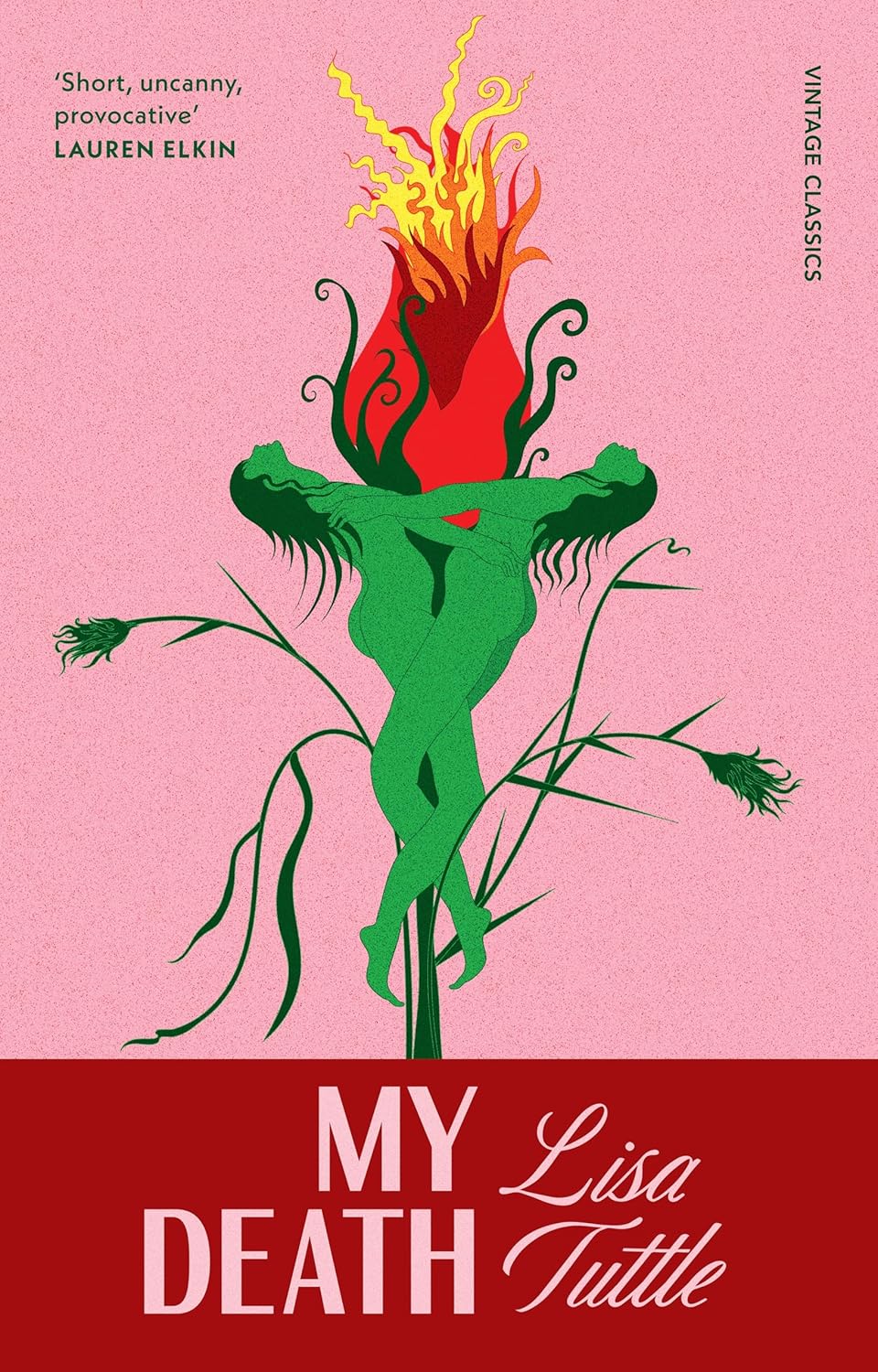
Paul March-Russell: I’m honoured to have Lisa Tuttle here to discuss her novella My Death, which was originally published by P.S. Publishing in 2004, reprinted by NYRB Classics, and is now available in a beautiful edition from Vintage. A number of Lisa’s other works are also being reprinted by Valancourt – A Nest of Nightmares and later this year Lost Futures, which was shortlisted for the Arthur C. Clarke Award in 1993. Lisa, it’s a delight to have you here. My Death is a wonderfully intricate work, so I’m going to be very careful to not give anything away. But what was it that first inspired you to write the novella?
Lisa Tuttle: It was a few things that came together. One is that I’ve always been interested in women writers, women artists, particularly women who’ve been sort of forgotten. I can’t think who it was, someone like Gail Godwin, who was recently talking about when she was at college, she always felt slightly embarrassed being particularly interested in women writers. It didn’t seem right. You were supposed to look at the great writers, and they were all men. Well, I’m from a slightly younger generation, and I think that by the time I got to college, there were women – women’s writing, women’s work, women’s history. The courses were just starting. This was back in 1970. So, I didn’t feel this wasn’t proper. It was like, no, now is the time to find out about all these forgotten women or the women who haven’t been celebrated.
I also read a lot of biographies and autobiographies by women and about women. And at one point, years ago, I thought I might write a biography, but it all seemed a bit too daunting. What suited me better was to write an imaginary biography of an imaginary writer or artist or muse. That was another subject that interested me: women playing the role of muse to a male artist or writer. I’d recently read a memoir of Robert Graves, can’t remember by whom (we’ve just moved house so my books are everywhere!). But one of the things was that the author and his wife went to live in Mallorca, and he had a letter of introduction to Graves, who was at that time living with the American poet and critic, Laura Riding, and the stories that he told about her just fascinated me. I was interested in writing about someone who’d been connected to a more famous male, but had her own talents, more than just being a muse. So, I took elements of Laura Riding’s life for my imaginary writer, and I began in a kind of semi-autobiographical fashion to write about a woman writer, who would have been around my age at the time.
The writer was widowed which I was not, and am still not, I’m very happy to say. But she had some of my own characteristics. That was a kind of a tease, in a way, because some of the things were true. I made her be from Texas, going to college in New York, and then coming over to Britain, winding up in Scotland. And the writer that she is interested in is someone she first encountered as a painted female figure, a kind of mythical person. Because that was another element. I’ve recently been going through my old notebooks, and some of the same names were in there from this story I’ve never written. It was called ‘The Fountain’, and there was a Willie Logan and a Hermione, I think, or Hermine. It was a sort of Circe story with a magical fountain and men being turned into animals. But anyway, I never wrote that, but it was something I was thinking about at the same time. And then Pete Crowther invited me to write a novella, and so suddenly I had a reason to write this, because I couldn’t really see it as a novel and it was way too complicated for a short story. And, in fact, I didn’t even know how it was going to end. When I began writing it, it was really just a character a bit like me researching someone who turns out to still be alive, so she can actually go and interview her, and then finding these rather odd connections or echoes of her life.
PMR: That’s fascinating. When I was a recently graduated PhD student in the early Noughties, around about the time that you’d have been writing My Death, Laura Riding had really come back into focus in terms of modernist studies. And there’s lots of other allusions here. You start with an epigram from the poet H.D., and again, we’ve had more recent reclamations of people like Leonora Carrington and Ithell Colquhoun. I was wondering whether you saw the novella as part of a process of reclamation? Is it contributing, not just as a kind of fictional biography, to that process of reclaiming women writers and artists from the past?
LT: For me, certainly. Leonora Carrington was very much on my radar, because when I was living in Austin, Texas, there was an exhibition of her work at the university. And I thought, whoa, she’s fantastic. And she was a writer as well, and I bought some of her books which were being reprinted by small presses back then in the 70s. So, Carrington was part of that. H.D., very much. I read two biographies of H.D, and I had her collected poems, and I was fascinated by her early life story, being picked up as a modernist writer, and her relationship with Ezra Pound, and her very much not traditional relationships and marriages and semi-marriages with both men and women. So, she was a fascinating character as well. But Ithell Colquhoun, I had not even heard of, but then I got an email from someone a couple of years ago. The strange thing is that there was something in The Guardian about her, I think, and I was reading about her, and thinking she sounds fascinating. Then I got this email from someone saying, was this one of the real women behind your idea? And I had to admit, no, I’d never heard of her until a week ago. It’s also quite exciting, I think, to find these writers and artists who have dropped out of sight, and are being constantly rediscovered. I love it. I love coming across an artist I haven’t heard of before, or a book by a writer, particularly when they’re women.
PMR: Exactly. It does seem to me that the republication of My Death is feeding into this whole process of reclaiming the work of early 20th century women writers and artists, but also more recent ones. So again, we think about people like Ann Quin and Anna Kavan and Maureen Duffy. Which brings me to my next question, because the other thing I really love are all these period details about Virago Press. So, the narrator has a copy of Helen Ralston’s novel In Troy (more echoes of H.D. I suspect) published by Virago, and there’s even a little account of how they went about reprinting their books, and the damage done to the original text. Was there also a reclaiming of the history of women’s presses and a revisiting of your own early life as a writer?
LT: I didn’t think, I’m going to reclaim women’s publishing history, I was just looking into my own recent past. In the 80s, I lived in Harrow and I joined a group called Women in Publishing, because it was a way of meeting other women since I didn’t go out to work. And I didn’t want to just meet people – I already knew people in the science fiction field – I felt like I needed some new friends of my own. And so I joined Women in Publishing and we would do things like type up things in the Virago offices or have conferences where some of the more established women publishers and editors would be. I was mainly with people working in publishing, but one year Jeanette Winterson and I were on the same committee. I even briefly provided maternity cover for Sarah Lefanu at the Women’s Press. It was just for a few months, but I was working with Tanith Lee and Carol Emshwiller, possibly Josephine Saxton. These were books that Sarah had bought and I’d be on the phone to her every couple of days. I wrote the Encyclopedia of Feminism as well, and when that was about to be published by Longmans, I was actually invited to a sales conference. There were all of these eye-opening facts about the reality of publishing, and I subsequently married someone there who had signed the contract for A Nest of Nightmares. We were both divorced and we’d run into each other at parties and things like that, and I think it was on our first or second date where I referred to A Nest of Nightmares, and I said, oh, I don’t know if you know it. He said, of course I know it, I read it. I said, well, I wouldn’t assume that you would go out and read something by me. And he said, Lisa, I published that book, I’m the one who bought it. And I said, no, no, no, no, no, that was Nann du Sautoy. She’s the one who took me out to lunch and commissioned the book, and he said, look who signed the contract. And he had. I hadn’t even realized he had been there. So, meeting other publishers and writers, who always complain about publishers of course, it’s always been a thing. But yeah, it was fun to have this character just going back to how things had been. Of course, things had changed a lot by the early 2000s, but everything I knew about publishing was from the 80s.
PMR: It’s an absolutely fascinating history. Women in Publishing has also been celebrated by the British Library with a whole bunch of links on their website, including an interview with yourself. And Rosy Mack has got a forthcoming book about the Women’s Press.
LT: Yes, I spoke with her.
PMR: So, it’s not just that this book is chiming with that reclamation of women’s writing from the early part of the 20th century, it’s also feeding into this other reclamation of the post-war enterprises of Women in Publishing, Virago, Women’s Press. It’s full of these lovely period details but a sense also of continuity over the decades that adds to the pleasure and grounding of the whole story.
You mentioned earlier that there were some biographical similarities between yourself and the narrator, and I wondered if you could say a little bit more about that, but also about the way in which there’s a doubling between the author, the narrator, and Helen Ralston. I don’t want to offer any plot spoilers, but would you say a little bit more about how that doubling emerged in the writing of the text?
LT: It’s very difficult to talk about because a lot of things that I write are sort of semi-conscious, or even unconscious, and quite often I draw on things from my own life without knowing it. I mean, I hadn’t realized that Ralston was a friend’s grandparent’s name. I don’t know if I knew it or if it was just a strange coincidence, but chances are I’d heard it, and it was connected with Scotland because that was where her grandparents were from. I often find that when critics are looking at things and talking about them, I just think, well, the way I work is I put something in because it just occurs to me when I’m writing. Only later do I think, that’s what it was about, there was a reason for that, it wasn’t just random. But at the time, it felt random – you know, where was her first job, who is this person, what name can I give them? And then it comes to seem more important or it has an echo with something. But I have to admit the doubling was not a conscious decision. It wasn’t like, oh, I’m going to do this, so that the reader will notice it or be happy about it or excited or question it. It’s just more happy accidents and coincidences, and I find that very often when I’m writing. Not just fiction writers but people doing research, I think, will probably recognize the way you stumble across so many serendipitous discoveries. You’re not even looking for it, you were looking for something else, and then you find the absolutely perfect detail. It’s just a kind of going with the flow, in a way.
PMR: And I’m assuming that the intricacy of the story must come through the drafting and redrafting as you incorporate those accidents and explore them further?
LT: Yes, I always think my first drafts are horrible. They’re very rough. Of course, the whole idea of a draft is not the same as when it used to be on a typewriter, and then you had to start retyping it. But I still do have a tendency to start over again rather than just trying to make little changes, because I feel it’s not good enough, you know? I will waste a lot of time just trying to rewrite something that I’ve just written. So, I think it’s often better, for me anyway, to just move on, and then when I go back to it, I can fix it. But I’ve just had this thought about something I’ve been working on for probably two years, which I haven’t been able to write because I’ve been busy with other things. The book opens going down a particular road that I’m describing, an imaginary road based on a real one, and I just started thinking, oh, I began in the wrong place, and I’ve just thought of a different opening for it.
PMR: Really?
LT: Yeah, completely different.
PMR: Wow, that also makes me think of something you said earlier, that you didn’t know what the ending was going to be for My Death…
LT: I know it seems unlikely, doesn’t it?
PMR: Again, no plot spoilers, but it’s not just the intricacy, it’s also about choosing whether this is going to be a short story, a novel or novella? Because the novella has a particular kind of form and structure to it, and critics will say, you need an epiphany or turning-point at the end, some kind of revelation, but if you’re working blind, the form becomes kind of interesting, doesn’t it?
LT: Well, it’s the way I usually work. Actually, though, usually about halfway I will realize what I’m aiming at, you know? But the very final ending is different than I was originally thinking it would be halfway through.
PMR: Yeah, I won’t say anything more about the ending, but it literally goes, whoa! And it throws you out, and then you go, oh, hold on a minute, I’ve got to re-read this, so it’s that classic short story or novella form, the twice-told tale. You’ve got to go back and read it all again which is so, so pleasurable. The other thing I wanted to pick up on, apart from that dramatic twist, is the way the novella seems to resolve itself – because, you know, this is a slippery tale we’re talking about – but it seems to suggest the presence of parallel universes, alternate timelines, which we see also in Lost Futures and some of your earlier short stories like ‘No Regrets’, the opening story in A Spaceship Built of Stone. What significance do you see that notion playing in your work more broadly? What is it about that theme that draws you in over and over again?
LT: It does… it does interest me. It has for a long time, I guess. Reading other people’s takes on these things like R.A. Lafferty. Not just alternate histories, but the whole idea of time travel, the idea that you could actually change the past and then what does that mean? One of the things that has had an impact on my writing of time travel stories is the very notion of alternate time streams and the actual theory behind that, not some kind of fantasy, of going back and changing the past. Although if it was real, you’d never know it, for the rest of the world would just be carrying on in its usual path. There’s some people in Hollywood who have written a script of My Death which they’re hoping to sell. And I got a phone call from them once, asking me, when does this happen and how does that happen? And I said, well, there is no explanation. Because it isn’t something that happens every day. So yeah, there probably are echoes of ideas like alternate realities, but there’s no explanation.
PMR: Exactly. Instead, that’s the mysterious effect the novella has because as an author you pause the reader and say, no, I can’t explain it. But in that moment, the story pulls me back in again, because now I’ve now got to re-read it from the start, and that reiteration is like a time-travelling effect. I’ve been here before but it’s not the same place.
LT: Yeah, it wasn’t like a conscious decision, like I’m going to play with time travel like that. It was because the story just evolved that way. And I didn’t worry too much about not explaining what happened. I didn’t have a clever magic trick or whatever, but that’s the thing about fantasy, right? It doesn’t always come with an explanation, unlike a magic trick, which can be unwound and explained.
PMR: And in that way, it’s such a wonderfully slippery tale. But that alternate timeline also seems to feed back into the reclaiming of women’s histories, an alternate way of looking at, in this case, the 20th century. So, it seems structurally connected to the whole point of the story. It’s not just a rabbit out of the hat, as it were.
LT: Oh yeah, definitely, it’s not meant to be. But you know, sometimes you read a book, and you really feel like this is my story, or it may not be your actual story, but there’s something in it that you then want to know about the writer. Like, how did you get to this, and where did this come from? And I suppose it’s why people then want to read biographies of writers or artists, because if their work speaks to you, then you sort of think the secret must be in them, and you may be horribly disappointed when they can’t explain the magic. Partly, then, My Death is a response to my feeling about certain books and certain authors, that you just feel this connection, even though the writers may have died before you were born. And you just wish you could have known them.
PMR: Which is very much what the narrator feels towards Helen when she encounters the Circe painting. And which also seems to evoke the mesmeric power that Circe has in The Odyssey or Helen of Troy in The Iliad. The painting also reminded me of the ‘fatal book’ in The Picture of Dorian Gray that possesses Dorian’s mind. Maybe that weird fiction, Gothic-y trope of the artwork that takes over its audience, alongside the time-travelling trope, is another way of thinking about the relationship between the reader and the novel?
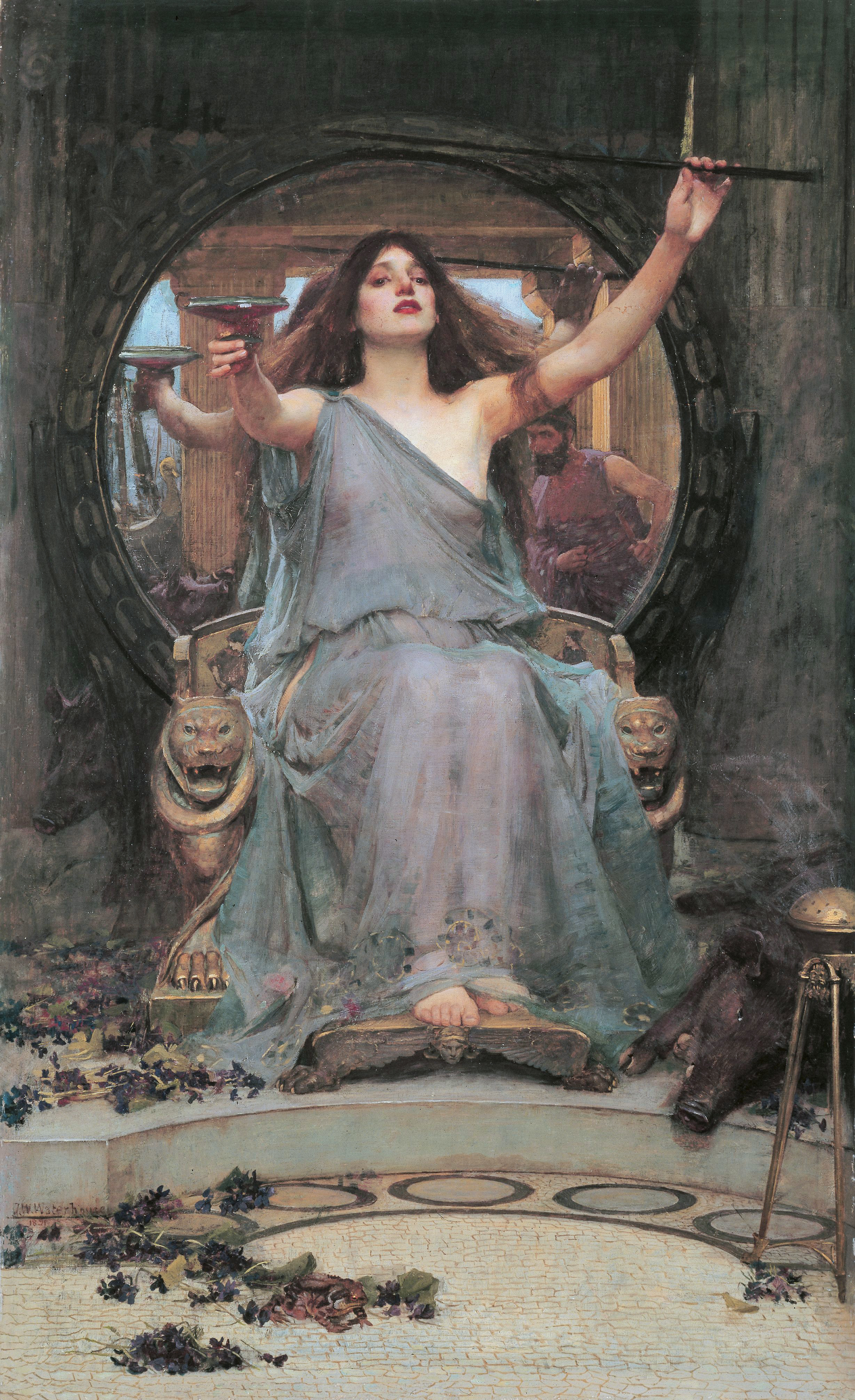
LT: I don’t know what I can say, really, except whether it’s a story, a visual image or a work of art, or even something that isn’t particularly a work of art, if you encounter it at an early age, it just takes over your mind or your imagination, and you think about it all the time. If you’re a lover of books, and if you’re a writer and a reader, it’s just one of those basic feelings that there’s some kind of deep magic involved.
PMR: It’s a visceral feeling, isn’t it? I think of being a 12-year-old and reading A Wizard of Earthsea for the first time, and literally being completely gripped by that story.
LT: Because you wanted to live in it.
PMR: Yeah, exactly. We’ve talked a lot about reclamation, so how does it feel for you to see your work coming back into print like this beautiful edition here?
LT: Wonderful. Particularly with My Death, because I felt how well it came out. You know, some people read it, and they loved it, and then it just kind of vanished. And of course, it was from a small press, and there were lots of other things for people to read. And then for it to be picked up… I mean, I couldn’t even believe it! But the editor at the NYRB got in touch with me via Facebook and just mentioned, well, I have a very small press but I’d be interested. And I’m thinking, well, it was published by a small press. Then I’m going, what? The New York Review of Books? NYRB? And not only that, NYRB Classics! I’m a classic! How amazing! It’s just great. I love it. And I’ve just sold the Catalan rights. It’s already out in Spanish and Italian. So, yeah, it’s wonderful, actually.
PMR: It’s definitely wonderful, and all these works need to be back in print, and we need new works as well once you’ve settled into your new home. I think that’s definitely the case. Lisa, thank you so much, it’s been a huge pleasure talking to you.
LT: Thank you.
Lisa Tuttle has written over a dozen fantasy, science-fiction and horror adult and YA novels, and hundreds of award-winning short stories collected in several volumes, including A Nest of Nightmares and The Dead Hours of the Night. She is the author of The Encyclopaedia of Feminism and currently writes a monthly science-fiction review column for The Guardian.
Paul March-Russell is the outgoing editor of Foundation and the co-commissioning editor for Gold SF (Goldsmiths Press). His Strange Horizons review of E.J. Swift’s When There are Wolves Again was shortlisted for the 2026 BSFA Awards.

