Guessing the winner of the 2011 Arthur C Clarke Award

We have a winner, not “just” of the Clarke Award itself, but of a certain contest too.

In the weeks leading up to the 2011 Arthur C Clarke Award ceremony, we ran a contest here on Torque Control to guess the winner of this year’s award, in conjunction with the Clarke Award itself and NewCon Press.

The winner will be receiving two prizes, both generously donated by NewCon Press.

The first is Fables from the Fountain, the recently-published anthology edited by Ian Whates from NewCon press. Fables is a collection of all-original stories written as homage to Arthur C. Clarke’s Tales from the White Hart and published in honour of the Clarke Award’s twenty-fifth anniversary. The volume includes new stories by Stephen Baxter, Ian Watson, Paul Graham Raven, James Lovegrove, Neil Gaiman, Colin Bruce, Liz Williams, Charles Stross, Eric Brown, Steve Longworth, Henry Gee, Andy West, David Langford, Andrew J Wilson, Peter Crowther, Tom Hunter, Adam Roberts, and Ian Whates. You can order a copy of Fables here (if you haven’t already done so!), with a share of profits going directly to support the Clarke Award’s current fund raising efforts. (A good cause!)

The second part of the prize is Celebration, an anthology of all-original stories published in honour of the fiftieth anniversary of the BSFA (which publishes Vector, of course), also edited by Ian Whates. It includes stories, original to this volume, by Ken MacLeod, Kim Lakin-Smith, Ian Watson, Tricia Sullivan, Jon Courtenay Grimwood, M. John Harrison, Molly Brown, Brian Stableford, Dave Hutchison, Liz Williams, Brian Aldiss, Martin Sketchley, Alastair Reynolds, Ian R. MacLeod, Christopher Priest, Adam Roberts, and Stephen Baxter.
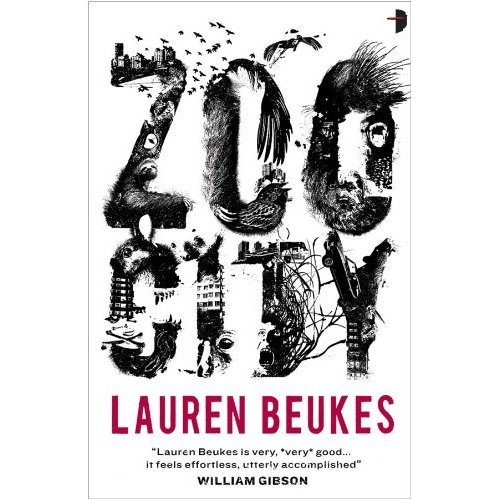
The book which won the Clarke Award was, of course, Lauren Beukes’ Zoo City, which means that the eleven people who chose that book off the shortlist as their entry, complete with reason why it should win, were all eligible to win this contest.

In order to choose the contest winner, our judge, Tom Hunter, put all eleven eligible names into the “ceremonial Clarke Award hat”*, from which the winning name was drawn by independent witness Kat Havelock.

And the winner is… Adam Christopher!

Congratulations to Adam! Tom Hunter will contact you shortly about getting the prizes to you, if he has not already done so.

* Intriguing! Is the hat photogenic?

Why Zoo City won the Clarke Award in 2011

Why did Zoo City win this year’s Clarke Award?

The jury isn’t allowed to tell us, but the entrants into the contest to guess the winner of this year’s Clarke Award can.

David Rowe:

Zoo City because if it doesn’t win then the judges are wrong.

Weirdmage:

I haven’t read any of the books, but that is the one I keep hearing the most positive things about. Also, she’s the most active on Twitter.

Adam Christopher:

Zoo City by Lauren Beukes. One of the most extraordinary books I’ve read in the last ten years or so. Hopefully the Clarke Award is just a stop-off point on the way to the Hugos.

Chris:

Zoo City by Lauren Beukes – any book recommended by William Gibson as a favourite stands a very good chance!

Laurian Gridinoc:

Because [it] made me realise how much I missed devouring a book.

theforgottengeek:

Zoo City by Lauren Beakes – like nothing you’ve read before. A true original.

Yagiz [Between Two Books]:

I haven’t read it yet but many people speak very highly of it and it’s been on my TBR pile. So I think it’s going to win the award and this will make me read it soon after.

adamjkeeper:

Zoo City by Lauren Beukes, because its a shoe-in.

Yidya:

Zoo City by Lauren Beukes because it’s as good a guess as any, seeing as I haven’t read any of these.

Emil:

For it’s originality and true grit, countermanding old-school cyberpunk without puerile braggadocio

Not Cas:

Zoo City. I like the cover and the title.

Group-Reading the Guardian Reviews Section

The best part about being in a bookstore at midnight when the latest Harry Potter book was released wasn’t having the first opportunity to read the latest installment. It was the joy of the yearly enterprise of group-reading the same book at the same time, of knowing that a blogged reaction would appear on my feed as soon as any given friend had finished reading it. It showed me the sheer, astonishing speed with which some people were able to skim the entire volume (two hours!) and the steady chipping away at it required by those unable to take time off from the rest of their lives. It was a momentary community of joint reading I have not even found in formal book groups, because for them, the reading is not the synchronous part; the having-read is.

In honor of the exhibit on the history of science fiction opening at the British Library later in the week, the Guardian has dedicated its Saturday Reviews section to the subject of science fiction. It released the first few articles a few days early, beginning the resulting group discussion which percolated across my feeds, which was spurred especially by mixed reactions to Iain M Banks and his irritation over those writing in genre who have never read it.

Today, the reviews section came out. One by one, commentators went to their local news agents to pick up a copy, which made it comment-worthy when at least one had sold out. (Those who have ongoing subscriptions, and thus automatic delivery, have not mentioned it. Why would they?)

To state the very obvious, one advantage of the newspaper section is that it is made up of articles. Small units enable more immediate reactions, such as just how apt or not the top 10 list of the best aliens in science fiction was, or noting the cumulative tendency of respondents in the initial survey of the best books or authors of science fiction (as picked by “top SF writers”) as being oriented towards books written long ago by men.

When it comes down to it, it is a small swathe of geographically-limited internet which is reading and responding to the Guardian today, especially about science fiction. But it is a group of whom many have gone out today specifically or in part in order to hunt down the paper version of a collection of critical works to read together.

Perhaps others of you have encountered it before, but I have never noticed a simultaneous effort to group-read science fiction criticism before, complete with physically tracking down the  publication on the same day as others, and I’m delighted that it’s happening today.

Out of this World at the British Library

The British Library will be hosting an exhibition this summer on the history of science fiction. The show runs from Fri 20 May to Sun 25 September.

The initial schedule of events has been posted – more will be added. Note that most require an admission fee. There are some very good looking events on the agenda. In particular, note that the author, Audrey Niffenegger, of this month’s book-for-discussion, The Time Traveler’s Wife, will be talking on Friday, 10 June, with Stephen Baxter about time travel. Her latest book, The Night Bookmobile, was recently published, but it is still her first which clearly dominates what she is associated with.

May: The Time-Traveler’s Wife

It is still 2003, and will be for another month yet, with a trio of books published in that year making it onto our collective list of the best science fiction novels by women published in the last decade.

The second book of 2003 is Audrey Niffennegger’s The Time-Traveler’s Wife. Astonishingly, given how much attention it has received, I have neither read the book nor seen the movie, so this really will be a first reading of it for me.

It was Niffennegger’s first novel. Although it is now what she is best known for, she has spent most of her career as a professional artist (see, for example, some of her prints) and writes of the novel,

She originally imagined making it as a graphic novel, but eventually realized that it is very difficult to represent sudden time shifts with still images.

Sometimes, a novel really is the right medium.

Strikingly, the title was not altered (to “traveller”) for British audiences.

I will be leading the discussion of The Time-Traveler’s Wife later this month. I hope you will join me in reading and discussing it.

Natural History: Recap

April’s book, Natural History, by Justina Robson, was the third in the chronological series of best science fiction novels written by women in the previous decade which we are reading here at Torque Control over the course of 2011. Published in 2003, it is the first of three books we will be reading from that year alone – clearly a significant one. Whether it was significant because it really was a bumper year for good science fiction, or because it takes seven years to truly judge, digest, and yet still remember a book, I leave to your judgement.

In my posts on the book, I focused on the parts which interested me the most: the fascinating Forged hybrid people, created, categorized, literally enmeshed in the debate over whether or not form dictates function; the alien technology which sparks off the storyline among the Forged and Unevolved; and the impression that ultimately, for all the things I like about it, I like this book better as a thought experiment than I do as a novel per se. And I really do like and admire it in that capacity.

Thank you to all who joined in reading or re-reading this book.

Discussion: Part 1 (Cladistics); Part 2 (Space and Stuff); and Part 3 (Conceptual Resolution)
Chris Moriarty at SFness

Natural History – Conceptual Resolution

Take a new kind of humanity, the Forged, created as part machine, part animal, part human, living uneasily with Unevolved humans.

Take the Stuff, a mysterious substance capable of becoming an instantaneous interstellar drive and a strangely-uninhabited alien planet.

Shake.

Natural History is, at its heart, an experiment, working out the ramifications of an alien intervention into humanity’s future developments. It features a wonderfully-wrought cast of characters in a plausibly sketched future, a couple hundred years ago. I didn’t get a strong sense of the fabric of daily life in that future so much as the power struggles over creation – quite literally encoded into the name of guy in de facto charge of shaping Earth, Machen, and the progenitor Pangensis Tupac. Robson shows us the lines of power and the lines of information, in names as well as actions.

Moments of importance are often underlined in overwrought moments of reaction:

Corvax leaped back from the consoles, straight through his virtual arrays, and landed against the wall, smacking his back so hard with the force of his own involuntary retreat that he snapped several feathers and a minor wing bone. (33)

Overreaction such as this, rather than just reaction, was little a little too frequent for my taste, especially given the general lack of emotional reaction to the immense potential of the universe theoretically opening up for humankind. That’s also why I could never quite relate to Isol, whose journey the book is structured around more than most. But those are minor objections.

What really undermined the ultimate shape of the plot arc for me was that there was no way to show the resolution; instead, it required a chapter of info-dumping. Hard-won, it is true, but nevertheless a weary unwinding in words rather than the visualized playing-out of the fate of those with Stuff. The plot-shape is discovery, a burst of experimental effort, and a steady dying away into a much more limited vision of the likely future.

And yet – this is an impressive book, more so on re-reading than reading for me. The world building was too rich for me to process the first time around. The Forged characters and the solar system which created them are the vividly-realized background of this book. Against them, an elegantly-conceptualized philosophy experiment, in effect, can be carried out; but I deeply admired the world more than I enjoyed the story qua story.

Enjoyment isn’t everything though. Since finishing Natural History, I keep finding ways to relate it to other books. To tell you what they are would be to more clearly spell out exactly how the book ends; suffice to say, Natural History does a more compelling job of realizing the possible consequences of that kind of communication system than most which are even vaguely similar.

Natural History – Space and Stuff

If I could instantly teleport through space, secure in the knowledge that I could safely arrive at my destination without worrying about co-occupying space with something else, and certain of being able to breath and not fall, I don’t think I would be content to do it only twice, not if the method I was using allowed for more than that. I would want to know the capabilities of the method I had found, and what wonders the universe holds.

In the first chapter of Natural History, Voyager Lonestar Isol, hurtling through space, damaged and dying, encounters what she nicknames the “Stuff”. It’s a multi-dimensional technology so advanced that it might as well be magic so far as these twenty-third century humans and Forged are concerned. In Isol’s unwitting, stubby hands, the Stuff mutates into a drive allowing for transportation at the speed of thought. And yet she only goes two places: an unknown planet, and back home to Earth.

Isol has a suspicion about the Stuff which the other characters don’t share. She knows she, personally, should not overuse it – but no one else realizes that for the majority of the book. Yet those other characters don’t seem bothered by this lack of use. They’re interested in the political ramifications of that single other planet existing. They’re interested in how the Stuff works, the seven-dimensional mathematics which may lie behind its improbable operations. They never spend that moment in wonder over the possibility that the whole universe has opened up to human exploration.

There are astonishing things and awe-inspiring vision in Natural History, but early on, the lack of wonder expressed by the characters themselves – up until one arrives on that alien planet – baffled me.

‘So, you believe this claim that Isol’s found an extra-solar planetary system?’

The Strategos glanced at the shadows of the two Orniths shifting on the blind, looking like a single monster with two heads. ‘What interests me is this machinery it mentions.’ (62)

Those are the two things which interest all the characters: a single extra-solar planetary system, and the machinery, the Stuff, which Isol has brought back from her interstellar journeying.

How can they be so blasé about the possibilities of instantaneous travel, especially when so many of the Forged to which we are introduced over the course of the story are transit ships? Even when a Forged transit ship take the Stuff on board in the form of a drive, he fails to make much use of it, even though he does not appear to share Isol’s reservations. The universe his apparent oyster, and he coasts about the Solar System.

Natural History is a book which made me feel wonder about the extraordinary things it contains; but it struck me as dissonant that its own characters so rarely succumbed to any sense of wonder about their own world.

(To be continued)

Arthur C Clarke Award Winner, 2011

Congratulations to Lauren Beukes, whose Zoo City yesterday won the juried Arthur C Clarke Award for the best work of science fiction published in the UK in 2010!

<strike>Twelve</strike> Eleven people correctly guessed the winner from the shortlist of six books. Next week, we will find out which of those twelve is the lucky winner of two short story collections, Fables from the Fountain, NewCon Press’ homage to Arthur C. Clarke’s Tales from the White Hart; and Celebration, an anthology published in honour of the BSFA’s fiftieth anniversary.

P.S. Abigail rounded up reviews of the shortlist, pre-award announcement.
After the award announcement: Alison Flood at the Guardian; Paul Graham Raven at CultureLab; Niall at Strange Horizons

BSFA Award Winners

The winners of the BSFA Awards for the best works published in 2010 were awarded at Eastercon on Saturday night in a ceremony hosted by Paul Cornell, assisted by hard-working BSFA Award Administrator, Donna Scott.

Best Novel: The Dervish House, Ian McDonald

Best Short Story: “The Shipmaker“, Aliette de Bodard (PDF)

Best Non-Fiction: “Blogging the Hugos” at Big Other, Paul Kincaid (Part 1)

Best Artwork: Cover for Zoo City, Joey Hi-Fi

Thank you to everyone who nominated and voted, and congratulations to the winners!