Every issue of Vector is special, but this one is especially special. It is guest-edited by science fiction author Stephen Oram, and it was made possible through a collaboration between the British Science Fiction Association (BSFA), the UK’s oldest and largest association for writers, publishers and fans of science fiction1, and the Institute for Development Studies (IDS), an independent think tank affiliated with the University of Sussex.
The theme is ‘futures.’ Plural, obviously: science fiction would never be content with just one future. ‘Futures’ is also shorthand for ‘futures studies‘: horizon-scanning, strategic foresight, scenario planning, anticipatory governance, forecasting and backcasting, red teaming and wargaming, speculative design and diegetic prototyping, experiential futures, futures futures, superforecasting and plenty more besides.
When businesses, governments, financial institutions and other actors seek to peer into the future, they often use some variety of risk management. Risk management overlaps with futures studies, but it is really pretty distinct. As crystal balls go, it’s a prosaic one. It involves identifying risks, assessing (perhaps quantifying) them, monitoring them, and implementing treatment strategies (such as avoiding, reducing, sharing, transferring, or informed acceptance). There is even an International Standard for Risk Management (ISO 31000). By contrast, future studies is a field where the expert and the charlatan can be difficult to distinguish. Many futures practitioners may be unsure themselves which of these they are, or in what proportion they are both.
Semiosis is second nature to us. The methods by which we transcribe and store information, the processes of creating and reading texts, are so baked into our everyday lives that we barely recognize them as inventions. People who we believe to be ‘ancient’ — civilizations who nevertheless succeeded many thousands of years of prehistory — believed writing to have been a miracle bestowed by heaven (Senner, 10-16). For our part, most of us seldom think about where writing comes from. If we do reflect on it, we might assume that writing is simply the best way (or the only way) to perform all of writing’s functions: our preoccupations are with the many hundreds of millions of bytes processed by a computer instead of the rote conventions of literacy. But that in the English-speaking world there should be some twenty-six visible orthographic marks and a handful of other numbers and symbols, that these should indicate English phonetics and be placed together to make words, that these words should be grouped into sentences with punctuation for clarification, that there should be this number of sentences on a page and that number of pages in a book, that a book should deliver information and move the heart within expectations of convention and genre, that there should be a library to organize these books, and that other languages though they use abjads, abugidas, or syllabaries, should be similar enough for translation — these are not inevitable developments.
By looking at the early history of writing I hope to isolate key moments of its adoption and development into the primary medium of the literate world today. At the same time I hope to explore other methods of data collection and meaning transference, other systems of semiosis, and speculate on their potential to act as modes of literary communication as complex as the written word. In doing so I risk a Whiggish and deterministic approach to history, I flirt with clumsy teleology and notions of progress. I hope that these extrapolations are understood as not one-to-one equivalences on an imagined great path of history, as they would be in an inelegant alternate history. I don’t intend here to elevate writing above speech, song and dance; nor to imply that my inspirations are in any way lacking their own semiotic richness and complexity. Rather, I intend this article as a playful investigation into possibilities, and as a reminder of how speculative fiction often presents as ‘universal’ what are really just the technologies and practices of a handful of recent powerful empires.
Though Avatar: The Last Airbender’s (Nickelodeon, 2005-2008) final episode aired 14 years ago, the television show left an unforgettable mark on its young audience. When the show started streaming on Netflix in 2020, waves of viewers returned to watch, including myself. Perhaps people found comfort in the show during the pandemic, and many new eyes were opened to the incredible art, moving storylines, and powerful social criticism about war, industrialism, and oppression.
For those who have not watched the show, some people in the world of Avatar are born with “bending” power, or the ability to manipulate one of the four elements (water, earth, fire, and air). Avatar follows the journey of Aang, the most recent reincarnation of the Avatar, the only person who can control all four elements. As the Avatar, Aang is connected to all his past selves and is the bridge between the mortal world and spirit world. In search of a way to defeat the tyrannical Fire Nation and restore balance to the world, Aang travels with water bender Katara and her brother Sokka. They are later joined by Toph, a blind earth bender who can sense motion and objects through the soles of her feet, and much later by Zuko, a reformed Fire Nation prince.
“Water. Earth. Fire. Air. Long ago, the four nations lived together in harmony. Then everything changed when the Fire Nation attacked.”
Every episode is introduced this way, reminding the audience that despite endearing storylines about love and friendship, the show exists always in the context of war, genocide, and diaspora. That context allowed Avatar: The Last Airbender to explore deeply complicated themes using a speculative world inspired by many cultures, including Japanese, Chinese, Tibetan, and Inuit.
While there are several ways to analyze how that complicated world is rendered across each episode, I will focus on records, record-keeping, and documentation or “information-as-thing.” Information-as-thing applies to all kinds of tangible objects that embody knowledge. Documents are not the only records that contain essential information because “objects that are not documents in the normal sense of being texts can nevertheless be information resources, information-as-thing” (Buckland, 1991). A record can be a book. It can arguably be a fish (Ginsburg, Ruth B., Yates v. United States). Information-as-thing is usually manifested in something material, and people can read, see, interpret, misunderstand, understand, control, and destroy it.
(left to right) Katara, Sokka, and Aang take in the stars at the planetarium.A dial allows Sokka to control the planetarium.Wan Shi Tong confronts Aang and the gang about using their knowledge for war.Wan Shi Tong destroys his library.The planetarium as it is in motion.Pipes protrude from a statue depicting an air bending master from the past at there Northern Air Temple.Green sludge oozes from a large statue of a sky bison, stylized to look like a Chinese guardian lion, popular in Chinese Buddhism.Aang holds one of the hermit crab creatures that have evolved at the Northern Air Temple in front of the mechanist and his son.The calendar in Temple fo Roku is activated when the light from the window touches the statues eyes.
Finding other forms of resources outside of paper is also important in Avatar. Posters, maps, and scrolls often guide the main characters to an insight, refuge, or even triumph – but these documents are corruptible, easily changed or destroyed. The authoritarian regime of Earth Kingdom city Ba Sing Se disposes of posters and pamphlets that counter the government’s messaging in ‘City of Walls and Secrets’ (2.14). The totalitarian Fire Nation has re-written its history books to better suit its narrative of conquest in ‘The Headband’ (3.2). If these tactics sound familiar from our own world, it’s because they are meant to. And much like in our world, the fragility of paper documents, erasures of history, and domination of information exchange often require the past to be reconstructed through cultural objects, ancient architecture, and other artifacts. Even in a world of earth bending, where someone could use her power to shatter stone carvings and sacred temples, there are many intact structures and objects scattered across the four nations.
How Jennifer Walshe is Reinventing the Music of the Past and Reclaiming the Music of the Future
By Paul March-Russell
One of the highlights of the 2022 Proms season was the London premiere of The Site of an Investigation (2018) by the Irish avant-garde composer Jennifer Walshe. This thirty-three minute piece in twenty-six sections offered a synopsis of Walshe’s preoccupations. Walshe herself, sounding like a cross between Laurie Anderson and Diamanda Galas, took the role of soloist, offering an elegiac commentary upon such topics as the race to Mars, the threat to the oceans and the prospect of digital immortality. The orchestra, largely acting as the symphonic backdrop to Walshe’s fragmented monologue, were further inveigled into the proceedings by waving party streamers, building and demolishing a tower of bricks, and wrapping a four-foot high giraffe in crinkly paper. Both the absurdity and incoherence of the piece, culled from an array of internet sources, recalled ‘the blip culture bombardment’ of the mediascape in Don DeLillo’s White Noise (1985).[1]
Jennifer Walshe/Arditti Quartet, EVERYTHING IS IMPORTANT (2019). Credit: IMD 2016/Daniel Pufe
Exactly a hundred years since the first composition of Kurt Schwitters’s sound poem Ursonate (1922-32), a text that Walshe cites as an inspiration,[2] such anti-art performances can still drive audiences either to delight or despair. In Walshe’s case, however, The Site of an Investigation is only an adjunct to her two main projects in recent years. The first, Aisteach, archives an alternate history of an Irish musical avant-garde that never existed, presenting original sound recordings and learned academic discussion. The second, The Text Score Dataset 1.0, involves the compilation of over 3000 text scores with which to retrain machine learning algorithms so that new scores can be generated by AI. This article offers an introduction to these two projects from the perspective of Walshe’s acknowledged debts to science fiction. The final section presents a speculative synthesis since, at the time of writing, Walshe has not linked the two projects together. But what if Aisteach was included as part of the dataset? What kind of future music emerges from an invented set of past sounds? How might we reclaim the future as well as the past? Could we obviate that ‘slow cancellation of the future’ as described by Mark Fisher and others?[3]
This two-day conference was organised by the London Science Fiction Research Community (LSFRC), with support from Birkbeck, University of London. This was the third wholly online annual conference held by the LSFRC since the beginning of the pandemic, although this event was somewhat smaller than its predecessors. Making use of the online technology, speakers and audience were again drawn from across the world, and from many different perspectives.
Although the notion of ‘extraction’ was interpreted broadly, at its heart it was located in a series of exploitative colonialist, capitalist practices. The original call for papers sought:
… contributions that think with, through and about extraction in all its forms – as extraction of human and nonhuman subjects; appropriation of knowledge and indigenous practices; instrumentalization of landscapes beneath, upon and beyond the Earth; parasitism; pollution as colonialism; the accumulative schematisation of linear temporal frames; forcefully extracted emotional labour; legacies of trauma and more – and its relationship with sf both as an extractive form of fiction and as a corrective/counter to extraction. From asteroid mining to dream harvesting, we want to engage with sf texts and ways of thinking across all media that explores, unravels and seeks to push beyond extraction’s mastery of the past, present and future.
The LSFRC runs a regular reading group exploring the same themes as the conference during the year leading up to each annual event. I attended a few of these, which were very productive, and encouraged a broader consideration of the subject. Despite its name, the reading group covered a range of media, including graphic novels, films and games as well as written sf, and the same was true of the conference.
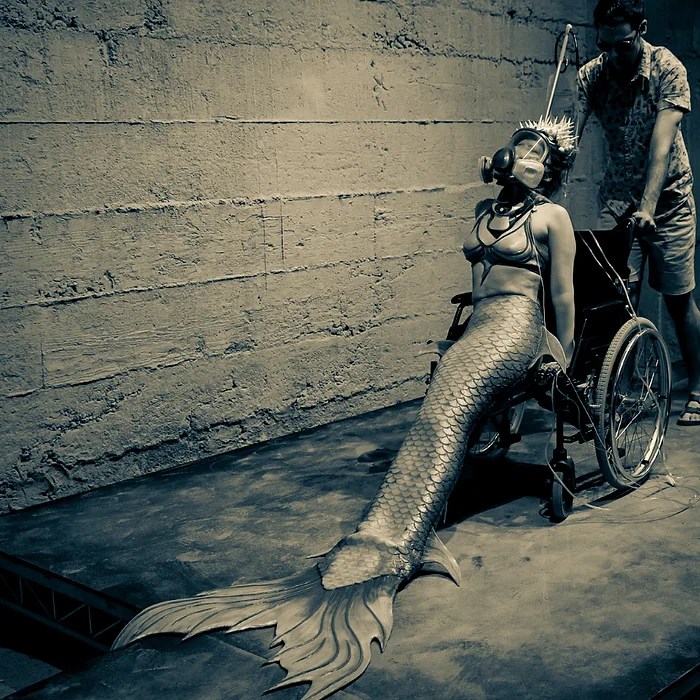
Rather than cover every item I attended, I will concentrate on those papers that were my personal highlights, although I realise that in taking this approach, I will doubtless fail to mention some fine presentations. The first day began well, with two papers that I particularly enjoyed in the first panel, on ‘Human and Nonhuman Entanglements.’ Iuliia Ibragimova’s paper on ‘Space-Faring Animals and Their Humans’ looked at the sentient spaceship trope in sf literature and tv. Developing a brief survey of examples, including the Spline in Stephen Baxter’s Xeelee sequence, the insect/machine hybrid Lexx, and the Miri ships in Nnedi Okorafor’s Binti series, in a series of ravishing slides, she considered the relations between the human/humanoid aliens and the sentient spaceships presented as non-human animals. Ibragimova suggested that alongside more hierarchical and exploitative depictions, some of these examples also offered an opportunity to challenge anthropomorphic assumptions, and pointed towards more positive models of co-existence. Alongside this paper, Chiara Montalti’s ‘The Ecology of a Mermaid’ explored the notion of the mermaid to discuss the relationship between disability and environmental (in)justice, notably using the performance piece The Mermaid by the Australian artist and dancer Hanna Cormick. The latter has a cluster of medical conditions that require the use of a wheelchair, braces, respirator mask and oxygen when outside. The figure of the mermaid, as one who is differently abled in different environments, is used to suggest that the perspectives of disabled people can help address environmental toxicity and injustice. There was a need for this to be reflected more often in sf. The various papers delivered on this panel opened a space for a fruitful discussion, with the notion of ‘super-abled’ insectoidal non-humanness compared to the aqueous mermaid (with the waterborne mermaid as possibly still-disabled), and questions about individuality in the framing of the insectoidal ships.
The Mermaid by Hanna Cormick
Amy Cutler’s paper, ‘“[dying words] More light…” : Anti-Cinema and Black Hole Fishing’ described a creative experiment, her work ‘7 Ways of Exploiting A Black Hole’ (2022). She explored techniques for decentering cinema, moving away from the single-screen display to a fixed audience, and discussed the use of cinematic techniques to present and comment on astrophysics and future visions of extraction. The latter was pictured in terms of Roger Penrose’s ‘The Lost Art of Fishing in a Black Hole (1971)’ – in which he considered how energy might be extracted from a spinning black hole – as well as other interventions. How to exploit the least exploitable thing in the universe? Yet the black hole can also be considered an archive of the past, and hence a form of cinematic library. Conceived as a commentary on the languages of astrophysics and future visions of extraction, and a form of cinema deliberately inverted to curb storytelling practices of ‘eternal growth’, Cutler’s cinematic installation engaged with multiple readings of the Penrose process for geostationary energy extraction as well as the notion of the black hole, also touching, along the way, on the myth of Icarus, Clarke’s The Fountains of Paradise (1979) and Disney’s film The Black Hole (1979).
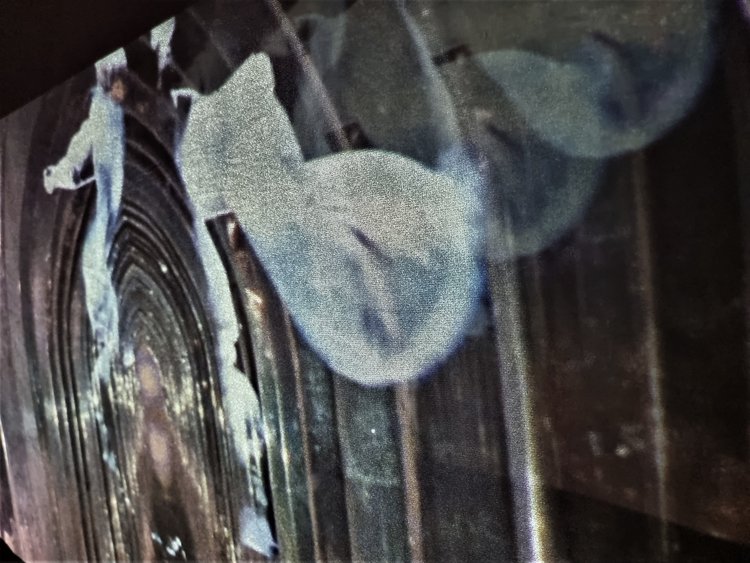
Lorrie Blair’s presentation on the same panel, ‘An artist’s response to living on a damaged planet: An Appalachian ghost story’ brought together three strands from Appalachian Ohio: a historic mine disaster, acid drainage from abandoned coal mines, and her own lived experience as a child and a young teacher. She described how she played in creeks near the mines as a child, and as a teacher learned of the Hocking Valley coal strike, which resulted in an extensive mine fire in November 1884. Burning coal cars, filled with oil-soaked wood, were pushed into the mines in response to the company’s use of scab workers during the strike. Flames burned into the coal seams, and over time the ground collapsed under buildings and roads, and mine gases escaped into local towns. Residents were evicted and homes demolished. The fires are still burning below ground: steam comes from wells, roses bloom in Winter and snow does not settle. Blair creates subtle and complex photographs to tell the story of this ongoing environmental disaster, using digital photography and paint sourced from the toxic run-off from streams near the abandoned mines, combined with cyanotype chemistry. Her images are palimpsests of old and new images, creating ghost-like collages echoing the past and present, combining the dead with the living. I found these images quite haunting, and a compelling reflection on the damaged and damaging, complex pasts she described. The manner in which each of these papers used various technologies of image-making and sharing to tell their stories opened a rich discussion. It created a materiality of storytelling, but there was also cultural cost, for example, photography also pollutes. Lorrie suggested the making of small work was key as a hope that the resulting artwork’s environmental footprint could be lessened.
Science fiction often pictures astronomical observatories, and the astronomers therein, in a positive light. They are the first to spot the Armageddon meteor or alien invader, and they tend to symbolise a pure, disinterested science. The latter is also emphasised by their frequent remote, mountaintop locations. One such location is the contested site discussed in Teresa Shewry’s paper, ‘”Making Things Look Bad”: Extraction, Humor and Science Fiction at Mauna a Wākea’, which provided a constructive counterargument to such views. A new Thirty Meter Telescope (TMT) is proposed for the Hawaiian mountain of Mauna a Wākea, whose potential cultural and environmental impact is significant. The mountain has an alpine ecosystem, and the attempt to use Crown lands for the observatory is seen by many as an act of expropriation and accumulation by the settler state, in aid of militarisation and the exploitation of space. Shewry explored some of the artistic responses to the proposals, introducing the short comic film ‘TMT-5000’ by Rian Basilio and Conrad Ikaika Lihilihi, (see on YouTube), which compressed the debate over the new device into a domestic setting. The adult child begs for a new toy telescope while his father tells him off for having already messed up the house with thirteen previous toy instruments. This referenced the thirteen astronomical telescopes already installed on the mountain, while ridiculing them as simply toys – and there were other, similar reflections, undercutting the project. The crude and sometimes slapstick humour was also an interesting weapon of resistance to the corporate planners. It worked to undermine the seeming seriousness of the astronomical community, the architects and engineers, and opened up the opportunity for different conversations about the contested spaces.
In the same section of the conference, on ‘Blue SFs/Oceanic/Coastal’, Peggy Riley also focused on a specific place, discussing the writing of her latest novel in her paper ‘Uncanny Intimacies: Writing Seasalter’. Riley, who lives in Whistable, just down the coast from Seasalter, wrote the novel for her MFA dissertation at Birkbeck. She described the colonisation of the shoreline by aggressive oyster farming, extraction of the estuary by dredgers and the coastal erosion brought on by drought and rising tides. A landscape of sewage, unexploded bombs and of power lines to wind turbines. The locals in the town must deal with this landscape and these issues, as well as the increase in migrant crossings in East Kent. One character in her story keeps a monster’s tail, as a memorial of a battle in 1953, in the last great flood. When he dies, and his son returns, the monster comes to claim its tail, and calls upon the sea to rise again, and drown all the lands. In describing her approach, Riley referenced Donna Haraway and LeGuin, as well as Amitav Ghosh’s linking of the idea of the Uncanny with climate change, and the sense of menace and uncertainty it engenders. Her story was also inspired by the landscape itself. A tale where the human and nonhuman meet and both are in crisis. I found Riley’s slow and careful description of her work entrancing, as it interlaced the landscape with the forces that had created it, and the theoretical arguments and positions that had inspired her. This was my favourite presentation. Riley also ran a creative workshop later in the conference, which, sadly, I couldn’t attend.
Much of the conference was multi-stranded, with two or three panels of thematically-linked papers given in parallel. Often, at such events, whatever presentations I attend, I remain slightly haunted by a sense of regret, perhaps akin to buyer’s remorse or just a simple fear of missing out, about choices I have made. The feeling that ‘over there’ is a shadow conference made up of all the panels I didn’t see, that is marginally better than the one I am actually attending. And it is one I might actually have been at, if I’d only chosen differently. That feeling was entirely absent here. Perhaps because I had purposefully chosen a number of papers that were slightly out of my comfort zone. Certainly I found myself concentrating harder than usual to appreciate and understand the papers of Blair and Montalti, to their certain benefit. There was also a strong sense that the conference had been carefully curated. There were strong synergies and resonances between the papers, which opened up a number of spaces for the subsequent discussion. Many focused on contested landscapes and spaces, as might have been expected, given the theme of the event. Even so, the panels were exceptionally diverse in subject and treatment.
All conferences, it seems, have challenges to overcome. Sadly, due to illness, the keynote speech by Kathryn Yusoff (Professor of Inhuman Geography at QMUL) had to be cancelled at short notice. The organisers did manage to substitute a selection of short films related to the conference theme in the same slot, including Pumzi (Wanuri Kahiu, 2009), The 6th World (Nanobah Becker, 2012), Three Thousand (Asinnajaq, 2017), and an extract from Tarkovsky’s Stalker (1979). While this was of course a poor substitute, it did at least provide further perspectives on the theme. Technical issues also intruded: at least one presenter had problems with the Blackboard software used for the conference. This resulted in a successful switch of the presenter, moderator and the whole audience to Zoom. Everyone involved moved across just for that paper. Which arguably demonstrated how au fait we have all become with conferencing technologies over the last three years. However, in another paper I attended the sound was so poor that, despite the work of the organising team, I could hear nothing of what was said. And as someone who also gave a paper at the conference, I can vouch for the efficiency and helpfulness of the LSFRC team. This online conference was also the first such in which I felt the planned social event actually worked. The Conference chat system was extensively used, with the screen offering slow-moving, immersive images, and background music playing. The atmosphere was relaxed and the ‘conversation’ seemed to flow spontaneously, albeit limited by the software. Nevertheless, I feel it still didn’t match up to the full richness of an in-person event; so, if the risks of Covid continue to fade, I’m hoping that next year the organisers will offer the opportunity to attend the conference in the flesh.
This story begins with a book that was given, and then taken away. It was Christmas Eve, the night my family and I traditionally exchange gifts. My youngest sister took her turn doling out packages, many of them small, rectangular—the size of books. My brother and I were recipients of two such similarly-sized, book-shaped packages. We were instructed to open them simultaneously (with the caveat that they might be mixed up, that I might be holding his, and vice versa). I tore off the wrapping paper from my book and behold: it was the wrong book.
This is how Patrick Rothfuss’ The Name of the Wind (NW) first made its way into my hands:[1] briefly, and only to be snatched away and swapped with another mainstay of contemporary fantasy writing—Brandon Sanderson’s The Way of Kings. This first encounter, however, is hardly inappropriate given the particular place of books—the ways they circulate, the value they hold, the physical spaces in which they’re stored—in Rothfuss’ Kingkiller Chronicle, a trilogy whose third installment has yet to appear on shelves (though an off-shoot novella, The Slow Regard of Silent Things, has offered readers an interlude while they wait for no. 3).
The Chronicle is, from its earliest chapters, exactly what it says on the box: a chronicle—events which are being written down by the appropriately-monikered Chronicler, who records, by hand, the life events of the narrator, Kvothe—musician, student, and would-be arcanist-turned-innkeeper by the time we meet him in the outer narrative frame of The Name of the Wind. Kvothe’s life story, as told in The Name of the Wind and its sequel, The Wise Man’s Fear,[2] follows his development as a young boy who grows up among an itinerant troupe of performers (thespians, musicians, and magicians) and is singled out, at a young age, as a prime candidate for education at the (apparently singular) University and instruction in the arcane (read: magical, but also scientific and plastic) arts. Before the troupe’s massacre by the mysterious Chandrian (a traumatic event which kindles his desire to enter the University in order to gain access to its famous Archives and learn more about his family’s killers), Kvothe begins his training in the art of sympathy with the skilled arcanist who travels with the troupe. From this arcanist, he inherits a book—a book that he later hocks to fund his first term’s tuition at the University, where he undertakes study in a variety of subjects, quickly passing from one rank of the Arcanum to the next whilst also facing an inordinate number of extracurricular trials and adventures along the way.
As the title of the trilogy and its first installment suggest, names, stories, and storytelling should be at the forefront of our minds as we read the Chronicle—stories which we witness literally coming into being as stories as we listen to Kvothe tell them and watch Chronicler write them down on one broad sheet of paper after another. But it’s not only stories themselves which fascinate Rothfuss and his characters in the Chronicle. It is also the physical forms through which stories and histories are transmitted that matter. That is, for Rothfuss and his characters, booksmatter.
As a genre committed to exploring “alternatives to how we live”, questions of justice have always been at the forefront of contemporary SF writing. One of the most frequently recurring themes has been that of crime and punishment: indeed, SF’s focus on technology has allowed writers to explore a range of questions related to criminal justice, from policing (Philip K. Dick’s “precogs” come to mind) to prisons. Some of the most interesting thinking has considered entirely alternative forms of criminal justice altogether: for example, Alastair Reynold’sThe Prefect gives us a brief glimpse of a future society where policing takes place through randomly selected civic volunteer militia, which are disbanded as soon as the immediate task is done.
Issues around criminal justice fall within the broad category called “corrective justice”: i.e., at their root, they deal with how to rectify a wrongful harm or injury inflicted by one person (or set of persons) upon another. Corrective justice assumes a prior normative consensus about what constitutes wrongful injury, and then asks: how is this injury best rectified? Variants of this question are at the heart of the many volumes of science fiction that deals with policing, crime, and punishment. They are also present in some of the most famous “courtroom” scenes in SF: for example, in Star Trek: The Next Generation’sThe Measure of a Man, Commander Data must establish that he is entitled to a right to self-determination, in order to avoid being dismantled by Starfleet. The establishment of his rights takes place through structured courtroom argument, and it turns upon the interpretation of existing Starfleet law.
There is, however, another set of anterior questions that corrective justice and courtroom set-pieces do not adequately address. These are questions of “distributive justice”: that is, the allocation of resources across society [1]. Questions of distributive justice are embedded within the political economy and the constitutional arrangements that structure a society. It is here that I think that we have not yet seen the variety and diversity of treatment in SF that we have seen when it comes to questions of corrective justice.
Consider, for example, Isaac Asimov’s Foundation Trilogy and Arkady Martine’s A Memory Called Empire and A Desolation Called Peace. The two series are separated by seven decades, and—as Martine has noted in interviews—A Memory Called Empire, in many ways, is in conversation with, and responds to, Foundation. However, while very different in their sensibilities, the two series are united in their starting point: i.e., the choice of Empire as the overarching governing and administrative framework of the galaxy. With this initial choice, a set of other choices inevitably follow: a certain structure of the political economy, centralised administration, the distinction between a core and a periphery, and the flow of resources from the latter to the former. While both series explore a range of questions with great subtlety and thoughtfulness within this context, their basic assumptions—that go to questions of distributive justice—are unshakeable [2].
Iain M. Banks’ Culture novels and the Strugatsky Brothers’ Noon Universe are two SF series where the starting point—in terms of governance and political economy—is very different, and therefore presents us with different questions of justice. Both the Culture and the Noon Universe and imagine a post-scarcity, anti-capitalist society, where there is no more private ownership over the means of production (the root of a lot of distributive injustice). However, both the Culture and the Noon Universe come to us as fully-formed, mature societies, with the writers focusing almost exclusively on external conflict with other societies (and thus dropping us back into the well-traversed terrain of corrective justice: think of Banks’ Look to Windward or the Strugatskies’ Hard To Be A God).
One striking exception is Ursula K. Le Guin’s The Dispossessed. The Dispossessed is an SF meditation on distributive justice par excellence. Le Guin takes us into the nuts and bolts of how Annares—an anarchist, non-capitalist, post-carceral society—would function in practice. The questions she considers range from social production (indeed, running through The Dispossessed there is an open question of whether it is just that the weight of moral consensus effectively compels everyone to spend a certain amount of time engaging in physical labour, regardless of what their other talents might be) to social reproduction (i.e., the range of activities that ensure the continuation of social life, including child-rearing). Indeed, in The Dispossessed, questions of distributive justice are presented particularly starkly, as Annares is a counterpoint to the planet Urras, where a recognisably capitalist and a recognisably state-socialist nation-state are locked in a conflict with each other.
The Dispossessed is not entirely alone in this. There is a tradition of writing—such as Kim Stanley Robinson’s Blue Mars [3]—that has built upon it. It is my impression, however, that as a genre, SF still remains overwhelmingly focused on issues around corrective justice. That is not to suggest that these issues are unimportant or uninteresting; however, as we enter a time in which the climate crisis reveals to a greater and greater degree the unsustainable bases of our current society and political economy, it will therefore be interesting to see if science fiction will respond with a greater, sharper focus on questions of distributive justice.
Notes
[1] The terms “corrective justice” and “distributive justice” are, of course, reductive; I use them here as placeholders for a set of family resemblance concepts. Here I focus on these two concepts of justice, although other important distinctions include those between “retributive justice,” “restorative justice,” and “transformative justice.” Broadly speaking, retributive justice focuses on punishment and compensation, restorative justice focuses on repairing relationships between offenders and victims, and transformative justice focuses on changing both these interpersonal relationships and the wider social and economic structures within which harm occurs.
[2] Although, arguably, they are challenged to an extent at the end of Foundation and Earth, and with First Contact in A Desolation Called Peace.
Gautam Bhatia is the author of the SF duology, The Wall and The Horizon. He is the co-ordinating editor of Strange Horizons. In his spare time, he is a constitutional lawyer.
“Futures from the Margins”—the theme of this year’s annual conference of Science Fiction Research Association (SFRA)—reminds me immediately of Paul Kincaid’s review of The Cambridge History of Science Fiction (2019) co-edited by Gerry Canavan and Eric Carl Link, published in Extrapolation 61.1. Kincaid claims that this anthology challenges the American-centric history of sf and re-writes it with a hope of amplifying the previously repressed voices from the “unseen” worlds—voices from China, South and South-Eastern Asia, Eastern Europe, Middle East, Latin America, and Africa. “Such cultural differences give this sf a different feel from the Campbellian hard sf we are used to, but it is sf nonetheless” (217), and they all respond in various ways to the socio-political condition in the related countries, regions, and nations at a specific moment.
No matter how global or how planetary sf appears, it is always anchored in the soil of particular places. Although the diversity of sf has been disguised under the ostensible universality formed pretty much in accord with the American tradition, localised interpretations are waiting to be discovered. “Once the will was there,” writes Kincaid, “it didn’t really take long to start unearthing them” (216). In line with Kincaid’s comments, I believe the conference “Futures from the Margins” also indicates such a will of unearthing, of amplifying the previously muffled voices, and—as demonstrated in the programme—of foregrounding the issues of those whose “stakes in the global order of envisioning futures are generally constrained due to the mechanics of our contemporary world” (CoFUTURES).
Isn’t capitalist system, which humans invented 200 years ago, growing into an uncontrollable beast that will devour human society?
Clock of Babel runs the whole world to the same rhythm of time.1]
The Cabinet
The Cabinet starts with a description of the cabinet. Inside, there are files of amazing people. A man who is turning into a tree, a woman who is growing a lizard instead of a tongue, and many more. This is not regarded as much of a mystery, and we never learn what is the mechanism of their transformation. The fantastic simply exists, not to be questioned, though for sure, in other respects this is our world. The protagonist could have come straight from the pages of David Graeber’s Bullshit Jobs. When he is not describing the fantastic files, he is ranting about his predicament: “As long as you don’t ask yourself what you are doing, you can keep doing it until the end of life” or “the only thing that capitalism ever produced is anxiety”. Reading The Cabinet from the perspective of Bullshit Jobs seems appropriate in more senses than one. The Cabinet is a multipronged critique of capitalism disguised as a fantasy novel.