Guangzhao Lyu, Angela Chan and Mia Chen Ma. Published as part of Vector 293 exploring Chinese SF. If you’d like to receive the issue, join the BSFA.
This is a transcription of Chen Qiufan’s public talk at Goodenough College, London, invited by London Chinese Science Fiction Group (LCSFG), on 12th August 2019, which is followed by a conversation with Angela Chan and Mia Chen Ma. This was originally published in Chinese on LCSFG’s WeChat account.[1]
The London Chinese Science Fiction Group (LCSFG) is a community for people interested in Chinese languages (sinophone) science and speculative fiction. Since it was founded in April 2019, LCSFG has been organising monthly reading groups focusing on short stories available both in Chinese and English and has been inviting established/emerging Chinese SF writers to participate in online discussions following the pandemic lockdown since March 2020. During our meetings, we explore the story’s themes, literary styles and even translation techniques and choices, as a way to better understand the piece, as well as the evolving field of contemporary Chinese SF.
Chen Qiufan:
Firstly, many thanks to the London Chinese Science Fiction Group for inviting me here, and to Goodenough College for providing such a gorgeous place. Today, I would like to talk about my debut novel, and only novel to date, Waste Tide. And don’t worry, there won’t be any spoilers. Before I discuss the story itself, let me give some general background information and my inspiration, that is, why I wanted to write a science fiction novel about China’s near-future in conjunction with e-waste recycling.
Reviewed by Nick Hubble. This review first appeared in The BSFA Review.
Originally published in 1918, Rose Macaulay’s speculative satire, What Not: A Prophetic Comedy, extrapolates from the wartime state’s unprecedented intrusion into private life – conscription, censorship, food rationing – to imagine a Ministry of Brains committed to raising public intelligence through various measures such as the ‘Mental Progress Act’, the introduction of a ‘Mind Training Course’ and, more sinisterly, stipulating who may marry who according to an A-C intelligence classification. Babies born according to the regulations gain their parents financial bonuses, but unregulated infants are taxed on a sliding scale ‘so that the offspring of parents of very low mental calibre brought with them financial ruin’.
As Sarah Lonsdale points out in her helpful introduction to the novel, there are clear points of comparison with better known works of utopia and dystopia. Like William Morris’s News from Nowhere (1890), What Not begins in a carriage on the London underground. More significantly, Macaulay moved in the same circles as Aldous Huxley and it is difficult to imagine that her work was not in some way an influence on Brave New World (1932), which might be seen in Lonsdale’s words ‘as the world of What Not some few decades into the future’. Finally, the novel also anticipates George Orwell’s Nineteen Eighty-Four (1949), in its story of one clerk’s revolt against the system in the name of love.
Macaulay’s protagonist is Kitty Grammont, introduced to us as a woman who takes both the New Statesman and the Tatler: ‘She was partial to both, which was characteristic of her attitude towards life’. This attitude of seeking to have her cake and eat it corresponds to the general sense conveyed by the novel – people’s experience of the war having overturned all sorts of time-honoured and apparently stable social norms – of nervous, reckless times in which people are determined to make the best of whatever they can get and live life to the full. However, what makes Kitty stand out from the crowd of female clerks, whose culture is nicely evoked, is her determination ‘to defeat a foolish universe with its own weapons’. Her romance and secret marriage to Nicholas Chester, the Minister of Brains – who is forbidden to marry by his own laws due to the mental deficiency of his siblings – is played out as a scathing comedy rather than the tragedy it might be in a lesser work.
The relentless cynical wit means that the novel remains, as Lonsdale suggests, an ambiguous and ‘sometimes slippery book to grasp hold of’. On the one hand, Macaulay clearly does not endorse the eugenics programme of the Ministry, which unsurprisingly leads to many abandoned babies turning up on doorsteps around the country. On the other hand, What Not is not a straightforward dystopian warning or ‘protest against social engineering’ as the back-cover blurb suggests. One of the most heart-felt passages in the novel is Chester’s bitter complaint at the stupidity of a society that fails to educate people and provide effective medical care. Equally in favour of social reform is this pointed narrative gloss on male audience responses to Kitty publicly talking on behalf of the Ministry: ‘Rural England [. . .] was still regrettably eastern, or German, in its feminist views, even now that, since the war, so many more thousands of women were perforce independent wage-earners, and even now that they had the same political rights as men.’
Therefore, it probably makes sense to see What Not as a comically-resigned lament for the impossibility of evading the cruel stupidity of life without imposing a system that is even crueller and more stupid. However, there is also just the faintest suggestion in Kitty’s momentary out-of-body experience, in which she realises the entire society depicted in What Not is no more than a ‘queer little excited corner of the universe’, that other worlds are possible. Overall, the novel should be recommended as more than a historical curiosity.
Reviewed by Paul Graham Raven. This review first appeared in The BSFA Review.
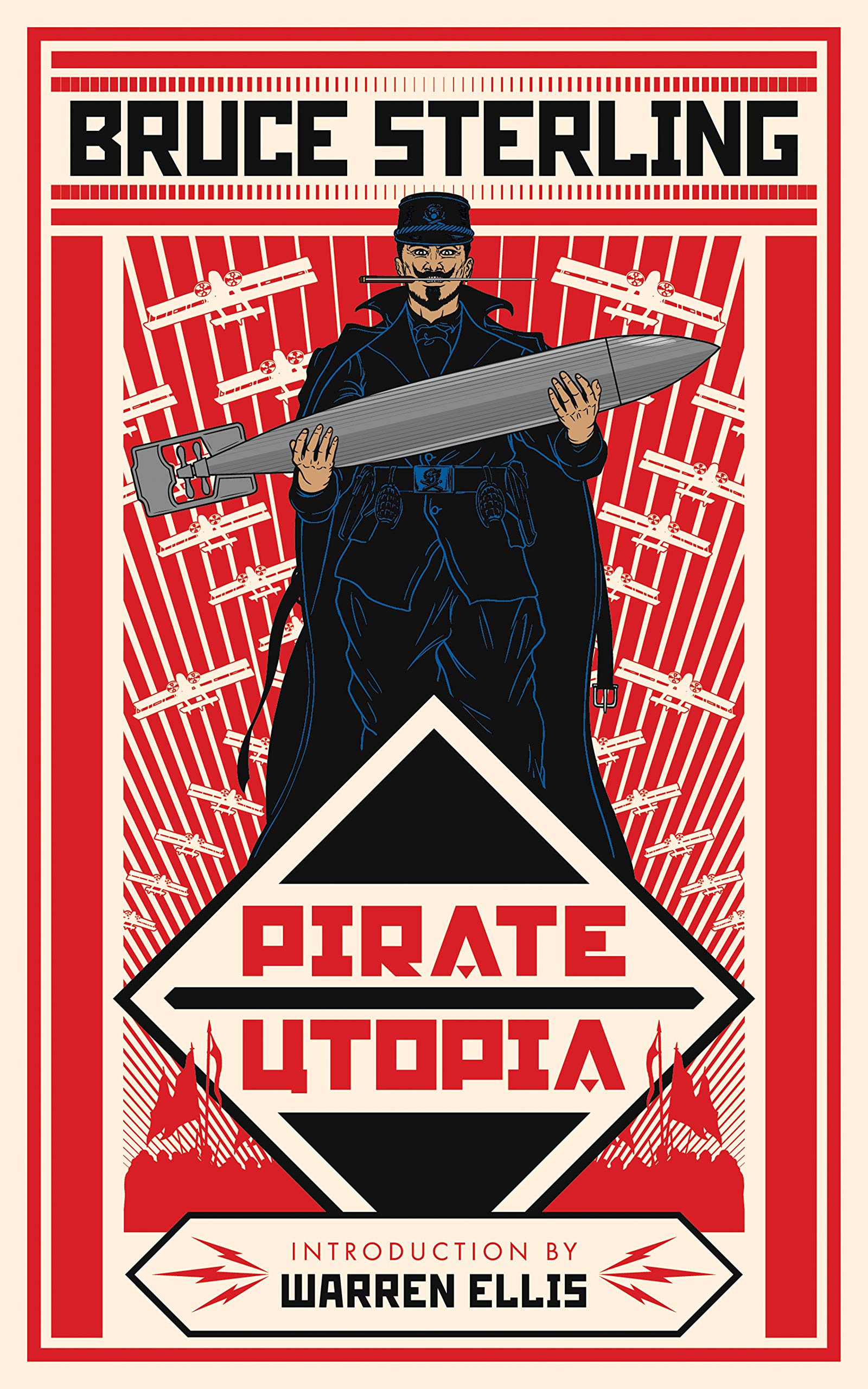
If you ever publicly identify as a futurist, you will eventually be asked what contemporary futurism – an admittedly vague term which somehow covers everyone from tech-centric venture capital strategists and Pentagon policy wonks to Ray “Singularity” Kurzweil and the snake-oil Barnums of Silicon Valley – has to do with the proto-fascist 1920s Italian art movement of the same name. Bruce Sterling’s latest novella, Pirate Utopia, is (in part) an attempt to answer that question.
Written in the bombastic style that animates much of Sterling’s more recent short fiction, Pirate Utopia is populated by characters whose larger-than-lifeness is predominantly a function of their unfettered will-to-power (but also cocaine). In this alternate Adriatic, minor historical figures and allegorical types rub shoulders in Fiume, the little city at the heart of the breakaway microstate known as the Republic of Carnaro, where Futurist poets and artists work side by side with rogue military leaders and mercenary engineers to establish a proto-fascist entrepôt with its own hi-tech missile factory.
Identified by glamorous (and thus ridiculous) nicknames – “the Poet”, “the Ace of Hearts”, “the Art Witch” – the heroes of capital-F Futurism unwittingly slip into the narrative space occupied, in our own timeline, by the more fully developed European fascisms of the early 20th Century: Mussolini, a magazine editor, is emasculated in his office chair by Syndicalist women with single-shot handguns, while a former Austrian art student takes someone else’s bullet during a failed putsch in a Bavarian beer-hall. But Carnaro is doomed not to last – for as Peter Lamborn Wilson has observed, the pirate utopia is always-already temporary and contingent; the polder cannot hold.
The arrival of “the Magician” – one Harry Houdini, squired by two USian pulp fiction pioneers – and his inviting of Lorenzo Secondari the Pirate Engineer to the States completes the story of Futurism and futurism. Both are essentially poetic movements fuelled by utopian genres of writing and the creative arts, and powered by the modernist legacy of a lust for power, velocity and creative destruction. Which is not to claim that small-f futurism is necessarily fascist, of course – but the same desires and fetishes can be found the manifestos of both, and today’s self-styled “neoreactionaries” (a small but scary intellectual splinter of the soi disant “alt-right”, fond of cool tech, racist pseudoscience and the presumed meritocracy of enlightened dictatorship) mark the ideological space where futurisms past and present overlap. Both futurism and Futurism are far less about the future than they are about a present in the perpetual process of radical sociotechnical reconfiguration, and the possibilities of power in times of flux.
Warren Ellis’s Normal begins with an ageing academic demanding cat gifs with menaces (assuming “menaces” can stretch to include a shank whittled from the handle of a ten-buck toothbrush), and the story only gets darker and weirder, unfolding around a plot featuring “a missing guy, a locked-room mystery out of Agatha Christie, and a pile of insects.” Normal Head is a retreat facility for burned out futurists – not the “woo, flying cars!!” sort of futurist, but the strategists and forecasters who have learned the truth of Nietzsche’s old aphorism about gazing into the abyss, and learned it the hard way. The abyss in question is the light-cone of increasingly plausible and probable end-games facing a civilisation whose ability to generate interesting new technologies has far outpaced their ability to plan, predict or control the consequences – and speaking from beneath my own futurist’s hat, I assure you it can best a basilisk when it comes to lookin’ back atcha.
In contrast to the pulpy swaggerdocio of Sterling’s story, Normal has a stark style and shape, tracing a bleakly Ballardian arc which, plotted on paper, would resemble a stock-market chart during a bank run: a justifiably and self-consciously doomed male Western professional attempts a heroic final act of self-abnegating redemption, only to reveal in doing so the even more comprehensive fuckedupness of, well, pretty much everything. Mercifully, Ellis leavens his grim prognosis with gallows humour, and with his well-tuned ear for the contemporary vernacular: you may be headed for a boot-on-a-human-face-forever sort of an ending, but you’ll find yourself smiling as an academic from a rival discipline describes economics as “a speeding death kaleidoscope made of tits” – particularly if you know anything about economics. (Or about academics, for that matter.)
Taken together, these two books shine a light on the intimate but often occluded kinship between science fiction and futurism, rooted in a shared ideology and teleology. I am reminded of a recent Clute riff, in which he observes – and I paraphrase – that in “the old sf” (which is to say, roughly speaking, 20th century sf) the reward for saying ‘yes!’ was the future, while in “new” sf, the reward for saying ‘yes!’ is death; this reflects and reproduces a recent tectonic slippage in our attitude to change, and to technological change in particular. The Republic of Carnaro may be doomed in Sterling’s story, but as Houdini and friends say ‘yes!’ to Futurism and smuggle its Promethean flame back to their homeland, they mark the beginning of a hegemonic American century – albeit one which seems to be drawing to a shuddering halt even as I type. But Adam Dearden and the other inmates of Normal Head, after long careers of saying ‘yes, but…’ to the future, suddenly find that it’s too late for questions and analysis, let alone for saying ‘no’.
Things being what they are, I think we’re all victims of #abyssgaze to some extent … and yet the dream of Carnaro lives on in the tax-exempt sea-steading fantasies and vaporware Martian colonies of libertarian millionaires. Perhaps, then, we could say that Futurism’s greatest trick was – and still is – making the capital disappear.
Members of the BSFA and those registered for ConFusion 2021 — this year’s Eastercon — should receive a digital copy of the BSFA Awards 2020 Booklet together with a link to the ballot form when voting opens. All BSFA members were emailed on Monday, March 1st, 2021. If you are a member of the BSFA but have not received a ballot email, please contact Luke Nicklin, our membership officer: membership@bsfa.co.uk. Voting will close at noon on the day the awards ceremony is held (likely to be Saturday 3 April; watch this space for confirmation).
A physical copy of the awards booklet will be mailed later this month to members of the BSFA, together with Vector #293.
The BSFA Awards will be presented at ConFusion, which will be held online 2-5th April 2021. A list of nominees is found here.
Reviewed by Dan Hartland. This review first appeared in The BSFA Review.
In Nina Allan’s novels, characters are orthogonal to each other, constantly missing out on connection. In 2017’s The Rift, for example, the narrator’s long-lost sister – feared for years to have been murdered as a girl – returns from what she insists has been exile on another planet. Her identity is never clear, least of all to her. In 2014’s The Race, the narrators of its successive parts all seem to be reiterated versions of each other, but in what sequence or by what logic is obscure, perhaps irrelevant.
In this elusive and allusive approach, Allan recalls M John Harrison or Gwyneth Jones, writers who were championed during the British Boom of the early 2000s but whose career long pre-dated it. For her part, Allan first appeared towards the end of the Boom, and has since matured into perhaps the most interesting writer it left to us.
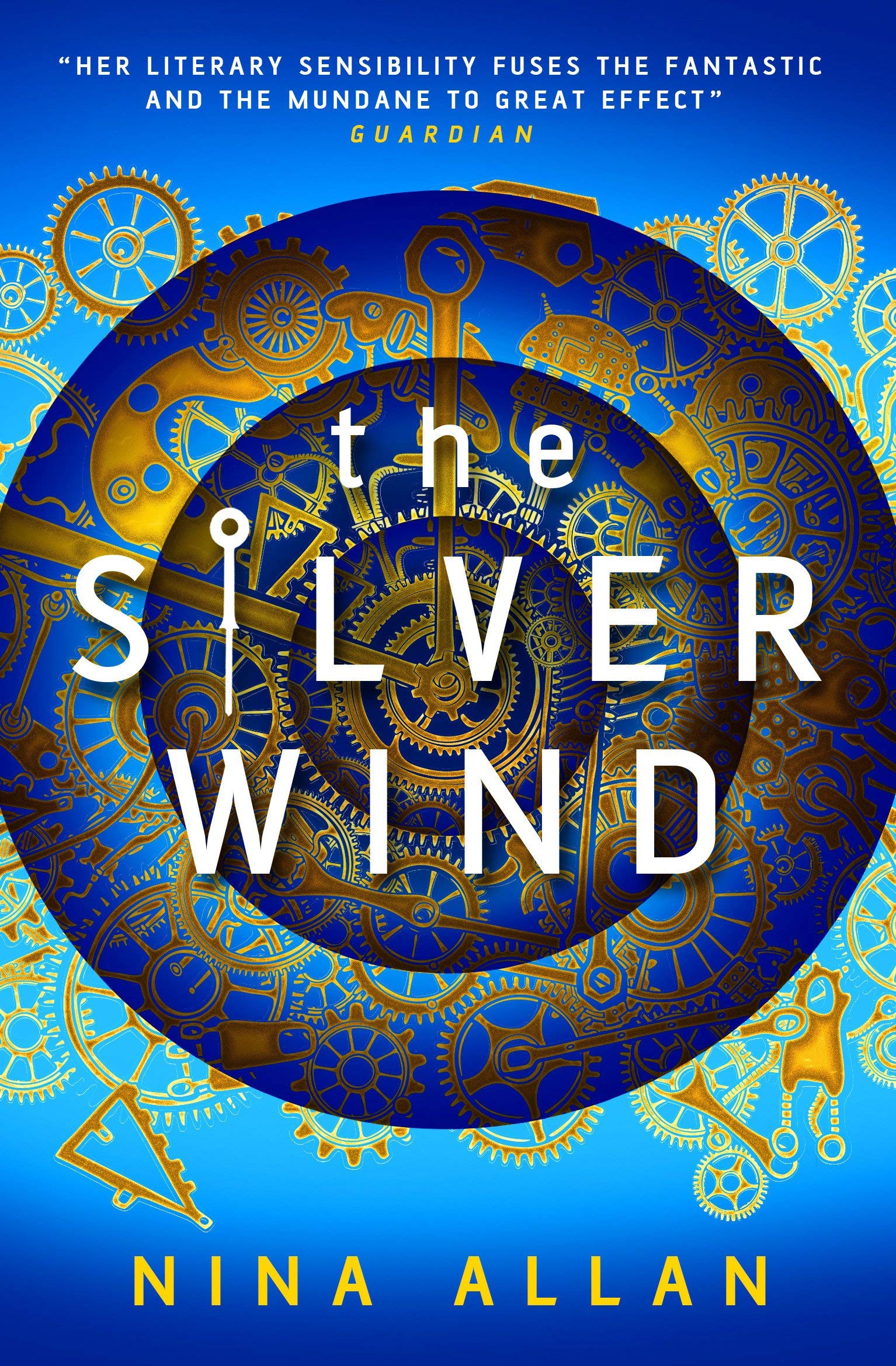
The writings that comprise The Silver Windin large part predate those later novels. Reissued now by Titan Books, it was published in an earlier form by Eibonvale Press in 2011. “These are stories of a time in my life as a writer,” Allan writes in a foreword; the book even includes an “out-take” a story written more than ten years ago, 2008’s “Darkroom”, which in its reliance on dialogue and rather choppy structure demonstrates just how far Allan’s lyrical, resonant and complex writing has come in the intervening years.
None of this is to say that The Silver Wind is juvenilia. Its selection of stories – which, while separate standalone pieces, also, in the manner of thesequential narratives of The Race,collate and collide into a much richer narrative – include arresting and affecting writing, vivid imagery and haunting ideas. For example, the progress through a barren, mutated heath of Martin Newland, the sequence’s protagonist (if not its hero), takes place in a particularly weirded landscape and sticks especially in the memory:
I saw she was disfigured, quite literally de-formed, squeezed apart and then rammed back together again in a careless and hideous arrangement that bore as little resemblance to an ordinary human face as the face of a corpse in an advanced stage of decomposition.
The Silver Wind, p. 199
There is an air of H.G. Wells and Dr Moreau in that passage, and this is no coincidence: The Silver Wind is a novel about a very particular kind of time travel, and Wells is its leitmotif; unusually for Allan, her readers here must have a taste for pastiche. There is some steampunk and some horror, a sprinkling of DH Lawrence and a soupçon of Proust. Stylistically, it is a gumbo of fin de siècle effects.
Narratively, it is a palimpsest. It begins with Owen Andrews, an ambitious watchmaker apprenticing with a legendary horologist in London. Andrews becomes obsessed with building a tourbillon, a form of watch escapement invented by Louis Breguet to reduce the impact of gravity on the mechanism – and which may, on a grander scale, also allow human beings to exist, and move, at the centre of a similar bubble.
Owen is in love with a woman from his village, Dora Newland, who opts instead to marry a local war hero. The next story in the sequence switches perspective, and seemingly reality, to a brother of Dorothy who in the previous story seemed not to exist: Martin, he of the heath-based exploration. From there, each story shifts through various versions of Newland’s life – lives? – until he comes close to understanding the strange effect of time on a person’s experience of reality … and of other people. “[Time] is like water pouring out of a tap […] once it’s been spilled there’s no calling it back again” [p. 168].
Allan’s shifts of reality are indicated obliquely: it is 1920, but Paris is connected to London by rail; it is 1940, but the British government seems to have a rather different make-up. “I felt dazed not so much by the scale of the changes as by their subtlety,” writes one time traveller. The reader’s disorientation is part of the novel’s effect: it isn’t designed quite to align, like a watch mechanism too long tinkered with.
This sort of effect is extremely difficult to achieve in a manner that satisfies; perhaps The Silver Wind isn’t quite as convincing in achieving this balance as Allan’s later works. But it is nevertheless sinuous, sly and affecting; and in this offers a sure sign that Allan is in the very first rank of contemporary SF.
Reviewed byNick Hubble. This review first appeared in The BSFA Review.
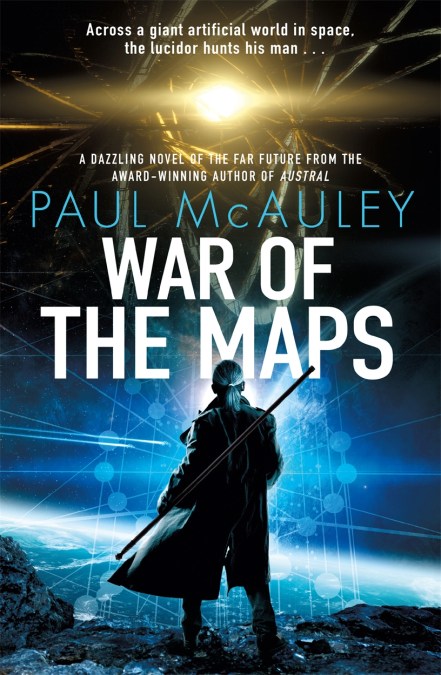
On one level, War of the Mapsis a really well-told, slightly old-fashioned science-fiction adventure novel, which is accurately summarised by the front-cover tagline: ‘Across a giant artificial world in space, the lucidor hunts his man’. As McAuley notes in his ‘Acknowledgments’, the inspiration for the world depicted is an article by Ibrahim Semiz and Selim Oğur, ‘Dyson Spheres around White Dwarfs’. However, as he has pointed out on his blog, the story grew from ‘a character and a situation’ and an idea for the ending. Once he had the character’s voice right, the novel flowed because ‘the protagonist’s path through the world was mapped by his needs, desires and beliefs, and his interactions with other characters’. I quote at length both because this seems like useful advice for anyone wanting to write this kind of novel but also because I think this accounts for how convincing and satisfying this novel is to read; there are no false notes.
Lucidors are law-keepers in the Free State. While there are more than one in the novel, the protagonist is referred to throughout as the lucidor. Although he is retired, he is on one last mission to bring back to justice the villainous Remfrey He, who he had previously tracked down and captured at great cost but who has now been released by a political faction to go and help the war effort in neighbouring Patua against ‘the invasion’. This set-up is reminiscent of a classic Western and indeed the opening finds the lucidor on horseback fleeing bandits in a beautifully written sequence which recalls the spare poetic tone of Cormac McCarthy. While this genre setting changes – at one point later in the novel the action switches into a Hornblower-style naval voyage – the lucidor retains the moral and narrative integrity of the sheriff pursuing justice. I imagined him as like Gary Cooper or James Stewart or possibly even Joel McCrea in Ride the High Country.
The novel turns on two linked questions: is the lucidor’s single-minded hunt for Remfrey He correct, and what the right values to live by are. There is an ongoing disparity between the plain egalitarianism of the Free State and the aristocratic hierarchy of Patua. This latter contrast forms part of the war (although to be clear the two countries are ostensibly allies) mentioned in the novel’s title. The term ‘map’ refers equally to land masses, countries, societies and the genetic make-ups of organisms and thus indicates some sort of scaled fractal relationship between the particular and the universal. ‘The invasion’ is a creeping wave of mutation producing a new biology, including the ant-like ‘alter women’ whose nests are gradually overtaking the north of Padua despite the best efforts of the army.
We see what is at stake in all of these struggles through the lucidor’s various encounters with others: often women who, as the lucidor observes ‘don’t have the same obsession with hierarchy as men’. This is a point of superficial similarity between the lucidor and Remfrey He, who extols the alter-women colonies as utopias in which everyone works peacefully for the common good, even as he manipulates them for his own ends. Gary Wolfe likens Remfrey He to a Bond villain in his review of the novel for Locus and suggests that the archetypal confrontation between the two men is a little too clichéd. But I wondered if that was the point. The lucidor’s most important relationships are actually with his dead wife (in memory) and with the novel’s other main protagonists, the ‘map-reader’ Orjen Starbreaker and her steward Lyra. The standoff with Remfrey He seems more like a commentary on such male rivalries rather than the key point of the plot. Indeed, War of the Maps, with its intertextual allusions to ‘new flesh’, ‘dire wolves’ and Pratchett, may be read as a metatext subtly commenting on the traditional form of the genre and thereby opening the way to representing social change. Perhaps the novel is not so old-fashioned after all. It is certainly one that I recommend reading and which I will myself reread.
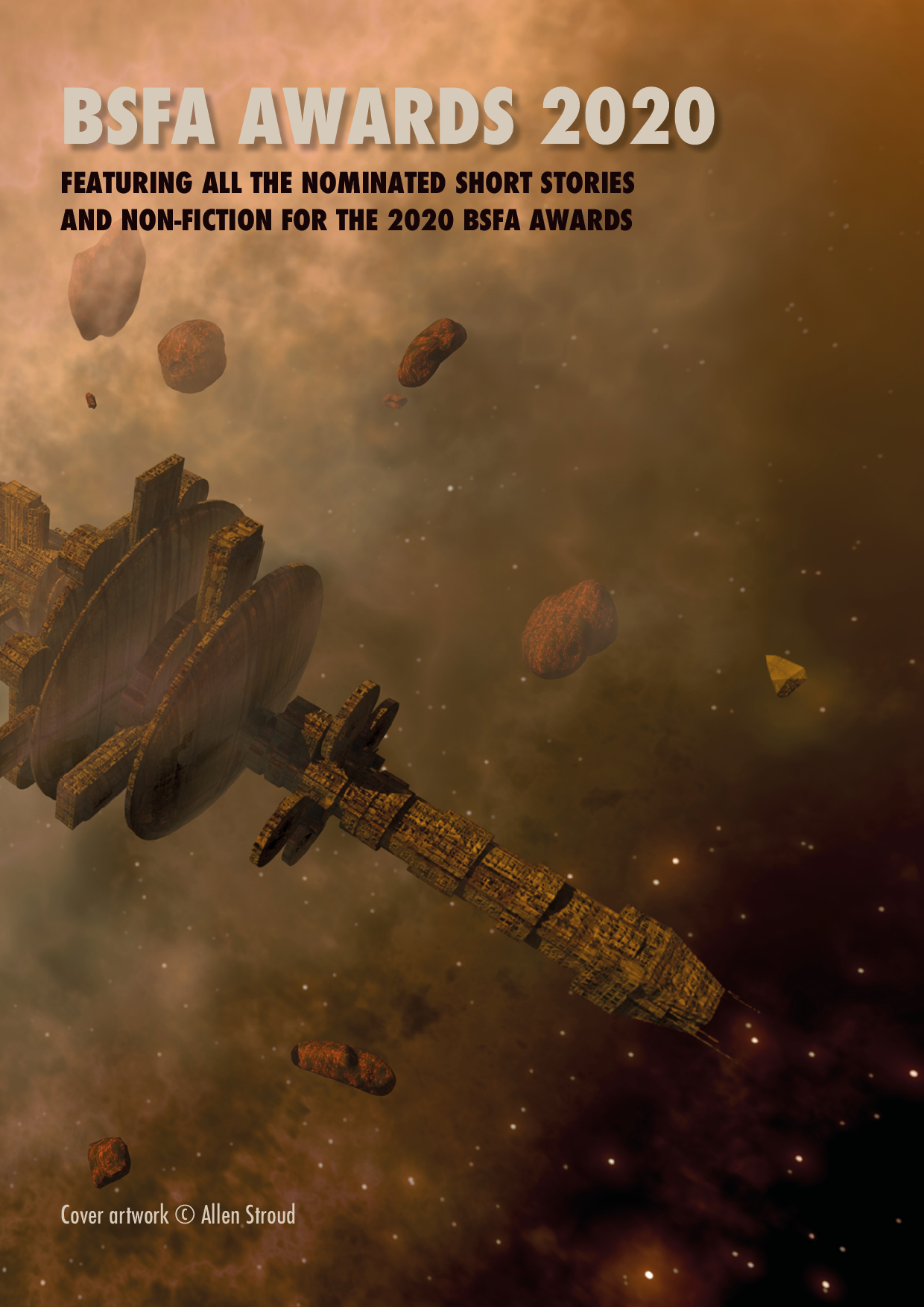
The British Science Fiction Association is delighted to announce the shortlist of nominees for the 2020 BSFA Awards. The BSFA Awards have been presented annually since 1970. The current categories have been in place since 2001. The awards are voted on by members of the British Science Fiction Association and by the members of the year’s Eastercon, the national science fiction convention, held since 1955. This year Eastercon, ConFusion, will be held online 2nd-5th April 2021, where the winners will be announced.
The BSFA Awards ceremony will be free to attend for all BSFA members, all members of Eastercon, and all shortlisted nominees: details will be released closer to the date. Members of the BSFA will additionally receive a PDF with excerpts of many of the nominated works in advance of the convention, and a physical copy of the Awards Booklet at a later date. If you are not currently a member of the BSFA and are interested in joining, please visit the main BSFA site.
Best Artwork
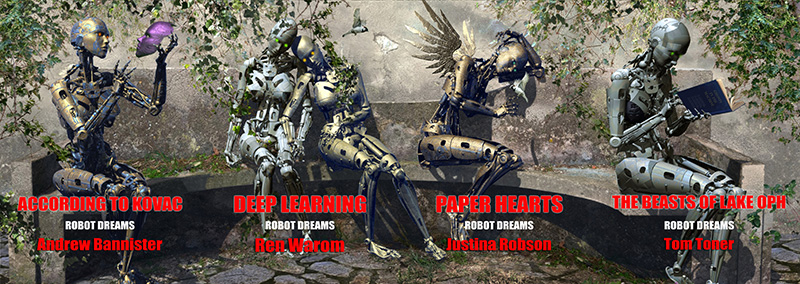
Fangorn, Covers of Robot Dreams series, NewCon Press.
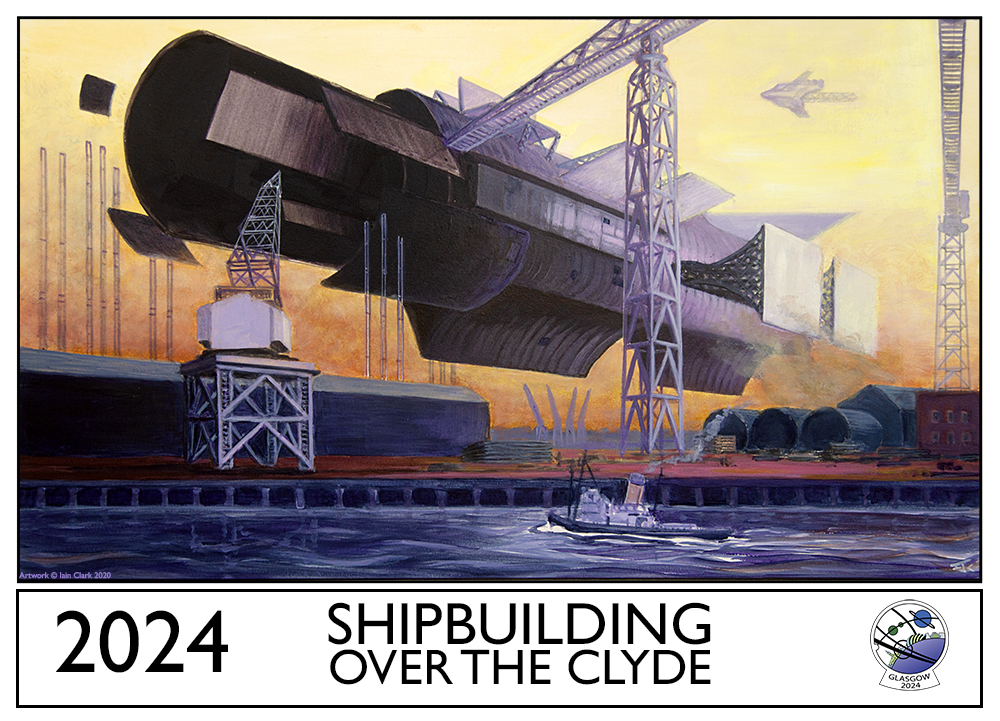
Iain Clark, Shipbuilding Over the Clyde, Art for Glasgow in 2024 WorldCon bid.
Ruby Gloom, Cover of Nikhil Singh’s Club Ded, Luna Press Publishing.
Sinjin Li, Cover of Eli Lee’s, A Strange and Brilliant Light, Jo Fletcher Books.
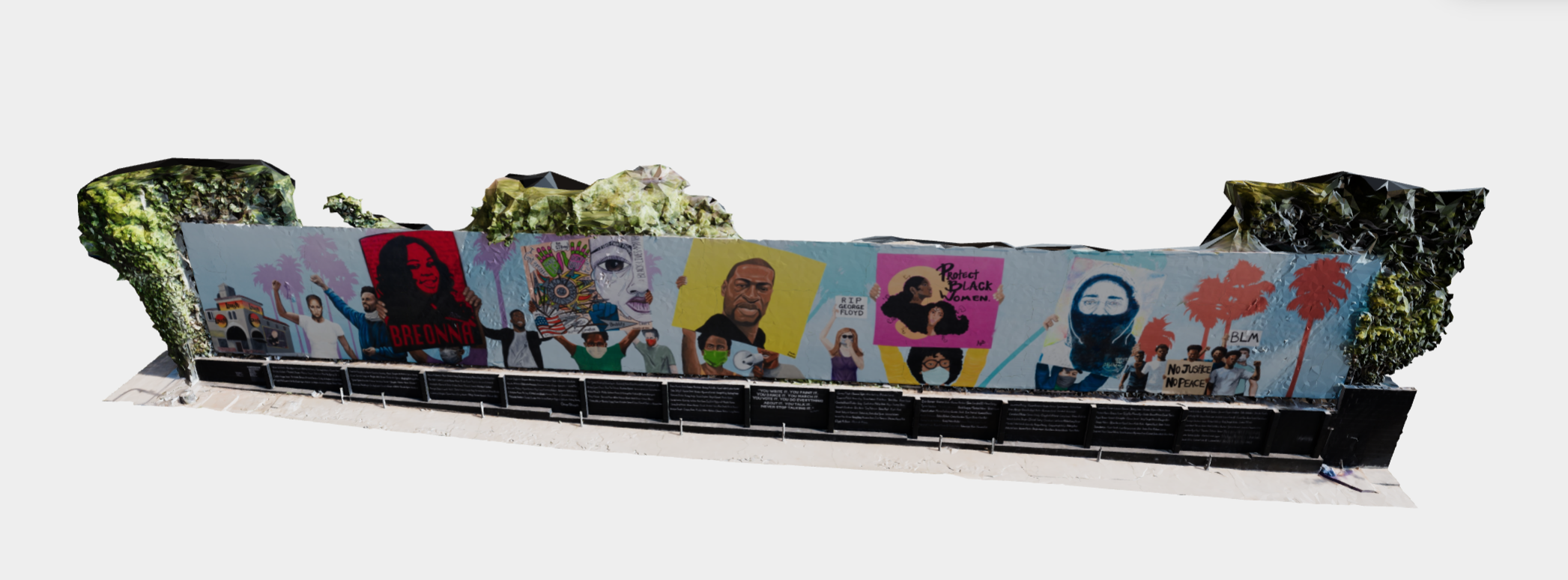
Four Black Lives Matter Murals in AR
Nani Walker, Four Black Lives Matter Murals in AR. Using drone photogrammetry, Nani Sahra Walker produced 3-D models of four Black Lives Matter murals as memorials to George Floyd, Breonna Taylor and others killed by police. Published by the Los Angeles Times in collaboration with RYOT and reported by Dorany Pineda.
Oghenechovwe Donald Ekpeki, ‘Ife-Iyoku, the Tale of Imadeyunuagbon,’ Dominion: An Anthology of Speculative Fiction From Africa and the African Diaspora, Aurelia Leo. Edited by Zelda Knight and Oghenechovwe Donald Ekpeki.
Ida Keogh, ‘Infinite Tea in the Demara Cafe,’ Londoncentric, Newcon Press. Edited by Ian Whates.
Note that there was a multiple tie for fifth place this year. The committee decided that instead of abbreviating the shortlist, all nominees would be included.
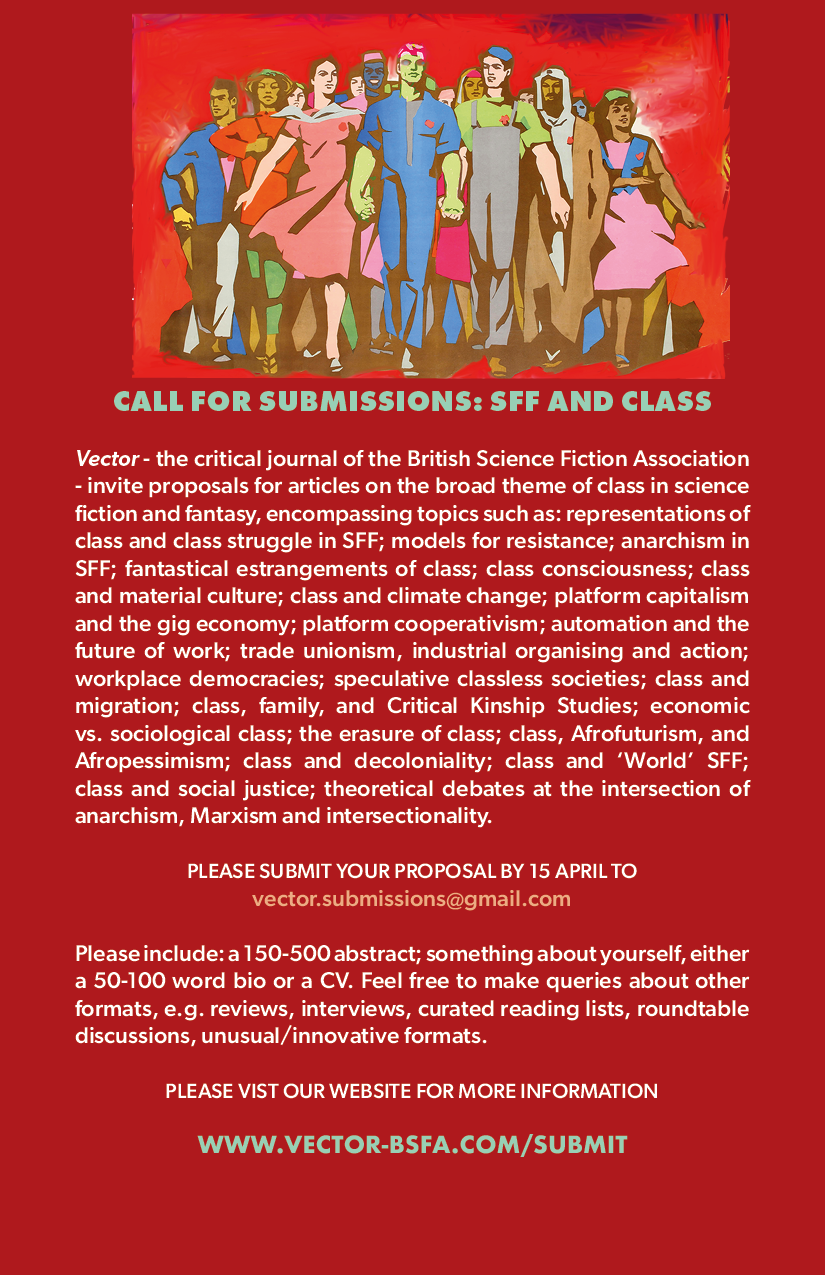
Vector and Focus are inviting submissions on the theme of class, with proposals due 15 April, and articles due 15 July. Please see the full call for more information. Vector will be publishing a special themed issue, guest-edited by Nick Hubble.
Keep an eye out for more CfPs for future special issues to be edited by Stewart Hotston, Stephen Oram, Phoenix Alexander, and Nina Allan.
There is no particular issue with the timeline of the original 1973 film, Westworld, written and directed by Michael Crichton. It is set in the then near future, 1983, and the linear action takes place entirely within the Delos theme park. But when the film became the basis for the television series created by Jonathan Nolan and Lisa Joy, Westworld (2016-present), time became a complex and confusing issue.
Nolan had already displayed a rather cavalier attitude towards time in his earlier television series, Person of Interest (2011-2016). The first series, first broadcast in the autumn of 2011, was set in 2012, but contained multiple flashbacks to events over the previous decade. Although these flashbacks are often dated, it can be difficult to construct a coherent timeline for the two principal characters, Harold Finch (Michael Emerson) and John Reese (Jim Caviezel). But when it came to Westworld, that tendency to play fast and loose with chronology became an often understated but defining characteristic of the series.
To date there have been three series of Westworld (it has subsequently been renewed for a fourth season). For convenience I will refer to Westworld Season One: The Maze as WW1 (2016), Westworld Season Two: The Door as WW2 (2018), and Westworld Season Three: The New World as WW3 (2020), each of which presents time in a different way, even though theoretically each is a direct sequel to the series before.








 vector-bsfa.com