Reviewed by Graham Andrews.This review first appeared in The BSFA Review.
In Jack Williamson’s thought variant short story, ‘Born of the Sun’ (Astounding, March 1934), Sol – like possibly every other star in the universe – is a sentient being and the planets are its incubating eggs. Well, you can’t get much more “thought variant” than that! But since the Sun didn’t give birth by self-genesis, Mike Ashley has excluded it from his whistle-stop tour of the solar system. (I would have plumped for ‘The Golden Apples of the Sun’ – which is neither here, there, nor anywhere else.)
Ashley explains in his general introduction that the stories will deal with “the old solar system, beloved of writers of science fiction, before the space probes discovered what was really out there.” His Planetary Exclusion Order also applies to the Moon (but then he had placed Luna-set stories in the BL Moonrise: The Golden Age of Lunar Adventures anthology). Mars, however, could hardly have been left out of the batting order (see below). Following my usual form, I started by reading Ashley’s erudite* prologues before reading the actual stories.
*A redundant adjective, if ever there was one.
“So strap yourself in and prepare for a kaleidoscope of worlds!” (ibid.).
I’ll get the Golden Oldies – or at least Silveries – out of the way first. ‘Sunrise on Mercury’ (1957), by Robert Silverberg, takes place on the hot-side/twilight zone/cold-side innermost planet that we used to know and love so well. It’s one of his best early stories that never stops moving – or thinking. ‘Garden is the Void’ (1952) is Poul Anderson’s haunting exploration of an asteroid: “A green asteroid.” James Blish went over all Joycean again with ‘How Beautiful with Banners’ (1966), set on Titan, if not Saturn itself. Par example: “Feeling as naked as a peppermint soldier in his transparent film wrap, Dr. Ulla Hillstrom watched a flying cloak swirl away toward the black horizon with a certain consequent irony.” ‘Wait It Out’ (1968) is a marooned-on-Pluto story that shows how well Larry Niven could write hard science fictioon when he used to work at it. [And I, for one, will never accept Pluto as a ‘dwarf’ planet.] But my favourite classic story – and also my favourite story in the whole book – is Clifford Simak’s ‘Desertion’ (1944).
‘Desertion’ (1944). Set on and around Jupiter, it became an integral part of the fix-up novel City (1952) and inspired a crucial plot device in Avatar (watch and compare). The last four understated lines of this story never fail to move me. I envy anyone reading them for the first time.
As usual with Mike Ashley, however, it’s the little-known or even unknown stories by ditto authors that make these BL anthologies so worthwhile. Leslie F. Stone (1905-1991) was one of the “pioneer women” contributors to the dawn-age sf pulp magazines. She set ‘The Hell Planet’ (1932) on the “real” Vulcan, once thought to lie between Mercury and the Sun. Background reading: The Hunt for Vulcan (2015), by Thomas Levenson. ‘Foundling on Venus’ (1954) by John and Dorothy De Courcy has a stinging twist in the tale. John Ashcroft (1936-1997) does Mars proud with ‘The Lonely Path’ (1961). ‘Where No Man Walks’ (1952), by E. R. James (1920-2012), about mining for industrial diamonds on the “surface” of Uranus, could well have been expanded to novella, or even novel-length. It’s the strongest story in the book, in my opinion, after ‘Desertion’. By the same token, ‘A Baby on Neptune’, a collaboration between Claire Winger Harris (1891-1968) and Miles J. Breuer (1889-1945) is by far the worst story in the book. “Ye Gods!” shouted Kuwamoto. “Just at the crucial moment, like a cheap novel serial! I suppose all we can do is nothing, and Elzar’s child has been devoured by the filthy beast.”
It just remains for me to say thatBorn of the Sun is yet another excellent theme anthology edited by Mike Ashley for the British Library. Buy it! Read it! Keep it!
This academic article explores Damien Hirst’s 2017 exhibition The Wreck of the Unbelievable, which mischievously purported to present treasures salvaged from the wreck of the legendary Apistos. How might we preserve, curate, and otherwise mediate such ambitious and distributed artworks, which extend in such convoluted ways through diverse social and cultural spaces, and which deliberately ambiguate their own boundaries and encounters? Where artworks both seek to capture and to intervene in their own historical moment, what obligations and affordances arise for future historians, curators, critics, and publics? Might the challenges set by The Wreck of the Unbelievable even model a new kind of digital art history including, for example, data generated incidentally and abundantly by digital processes? This article playfully mobilises new Digital Humanities methods for reading the vast and stormy seas of social media data discourse, reading between the artwork itself and the historical ‘moment’ in which it is so entangled.
Review: This article underwent editorial review from three editors.
License: Copyright Alex Butterworth. All rights reserved.
Keywords: art history, conceptual art, curation, Digital Humanities, distant reading, installation art, participatory art, social media
Man has no harbour, time has no shore;
It flows, and we pass away!
Alphonse de Lamartine: ‘The Lake’ as quoted by Franck Goddio, ‘Discovering a Shipwreck,’ in Damien Hirst, Treasures of the Wreck of the Unbelievable
Damien Hirst’s 2017 Treasures from the Wreck of the Unbelievable was work of ‘spreadable’ historical narrative, spun around an elaborately wrought hoax. Ten years in planning and execution, the exhibition straddled two large spaces on either side the mouth of Venice’s Grand Canal, the Palazzo Grassi and the Punta della Dogana. It alleged to present treasures salvaged from the Apistos, a ship lost almost two thousand years ago, comprising the art collection of a freed slave of incalculable wealth and cupidity. Treasures wrought of marble, gold, crystal, and jade were accompanied by films of the marine archaeology in action, featuring animistic figures — some with the disconcerting features of Disney characters — gently raised from the sea bed. The authenticity of the sculptures themselves was vertiginously involuted, with some sculptures appearing in variant versions, scaled up or down, cleaned of or encrusted with coral. Captions, located inaccessibly, also played games with curatorial authority, describing the construction of the luxurious display ‘cabinets’ as often as they did the contents of the vitrines.
But the physical exhibition was only a single, ephemeral manifestation of the world of Treasures. To commit wholeheartedly to comprehending that world is to hazard one’s sense of coherence in a game of narrative disentanglement, played out within a mise-en-abyme. The layering of the Lamartine epigraph, above, illustrates this experience: it serves as a textual gesture towards mortal infinitude, extracted from its context, relocated within an essay of playful dishonesty — printed in one of three catalogues advertised as accompanying the exhibition, of which only two appear ever to have been published — that aims to ground the exhibition in a plausible fictionality. In his essay in the same catalogue, Goddio ponders parenthetically of the wrecked ship, which bore the Greek name Apistos, translated as Unbelievable: ‘Was that its original name? Or did it acquire it subsequently because of its fabulous cargo? No one knows.’ On such uncertainty, the fascination of the show pivots.
It’s become almost a cliché of conversations in sf circles: someone says that they would love to read more works by authors from non-Western, non-White, and/or postcolonial origins, but, they add, “I don’t really know where to start.” While the recent rise to prominence of African and African-diaspora authors like NK Jemisin, Nnedi Okorafor and Tade Thompson has been welcome, potential readers might still wonder where to look for writers in other sub-genres of sf, such as horror, Weird fiction, or post-apocalyptic fiction.
Dominion: An Anthology of Speculative Fiction from Africa and the African Diaspora provides a suitable answer to this question, being a sampler of a diverse range of stories by established African and African Diaspora authors, covering a startling range of genres that provides something for everyone. At the same time, however, there is plenty for those with a good understanding of Afrofuturism and Africanfuturism to appreciate.
All the stories were, however, at the very least interesting and in most cases very enjoyable to read. Some fit comfortably within familiar sf categorisations. “Trickin’”, by Nicole Givens Kurtz, is a Hallowe’en-set horror piece which develops both the vampire and demonic-possession subgenres. “Sleep, Papa, Sleep” by Suyi Okungbowa Davies is also on the conventional horror spectrum, a Lagos-set story involving necromancy and revenant corpses to explore family relationships. On the science fiction side, “Red_bati” by Dilman Dila, about a former robot pet now repurposed as a mining robot after the death of its human owner, fits into the growing genre of stories exploring the morality of creating AI for human use; this example does a good job of handling the balance between making the AI sympathetic and not obscuring his non-human mindset.
Other stories engage more directly with colonialism and postcolonialism. “A Maji Maji Chronicle” by Eugen Bacon is a fantasy about a mage who meddles with African colonial history, exploring questions about power, corruption and legitimate leadership. “To Say Nothing of Lost Figurines” by Rafeeat Aliyu is a mixed genre SF/fantasy, giving us a wizard from Earth tracking a magical object to an alien society and retrieving it with the aid of a half-human-half-alien woman. The idea of magic-as-science, a feature of much postcolonial sf including that from Africa and its diaspora, arises both as an embracing of the indigenous logics dismissed as superstition in a colonial context, and a challenge to the idea of “Western” science as hegemonic and objective. Here, it is counterpointed by the narrative of a mixed species character finding an escape from her oppressive birth society.
“The Unclean” by Nuzo Onoh is a genuinely terrifying horror fantasy about an Igbo woman in the 1950s in an abusive marriage; the best horror for me is always that which works as a metaphor for real-life issues, and the way in which the protagonist struggles against not just her husband and his family but the patriarchy of 1950s Nigeria in general is both reflected and amplified by the supernatural terrors she encounters (and sometimes brings into being herself). Mame Bougouma Diene’s “The Satellite Charmer” engages directly with Chinese neo-colonial activities in Africa, the background involves two Chinese mining companies using satellite technology for resource extraction in Senegal, our foreground is the life of one man, Ibrahima, affected by the satellites in unexpected ways and how he, and they, converge to an explosive meeting.
History, and more specifically the loss of (and recovery of) history, also emerges as a key theme. “A Mastery of German” by Marian Denise Moore is a near-future hard-science story whose protagonist is an American project manager tasked with evaluating (and possibly cancelling) a project meant to enable the transfer of human memory for profit; at the same time, we have the counter-narrative of the protagonist’s father attempting to trace the family history, thwarted by the invisibility of Black, enslaved and working-class people. The end result explores the meaning of individual and social memory not just in the USA, but any postcolonial country. “Emily,” also by Marian Denise Moore, is the shortest piece in the book, a poem starting with a historical advertisement for the return of an escaped enslaved girl and imagining different parallel futures for her, picking up on the theme of lost history in Moore’s earlier piece for the volume. “Thresher of Men” by Michael Boatman is a deeply satisfying revenge narrative: as a goddess takes vengeance on the White residents of an American town for past atrocities, we see the hidden history of the seemingly idyllic community emerge, beginning with a recent police shooting of a young Black man but going deeper into the past as the story unfolds, revealing the murder as one horror in a long chain of atrocities extending back decades, if not centuries.
Finally, some stories in this collection cross genres or defy classification. “Convergence In Chorus Architecture” by Dare Segun Falowo is a strange and surreal Weird fiction piece involving quests, boneships, human-arthropod fusions; the prose is beautiful and haunting and the imagery lingers. “Clanfall: Death of Kings” by Odida Nyabundi is a post-human post-apocalyptic adventure story, which reads like the setup to what could be a very interesting series, and one hopes the author develops this universe further. Finally, “Ife-Iyoku, The Tale of Imadeyunuagbon” by volume coeditor Ekpeki Oghenechovwe Donald tells the story of a society undone by its own essentialism; as the narrative twists and turns unexpectedly, so the story shifts genre, beginning as an epic heroic fantasy, before shifting into a postapocalyptic story with echoes of The Chrysalids, and shifting again into another divine revenge narrative.
Dominion is a worthy addition to volumes like Walking the Clouds and So Long Been Dreaming which serve as introductions to postcolonial and indigenous science fictions and fantasies. The interesting range of stories, genres and themes provides a clear guideline for people looking for new work by African and African Diaspora writers in their favourite subgenres. However, the exploration and development of themes of colonialism, history, and memory, as well as the re-interpretation of colonialist sf tropes such as vampires and AI through African and/or Afrofuturist lenses, means that the volume also contributes to the ongoing dialogue on decolonising science fiction.
A sneak peek at Vector 292, the contemporary art issue. Juliana Huxtable’s groundbreaking postdisciplinary artistic practice encompasses cyberculture, portraiture, performance, poetry, transmedia storytelling, critical making, fashion, happenings, and myriad other modes and magics. In September 2020 Vector took the opportunity to chat with Juliana about her work, especially the role played by science fiction …
What were your early encounters with science fiction like?
My father, in particular, was obsessed with science fiction, and so we had a lot of science fiction lying around the house, games, films, magazines. He was really into Heavy Metal magazine, which featured this sci-fi soft-core pornography. For my dad, who was not a religious person, it was as close to a religious practice as we came.
My mom on the other hand was highly religious. But both of my parents really saw technology almost as this necessary gateway to liberation, to cultural and social advancement. There was a strong racial aspect to that. So that was the context in which I grew up, and what’s funny is that when I went to university, I almost had this kind of adolescent “I need to define myself!” moment. I pulled away from science fiction, and would feign disinterest.
How long did that last, that feigned disinterest?
It really was when I moved to New York that I started to develop my own interest in science fiction. Possibilities related especially to gender are so interesting to me. So I found myself naturally drawn to subjects that heavily relied on science fiction, or that were actually a form of science fiction … even if they might not be formally classified as part of that cultural sphere.
For instance, there was my interest in the Nuwaubian Nation. The merger of Ufology and Egyptology, and the literature and contemporary almost pseudo-science which that produces, is essentially a form of science fiction. That reanimated my interest in science fiction more generally. I started engaging with it again almost as a form of art research.
“Maybe the goal is that gender doesn’t have any meaning, because there’s less ascribed to that tethering …”
This morning I saw this tweet where somebody was like, “Describe your gender in five words or less or more, and you can’t use words like masc, fem, androgynous.” People were replying with song lyrics and so on. I guess my question is, Juliana, what is gender?
For me, the struggle for gender that I’m interested in, and the work for gender that I’m interested in, is about expanding beyond inherited gender structures. That means expanding the signifying space that floats right above the concrete materiality of sex. So if ‘sex’ is this literal form of inherited embodiment, whose essence supposedly can’t be modified, then ‘gender’ is the directly corresponding world of cultural, religious, linguistic, and social meanings. Meanings that are, it’s assumed, birthed from that materiality.
The struggle for gender and the work for gender that I’m interested in is de-linking those two, and then expanding that field, ideally to a point where maybe it doesn’t have any meaning any more. Maybe the goal is that gender doesn’t have any meaning, because there’s less ascribed to that tethering, both of the two parts of a binary to each other, and to the idea of gender as it’s tethered to sex.
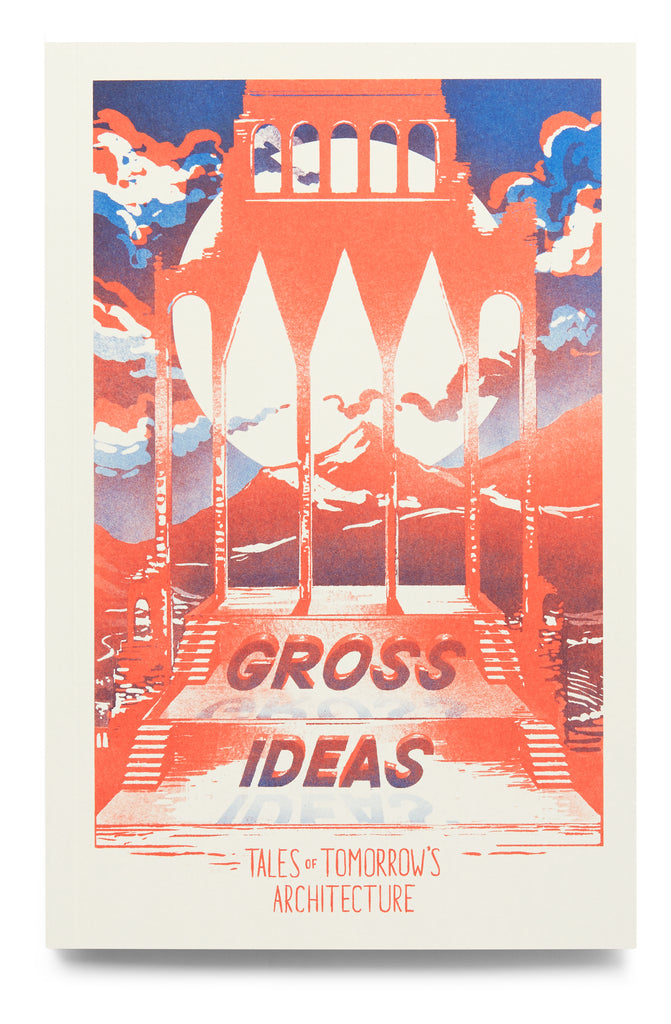
To understand Gross Ideas, start with the Oslo Architecture Triennale to which this book is a companion. The Triennale is “a member organization that unites the major architecture and urban planning networks in Norway” for conversations and public programs about the role of architecture in society. Participants and supporters include national associations of design professionals, architecture schools, Norwegian government agencies, and international architecture firms with Norwegian roots. The 2019 Triennale in the fall of 2019, was the seventh iteration.
Some of the contributors identify as writers and some as architects, and a few work both sides. There are two poems, one graphic narrative, and fourteen prose narratives of widely differing character …
The book itself is a miscellany of contributions that is more a curated exhibit in verbal form than a tightly edited collection, a characterization that I suspect the curator-editors would find quite acceptable. Some of the contributors identify as writers and some as architects, and a few work both sides. There are two poems, one graphic narrative, and fourteen prose narratives of widely differing character. Some of these latter are stories that could easily find homes in science fiction magazines. Others range from Will Self’s takeoff on Invisible Cities to Lesley Lokko’s essay on women and transnational remittances that includes a fictional vignette, a short factual summary, and scholarly endnotes (it is quite effective).
Architects have long delighted to imagine grand buildings and building schemes—Arturo Soria y Mata’s Ciudad Lineal, the arcologies of Paolo Soleri, Walking City and other thought experiments of the Archigram group, a linear supercity from Michael Graves, the mile-high skyscraper of Frank Lloyd Wright (even Burj Khalifa gets only halfway there). Science fiction has appropriated the taste for the grandiose from Trantor and Coruscant to countless artists’ depictions of imagined urban futures full of soaring towers in shimmering color.
What naïve readers might expect from the “architecture” in the subtitle is often absent …
There is no such here. What naïve readers might expect from the “architecture” in the subtitle is often absent. Instead we get one story in which the largest building is a village house (Sophie Mackintosh, “Placation”), a second set in a caricature of a dusty, unchanging town of the old American Southwest (Joel Blackledge, “Fountainwood”), and another in derelict and abandoned Edinburgh (Camilla Grudova, “Deliberate Ruins’). The only story to center a single building uses an unfinished and abandoned Persian Gulf skyscraper (Deepak Unnikrishnan, “Cat”). The other entry in which architecture is the explicit focus is the graphic narrative “Exile’s Letter” by Mill + Jones, which chronicles efforts to build in a low-technology future (temple, town, giant fishing pier) that are laid low by fire and flood and end with the triumph of unbuilding in a sort of Nature-driven version of the Tower of Babel.
Some of the entries posit future engineering rather than architecture—a distinction that the curators and the Triennale folks would likely disregard anyway. For example, Robin Nicholson projects the green retrofitting of London in 2039. I had the most fun with “The Aqueduct,” which presents a scenario for replacing Britain’s rail and road transportation with a set of canals. It is a fascinating think-piece that painlessly introduces elementary physics to extrapolate from Britain’s current restored canals. If he hasn’t, author Steve Webb should look up Railroads and American Economic Growth by my old graduate professor Robert Fogel, which includes a long counterfactual to test whether the United States might have had the same robust economic growth had it invested in canals and river improvements rather than railroads in the nineteenth century.
As she starts work and experiments on her own small house, she finds herself slowly absorbed by the microbes …
The contributors took to heart the theme of the 2019 Triennale—“Enough: The Architecture of Degrowth.” Some stories imagine the built world in decay (Grudova, Unnikrishnan), others the natural world actively triumphant (Mackintosh). Lev Bratishenko, “You Wanted This,” reports a future United Nations conference at which national representatives offer their own favored ways to drastically reduce the world population—the Russians want to use thermonuclear bombs, the Japanese want to weaponize the Internet of Things, the Americans want to drug everyone to euphoric death (cue up Serenity). One of the most powerful stories is Rachel Armstrong’s “Bittersweet Building.” A new architecture graduate in desperate need of a job catches on with a Norwegian firm that is trying to incorporate bacteria as part of a building’s metabolism (waste into clean water, heat, oxygen). As she starts work and experiments on her own small house, she finds herself slowly absorbed by the microbes into their own complex world and finally merging fully into the “metabolic community of the landscape.” It is both a chilling and a comforting variation on the natural process of bodily decay. For the theme of degrowth, score a big one for the Earth.
Having considered the “architecture” half of “tales of tomorrow’s architecture,” what about the “tales” part? To no surprise, the pieces run a wide span from interesting but undramatic speculation to engaging story. For an example from the didactic side, Edward Davey, “Oli Away,” uses the mechanism of a report on a gap year journey to explicate some favored energy and transportation options. The entries by Nicholson, Bratishenko, and Webb are additional examples of scenario-building rather than storytelling. They have a lot of information without much surrounding story, which is not to say that we should not think about the ideas they present. After all, nobody read Looking Backward for its compelling characters and plot, but it had enormous influence.
Several of the contributions that are strong as stories are, not surprisingly, by people with lots of writing experience who know how to create engaging characters. For many Vector readers, the biggest name in the collection is Cory Dotorow, who contributes an interesting variation on his Disneyland obsession with “Materiality.” He posits a theme park in which high school classes spend a week inhabiting reconstructed towns from different eras. Think Main Street USA meets the living displays of colonial “savages” found at early twentieth century world’s fairs (also see the living diorama in Colson Whitehead’s fantastic alternative view of American history in The Underground Railroad). The theme park contrasts with a present in which recycling and three-dimensional printed make the objects of everyday life ephemeral if not immaterial. Doctorow’s teenaged protagonist indirectly confronts the lasting imprint that seriously stupid Old Timey People left on the landscape by considering whether his favorite old tee shirt is still cool (it is).
… architecture as a practice of designing individual buildings should be and is being swallowed up by the all-consuming impacts of climate change and necessary transformations in global energy systems.
Maria Smith in “Lay Low” uses the familiar frame of singles gossiping in a bar to introduce a society of scarcity in which everyone has monetized allowances for necessities like water, food, and electricity. Her variation on a familiar science fiction future is a new way to get ahead on your budget—perhaps—by going into hibernation for a few months to lower your consumption levels and build up points. The women in the bar, who are just learning about the new option, don’t think that monetizing unconsciousness is going to go well.
Jo Lindsay Walton contributed the longest, most complex, and perhaps most readable story (no, there was collusion with your book review editor). “In Arms” is cleverly constructed with two parallel threads—a woman waiting for a date to show up and an ecoterrorist launching an operation—that slowly grow more complex and intertwine in unexpected ways. Radical changes in building styles are slipped in as background, including the cool idea that rising seas have forced the seat of British government to shift to a mobile seastead platform nicknamed Wetminster.
Without the subtitle and the wraparound material describing the Triennale, someone who casually reads through Gross Ideas would think it is about economic transition and “degrowth” in general, with architecture one of many avenues of exploration. The overall message is that architecture as a practice of designing individual buildings should be and is being swallowed up by the all-consuming impacts of climate change and necessary transformations in global energy systems. Some contributors see a complete devolution to a nonindustrial future, others a society of scarcity, and still others an adapting world. Tomorrow’s architecture, the book suggests, will be valuable to the extent that it is subordinated not just to social needs—an architectural truism, if not always heeded—but rather to fundamental institutional and social transformation.
Carl Abbott is author of The Metropolitan Frontier: Cities in the Modern American West, The New Urban America: Growth and Politics in Sunbelt Cities, and Political Terrain: Washington, D.C., from Tidewater Town to Global Metropolis.
Cargo (Arati Kadav 2019 Hindi): A meandering rumination about the weightlessness of human existence
Reviewed by Abhishek Lakkad
Please note that this review contains spoilers.
Death can be understood as a scientific/biological phenomenon, but its gravity is experienced as a spiritual phenomenon. Both the scientific and the spiritual perspectives allow one to contemplate death. But when the makers of Cargo (2019) choose science as merely a veil for religious/spiritual ideas in order to comment on alienation and abandonment rampant in contemporary societies, they could have made sure that the film is passionate (or at least compassionate) enough to sustain its slow-paced narrative. Cargo (now available on Netflix) is the first feature length film of Arati Kadav, although she has written and directed several science fiction shorts in the last decade. Cargo highlights the theme of ‘loneliness’ in these times of pervasive social media that creates the impression that one is always connected and hence never alone. Hindu spiritual/religious ideas about karma and the cycle of life, death and rebirth are central to the narrative. The action mostly takes place on a spaceship orbiting Earth where human-like demons called rakshasas are essentially technicians enabling the transition from death to rebirth in a mundane, technocratic and institutionalised process — reminiscent of an airport security checkpoint, medical lab or a prison admissions office. The film terms this process as “post-death transition”, supervised by a department called Post-Death Transition Services (PDTS) that operates under the aegis of Inter-Planetary Space Organisation (IPSO) that has been established by the rakshasas. Owing to the film’s stance of deriving its fictional futuristic technology from elements of Hindu spirituality and mythology, the film has a distinct retro-futuristic feel. Perhaps the datedness of the film’s visual effects is meant to reinforce the 80s inspired aesthetics.
In this academic article, Alexei Warshawski explores themes of architecture, fragmentation, and ontology (in the sense of existence or Being as such) in two speculative fiction novels, China Miéville’s The City and the City (2009) and Ken MacLeod’s Learning the World (2005). MacLeod’s and Miéville’s engagement with postmodernism, read alongside Heidegger, reveal that no matter how fragmented our architecture, and whether we do or don’t truly dwell, our ontology is greatly contingent on the architecture which surrounds us, and our ability to exist within and alongside architectural constructs is an undeniably and increasingly precarious one.
Review: This article underwent editorial review from two editors.
License: Copyright Alexei Warshawski, all rights reserved.
Keywords: architecture, China Miéville, dwelling, fragmentation, Ken MacLeod, ontology
The relationship between architecture and its inhabitants is a powerful one which can be liberating or repressive, inclusive or exclusive, reflective or reductive. These relations are neither cohesive with one another, nor mutually exclusive, so they problematise our relationship with architecture in spatial, temporal and ontological terms. Examples may be found in China Miéville’s The City and the City (2009) and Ken MacLeod’s Learning the World (2005). Miéville’s The City and the City follows Inspector Tyador Borlú as he investigates the murder of a foreign student whose body is found in Besźel, a city which is topographically twinned with another city called Ul Qoma. These two cities are on the same physical site and their residents are expected to ignore the city which they don’t live in, ‘unseeing’ any elements that they accidentally notice. Ken MacLeod’s Learning the World follows a future human race’s attempts to find a new planet to colonise as they travel on their planet-sized generation ship, and grapples with the problems they face in understanding a temporary architectural construct as a seemingly permanent and homely environment. Both novels engage with one of postmodernism’s key architectural concerns – the question of fragmentation, which this paper will argue is a necessity in sustaining the architecture of the worlds of both texts. While The City and the City explores fragmentary architecture through its twinned cities, Learning the World presents architecture as an inherently fragmentary construct, both in spatial and temporal terms. This paper will suggest that the ‘necessary fragmentation’ of the architecture in these texts proves the untenability of postmodern, neoliberal architecture as something permanent or fixed, in both spatial and temporal terms. Furthermore, this paper will argue that the idea of necessary fragmentation in this context give credence to Martin Heidegger’s understanding of ‘building’ and ‘dwelling’, a distinction he outlines in ‘Building, Dwelling, Thinking’(1951) which suggests that ‘dwelling’ as an ontological condition is not a guaranteed effect of building or settling within architectural constructs, and that the ability to ‘build’ in an ontologically authentic manner requires one to possess the capacity to ‘dwell’ in the first place. This paper will outline how these paired concepts of building and dwelling can affect the formation and occupation of architecture, as well as architecture’s relationship to nature. Drawing together the fragmentary elements of architecture and their relationship to Heidegger’s thinking in both texts, this paper will conclude with an analysis of the reflective properties of architecture – in both literal and metaphoric senses – to demonstrate the extent to which architecture can affect not just our social and domestic lives, but our ontology itself.
In this academic article, the authors explore two contemporary movements associated with the literature and art of the Amazon region: Amazofuturism and Indigenous futurism. Amazofuturism is understood as a subgenre with ties to cyberpunk and/or solarpunk, in which the future of the Amazon region is portrayed in a broadly optimistic light. Indigenous futurism refers primarily to speculative artwork and writing by Indigenous people, which expresses Indigenous perspectives and epistemologies, and/or which centres Indigeneous experience. Indigenous futurism opposes reductive, pessimistic, and exoticising discourses about the Amazon region and Indigenous peoples, challenging Western stereotypes and allowing the complexity of Indigenous voices and perspectives to be shared. Together, both these interconnected movements attest to the power of the speculative imagination in social and political resilience and regeneration.
Review: This article underwent anonymous peer review.
License: Copyright Vítor Castelões Gama and Marcelo Velloso Garcia, all rights reserved.
This essay will explore two contemporary movements associated with the literature and art of the Amazon region: Amazofuturism and Indigenous futurism. We hope that it will increase the visibility of these two interconnected movements, in order to enrich diversity within the art world, and contribute toward a broadening of cosmologies and worldviews beyond dominant Western imaginaries [1].
But to do so, let’s start by trying out some definitions. First, Amazofuturism is a subgenre of SF where the Amazon region is represented in a more positive light, often with an aesthetic akin to cyberpunk and solarpunk. Indigenous futurism, on the other hand, focuses on Indigenous worldviews in the context of the SF megatext, and, while doing so, challenges ingrained colonialist assumptions about Indigenous people. Ideally it is also created by Indigenous people. Finally, Brazilian SF, the broadest of these three terms, is simply science fiction from Brazil. It does not necessarily represent either the Amazon region nor Indigenous people at all, and when it does, may do so either positively or negatively [2]. Now, let’s expand a bit on these definitions.
The AGM is happening this weekend, 23 of August, 2.30pm till 5.30pm, on Discord. Hope you can make it! We’ll be discussing some reasonably big developments, including the new BSFA constitution.


![Dominion: An Anthology of Speculative Fiction from Africa and the African Diaspora by [Zelda Knight, Marian Denise Moore, Eugen Bacon, Nicole Givens Kurtz, Dilman Dila, Rafeeat Aliyu, Suyi Davies Okungbowa, Michael Boatman, Odida Nyabundi, Ekpeki Oghenechovwe Donald]](https://m.media-amazon.com/images/I/51ykGGZ8LJL.jpg)


 vector-bsfa.com