
Looking Forward Through the Imagination of Africa

By Anwuli Okeke

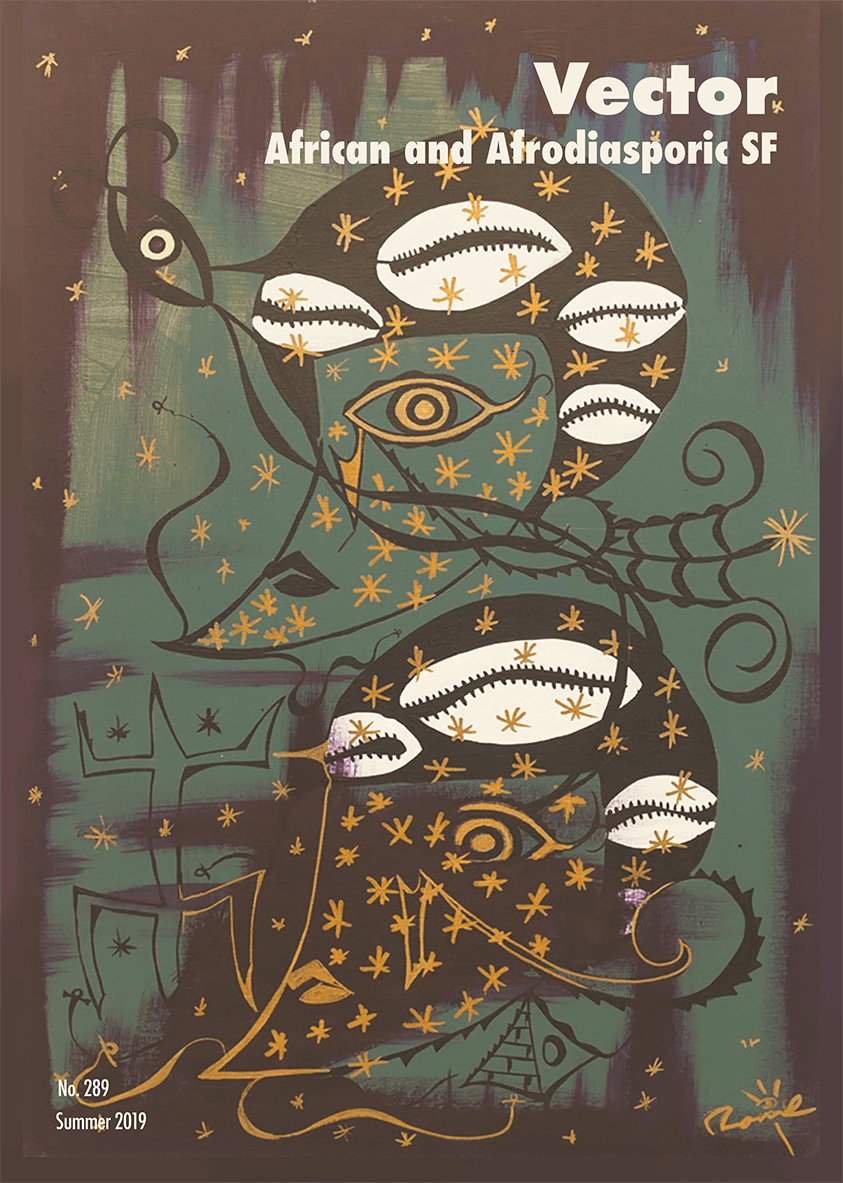
First published in Vector 289.Vector289_Cover

“Science Fiction is the only genre that enables African writers to envision a future from our African perspective.” 

– Nnedi Okorafor

The future of Africa, as imagined and portrayed by African writers, is every bit as vibrant and glossy as that seen in any Hollywood sci-fi thriller. We have the robots, bio-hackers, cyberpunk badasses, cyborg implants, and brain-computer interfaces that let you access cyberspace or pilot a vehicle with the pure power of thought. But this is also Africa, a continent where the supernatural is just as real and palpable as the natural (and sometimes even more so). So of course science and technology are interwoven with the material and spiritual worlds — education; spirits; infrastructure development; magic; healthcare; the gods; jobs; prayer — to create a new third world that is its own unique blend. In this way, African science fiction brings its own distinctive sense of where the boundaries lie between the real and the unreal, and of how those boundaries blur.

Not only does it have its own unique realities, it also has its own unique temporalities. For example, African science fiction can challenge the standard narratives of development and progress which Western culture imposes. In the myriad futures which African writers envision, there are plenty that refuse predictable progression from one stage to the next, and instead imagine a kind of ‘leapfrogging’ — as though the tech-tree were inhabited by a tech-tree-frog. By leveraging technologies developed elsewhere, and through our own innovations such as mobile money or other localized solutions, African countries can compress development life-cycles and jump several rungs up ladders of economic and technological advancement. For example, the leap from using kerosene as a source for light to solar-powered electricity in a few short years, completely bypassing grid-based power generation. Economic and technological development also needn’t follow the same paths as elsewhere, but can discover new directions and new opportunities missed by highly developed countries.

In some of these future Africas, thought-communication, robotic companionship, holograms, radio frequency identification (RFID) chips wired into human synapses, and the proliferation of Artificial Intelligence (AI) in everyday life, may exist and thrive alongside the slums, poverty, oppression, ethnic rivalry, and corruption that are today the hallmarks of many African societies. Rapid technological advancement can help to improve economic inequality, but it can also worsen it, or simply transform it in unpredictable ways which stymy other efforts at progress. Furthermore, technology is no quick fix for bad governance or deep-rooted colonial legacies. The existence of this duality can create even more complex and contradictory worlds. On the one hand, intelligent and developed, as seen in the application of advanced technological systems for interconnectivity and social regulation. On the other hand, lagging behind the rest of the developed world, as demonstrated in the failure of the system to properly address the provision and maintenance of basic infrastructure and services.

Science fiction allows Africa to portray its many futures: sometimes in dialogue with academia, and its perspective on Africa’s challenges and accompanying solutions, and sometimes far removed from those perspectives. Science fictional visions of Africa are interwoven with the fabric of the history, culture, spirit and norms of the continent. They may paint African futures antithetical to Africa’s current self, albeit from a technological perspective, while embracing aspects of that current self — its citizens’ exuberant appetite for life and largeness of spirit. Continue reading “Looking Forward Through the Imagination of Africa”

Vibranium, Nigerium, and the Elements of a Pessimistic Afrofuturism

By Kate HarlinVector289_Cover

This academic article explores T.J. Benson’s short story “Jidenna” and Ryan Coogler’s film Black Panther in relation to Afrofuturist and Afro-pessimistic discourse. Afro-Pessimism seeks to critique politics based around a “we” — even the best kind of “we,” made up of marginalized people united in the pursuit of justice. Rather, I hope this analysis reveals the ways two vastly different texts that deploy elements of Afrofuturism can be enriched using the lens of Afro-Pessimism.


In his debut short fiction collection, We Won’t Fade Into Darkness, Nigerian writer T.J. Benson imagines a post-apocalyptic Nigeria. Several of the stories trace the apocalypse to the same inciting moment: the release of a previously unknown element dubbed Nigerium into the air, after its discovery deep beneath the Nigerian soil where crude oil had been completely extracted. Taking a single story from Benson’s collection — “Jidenna” — as my example, in this essay I will explore WWFID’s technologically advanced but politically pessimistic vision of an African future. Furthermore, I will use another ostensibly Afrofuturist work from 2018, Ryan Coogler’s Black Panther adaptation, to consider the place of Afro-pessimism within the paradigm of Afrofuturism.

We Won’t Fade Into Darkness was released by Parrésia Books, a small Nigerian press, in 2018. Benson, a writer and photographer based in Abuja, has gained notoriety within Nigerian literary circles, but is not (yet) known to an international audience. His collection is specifically located within Nigeria, rather than a vague or fictionalized African city, and this specificity of place is especially crucial to his story “Jidenna.”

Pessimistic Afrofuturism?

“Jidenna” is titled for the young man at its center, but the story’s true protagonist is Jidenna’s unnamed “Father.” The two live in an improvised shelter built into the crumbling Nyanya Bridge in a post-apocalyptic version of the Nigerian capital of Abuja. The story-world is in many ways a hyperbolic imagining of inequality and social segregation in an African city: post-apocalypse, futuristic technology coexists with poverty and political tyranny. In the case of “Jidenna,” women have gained control of and developed reproductive technology to the extent that men are rendered biologically unnecessary. The matriarchal regime, led by a series of woman rulers referred to only as “Mama,” has subjugated men into mainly domestic and reproductive roles within The Citadel, forcing those men who do not comply (including Jidenna’s father) into hiding. Struggling to cope in this post-apocalyptic society, Father has grown addicted both to alcohol and to his Zivini, an augmented reality helmet that infuses the user’s blood with a less dangerous form of the Nigerium isotope, allowing him to travel to the past, apparently by using their genetic material.

There are two distinct and potentially contradictory terms that can both be useful in understanding “Jidenna,” Black Panther, and the resonances between them. Afro-pessimism is a critical paradigm that values the interrogation of racist and imperialist structures in society, but is skeptical as to whether dismantling them is an achievable goal. Jared Sexton explains it thus:

“Afro-Pessimism is thus not against the politics of coalition simply because coalitions tend systematically to render supposed common interests as the concealed particular interests of the most powerful and privileged elements of the alliance… [But also] because coalitions require a logic of identity and difference, of collective selves modeled on the construct of the modern individual, an entity whose coherence is purchased at the expense of whatever is cast off by definition.”

In other words, Afro-Pessimism seeks to critique politics based around a “we” — even the best kind of “we,” made up of marginalized people united in the pursuit of justice. In any identity-based coalition there will almost always be some contingent that is relatively marginalized, so that even when the coalition succeeds, it simply succeeds in replacing one unjust system with another. Moreover, each of us has many aspects to our identity, and a coalition always demands a suppression of some of these aspects so that, as Sexton puts it, “there is in effect always another intervention to be made on behalf of some aspect of the group excluded in the name of the proper.” Nevertheless, the Afro-Pessimist paradigm is not defeatist. Nor does it argue that working together is futile. However, it is a powerful tool for analyzing the shortcomings of movements predicated on liberating marginalized people, especially global Black populations.

Continue reading “Vibranium, Nigerium, and the Elements of a Pessimistic Afrofuturism”

Afro- versus Africanfuturism in Nnedi Okorafor’s “The Magical Negro” and “Mother of Invention”

Vector289_Cover

By Päivi Väätänen

This academic article contrasts Afrofuturism and Africanfuturism through an exploration of two works by Nnedi Okorafor. Writers like Okorafor are expanding and radically transforming the worlds of speculative fiction to be more representative of the world we live in. “The Magical Negro” is a comic vignette in which the central character rebels against his subservient role, referred to in the title, and is revealed by the end of the story as a powerful Afro-Caribbean spirit. “The Magical Negro” subverts stereotypes and exposes racist conventions in the speculative genres of fantasy and science fiction. “Mother of Invention,” on the other hand, severs ties with the Anglo American historical context by moving its storyworld to the futuristic, technologically advanced Nigerian city of New Delta.


Adilifu Nama notes how “[i]n America, there is a dubious history of presenting Africa as a primitive and backward nation in books, television and film” (137). But with the emergence of writers like Nnedi Okorafor and films like Black Panther, the association of Africa with technology is changing rapidly. In this article, I discuss two short stories by Okorafor, a Nigerian-American who has based much of her fiction in Africa and has also written for Marvel Comics (most recently as the sole writer for Shuri). The two stories I will discuss are “The Magical Negro” (2004) and “Mother of Invention” (2018). “The Magical Negro” is a comic vignette in which the central character rebels against his subservient role, referred to in the title, and is revealed by the end of the story as a powerful Afro-Caribbean spirit. “The Magical Negro” subverts stereotypes and exposes racist conventions in the speculative genres of fantasy and science fiction. “Mother of Invention,” on the other hand, severs ties with the Anglo American historical context by moving its storyworld to the futuristic, technologically advanced Nigerian city of New Delta.

During the fourteen years between the two stories, much has changed in the field of speculative fiction, and these stories reflect it. Okorafor insists in a recent Native interview that what she does is “Africanfuturism, not Afrofuturism” (Okolo et al. n.p.). Whereas “The Magical Negro” can be read as an Afrofuturist text in its engagement with American culture via direct critique of stereotypes and racist genre conventions, “Mother of Invention” more strongly suggests the newer designation of Africanfuturism, rooted both geographically and culturally on the continent.

Continue reading “Afro- versus Africanfuturism in Nnedi Okorafor’s “The Magical Negro” and “Mother of Invention””

The Speculative Turn in African Literature

By Michelle Louise Clarke

The following academic essay by Michelle Louise Clarke is the guest editorial to Vector 289, a special themed issue on African and Afrodiasporic SF. SF from Africa faces contradictory challenges. It must fight on the one hand to be read as SF — and not just something SF-adjacent — to be given full use of the genre’s rich megatext of tropes and conventions. On the other hand, it must fight to be permitted to transform the traditional conventions of the genre, to make SF do new and different things. It must also often contest with the preconceived and reductive notions of Africa nurtured within the Western imagination. This editorial offers a broad and necessarily overview of African and Afrodiasporic SF, emphasising speculative Anglophone texts from sub-Saharan Africa. 

Vector289_Cover

“Over the last two decades, Achimota City’s fast new geography had devoured Accra almost completely while at the same time most of the rest of the country had inexplicably vanished, land and all. Thus, by the year 2020 Achimota was a truncated city bursting to survive and to find the rest of its country soon. The three elders of government, each with a beard the shape of X, Y or Z, had shepherded the city over this deep crisis, directing history as if it were mad traffic. They had rules which helped to form the new ways that the century demanded. Fruit was law: every street had to have dwarf banana trees in belts and lines, buckled with close groups of any other fruit trees, so many guavas and oranges. There was fruit in the toilets, fruit in the halls, and fruit in the aeroplanes, so that you could eat the city.”

Kojo Laing, Major Gentl and the Achimota Wars (1992), p.3.

Realism and Resistance

golden cockroach, a Grandmother Bomb, elders with beards shaped like letters of the alphabet, and a carrot millionaire are just a few of the eccentric characters which fill the pages of Kojo Laing’s surreal classic of African SF, Major Gentl and the Achimota Wars (1992). Laing’s novel is set in the distant future of 2020, at a time when the Ghanaian city of Achimota is locked in the Second War of Existence, battling Europe and South Africa, which have become a cyberworld where physical existence is deemed unnecessary. These virtual superpowers have decided that the ‘Third World’ is no longer relevant to their modernity, having been used as a toxic dumping ground, a place for germ warfare and genetic engineering and nuclear experiments. The city Achimota fights to recover the rest of its disappearing country, and to exist independently of Europe’s rhetoric and portrayal of it as primitive, reasserting its own worth and agency in the face of neocolonial domination.

The book has been praised as vivid and imaginative, but also characterised as unusual, complicated, and unclassifiable (Ryman, 2017; Klein, 2007; Ngaboh-Smart, 1997; Wright, 1996). T.R. Klein (2007) describes Laing’s work concisely: “Once the initially introduced ‘innocent’ reader decides against prematurely tossing away Laing’s difficult books and is willing to accept an encounter with cartoon-like images, allegories, and projections rather than full-fledged, realistic characters, s/he will be rewarded with the experience of a unique conjunction between technological and aesthetic modernity in African literature” (55).

It’s unfortunate that Laing’s work has so often been overlooked and underappreciated, as it has plenty to contribute to debates surrounding genre and ‘authenticity’ within African literature. He at once defies generic pigeonholing and challenges established norms of the Anglo-African literary canon. His unique prose “confidently defies simple reduction to a single larger theory, agenda or narrative” (Klein, 2007: 38), with its usage of words and phrases from across languages including English, Ga, Haussa, and Italian. He also addresses issues of science and technology before many Ghanaian authors had even begun to move away from nationalist rhetoric of post-independence Ghana (Klein, 2007).

In terms of genre, Laing’s work has been variously described as postmodern, utopian, or magical realism. Ngaboh-Smart (1997) identifies Major Gentl and the Achimota Wars as using “conventional science fictional motifs” to explore the effects of science and technology on humanity, and mentions the inclusion of “galactic travels” and “adventure.” This hesitancy and ambiguity is not uncommon in discussions of speculative fictions from Africa. Mark Bould (2015) suggests that one can come across science fiction from Africa mentioned by critical journals that refuse to use the term, or “would at least prefer not to, deploying instead a de-science-fictionalized discourse of utopia and dystopia, and labelling anything irreal as some kind of postcolonial magic realism or avant-gardist experimentalism”(13).

So SF from Africa faces contradictory challenges. It must fight on the one hand to be read as SF — and not just something SF-adjacent — to be given full use of the genre’s rich megatext of tropes and conventions. On the other hand, it must fight to be permitted to transform the traditional conventions of the genre, to make SF do new and different things. It must also often contest with the preconceived and reductive notions of Africa nurtured within the Western imagination. Jennifer Wenzel (2006) explains that Western readers who encounter ‘strange’ literatures from elsewhere often impose a binary between ”the West and the rest,” and between “a singular European modernity and multifarious worldviews, variously described as pre-modern, prescientific, pre-enlightenment, non-Western, traditional, or indigenous” (456). New readings of classic works such as Laing’s, alongside emerging work from Africa, are paving the way to a more nuanced map of Africa’s diverse speculative literature. This issue of Vector explores varying definitions, and showcases just a few examples from Africa and its diaspora across various mediums: from Nick Wood’s exploration of the South Africa’s comics scene and Joan Grandjean’s research into the Arab-futurist art of Mounir Ayache, to Jonathan Hay’s study of Afrofuturism in hip hop and its political aesthetics built on science fiction tropes of aliens and spaceships. Like artists everywhere, creators of African SF aren’t simply imagining worlds to escape to, but also exploring contemporary and historical reality through the lens of fiction. Gemma Field’s ecocritical reading of Nnedi Okorafor’s Lagoon acknowledges the slow violence of the oil industry in Nigeria. Masimba Musodza’s article opens up important questions about genre, language, and elitism within the African SF genre, through his experiences in writing and publishing his works in ChiShona. Definitions of Africanfuturisms and Afrofuturisms collide and converse in articles from Kate Harlin and Päivi Väätänen. Interviews with award-winning authors Dilman Dila and Wole Talabi give insights into the current movements within African SF directly from the creators’ perspectives.

Continue reading “The Speculative Turn in African Literature”

The Tea: An Interview with Emma Newman

Photograph by Lou Abercrombie

Vector caught up with Emma Newman, author of the Split Worlds, Planetfall, and Industrial Magic series, and other excellent things, at BristolCon in October 2018. 

Hello Emma Newman! What a delight and an honour. How has your BristolCon been so far?

Well, I actually arrived quite late, so I’ve really just got here.

So far it’s been, “ambushed for an interview.”

Yes! And looking at beautiful art, actually.

Now, you are much better at interviewing people than I am. But one person you never seem to interview is you. So if you were interviewing you, what would you ask you?

“Would you like a cup of tea?”

Would you like a cup of tea? Continue reading “The Tea: An Interview with Emma Newman”

Vector 289 African SF

Cover art by Ronnie McGrath

Vector #289 (August 2019) is a special issue on African and Afrodiasporic SF, guest edited by Michelle Louise Clarke. It includes articles by Michelle Louise Clarke, Anwuli Okeke, and Chinelo Onwualu on the state of contemporary SFF across Africa and the African diaspora; Jonathan Hay on clipping.’s Splendor & Misery; Kate Harlin on Afrofuturism and Afro-Pessimism in Black Panther and the short fiction of T.J. Benson; Päivi Väätänen on Nnedi Okorafor’s short fiction; Lidia Kniaź on African SFF cinema by Miguel Llansó and Wanuri Kahiu; Andy Sawyer on AfroSF Vol. 3 ed. Ivor W. Hartmann; Gemma Field on Nnedi Okorafor and ecological crisis, Nick Wood on South African comics; Masimba Musodza on the experience of writing SFF in ChiShona; plus Polina Levontin interviewing Dilman Dila, Louisa Egbunike interviewing Wole Talabi, and Joan Grandjean interviewing Mounir Ayache.

Cover: Ronnie McGrath

You can order a print copy here.

Round-Up

A round-up of recent posts:

Meanwhile, there’s also our Round-Up of SFF in 2018 if you missed it, plus we’re hard at work/play on the next issue of Vector (guest edited by Michelle Clarke), on the theme of African and Afrodiasporic SF. Don’t forget, Vector is always open to submissions. And some of you may be interested in the London Science Fiction Research Community’s call for proposals for the 2019 gathering.

Political pragmatism and utopian anticipation: A review of Fully Automated Luxury Communism

Thomas Connolly reviews Aaron Bastani, Fully Automated Luxury Communism (London: Verso, 2019), x + 278 pp, ISBN 978-1-78663-262-3.

9781786632623The term “fully automated luxury communism” (or FALC) first began circulating among far-left internet commentators in the mid-2010s as a name given to one potential form of post-scarcity economy. Alongside a number of variations (such as “fully automated luxury gay space communism”, or FALGSC, which inflects the term with post-gender and post-sexuality connotations),

FALC gained wider recognition following a Guardian write-up in March 2015 that discussed the origins and significance of the term. Aaron Bastani—a British political commentator and co-founder of Novaro Media, an independent left-wing media outlet—was interviewed as part of that article, and has since become the key intellectual figure associated with FALC. The current work is Bastani’s attempt to unpack the meaning and implications of FALC.

Continue reading “Political pragmatism and utopian anticipation: A review of Fully Automated Luxury Communism”

Reciprocal babymaking is the future: a review of Full Surrogacy Now

Katie Stone reviews Sophie Lewis’s Full Surrogacy Now: Feminism Against Family (Verso, 2019).

Sophie Lewis’s Full Surrogacy Now (Verso, 2019) is, like all good science fiction, “a book about an impossibility.”[1] In this provocative and carefully-argued work, Lewis clearly demonstrates that the boundaries of possibility not only can, but must, be contested. Lewis moves from a consideration of the impossible, yet actually existing, working conditions of professional surrogates — those who carry and give birth to ‘someone else’s’ infant — to the similarly impossible premise under which all gestational labour is undertaken. In Lewis’ analysis, the reason that “bearing an infant ‘for someone else’ is always a fantasy, a shaky construction” is not because of the uniquely fantastic conditions of commercial surrogacy. Rather, it is attributable to the fact that “infants don’t belong to anyone, ever” (19).

Full Surrogacy Now includes astute readings of prominent science-fictional texts, such as Margaret Atwood’s The Handmaid’s Tale (1985), Octavia Butler’s ‘Bloodchild’ (1984) and Marge Piercy’s Woman on the Edge of Time (1976). However, Lewis’ work also provides a striking example of the power of science-fictional thought in its own right. Here the strangeness of cyborgs and surrogates is explored, not to establish surrogacy as an embattled, economically-compromised alternative to ‘normal’ pregnancy, but rather as a way of reflecting on the compromising, violent realities of gestation as such. Full Surrogacy Now extends us a science-fictional invitation to understand deeply familiar words — nature, work, mother, create — in radically new and unfamiliar ways. By asking over and over again—“why accept Nature as natural[?]” (7)—Full Surrogacy Now proves itself the “disloyal, monstrous, chimerical daughter” (27) of Donna Haraway’s classic ‘A Cyborg Manifesto’ (1985), and of the tradition of feminist science fiction from which that seminal text was—and continues to be—partially, laboriously, and reciprocally birthed.

To begin with, we must remember that pregnancy is work, and it is often difficult and dangerous work. It is also often work in which the body is “working very, very hard at having the appearance of not working at all” (59). However, Lewis reminds us that the working conditions of gestational labourers vary hugely:

Pregnancy has long been substantially techno-fixed already, when it comes to those whose lives really ‘matter.’ Under capitalism and imperialism, safer (or, at least, medically supported) gestation has typically been the privilege of the upper classes. And the high-end care historically afforded to the rich when they gestate their own young has lately been supplemented by a ‘technology’ that absorbs 100 percent of the damage from the consumer’s point of view: the human labor of a ‘gestational surrogate.’

(3)

Since its publication, Full Surrogacy Now has drawn fierce attacks from ‘readers’ who — having read the title, but not the book itself — assume that Lewis is arguing that such commercial gestational surrogacy is utterly unproblematic, and that we should welcome the expansion of the commercial surrogacy industry. This, of course, is to entirely miss the point. Lewis carefully outlines the exploitative realities of commercial gestational surrogacy, a booming business that is rife with wage theft, deception, brutally inadequate health-care, a lack of informed consent, and extreme power imbalances. She also carefully picks apart the neoliberal, faux-feminist rhetoric used to justify such practices. Instead, Lewis places the lives and voices of actual surrogates, particularly those from the Global South, at the heart of her analysis.

Nevertheless, within commercial gestational surrogacy, Lewis also discovers the traces of a wider revolutionary agenda. Thinking about the experience of gestational workers becomes a way of thinking more generally about pregnancy, child-care, the organisation of our society, and the labour we undertake to reproduce society from one day to the next. Lewis writes, “We are the makers of one another. And we could learn collectively to act like it. It is those truths that I wish to call real surrogacy, full surrogacy” (19-20). Ultimately, for Lewis, “surrogacy politics aren’t just a concern for an infinitesimal, niche sliver of the proletariat” (56), any more than the anarchism of Ursula K. Le Guin’s Anarres, or the lesbian feminism of Joanna Russ’ Whileaway is ‘just’ a concern for the inhabitants of those imagined regions.[2]

Lewis draws upon a long history of socialist feminist thought—Silvia Federici’s ‘Wages Against Housework’ (1974) is a particular influence—to reframe the discourse around pregnancy. By using surrogacy as her lens, she can reveal the inconsistencies in what passes for ‘common sense’ about pregnancy. “Pregnancy is not something society as a whole tends to question. Surrogacy, on the other hand, is hotly contested. Yet we can readily perceive that all that really separates the two is the possibility of a wage” (44). Refusing to position gestational work as a sacred maternal sphere, determined by a naturalised biology, Lewis instead asks: “What if we really felt the politics of uterine work to be comparable to other labors[?]” (129).

In this way, Full Surrogacy Now is part of a larger, pressing, political project. This is the project that challenges the white, liberal, trans-exclusionary, whorephobic, ‘feminist’ discourse which is currently dominating conversations around sex work and gestational labour. Just as infants do not belong to their parents as property, workers do not belong to their clients or employers. In advocating for the rights of workers whose labour is so often delegitimised, exploited, and criminalised, Full Surrogacy Now joins texts as Juno Mac and Molly Smith’s Revolting Prostitutes (2018). Here, Lewis argues for the recognition of surrogacy as work, while simultaneously taking up a fundamentally anti-work position. For Lewis, gestational labour’s “articulation as work in the first instance will be key to abolishing [it] (as work) in the long run” (42).

Although Full Surrogacy Now always keeps these wider goals in sight, a substantial part of Lewis’ writing takes the form of an analysis of the material conditions of gestational workers currently labouring within the commercial surrogacy industry. The study which Lewis provides of the Akanksha Hospital, and in particular of the charismatic representative of neoliberalism Dr. Nayana Patel, is detailed, wide-ranging and politically and theoretically rigorous. Lewis notes that

[…] most prominent white feminists, no matter how queer they are at home, no matter how critical of the family as the primary site of patriarchal and queerphobic abuse, are remarkably prone to forgetting this antipathy when it comes to legislating lives in sufficiently “other” (proletarian) neighborhoods.

(41)

In contrast, Lewis’s approach provides a welcome alternative to this ideologically-driven amnesia. Even for those for whom commercial surrogacy is not (yet) a particular area of interest, Lewis’s determined focus on the material conditions of these particular labourers should be noted.

The emphasis on the working conditions of surrogates is also of particular relevance to those SF critics who study so-called “pregnancy dystopias” (10), given that, as Lewis argues, “in order to paint the neat picture of surrogacy-as-dystopia that First World feminists so often seem to want to paint, actually existing gestational workers have to be ignored almost by definition” (16). Lewis reintroduces the voices of those workers who are actively seeking out these supposedly-dystopic surrogate pregnancies into the conversation around dystopian pregnancy narratives. In this way, she demonstrates that a queer, feminist, anti-capitalist critique of an industry in which “living humans have become the sexless ‘technology’ component of the euphemism Assisted Reproductive Technology” (24) need not take a Eurocentric perspective which erases the agency and desires of those same “living humans.”

One prime example of a ‘pregnancy dystopia’ is Margaret Atwood’s The Handmaid’s Tale (1985). Lewis joins scholars such as Kate Meakin in critiquing “Atwood’s sterility apocalypse” (11) for its deification of white motherhood, its race-blindness, and the “stylized pleasure” it takes in its “chastity cos-play” (13): something which has become increasingly prominent in the recent HBO adaptation of Atwood’s writing.

Borrowing the historical experience of forced surrogacy from the American plantation, Atwood had […] clearly adapted its emotiveness for the purposes of a color-blind — white — feminism. […] At least the original novel had referred to Gilead’s eugenic purging of the tacitly African ‘Children of Ham,’ thereby demonstrating some recognition of the racial character of reproductive stratification as elaborated through the Middle Passage [slave ships crossing from Africa to the Americas]. In 2017, Hulu series director Bruce Miller took blithe erasure of black women’s historic connection with surrogacy to the next level. Announcing that he had ‘simplified’ the story, Miller presented an image of a society with no race, class, or history: a society in which ‘fertility trumps all.’

Lewis further argues: “the pleasures of an extremist misogyny, defined as womb-farming, risks concealing from us what are simply slower and less photogenic forms of violence, such as race, class, and binary gender itself” (14). She is certainly not dismissive of those for whom, as she puts it, “a personal encounter with this particular text has been the moment of feminist coming-to-consciousness” (14). But nor does she accept that the popularity of The Handmaid’s Tale in feminist circles ought to absolve it of all its many failings. In this she provides a model for those feminist SF critics who are hesitant about demanding a rigorously intersectional, trans-inclusive feminism from texts which are often hailed as feminist masterpieces simply because they champion the rights of (cis, straight, white) women.

Lewis also offers readings of Butler’s and Piercy’s writing: framing their surrogate-focused works as texts which either engage in surrogacy as terrifying and alien (Butler) or as a utopian alternative to the ‘problem’ of human gestation (Piercy). By returning frequently to these texts as part of her wider theorisation of surrogacy, Lewis joins the great tradition of feminist writers such as Haraway, Susan Stryker, and adrienne maree brown, who weave science fiction into their theoretical analyses—once again challenging the boundaries of possibility. From a SF studies perspective, it’s worth pointing out that Lewis’ coverage of these texts is relatively brief, and highly focused. I feel that there is more room here for SF scholars to explore the implications of what Lewis calls “full surrogacy” (20) within feminist SF. Feminist SF is a field which is deeply invested in the ethics of reproductive technology, and thus in the fact that, as Lewis puts it, “we are the makers of one another” (19). In Piercy’s lactating fathers and Butler’s multi-generational, multi-species communities where — just as in the contemporary commercial surrogacy industry — gestational labour is coercively but consensually entered into, I see more than the oscillation between “the alienated misery of the status quo” and “the silver absolutism of their techno-fix” (28). I see a gesture towards the “horizon of gestational communism” (21) that Lewis locates in the science-fictional sculptures of artist Patricia Piccinini. Lewis argues that the question to be gleaned from Piccinini’s sculptures is “not whether surrogates will intimately produce us one day,” but “rather, how we should respond to them and hold them—since they’re already here” (158).

It is this utopian turn in her writing which, I argue, transforms Lewis’ work from insightful critique into transformative critical apparatus. This is not a book which is merely about impossibility; rather, it demands impossibility.[3] The fact that we cannot necessarily explain every detail of what Lewis calls the “gestational commune” (29) must not prevent us from desiring it, nor from creating it. Moreover, this is not an impossibility which lies in a distant future, beyond the utopian horizon. As Lewis rightly notes: “Despite capitalism’s worldwide hegemony, many people on earth are putting something like ‘full surrogacy’ into practice every day, cultivating non-oedipal kinship and sharing reciprocal mothering labors between many individuals and generations” (147). Reciprocal baby-making is the stuff of impossibility. It is also happening right now. We can only hope that, as Sun Ra might put it, “when you’ve achieved one impossible the others / Come together to be with their brother” … or, in this case, with their multiply-parented surro-sibling.[4]

Patricia Piccinini, ‘Surrogate’

Katie Stone is a PhD student at Birkbeck, University of London. Her thesis explores childhood and utopianism as imagined in science fiction. Katie is co-director of the London Science Fiction Research Community and co-founder of the research network ‘Utopian Acts’. She recently co-edited a special issue of Studies in Arts and Humanities Journal and she has written for Foundation, Fantastika and SFRA Review. She is on Twitter @cyborg_feminist.

[1] Sophie Lewis, Full Surrogacy Now: Feminism Against Family (New York, NY: Verson, 2019) p. 19. All subsequent references are to this edition and are given within the text.

[2] See Ursula K. Le Guin, The Dispossessed (London: Gollancz, 2002; first published 1974) and Joanna Russ, The Female Man (London: Gollancz, 2010; first published 1975).

[3] See Tom Moylan, Demand the Impossible: Science Fiction and the Utopian Imagination (York: Methuen, 1986)

[4] Sun Ra, ‘Reality has touched against myth’, Esquire (July, 1969) 53-141.

N.B. This review was slightly updated in September 2019.