Chisom Umeh in Conversation with Adedapo Adeniyi

Adedapo Adeniyi (also goes by Dapo The Abstract) is a Nigerian artist working in literature, film and photography, music (DJ) as well as art curation and counterculture archiving. He expresses his art through abstract avant-garde sensibilities. His debut novel, Wanderer, is available in stores.

Dapo holding his novel, Wanderer

Chisom Umeh is a Nigerian fiction writer and poet. His short stories have been featured in Omenana, Apex, Clarkesworld, Year’s Best African Speculative Fiction 2023, African Ghosts anthology, Isele, Mythaxis, Scifi Shorts, and elsewhere. His short story, “Ancestor’s Gift”, won the 2024 Tractor Beam short story contest. He was a finalist for the Seattle Worldcon Short Story Contest and is the winner of the 2025 Nommo Award for Best African Speculative Fiction Short Story.

Chisom, holding a copy of the Wanderer. Image: African Imaginary

Chisom: Hey Dapo.

Nice to have you do the interview.

I finished reading your novel Wanderer a couple of days ago, and I must say, the journey feels like one long dream. It’s a steady flow of alternating sentences and logic that sometimes contradict each other and yet, strangely enough, feels complete and cohesive. Can you tell me how you were able to keep the story you were trying to tell in focus, even while spinning such a wild tale?

Dapo: Thank you, Chisom. I’m excited to have this interview with you.

I want to start by saying the story mostly wrote itself; I was just a conduit. Most of this book was written in an automatist, stream-of-consciousness style. They were retellings of dreams, memories, and reality, and I wanted them to appear that way. I never lost sight of the story because I welcomed getting lost as I was writing it to find myself.

Chisom: Oh, that’s pretty interesting. To me, the novel reads like Amos Tutuola’s The Palmwine Drinkard crossed with Vajra Chandrasekera’s luminous prose. It definitely felt like older hands were guiding yours on the page. Were there literary influences you were channeling when writing the book?

Dapo: Yeah, I mean, I try to stay away from direct influences while I’m writing, and I didn’t read The Palmwine Drinkard until after I wrote Wanderer. I took influences more from films and cinematic sensibilities than literary, but in that regard, Borges, Philip K. Dick, Timothy Leary, André Breton’s Surrealist Manifesto, Aldous Huxley’s The Doors Of Perception, and my editor and friend, Manuel Marrero. I think these are the ones I can remember right now, plus I don’t want to go overboard. But these people and their works across surrealism, psychedelia, paranoid fiction, sci-fi, metafiction, and so on influenced me in many ways and were formative for how I approached writing and this book.

Chisom: It’s interesting that you mentioned Surrealist Manifesto, psychedelia, and paranoid fiction, because in an essay in Medium titled Abstractism Manifesto, you talked about how ‘abstractism’ is a term that subsumes all of these concepts and more. I like the way you explained it in the essay and how it relates to your work. But could you do a quick description of the term (abstractism) so we could understand it in relation to your work?

Dapo: Absolutely! So when I wrote the Abstractism Manifesto in early 2023, I defined it as being an amalgamation of solipsism, surrealism, psychedelia, subjective reality, and the physics of psychosis. I believe abstractism brings these concepts together to take reality and the world around us from a state of form to an abstract sensory state of formlessness, and that’s what I try to do with my work — the dissolution of some absolute real into an abstract cosmic real.

Chisom: In your experience as a filmmaker, what is the major difference between visual storytelling and written one? Do you prefer one medium over the other?

Dapo: I mean, writing is definitely cheaper. Making films is more expensive and taxing. I also think it’ll kill me faster so that might be why right now it excites me more than writing does. But, frankly, the major difference is the painting. With words, I’m guiding the readers’ imagination. At the end of the day, everyone will come out of it with different images. But with film, I have to literally represent those images on the screen. I’m doing the painting for the audience, they just have to watch and engage.

Chisom: Besides making movies, I know that you do some DJ work on the side. You had a collaboration with NTS, which is really great. How did that happen?

Dapo: Let me put it in context: I work with this new-age collective called Freewater, which was founded by my friends. I serve as its curator and co-director. Freewater secured a residency with NTS Radio, and since I also DJ, they featured one of my mixes as part of the collective. We’re having an underground, new wave music festival/concert on the 11th of December (I think the interview will be out after it?), and NTS is our major partner.

Chisom: That’s incredible, actually. So, does your music influence your writing in any way? Some writers like to curate playlists for particular writing projects. Something they listen to just to put themselves in the mood. Are you that kind of writer?

Dapo: Music definitely plays a huge part in my process. When I was writing Wanderer, all I listened to was shoegaze. I found a shoegaze playlist that had over a hundred songs and it was all I listened to while I slept and dreamt and while I wrote as well. I’ve been DJing for almost 2 years now, and it’s made me understand music as well as how different people interact with it. There are sensibilities of transience I borrowed from writing and translated to how I DJ.

Chisom: I kept wondering about the shoegaze reference when I was reading the book. Something told me there was more to it than just being an element in the story, and I’m glad you just confirmed that. Which brings me to your process with writing your stories and how you edit them. Do you edit while writing or after?

Dapo: Oh yeah, shoegaze has a very dreamlike, haze-inducing feeling and I wanted the book to feel like that. I do very minimal editing while writing. I finished the entire thing then read it over a couple of times before sending it to my editor, and we had this period of sending drafts back and forth and conversations on the subject matter.

But enough about me, I want to hear what type of music you listen to and how editing works for you. I mean, you just won the Nommo, haha.

Chisom: Oh, lol.

Well, I’m very mundane with my music. I don’t have any playlists or do any sort of curation. In fact, when I’m writing, I wouldn’t want to hear any music at all as it easily interferes with my thought processes and breaks my stream-of-consciousness, AKA “flow”. But when I do listen to music, outside writing, it’s very Davido and Asake and Victony, and whatever Dlala Thukzin just released. For edits, I can’t move forward with writing if I feel like there’s something wrong with a previous sentence. So I tinker with that till it feels fine to me. So we’re maybe kind of opposites on this.

Dapo: Correct me if I’m wrong but you seem like a very calculated writer. You’re delicate about detail, you’re careful. I think it’s beautiful. I wish I could be that type of writer. Like I said before (this may sound a little pretentious but I fully believe it), I don’t really do any writing, these things write themselves and use me as a conduit. I don’t know where they come from or where they are going or why; they come raw and I write in real time. My flow can be erratic most times.

Chisom: I like to think I have an eye for detail, but, trust me, I’m not really that meticulous. I know writers who would draw up elaborate plots that cover the first scene to the last, and fill up a board with sticky notes. Me? I mostly just sit down and write a story as it comes into my head. I think both our approaches are valid, so long as the outcome is something folks can read and enjoy. When I’m done writing and send the work out, that’s where my effort ends. But I’ve seen you go through hell and high water to publicize your book. And it has really paid off. Maybe that’s something you’d teach me someday?

Nardwuar holding a copy of Dapo’s first novel, Wanderer

Dapo: You’re amazing, so we’re kin.

Thank you, I think it’s been a learning curve. A lot of how this book has been handled is experimental, constantly trying to see how to reinvent whatever a rollout is supposed to be. Some days before the book came out I’d post videos of just my legs as I was walking around. Wandering, if you will. I made cards and handed out googly eyes. I’ve had readings and talks. I even had an abstractism lecture and played a psychedelic techno set. I keep thinking of ways to present a work of literature outside of just the confines of literature, especially as a multimedia artist. I look forward to reinterpreting the book and presenting it in so many other formats: photograph, sound, installation, you name it.

Chisom: Say I wanted to try my hand at writing abstractism, are you holding one of those lectures anytime soon?

Dapo: Hopefully sometime early next year. I’m working on writing another edition of the manifesto that’s more professional, but I think that through reading the manifesto that’s up right now, as well as Wanderer and some of my short stories, anyone could get the gist of what abstractism is.

What’s next for you now Chisom? In the world of African Speculative Fiction.

Chisom: For me, I’m also trying to piece together a collection of short stories that hopefully might be my debut in the book-publishing space. I want most of the stories in the collection to be centered around two themes, so that means I’m writing mostly new stories.

Anyway, it’s really been wonderful having this chat with you. I’m looking forward to reading more of your stuff in the future.

Dapo: Sending you love and the best of wishes Chisom, excited to see your collection. I’ll send you mine as it comes along. You’re a refreshing voice in the scene here.

Wanderer, cover art

‘The Utmost Sail’ by Karel Janovický: A Neglected Czech SF Opera 

By Cyril Simsa

My late father, the Czech composer and broadcaster, Karel Janovický – born Bohuš František Šimsa in Pilsen in 1930, but better known under the pseudonym he adopted in the 1950s to protect his parents, whom he had left behind in Communist Czechoslovakia, when he skipped the border during the Cold War – died in January 2024. He left behind a four-storey Victorian terrace in North London, crammed with music, books, and papers, including 250 or so classical compositions and a not inconsiderable personal archive. 

It was in his papers that I found a booklet with the libretto of his one-act opera, The Utmost Sail, which he wrote in 1958 to an English-language text by another Czech émigré, Karel Brušák (1913-2004). The booklet is mimeographed, fanzine-style, so it is not a professional publication; but to anyone familiar with the history of fanzines or sf fandom, the format will be immediately recognisable, and I assume this is something that he or Brušák must have had printed for the benefit of future producers and performers at around the same time they were finishing the work itself.

Karel Janovický, Ludwigsburg refugee camp, Germany, ca. 1950

I had been long aware that my father had written an opera, and back in my teenage years, when I was at the height of my initial involvement with science fiction, he had even told me it was set on a spaceship. However, in the way children have of ignoring their parents, I had never actually seen a copy or read the text. And while I have still not seen a performance, the libretto can stand on its own as an interesting example of mid-20th Century European sf theatre. 

Continue reading “‘The Utmost Sail’ by Karel Janovický: A Neglected Czech SF Opera “

Costume as Community History 

By Ibtisam Ahmed 

Science fiction narratives all engage in an element of world-building, even if the descriptions are minimal. By their very nature, the settings are fictitious and, more often than not, have elements that are fantastically different to reality. They are imaginary potentials, the possibilities of what-could-be. As such, every single aspect of these stories is crucial to creating a fuller picture. One element that can be overlooked in the analysis of the genre is costume (especially in texts that are only in the written form), but it is still a vital part of the wider world-building. In this essay, I consider the impact of costume in creating and holding community history in two science fictional texts – the short story ‘The Last Dawn of Targadrides,’ and the X-Men comic book arcs focusing on the Hellfire Gala.

Both examples are fictional counterparts to real-world analogues, but heightened to focus on marginalised community identity. As a scholar and performer whose artistic work engages with my own multiple marginalised identities (queer, Bangladeshi, migrant), these narratives provide instances of meaningful empowerment and even liberation. As such, just as these fictions build on real-world histories, my own work is influenced by and builds on these fictions. This is something I will reflect on at the end of this essay, but it is important to start by exploring each of the examples individually.

Continue reading “Costume as Community History “

Destroying ‘Centuries of Evil Work’: Female-Authored Dystopian Science Fiction in Spain

By Angela Acosta 

The Speculative and Surrealist Origins of Spanish Modernism 

Ángeles Santos’s painting, Un mundo [A World] (1929), is a large surrealist composition one may easily miss if one is too eager to reach Pablo Picasso’s Guernica (1937) in Madrid’s Reina Sofia Museum. In 1929, at the age of seventeen, Santos presented Un mundo at the Ninth Autumn Salon of Madrid where prominent Spanish intellectuals like Ernesto Giménez Caballero, Vicente Huidobro, and Federico García Lorca noticed her work. The three-by-three metre painting projects a surrealist world not unlike literary utopias of the early twentieth century. A world in the shape of a cube hangs suspended by angels in the sky. Female figures clad in dark dresses race down a staircase, reaching towards stars that serve as anchors for this small world. The image is equally precarious as it is carefully crafted. Santos painted the self-sufficient world with the same dark, muted palette as the cloudy blue sky. There, one can see into buildings as miniature humans go to work, play sports, and ride the steam train that snakes its way across each side of the cube. What lives do these people lead? What references to modern Spain can be found in this painting and similar works of literature? How might we recognize the contributions of women within this milieu? 

“Un mundo” by Ángeles Santos (1929) photographed by eckelon is licensed under CC BY-NC-ND 2.0.
Continue reading “Destroying ‘Centuries of Evil Work’: Female-Authored Dystopian Science Fiction in Spain”

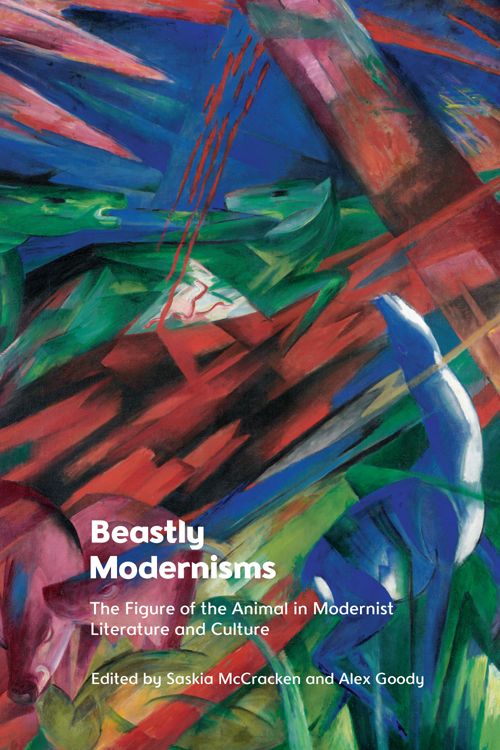
Beastly Modernisms reviewed by Paul March-Russell

Beastly Modernisms: The Figure of the Animal in Modernist Literature and Culture, eds. Saskia McCracken and Alex Goody (Edinburgh University Press, 2023)

Reviewed by Paul March-Russell

At face value, this collection of essays may not seem to be of immediate interest to the sf reader. It is primarily concerned with the development of Animal Studies – a sub-discipline that has already been significantly explored in relation to sf in the work of Sherryl Vint, Joan Gordon, and others – with reference to literary modernism, a diverse movement already noted for its challenge to traditional notions of identity and individual autonomy. The potential, though, for creative overlaps between modernism, sf and Animal Studies is already indicated by the fact that one of the co-editors, Alex Goody, was a keynote speaker at the 2019 Corroding the Now conference at Birkbeck College, London. Seen through a science-fictional lens, the encounter between human and non-human animals, the slippages between them, and their mutual affinities and kinships immediately invoke the First Contacts and uncanny relations between humans and aliens which are the stuff of genre sf. As the introduction’s reference to Jorge Luis Borges and Karen Eckersley’s chapter on Leonora Carrington make clear, imagined bestiaries are common to both Animal Studies and speculative fiction.

Without seeking to be a guide, the introduction nonetheless touches upon many of the key moments in the evolution of Animal Theory: from Peter Singer’s pioneering Animal Liberation (1975) and Donna Haraway’s ‘cyborg manifesto’ (1985) to Gilles Deleuze and Félix Guattari’s concept of ‘becoming animal’ (1982) and Jacques Derrida’s pivotal essay ‘The Animal That Therefore I Am’ (2002). The introduction also registers many of the other posthuman thinkers whose ideas have contributed both to Animal Studies and this volume in particular; from Giorgio Agamben and Rosi Braidotti to Michel Foucault and Cary Wolfe. The editors however, beginning their account with an exchange between Djuna Barnes and James Joyce (two modernists in exile, both of whom would flit between the centres and margins of the modernist canon), emphasise the affinities between Animal Studies, the revaluation of women’s writing and the decolonising of the curriculum. All such practices foreground and deconstruct the historic imposition of borders, the arbitrary gatekeeping that has characterised academic protocols and the maintenance of cultural shibboleths. To that end, the editors also note the collapsing boundary between ‘high’ and ‘low’ cultures, an elision that not only permits the entry of sf into the conversation, but which would also have appealed to such modernists as Barnes (boxing fan and purveyor of crime fiction) and Joyce (publican’s son, cineaste, and Anita Loos devotee).  

Continue reading Beastly Modernisms reviewed by Paul March-Russell”

An emotional affair with a particular orchid

Plants in Science Fiction: Speculative Vegetation. Edited by Katherine E. Bishop, David Higgins and Jerry Määttä. University of Wales Press, 2020.

Reviewed by Rhona Eve Clews


Before we dive into the myriad wonders of the first-ever collected volume on plants in SF, let me signpost by saying this article is not intended as a straightforward book review, more a subjective-entangled way into an intense and highly transformative text. As an Artist, Ecologist, Healer and dyspraxic my approach might be perceived as that of a fuzzy set, so named by Brian Attlebury, that is ‘affiliated with other texts that might seem to belong to other…terrains’ and tending to spy unexpected connections and join unexpected dots. I draw attention to this method as the unconventional, multidisciplinary approaches might be the essence of what this book points to, namely an urgent need for cross-species intimacy, or inter-kingdom intimacy. My hope is that bridging the separate islands on which different academics tend to reside will foster such closeness.

 Slurp, collage, Rhona Eve Clews
Continue reading “An emotional affair with a particular orchid”

Beyond Gender Collective: Abolish the Family!

Abolish the Family by Sophie Lewis

Review by Beyond Gender

Abolish the family? You might as well abolish gravity.” (1)

It is with these words, spoken by an imagined, horrified reader, that Sophie Lewis begins their new book. From the outset, the magnitude of the task ahead for family abolitionists is clear. To abolish the family is to attempt something frightening, something unthinkable, something which requires one to challenge the fundamental rules which bind our world together. It is, then, no surprise that again and again Lewis reaches for science fiction (SF) to articulate this vision of a world beyond the family. For an SF creator, to abolish a so-called law of nature is not a ridiculous proposition which can be used to embarrass utopians into giving up on their belief that “things could be different” (4, emphasis in original). It is rather a serious undertaking which involves an investigation of those forces which hold life as we know it together, the willingness to experiment with those same forces, and the determination to remake the world, however alien what comes next might be. This is the spirit in which we, the Beyond Gender research collective, approach Lewis’ book. We are a group of SF fans, researchers and creators who are committed to tapping into the radical potential of SF to undo the supposed naturalness of such myths as the binary model of gender, cis- and heteronormativity and, now, the family.

“Abolish the family? You might as well abolish gravity.” 

“Okay then, might as well.”

Continue reading “Beyond Gender Collective: Abolish the Family!”

Into The Spider-Verse and (Side)Setting the Scene for Social Change

By Christy Dena

This piece contains mild spoilers and mild mind scrambling if you haven’t seen the 2018 film Spider-Man: Into the Spider-Verse.

Margaret Thatcher had something to say about Miles Morales, so too did narrative theorist Seymour Chatman, as well as those fighting the idea of a “half-black, half-Hispanic” Spider-Man (Rose, 2018). It wouldn’t be a stretch of my tingly senses to say these folks share the belief that there is no alternative, there is a single, right, way. Thankfully, the opening sequence of the film Spider-Man: Into the Spider-Verse (screenplay by Phil Lord and Rodney Rothman, story by Phil Lord), sets the scene for social change with some cool emancipatory narrative devices.

It’s the kind of interventionist work that needs to be done because audiences have been trained to approach their story experiences, and much of life, with closed thinking. As part of his work on The Psychology of Closed Mindedness, social psychologist Arie Kruglanski explains that ‘the need for closure is the desire to have certainty, to have a definite answer to a question and avoid ambiguity’ (Kruglanski, 2021). A consequence of this is we can ‘jump to conclusions about others, and to form impressions based on limited and incomplete evidence’ (Kruglanski, 2004, 2). That character is the killer! Capitalism is the answer!

Former British Prime Minister Margaret Thatcher found it hard to imagine alternatives, and encouraged everyone else to find it hard. Thatcher is associated with the slogan ‘There is No Alternative’ — which refers to the neoliberal logic she popularised. In a speech, Thatcher not only said ‘there’s no real alternative,’ but also said ‘What’s the alternative? To go on as we were before?’ (Thatcher, 1980). As if the future is a long, single, inevitable, line of progression and the only choice is to stick with what isn’t working or proceed in the only available direction. Do nothing and crumble, or do the only change available. 

In Capitalist Realism, Mark Fisher connected the belief that there is no alternative to capitalism with dystopian films and novels that don’t imagine ‘different ways of living’ (Fisher, 2009, 2). Instead of representing or prefiguring different ways of living together, many works of fiction depict the destruction of the world by unbridled capitalism. Even our fiction jumps to conclusions.

Continue reading “Into The Spider-Verse and (Side)Setting the Scene for Social Change”

Adventures in Science Fiction Prototyping

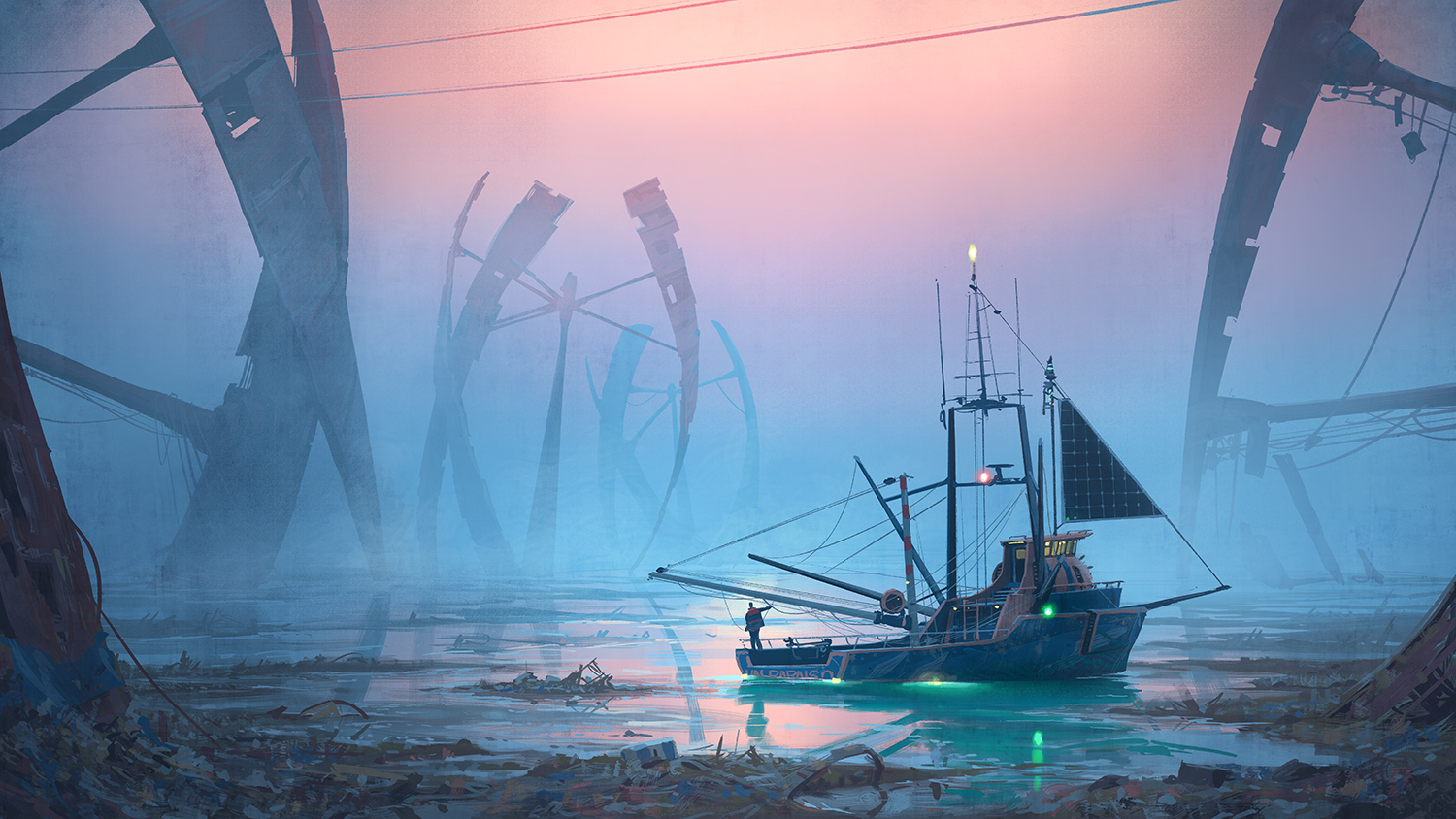
Andrew Merrie and Pat Keys in conversation with Jo Lindsay Walton (and briefly Polina Levontin) about science fiction prototyping and the Radical Ocean Futures project. 


Radical Ocean Futures project

JW: We’re lucky enough to be joined by Andrew Merrie and Pat Keys. Andrew is a Research Liaison Officer at the Stockholm Resilience Centre, Stockholm University (Sweden) and the Head of Futures at Planethon. Pat is an Assistant Professor in the Department of Atmospheric Science at Colorado State University (USA).

We want to find out more about your very intriguing Radical Ocean Futures project, and Science Fiction Prototyping in general—as well as adjacent ideas like applied science fiction, critical design fiction, diegetic prototyping, speculative design, all part of the theme of this special issue. But I guess let’s start with the high seas themselves. How do we define the high seas? What are some of the issues that arise in their governance? Surely mighty Poseidon is ungovernable? To me, those words already feel strange in a sentence together: ‘governing the high seas.’ 

AM: The high seas are areas of the ocean that are not managed by any single authority. In some ways they represent this largely unexplored ‘wild west’ of the global ocean. When you’re trying to think about how to govern the high seas, you are thinking about things like climate change, overfishing, deep sea mining, genetic resources and so on. But you also have to contend with the pace of change. The ecosystems are changing, and the technology is changing, and companies and other kinds of actors can basically take advantage of these gaps or delays in regulation, and sort of do what they want in this ocean space. Interestingly enough, just a few weeks before this issue of Vector went live, a historic deal was made, after nearly 20 years of talks to put in place a legal framework, the UN High Seas Treaty. That said, monumental governance challenges remain and though very consequential, this is really the start of another 20 years of work.

JW: In this context, does ‘governance’ refer to international law?

AM: Partly. Governance is actually broader than that. It refers to a variety of laws, regulations, institutions, certifications, norms and so on. It’s everything that is relevant to how we look after the oceans, or fail to look after them. For example, for the governance of marine ecosystems, computer modelling is very important. But you can’t just look at a model and go, ‘OK, here is what will happen, if we follow this management strategy.’ There are all kinds of questions about what is possible or plausible. About what models to use, what their assumptions are, how you should interpret and use their outputs. All that could be part of governance. 

JW: OK. And these questions are more than technical questions, right? They quickly get us into the realm of politics and ethics. But sticking with ocean ecology for a moment. Honestly, when I think of the ocean, I mostly think, ‘I have no idea what’s going on in there.’ I want to quote a 2016 WIRED article about your project. ‘Earth’s oceans are having a rough time right now. They’re oily, hot, acidic, full of dead fish—and their levels are rising.’ Can you tell us a bit more?

Continue reading “Adventures in Science Fiction Prototyping”

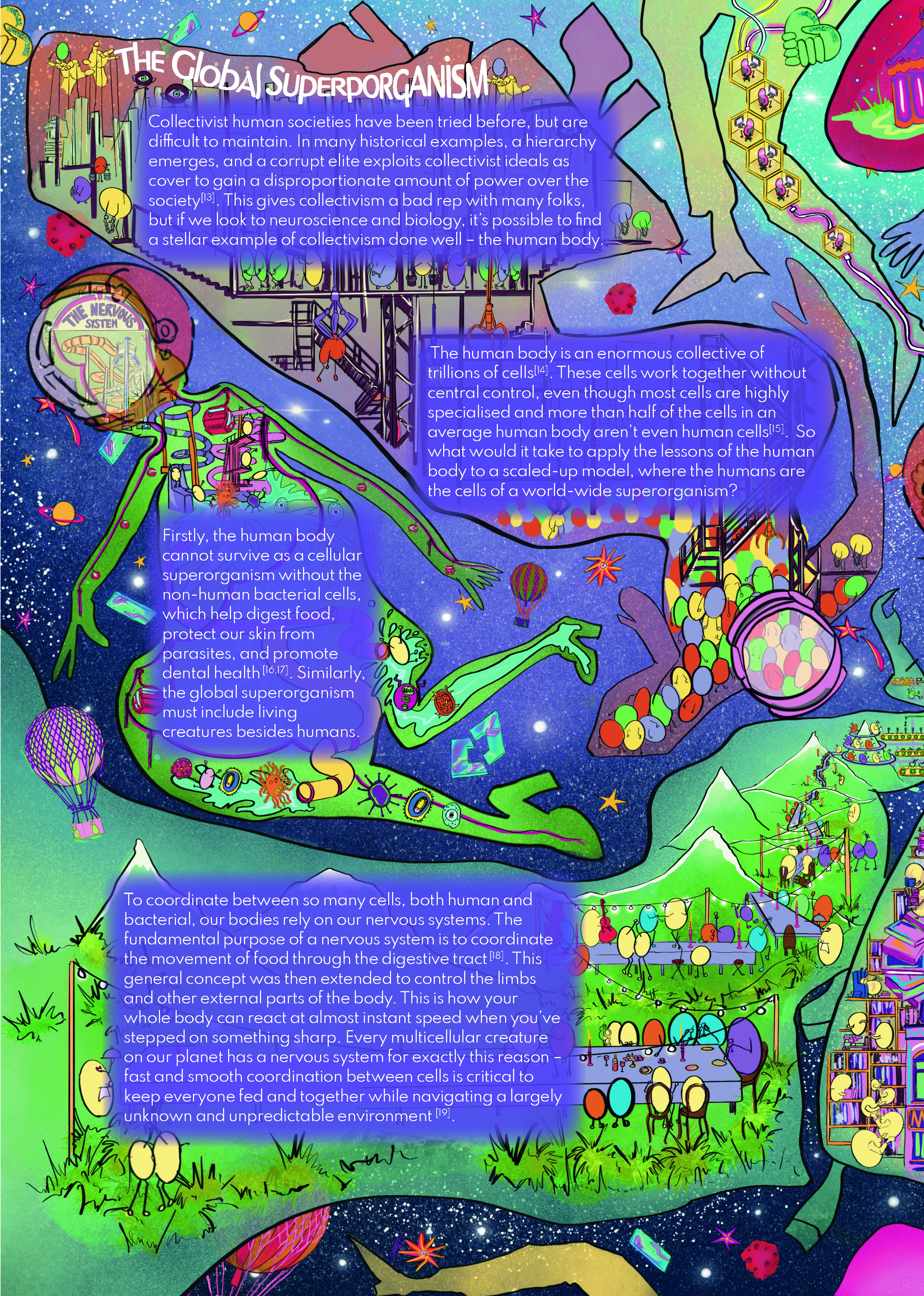
A Solarpunk Nervous System

Danbee ‘Tauntaun‘ Kim, PhD; Xiao Xiao, PhD; and Amelia Goldie, MArch


This artwork-essay first appeared in Vector: Futures, a publication in part supported by the PASTRES programme (Pastoralism, Uncertainty, Resilience: Global Lessons from the Margins, www.pastres.org), funded by the European Research Council (ERC) (Grant No. 70432). PASTRES is co-hosted by the Institute of Development Studies (IDS) and the European University Institute (EUI).