Aldiss’s Error: Aliens, Science Fiction, and the Problems of Genre

By James C. Bassett

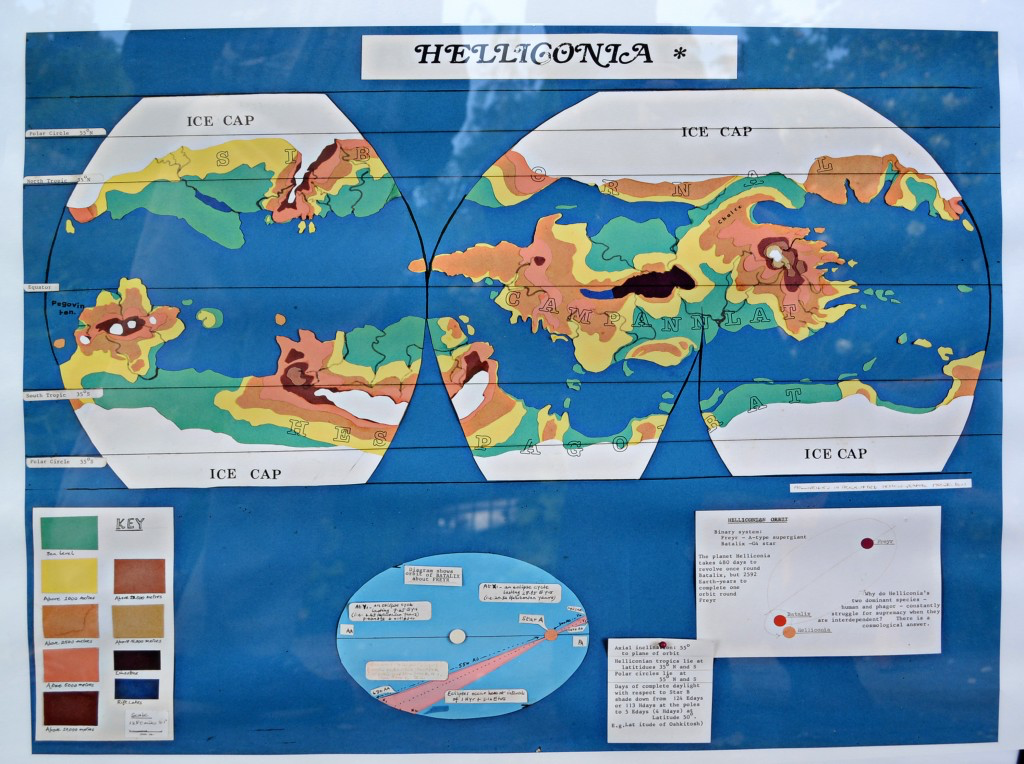
Brian Aldiss, map of ‘Helliconia.’ https://brianaldiss.co.uk/writing/novels/novels-h-l/helliconia/

I recently came across a most curious and unsettling pair of essays by Brian Aldiss that I am still trying to process, because they seem to strike against the very heart of science fiction literature, and even much of Aldiss’s own writing. “As far as we know, we are alone in a universe,” Aldiss points out in the second of these essays on the subject of aliens (Aldiss 1999, 340), and he is absolutely right. As far as we know.1 But although the jury is still out on the Big Question, in this essay Aldiss seems fervidly convinced that extraterrestrial sentience simply does not exist. When Aldiss argues “the case for mankind’s solitary state here [the universe], for which the evidence is plentiful” (Aldiss 1999, 334). He appears to accept an absence of evidence as evidence of absence, an extrapolative leap which defies logic and scientific method.

“There is no scientific evidence that [alien sentience exists], any more than there was ever any evidence for the long-held belief in spontaneous generation”2 (Aldiss 1999, 335), an unfair comparison, because spontaneous generation (the theory that living creatures could arise from nonliving matter—for example, that flies grow from rotting meat or that frogs grow from mud) was disproved by scientific evidence against it, a state of affairs that has not been reached regarding the existence or non-existence of sentient extraterrestrial life.

Still, anyone who believes in aliens absent any definite proof is misleading themselves, according to Aldiss. Such belief “represents a continuation of that venerable credulity” (Aldiss 1999, 340) that cursed our race with gods and monsters. Yet absent any definite proof that aliens do not and have never existed, Aldiss seems to be just as guilty of relying on a type of faith — just as “credulous” — in forming his conclusions.

Whatever the reasons for it, or the reasoning behind it, this personal disbelief in the existence of aliens is of little consequence to anyone but Aldiss himself. Of far greater import, however, and far more troubling to the science fiction genre, is an earlier essay in which Aldiss presents an overview of the development of the role and portrayal of sentient alien life in SF literature from its long pre-Campbellian days to the present, and an examination of the causes and effects of the debased and increasingly “monsterish” concept of aliens and what is alien (Aldiss 1996).

Continue reading “Aldiss’s Error: Aliens, Science Fiction, and the Problems of Genre”

Cultivated Meat: Science Fact and Fiction

By James Henstock

 Cultivated (lab-grown) meat has emerged from science fiction into a genuine commercial product. The promise of sustainable, animal-free meat has captured the interest of governments concerned with national food security in a time of rapid and unpredictable climate change. Supported by a rapidly developing $3Bn industry, cultivated meat is now available for limited public consumption.

However, public opinion on cultivated meat is strongly polarised. Since most people haven’t yet tried cultivated meat, preconceptions have instead been formed by its depictions in science fiction which may be either inspiringly utopian or more commonly, starkly dystopian. Real culture-grown products are being introduced to a consumer base with expectations based on imagined realities. 

In this article I will introduce some of the technology that underpins the production of cultivated meat, and how its origins in the biopharmaceutical industry present both opportunities and challenges for manufacturing appetising food. How far does the reality of cultivated meat match the science fiction representation? Can scientists and storytellers work together towards a shared utopian vision of this Future Food?

A new era: the Post-burger 

On Monday 5th August 2013, Dutch pharmacologist Mark Post unveiled the world’s first cultivated beef burger at a press conference in London, thus launching a new era in food. The burger was cooked and eaten, and whilst being described as ‘close to meat, but not as juicy’ and costing around $325,000 nevertheless inspired a boom in investment that saw the creation of over a hundred start-ups and university spin outs, plus a handful of very well-capitalized companies in the USA, Israel, Australia, and the Netherlands (Mead, 2013; Gregory-Manning & Post, 2024). Since 2013 it is widely estimated that over $3.1 billion has been invested into cultivated meat enterprises, with a peak in 2021 (GFI, 2023). New consumer markets are opening up following regulatory approvals in Singapore, China, Australia, New Zealand, the USA, Israel and the UK as governments recognise the value of a diversified ‘Alternative Proteins’ ecosystem in enhancing food security in response to growing population challenges and climate change. 

Yet the concept of ‘synthetic’ meat has been in the public consciousness for generations. Since first being articulated in fiction in 1897 (as a gift from the Martians in Two Planets by Kurd Lasswitz), social and technological revolutions have triggered particular bursts of literary creativity in the 1930s, 1950’s and 1960s, corresponding to increasingly mechanised intensive farming practices and the overall boom of technological progress in the 20th century, not least of which was in biomedicine and laboratory cell culture. In a 1931 essay on the future of science, Winston Churchill wrote:

‘We shall escape the absurdity of growing a whole chicken in order to eat the breast or wing, by growing these parts separately under a suitable medium. Nor need the pleasures of the table be banished. That gloomy Utopia of tabloid meals need never be invaded. The new foods will from the outset be practically indistinguishable from the natural products, and any changes will be so gradual as to escape observation.’ 

Churchill’s predictions and the early optimism of fin de siècle authors in humankind’s salvation through science are admittedly taking some time to realise, yet the technology required to bring cultivated meat to fruition is being developed at pace. 

Continue reading “Cultivated Meat: Science Fact and Fiction”

Energy Economies in Science Fiction

By Jo Lindsay Walton

‘Embers’: Stranded Assets

Wole Talabi’s short story ‘Embers’ (2024) explores the potential consequences of energy transition for a rural community in Nigeria, focusing on one oil worker who cannot let go of dreams of petrochemical prosperity. 

Kawashida fuel cells were invented by a team of scientists at the ShinChi Technology Company of Japan […] By using a proprietary genetic modification technique to rewire the metabolism of a heterotrophic bacterial strain, making it autotrophic, and then further splicing the synthetic microbe with a cocktail of high cell density, rapid reproduction genes, Dr. Haruko Kawashida and her team created a living, breathing, renewable supply of energy for the planet. The synthetic autotroph used concentrated sunlight to efficiently consume carbon dioxide and exchange electrons, creating a steady stream of electricity.1

How convenient! And as if its abundant, net carbon-negative energy weren’t enough, Kawashida cell technology also revolutionizes wastewater treatment. It’s a near-perfect deus ex machina for the climate crisis. 

But not everyone is happy. When Kawashida decimates the oil industry, Uduak is abruptly cut off from his sponsored scholarship. Cast adrift, Uduak becomes a kind of inverted solarpunk protagonist—he uses grit and ingenuity not to jury-rig funky green utopiatech, but rather to attempt to revive the village’s derelict oil refinery. Even though clean energy is widely available, Uduak argues that the village’s real needs remain unmet, and he remains hostile to the post-carbon vision laid out by his idealistic rival, Affiong.

The story comes to a grisly and tragic conclusion—murder, arson, suicide. Without excusing Uduak’s rather OTT response, we can see that there is a clear lack of compassion to support him transition to the era of a stabilised climate. One wonders if Uduak might also have a point: will the village as a whole be left behind by government, industry and civil society? Just as Uduak was left behind by the village?

Uduak becomes what is sometimes called a ‘stranded asset,’ something once valuable, whose value has vanished because of a probably permanent shift in its circumstances. The story’s core tension—between his thwarted social mobility and the new sustainable technology—reflects the current dilemma of green transition for petro-states like Nigeria. 

It also implies broader questions about energy transitions. Within science fiction, transformation of the energy system often forms the hard-to-imagine bridge between the dystopian present and the ambiguously utopian future. There are the dilithium crystals and warp cores in Star Trek, there is the Grid in Iain M. Banks’ Culture novels. But the questions which arise are not just about what energy will power the future. They are also about how societies will allocate and manage such energy.  Could energy itself somehow be the foundation of a just and equitable economy? If the flow of energy were to directly underpin the flow of money, could this support systems that are more cooperative, collective, and liberated, and less exploitative? Systems that are not just energy-based, but also just based pure and simple?

Continue reading “Energy Economies in Science Fiction”

Eternally Displaced Persons? Territorial Bodies and The Ministry of Time

By Matt Finch

Introduction

What does travel through time and space reveal about the body?

This essay is an invitation to think about bodies moving through time in a work of contemporary literature. What is exposed about a body when it is displaced in time and space? The concept of the territorial body, developed from the pioneering work of Verónica Gago (2020), serves as a lens through which we can understand “the body of the individual person in the context of its entanglement with questions of territory, incorporating the complex multidirectional dynamics which arise between the individual body, the collective, and the various territories they inhabit” (Finch and Mahon, 2025, p.163). I also consider the temporal dimension of how “institutionally and culturally enforced rhythms, or timings, shape flesh into legible, acceptable embodiment” (Freeman, 2010, p.40). In this framing, the body is always the body in context and contexts, in turn, are changed by the bodies which populate them.

This lens is trained, here, on Kaliane Bradley’s 2024 novel The Ministry of Time. Bradley uses a science fiction conceit to bring together bodies from the territories of Britain’s past, present, and future. They populate a narrative which is at once a romance with sophisticated queer dynamics, a techno-thriller, an “odd couple” comedy of cultural misunderstanding, and a meditation on race and national identity in the era of climate crisis.

Kaliane Bradley, The Ministry of Time (Hodder and Stoughton, 2024)

The novel also provides the perfect opportunity for us to move Gago’s concept beyond the limits of “real world” plausibility; as one of Bradley’s characters puts it, “we are interested in the actual feasibility of taking a human body through time. Our concern is if the process of time-travel has major implications for the expat or the expat’s surroundings.” (p.37). From Bradley’s science-fictional vantage points, distinct interrogations of the territorial body can be made.

Continue reading “Eternally Displaced Persons? Territorial Bodies and The Ministry of Time”

Gender, Democracy, and SF/F Literary Awards

Published in Foundation 149 (winter 2024) edited by Paul March-Russell. Republished with permission.

By Jo Lindsay Walton and Polina Levontin

This article explores cultural and design dimensions of non-governmental voting systems, focusing on science fiction and fantasy (SFF) literary awards voted for by fans, with a focus on the British Science Fiction Awards. The design of such voting systems needs to juggle a range of goals, one of which is fairness with regard to gender — acknowledging that ‘fairness’ is not straightforward to define, particularly given such awards are embedded within broader gender inequalities. Our analysis suggests that men have been more likely than women to vote for works by men, and also more likely to vote in ways that amplify the influence of men’s votes under an Alternative Vote System. We suggest that SFF awards are cultural spaces which lend themselves to experimentation with new democratic forms, and briefly offer potential sources of inspiration. Just as SFF has aspired to be a space to think about the future of technology, gender, the environment, and many other issues, SFF award spaces could be spaces for thinking about the future of democracy. We also offer recommendations to SFF awards designers and communities to address gender bias (emphasising reflective practices over technical solutions), and to continue to explore how aesthetic and cultural values and identities are constructed and negotiated within SFF award spaces, and beyond. 

Science-Fiction, Quantum Physics and the Modernists

By Steven French

Introduction

In 1926, Erwin Schrödinger published the paper containing his eponymous equation, one of the most significant scientific achievements of the twentieth century. In the same year Hugo Gernsback founded Amazing Stories, dedicated to what he insisted at the time on calling ‘scientifiction’. Given this, an obvious question to ask is whether the new theory of quantum mechanics had any impact on this emerging genre of literature, and if so, in what form?[1] As far as I can tell, however, no one has seriously considered this before now.[2] That’s not to say that there are no studies of the impact of quantum physics on science fiction at all – there are, but they tend to focus on later, post-war, developments. My interest lies with the earlier years, stretching from the late 1920s into the 1940s, when the theory spread beyond a small set of theoretical physicists and not only began to be applied to a range of phenomena – physical, chemical and biological – but was also presented to the general public through a number of popular scientific texts.  

Unfortunately, however, with one or two exceptions, it appears to have had little impact on the science fiction stories of that era, beyond the occasional name-dropping and the odd, usually distorted, reference. it might be thought that this was because quantum mechanics was too new a theory and had not yet filtered into the consciousness of the general public, even of those who might be taken to be attuned to the latest scientific advances. Yet, this situation appears to contrast sharply with another form of literature prevalent at the time, namely Modernism. There is now a burgeoning literature on how the likes of Virginia Woolf were receptive to the new quantum physics, drawing on it to give non-traditional shape to their works. That suggests that the early authors of ‘scientifiction’ were not quite as ‘on the ball’ scientifically speaking as certain avant-garde writers in the UK. As we’ll see, however, things are not quite so clear, although there remains enough of a disparity to demand some form of explanation.

Continue reading “Science-Fiction, Quantum Physics and the Modernists”

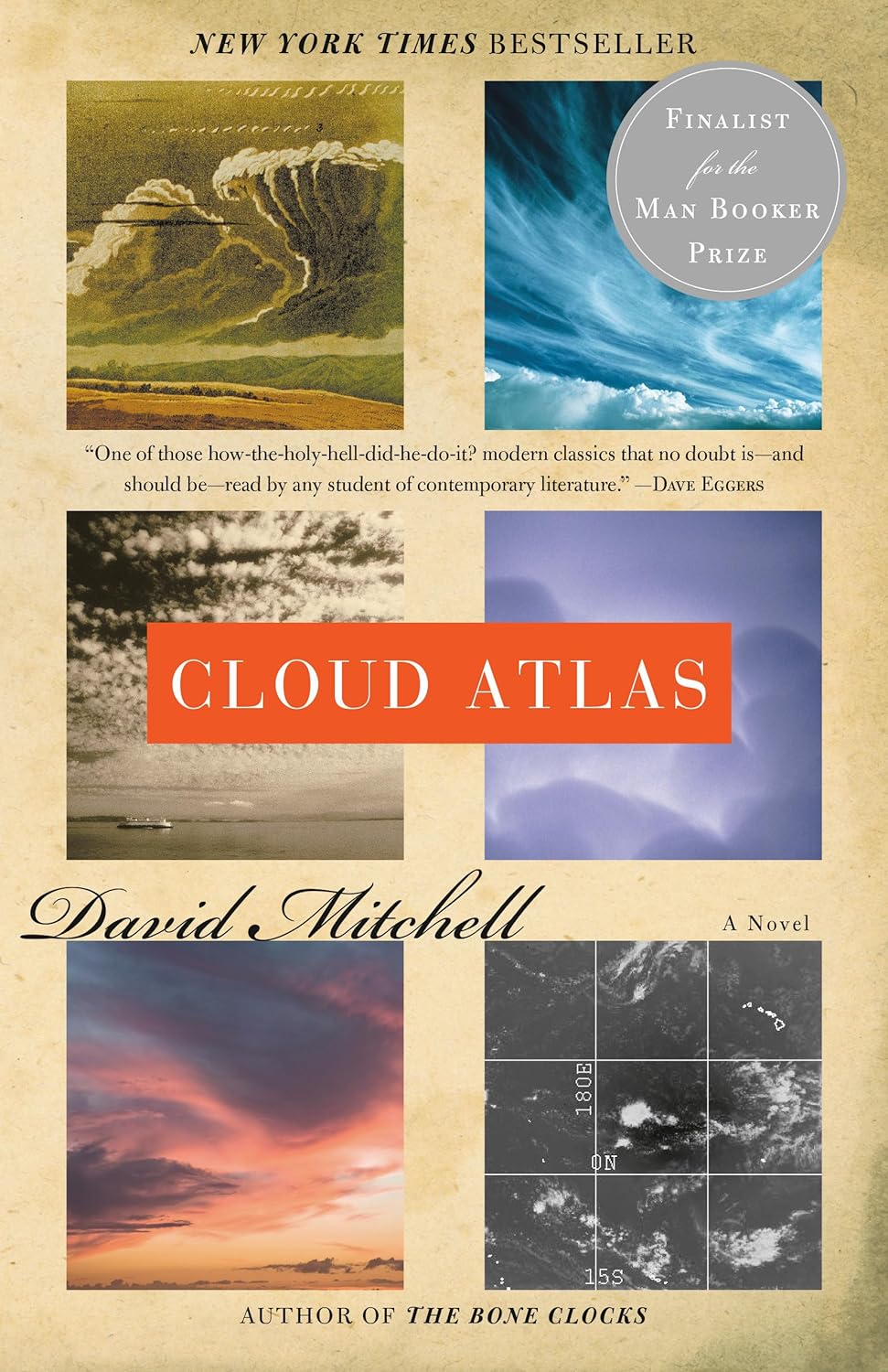
Stuck in the Middle with You: Speculative Structure and Concentric Reading in David Mitchell’s Cloud Atlas

By Matthew Burchanoski

Immediately praised upon its release, David Mitchell’s Cloud Atlas (2004) stands as one of the most significant books of the 21st century. Though it has its skeptics, the novel was shortlisted for the Booker Prize, Arthur C. Clarke Award, and Nebula Award for Best Novel and won in Literary Fiction at the British Book Awards. The novel’s support across the communities of historical, speculative, and literary fictions is itself quite interesting but, suffice to say, the novel was well received and remains so in myriad lists of Best Books of the Century. 

One reason potentially behind its plaudits is how Cloud Atlas attempts to catalogue the challenges, tensions, and anxieties of its post-postmodern period. Many of the sociopolitical concerns shared by theorists regardless of their periodizing name of choice also drive Cloud Atlas’ structure and world. Less a realist representation of the contemporaneous moment than a warning about violent mistakes being repeated over and over, the novel assesses what entwines human’s past, present, and future morally as well as, in the broadest sense, politically. Put simply, Cloud Atlas is one of the most comprehensive attempts at understanding and representing the anxieties of the present moment. 

The impressive chronological and physical scope of Cloud Atlas is both obvious from its audacious structure and poured over in critical assessments. More than any other element, its expansive world motivates and helps organize analysis of the novel. Spanning roughly 1200 years with sections set on four different continents, Cloud Atlas presents a truly global vision of connectivity through time and space. The recurrence of objects, themes, and markers, as well as the reappearance of distinct, previous texts in newer sections, binds the eleven sections together as not simply diegetically related, but in many ways as repetitions of similar stories, phenomena, and souls. 

Continue reading “Stuck in the Middle with You: Speculative Structure and Concentric Reading in David Mitchell’s Cloud Atlas”

Issue 300, ‘Community’— Call for proposals

Solaris (1972), Andrei Tarkovsky

Science fiction, for all it encompasses strange new worlds and fantastical creatures, is a literary genre that is built and sustained by human communities. Writers, artists, and creators have imagined new social formations, technologies, economic, ecological, and sociopolitical systems for centuries; indeed, science fiction may be the most nakedly political of all literary genres, as thought-provoking as it is beguiling. Who is present in narratives of futurity? What kinds of technologies enable—or stymie—human connection? How can inter-species communities develop and flourish? 

Pre-internet, fanzines and conventions were the spaces where editors, authors, and fans met, shaping the genre in new and exciting ways. Praise and critique and conflict and collaboration were equally already common before social media. Some landmark dates include: the first WorldCon (1939), the first British science fiction convention, Eastercon (1937), the Maleyevka seminars, Nihon SF Taikai (from 1962), and many others, around the globe.

In 2024, the ideologies of ‘community’ are under pressure and scrutiny. Violent geopolitical events shadowplay on smartphone screens, small enough to fit in the palm of our hands, fulfilling the most dystopian dreams of the genre; we venture to fight and commiserate and celebrate with people from all over the world, instantly. Where wealthy industrialists were (and are) once praised as saviors of humanity with the glittering promise of their space programs, now SF tends to show how the relentless logics of capitalism undermine any notions of transcendence. The challenge of space travel was supposed to unite us. What would the pioneers of SF make of the now-straining politics around the International Space Station, scheduled for dismantling by 2030? 

In light of these challenges, the Vector team—for the journal’s milestone 300th issue—invites contributions that reify the notion of ‘community’ as it manifests in speculative cultures. What tools can SF offer us to construct better tomorrows, together? How can we innovate new ways of collaborating, such as the world-building projects of Syllble? What does ‘community’ look like in fiction, non-fiction, conventions, awards, conferences, collaborations, online spaces, and other literary and paraliterary formations?

Suggested questions / topics

  • history of fandom/conventions 
  • the practice of writing: zines, magazines, letters 
  • science fiction publishing: editors and collaborators on the printed page 
  • utopias and dystopias 
  • terraforming
  • defining personhood 
  • future societies 
  • sex and sexuality 
  • navigating conflict 
  • political divides, past and present 
  • interspecies alliances
  • the posthuman 
  • the future of communication 
  • translating SF 

Please submit your proposal by June 15th, 2024 to vector.submissions@gmail.com, including:

  • a 150-500 word proposal, including estimated length;
  • something about yourself, either a 50-100 word bio or a CV.

Articles should be between 1,000 and 8,000 words. Please let us know your estimated word count. We seek articles that are carefully grounded in scholarly research, while also being clear, engaging, and suitable for a broad audience (including non-academics). Articles will be due by July 31st, 2024.

Please also feel free to make queries about other formats, e.g. reviews, interviews, curated reading lists, roundtable discussions, unusual / innovative formats. 

Electricity as a Speculative Device: The Romanian Modern(ist) SF

By Amalia Cotoi

This article explores how Romanian science fiction novels written between 1899 and 1954 engage with modernity. I am particularly interested in examining how key texts that center around the protagonist’s exploration beyond the familiar realms intersect with a modern development that was a game changer in human history: electric energy.  The analysis centers on three novels from the modernist era − Victor Anestin’s pioneering Romanian Sci-Fi novel, În anul 4000 sau o călătorie la Venus [In the Year 4000 or A Trip to Venus] (1899), Henri Stahl’s Un român în lună [A Romanian on the Moon] (1914), and Felix Aderca’s Orașe scufundate [The Submerged Cities] (1937) − and one written and published in the aftermath of WWII − Drum printre aștri  [Path Among Stars] (1954), penned by I. M. Ștefan and Radu Nor. If the works written during the interwar period represent initial major forays into the Sci-Fi genre, it wasn’t until the postwar era that the first notable presence of Sci-Fi in Romanian literature, holding institutional significance and capturing general interest, emerged. By including a novel written in the 1950s in this inquiry, I aim to challenge the chronological convention of the modernist era ending with World War II. The emergence of the communist regime, influenced by the Soviet model, signaled an unparalleled drive toward industrial and technological advancement in a European nation that was among the least developed, with a rural population twice the continental average (Murgescu, 140). Such a transition is all the more justifiable in the case of electricity, as the pace of electrification accelerated after World War II, particularly between 1950 and 1970 (Murgescu, 344), witnessing the shift from electricity as a speculative concept to a democratically commodified resource.

Continue reading “Electricity as a Speculative Device: The Romanian Modern(ist) SF”

Destroying ‘Centuries of Evil Work’: Female-Authored Dystopian Science Fiction in Spain

By Angela Acosta 

The Speculative and Surrealist Origins of Spanish Modernism 

Ángeles Santos’s painting, Un mundo [A World] (1929), is a large surrealist composition one may easily miss if one is too eager to reach Pablo Picasso’s Guernica (1937) in Madrid’s Reina Sofia Museum. In 1929, at the age of seventeen, Santos presented Un mundo at the Ninth Autumn Salon of Madrid where prominent Spanish intellectuals like Ernesto Giménez Caballero, Vicente Huidobro, and Federico García Lorca noticed her work. The three-by-three metre painting projects a surrealist world not unlike literary utopias of the early twentieth century. A world in the shape of a cube hangs suspended by angels in the sky. Female figures clad in dark dresses race down a staircase, reaching towards stars that serve as anchors for this small world. The image is equally precarious as it is carefully crafted. Santos painted the self-sufficient world with the same dark, muted palette as the cloudy blue sky. There, one can see into buildings as miniature humans go to work, play sports, and ride the steam train that snakes its way across each side of the cube. What lives do these people lead? What references to modern Spain can be found in this painting and similar works of literature? How might we recognize the contributions of women within this milieu? 

“Un mundo” by Ángeles Santos (1929) photographed by eckelon is licensed under CC BY-NC-ND 2.0.
Continue reading “Destroying ‘Centuries of Evil Work’: Female-Authored Dystopian Science Fiction in Spain”