Call for papers, applications, and nominations

Firstly, a reminder that the Third Annual Science Fiction Foundation Masterclass is still open for applications until the end of the month.

Secondly, the Science Fiction Foundation has issued a Call for Papers for their latest book, The Unsilent Library: Adventures in new Doctor Who:

Published by the Science Fiction Foundation
edited by Simon Bradshaw, Antony Keen, and Graham Sleight

The Science Fiction Foundation, which has published a number of books on sf (including The Parliament of Dreams: Conferring on Babylon 5 and Terry Pratchett: Guilty of Literature) is now seeking contributions for a new book, proposed for publication in 2010, on Doctor Who. This book will focus on the series’ revival since 2005. Contributions are invited on all aspects of the new series, including its scripting, production, and reception, as well as links to the “classic” series. A variety of critical approaches/viewpoints will be encouraged.

Potential authors are asked to submit brief proposals (max. 250 words) for chapters by 1st March 2009. Final chapters (max. 6,000 words) will be due by 1st August 2009. Please send proposals to sjbradshaw@mac.com.

Finally, another reminder that if you have not yet nominated anything for the BSFA Awards, you can do so until Friday 16th; here’s the list of current nominations if you need some inspiration.

Alice in Sunderland

The most interesting review that I’ve seen of Alice in Sunderland (and there are plenty to choose from) is probably that by Steven Flanagan at Gad, Sir! Comics!. It’s done as a comic in the same sort of style as Alice, and so gives a better idea of what the book is like to read than any of the other reviews. Flanagan, like pretty much every other reviewer, and like me, rates the book (although he has some valid criticisms, one of which Talbot responds to in a comment), and is probably better at articulating why than I’m going to be. But for the record, here’s my take.

Alice in Sunderland is an argument about history, couched as a lecture in a dream. It is, specifically, an argument about the history of Sunderland, or perhaps at a stretch the history of England – to paraphrase Crowded House’s marketing people, according to this book you know more Mackems than you think you do – but in its general form, as a provocation to think about who writes history and what they write and why, it could be applied to just about anywhere. From a stage in the Sunderland Empire, and in another guise (referred to in the text as “the pilgrim”) wandering around Sunderland itself, Talbot narrates, explores, and invigorates the history of the city he has made his home with a fluidity and range of reference that is dizzying, and certainly more than I can decode in one reading. Some individual stories or legends are highlighted, such as the story of Jack Crawford, Hero of Camperdown (and source for the phrase “nailing your colours to the mast”), or the Legend of the Lambton Worm; these are generally presented as traditional panel-driven comics, some with guest art or script by such luminaries of British comics as Leo Baxendale. For the most part, however, Alice is a work of collage, a tremendous mish-mash of many different styles of artwork. The signature look is a black and white line-drawn figure against digitally manipulated photographs of the area being discussed, perhaps with other elements – manuscript pages, older artworks, and so on – overlaid. Such a variety of styles is no doubt intended to reflect the variety of ingredients being thrown into the melting point that is Sunderland’s story, but without pictures, it’s hard to convey how ambitious some of the layout is, nor how playful it can sometimes be.

It’s an approach that allows Talbot to bring many different versions of history, intimate conversations and epic battles and everything in between, convincingly to life in a way that, yes, is not possible in a prose work. Which is not to say the script isn’t important. Throughout the book, Talbot keeps the narration in present tense — that’s one of the things Flanagan expresses reservations about, but on balance I think it works, giving the whole book a panoptic quality, all of its events taking place at the same moment, seen from a god’s perspective. It’s not so much a criticism as an observation to say that the book lacks a strong narrative; it doesn’t do anything so obvious as run through Sunderland’s history from its early days to now, and Talbot is forever freewheeling (or so it seems) off to riff on some seemingly tangential element. Sometimes it’s hard not to feel he’s reaching a bit – to imply that Sunderland University is an older centre of learning than either Oxford or Cambridge because it’s built on the site of an earlier monastery seems a little tenuous, while the explanation of how to “read” pictures, and the repeated justification of comics as a serious medium feels a bit unnecessary in this day and age, particularly when the book itself is the best justification you could ask for. Talbot, for example, links Sunderland to the creation of the Bayeux Tapestry, which he calls “the birth of British comics”; this strikes me as about as useful as some of the claims for Greek or Roman texts as the first science fiction novel.

But looked at another way, the digressions and six-degrees-of-separation revelations are part of the point — you can find interesting facts about anywhere, if you put your mind to it, the book says, and more often than our brains expect everything is connected to everything else. (I have a connection to Alice in Sunderland, as loose as some of the connections made in the book: a couple of the people who contributed photographs of the area are acquaintances.) Moreover, Talbot quite reasonably points out that, thanks to heavy bombing in World War II, much of Sunderland’s history is invisible even to most of its current inhabitants. Perhaps some excess in bringing the history back is forgivable. And if it means the book is best read in small doses, which it is, and that it can get a bit wearying towards the end, which it does, well, those are prices worth paying for the many pleasures Alice in Sunderland offers along its way. It is many things – informative, funny, inventive, argumentative, beautiful – but perhaps above all, as the cover declares, “an entertainment”.

So read it for all those reasons. Of course, I read it because it’s on this year’s shortlist for the British Science Fiction Association Award for Best Novel, and I want to talk about that a bit if only to see if I can get Jeff VanderMeer frothing. Look at it this way: any description of a book is in part about expectation management. If I enthuse to you about a book enough, I can probably persuade you to read it, but I don’t want to do so if it means raising your expectations beyond what the book can meet, or actively misleading you about what the book contains. Equally, shortlisting a book for an award acts of a description — it says, this book is eligible for this award — and similarly generates expectations. Admittedly this is more true in the case of a juried award, where you can probably assume a degree of intentionality (say, considering Quicksilver to be a science fiction novel; or considering alternate history to be science fiction [or not]) than in a popular-vote award like the BSFA, which exists to reflect the taste of a diverse group; but still, expectations are set. All of which is a long-winded way of saying that because I came to the book the way I did, I couldn’t stop thinking about what Alice in Sunderland is, and is not, instead of just being able to enjoy it as what it is advertised as.

The appearance of Alice on the shortlist constitutes an argument that it is a fantasy novel (despite the name, both science fiction and fantasy are eligible for the BSFA’s Awards), which is certainly an interesting way to think about the book, if only because it’s not even clear that it’s fiction. Oh, it’s framed as a story, as I suggested — it opens with a man walking into Sunderland’s Empire Theatre, and ends with Bryan Talbot waking up at the end of a performance of Swan Lake taking place in the same venue, realising that the previous 320-odd pages were all a dream — but for most of the book the frame is irrelevant. What you get is a narrator and a historical lecture; a lecture that often takes the form of a story, and indeed includes sub-stories, but a lecture that we’re told is entirely true (to the best of Talbot’s ability to determine such things). That means that the fictionality of Alice in Sunderland inheres entirely in its frame; it seems to me you might almost as well call Scott McCloud’s Understanding Comics fiction; after all, it uses a similar type of narrator in its exploration of how comics work.

But say we accept Alice in Sunderland as fiction; and accept it as a novel, although you could probably argue that it’s better considered as an anthology; and accept that a graphic novel is comparable to a prose novel, although that’s not an unproblematic stance. We’re left with another question: is it fantasy?

Again, technically, yes: as I said, the ending reveals that it’s a dream-story, even if a dream of things that are true. It’s also true that there are occasional moments when, presumably to break up the lecture, Talbot has one or another historical (the White Lady who is meant to haunt the Sunderland Empire; or, from more recent history, Sid James) or contemporary individual (in one of the book’s most interesting sequences, Chaz Brenchley and Colin Wilbourn turn up to explain the genesis of a riverside sculpture park), or even fictional character (mostly from Alice), butt in, somehow, and assume an equal level of reality to Talbot-the-narrator. These are, effectively, moments of fantasy. But even when they add something to the book’s general argument they are also, by and large, intended first as jokes, gimmicks, momentary diversions from the main thrust of the book. Of course, one of the threads that runs through the book, as the title implies, is an investigation of Charles Dodgson’s life, and how wrong the popular portrait of him as a dreaming spires recluse is, and of course Alice in Wonderland is a key text of the surreal and absurd fantastic. Being about something, however, is not actually the same as being something; put another way, although Alice in Sunderland is at times about fantasy and mythology, it is not itself either in more than a trivial sense. Moreover, the fantastic elements are not nearly as central to the book as a whole as is the concern with story more generally, and how story becomes history.

So despite the fact that it’s led me to a good book that would otherwise have taken me longer to get around to reading, I feel a bit mis-led by the shortlisting of Alice in Sunderland. It seems to me that while technically supportable, the implicit description of the book that this shortlisting provides is not a Quicksilver case, is not something that makes us think about what we mean by “fantasy novel”, because Alice in Sunderland is not trying to be either fantasy or a novel. Indeed, to think of it in such a way almost seems to miss the point, to miss what’s good and important about Talbot’s fascinating, if at times frustrating book. Looked at one way, of course, in the end it doesn’t matter, because Alice in Sunderland teaches you how to read it, and even I managed to forget my genre-quibbling ways, which means that most people probably won’t think twice about the issue; and though the detail won’t stay with you (the detail overwhelms), the overall impression will, the passion and the exhilaration of its best moments. But this recommendation does it no favours.

BSFA Awards: Shortlists

Announced last night:

Best Novel:
Alice in Sunderland – Bryan Talbot (Jonathan Cape)
Black Man – Richard Morgan (Gollancz)
Brasyl – Ian McDonald (Gollancz)
The Execution Channel – Ken MacLeod (Orbit)
The Prefect – Alastair Reynolds (Gollancz)
The Yiddish Policemen’s Union – Michael Chabon (Fourth Estate)

Not much I can say about this category, for obvious reasons, except that I called five out of the six nominees ahead of time, and I only didn’t call the sixth (the Talbot) because the shortlist usually has five items on it (ie there must have been a tie this time). Clearly, BSFA members, you are too predictable.

As has been noted elsewhere, in a friendslocked livejournal post I can’t link to, this and all the other lists are all-male. That this list is all-male doesn’t surprise me in the slightest: taking a broad view of “science fiction”, there were a grand total of eight science fiction novels by women published in the UK last year, and only five of those were published as genre science fiction, compared to about sixty science fiction novels by men, of which about fifty were published as genre science fiction. Fantasy novels, of course, are also eligible for the award, but we all know that BSFA members don’t read fantasy.

Best Short Fiction:
Lighting Out‘ – Ken MacLeod (disLocations; NewCon Press)
Terminal‘ – Chaz Brenchley (disLocations; NewCon Press)
The Merchant and the Alchemist’s Gate‘ – Ted Chiang (F&SF, September)
The Gift of Joy‘ – Ian Whates (TQR)
‘The Sledge-Maker’s Daughter’ – Alastair Reynolds (Interzone #209)

Not, it has to be said, the strongest list in the world. Chiang should obviously win.

Best Artwork
Cracked World‘ – Andy Bigwood (cover of disLocations anthology, published by NewCon Press)
H P Lovecraft in Britain‘ – Les Edwards (cover of chapbook by Stephen Jones, published by the British Fantasy Society)
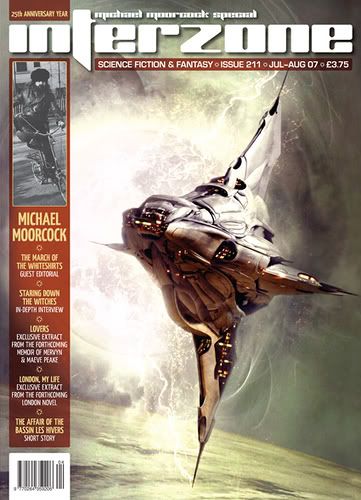
Lunar Flare‘ – Richard Marchand (cover of Interzone #211)
‘Metal Dragon Year’ – Kenn Brown (cover of Interzone #212)

An ok list; suspect I’ll be voting for the Marchand.

BSFA Fiftieth Anniversary Award: Best Novel of 1958:
A Case of Conscience – James Blish (first published by Ballantine)
Have Spacesuit, Will Travel – Robert A Heinlein (first published in F&SF, August – October 1958)
Non-Stop – Brian Aldiss (first published by Faber & Faber)
The Big Time – Fritz Leiber (first published in Galaxy, March/April 1958)
The Triumph of Time – James Blish (first published by Avon; subsequent UK title A Clash of Cymbals)
Who? – Algis Budrys (first published by Pyramid)

Quick! To Amazon marketplace! I’m really looking forward to reading these, and will try to post my thoughts before Eastercon.

You may have noticed that the non-fiction category is missing. The reason for that is:

Nominations were also invited for the best non-fiction of 2007, but although a number of works were nominated there was no consensus and so no shortlist could be formed. A non-fiction award will therefore not be presented this year.

So it goes. Paul Raven isn’t thrilled, but says:

I suppose there are a lot of ways to look at that – I’m going to take the charitable view and assume they knew that the limited number of us who care about such things would rather thrash it out for ourselves than submit to a consensus we couldn’t agree with.

In which case, ladies and gentlemen – start your engines!

I do find it a little disappointing that BSFA members can come up with a shortlist for novels published fifty years ago, but not non-fiction published last year. So: I already mentioned some of the non-fiction I liked; if I get a chance this weekend, i’ll mention some of the individual articles, essays and reviews I rated, as well. If the limited number of the rest of you who care about this category would like to chime in with the things you nominated, and why, that’d be neat.

BSFA Awards: Cover Art

I’m finding this category the most difficult to nominate for. The rules say:

The Best Artwork award is open to any single science fictional or fantastic image that first appeared in 2007. Again, provided the artwork hasn’t been published before 2007 it doesn’t matter where it appears.

First, establishing whether or not artwork has been previously published is, well, challenging. I do like some of Clarkesworld’s covers, for instance — particularly those for issue 5 and issue 8 — but I’m almost certain I remember seeing that the cover of issue 12 is a reprint, and I have no idea about the others. Second, this doesn’t seem to have been a particularly exciting year for sf artwork on book covers. You’d really be hard-pushed to tell, from the covers, that recent books by Paul McAuley, Ken MacLeod and Richard Morgan are sf, and while the covers of books like Splinter and the “Future Classics” edition of Fairyland are terribly pretty, I’m not sure they’re science fictional or fantastic images. (Although the award has taken a pretty broad view of what that means in past years, it has to be said.)

Here are the other nominations listed on the BSFA website:

Cover of Dark Benediction – Dominic Harman (novel by Walter M Miller; Gollancz SF Masterworks edition)
Cover of Interzone #209 – Jim Burns
Cracked World’ – Andy Bigwood (cover of disLocations, ed. Ian Whates; Newcon Press)
‘Dada Jihad’ – Chris Nurse (Interzone #212)
It Will Never Fly Again’ – Alexander Kruglov (cover of Albedo One #32)
‘Looking In, Looking Out’ – Martin Deep (Murky Depths #1)
Lunar Flare’ – Richard Marchand (cover of Interzone #211)
Transcendance Express’ – Vincent Chong (cover of Hub #2)

I quite like the Dark Benediction cover, and “Lunar Flare” is a very fine spaceship, but beyond that I’m not being particularly inspired. What else can I think of? The cover of Interfictions, which I think probably can be justified under “fantastic image”; the cover of The Fade, although to an extent that is just Edward Miller (I assume) doing what Edward Miller does; and I’m quite fond of the cover of In War Times. But I feel I must be missing something. Any suggestions, anyone? Remember, the deadline for your nominations is midnight tonight…

BSFA Awards: Short Fiction

I was hoping to write up some thoughts on my favourite stories of last year, but time is moving on and I don’t seem to be getting around to it. So I’m just going to do what Martin did, and list the stories I’m planning to nominate for the BSFA Awards. You can also see what other members have nominated so far, and the tables of contents for Gardner Dozois‘ and Rich Horton‘s Year’s Best SF books.

So, my nominations:

“The Merchant and the Alchemist’s Gate” by Ted Chiang (F&SF, September)
“Dead Horse Point” by Daryl Gregory (Asimov’s, August)
“Light” by Kelly Link (Tin House 34)
“The Master Miller’s Tale” by Ian R MacLeod (F&SF, May)
Sulphuric Acid by Amelie Nothomb (Faber & Faber)
“Three Days of Rain” by Holly Phillips (Asimov’s, June)
Of Love and Other Monsters by Vandana Singh (Aqueduct Press)
“Dispersed by the Sun, Melting in the Wind” by Rachel Swirsky (Subterranean, Summer)

I read much less short fiction in 2007 than usual, but I read some good stuff. The notable omission from the list, perhaps, is Greg Egan, but although I read three good stories by him (“Glory”, “Dark Integers” and “Steve Fever”), I didn’t think any of them were quite first-rank.

Remember: if you’re a member, the deadline for your nominations is this Saturday.

Yet More Awards

Farah Mendlesohn thinks there’s something missing from the nominees for the Andre Norton Award for Young Adult Science Fiction and Fantasy, specifically the science fiction, and has some suggestions for filling the gap.

While this is a nice idea, I can’t help thinking the Nebulas are now pretty much a waste of space, and that the only viable solution is to take off and nuke the site from orbit. Here’s the full preliminary ballot. I just want to pull out the nominees for Best Novel:

Ragamuffin, by Tobias Buckell (Tor, Jun07)
The Yiddish Policemen’s Union, by Michael Chabon (HarperCollins, May07)
Species Imperative #3: Regeneration, by Julie E. Czerneda (full PDF on Private Edition) (DAW, May06)
Vellum: The Book of All Hours, by Hal Duncan (Del Rey, Apr06 (Macmillan hardcover Nov05 (UK)))
The Accidental Time Machine, by Joe Haldeman (Ace, Aug07)
The New Moon’s Arms, by Nalo Hopkinson (Warner Books, Feb07)
Mainspring, by Jay Lake (Tor, Jun07)
Odyssey, by Jack McDevitt (full PDF on Private Edition) (Ace, Nov06)
The Outback Stars, by Sandra McDonald (Tor, May07)
Strange Robby, by Selina Rosen (full PDF and hardcopy offer on Private Edition) (Meisha Merlin Publishing Jul06)
Harry Potter and the Deathly Hallows, by J.K. Rowling (Scholastic Press, Jul07)
Rollback, by Robert J. Sawyer (Analog, Feb07 (serialized in Oct06 through Jan/Feb07 issues; Tor book, Apr07))
Blindsight, by Peter Watts (free Creative Commons versions) (Tor, Oct06)

These are, apparently, the novels that professional science fiction and fantasy writers think are the best examples of their craft from the most recent Nebula nomination period. You will see there are a couple of problems with this idea. First is the presence of the names “Jack McDevitt” and “Robert J Sawyer”. Second is the fact that about 40% of the nominees were published in 2006, and one was first published in 2005.

The BSFA doesn’t do a preliminary ballot for its awards, but just as a contrast, here are the nominations received so far for the BSFA Award for Best Novel, which is of course primarily nominated for by fans.

Alice in Sunderland – Bryan Talbot (Jonathan Cape)
Bad Monkeys – Matt Ruff (Bloomsbury)
Black Man – Richard Morgan (Gollancz)
Bone Song – John Meaney (Gollancz)
Brasyl – Ian McDonald (Gollancz)
Glasshouse – Charles Stross (Orbit)
Harm – Brian Aldiss (Duckworth)
Helix – Eric Brown (Solaris)
Ink – Hal Duncan (Macmillan)
Season of the Witch – Natasha Mostert (Bantam)
Selling Out – Justina Robson (Gollancz)
Sixty Days and Counting – Kim Stanley Robinson (HarperCollins)
Sound Mind – Tricia Sullivan (Orbit)
Spook Country – William Gibson (Viking)
Stealing Light – Gary Gibson (Tor)
The Atrocity Archive – Charles Stross (Orbit – collected in The Atrocity Archives)
The Blood Knight – Greg Keyes (Tor)
The Dreaming Void – Peter F Hamilton (Tor)
The Execution Channel – Ken MacLeod (Orbit)
The H-Bomb Girl – Stephen Baxter (Faber)
The Prefect – Alastair Reynolds (Gollancz)
The Yiddish Policemen’s Union – Michael Chabon (Fourth Estate)
Tourniquet: Tales from the Renegade City – Kim Lakin-Smith (Immanion Press)

Now, this is not a list without its own omissions (in my opinion) and oddities (I thought the long-ago magazine publication of The Atrocity Archives would make it ineligible, but apparently not). However, the large majority of these books were eligible for this year’s Nebula Award. Is there anyone out there who wants to argue that, of the two, the Nebula list is a better snapshot of contemporary science fiction? Hell, does anyone want to argue that it includes better books?

This is, of course, not to mention the many excellent novels that were published in the US only this year, and were therefore not eligible for the BSFA Awards. Books by Jo Walton, Susan Palwick, Kathleen Ann Goonan, Robert Charles Wilson, Charles Stross, and Karl Schroeder, for instance. Heck, any of the books on the PKD shortlist wouldn’t have been out of place. Of course, some of them will still be eligible next year, thanks to the Nebula’s rolling eligibility rules. But you do start to wonder what the point of having an award nominated for by professionals is.

In better Nebula news, Abigail Nussbaum points out that Ted Chiang’s nominated story, “The Merchant and the Alchemist’s Gate”, is already up on the F&SF website. Go forth and read.

BSFA Awards: Non-Fiction

Nominations for the BSFA Awards need to be received by midnight on Saturday 19th January. That’s a week on Saturday, so for those of you who haven’t made your nominations yet, I thought I’d put up some posts to jog your memories, and encourage you to do so.

First up is the non-fiction award, which after all the debate has reverted to a purer, simpler form:

The Best Non-Fiction award is open to any written work about science fiction and/or fantasy which appeared in its current form in 2007, in print or online.

There are two books that I’m pretty sure I’m going to nominate; I’m still deliberating about shorter works.

The first book is Jeff Prucher’s Brave New Words. This has received, to be kind, mixed reviews, but I am impressed enough to think it deserves a nomination, though I probably wouldn’t vote for it as a winner. The two main criticisms of it, that I’ve seen, have to do with the selection criteria and with the accuracy. On the latter point, it seems to me you have to take any dictionary of citations as a work in progress, and any errors you find as an invitation to contribute a correction; and I didn’t find that many errors, though I’m not convinced that “infodump” was first used by Howard Waldrop as late as 1990. The earliest citation for “science fiction”, by the way, is from W. Wilson’s 1851 Little Earnest Book upon Great Old Subject [sic], which describes “Science-Fiction, in which the revealed truths of Science may be given, interwoven with a pleasing story which may itself be poetical and true — thus circulating a knowledge of the Poetry of Science, clothed in a garb of the Poetry of Life.” That is, if you ask me, a rather fine way of putting it, and I would be surprised if there were citations from much earlier.

As to the selection criteria: Prucher includes five major categories of words: fanspeak, critical terms, sf terms used in a non sf sense (“space cadet”), words that were not coined in sf but are closely associated with it (“cyborg”), and — this may be the controversial one — words coined in sf if they are used either in multiple fictional universes, or in mainstream conversation. Which means “newspeak” (and, entertainingly, “frell”, although not “dren” or — my personal favourite Farscape-ism — “mivonks”), but no “dilithium”. Moreover, there’s nothing since 1999 — an arbitrary line had to be drawn somewhere, and the end of the 20th century is as good a place to draw one as any, but it does mean there’s no entry for “new weird” (or “mundane sf”, or “interstitial”; “slipstream”, being older, does get an entry). Within these parameters, so far as I can tell from a random sampling, the book does its job: I haven’t yet gone looking for something that falls within Prucher’s criteria but isn’t there. So the question is whether you think one or more categories should have been left out, or another category should have been added. I think having all the categories in one book adds richness, and makes simply browsing the thing more enjoyable than browsing a dictionary really should be. And when it comes down to it, this is a dictionary which, with a straight face, having explained in the “note on definitions” that for obvious reasons “they” and “their” are used as singular and plural third-person pronouns, avers that “Definitions of words relating to science fiction fans and writers, however, can be assumed to have human referents” (xxiv).

The second book is The Country You Have Never Seen, by Joanna Russ. Billed as a collection of essays, letters and reviews, it’s really the latter that are the main attraction. The earliest review, from The Magazine of Fantasy and Science Fiction, is dated December 1966; the latest, from The Washington Post “Book World”, is dated May 10, 1981. They are by no means all reviews of science fiction books — there’s a healthy smattering of more academic reviews, mostly of (as you would expect) more academic feminist texts — and even more than most collections of reviews, it’s a very partial sampling of the field of the time. But they are spectacular. Until now, everything I’ve read by Russ has invoked admiration without enthralling me; it’s probably just down to the fact that here she’s closer to my core interests, but I flat-out enjoyed this book more than any other of Russ’s that I’ve read.

As a critic, Russ is merciless, impressively concise (anyone who wants to know why and how reviewers should quote from the books they read can learn a lot here), and unapologetically funny. Of a particularly poor first novel (Retreat as it Was! by Donna J. Young) she says she wants “to convey as forcefully as possible the absolute, limp, thinness of the book”; then, ‘What is the book about? Hugging, I think. Thirty-nine (non-erotic) hugs and seventeen incidents of weeping occur in one hundred and six pages, which averages out to one hug per 2.7 pages, one weep every 9.4 pages, and one of either (if you’re not picky) every 1.9 pages”(183). Riffing on George Bernard Shaw’s description of plays as either artificial or real rabbits (commercial work is the artificial rabbit, true works of art the real deal), Russ says that “Ben Bova’s Millennium is an artificial rabbit. My copy tried to eat real grass in the back yard and died” (125). She seems to have a particular fondness for James Blish (she reviews more books by him than by any other writer, and cites his criticism more frequently than she cites any other critic, too) and Kate Wilhelm (I am left with a strong desire to seek out and read more Kate Wilhelm), but in general roams pretty widely, even if the unhelpfully sparse table of contents makes it hard to hold a picture of her range in your head.

Perhaps the most striking — and, I have to say, refreshing — aspect of the reviews is that, more than any critic working today, Russ is first, foremost and proudly a science fiction critic. Not for her the present received wisdom that science fiction and fantasy are really, when you get down to it, the same thing; if the Joanna Russ who wrote these reviews still exists, I imagine she would not be terribly impressed with Interfictions or Feeling Very Strange. (But how I would like to know for sure!) It’s not that she necessarily doesn’t like fantasy, but she is more prone to be impatient with it. In one of her columns for F&SF, for instance, she strongly criticises a slate of fantasy novels, drawing a storm of protest letters. Her response?

I know it’s painful to be told that something in which one has invested intense emotion is not only bad art but bad for you, not only bad for you but ridiculous. I didn’t do it to be mean, honest. Nor did I do it because the promise held out by heroic fantasy, the promise of escape into a wonderful Other world, is one I find temperamentally unappealing. On the contrary, it’s because I understand the intensity of the demand so well (having spent my twenties reading Eddison and Tolkien; I even adapted The Hobbit for the stage) that I also understand the absolute impossibility of ever fulfilling that demand. The current popularity of heroic fantasy scares me; I believe it to be a symptom of political and cultural reaction due to economic depression. […] That our literary heritage began with feudal epics and marchen is no reason to keep on writing them forever. […] Reality is everything. Reality is what there is. Only the hopelessly insensitive find reality so pleasant as to never want to get away from it, but painkillers can be bad for the health, and even if they were not, I am damned if anyone will make me say that the newest fad in analgesics is equivalent to the illumination which is the other thing (besides pleasure) art ought to provide. (169-70)

Other contenders? I haven’t read it yet, but if Mike Ashley’s Gateways to Forever is as the other volumes in his history of magazines, and reports seem to suggest that it is, then it would be a worthy nominee. And the SF Studies issue devoted to Afrofuturism that Adam Roberts mentions in his contribution to the Strange Horizons year-in-review sounds interesting. But I must have missed things. What else was out there?

BSFA Awards — open for nominations

An announcement from Claire Brialey, the BSFA Awards Administrator:

Nominations are now open for this year’s BSFA awards, with more opportunities than ever before for BSFA members to express their opinions about what’s good in science fiction.

All current members of the BSFA are eligible to nominate and vote for the awards, which will be presented at next year’s British national science fiction convention (Eastercon). Members of the Eastercon will also be eligible to vote for the awards.

The 2008 Eastercon will be the 50th anniversary of the founding of the BSFA and we will therefore be presenting a special award for the best genre novel of 1958. This will be nominated and voted on in the same way as the awards for works published in 2007; details about what’s eligible and how to nominate can be found on the temporary BSFA website.

There will once again be four awards categories for 2007 work: novel, short fiction, artwork and non-fiction. The main change for this year is for the non-fiction category, a topic which has previously excited some opinions on Torque Control. Those of you who are BSFA members now have every opportunity to express those opinions by nominating what you consider to be the best writing about science fiction in 2007. Read the rules and then email me to nominate or to comment more generally.

I’d also like to extend many thanks to Ian Snell for his work as awards administrator last year and his help in handing back over. I shall be acting as BSFA awards administrator until Easter 2008.

Short fiction-wise I suspect I’ll be nominating Holly Phillips’ “Three Days of Rain” and Daryl Gregory’s “Dead Horse Point”, but beyond that I haven’t thought about nominations yet this year. How about you?