

Cargo (Arati Kadav 2019 Hindi): A meandering rumination about the weightlessness of human existence
Reviewed by Abhishek Lakkad
Please note that this review contains spoilers.
Death can be understood as a scientific/biological phenomenon, but its gravity is experienced as a spiritual phenomenon. Both the scientific and the spiritual perspectives allow one to contemplate death. But when the makers of Cargo (2019) choose science as merely a veil for religious/spiritual ideas in order to comment on alienation and abandonment rampant in contemporary societies, they could have made sure that the film is passionate (or at least compassionate) enough to sustain its slow-paced narrative. Cargo (now available on Netflix) is the first feature length film of Arati Kadav, although she has written and directed several science fiction shorts in the last decade. Cargo highlights the theme of ‘loneliness’ in these times of pervasive social media that creates the impression that one is always connected and hence never alone. Hindu spiritual/religious ideas about karma and the cycle of life, death and rebirth are central to the narrative. The action mostly takes place on a spaceship orbiting Earth where human-like demons called rakshasas are essentially technicians enabling the transition from death to rebirth in a mundane, technocratic and institutionalised process — reminiscent of an airport security checkpoint, medical lab or a prison admissions office. The film terms this process as “post-death transition”, supervised by a department called Post-Death Transition Services (PDTS) that operates under the aegis of Inter-Planetary Space Organisation (IPSO) that has been established by the rakshasas. Owing to the film’s stance of deriving its fictional futuristic technology from elements of Hindu spirituality and mythology, the film has a distinct retro-futuristic feel. Perhaps the datedness of the film’s visual effects is meant to reinforce the 80s inspired aesthetics.
Continue reading “Cargo (Arati Kadav 2019 Hindi) reviewed by Abhishek Lakkad”By Bruce A. Beatie
Peter Swirski, Stanisław Lem: Philosopher of the Future. Liverpool University Press, 2015 (Liverpool Science Fiction Texts and Studies, 51). ISBN 978-1-789620-54-2. Paperback, $35.41 / £19.95.
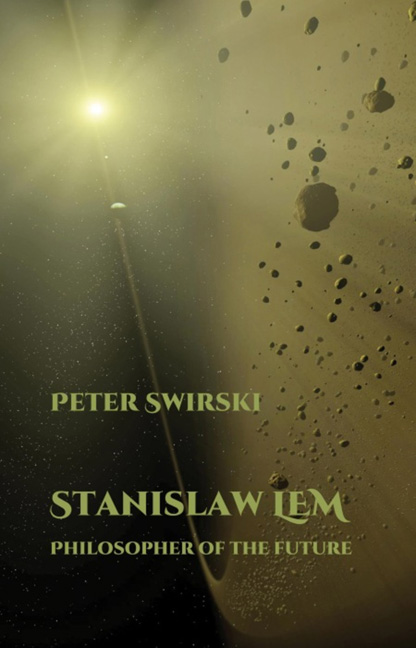
Memory tells me that I started reading science fiction in the late 1940s in the form of Heinlein stories that had appeared in Boys Life, which I subscribed to as a boy scout. When I started college at Berkeley in 1952, I discovered the Elves, Gnomes, and Little Men’s Science Fiction, Chowder and Marching Society. By the time I’d spent four years in the Air Force and finished my graduate studies at Harvard, I had collected a large SF library, including an almost complete run of Astounding. The point of this narrative is that my deepest knowledge of SF was the so-called Golden Age. Though I’ve continued reading SF and fantasy, and have published over fifty reviews of SF and fantasy books in the last twenty years, the renowned Polish writer Stanisław Lem has remained on the borderline of my reading.
When Vector (the journal of the British Science Fiction Association) solicited reviewers for this book, I offered because I wanted to learn about Lem. For readers who share my previous ignorance, Lem was born in 1921 in Lwów, Poland (now Lviv in the Ukraine), and died in Krakaw in 2008. According to Swirski’s bibliography, Lem’s first published science fiction story appeared in 1946 (Man from Mars—translated title); his first collection of SF stories appeared in 1957 (translated in 1977 as The Star Dairies). Fiasco, his final SF publication, appeared in 1987, translated with the same title in 1988.
Peter Swirski himself was born in Canada in 1966 but has spent most of his professional life elsewhere; presently a distinguished visiting professor in China, he has also taught in Finland and Hong Kong. His preoccupation with Stanisław Lem began with a 1992 article in Science Fiction Studies; the monograph reviewed here is the latest of Swirski’s six book publications on Lem. His other publications are on aspects of American literature and culture. Continue reading “A review of Stanisław Lem: Philosopher of the Future”
Sideways in Time: Critical Essays on Alternate History Fiction, edited by Glyn Morgan and C. Palmer-Patel
Reviewed by Nick Hubble
On Friday 19 February 2016, Boris Johnson, wrote two drafts of an article intended for publication in the following Monday’s Daily Telegraph. The first argued in favour of Britain leaving the European Union; the second argued in favour of Britain remaining in the European Union (see Shipman 2016: 170-3, 609-18). As we know, Johnson opted to publish a redrafted version of the original, went on to become the figurehead of the successful Leave campaign and, in 2019, became Prime Minister of the United Kingdom and then won a General Election by a landslide. But what if he’d published a polished version of the second article instead and decided to support Remain in the European referendum?
Reviewed by Jo Lindsay Walton
Time travel plus pandemic: the elevator pitch might simply be, “Dr WHO.”
Written by Jonathan Holloway and directed by Natasha Rickman, The Time Machine is a free and freewheeling response to H.G. Wells’s classic text, which is celebrating its 125th anniversary this year.
Like previous work by Creation Theatre, The Time Machine is an immersive, site-specific production. You prowl around the London Library in a little gaggle, led by your Time Traveller guide, occasionally chased by a spooky Morlock, and now and then bumping into other characters. Continue reading “The Time Machine”
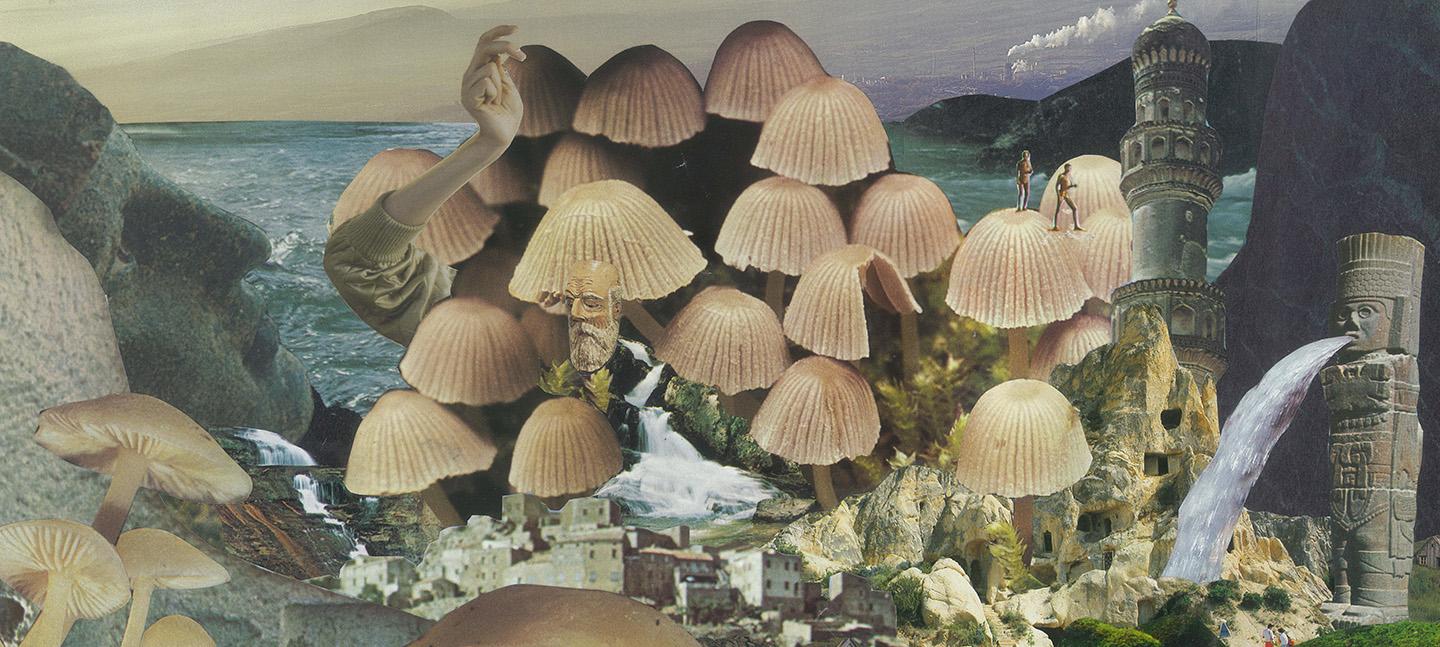
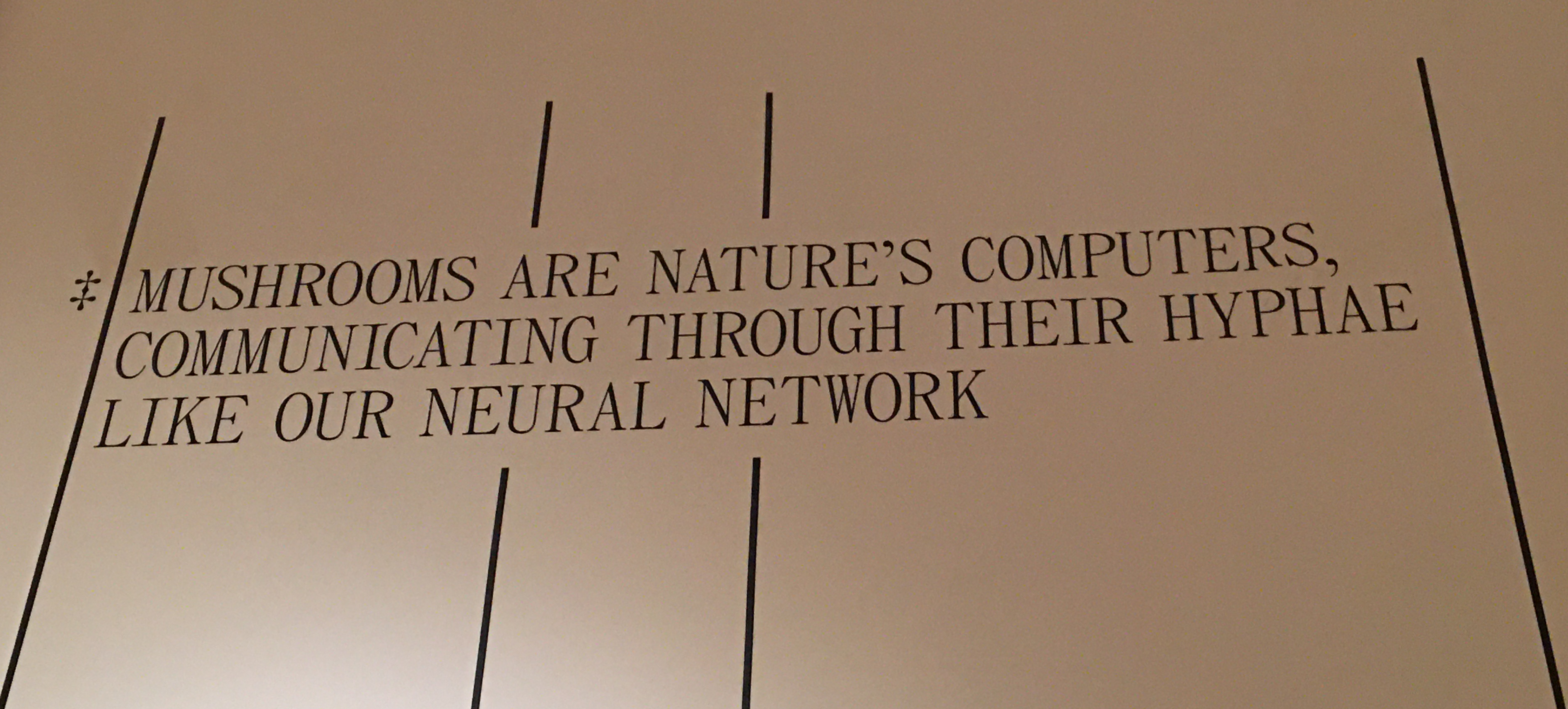
Mushrooms and fungi have a specific place in the imagination as strange and otherworldly, often associated with the fantastical or magical, but Gavin’s exhibition on the “future” of fungi posits them as significantly more science-fictional than fantastical. They are a technology – for use in the future of fashion, biotechnology or ecological industries, or an alien – an unexpected invader via decay or rot, part of the aesthetic that makes a landscape feel truly not of this world. The exhibition achieves this through the mix of mediums, beginning with some of Beatrix Potter’s botanical illustrations of mushrooms and fungi, and progressing through dance (in video form), textile arts, sculpture, collage, fashion, and an extensive display of books.
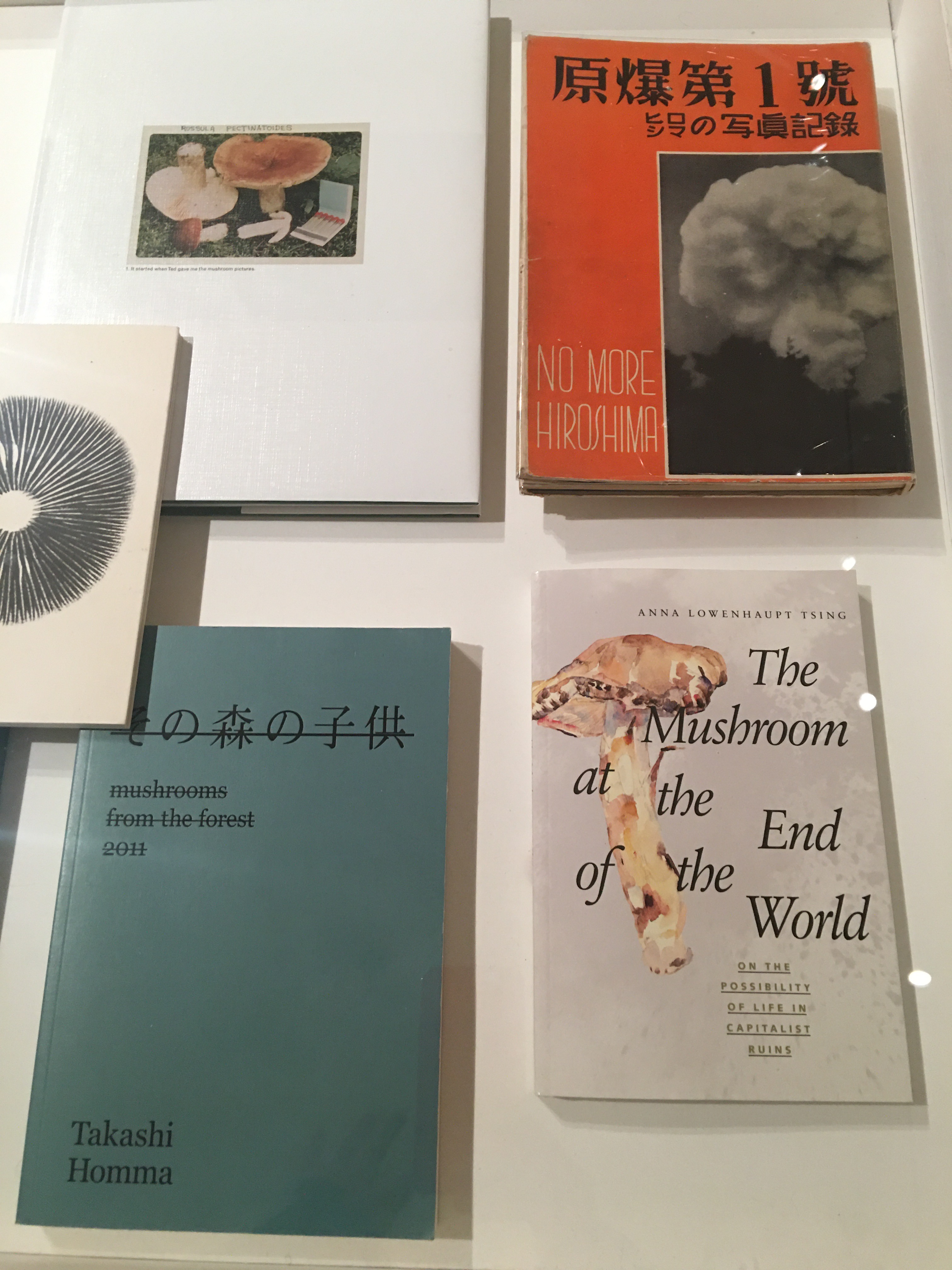
The effect is an exhibition that feels unfinished, if visually engrossing. Amanda Cobbett’s sculptures of mushrooms, perfectly rendered in thread and paper, are an illusion good enough to trick you, and Seana Gavin’s collages are alien worlds where mushrooms form otherworldly buildings, or fungi have unsettling human features. The small setting of the exhibit gives little room for in-depth exploration, and its high goal is undermined a little by the content. A display of mushroom-focused non-fiction literature amounts mostly to a display of book covers, which maybe spark thoughts but ultimately feel superficial. However, for a mushroom lover or for those interested in how the natural world can be positioned in a futurist mindset, it’s a fun way to explore how many different artists have used many different mediums to explore the world of mushrooms and fungi.
While the first two rooms of the exhibit largely explore mushrooms as an aesthetic or fascination, the final ‘Futures of Fungi’ room positions mushrooms as a future technology, one that humanity has not yet fully exploited, with potentials unexplored, with displays including experimental leather made from mushroom, and a typeface generated to ‘spore’ organically as mushrooms do. The strangeness of mushrooms, their in-betweenness between plant and animal, their interconnectedness, are all ways in which they challenge humanity to experiment with their potential. Not all science-fiction, after all, is an exploration of an alien world. Some are discoveries of the strange in our deep seas or our high peaks. Perhaps the next frontier is neither, but instead will be the forest floor.
By Gary Couzens.
As I’ve done in past years, this won’t be a comprehensive overview of genre films and television of 2019. Instead, this is a selection of titles which are worth your attention. All were commercially released or reissued in the UK last year.
If in Groundhog Day it was Sonny and Cher’s “I Got You Babe” which heralded its protagonist’s recurring day ahead, in Russian Doll (on Netflix, eight episodes of just under a half-hour each) it was Harry Nilsson’s “Gotta Get Up”. It’s Nadia (Natasha Lyonne), again and again in the bathroom of her friend’s apartment while her own birthday party goes on. A cynical, New York thirtysomething, Nadia certainly has her share of damage, manifesting itself in casual drug use and equally casual sex. At the end of today, Nadia will die, she finds out … and then she’s back in that bathroom with Nilsson on the soundtrack. After several go-rounds she finds Alan (Charlie Barnett) in the same predicament.
/cdn.vox-cdn.com/uploads/chorus_image/image/62980741/1461496_15619_zoomedR.0.jpg)
Although she was one of three creators (along with Leslye Headland and Amy Poehler), Lyonne dominates the show. She wrote and directed the final episode and co-wrote another. Her chartacterisation inevitably brings resonances of her own personal history, including publicly-known issues with substance abuse. It’s a commanding performance in a miniseries which works out its premise in several interesting ways. The music works perfectly, from Nilsson at the outset to Love’s “Alone Again Or” in the final scene. A second season is on its way. Continue reading “2019 in TV and Cinema”
There was a lot to try to keep up with in 2019. As usual my attention was split between what was new, what I’d missed and what I revisited. As this is the regular review of the new, I’ll keep my attention squarely there — though I’ll confess to missing key releases that will doubtless prove to be among the best of the year.
As 2019 was also the end of a decade, this is a moment to note that over the last ten years we’ve seen a number of new writers establish themselves as major names in the genre.
Continue reading “From the editor of Focus: Best of the Year 2019”


 vector-bsfa.com