Exhibition Review: Haroon Mirza/HRM199

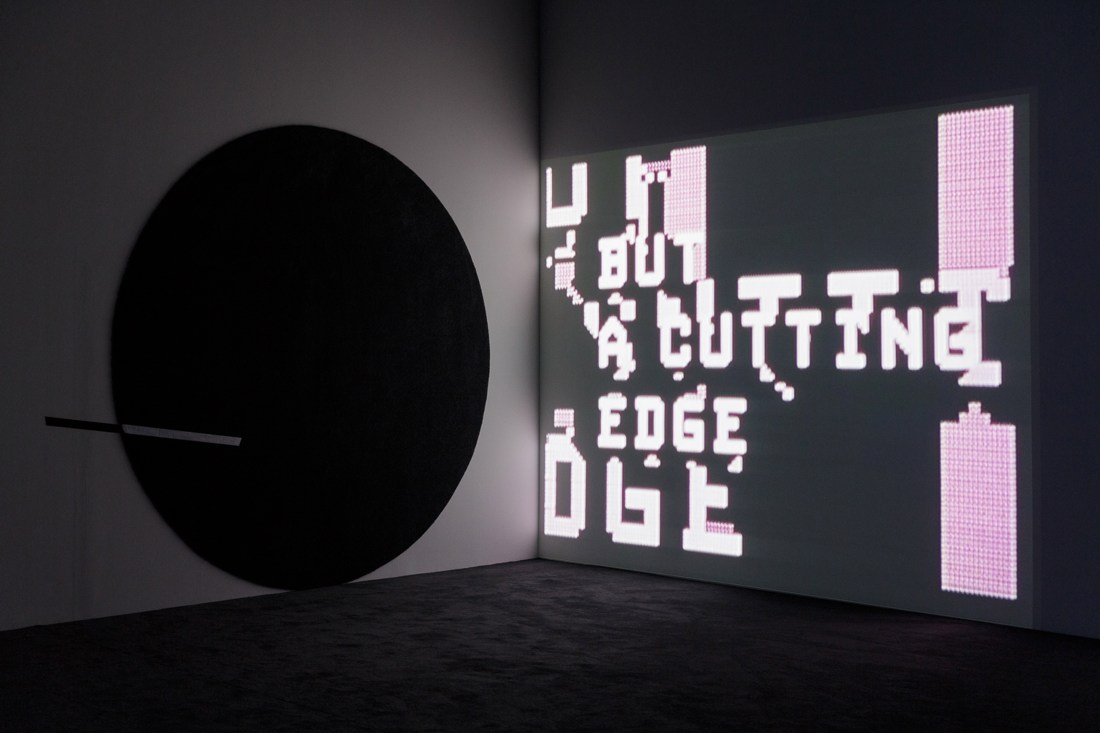
Haroon Mirza hrm199_Chamber for Endogenous DMT (Collapsing the Wave Function), 2017. Tim Bowditch, courtesy the artist and ZC Low Res-7734

Haroon Mirza/HRM199 reviewed by Polina Levontin

The Zabludowicz Collection in North London is hosting an art exhibition until December 17, which is of particular interest to the sf community. The commissioned work is by Haroon Mirza, whose own studio is located nearby. The exhibition is titled ‘For a Partnership Society’ and the word partnership is key to thinking about the works presented. Firstly, the exhibition itself is a collaborative project on many levels and in almost all of these collaborations science plays a role. Science is invoked in the exhibition as a subject, for example, when the production of scientific knowledge is being compared to a process of forming other sorts of beliefs. Science appears as an object when the standard theory of physics or excerpts from topology lectures become the material parts of an art installation. A history of science serves as a context for the conversation about the fundamental building blocks of a belief system. Furthermore, both technology and scientific methods are intentionally employed as tools for making the artwork, as well as appearing as subjects for Mirza’s artistic explorations.

The premise of Mirza’s work is that the fictional, the religious, the artistic and the scientific are not separable modes, that ‘science, like art, politics and religion often relies on system of beliefs in its pursuit of truth’ [Zabludowicz Collection]. References to a Pythagorean society which practised mathematics as religion remind the viewer that the pretence of decontextualized objectivity in science is a relatively recent phenomenon.  In his 1984 essay ‘No Apocalypse, Not Now’ Derrida gives another reason for why we should no longer pretend that beliefs and science can be disentwined: technological powers have passed the threshold where the science itself poses an existential threat to humanity. Derrida was referring to nuclear physics, something which Mirza references in almost all the works that are part of the current exhibition. Since 1984, when Derrida wrote ‘one can no longer oppose belief and science, doxa and episteme’ because modern/atomic technology ‘coexists, cooperates in an essential way with sophistry [imagination]’, new technological threats such as AI have emerged.  Mirza’s work is a manifestation of this quote:  the AI and other forms of technology coexist and cooperate in an essential way with his art.

Haroon Mirza hrm199_Pathological Theology, 2017. Tim Bowditch, courtesy the artist and Zabludowicz Collection Low Res-6038

At least one part of the exhibition is literally a scientific experiment, conducted with researchers from Imperial College. In ‘Chamber for Endogenous DMT (Collapsing the Wave Function)’ Mirza constructs a confined sensory deprivation space which is being used by the scientists to explore human perception. Like the scientists, Mirza is interested in the potential of art to influence a state of mind, or even alter the state of mind as much as some psychotropic chemical substances or meditation practices. In a spirit of experimental design and following a framework for scientific investigations, Mirza’s art installations produce a range of sensory input levels – from near complete deprivation to sensory overload.

The scientific method is used by Mirza not just in setting up progressively increasing levels of exposure to sensory inputs, but also in taking a deductive approach as the principle for creating artwork. He dissects, breaks down and analyses various materials (including works of other artists) as a scientist would in trying to understand the basic principles of how something works.  His approach is hierarchical, making explicit different meta-levels. For example, Mirza takes a ‘found’ YouTube video where young Bjork is seen examining the functions of a cathode ray tube and, echoing her curiosity about technology, breaks the wholeness of the video down to expose its more elemental aspects: the RGB (Red, Green, Blue) system of colour projection, the individuality of video frames and how these are cropped, sequenced and made to follow one another at predetermined intervals (24 frames per second).

Haroon Mirza hrm199_The System, 2013, installation view, Tim Bowditch, Courtesy Zabludowicz Collection_Low Res-7017

Mirza’s thesis is that a partnership first and foremost requires the dismantling (or at least the questioning of) barriers. Mirza successfully makes the viewer (even a scientifically trained one like myself) uncertain of where scientific knowledge ends and the pseudo-scientific begins. Science is never presented as an isolated subject, more poignantly, videos with snippets of lectures on topology are shown side-by-side with a commentary on a history of colonialism. The idea that there is only one true system of knowledge is questioned as the viewer is invited to contemplate the standard theory of physics alongside indigenous knowledge systems, shamanic rituals and AI. Topology, colonialism, quantum physics, environmental catastrophes and political upheavals dissolve into one another with the aid of the AI Deep Dream technology.  Cumulatively all these ideas are given an inorganic but seemingly living presence by Mirza who uses an Emerging Paradigm (hrm199) technology to forge a coalescence of synchronised video, sound and led lights.  Mirza’s genius of generating meaning out of seemingly inarticulate materials is evident in the title of this work. It is simply a pair of numbers, ‘9/11 11/9’. Mirza uses the succinctness of mathematical notation to tell a complex story, where an attack on the World Trade Centre becomes conjoined with the 9th of November, the date Trump’s victory in the American election was declared.

Mirza’s many disruptive dualities are designed to induce the kind of ‘cognitive estrangement’ (Darko Suvin) that is characteristic of sf. Further, his preoccupation with science and technology and their interactions with human perception and understanding of reality places his work in the critical space occupied by the theorists of science fiction.

Haroon Mirza hrm199_Pathological Theology, 2017. Tim Bowditch, courtesy the artist and Zabludowicz Collection_Low Res-6124

From the BSFA Review: Lagos_2060

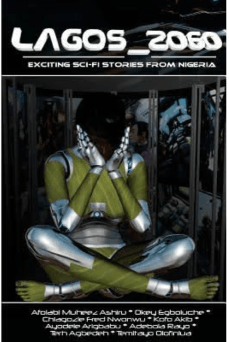
Lagos_2060 curated by Ayodele Arigbadu (DADA books, 2013)

Reviewed by Polina Levontin

Lagos_2060

Writing about present day Lagos, Rem Koolhaas warns that already ‘the city itself has mutated into something’ quite unrecognizable to Westerners who think of cities in terms of European or North American models.  ‘What will the city be like in 2060?’  This was the question posed to 8 Nigerian science fiction writers during a workshop that yielded an anthology: Lagos_2060. The resulting eight stories, three of which are written by women, represent a diverse range of imaginaries all set in Lagos, the year 2060.  These stories engage with science and governance, city infrastructure and climate change, co-evolution of technology and social norms, urbanization and the future of global capitalism. Yet these scholarly themes emerge from stories that are first and foremost exciting, often romance-filled adventures.  There are man-eating frogs and time-travel inducing herbs, girls with luminous tattoos and zero-gravity bedrooms, albeit in separate stories…

Individual writers approached the remit to imagine the future of one of the world’s greatest cities each with their own genre pallette and a remix of intellectual priorities.  But what these stories share is a sense of dynamic liveliness that can only be a feature of a work in progress, their various literary forms reflective of the chaotic process by which the city itself is shaped. Their gift is the recklessness of trying out new things. These are pioneering works, regardless of how one decides to date science fiction in Nigeria.

What interested me in particular were the discourses on science.  The first story of the anthology, ‘Amphibian Attack’ by Afolabi Muheez Ashiru presents the dangers of leaving the sciences in the hands of the private sector.  The private company ‘Bright Life Group’ is so efficient in curing diseases and supplying energy that it has to use science also to undo the progress, secretly engineering catastrophes, so that it can keep itself profitable and powerful by fixing its own ‘accidents’.   The discourse in the second story ‘Animals on the Run’ by Okey Egboluche is that of conflict between technological progress on one hand and society and environment on the other.  The value of robotics in particular is questioned because it reduces employment in conditions where large numbers of people need jobs.  Robotics is critiqued on an intimately personal scale in another story in the collection, ‘Metal Feet’ by Temitayo Olofinlua.

Technological advances such as land reclamation to expand Lagos are questioned as risky and as a violation of ‘natural order.’  In ‘Mango Republic’ by Terh Agbedeh scientific rationalism is instituted in Lagos, making it ‘the most beautiful prison in the world ever conceived by man’ (p. 197).  But even supreme scientific achievements are shown to be powerless against the forces of nature unhinged by climate change. Floods and rising sea levels threaten Lagos, while environmental destruction elsewhere in Nigeria swells the city’s population beyond capacity. In ‘Mango Republic’ the discourse of science is survivalist – science is our last hope to adapt to a perilous future.  Yet, exemplifying the complexity of the narratives in Lagos_2060, other stories demonstrate the political danger of seemingly desirable scientific solutions.  On the extreme opposite spectrum from ‘Amphibian Attack’, scientific knowledge becomes highly guarded government property in ‘Cold Fusion’.  A new way to produce cheap renewable electricity reinforces the government’s control over the people of Lagos and stirs political ambitions to secede from the rest of Nigeria.   Science promising energy independence actually does enable the politicians who rule Lagos to secede from Nigeria in another story – ‘Coming Home’ by Rayo Falade.

The collection is full of ideas pertinent not only to the future of Lagos but the future of humanity in general. The writers don’t envision Lagos in isolation but as an integral part of the global economic and natural system. Their visions and hopes for Lagos, their individual philosophies and fears are expressed with humor and showmanship. Their ability to ask urgent questions about the direction we are heading is made invaluable by their skills to entertain.

vN by Madeline Ashby

vN: The First Machine Dynasty by Madeline Ashby (Angry Robot, 2012)
Reviewed by Andy Sawyer

The robots in Canadian author Madeline Ashby’s novel are self-replicating artificial humanoids designed by a “global mega-church” as post-Rapture “helpmeets” for those humans left behind after the ascension of the just. Why, it’s not clear – though given what we learn about how these robots are conditioned to engage with humanity, something beautifully ironic and poignant could have emerged. That is not what we get but vN is an interesting though flawed work.

Amy is one such construction, the daughter of robot Charlotte and flesh-human Jack. vN robots like Amy and her mother eat special robo-food and are fitted with a “failsafe” – a kind of First Law which not only prevents them from harming humans but actually causes them to shut down if violence is observed. On Amy’s graduation from kindergarten, her grandmother Portia turns up and attacks Charlotte. Amy eats her in her furious attempt to defend her mother but Portia somehow survives as a consciousness linked to Amy’s. Fleeing, Amy encounters Javier, a “serial iterator” who has given birth (vN reproduction is not gendered and vNs exist in networks of identical clades) to a dozen unauthorised copies of himself and becomes involved in a rather hazy political plot. The revelation that in her the failsafe has broken down is key: each side, human and vN, sees her as a potential weapon to be used or destroyed.

The novel only takes us so far and like many sf futures, vN suffers from something of a lack of focus. The robot-world is well evoked, with vN vagrants living off junk and tensions between vNs and humans. There has been a violent quake on the USA’s West Coast and, somewhere, a (semi?)-autonomous city-state of Mecha exists as a possible sanctuary. But is this culture all world-wide? Does every country in the world “have” vN humanoids? All this may be explored in subsequent volumes but some generic flattening undermines the interesting things Ashby is doing with the “robot” icon.

Still, there are fascinating things here in what is implied about families here – notably the relationship between Amy and her artificial-humanoid mother and human father and between her and Portia, the predatory grandmother. There’s also a skilful creepiness. It’s clear that these robots are – as ‘real’ robots may well be – used as sex toys. The term helpmeet does not necessarily have (in its original Biblical context) a sexual implication but it certainly derives this as a term for marriage partners and equally certainly New Eden Ministries, Inc. means this. The ungrown “child” vNs are of course tempting for those whose interests lie that way. The development of the ability in Amy’s clade to overcome their failsafes is ingeniously linked to her family history and the darker side of desire for robot sextoys that will do whatever you want.

There is, though, a lot about the nature of love (not all sexual) in the novel: obsessive love, the kind of love that may be simply exploitative. And here the most interesting figure may be Jack, Amy’s father: “Charlotte didn’t do drama… now he suspected he’d find human women too warm, too loud, too mobile.” Or, on the same page, “at one point [Amy] and Charlotte would be indistinguishable. Jack worried about that sometimes. What if one day, years from now, he kissed the wrong one as she walked through the door?”

This review originally appeared in Vector #271. vN has been shortlisted for the 2012 Golden Tentacle Award for debut novel that best fits the criteria of progressive, intelligent and entertaining. The winners of this award and the rest of The Kitschies will be announced on Tuesday, 26 February 2013.

Spirit, Part 1: Take One

I started Gwyneth Jones’ Spirit at the wrong time, or at least in the wrong headspace. The plot was a Lego patchwork of interlinked episodes, and it didn’t seem to have enough momentum to take me much of anywhere plot-wise, even as it spanned a barely-known universe in its events. I hadn’t read any of Jones’ other Aleutian novels, had no greater context thus far into which to slot it. I didn’t feel lost, but it wasn’t a universe to which I had any existing commitment.

It didn’t help that I knew there was a rape scene coming, somewhere in its expansive, multi-volumesque middle. With that looming, somewhere, I read more and more episodically, which did nothing to help the volume’s flow. Doom, gloom, and stuckness overwhelmed the characters and I, seeing no hope for them and fearing what I knew was coming, went adrift. I stopped reading.

Despite that unpromising beginning, I always meant to go back to it. My intentions were good. The SFX blurb promised me a take on The Count of Monte Cristo, a novel I remembered fondly and whose plot I’d happily revisit. Nearly halfway through the book, I was barely halfway through the lavishly extensive blurb on the back of the book when I failed to keep reading.

It really is quite a blurb. As Martin Lewis observed in his discussion of the novel last week, it synopsizes up to page 255 out of 472 pages. At the time, however, it was a token framework for me, a checklist of events which the plot had gotten around to, rather than any real roadmap of structure. (Which raises the question: is it still really a spoiler once it’s mentioned in the blurb?) It really was the wrong time and headspace for me to be reading the novel.

Fortunately, Martin suggested I have another go at the novel this March, complete the task I set myself last year when I undertook to write – or host writing on – the eleven best science fiction novels by women from the first decade of this millennium.

I’m glad he did. The second time around, the book was good.

Updates: Guess the Clarke shortlist, BSFA Awards, Spirit

It’s been an exciting week, with the guesses coming in as to what will be on this year’s Arthur C Clarke Award shortlist.

In posting her guesses to her blog as to what books might be on that shortlist, Nina Allan wrote,

What matters most about the Clarke is not who wins, but that it acts as a showcase for what is happening in SF now. As such, I believe it should take a pride in presenting writers who are prepared to risk themselves intellectually, stretch themselves imaginatively and hone their skills as writers to produce works of artistic originality and lasting literary power.

It is certainly not clear exactly which six books will be on the shortlist for this year’s, but every guess in the contest (ongoing until Sunday) is a contribution toward the wider discussion of “what is happening in SF now”.

What impresses me in particular about this year’s guesses so far is how wide-ranging they are. About two-thirds of the submitted books have appeared on one or more possible lists so far. It’s entirely possible that one or more of the currently unguessed books will be on that shortlist. Last year, only one person correctly guessed that Declare would be on it, after all.

For those of you who haven’t already entered the contest (and those of you thinking about the state of SF today), here are the currently unguessed-at books for your consideration:

Dead of Veridon by Tim Akers (Solaris)
Novahead by Steve Aylett (Scar Garden)
Sequence by Adrian Dawson (Last Passage)
The Last Werewolf by Glen Duncan (Canongate)
Gods of Manhattan by Al Ewing (Abaddon Books)
Final Days by Gary Gibson (Tor UK)
Heaven’s Shadow by David S. Goyer & Michael Cassutt (Tor UK)
The Ironclad Prophecy by Pat Kelleher (Abaddon Books)
Shift by Tim Kring and Dale Peck (Bantam)
Echo City by Tim Lebbon (Orbit)
Nemonymous Nights by D.F. Lewis (Chomu Books)
The Age of Odin by James Lovegrove (Solaris)
The Shadow of the Soul by Sarah Pinborough (Gollancz)
The Straight Razor Cure by Daniel Polansky (Hodder and Stoughton)
Here Comes The Nice by Jeremy Reed (Chomu Books)
The Demi Monde: Winter by Rod Rees (Jo Fletcher Books)
War in Heaven by Gavin Smith (Gollancz)
The Noise Revealed by Ian Whates (Solaris)
Son of Heaven by David Wingrove (Corvus)

The contest is open for entries until this coming Sunday night, 11th March, at 23:59 GMT.

The Clarke Award isn’t the only thing going on right now. Hopefully, many of you are busy reading and examining the shortlists for the BSFA Awards, which will be announced on the Sunday of Eastercon this year. Forbidden Planet is offering discounts on all the novels on the shortlist. Also, the BSFA Awards short story booklet is on track to go out with the next mailing.

Finally, we never quite finished discussing all of the books we had planned to last year, here on Torque Control. We’ll be filling in those gaps this year, starting with Gwyneth Jones’ Spirit, toward the end of March.

Lavinia, Part 3: Science Fiction?

Enough people thought Le Guin’s Lavinia was science fiction that it was shortlisted for the BSFA best novel award, and  placed in last year’s poll of the best sf novels by women of the previous decade.

But why is it science fiction? Is it science fiction because that’s what Le Guin writes, and therefore this must be too? Is it science fiction between there’s a time traveler in the story, albeit one who makes a limited number of appearances, and those through extended vision sequences? Is it science fiction because, as I have proposed elsewhere, history is a form of science, and this story plays around with historiography in a science fictional way?

Jo Walton and Niall Harrison assert that it’s fantasy, as opposed to science fiction. Others clearly saw no distinction between science fiction and fantasy for the purposes of these particular two samplers – the BSFA Award is specifically open to fantasy, after all, despite the name of the organisation. And Niall didn’t define “science fiction” for the purpose of last year’s best-of poll, so its presence there doesn’t preclude it being only fantasy.

And yet, Niall observed that some people voted for Lavinia for the best-of poll in the same email as they said they wished they could vote for Jonathan Strange and Mr. Norrell, but couldn’t because that was fantasy. Clearly, some people were consciously thinking of Lavinia as being science fiction as opposed to fantasy.

Personally, I don’t believe that one categorisation precludes the other. Above all, Lavinia is historical fiction, with a focus on the practical intricacies of daily life, and the mechanics of legend. It has one minor possible moment of mythic magic, when a group of household lares are mysteriously transported from one place to another. It has a time-traveling poet on his death bed, whose transtemporal dialogues can be interpreted as science fictional time travel, or as fantastical vision.

It also has a self-aware narrator, whose story is suffused with her consciousness of contingency. Her existence depends upon her being recounted. I’d never thought of post-modern as a mythic mode, but her self-consciousness is thoroughly both in this tale, as is the literalness embodied in her final transformation. Looked at from a different angle again, she feels a keen sense of wonder at the very fact of her own existence, under the circumstances. Perhaps her historiographic analytic self-consciousness is enough of a psychological experiment to justify Lavinia being thought of science fiction.

Lavinia, Part 2: Audience

Lavinia is one of the most recent installations in a long history of what is, in effect, Aeneid-related fan fiction. It was a particularly popular topic for authors in the seventeenth and eighteen century, when the well-educated were quite likely to have read it in Latin as part of their education. The ancient Latin work spawned a slew of elaborators and continuations, best know of which is Purcell’s opera, written about Dido and Aeneas.

Indeed, one of my own extremely rare forays into fan art was when a friend at university asked me to draw a series of small images of Aeneas and his escape from Troy. The images were quite tiny and in watercolour pencil, so barely more than stick figures at that scale. Further, I hadn’t read the Aeneid yet, so relied entirely on my friend’s description of each of eight or nine scenes. That’s how I first met Ascanius and Aeneas and their household Lares, the house gods they saved from Troy, and which find their home, ultimately, with Lavinia in Le Guin’s novel. In Lavinia, Aeneas’ first point of personal commitment to the title character is in entrusting her with their care; and one of the few moments proposed as potentially-supernatural intervention occurs when the Lares move themselves back to her custody.

I’m sure other Aeneid-related works are still being produced, if not so many as in their heyday. Certainly Troy-related works have been going strong lately, if more focused on the Trojan War itself than its aftermath. Equally certain is how well known the stories of Troy are, from their related epics to the ongoing archeological investigations into the history of a city long-since defunct. It’s as inspiring as Atlantis.* Just the other day in Paris, I saw a Trojan dog in the window of some upscale mass-market clothing store, big enough for at least three people.

So the stories generally are known. But how well is the Aeneid in particular known these days among those who haven’t studied Latin? I wonder, not in terms of judging whatever count as “reading the classics”, but in term of who the target audience for Lavinia might be. And does knowing the source material even matter?

My copy of the book is printed in a nice, clear, big font, which leaves me wondering if it was marketed – as many of Le Guin’s books have been – as that relatively-recent classification, Young Adult fiction. The story does deal with a young woman coming of age. How accessible would this book be to someone with no background in Aeneid, whether or not they were a teenager? The story itself provides a summary, in effect, of the last three books of the Aeneid, plus quite a big of its contextual background, but equally the book is written in conscious dialogue with the poem and its poet, who himself appears as an influential character in the book. Lavinia herself tells the reader that her very existence is contingent on his having told of her having been.

Le Guin’s books often deal with historically-rich civilizations, burdened from and benefitting from their layers of past. Might that mean her books would intrinsically appeal to readers with a greater historical consciousness and interest? Or perhaps it is largely through partially-derivative works like this that audiences are most familiar with the Aeneid these days, if at all?

I first read Lavinia specifically because it had been nominated for the BSFA Award for best novel of 2009. Le Guin is, of course, one of the most important authors of science fiction and fantasy; but is this book even targeted at readers of those genres? (I’ll consider the degree to which it even is science fiction in my next post.)

It’s a Le Guin book, and a good and well-reviewed book, so of course it sold at least moderately well. It’s been published at least in the US, the UK, and Japan, and had both hardback and paperback editions; but who is the book’s audience?

* I was recently looking through a brochure of things to do while in Dubai. It includes a theme park devoted to how the residents of Atlantis might have lived.

Lavinia, Part 1: Voice and Identity

Ursula Le Guin’s novel Lavinia is the story of an identity, and of permutations of “I”.

The book begins with the word “I”, and, as throughout, the reader sees this world through the eyes of the titular Lavinia:

I went to the salt beds by the mouth of the river, in the May of my nineteenth year, to get salt for the sacred meal.

Lavinia was a minor figure in Vergil’s Aeneid, a voiceless treaty-bride to his hero Aeneas once he finally settles in Italy and metaphorically plants the seeds which will grow into the city and empire of Rome. Vergil had little enough to say about the young woman, and, as Le Guin’s Lavinia tells us, much of what little he said was cliché rather than accurately descriptive.

The Lavinia of the novel is a voice of several parts. The primary story is that of her more distant past, growing up in Latium, learning the rituals of worship which structure her experience of time, and encountering Aeneas, first through prophecy, then from afar, later through treaties, and finally as his bride. Interludes tell us of a later past, her time happily married with Aeneas, in the three brief years they have together – as she knows and he does not. The framing narrative is the mystery of her voice, that she has one at all, for Vergil, her poet, did not give her one in his poem.

Vergil narrated her into existence, she tells us, in turn recursively narrating his existence in to her story. He appears in her story as a time-traveler in the dreams of his death bed. He meets her that way for the first time, when it is far too late to include her properly in the poem he has already written in his own time; Lavinia, and how badly he misrepresented her that poem, become sone of his dying regrets.

Their conversations cast a long shadow over the playing out of the book’s events; his descriptions of what will happen to Aeneas and what is shown on his shield shape Lavinia’s life for the next three years, and, ultimately, leave her with the difficulty of going on after his effectively-prophetic tellings have concluded. Vergil can tell her of the future glories of Rome, but not of what might happen to her once Aeneas has died. She tells us she is contingent, existing only because of Vergil’s telling of her; and yet, she must find most of her life and the degrees of her existence for herself, because he did not know them. When the contents of the poem have finished working themselves out in her life, she tells her readers that she “has lost my guide, my Vergil.” That “I must go on by myself through all that is left after the end, all the rest of the immense, pathless, unreadable world”. (p. 183)

The end of the Aeneid is not the end of Lavinia, since the whole point, the whole argument, of the book is that she has her own life; by inference, so too does any tertiary character, especially any given woman in a story of antiquity. The rest of the book is a meditation on finding identity amongst political and social conflict.

By the end, the “I”s have multiplied from what seemed to be the simple voice of telling with which the book began; in the the “I”s of the ending, there is the English word for first-person nominative identity but in them too is also the last externally-structuring words Lavinia has – the Latin command to “go”. To go on.

And so, in her own way, she does.
Coming up: Lavinia

Next up in reading the Future Classics is a novel set in ancient Latium.

For November, what’s left of it, I’ll be looking at Lavinia, Ursula Le Guin’s retelling of part of the Aeneid from the perspective of a character who, in the original, has no lines. The book was contentious as science fiction at the time: does it even count as part of that genre? Whether or not it does – we’ll reconsider the arguments – it’s certainly a fascinating and admirable book. It won the Locus Award for Best Fantasy Novel, and was shortlisted for the BSFA Award.

Lavinia was published in 2008 (meaning we’ve skipped 2007). In that year, Fidel Castro resigned as president of Cuba, Bill Gates as chairman of Microsoft, the island of Sark lost its distinction for preserving feudalism, the summer Olympics were held in Beijing, and the Large Hadron Collider was officially opened. Arthur C Clarke died, and Terry Pratchett announced that he was in the early stages of Alzheimer’s. The BSFA began its experiment with running Matrix as an online magazine.

I can promise you a discussion of Lavinia before the end of the month. I’ll be posting on it starting a week from today.

P.S. These year recaps paid off at the BristolCon quiz for me, when, thanks to doing them, I knew in which year Pluto lost its planetary status.

Coming up: The Carhullan Army / Daughters of the North

The next book on the Future Classics list we’ll be reading is Sarah Hall’s The Carhullan Army, published in the US as Daughters of the North.

We’re moving steadily towards the present now. The Carhullan Army was published in 2007 and did extremely well for itself. It won the Tiptree Award and the John Llewellyn Rhys Prize. It was shortlisted for the Arthur C Clarke Award (which was won by Richard Morgan’s Black Man). The book was her third novel, the previous one having been shortlisted for the Man Booker award.

2007 was the year that Romania and Bulgaria joined the EU. The book Harry Potter and the Deathly Hallows was published. The Writers Guild of America began the strike which would go on to give us, the following year, Dr. Horrible’s Sing-a-long Blog. The Hugo shortlist for best novel included Naomi Novik’s His Majesty’s Dragon, the only work by a female author to be nominated in that category since 2005 or until 2010. Madeleine L’Engle and Ingmar Berman died.The Science Fiction Foundation held its first-ever Science Fiction Criticism Masterclass. It was also, apparently, the Year of the Dolphin.

Tony will be leading discussion of The Carhullan Army / Daughter of the North.

(I leave it up to Niall and Tony whether we’ll be looking at Farthing or The Carhullan Army first.)