By Wole Talabi. This article originally appeared here.
Problems.
2021 was full of them. And as we say in Nigeria, problem no dey finish. But not all problems are created equal. Take for example the good problem of African SFF, or to be clearer, the good problem of keeping up with African SFF. I try to maintain a working list of (almost) all African SFF published for the ASFS at this LINK (I’d also like to encourage you to please fill THIS FORM with any works that might have been missed out) and this may have been the hardest year to keep up with especially with constraints on my time forever tightening. There were so many good stories put out in 2021, it’s an uptick in both quantity and quality and is something I am particularly glad to see. This is especially true in the short fiction category which I have repeated multiple times is the category I enjoy writing, reading and keeping up with most because I basically grew up on SF short fiction: Asimov’s Hugo winners collections and Dozois’s Years Best SF, etc. I have been working on a novel but also finally returned to publishing short fiction myself in 2021 with two stories, after a dry 2020:
You can take a look at my ELIGIBILITY POST for details on those, my own contribution to the good problem of Short African SFF.
And now for another contribution: as it is now basically tradition, I’d like to highlight the African speculative fiction short stories I read and enjoyed most from the year gone by.
[Before we begin, as always, a few notes: these are my personal favourites, those that left a lasting impression on me based on my own tastes – for example, I lean more Sci-Fi than Fantasy although I love both. Also, while I’ve read a lot of the African SFF short work put out this year, I’m sure I haven’t read everything. I am also really restricting myself to just 10 in this list, as difficult as that is so naturally many stories I enjoyed just missed out. So, without further ado, here are my 10 favourite African speculative fiction short stories of 2020, in no particular order.]
“Undercurrency” by Sam Beckbessinger (South Africa), UPSHOT: Stories of Financial Futures
This is one of my favourite stories in an exceptionally strong anthology. Edited by Lauren Beukes, for the investment services company, RisCura, working with their investment experts and a star-studded team of African authors, the anthology explores a range of important financial and economic concepts through science fictional, near-future extrapolation. I enjoyed every story in this anthology and I really recommend you read them all but this one stood out to me. A brilliant story focused on climate change, energy transition and sustainable investment, “Undercurrency” follows a South African woman’s attempt to build her company, growing underwater kelp for biofuel on the coast while falling in love and learning about the complexity of doing the right thing in a world of complex and competing drivers. The voice in the story is strong, the description of the romance, while quick, feels natural and the descriptions of the science and the diving are vivid, accurate and wonderful. Full disclosure: I am an engineer in the energy industry and an avid diver, therefore naturally biased or as we say in Nigeria, I am the story’s target market. Consider me sold. Highly Recommended.
This article reframes a prefatory essay that was first published in Fafnir – Nordic Journal of Science Fiction and Fantasy Research
Notable Black Speculative Fiction
Eugen Bacon
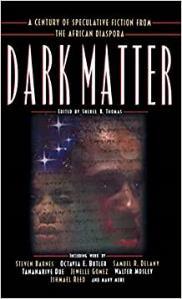
More than two decades after the publication of Dark Matter: A Century of Speculative Fiction from the African Diaspora (2000), an anthology of short stories, black speculative fiction continues a powerful conversation in genre fiction on culture and identity, and increasingly tackles themes pertaining to colonialism, as well as feminist and queer themes that engage with difference.
Anthologies and collections have become instrumental in the proliferating Afrofuturistic writing that heroes black people in stories from Africa and the diaspora, stories whose visibility is increasingly evident in award nominations and reading list recommendations. For example, Dominion: An Anthology of Speculative Fiction from Africa and the African Diaspora– with its stories of gods, demons, magicians, dead children, refugees, taboos, apocalyptic worlds, and more – saw nominations, finalists and winners in the Hugo, British Science Fiction Association, British Fantasy, and Nommo Awards….
This warm reception of black writing in the speculative-fiction industry and readership could be attributed to the calibre of stories and authors, as well as the continued response to global events, including Black Lives Matter, that demand radical new stories. In 2018, the New York Times determined N. K. Jemisin as the most celebrated science fiction and fantasy writer of her generation, with the staggering success of her Dreamblood duology, and the Broken Earth and Inheritance trilogies, all books that have received recognition in Hugo, Locus, Nebula, World Fantasy, Tiptree, and British Science Fiction Association (2020 BSFA) awards.
Timothy Morton is best known for their writing on ecology and as a philosopher who gave us the concept of ‘hyperobject’. While Spacecraft (2021) is only a small book of 129 pages, including index and notes, Morton has nevertheless written a dense but enjoyable book with a glittering insight on almost every page. Reviewing any book crammed with so many ideas is a challenge. Spacecraft is a heady mix of pop culture and philosophy, where it is difficult to pick out the unifying theory amidst the glare.
On one level, Morton has written a performative history of spacecraft, both speculative and real, in the media, with a particular focus on Star Wars. The book examines the role played by these vehicles, not the method of portraying them or the nuances of their design. While the principles may apply to all spacecraft, Morton’s sources are primarily drawn from within Western cultures, especially American. Essentially, spacecraft representations, according to Morton, performed one of the following functions:
the ark, carrying all remaining life forms, such as in Silent Running or the Jupiter ship in 2001
the juggernaut, destroying all before it, such as the Death Star and Imperial Cruisers in Star Wars or the militarized version of the Enterprise from Into Darkness
the frigate, a standard SF warship
the fighter, small military vessels such as the X-wing and TIE fighter
the explorer, such as scouts or shuttles
the machina cum dea, Morton’s phrase inverting the traditional deus ex machina, meaning an alien vessel that sweeps in to dispense justice. Examples being the UFO at the end of Monty Python’s Life of Brian or the TARDIS
the coracle, where the spacecraft is a spiritual craft on a mystical journey, such as the EVA pod in 2001 or the real Voyager I probe.
Morton makes a distinction between spacecraft and spaceship, for example, with respect to size, with starships being much larger. Furthermore, starships such as the Enterprise and an Imperial Cruiser are part of an established fleet with a large crew in a fixed hierarchy. In contrast, spacecraft are smaller, often with a fluctuating crew roster: people simply climb aboard one and fly away, such as happens repeatedly with the Millennium Falcon over many films, or The Heart of Gold in The Hitchhiker’s Guide to the Galaxy. Morton notes the “craft” aspect of the name, reflecting the skill required to fly the vessel. There is also a sense that these ships are being crafty, meaning cunning.
Starship Enterprise U.S.S. Enterprise NCC 1701-D, Star Trek series
Imperial Cruiser, Star wars
While Spacecraft draws on many sources, the book is at its heart a love letter to the Millennium Falcon. Morton clearly sees this vessel as the archetypal spacecraft as each chapter casts the Falcon in a new light. Spacecraft highlights the Falcon as a feminist vessel because when the revolutionary feminist robot L3-37 is damaged beyond repair, her data and personality are incorporated into the Falcon’s electronics in the Solo prequel: “The Falcon is then really a ‘she’ insofar as the Falcon is a feminist robot keen to liberate other robots from their status as slaves.”
The Millennium Falcon is also the third important non-human to appear in A New Hope. Moreover, the Falcon is adept at defying the forces of gravity in a film series all about the use of the force. Morton also highlights how the Millennium Falcon is the plot pivot in The Empire Strikes Back. Once the Falcon functions properly and engages the hyperdrive, with the help of R2-D2, the film is emotionally “over” and we await the sequel.
Millennium Falcon, Star Wars
Spacecraft includes only four chapters and an introduction. Each chapter explores one aspect of spacecraft and the Millennium Falcon in particular. In the first chapter, Morton notes a recurring trait of garbage, or the “found-ness of objects”: “we need to consider the Falcon as pure contingency, as something that just happens to you, garbage or not”. The Falcon demonstrates this trait when Rey initially refuses to escape on a ship located off-screen in The Force Awakens, dismissing it as “garbage”. When her first choice spacecraft is destroyed, she concedes “the garbage will do” and we see her and Finn escape on the Falcon. Indeed, through the whole franchise the Falcon is repeatedly found just when it is needed.
Morton specifically notes the role of dirt in the Star Wars series. Unusually, all the good vehicles in these films are dirty, a notable difference from the Imperial vessels or a spaceship like Star Trek’s USS Enterprise. Dirt seems to be used as a signifier for the rebellion, while at the same time making the setting appear more real. After all, what actually is dirt? Morton shares the definition given by Mary Douglas in Purity and Danger of “matter in the wrong place”. How often is the Falcon in the wrong place? Taking the viewpoint of the Empire, the Falcon is forever in the wrong place, typically waiting to be found by one rebel faction or another.
This aspect of stumbling upon the Falcon is a focus of chapter two of Spacecraft. Here Morton explores the concept of spacecraft as winnings, such as how Lando won the Falcon in a card game. More broadly, spacecraft are often outright stolen and become the trophy of the escape. Once again, the Falcon is the epitome of the getaway vehicle, repeatedly evading Imperial entanglements in almost every appearance. Other stolen spacecraft include The Heart of Gold, The Liberator in Blake’s 7 and the TARDIS. Yet, so often these thefts are justifiable and necessary to escape the crimes committed by the state.
Morton’s third and longest chapter deals with hyperspace, that common avenue of escape. One example of a coracle is a passage from Coleridge’s Rime of the Ancient Mariner, where the Mariner is taken through the netherworld. To Morton this netherworld reads a lot like hyperspace:
And soon I heard a roaring wind:
It did not come annear;
But with its sound it shook the sails,
That were so thin and sere.
The upper air burst into life!
And a hundred fire-flags sheen,
To and fro they were hurried about!
And to and fro, and in and out,
The wan stars danced between.
The opening credits of Vertigo (1958)
Modern film depictions of hyperspace turn “fire-flags sheen” into a familiar visual, argues Morton. The dominant method arose from the slit-scan technique of computer animation pioneer John Whitney for Hitchcock’s Vertigo in 1958, that impressed Douglas Trumbull who made similar visual effects for To the Moon and Beyond, which in turn brought Trumbull to Kubrick’s attention. Trumbull was thus engaged to create the stargate sequence for 2001. A similar slit-scan technique was developed by graphic designer Bernard Lodge for Doctor Who and was applied in Nolan’s Interstellar in the tesseract scene.
In Morton’s view, hyperspace is a place of bliss and sensuality. Hyperspace is an expression of Gaussian geometry – the term Morton uses for not Euclidean (but euphoric) space-time. When the Falcon “makes” hyperspace, it is catapulted into a whirling, glittering realm of beauty. The visuals of hyperspace are a liquid tunnel that whisks spacecraft off. Morton invokes the feminist term circlusion, coined by Bini Adamczak to describe these visualisations in the media as circlusion of a spacecraft by hyperspace. The verb circlude was defined by Adamczak as describing any process of enveloping one thing with another: “Indeed circlusion is an extremely common experience of everyday life. Think of how a net catches a fish, how gums envelop their food, how a nutcracker crunches nuts, or how a hand encircles a joystick”.
This random, democratic and almost chaotic nature of hyperspace is contrasted in the conclusion with the precise orderliness of the Death Star or the Enterprise. These spacecraft resemble giant, open-plan offices in space. Such “middle class” workspaces seem so unlike the rogue-ish Falcon and its crew of misfits.
Enterprise bridge
There are so many ideas in this small book that I have barely scratched the surface in this review, and I am sure that rereading it will uncover new ideas each time.
By Monica Evans. This academic article was first published in Vector #291.
Abstract: This article examines the relationship between digital games and science fiction. Digital games are predisposed to science fiction content for two reasons: game developers, at every historical point, have been science fiction fans, and therefore tended to make games with science fiction content; and digital games’ dependence on rapidly-changing technology makes them a natural fit for science fiction content and themes. Furthermore, even games that may not have overtly science fictional themes at the level of content can still be interpreted as examples of science fictional culture, through their capacity to mobilise interactions between technology, mechanics, narrative, and the imagination and emotion of their players. Game developers, science fiction authors, and the increasing number of creators who are both at once, have a great deal of territory to explore, to continue discovering how best to use this naturally science fictional medium to express what it means to be technological, computational, and human.
Review: This article underwent editorial review from two editors.
License: CC BY-NC-ND 4.0.
Citation: Evans, Monica. 2020. The Needle and the Wedge: Digital Games as a Medium for Science Fiction. Vector #291, pp.15-24. Summer, 2020.
Keywords: digital games, video games, science fiction, speculative fiction
DOI: 10.5281/zenodo.6533414
In 1962, four computer science students at MIT, looking for something interesting to display on their new PDP-1 minicomputer, turned to science fiction. According to Steve Russell, the group’s core programmer, they started with “a two-dimensional maneuvering sort of thing, and decided that naturally the obvious thing to do was spaceships” (Brand 1972). Before long, two ships – one long and thin, the other a squat triangle – could engage in an interactive, physics-based dogfight, and Spacewar!, the world’s first digital game, was born.
Spacewar! may have been the first, but it was hardly the last. A staggering number of successful, influential, and critically-acclaimed games can be categorized as science fiction (Krzywinksa and MacCallum-Stewart 2009), from classic arcade games like Asteroids and Space Invaders to major franchises like Metroid, Halo, StarCraft, and Mass Effect; critical trailblazers like Portal, Half-Life, and Bioshock; indie darlings like Thomas Was Alone, Soma, and FTL; and recent critical and commercial favorites like Horizon Zero Dawn, Nier: Automata, and even The Legend of Zelda: Breath of the Wild. In the absence of science fiction, an equally staggering number of games can be classified as fantasy, horror, or broadly speculative – to the point that it’s uncommon, if not rare, for a digital game to be set in a non-speculative, mundane world.
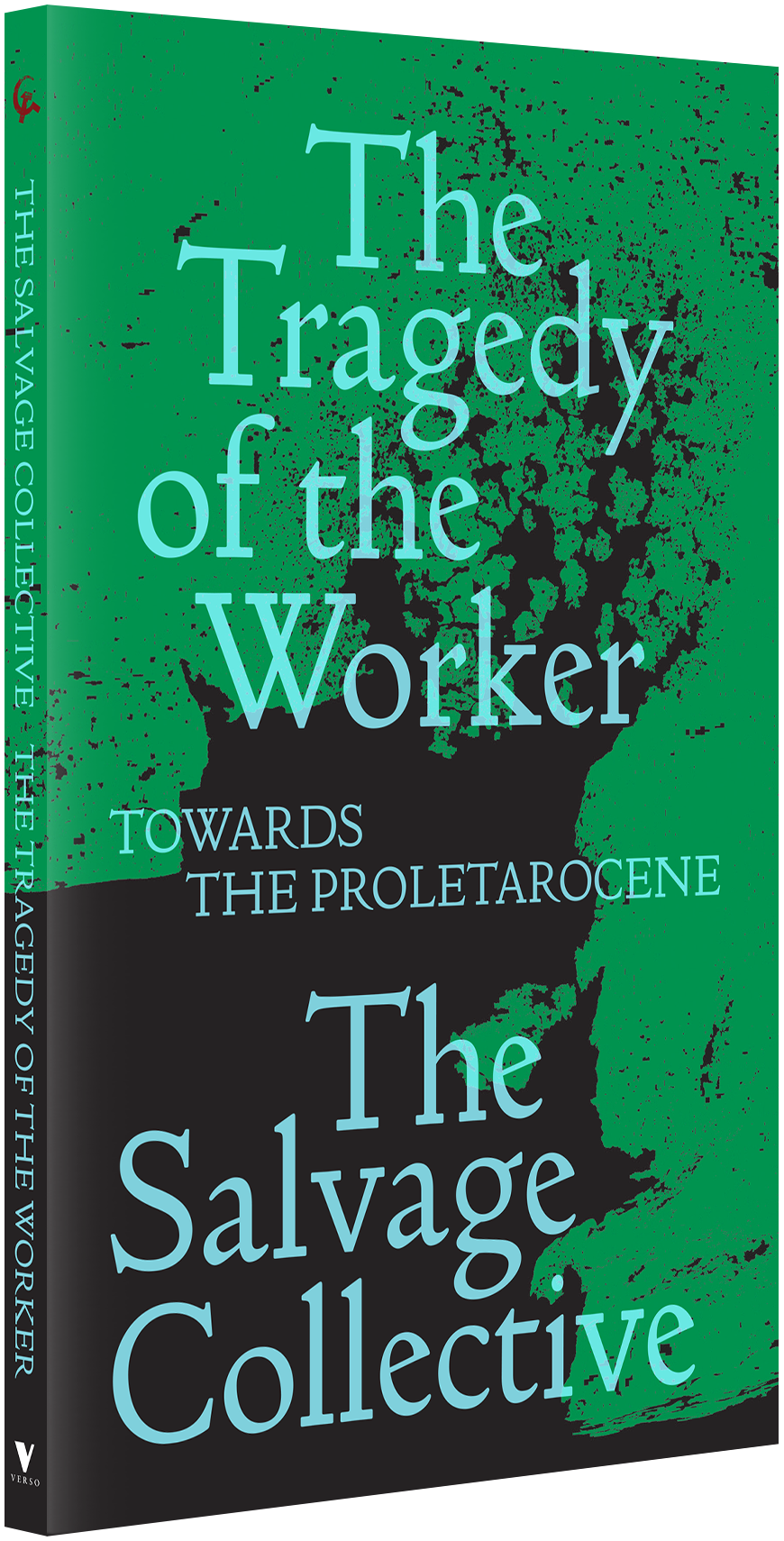
The Tragedy of the Worker: Towards the Proletarocene. The Salvage Collective. Verso, 2021.
Julian Rosefeldt’s video installation Manifesto(2015) has Cate Blanchett reading out various manifestos from the 20th century, each of them declaring a specific artistic view on the world as central to its time and circumstances. From Futurism to Fluxus, from Dadaism to Situationism, from Vorticism to Dogme 95. The outlier in all of this, or maybe the underlying basis, seems to be the Manifesto of the Communist Party (1848) by Karl Marx and Friedrich Engels, which Blanchett intones as the film opens with the image of a lit fuse: “All that is solid, melts into air.” If Marx and Engels’ Manifesto is the spark that ignites the imagination of artists and writers to manifest their thoughts against the state of the world, that is against the capitalist system that subsumes us all, then maybe The Salvage Collective’s The Tragedy of the Worker is the moment that the fuse finally catches the powder and blows the system to bits and pieces. Well, probably not. Let’s be realistic. As the Salvage writers say themselves, the publication was “born out of defeat” (102) and carries with it a “certain political pessimism” (103), and it seems unlikely that one more left-wing publication about the climate crisis and its connection to the death cult of capitalism could make much of a difference. But it is a convincing one, one that is well-argued, poetically written, and with both dry cynicism and fiery revolutionary talk to light the spark in those still on the fence about how to change this world for the better.
So if you are looking to up your argument game for the next debate about capitalism, then here is your manifesto. Salvage Collective draw the connection between the climate catastrophe we are experiencing and the underlying mechanics of capitalism, revealing—you all guessed it—that within capitalism’s main logic of accumulation, the destruction of this planet is inevitable, it is part of the program. Working through different aspects of the issue, the essay explores the deceiving promises of “Green Capitalism,” the historic failure of generating a “Red Plenty” after the October Revolution, the upcoming fight for Arctic resources and the “Politics at the Poles”, as well as the need to be watchful of the establishing of a “Green Fascism” erupting as climate migration grows. Overall, The Tragedy of the Worker is a manifesto of sorts, rallying those on the left to see centrist politics as part of the problem, calling for more radical visions, claiming the need to stop capitalist’ accumulation dead in its tracks, or else … Or else—and that might be the issue of why Tragedy is not igniting the powder keg—it is simply too late. The writers close with acknowledging that it is already too late, that systems are too entrenched, and that left-wing politics would need to be so radical that they are “unrealistic […] an indication of how much would have to be achieved, and how quickly consent gained for radical new ideas, coalitions assembled, tactics innovated, the unthinkable realised” (86). For a manifesto, this is too dark. There is no call to arms, no utopian moment of hope. And that in itself might be why the essay is even more necessary, why we need to realize the catastrophic path we are on. Not to make it all better, but to stop it from becoming even worse. That is the tragedy of us all.
Lars Schmeink is Leverhulme Visiting Professor at the University of Leeds and project lead “Science Fiction” for the federally funded “FutureWork” research network at the Karlsruhe Institute of Technology. He inaugurated the Gesellschaft für Fantastikforschung and served as its president until 2019. He is the author of Biopunk Dystopias (Liverpool UP, 2016) and most recently the co-editor of Fifty Key Figures in Cyberpunk Culture (Routledge 2022) and New Perspectives on Contemporary German Science Fiction (Palgrave 2022).
It is as human to move from one place to another in search of a better life, as it is to divide the world into categories of “us” and “them.” However, there is no universal definition of a ‘migrant’. Migrants are not inherently vulnerable. However, they often find themselves marginalized in the host country and are perceived by some to threaten national identity, economy, social cohesion and cultural norms. As Saskia Bonjour and Sebastien Chouvin warn us, “discourses on migration, integration and citizenship are inevitably classed, because representations of Self and Other are inevitably classed [1]”. Practices of inclusion/exclusion are based on power dynamics which are rarely fair and more often than not based on a set of prejudices, including racial prejudices that perpetuate inequality and can lock the families in the boundaries of their ‘migrant’ status for generations. Hence, children of ‘migrants’ are continued to be seen by some members of society as migrants as well despite being born in the country or having lived there for most of their lives, thus reinforcing cultural alienation and inequality. Further, the continuity of colonialist discourse fuels dehumanisation of migrants. Read through this lens of colonialism, Yan Ge’s Strange Beasts of China offers a unique experience of sieving through the questions of migration, acceptance, domination and hybridity in the body of a chimera, a creature of fantasy. The book keeps asking the readers to re-evaluate the ideas of power and possession, speech and silence. Who colonised who, are humans nothing but the former beasts who have conquered the land and re-written its history? Who has the right of speech? Is silence a way of telling a story by the marginalised (beasts)? The entwined story of memory and oblivion for monsters and humans in Strange Beasts of China turns the narrative into a battlefield of falsifiable identities and historical assumptions. “This vast city, the beasts that come and go, all of this, is a secret,” muses Yan Ge’s narrator. “No one knows why they come or why they go, why they meet or why they leave. These are all enormous, distant mysteries [2]”. Yan Ge’s Yong’an is a postcolonial space where the story of subjugation of the beasts, or the struggle for de/re-territorialisation is already part of history, and the question that haunts both humans and beasts is the same that haunts in our day and time: how the interdependence of colonisers and the colonised has shaped – and continues shaping – our understanding of the world [3].
Reviewed by Sandra Unerman. This review first appeared in The BSFA Review.
In her introduction to this collection, Melissa Edmundson refuses to pin down a definition of the Weird. She discusses the history of the genre and considers ghost stories, Victorian Gothic and encounters with the unknown. But she places the stories chosen within a broader tradition of supernatural writing by women. As a reader, I enjoyed the mixture of flavours and moods, which results from this eclecticism, in preference to a narrow focus on one kind of tale.
The stories all convey a strong sense of place, in settings from Australia to Canada by way of the English countryside. For example, ‘The Red Bungalow’ by Bithia Mary Croker is set in Northern India, in the days of the Raj. It expresses the vulnerability and alienation experienced by British women and their children in a country that is not theirs, with a landscape and traditions they do not understand.
A sense of history is also a common characteristic. Even the stories set within the lifetime of the authors introduce the current reader to details and attitudes strange to us now, like the shirt waist and corduroy skirt suitable for young women travelling in Sarah Orne Jewett’s ‘The Green Bowl’. One story set further into the past is Marjory Bowen’s ‘Florence Flannery’, which provides a thoroughly unromantic depiction of a Devon manor in 1800, with a couple brought together by loneliness and poverty, who are haunted by events from three hundred years earlier. ‘The Blue Room’, by Lettice Galbraith, set in a Scottish castle, also concerns a haunting of earlier times, from the 17th century but sets characters with deliberately modern (at the time) attitudes, including a ‘clever, strong-minded young lady’ to challenge the evils of the past.
The role of women is often the focus of attention. ‘A Twin-Identity’ by Edith Stewart Drewry, is narrated by a female French police detective, who shows persistence and courage in her pursuit of a murderer, as well as the sensitivity to follow the supernatural clues she is given. Other tales take a more complex approach. In ‘Young Magic’, by Helen Simpson, Viola grows up neglected by her mother and her nursemaid but is content to play by herself, ‘exactly as a cat does’. She finds opportunities for encounters with invisible beings, which are both more satisfying than those she invents and disappointing because her contact with them is so limited. At one level, the story is about the constraints and limitations of her life as a middle-class girl, especially as she grown into adolescence. At another, it is about the power and danger of the imagination.
Some stories draw their strength from their depiction of character and setting, while others evoke the uncanny with more intensity. Katherine Mansfield’s ‘The House’ is one of the most memorable entries, as it draws the reader into the painful emotions of a young woman, and her vision of domestic bliss. For me, the supernatural element here seems almost incidental, not a significant feature of the story. By contrast, I found it difficult to sympathise with the narrator of ‘Outside the House’ by Bessie Kyffin-Taylor, a man reluctant to take advice or consider the wishes of his fiancée and her family. But the haunting of the family house from the outside struck me as both unusual and powerful, particularly in the way it engages with class conflict and industrial tragedy.
Two of the thirteen stories show familiar authors in an unexpected light. L.M. Montgomery’s ‘House Party at Smoky Island’ deals with love and jealousy in a darker mode than Anne of Green Gables, while Flora Poste of Cold Comfort Farm might not approve of the way the narrator of Stella Gibbons’s ‘Roaring Tower’ indulges her emotions. But the greater strength of the collection lies in its revival of authors who have been forgotten and I enjoyed being introduced to many of them.
Includes stories by Nnedi Okorafor, T.L. Huchu, Dilman Dila, Rafeeat Aliyu, Tlotlo Tsamaase, Mame Bougouma Diene, Mazi Nwonwu, and Derek Lubangakene.
Reviewed by Alexander Buckley
With a short introduction to African science fiction by Wole Talabi, himself a Nommo Award winning writer, Africanfuturism: An Anthologycontains eight stories and boundless insights into what Africanfuturism actually is, what it should look and read like. The anthology is freely available from Brittle Paper, a literary magazine established in 2010 that champions upcoming African artists and writers. The stories invite the reader to delve into imaginative futures of African societies, all of them conjuring up a range of compelling ideas, some offering novel interpretations of dystopian ways of living.
The anthology opens strong with a short, hospitable story by T.L. Huchu, a Zimbabwean writer, known for his debut novel The Hairdresser of Harare (2010) and his many award-nominated short stories. Huchu’s “Egoli”, written in the second person, details the life of an aged Shona woman living between the past and the future in her small village; her grandson is away working as a miner in space, meanwhile, this woman uses a smartphone and finds solace in the BBC World Service on the radio. The nostalgic inspection into the past is warm and balmy, contrasted with the introspective world of tomorrow that’s slowly encroaching, attempting to sever this woman from the life she tirelessly tries to hold on to. It’s beautiful. The writing is neat and immerses the reader in this woman’s life that seems so lonely and distant from everything around her. It’s one of the most interesting and developed stories in the anthology and is a fantastic introduction for anyone interested in Africanfuturism.
The second story is “Sunrise” by Nnedi Okorafor, whose definition of Africanfuturism, a term she coined, is featured at the beginning of the anthology. Okorafor’s “Sunrise” begins with a famous Nigerian-American science fiction writer being harassed while trying to board a flight with her sister. It then shifts into a narrative about the erratic uncontrollable nature of the Artificial Intelligence on her phone and the spoilt visit to her uncle’s house. The story doesn’t seem to know which way it wants to go, and the writing doesn’t help the confused nature of the storyline. The part at the beginning, about Nnedi’s self-insert being harassed by ‘Ian Scott’ who struggles to pronounce her name correctly is strong enough to be a standalone story. Everything afterwards felt tacked on and a little needless.
Ugandan filmmaker and science fiction writer Dilman Dila’s “Yat Madit” tells the story of Amaro, whose ex-president father is released from prison. Her father visits his smart, tech savant daughter to seek advice about using the voter’s online avatars to get himself re-elected. Yat Madit is the hardware that hosts everyone’s avatar and fosters interconnectedness, the nature of which remains enigmatic. The worldbuilding is very compelling, inspiring many questions about what Yat Madit is and how it works. Yat Madit means ‘a big tree.’ There are hints that a stormy family drama is buried underneath the narrative layer, but it’s unable to emerge through the text. The father tries ludic ways to reconcile with Amaro, but the back-and-forth trial does not suffice to banish the shadow of his criminal past. The writing struggles to support the plausibility of attempts to resolve the emotional conflict between Amaro and her father. “Yat Madit”’s main strength is its science fiction novum and worldbuilding. There’s a whole future happening within the story and it would have been great to explore more of the history of the avatars. This is a case where the science-fictional ideas are more interesting and involving than the emotional story they are embedded in. This is unfortunate because the characters want to do so much and be given the same treatment as the science that is being foretold.
Mazi Chiagozie Nwonwu is co-founder of Omenana, an essential Nigerian-produced magazine dedicated to speculative fiction from Africa and the African diaspora. Nwonwu’s “Rainmaker” is about a young boy named Bama who must perform a Raindance to bring rain to the dry, dusty planet of Arid. “Rainmaker” is a fun, short adventure story with a simple premise. It begins with an exciting encounter with ‘dust devils’ as Bama and his friend Katma are heading to school. From there, the story doesn’t let go of its sense of adventure and vision. On Arid, it’s believed that anyone who stands up to a dust devil is granted a wish. The story is wholesome and earnest. A journey on this strange arid planet is filled with bright characters and an involving mythos. Mazi Nwonwu’s writing is clear and hospitable and he serves the planet and its inhabitants to us like a tasty, filling meal.
Tlotlo Tsamaase is a Motswana writer of fiction, poetry and architectural criticism. Her work is featured in The Best of World SF (2021)edited by Lavie Tidhar, and appeared in Strange Horizons and the quarterly British magazine Wasafiri. Her story “Behind Our Irises” details the day in the life of a graphic designer working for a depressing corporate business to keep her life afloat after years of unemployment. This sinister company installs new technology into their employees, fitting holes into the back of their necks, draining them of their freedoms and exploiting them for profit. Although the company is based in and runs throughout Africa, one of the higher-ups is a “European man with a balding hairline, stocky fingers and a certain kind of confidence that intimidated me.” The various themes explored throughout the story are subtle and may not be so apparent on a first reading. Towards the end, the protagonist, against her will and quite suddenly, is forced to undergo ‘maintenance’ work on her ‘ports’. She is approached by “a man in blue coveralls that looked like a cross between a doctor and mechanic.” She tries to evade the procedure but finds she cannot move. She can’t even yell for help, and the man in blue coveralls nonchalantly takes what he came for then lets her go. This dystopian, sad, almost borderline horror short is well made and thought out. This story is a great addition to the anthology, reflecting on emerging issues in labour relationships between workers and corporations.
Derek Lubangakene, whose work has appeared in Omenana and Strange Horizons, brings “Fort Kwame” to the anthology, named after the orbital city that suffers the consequences of a failed rebellion. Its protagonist, Jabari Asalur, “acknowledged his dread.” Fort Kwame, and the inhabitable planet it floats above, is a deep and detailed world, full of exciting science-fictional ideas and entertaining characters. Lubangakene’s exploration of this futuristic orbital city is quite an adventure. The workings of Jabari’s “thermskin” are particularly well imagined and tickle a certain sci-fi itch. “Fort Kwame” fits perfectly into the anthology.
On her website, Rafeeat Aliyu’s describes “Fruit of the Calabash” as being “something I initially dreamed of, I recall hastily jotting down memories of the creepy dream before it faded”. In the story, Maseo fertilizes artificial wombs in her lab. The development of a fetus for the local senator doesn’t go as planned and she heeds the advice of a wise, judicious woman to help gain insight into the reason behind the fiasco. The plot develops with an urgent pace; elements of Maseo’s world are immersive and plausible, the characters are believable, the story feels like it could become a reality. It’s a delight to read and get lost in.
Mame Bougouma Diene, whose novella Hell Freezes Over which was nominated for a Nommo Award, blends mysticism with science fiction in “Lekki Lekki”, the final story of the anthology. Huge trees contain “engines” that connect humans to a giant network of seemingly everything. Humanity had harmed nature, and now it must painfully adapt. This story conjures up interesting imagery for the mind and the story’s lyrical ecocritical otherworldliness is noteworthy.
The anthology is a host to a range of wonders and imaginative worlds. Judging by what is contained within these digital pages, it’s regrettable that some of these writers have yet to become as widely read as their Western peers. This anthology is a brilliant introduction to Africanfuturism and hopefully its free PDF edition will attract new readers to the genre. I think it’s important that all serious fans of science fiction are conscious of the emerging talent in African science fiction. Publishers around the world should snap their stories quickly before they get beaten to it.
Reviewed by Nick Hubble. This review first appeared in The BSFA Review.
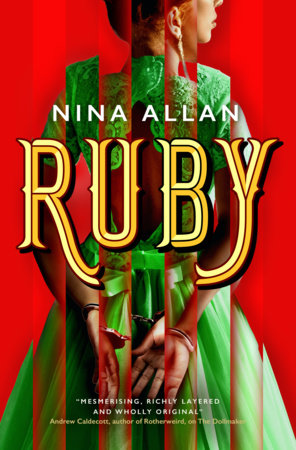
Titan have been publishing Allan’s work since they brought out an expanded edition of The Race in 2016. This was followed by The Rift in 2017 and an updated edition of The Silver Wind in 2019. Their latest offering from her is Ruby, which was originally published as Stardust: The Ruby Castle Stories in 2013. As that earlier title indicates, this book consists of a sequence of linked stories. At first, they seem to be very loosely linked––tied together only by fleeting references to the eponymous Ruby, a film star whose career ends when she is imprisoned for murder––but more connections become apparent to the reader in later stories.
Indeed, when I got to the end, I had to fight hard against an overwhelming urge to go back to the beginning again with my new knowledge and put all the events in the stories together into one coherent plotline. However, that would be the wrong reason to read these beautiful and entrancing stories again. Not only is there no overall temporal continuity but also, to the extent that these are horror stories, the horror lies in wait for those determined to keep religiously to the straight and the narrow. Morally these stories are ‘chaotic neutral’ and trying to impose order on them would at best be inviting frustration and at worst risking getting trapped in some maze-like time loop, as happens to several characters in these stories. Paradoxically, though, for those prepared to embrace the apparent unreason of time paradoxes and coincidences that unspool sinuously through these stories, potential nightmares turn into dreams of possibility.
For example, in ‘Laburnams’, Christine ‘had often wondered if it was possible to take a wrong turning and end up living a life that was not your own’ and there are lot of people in these stories trapped in lives that are not their own. In ‘Wreck of the Julia’, this condition is explicitly linked to the evasion and lying inherent to south London lower-middle-class suburbs such as Croydon and Sidcup, which are very similar to the one I grew up in. And you don’t get out of those lives by conforming to the moral parameters that structure and limit them. Therefore, escape is itself a traumatic experience that scars and is only overcome retrospectively by sensing the rightness of the new life. The protagonist of ‘Stardust’ feels ‘the change happen, a discernible click, as if a key had been twisted inside me’.
Such transformations also have little to do with free choice and that is what makes them doubly scary. One of the protagonists tries to make sense of his experiences through ‘dream science’ and ‘the idea of the subconscious as a crime writer’ throwing out as many red herrings as useful clues. But it is only by negotiating both the red herrings and the clues that he finds his way again. These stories are not merely tales of the unexpected or simple mysteries but a series of labyrinthine twists which simultaneously fold in and out on themselves to reveal unexpected perspectives and hidden views. The result of such an intricate weaving together of signs and wonders is a collection of stories that reads like a novel which you want to go on and on. So, while I didn’t immediately reread the stories, I would have been happy to have continued to lose myself within more of them for another thousand pages or so. Nevertheless, I didn’t end Ruby feeling unfulfilled because after thinking about it––and these stories do tend to embed themselves in your mind for a while––I realised that I could take the fluid mode of reading that the stories had seduced me into adopting and use it to read other stories and novels in productive ways. In this manner, Allan not only generates possibilities through her writing, but she also teaches her readers to generate possibilities through their reading.
Danaher, John. Automation and Utopia: Human Flourishing in a World without Work. Harvard UP, 2019. Hardcover. 248 pg. $99.95. ISBN 9780674984240.
Automation and Utopia: Human Flourishing in a World without Workis crafted as a response to fears over an automated future in which humans are made obsolete by technological developments. Written by John Danaher, senior lecturer of law at the National University of Ireland, Galway, the text consists of two main sections, which cover automation and the possibility of a utopian future, respectively.
After outlining the scope and purpose of his research, in the first chapter Danaher forecasts the obsolescence of humankind in an automated world. But this is not as catastrophic as it may sound since, for Danaher, “Obsolescence is the process or condition of being no longer useful or used; it is not a state of nonexistence or death” (2). In the rest of the automation section, Danaher responds to two propositions: that automation in the workplace is both possible and desirable, and that automation outside of the workplace is potentially dangerous and its threats must therefore be mitigated.
After making his case for why automation should be conditionally embraced, in the second section Danaher turns to two possible, ‘improved’ societies with automation fundamental to their economies, the cyborg and virtual utopias. While the cyborg utopia enables humankind to remain valuable members of the economy, occupying the cognitive niche that has historically provided an initial evolutionary advantage to the species, Danaher posits that such a future will likely maintain the degradations of employment, enhance our dependency upon machines, and disrupt humanist values while, due to the technological advancements it requires, ensuring no worthy improvements to human wellbeing in the near future.
Following up this analysis of the cyborg polity, Automation and Utopia concludes with a presentation of what Danaher views as the ideal, improved society, the virtual utopia. This improved society, in which humankind ventures into the virtual world to enhance its flourishing, is presented by Danaher as an ideal goal towards which humankind may aim since, as the author posits, it will ensure human agency, pluralism, stability, a myriad of alternative utopias, and a meaningful connection to the non-virtual, real world.
Pivotal to Danaher’s assessment of automation, and a possibly utopian future, are his views on labor and the avenue he identifies as optimal for human flourishing, the virtual utopia. For the purposes of his argument, he adopts a definition of work which he acknowledges as unusual and likely controversial, since it excludes “most domestic work (cleaning, cooking, childcare)” as well as “things like subsistence farming or slavery” (29). Defining work as “any activity (physical, cognitive, emotional etc.) performed in exchange for an economic reward, or in the ultimate hope of receiving an economic reward,” Danaher builds the case that obsolescence is almost certain and could result in as low as 10% or as high as 40% of the future population remaining employed (28). Such a development is framed as a positive result since work, he emphasizes, has a negative effect upon employees and improving it in the current economic milieu is, according to him, a more difficult route to take than shifting towards a virtual utopia. Specifically, Danaher argues that improving work, which often involves fissuring, precarity, colonization, classic collective action, domination, and distributive injustice is unlikely in our current system since it “would require reform of the basic rules of capitalism, some suppression or ban of widely used technologies as well as reform of the legal and social norms that apply to work” (83). Though this dismissal of the possibility of improving working conditions is short-sighted and ignores the likelihood that labor organizing will prove necessary as technological advances continue, this weakness of the text stands on its periphery. More important to Danaher’s vision of the future is his adoption of an approach that is interestingly more radical than such efforts to protect workers: the introduction of a universal basic income and the normalization of technological unemployment in current economic systems.
Danaher envisions this radically different distribution of economic power as a salient feature unique to the virtual utopia. Danaher rejects the cyborg utopia, believing it will threaten the prospect of universal basic income and technological unemployment and ensure the continuation of work and the injustices endemic to capitalistic systems. In considering the virtual utopia, Danaher’s audience must consider the ethics and consequences of a nation in which utopian games and escape become a salient feature of its culture. This ideal society is marked by its focus upon virtual worlds as the mechanism by which human flourishing may take place. By venturing into simulations that are shaped to satisfy the desires and needs of individual users, it avoids the problems of a single utopian ideal that must be enforced upon all citizens. It can therefore, as Danaher explains, “allow for the highest expressions of human agency, virtue, and talent… and the most stable and pluralistic understanding of the ideal society” (270).
Yet as with the cyborg utopia, the virtual utopia is plagued with ethical complications. The question of what actions are permissible in such a simulated environment is closely related to the ethical considerations surrounding cyborgs and artificial intelligence. In very briefly confronting this topic, Danaher asserts that the same moral constraints that shape human interactions in daily life will impact those occupying the virtual world. He supports this argument by pointing out that some of the characters inhabiting the simulation will be operated by human players and that interactions with such players will have ethical dimensions. In addition, he asserts that other actions may be deemed intrinsically immoral even without a corresponding ‘real-life’ consequence. Danaher asserts that, though there will be some moral frameworks unique to the virtual utopia, there will be no major alteration to human ethics. The virtual utopia, he claims, is therefore a reasonable goal for the post-work society since it enables human flourishing and protects values such as individualism and humanism.
Danaher is also keen to emphasize that “the distinction between the virtual and the real is fluid” (229). He rejects the “stereotypical” science fictional view of virtual reality, as something that is only produced within immersive technological simulations, like the Matrix or Star Trek’s Holodeck. On the other hand, he also rejects the “counterintuitive” view that everything humans experience is virtual reality in that our reality is constructed through language and culture. Instead, Danaher offers a middle position. Some things may be more virtual than others, but nothing is wholly virtual or wholly real. He sees virtual utopia as being filled with emotionally and morally meaningful interactions, but in the context of relatively inconsequential stakes (rather than survival, or struggle for hegemony). A Holodeck-style simulation is only one of many ways this could be accomplished.
Automation and Utopia delves significantly into the topic of possible futures at the intersection of ethics, technology, and humanism. It is a valuable resource for scholars, students, and laypeople engaged with conversations surrounding the advancement of automation in the 21st-century, its impact upon economics and workers, and optimal approaches to accommodating such new technologies through the advent of a post-work society. The work continues discussions at the intersection of technology and labor, but necessitates broader considerations related to the virtual utopia Danaher proposes. Namely, it does not convincingly explain how virtual utopia will avoid the ethical pitfalls outlined in relation to the cyborg utopia. It also does not thoroughly discuss how such simulations may be safeguarded from economic exploitation at the hands of those owning or operating these systems, or address the potential for intersectional inequalities. Finally, Danaher does not comprehensively discuss how such escapism and the further minimization of human interaction in the natural world may impact climate and the environment. Though it is difficult to accurately predict, estimations of both the ecological and psychological effects of a society in which the main mechanism of human interaction is not within nature but instead within a virtual world are vital to identifying optimal utopian aims.
Overall, Automation and Utopia productively dives into the topics of technological advancement and labor policy, proposes thought-provoking socioeconomic policies related to the challenges of automation, and necessitates further discussions concerning ‘the ideal society,’ its connection to technology, and the impact it may have upon human psychology and the environment.







 vector-bsfa.com